
Life, 1913-11-06 · page 32 of 56
Life — November 6, 1913 — page 32: what you’re looking at
What you’re looking at
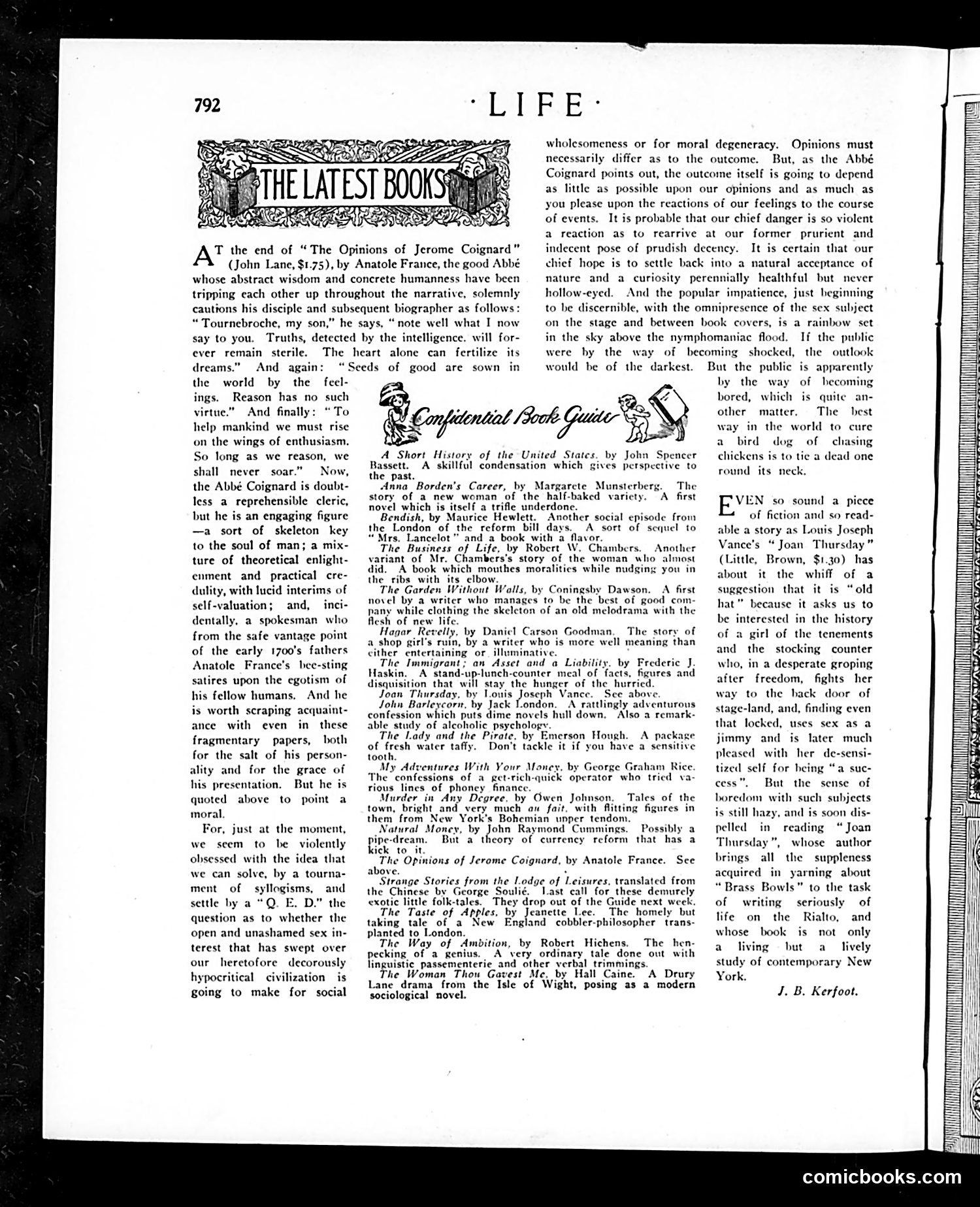
This is a book review section titled "The Latest Books" from *Life* magazine's "Confidential Book Guide." The page discusses Anatole France's novel *The Opinions of Jerome Coignard*, using quotations from the book to frame a contemporary social debate. The reviewer uses the fictional Abbé Coignard's philosophical musings about reason versus emotion and feeling to comment on a current cultural moment: society's fierce debate over whether frank discussion of sexuality and "sex interest" in literature represents moral progress or degeneracy. The Abbé's wisdom—that feelings matter more than logical argument—becomes the reviewer's point: this debate cannot be "settled by a 'Q.E.D.'" but depends on how people emotionally react to these cultural changes. The remainder lists new book releases with brief critical comments, covering history, fiction, and social commentary typical of the era.
📄 Transcribed text from this page (OCR, searchable)
Machine-transcribed from the original scan — historical spelling and the odd misread are preserved.
pb ALS. lela T the end of “The Opinions of Jerome Coignard” (John Lane, $1.75), by Anatole France, the good Abbé whose abstract wisdom and concrete humanness have been tripping each other up throughout the narrative, solemnly cautions his disciple and subsequent biographer as follows: wholesomeness or for moral degeneracy. Opinions must necessarily differ as to the outcome. But, as the Abbé Coignard points out, the outcome itself is going to depend as little as possible upon our opinions and as much as you please upon the reactions of our feelings to the course of events. It is probable that our chief danger is so violent a reaction as to rearrive at our former prurient and indecent pose of prudish decency. It is certain that our chief hope is to settle back into a natural acceptance of nature and a curiosity perennially healthful but never hollow-eyed. And the popular impatience, just beginning to be discernible, with the omnipresence of the sex subject “Tournebroche, my son,” he say: Truths, detected by the intelligence. will for- The heart alone can fertilize its “Seeds of good are sown in say to you. ever remain sterile. dreams.” And again: the world by the feel- ings. Reason has no such virtue.” And finally: “To help mankind we must rise on the wings of enthusiasm, So long as we reason, we shall never soar.” Now, the Abbé Coignard is doubt- less a reprehensible cleric, but he is an engaging figure —a sort of skeleton key to the soul of man; a mip ture of theoretical enlight- enment and practical cre- dulity, with lucid interims of self-valuation; and, inci- dentally, a spokesman who from the safe vantage point of the early 1700's fathers Anatole France's hee-sting satires upon the egotism of his fellow humans. And he is worth scraping acquaint- ance with even in’ these fragmentary papers, both for the salt of his person- ality and for the grace of his presentation. But he is quoted above to point a moral. For, just at the moment, we scem to be violently obsessed with the idea that we can solve, by a tourna- ment of syllogisms, and settle by a “Q. E. D.” the question as to whether the open and unashamed sex in- terest that has swept over our heretofore decorously hypocritical civilization is going to make for social note well what I now were by the way of would be of the darkest. Gera anepuc A Short History of the United States. by John Spencer Bassett. A skillful condensation which gives perspective to the past. Anna Borden's Career, by Margarete Munsterberg. The story of a new woman of the half-baked varie A. first novel which is itself a trifle underdone. Bendish, by Maurice Hewlett. Another social episode from the London of the reform y A sort of sequel to “Mrs. Lancelot” and a book h a flavor. The Business of Life, by Robert W. Chambers. Another variant of Mr. Chambers’s story of the woman who almost did. A book which mouthes moralitics while nudging you in the ribs with its elbow, The Garden Without Walls, by Coningsby Dawson. A first novel by a writer who manages to be the best of good com- pany while clothing the skeleton of an old melodrama with the flesh of new life. Hagar Revelly, by Daniel Carson Goodman. The story of hop girl's ruin, by a writer who is more well meaning than er entertaining or illuminative. The Immigrant; an Asset and a Liabil by Frederic J Haskin. A stand-up-lunch-counter meal of facts, figures and disquisition that will stay the hunger of the hurried. Joan Thursday, by louis i Vance. See above. John Barleycorn. by Jack London. A rattlingly adventurow confession which puts dime novels hull down, Also a remark- able study of alcoholic psychology. The lady and the Pirate, by Emerson Hough. A package of irah water taffy. Don't tackle it if you have a sensitive tooth. My Adventures With Your Money, by George Grab: The confessions of a get-rich-quick operator who tri rious lines of phoney finance. Murder in Any Degree. by Owen Johnson, Tales of the town, bright and very much an fait, with flitting figures in them from New York's Bohemian unper tendom. Natural Money, by John Raymond Cummings. Possibly a t e-dream. But a theory of currency reform that has a ick to it. The Opinions of Jerome Coignard, b above. . Strange Stories from the lodge of Leisures, translated from the Chinese by George Souli: Last call for these demurely exotic little folk-tales. They drop out of the Guide next week, The Taste of Apples, by Jeanette Lee. The homely but taking tale of a New England cobbler-philosopher trans- planted to London. The Way of Ambition, by Robert Hichens, The hen- pecking of a genius. A very ordinary tale done out with linguistic passementerie and other verbal trimmings. The Woman Thou Gavest Me, by Hall Caine. A Drury Lane drama from the Isle of Wight, posing as a modern sociological novel. y Anatole France. See on the stage and between book covers, is a rainbow set in the sky above the nymphomaniac flood. becoming But the public is apparently If the public shocked, the outlook by the way of bored, which is quite an- other matter. The best way in the world to cure a bird dog of chasing chickens is to tic a dead one round its neck, becoming VEN so sound a piece of fiction and so read- able a story as Louis Joseph Vance's “ Joan Thursday” (Little, Brown, $1.30) has about it the whiff of a suggestion that it is “old hat" because it asks us to be interested in the history of a girl of the tenements and the stocking counter who, in a desperate groping after freedom, fights her way to the hack door of stage-land, and, finding even that locked, uses sex as a jimmy and is later much pleased with her de-sensi- tized self for being “a suc- cess". But the sense of boredom with such subjects is still hazy, and is soon dis- pelled in reading “Joan Thursday”, whose author brings all the suppleness acquired in yarning about “Brass Bowls" to the task of writing seriously of life on the Rialto, and whose book is not only a living but a_ lively study of contemporary New York, J. B. Kerfoot. comicbooks.com