
Life, 1913-11-06 · page 20 of 56
Life — November 6, 1913 — page 20: what you’re looking at
What you’re looking at
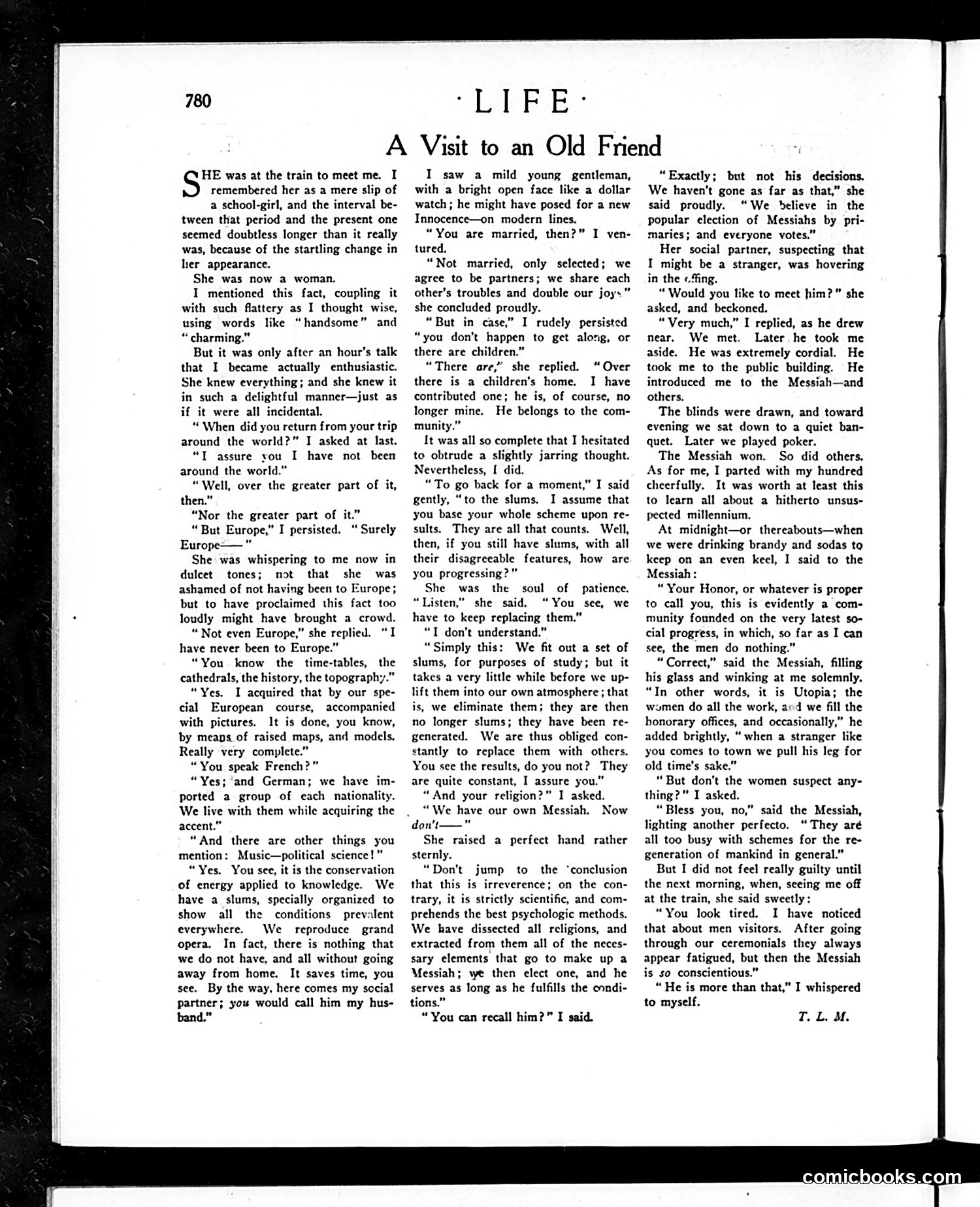
This story satirizes utopian social reform movements popular in early 20th-century America. The unnamed female character represents an idealistic reformer who has adopted an elaborate system of social improvement "without going away from home." The satire targets several progressive conceits: she claims to study slums through reproduction rather than direct engagement; she learns about Europe through models and raised maps instead of travel; she practices "conservation of energy applied to knowledge." Most pointedly, the story mocks her circular logic about slums—she "uplifts" poor people out of poverty, then must constantly *replace* them with new poor to study, defeating the purpose of actual reform. The joke deepens with her rejection of traditional marriage for "partnership" and her casual surrender of her own child to communal care. The final reference to a "Messiah" suggests quasi-religious fervor underlying her scientific rhetoric. The story critiques reformers who substitute theory, models, and efficiency schemes for genuine human engagement and measurable social progress.
📄 Transcribed text from this page (OCR, searchable)
Machine-transcribed from the original scan — historical spelling and the odd misread are preserved.
gp a 2 A Visit to an Old Friend HE was at the train to meet me. I remembered her as a mere slip of a school-girl, and the interval be- tween that period and the present one seemed doubtless longer than it really was, because of the startling change in her appearance. She was now a woman. I mentioned this fact, coupling it with such flattery as I thought wise, using words like “handsome” and “ charming.” But it was only after an hour’s talk that I became actually enthusiastic. She knew everything; and she knew it in such a delightful manner—just as if it were all incidental. “ When did you return from your trip around the world?” I asked at last. “TI assure you I have not been around the world.” “Well, over the greater part of it, then.” “Nor the greater part of it.” “But Europe,” I persisted. “ Surely Europe——"” She was whispering to me now in dulcet tones; not that she was ashamed of not having been to Europe; but to have proclaimed this fact too loudly might have brought a crowd. “Not even Europe,” she replied. “I have never been to Europe.” “You know the time-tables, the cathedrals, the history, the topography.” “Yes. I acquired that by our spe- cial European course, accompanied with pictures. It is done, you know, by means of raised maps, and models. Really very complete.’ “You speak French?” “Yes; ‘and German; we have im- ported a group of each nationality. We live with them while acquiring the accent.” “And there are other things you mention: Music—political science!” “Yes. You see, it is the conservation of energy applied to knowledge. We have a slums, specially organized to show all the conditions prevalent everywhere. We reproduce grand opera. In fact, there is nothing that we do not have, and all without going away from home. It saves time, you see. By the way, here comes my social partner; you would call him my hus- band.” I saw a mild young gentleman, with a bright open face like a dollar watch; he might have posed for a new Innocence—on modern lines, “You are married, then?” I ven- tured, “Not married, only selected; we agree to be partners; we share each other’s troubles and double our joys” she concluded proudly. “But in case,” I rudely persisted “you don’t happen to get along, or there are children.” “There are,” she replied. “Over there is a children's home. I have contributed one; he is, of course, no longer mine. He belongs to the com- munity.” It was all so complete that I hesitated to obtrude a slightly jarring thought. Nevertheless, [ did. “To go back for a moment,” I said gently, “to the slums. I assume that you base your whole scheme upon re- sults. They are all that counts. Well, then, if you still have slums, with all their disagreeable features, how are. you progressing?” She was the soul of patience. ten,” she said. “You see, we have to keep replacing them.” “T don’t understand.” “Simply this: We fit out a set of slums, for purposes of study; but it takes a very little while before we up- lift them into our own atmosphere; that is, we eliminate them; they are then no longer slums; they have been re- generated. We are thus obliged con- stantly to replace them with others. You sce the results, do you not? They are quite constant, I assure you.” “And your religion?” I asked. “We have our own Messiah. Now don’t— She raised a perfect hand rather sternly. “Don’t jump to the ‘conclusion that this is irreverence; on the con- trary, it is strictly scientific, and com- prehends the best psychologic methods. We have dissected all religions, and extracted from them all of the neces- sary elements that go to make up a Messiah; we then elect one, and he serves as long as he fulfills the onndi- tions.” “You can recall him?” I said. “Exactly; but not his decisions. We haven't gone as far as that,” she said proudly. “We »elieve in the popular election of Messiahs by pri- maries; and everyone votes.” Her social partner, suspecting that I might be a stranger, was hovering in the «fing. “Would you like to meet him?” she asked, and beckoned. “Very much,” I replied, as he drew near. We met. Later he took me aside. He was extremely cordial. He took me to the public building. He introduced me to the Messiah—and others. The blinds were drawn, and toward evening we sat down to a quiet ban- quet. Later we played poker. The Messiah won. So did others. As for me, I parted with my hundred cheerfully. It was worth at least this to learn all about a hitherto unsus- pected millennium. At midnight—or thereabouts—when we were drinking brandy and sodas to keep on an even keel, I said to the Messiah: “Your Honor, or whatever is proper to call you, this is evidently a com- munity founded on the very latest so- cial progress, in which, so far as I can see, the men do nothing.” “Correct,” said the Messiah, filling his glass and winking at me solemnly. “In other words, it is Utopia; the women do all the work, ard we fill the honorary offices, and occasionally,” he added brightly, “when a stranger like you comes to town we pull his leg for old time's sake.” “But don’t the women suspect any- thing?” I asked. “Bless you, no,” said the Messiah, lighting another perfecto. “They aré all too busy with schemes for the re- generation of mankind in general.” But I did not feel really guilty until the next morning, when, seeing me off at the train, she said sweetly: “You look tired. I have noticed that about men visitors. After going through our ceremonials they always appear fatigued, but then the Messiah is so conscientious.” “He is more than that,” I whispered to myself. T. L. M.