
Life, 1913-11-06 · page 34 of 56
Life — November 6, 1913 — page 34: what you’re looking at
What you’re looking at
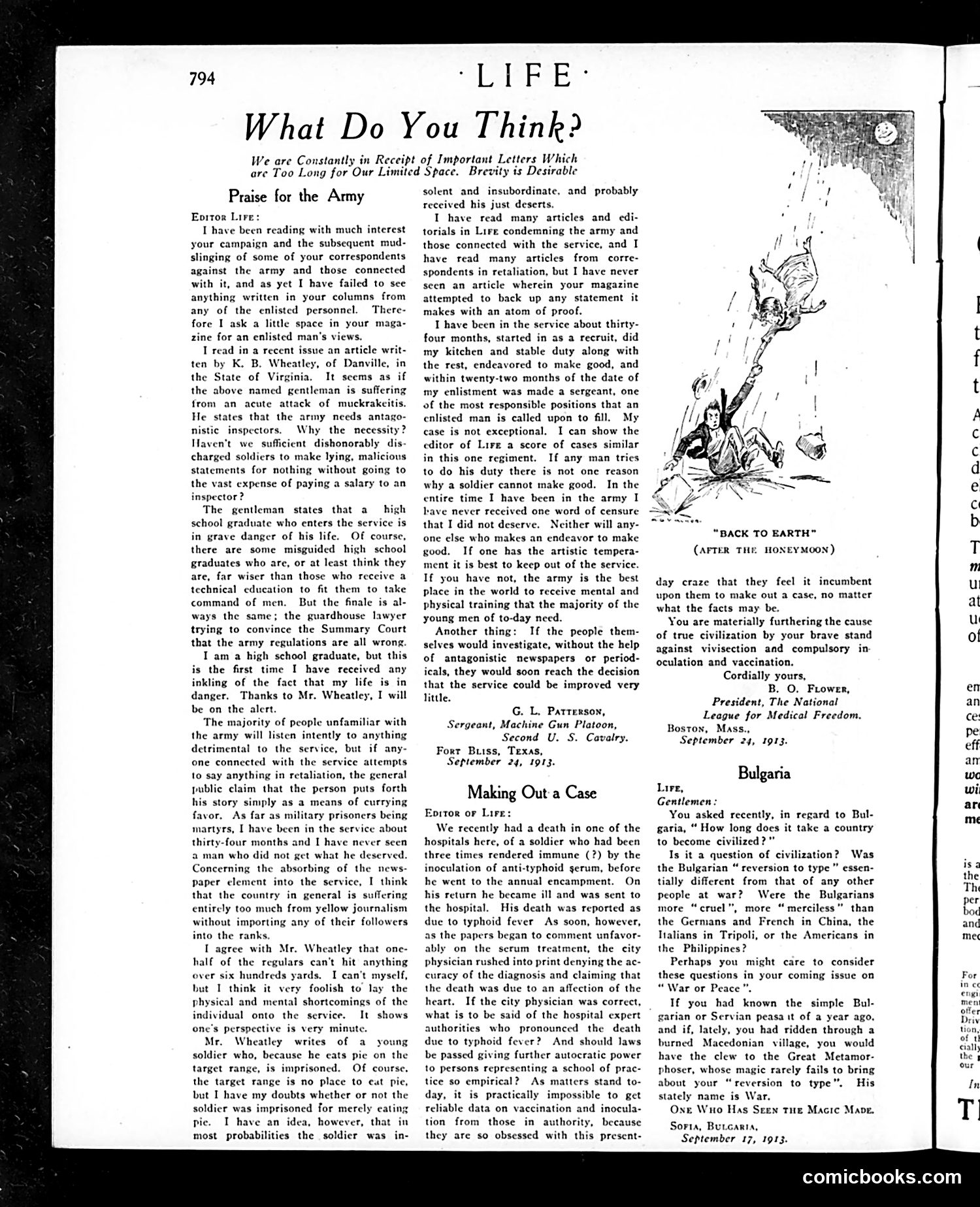
This page features readers' letters to *Life* magazine's "What Do You Think?" column, with a small cartoon titled "Back to Earth" showing a figure falling or tumbling. The dominant content is a spirited defense of the U.S. Army by an enlisted sergeant responding to prior published criticism. The writer, G. L. Patterson, challenges an earlier article by K. B. Wheatley condemning military conditions. Patterson argues that *Life* publishes anti-army critiques without evidence while dismissing pro-army responses as self-serving. He defends Army discipline, training, and merit-based advancement, citing his own rapid promotion as proof the system works. Below this is a separate letter about Bulgaria's civilization, referencing Balkan Wars violence. The page reflects early 20th-century debates over military reform and press responsibility—*Life's* satirical mission to expose institutional problems versus soldiers' claims that criticism was unfounded and demoralizing.
📄 Transcribed text from this page (OCR, searchable)
Machine-transcribed from the original scan — historical spelling and the odd misread are preserved.
*alsaE What Do You Think? We are Constantly in Receipt of Important Letters Which are Too Long for Our Limited Space. Brevity is Desirable Praise for the Army cn reading with much interest your campaign and the subsequent mud- slinging of some of your correspondents against the army and those connected with it, and as yet I have failed to see anything written in your columns from any of the enlisted personnel. There- fore I ask a little space in your maga- zine for an enlisted man’s views. I read in a recent issue an article writ- ten by K. B, Wheatley, of Danville, in the State of Virginia. It seems as if the above named gentleman suffering from an acute attack of muckrakcitis. He states that the army needs antago- nistie ectors. Why the necessity Haven't we sufficient dishonorably dis- charged soldiers to make lying, malicious statements for nothing without going to the vast expense of paying a salary to an inspector? The gentleman states that a high school graduate who enters the service is in grave danger of his life. Of course, there are some misguided high school graduates who are, or at least think they are, far wiser than those who reccive a technical education to fit them to take command of men. But the finale is al- ways the same; the guardhouse lawyer trying to convince the Summary Court that the army regulations are all wrong. Tam a high school graduate, but this is the first time I have received any inkling of the fact that my life is in danger. Thanks to Mr. Wheatley, I will be on the alert. The majority of people unfamiliar with the army will listen intently to anything detrimental to the service, but if any- one connected with the service attempts 1o say anything in retaliation, the general public claim that the person puts forth his story simply as a means of currying favor. As far as military prisoners being martyrs, I have been in the service about thirty-four months and I have never seen a man who did not get what he deserved. Concerning the absorbing of the news- paper element into the service, I think that the country in general is suffering entircly too much from yellow journalism without importing any of their followers into the ranks. I agree with Mr. Wheatley that one- half of the regulars can't hit anything over six hundreds yards. I can't myself, but I think it very foolish to lay the physical and mental shortcomings of the individual onto the service. It shows one’s perspective is very minute. Mr. Wheatley writes of a young soldier who, because he cats pie on the target range, is imprisoned. Of course, the target range is no place to eat pie, but I have my doubts whether or not the soldier was imprisoned for merely eatin pie. I have an idea, however, that in most probabilities the soldier was in- solent and insubordinate, and probably received his just deserts. I have read many articles and cdi- torials in Lire condemning the army and those connected with the service, and I have read many articles from corre- spondents in retaliation, but I have never seen an article wherein your magazine attempted to back up any statement it makes with an atom of proof. I have been in the service about thirty- four months, started in as a recruit, did my kitchen and stable duty along with the rest, endeavored to make good, and within twenty-two months of the date of my enlistment was made a sergeant, one of the most responsible positions that an enlisted man is called upon to fill. My case is not exceptional. I can show the editor of Lirgz a score of cases similar in this one regiment. If any man tries to do his duty there is not one reason why a soldier cannot make good. In the entire time I have been in the army I have never received one word of censure that I did not deserve. Neither will any- one else who makes an endeavor to make good. If one has the artistic tempera- ment it is best to keep out of the service. If you have not, the army is the best place in the world to receive mental and physical training that the majority of the young men of to-day need. Another thing: If the people them- selves would investigate, without the help of antagonistic newspapers or period- icals, they would soon reach the decision that the service could be improved very little. G. L. Patterson, Sergeant, Machine Gun Platoon, Second U. S. Cavalry. Fort Buss, Texas, September 24, 1913. Making Out a Case Eortor oF Lire: We recently had a death in one of the hospitals here, of a soldier who had been three times rendered immune (?) by the inoculation of anti-typhoid serum, before he went to the annual encampment. On his return he became ill and was sent to the hospital. His death was reported as due to typhoid fever As soon, however, as the papers began to comment unfavor- ably on the serum treatment, the city physician rushed into print denying the ac- curacy of the diagnosis and claiming that the death was due to an affection of the heart. If the city physician was correct, what is to be said of the hospital expert authorities who pronounced the death due to typhoid fever? And should laws be passed giving further autocratic power to persons representing a school of prac- tice so empirical? As matters stand to- day, it is practically impossible to get reliable data on vaccination and inocula- tion from those in authority, because they are so obsessed with this present- “BACK TO EARTH” (AFTER THE HONEYMOON) day craze that they feel it incumbent upon them to make out a case, no matter what the facts may be. You are materially furthering the cause of true civilization by your brave stand against vivisection and compulsory in- culation and vaccination. Cordially yours, B. O. Frower, President, The National League for Medical Freedom. Bostox, Mass., September 24, 1913. Bulgaria Lire, Gentlemen: You asked recently, in regard to Bul- garia, “ How long does it take a country to become civilized?” Is it a question of civilization? Was the Bulgarian “ reversion to type” essen- tially different from that of any other people at war? Were the Bulgarians more “cruel”, more “merciless” than the Germans and French in China, the Italians in Tripoli, or the Americans in the Philippines? Perhaps you might care to consider these questions in your coming issue on “ War or Peace”. If you had known the simple Bul- garian or Servian peasa it of a year ago. and if, lately, you had ridden through a burned Macedonian village, you would have the clew to the Great Metamor- phoser, whose magic rarely fails to bring about your “reversion to type’. His stately name is War. Oxe Wno Has Seen tHe Macic Mave. Sorta, Butcaria, September 17, 1913. Ora ew y oe 8 Gee eK Re ewe Re en an ce: eff an wi are comicbooks.com