
Life, 1913-11-06 · page 16 of 56
Life — November 6, 1913 — page 16: what you’re looking at
What you’re looking at
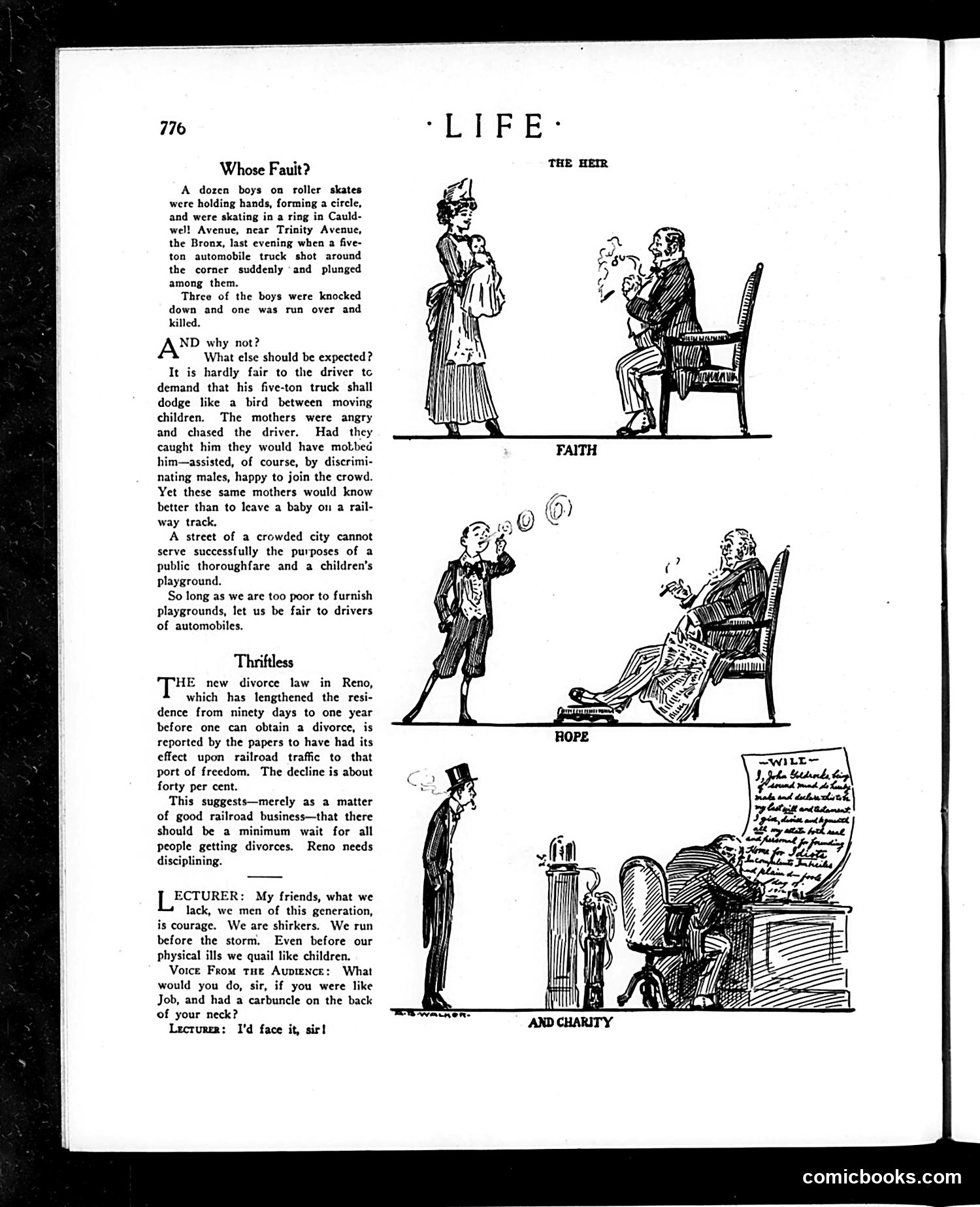
This 1920s *Life* magazine page contains three separate satirical pieces: **"Whose Fault?"** uses dark irony to critique urban negligence. After a child is killed by a truck among roller-skating children in the Bronx, the text sarcastically argues the truck driver shouldn't be blamed—rather, mothers are foolish for allowing children to play in streets. The satire exposes how society victim-blames and prioritizes traffic flow over child safety, while lacking public playgrounds. **"Thriftless"** mocks Nevada's Reno divorce law, which extended waiting periods from 90 days to one year. The text cynically suggests this is a "railroad business" problem since fewer divorces mean fewer people traveling to Reno, implying the railroad should lobby for faster divorces to boost traffic. **The Lecturer anecdote** is a joke about masculine bravado: a speaker claims men lack courage, but when challenged about handling a painful carbuncle (boil), he retreats to abstract "facing it" rather than admitting he'd actually suffer. The accompanying illustrations ("The Heir," "Faith," "Hope," "And Charity") appear to be unrelated decorative cartoons about human virtues and inheritance.
📄 Transcribed text from this page (OCR, searchable)
Machine-transcribed from the original scan — historical spelling and the odd misread are preserved.
Whose Fauit? A dozen boys on roller skates were holding hands, forming a circle, and were skating in a ring in Cauld- well Avenue, near Trinity Avenue, the Bronx, last evening when a five- ton automobile truck shot around the corner suddenly and plunged among them. Three of the boys were knocked down and one was run over and killed. A™? why not? What else should be expected? It is hardly fair to the driver to demand that his five-ton truck shall dodge like a bird between moving children. The mothers were angry and chased the driver. Had they caught him they would have mobbed him—assisted, of course, by discrimi- nating males, happy to join the crowd. Yet these same mothers would know better than to leave a baby on a rail- way track, A street of a crowded city cannot serve successfully the purposes of a public thoroughfare and a children’s playground. So long as we are too poor to furnish playgrounds, let us be fair to drivers of automobiles. Thriftless ‘HE new divorce law in Reno, which has lengthened the resi- dence from ninety days to one year before one can obtain a divorce, is reported by the papers to have had its effect upon railroad traffic to that port of freedom. The decline is about forty per cent. This suggests—merely as a matter of good railroad business—that there should be a minimum wait for all people getting divorces. Reno needs disciplining. [i ECTURER: My friends, what we lack, we men of this generation, is courage. We are shirkers. We run before the storm, Even before our physical ills we quail like children. Voice From tHe Auptence: What would you do, sir, if you were like Job, and had a carbuncle on the back of your neck? Lecturer: I'd face it, sir! comicbooks.com