
Life, 1913-11-06 · page 30 of 56
Life — November 6, 1913 — page 30: what you’re looking at
What you’re looking at
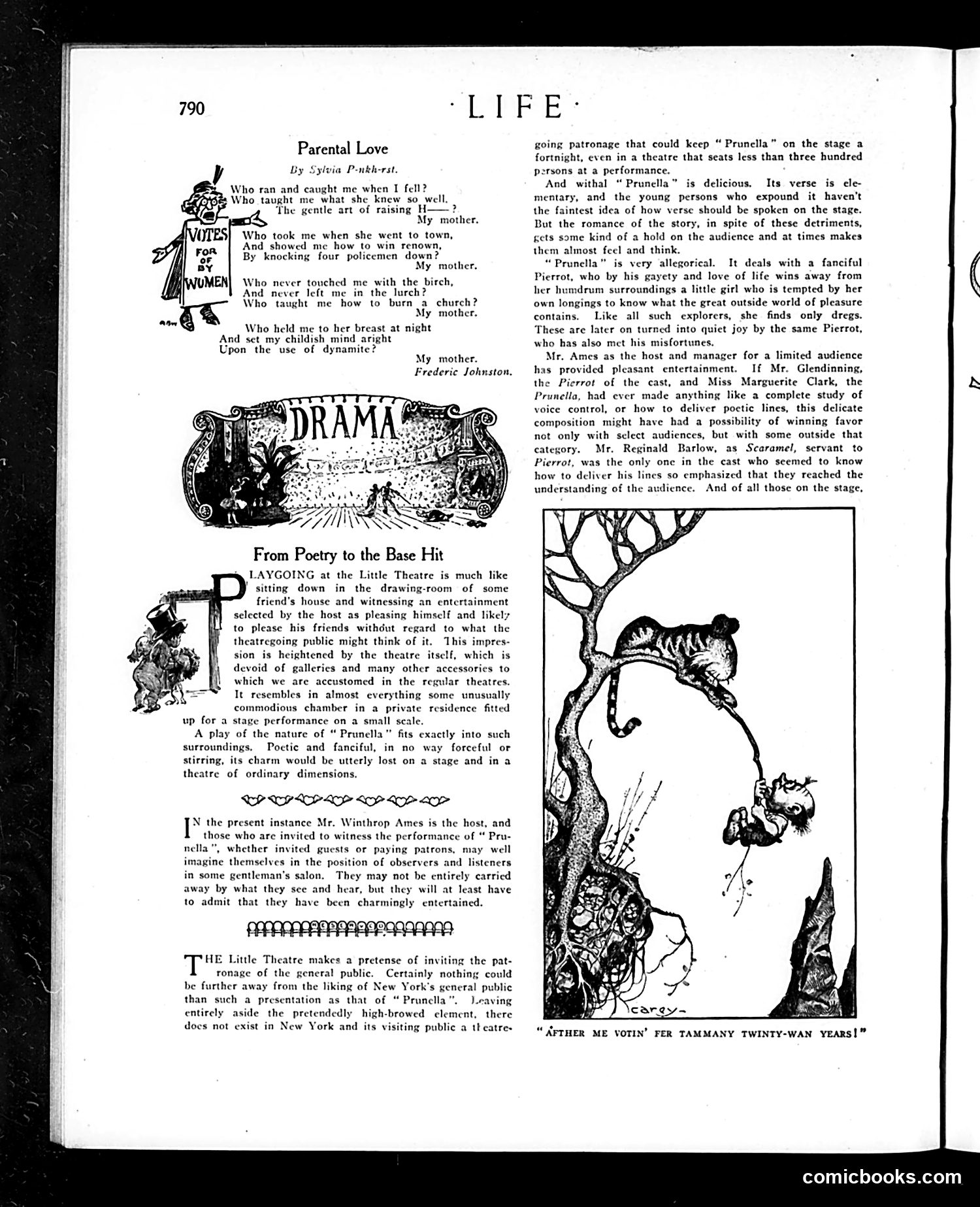
The poem "Parental Love" by Frederic Johnston is dark satire depicting a mother who teaches her child dangerous, illegal acts—knocking down policemen, burning churches, using dynamite. This appears to mock anarchist or radical ideology of the early 1900s, when such violence was a genuine social threat. The joke targets parents who indoctrinate children with extreme political views, presenting maternal affection twisted toward destructive ends. The accompanying theater review discusses a production of "Prunella" at the Little Theatre, critiquing its elite, exclusive appeal. The reviewer argues this poetic, allegorical play about a girl tempted by worldly pleasures—featuring actors with poor diction—cannot sustain public interest in New York. The satire suggests pretentious theater limited to small "gentleman's salon" audiences rather than accessible popular entertainment.
📄 Transcribed text from this page (OCR, searchable)
Machine-transcribed from the original scan — historical spelling and the odd misread are preserved.
“ENF E * Parental Love ia P-ukh-rst. Who ran and caught me when I fell? Who taught me what she knew so well, The gentle art of raising H. ?. My mother. Who took me when she went to town, And showed me how to win renown, By knocking four policemen down? My mother. Who never touched me with the birch, And never left_me in the lurch? Who taught me how to burn a church? My mother. Who held me to her breast at night And set my childish mind aright Upon the use of dynamite? My mother. Frederic Johnston, From Poetry to the Base Hit LAYGOING at the Little Theatre is much like sitting down in the drawing-room of some friend’s house and witnessing an entertainment selected by the host as pleasing himself and lik to please his friends withdut regard to what the theatregoing public might think of it. ‘This impres- sion is heightened by the theatre itself, which is devoid of galleries and many other accessories to which we are accustomed in the regular theatres. It resembles in almost everything some unusually commodious chamber in a private residence fitted up for a stage performance on a small scale. A play of the nature of “ Prunella” fits exactly into such surroundings. Poetic and fanciful, in no way forceful or stirring, its charm would be utterly lost on a stage and in a theatre of ordinary dimensions. PILLAI OP OP OO I* the present instance Mr. Winthrop Ames is the host, and those who are invited to witness the performance of “ Pru- nella", whether invited guests or paying patrons, may well imagine themselves in the position of observers and listeners in some gentleman's salon. They may not be entirely carried away by what they see and hear, but they will at least have to admit that they have been charmingly entertained. HE Little Theatre makes a pretense of inviting the pat- ronage of the general public. Certainly nothing could be further away from the liking of New York's general public than such a presentation as that of “ Prunella Jeaving entirely aside the pretendedly high-browed clement, there does not exist in New York and its visiting public a theatres going patronage that could keep “ Prunella” on the stage a fortnight, even in a theatre that seats less than three hundred persons at a performance. And withal “Prunella” is delicious, Its verse is cle- mentary, and the young persons who expound it haven't the faintest idea of how verse should be spoken on the stage. But the romance of the story, in spite of these detriments, gets some kind of a hold on the audience and at times makes them almost feel and think. “Prunella” is very allegorical. It deals with a fanciful Pierrot, who by his gayety and love of life wins away from her humdrum surroundings a little girl who is tempted by her own longings to know what the great outside world of pleasure contains. Like all such explorers, she finds only dregs. These are later on turned into quiet joy by the same Pierrot, who bas also met his misfortunes. Mr. Ames as the host and manager for a limited audience has provided pleasant entertainment. If Mr. Glendinning, the Pierrot of the cast, and Miss Marguerite Clark, the Prunella, had ever made anything like a complete study of voice control, or how to deliver poetic lines, this delicate composition might have had a possibility of winning favor not only with sclect audiences, but with some outside that category. Mr. Reginald Barlow, as Scaramel, servant to Pierrot, was the only one in the cast who seemed to know how to deliver his lines so emphasized that they reached the understanding of the audience. And of all those on the stage, “APTHER ME VOTIN’ FER TAMMANY TWINTY-WAN YEARS!” comicbooks.com