
Life, 1913-11-06 · page 21 of 56
Life — November 6, 1913 — page 21: what you’re looking at
What you’re looking at
This page contains two satirical opinion pieces rather than traditional cartoons. **"An Awful Possibility"** mocks a writer from *American Magazine* who argued laws are unnecessary. Life's satirical response warns that abolishing laws would eliminate lawyers, divorce cases, and sensational murder trials—thus depriving newspapers of content. The piece darkly jokes that criminals currently enjoy celebrity status through legal proceedings; without lawyers, crime would be punished too quickly to be "fascinating." It concludes absurdly that without legal costs, people might actually cultivate their minds. **"Too Much"** criticizes President Wilson's decision to abolish Cabinet meetings. Life sarcastically laments this threatens the Republic, since Cabinet meetings historically served merely to keep officials talking rather than actually governing. The piece mocks Wilson's apparent preference for action over endless discussion as dangerous "innocuous idealism." Both pieces exemplify Life's irreverent style: using exaggeration and paradox to critique American institutions, legal systems, and political leadership through humor rather than direct argument.
📄 Transcribed text from this page (OCR, searchable)
Machine-transcribed from the original scan — historical spelling and the odd misread are preserved.
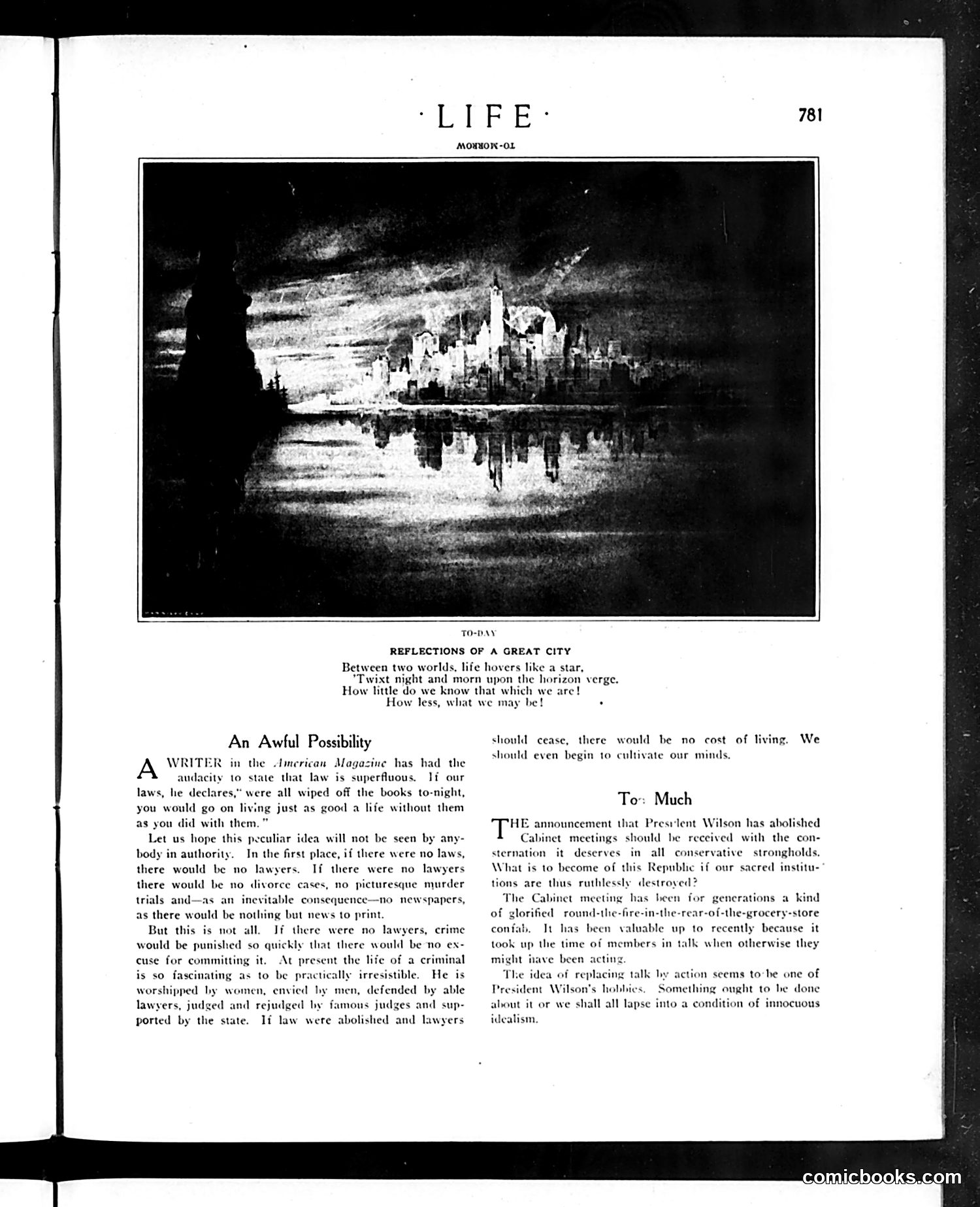
‘LTP E: MOOR -OL TO-DAY REFLECTIONS OF A GREAT CITY Between two worlds, life hovers like a star, *Twixt night and morn upon the | rizon verge. How little do we know that which we are! How less, what we may be! : An Awful Possibility WRITER in the American Magazine has had the audacity to state that law is superfluous. 1i our laws, he declares," were all wiped off the books to-night, you would go on living just as good a life without them as you did with them.” Let us hope this peculiar idea will not be seen by any- body in authority. In the first place, if there were no laws, there would be no lawyers. there would be no divorce cases, no picturesque murder trials and—as an inevitable consequence—no newspapers, as there would be nothing but news to print. But this is not all. Jf there were no lawyers, crime would be punished so quickly that there would be no ex- cuse for committing it. At present the life of a criminal is so fascinating as to be practically irresistible. He is worshipped hy women, envied hy men, defended by able lawyers, judged and rejudged by famous judges and sup- ported by the state. If law were abolished and lawyers If there were no lawyers should cease, there would be no cost of living. We should even begin to cultivate our minds, To: Much HE announcement that Prestlent Wilson has abolished hinet meetings should be received with the con- sternation it deserves in all conservative strongholds. What is to become of this Republic if our sacred institu- tions are thus ruthlessly destroyed? The Cabinet meeting has heen for generations a kind of glorified round-the-fire-in-the-rear-of-the-grocery-store confab, It been valuable up to recently because it took up the time of members in talk when otherwise they might ave been acting The idea of replacing talk by action seems tovhe one of President Wilson's hobbies. Something ought to he done about it or we shall all lapse into a condition of innocuous idealism,