
A complete issue · 44 pages · 1912
Life — June 13, 1912
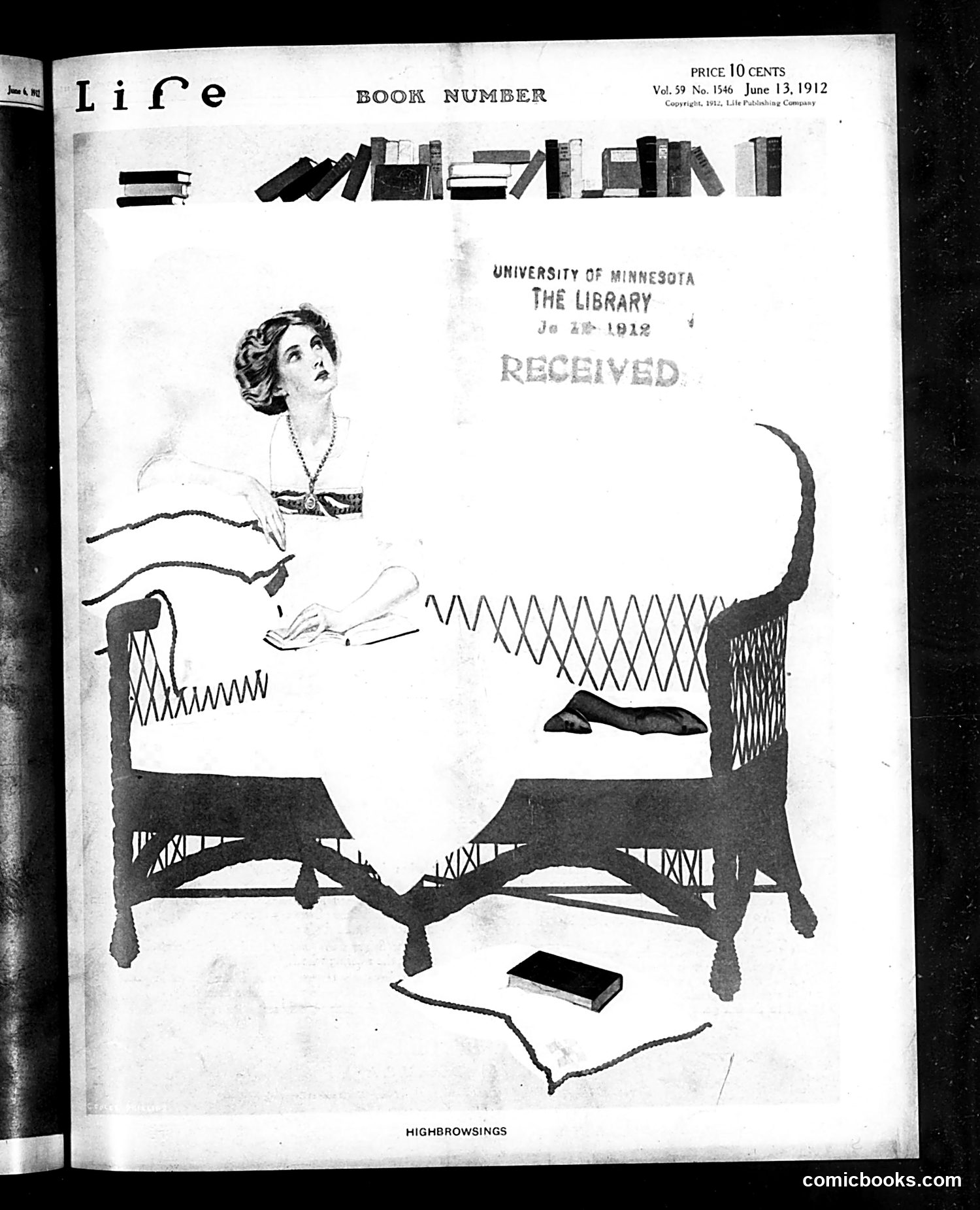
This cartoon satirizes intellectual pretension and affectation among the wealthy. A fashionably dressed woman reclines in an ornate chair, gazing upward in affected contemplation while holding what appears to be a cigarette holder. A cat with an equally elongated, affected posture mirrors her pose on the opposite chair. The humor derives from equating the woman's exaggerated "highbrow" sophistication with a cat's naturally aloof demeanor—suggesting her refined pose is as artificial and self-conscious as an animal's. The matching furniture and mirrored positions emphasize the comparison. The title "Highbrowsings" mocks the pretentious behavior of those attempting to display cultured superiority through affected mannerisms rather than genuine intellectualism.
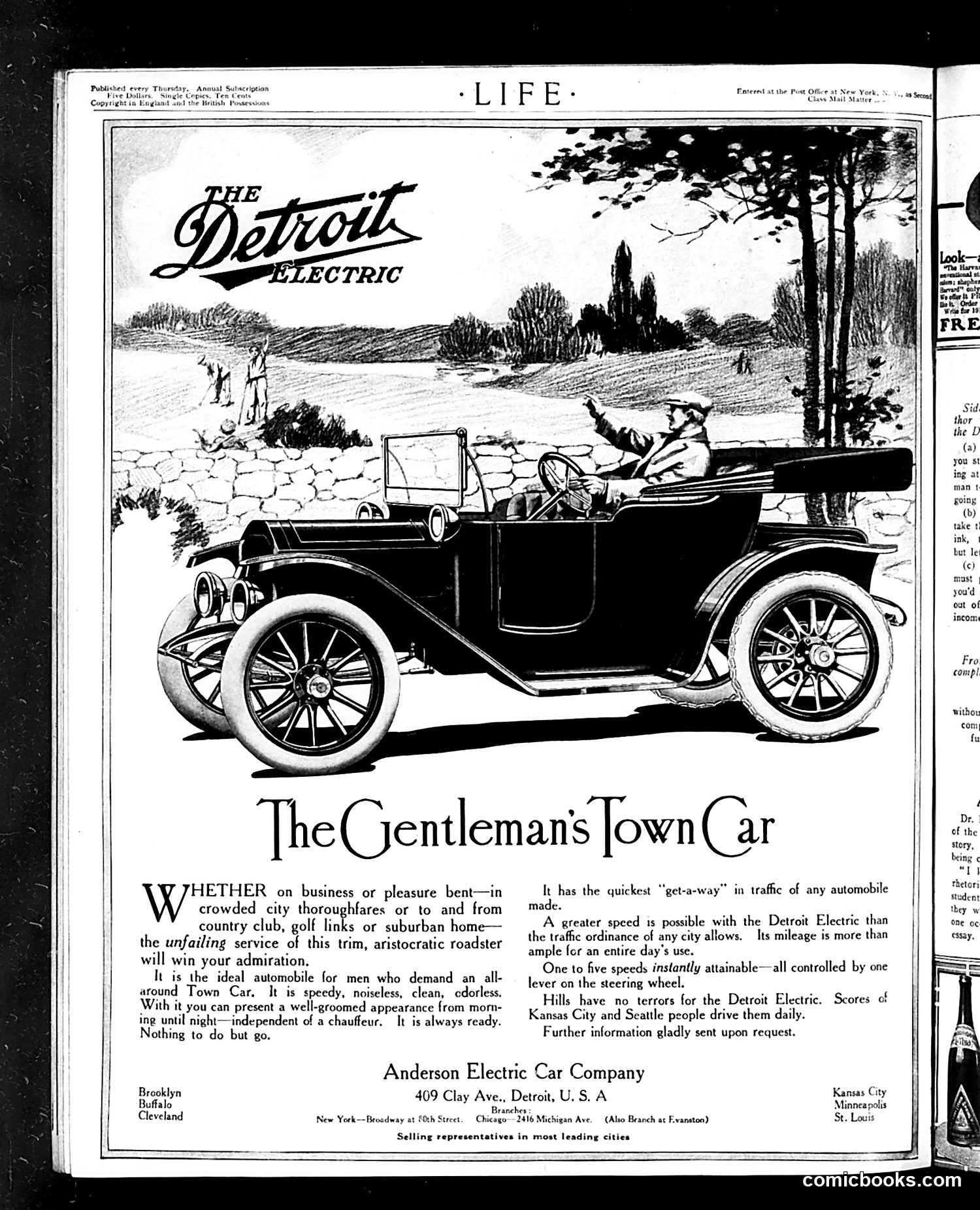
This page is primarily an advertisement for the Detroit Electric automobile, not political satire. The ad depicts an early 1900s electric car and targets wealthy male consumers ("The Gentleman's Town Car"). The illustration shows a man driving through countryside, emphasizing the vehicle's reliability, speed, and ease of operation—five speeds controlled by one steering lever. The ad highlights practical advantages: no hills present difficulties, it's noiseless and colorless, and ideal for business or pleasure use. The accompanying pastoral landscape scene with leisurely figures suggests electric cars as symbols of modern gentlemanly leisure and status. This reflects the pre-Model T era when electric vehicles competed with gasoline automobiles as luxury transportation for affluent buyers.
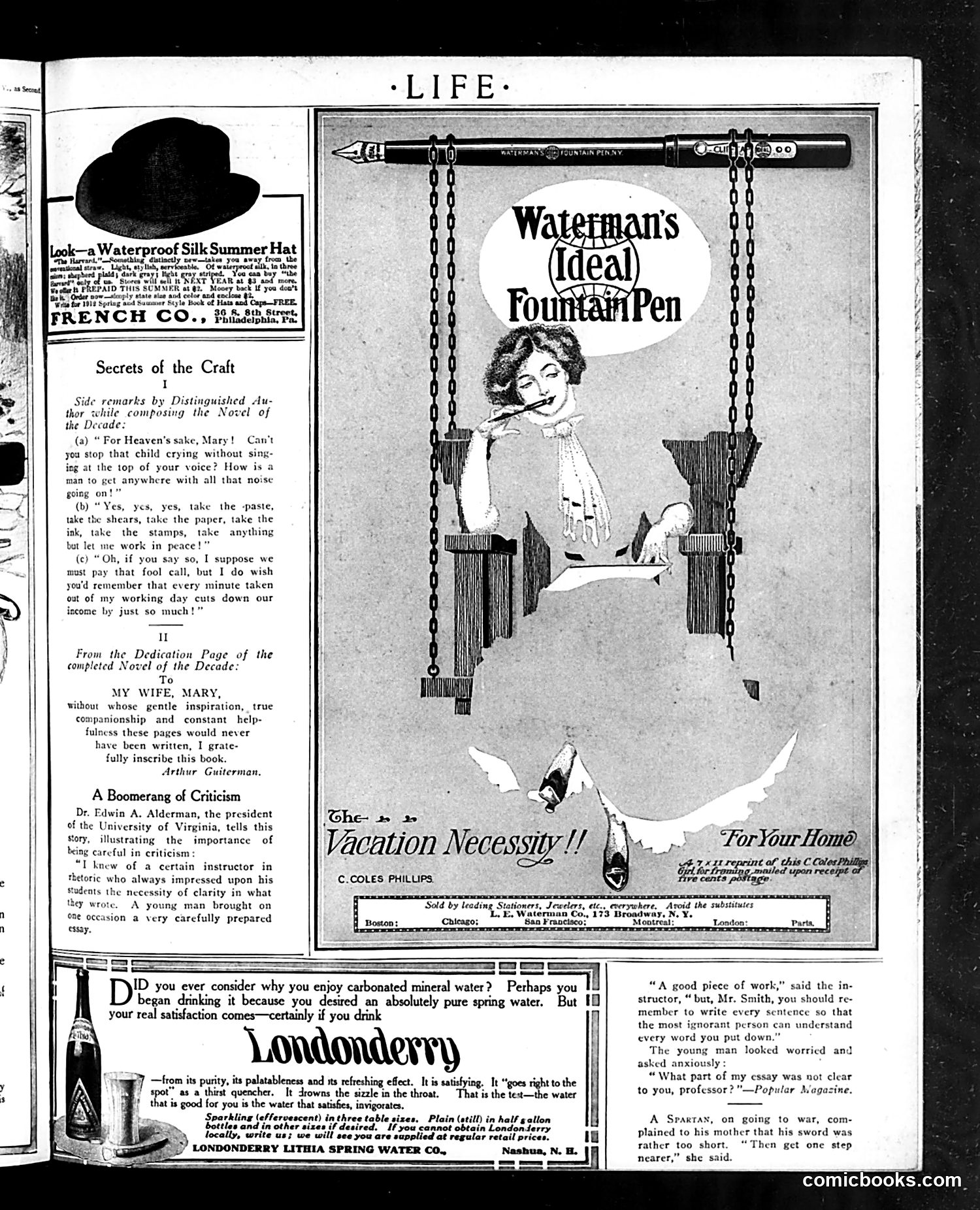
This page is primarily **advertising rather than political satire**. The dominant content features three ads: 1. **Waterman's Ideal Fountain Pen** (center): Shows a woman on a swing, marketing pens as a "vacation necessity" and "for your home"—typical early 20th-century consumer advertising. 2. **Londonderry Lithia Spring Water** (bottom): Promotes mineral water's health benefits with claims about carbonation and purity. 3. **French Co. hat ad** (left): Advertises summer hats. The left column contains literary commentary titled "Secrets of the Craft" and "A Boomerang of Criticism," discussing novel-writing and academic instruction—editorial content rather than satire. There is no identifiable political cartoon or social satire on this page; it's a standard magazine layout mixing advertisements with literary discussion.
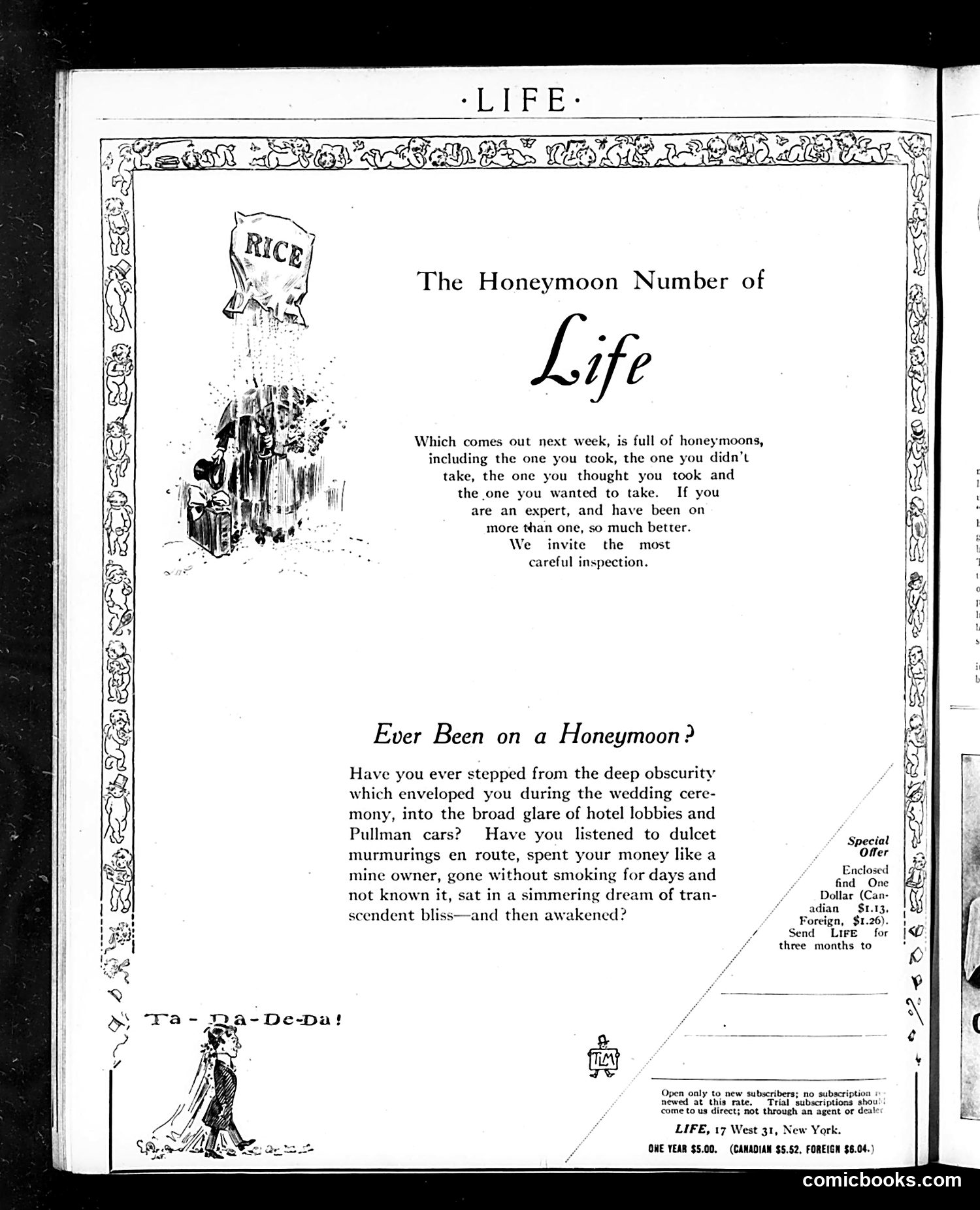
This is primarily a **subscription advertisement** for Life magazine, disguised as editorial content about honeymoons. The page features: 1. **A rice bag illustration** (top left) — a visual pun on "rice" (the wedding tradition) and suggesting abundance/value 2. **"Ta-Da-De-Da!" caption** (bottom left) — mimics wedding march music, reinforcing the honeymoon theme 3. **The actual pitch**: Life promises its "Honeymoon Number" will feature multiple honeymoon stories, humorously noting readers will recognize variations of their own honeymoon experiences 4. **Rhetorical questions** ("Ever Been on a Honeymoon?") use relatable scenarios—overspending, going without smoking, romantic daydreaming—to emotionally connect with the target audience of newlyweds and romantics The satire gently mocks honeymoon clichés while simultaneously selling subscriptions at $5.00 annually. It's advertising that entertains rather than directly promotes.
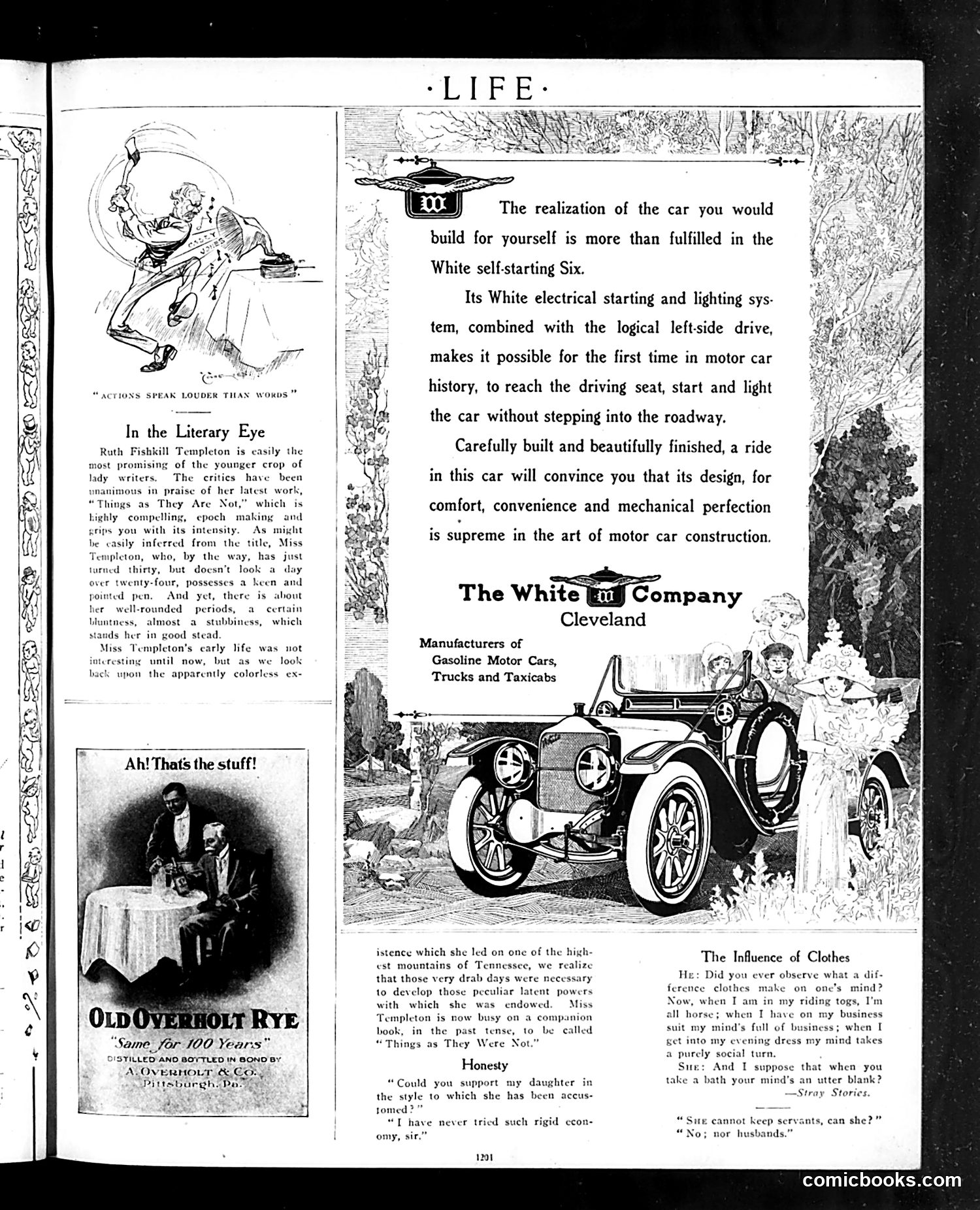
This page is primarily **advertising** rather than political satire. The main content features a White automobile company advertisement (center-right) promoting the White self-starting Six, emphasizing its electrical starting system and left-side drive as modern conveniences. The left side contains lighter content: a sketch labeled "Actions Speak Louder Than Words" accompanying a brief literary review of Ruth Fishkill Templeton; a humor piece titled "Ah! That's the Stuff!" advertising Old Overholt Rye whiskey; and sections on "Honesty" and "The Influence of Clothes" with humorous anecdotes. The page reflects early 20th-century Life magazine's mix of advertisement, humor, and light social commentary rather than hard political satire. No specific political figures or events are referenced.
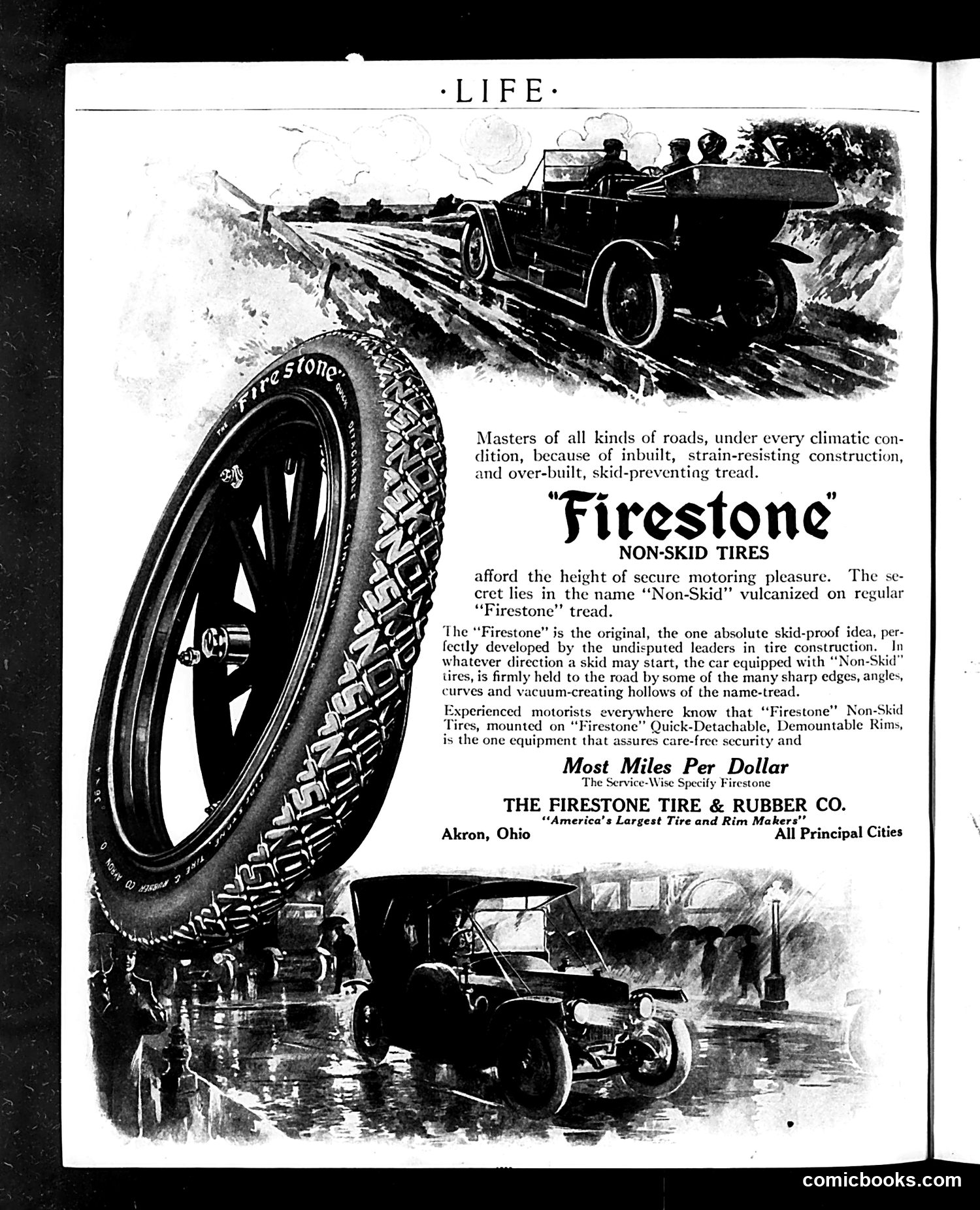
This page is **primarily advertising, not satire or political commentary**. It's a Firestone Tire & Rubber Company advertisement from *Life* magazine promoting their "Non-Skid" tires. The advertisement features two illustrated scenes of early automobiles on roads—one traveling through countryside, another near industrial/urban areas—to demonstrate the tires' reliability "under every climatic condition." The large tire image showcases the distinctive tread pattern that supposedly prevents skidding. The marketing emphasizes durability ("Most Miles Per Dollar") and positions Firestone as "America's Largest Tire and Rim Makers." There is no political satire or social commentary present—this is straightforward product promotion targeting motorists of the early 20th century.
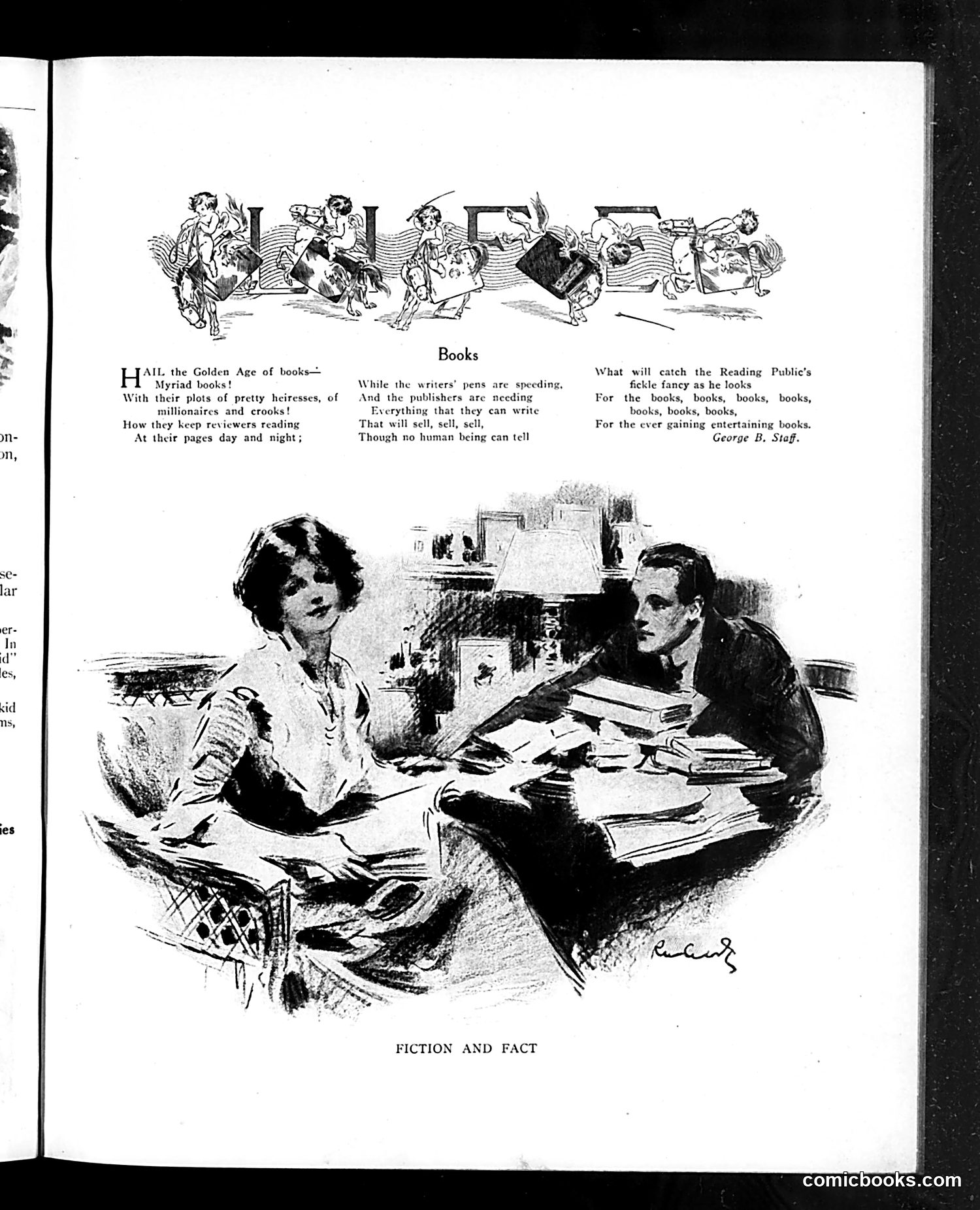
This page celebrates literature through satire. The top decorative header shows cherubic figures carrying enormous letters spelling "BOOKS," whimsically depicting the literary world's energy. The poem mocks the publishing industry's commercial frenzy: writers frantically producing content, publishers desperately needing material to sell, all driven by profit rather than artistic merit. It's cynical about the "Golden Age of books"—suggesting the era's literary output prioritizes marketability over quality. The illustration titled "FICTION AND FACT" depicts two people at a desk surrounded by books and papers, apparently engaged in editorial or publishing work, though their specific identities aren't indicated. The satire targets 1910s-1920s publishing's rapid commercialization, where demand for reading material exceeded concern for literary substance.
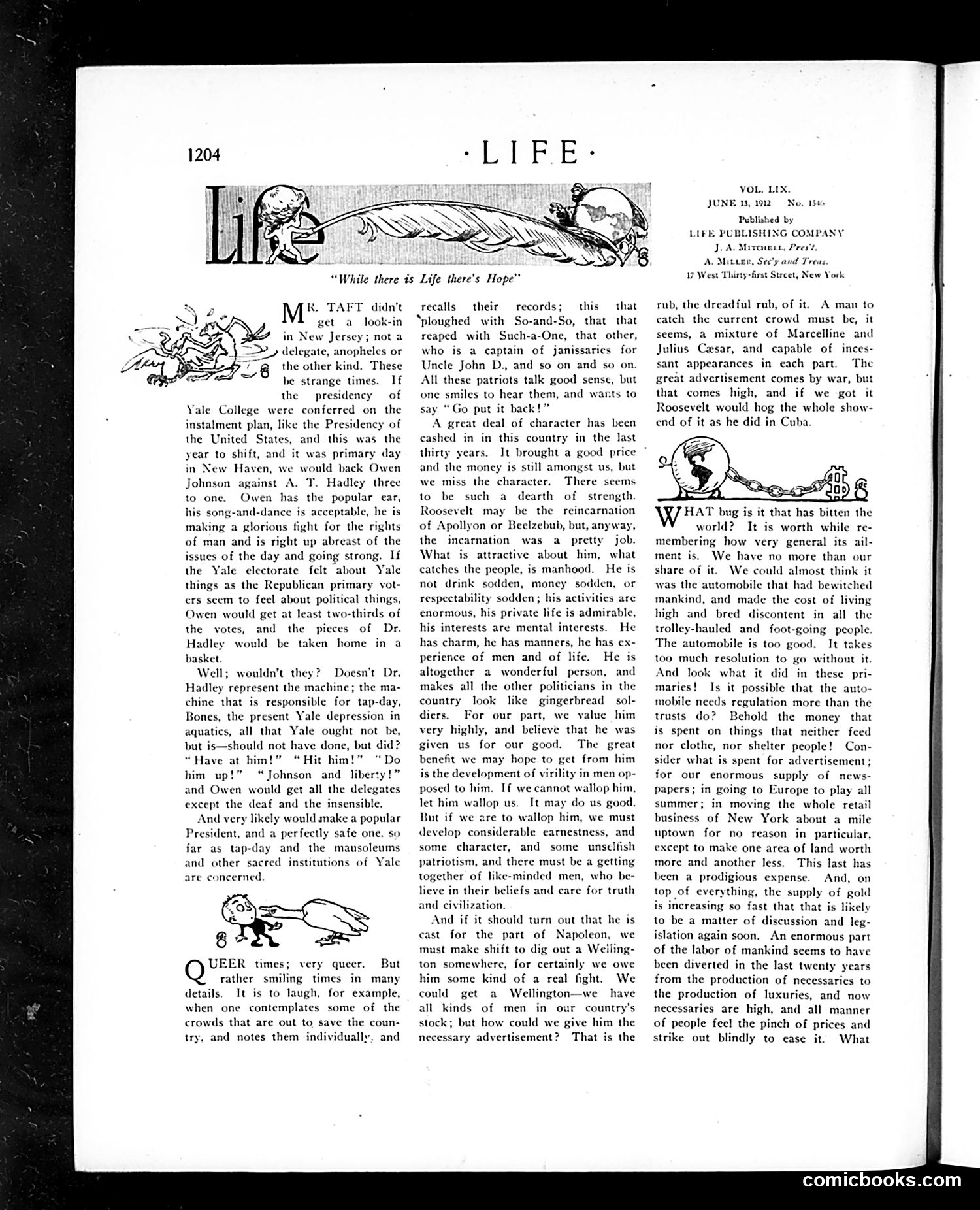
This page discusses Yale College's presidential succession and contains satirical commentary on American politics. The text critiques a Yale electorate decision, mentioning candidates including A.T. Hadley and Dr. Hadley, along with references to Owen and political maneuvering. The main satirical argument concerns character in politics: the author laments the loss of "strong" political figures and argues that while Roosevelt may be reincarnated strength, the country needs leaders with "manhood" and moral character rather than mere activity. The piece advocates for developing "earnestness" and "unselfishness" in public figures. The accompanying cartoons (rough sketches) appear to illustrate these themes humorously, though specific caricatures are unclear from the image quality.
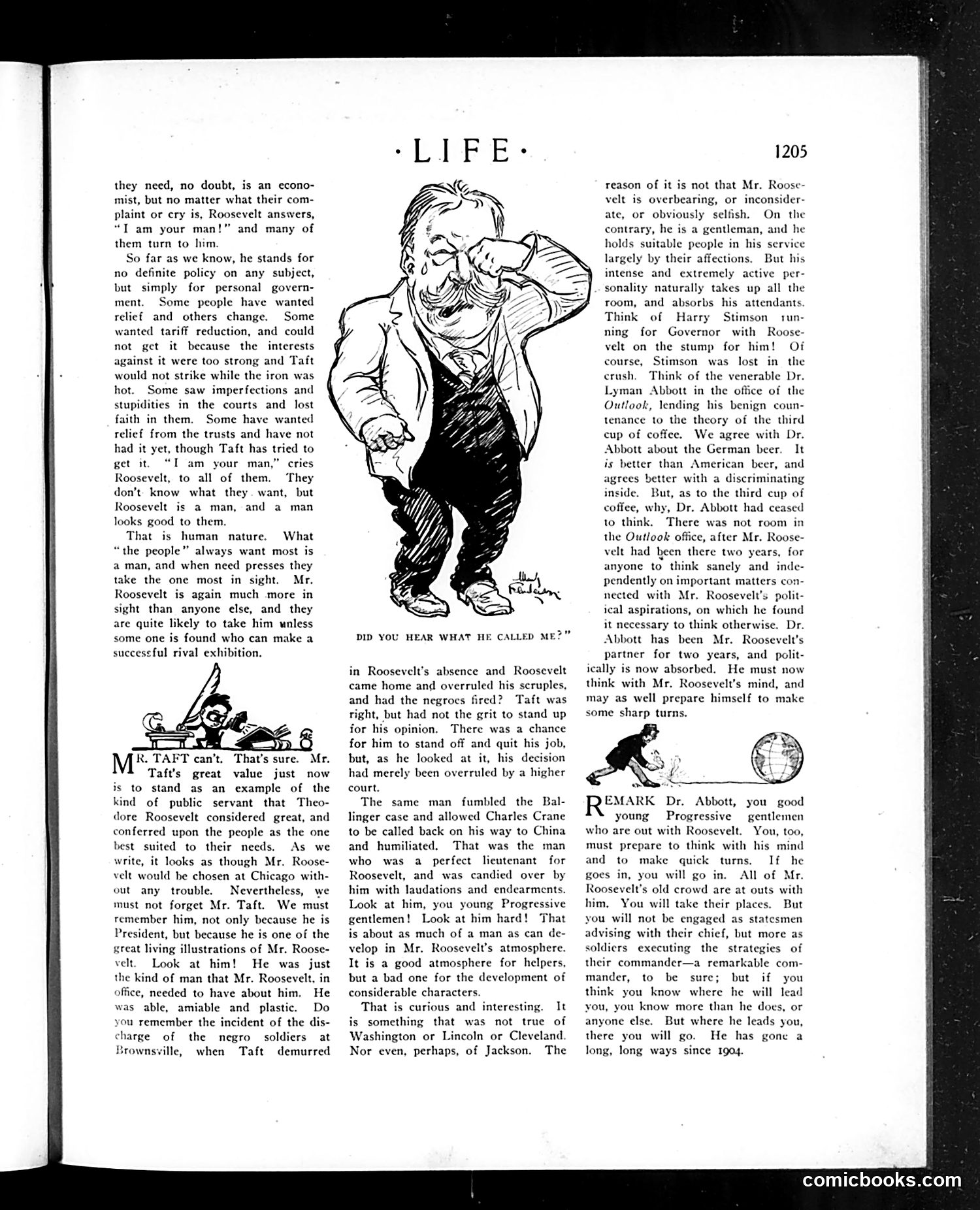
The cartoon depicts a caricatured figure labeled "DID YOU HEAR WHAT HE CALLED ME?" The exaggerated facial features and body language suggest mockery of a public figure. The surrounding text discusses Roosevelt's character and leadership style, praising his ability to select capable people despite personal differences. It references President Taft's position as "an example of the kind of public servant" and mentions Taft's handling of various political matters, including disputes with subordinates and the "Ballinger case." The satire appears to criticize political appointees' sensitivity to criticism while commenting on Roosevelt's pragmatic management style. The cartoon likely mocks someone's oversensitivity to being called out, contrasting with Roosevelt's more thick-skinned approach to governance and public service.
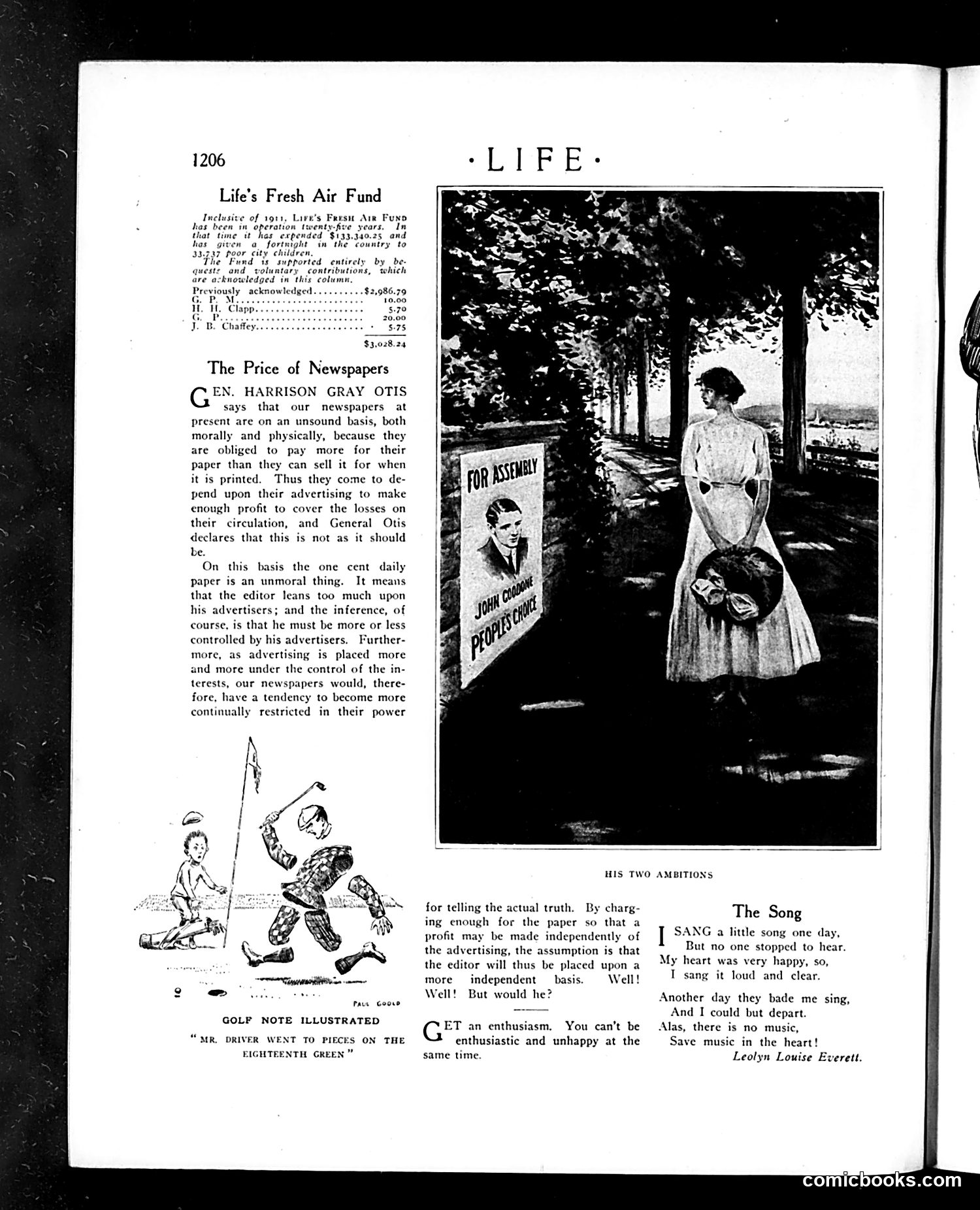
This political cartoon depicts a golfer mid-swing with the caption "Mr. Driver Went to Pieces on the Eighteenth Green." The humor works on multiple levels: it's literally about a golf player whose club ("driver") has broken apart, but "went to pieces" is an idiom meaning to lose composure. The illustration shows the club shattering mid-swing, with fragments flying. The joke satirizes golfers' frustration and loss of emotional control during competition—a relatable social commentary on how the sport, despite being leisurely recreation, provokes intense reactions in participants. The visual pun on "driver" (both the golf club and the person) amplifies the humor through wordplay typical of Life magazine's satirical style.
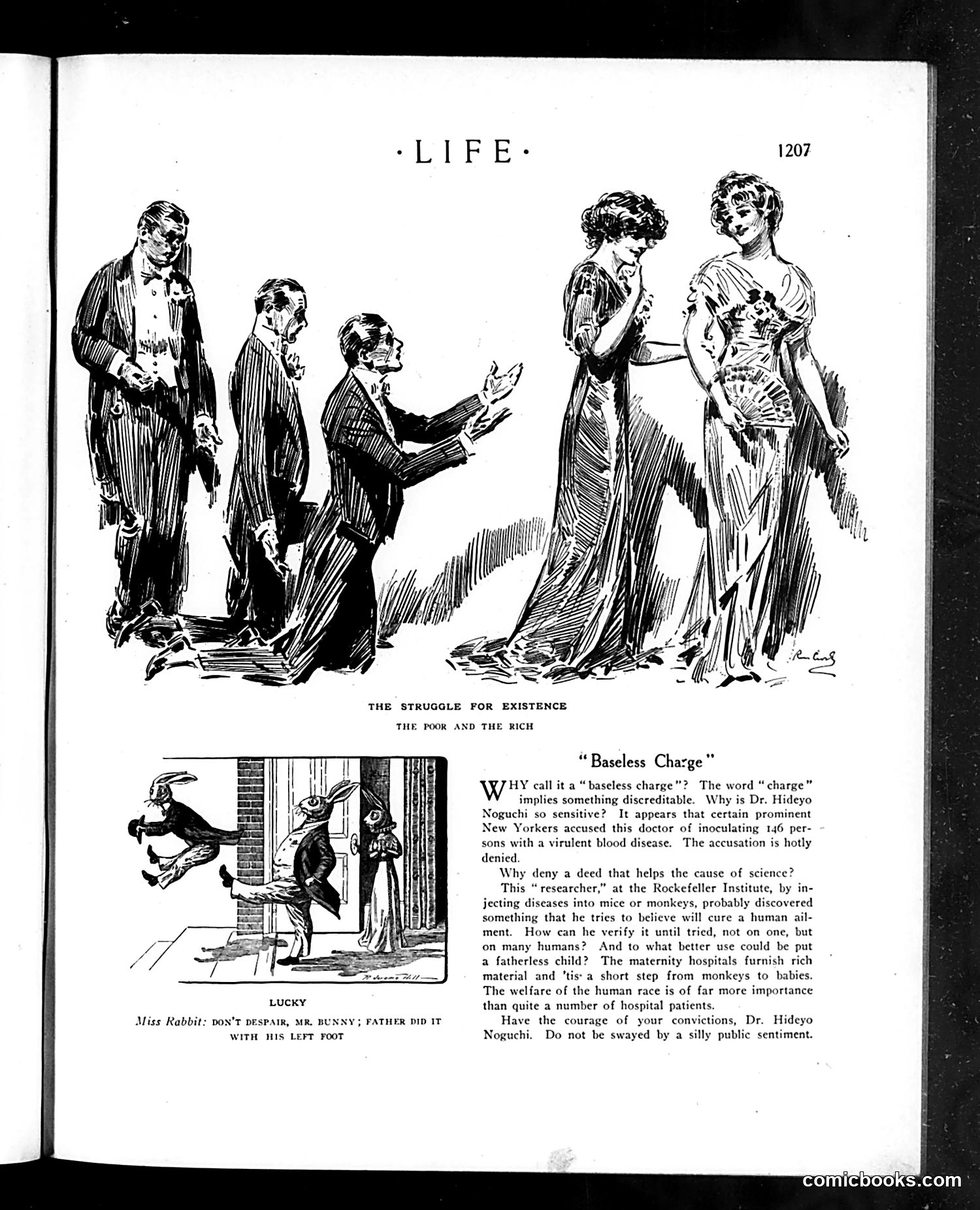
This page satirizes class inequality through two contrasting scenes. The top illustration shows poor men in worn suits desperately approaching well-dressed women, depicting poverty-stricken men's economic desperation versus wealthy women's comfort. The accompanying article titled "Baseless Charge" defends Dr. Hideyo Noguchi, a prominent researcher accused by New Yorkers of conducting unethical experiments (injecting diseases into animals and humans) at the Rockefeller Institute. The text argues his research benefits humanity and dismisses public criticism as "silly sentiment," prioritizing scientific progress over ethical concerns about human experimentation. The cartoon "Lucky" shows a rabbit evading danger—perhaps commenting on experimental subjects' slim chances of survival.
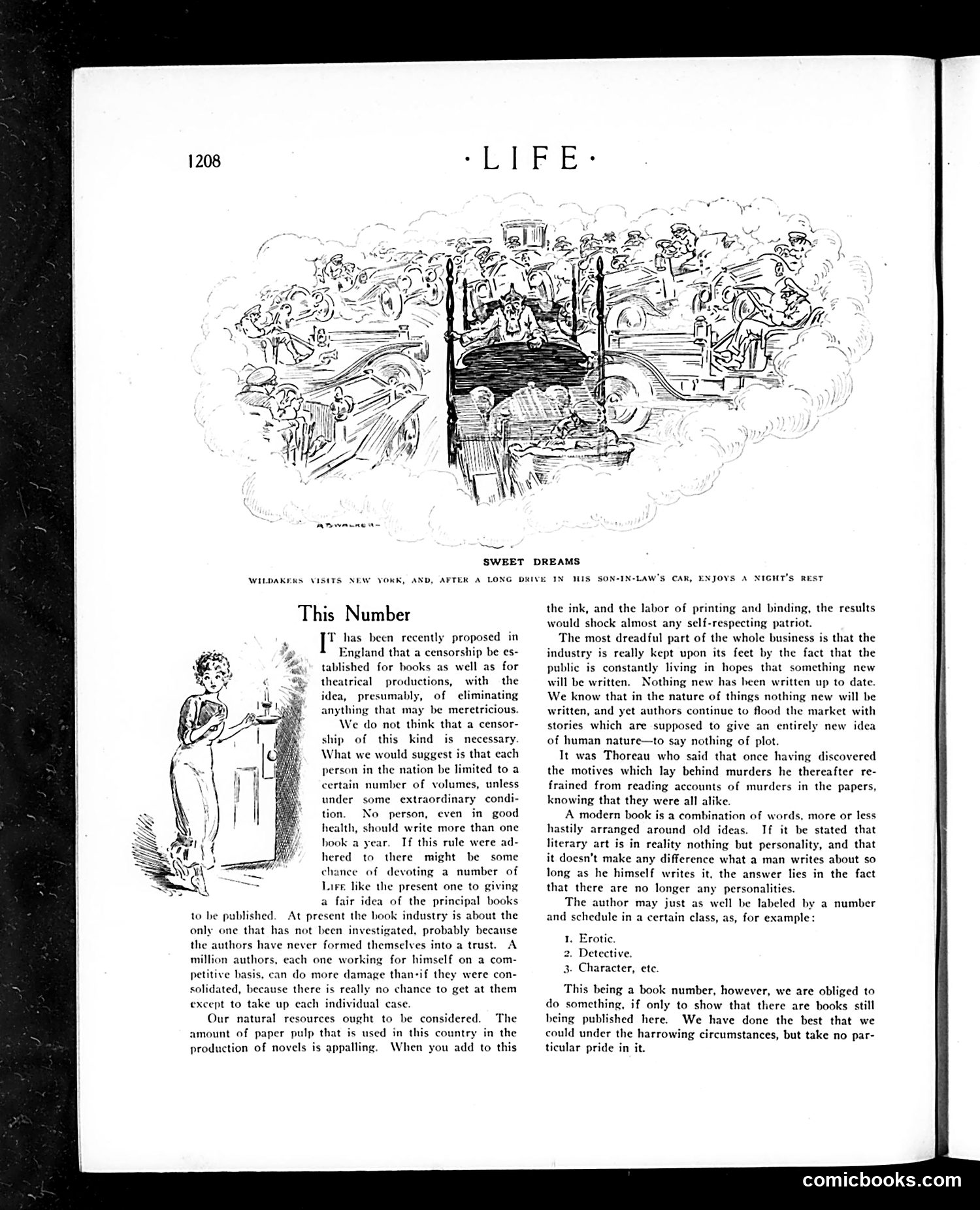
This page from *Life* magazine contains an editorial essay titled "This Number" rather than a political cartoon. The illustration shows a figure at a desk, likely representing an author or writer, accompanying commentary about book publishing and literary standards. The text argues against proposed censorship of books and theatrical productions in England. It critiques the book industry's overproduction—claiming authors flood the market with derivative works lacking originality. The author satirizes the notion that limiting book output would help, noting that "nothing new has been written to date" and authors merely recycle existing plots. The piece advocates for merit-based standards rather than censorship, suggesting books should be evaluated individually rather than restricted by arbitrary quotas. The broader point criticizes both excessive literary production and heavy-handed government control of publications.
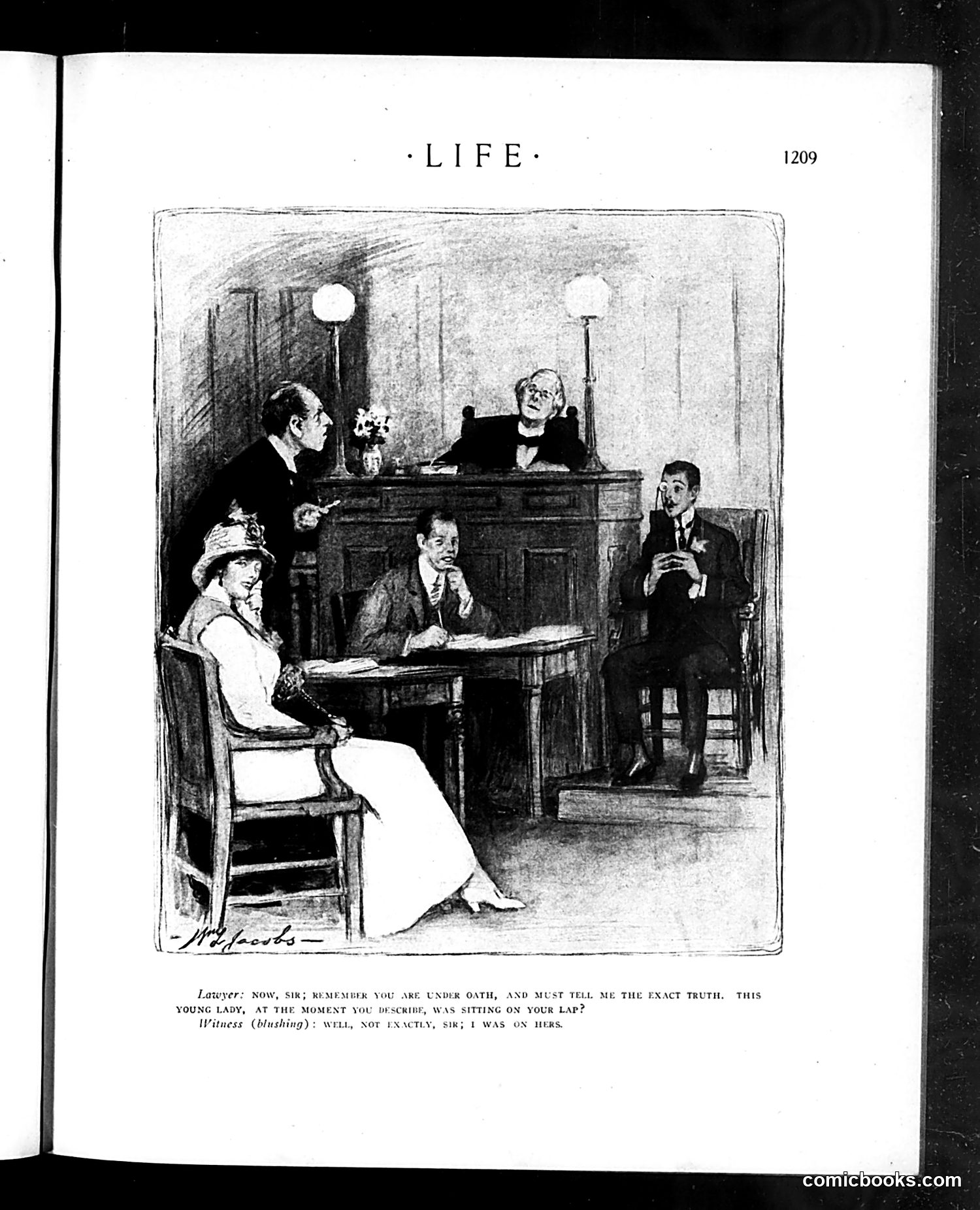
This cartoon depicts a legal proceeding where a lawyer cross-examines a female witness. The lawyer demands she swear under oath to tell the truth, then asks about a specific moment when "this young lady, at the moment you describe, was sitting on your lap." The witness, blushing, responds: "Well, not exactly, sir; I was on hers." The joke satirizes courtroom testimony and social propriety. It plays on the awkwardness of discussing physical intimacy under oath in a formal setting, while poking fun at the witness's attempt to obscure or reframe compromising details. The humor relies on early 20th-century sensibilities about what constituted scandalous behavior and the discomfort such matters caused in official proceedings.
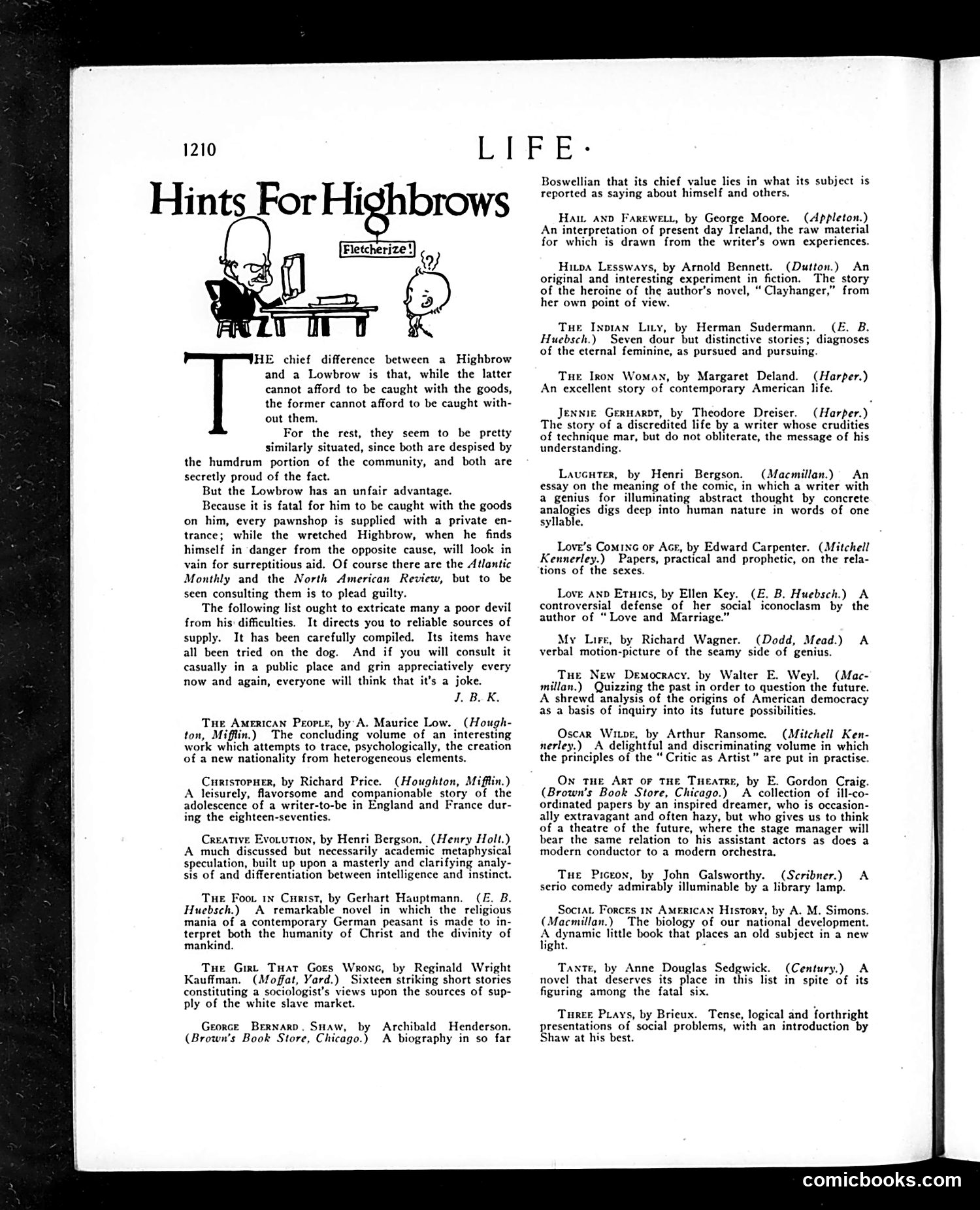
This page is a book review section, not a political cartoon. The small illustration at top shows two figures labeled "Fletcherize" — a man and woman at a dining table, demonstrating a contemporary dietary fad. "Fletcherizing" referred to thorough mastication (chewing) of food, promoted by nutritionist Horace Fletcher in the early 1900s. The accompanying essay humorously contrasts "Highbrows" and "Lowbrows," suggesting highbrows cannot be caught consuming goods publicly (appearing refined), while lowbrows eat unself-consciously. The joke: highbrows must pretend not to eat, creating awkward social performance. The page then lists book reviews of contemporary literature, mostly focusing on social themes and character studies popular in that era.
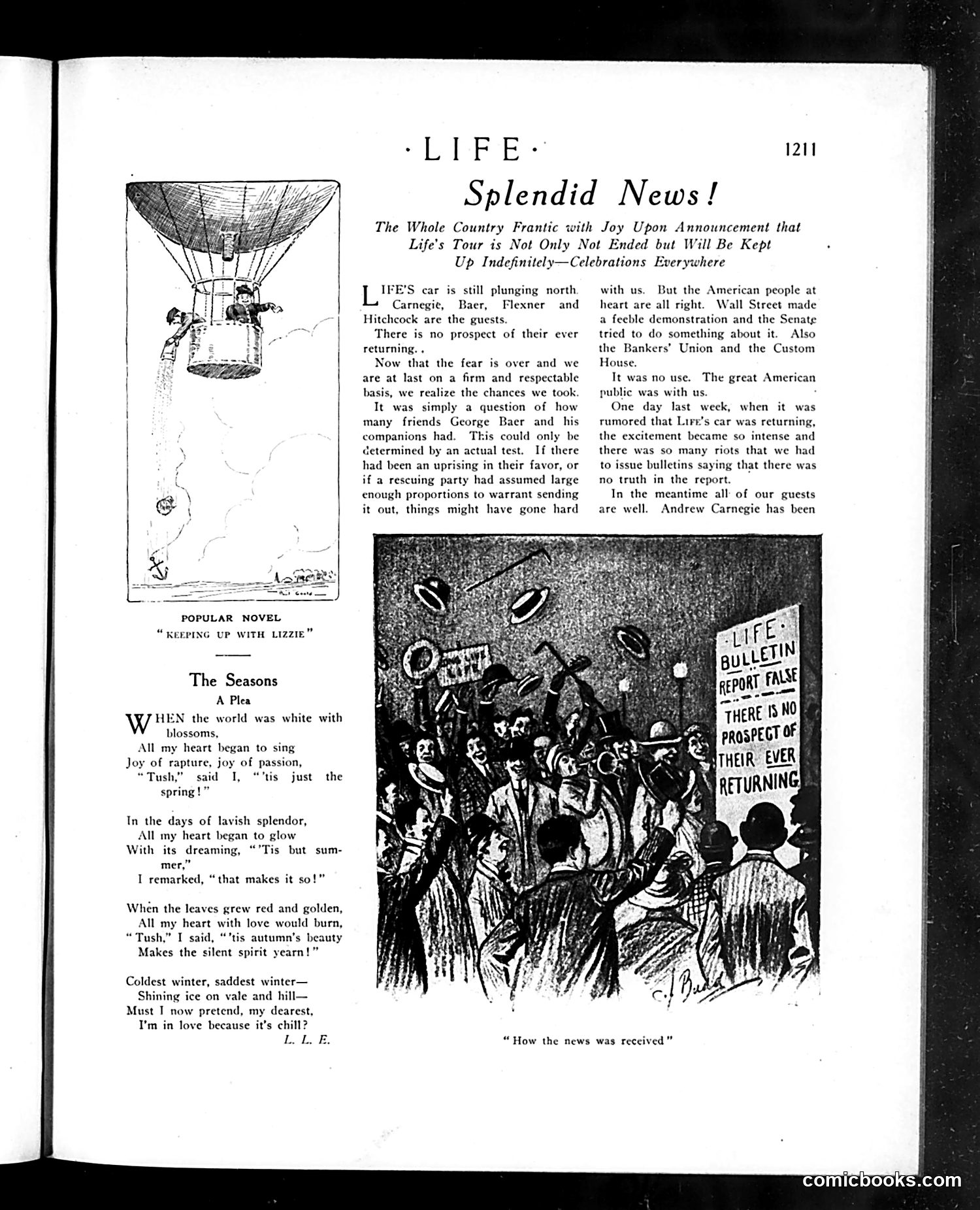
This page satirizes Life magazine's own famous 1909 cross-country automobile tour. The main article announces the tour will continue "indefinitely," celebrating public support for the journey while mocking both elite anxieties and populist reactions. The article names real figures—Andrew Carnegie, George Baer (coal magnate), and others—as tour guests. The satire targets: (1) wealthy industrialists' fear of public backlash (suggesting a "rescuing party" might be needed), (2) Wall Street and Senate attempts to stop the tour, and (3) the ironic contrast between rumors of the car's return causing "riots" and the public's actual apathy. The accompanying cartoon shows crowds celebrating the news with a bulletin reading "Life Bulletin—Report False—There is No Prospect of Their Ever Returning," capturing the satirical point: the public didn't actually care much about the tour's continuation, contradicting the article's claim of mass enthusiasm.
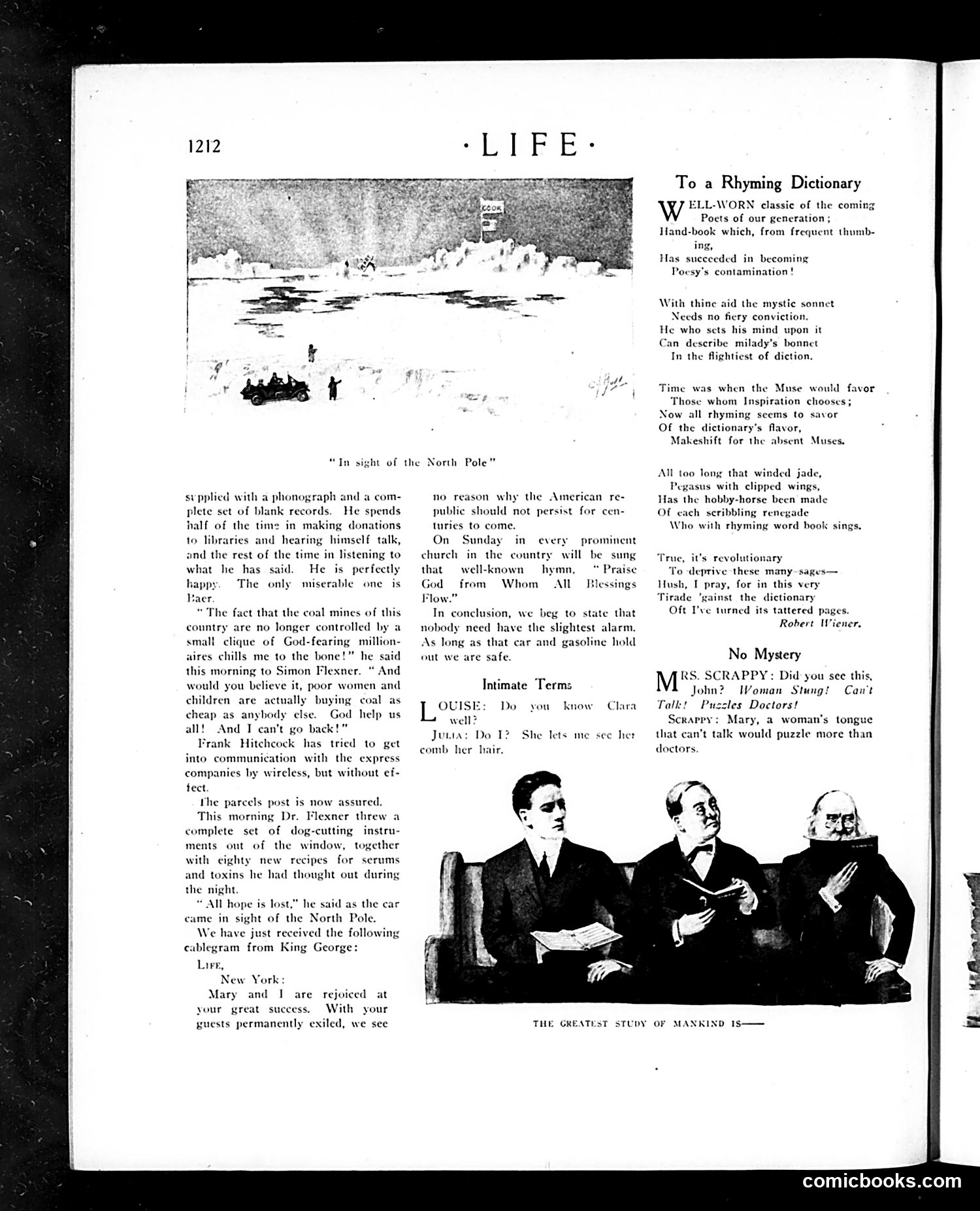
This page contains satirical pieces mocking early 20th-century American society and pretension. **Top narrative** ("In sight of the North Pole"): Satirizes a wealthy, self-absorbed millionaire who enjoys hearing phonograph recordings of his own voice while donating to libraries for vanity. The piece mocks his complaint that coal is now affordable to working-class women and children—treating economic democratization as a personal tragedy. The references to Frank Hitchcock's wireless experiments and Dr. Flexner's dog-cutting instruments suggest absurdist humor about scientific/business incompetence. **"To a Rhyming Dictionary"** (right column): A poem by Robert Wiener attacking modern poets' lazy reliance on rhyming dictionaries rather than genuine inspiration. It laments that contemporary versifiers use mechanical aids instead of the Muse's grace—a complaint about declining poetic standards. **"No Mystery"** (bottom right): A brief joke where "Scrappy" mentions a woman "stung" who can't talk. Scrappy's response that a non-talking woman would confound doctors more than any medical mystery plays on the period's sexist trope of women's excessive talking.
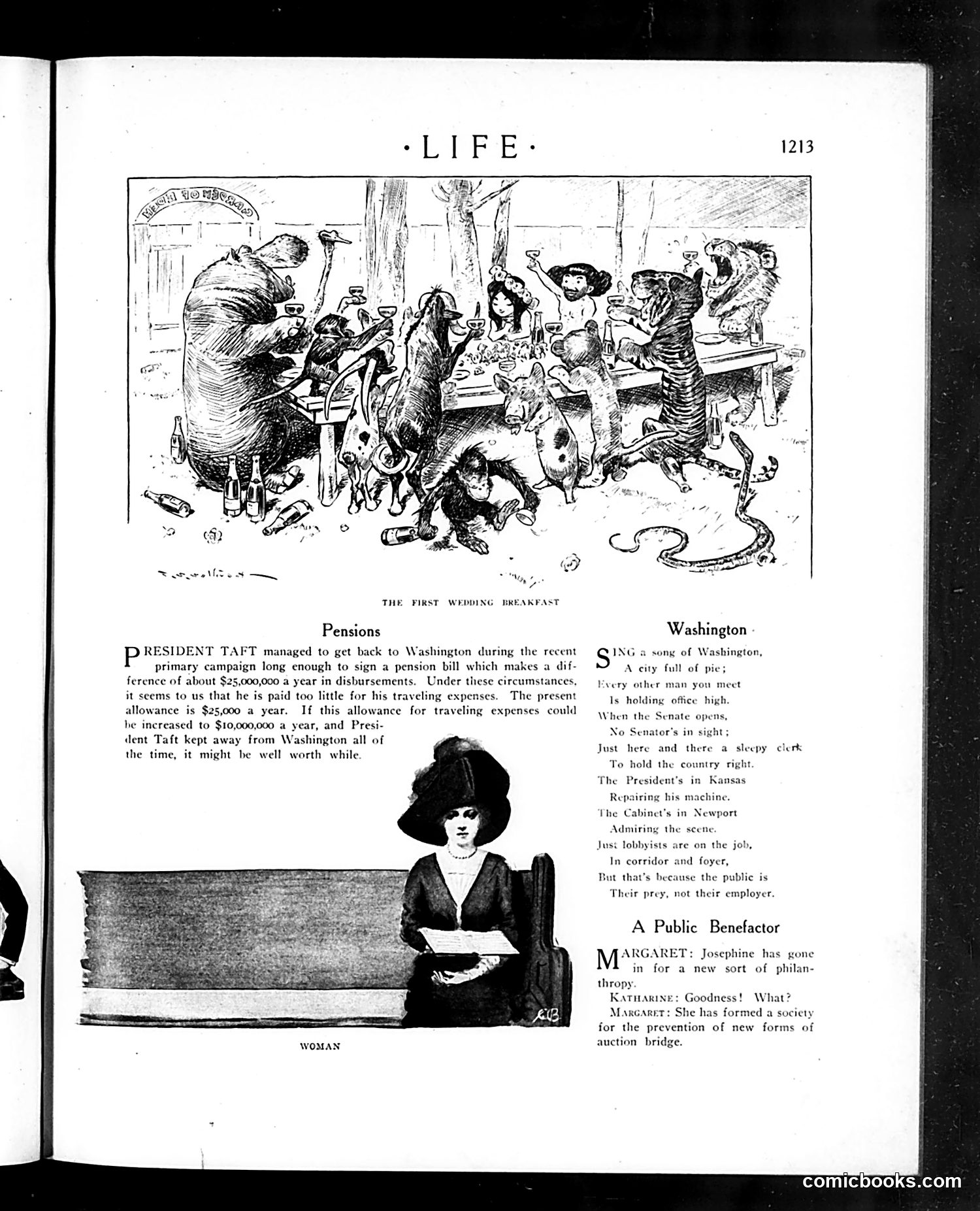
**Top Cartoon - "The First Wedding Breakfast"**: A chaotic scene depicting animals (appears to include bears, tigers, and snakes) at a wild party or celebration, likely satirizing a social event or political gathering through absurdist humor. **"Pensions" Section**: Satirizes President Taft's absence from Washington. The joke: Taft signed a $25 million pension bill while briefly visiting from campaign travel. The satire proposes paying him $10 million yearly to *stay away* from Washington entirely—implying his presence costs more in wasteful spending than his absence would save. **"Washington" Poem**: Mocks Washington politics as corrupt and ineffectual—senators absent, the president traveling, the cabinet vacationing in Newport, while only lobbyists (serving private interests, not public) actually work. **"A Public Benefactor" Dialogue**: Light satire on society women's philanthropic trends. Josephine forms an organization against new forms of auction bridge—a card game—suggesting frivolous "charity" among the wealthy. Overall: Political and social satire targeting government inefficiency, corruption, and upper-class pretension.
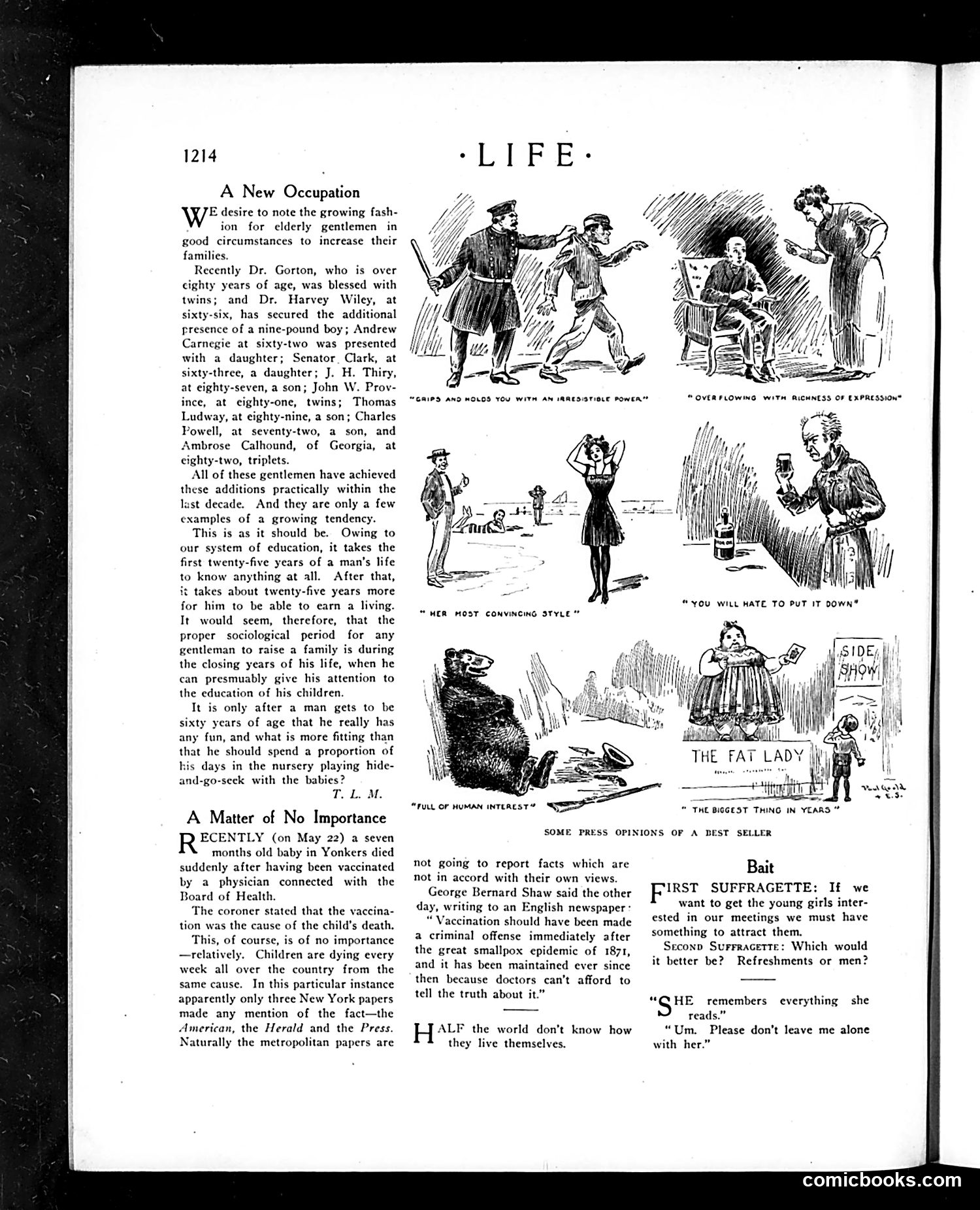
**"A New Occupation"** sarcastically celebrates wealthy elderly men fathering children late in life—Andrew Carnegie, Senator Clark, Dr. Harvey Wiley, and others in their 60s-80s. The satire mocks the illogic: men spend their first 50 years becoming educated and financially secure, then finally have leisure to enjoy life—precisely when they should be raising infants. The accompanying sketches show elderly gentlemen awkwardly managing young children, emphasizing the absurdity. **"A Matter of No Importance"** criticizes press suppression of a vaccination death in Yonkers (1909), noting major newspapers ignored the story because it contradicted pro-vaccination positions. It invokes George Bernard Shaw's call to criminalize vaccination, suggesting institutional pressure silences inconvenient medical facts—a commentary on journalistic bias and corporate influence over health reporting. Both pieces exemplify *Life*'s satirical tradition of exposing social contradictions and institutional dishonesty through irony and dark humor.
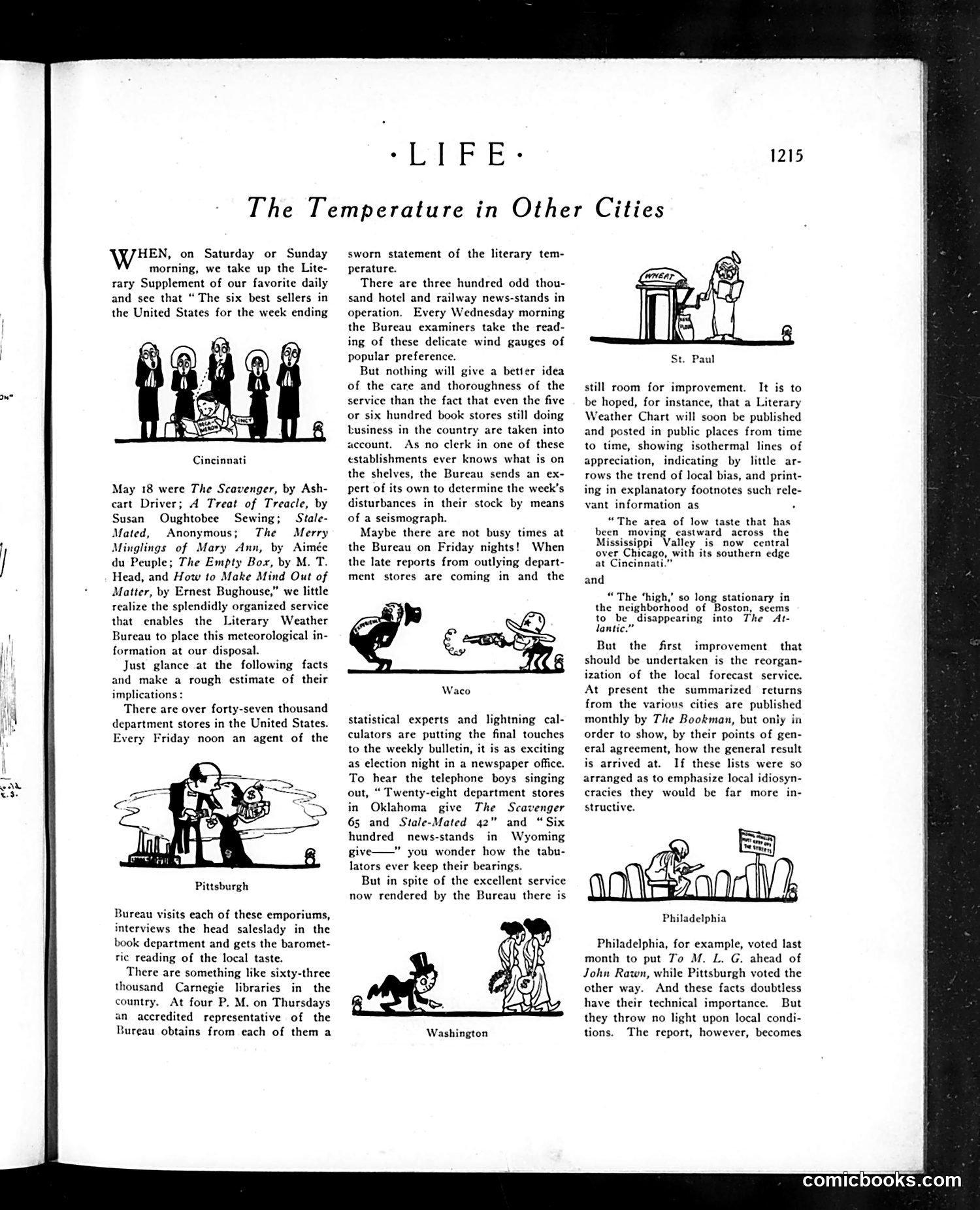
This satirical piece mocks the "Literary Weather Bureau"—a fictional organization that tracks weekly bestseller lists as if they were meteorological data. The joke: Life treats book sales with absurd scientific precision, deploying agents to 47,000+ department stores, libraries, and newsstands weekly to measure "literary temperature." The cartoons accompanying the text show cities (Cincinnati, Pittsburgh, Waco, Washington, Philadelphia, St. Paul) personified as locations receiving these weather forecasts, complete with illustrated characters. The satire targets the era's obsession with quantifying culture and publishing trends. By weaponizing scientific methodology against something inherently subjective—taste—Life ridicules both the publishing industry's marketing apparatus and readers' tendency to follow bestseller lists uncritically. The piece also gently mocks regional literary preferences, noting Philadelphia and Pittsburgh's diverging votes on book rankings, suggesting local "bias" in reading habits.
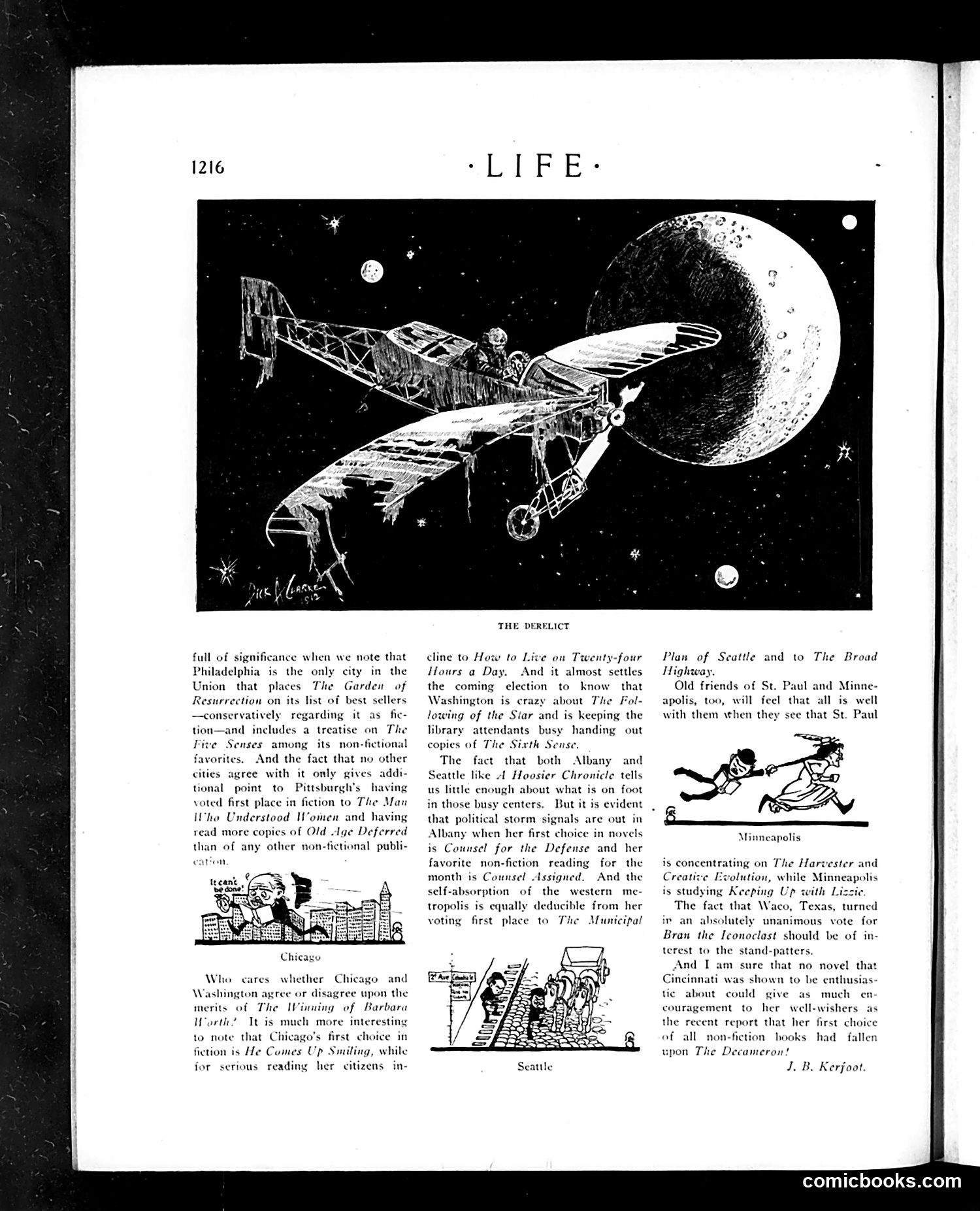
This page analyzes American cities' reading preferences to satirize their character and concerns. The main illustration depicts a derelict airplane near the moon—likely commenting on impractical aspirations versus reality. The text humorously uses book selections as windows into each city's priorities: Philadelphia's choice of religious/philosophical works; Chicago's preference for lighthearted fiction; Washington's focus on self-improvement guides; Albany's legal-themed selections (suggesting political intrigue); and Seattle's civic-minded reading. The satire's point: reading habits reveal a city's obsessions, anxieties, and pretensions. Cincinnati's enthusiasm for *The Decameron* (a ribald medieval text) draws particular mockery. By treating book circulation statistics as meaningful social data, the author gently ridicules American cities' self-seriousness while noting genuine differences in their intellectual cultures during the 1920s.
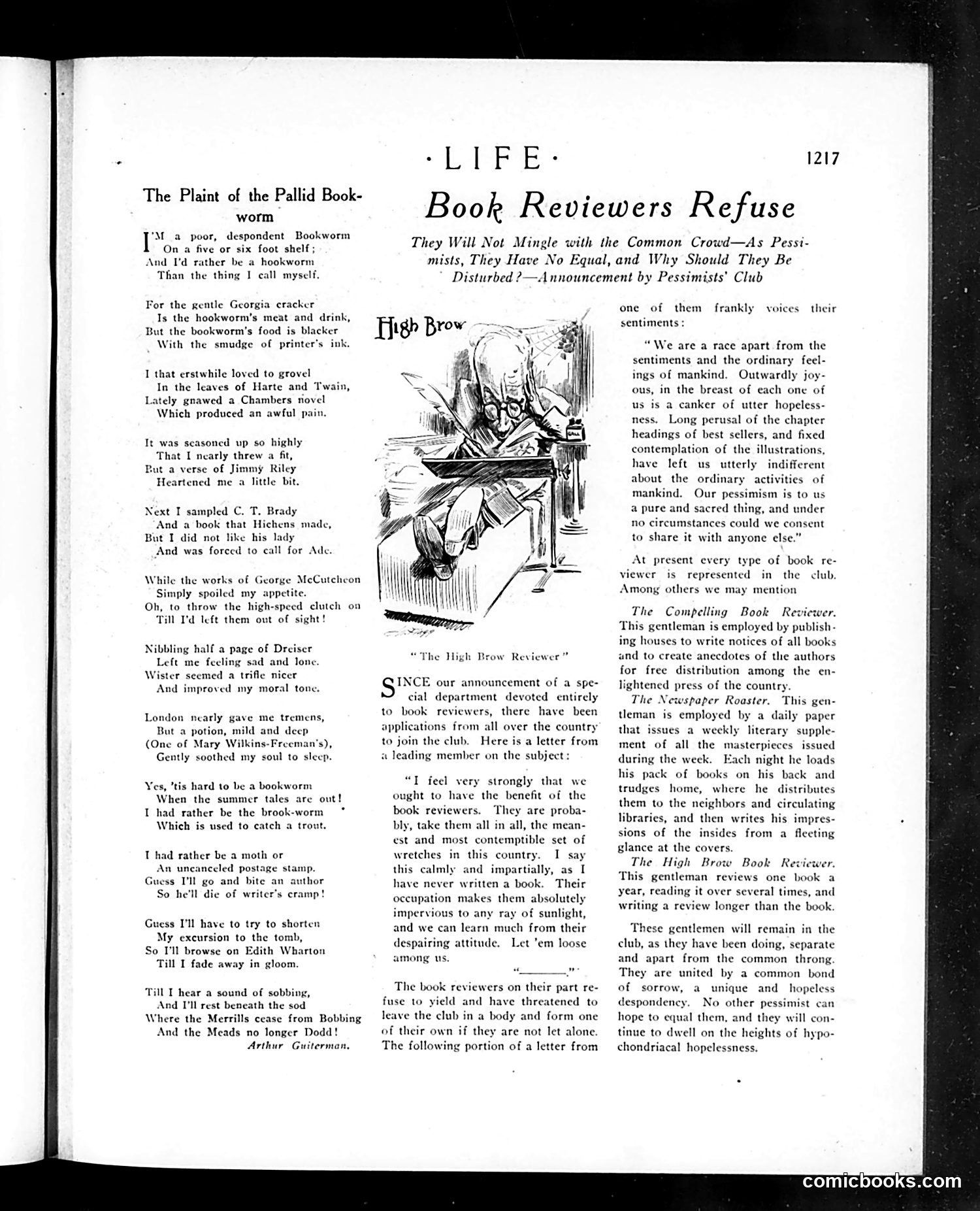
This page satirizes professional book reviewers as an elite, self-important, and perpetually miserable class. The main cartoon depicts "The High Brow Reviewer"—a thin, hunched figure absorbed in reading, representing the stereotype of the pretentious literary critic. The accompanying article mocks reviewers' refusal to socialize with ordinary people, claiming they constitute "a race apart" bound by shared pessimism and hopelessness. It catalogs different reviewer types: those hired by publishers to manufacture praise and anecdotes, and newspaper reviewers who treat literature with grim solemnity. The adjacent poem "The Plaint of the Pallid Bookworm" humorously lists contemporary authors (George McCutcheon, Theodore Dreiser, Owen Wister, Jack London, Edith Wharton, etc.), suggesting modern popular fiction is so poorly written it causes physical distress—a complementary jab at both reviewers' disdain for commercial literature and authors' perceived mediocrity. The satire targets early 20th-century literary snobbery and critics' affected superiority.
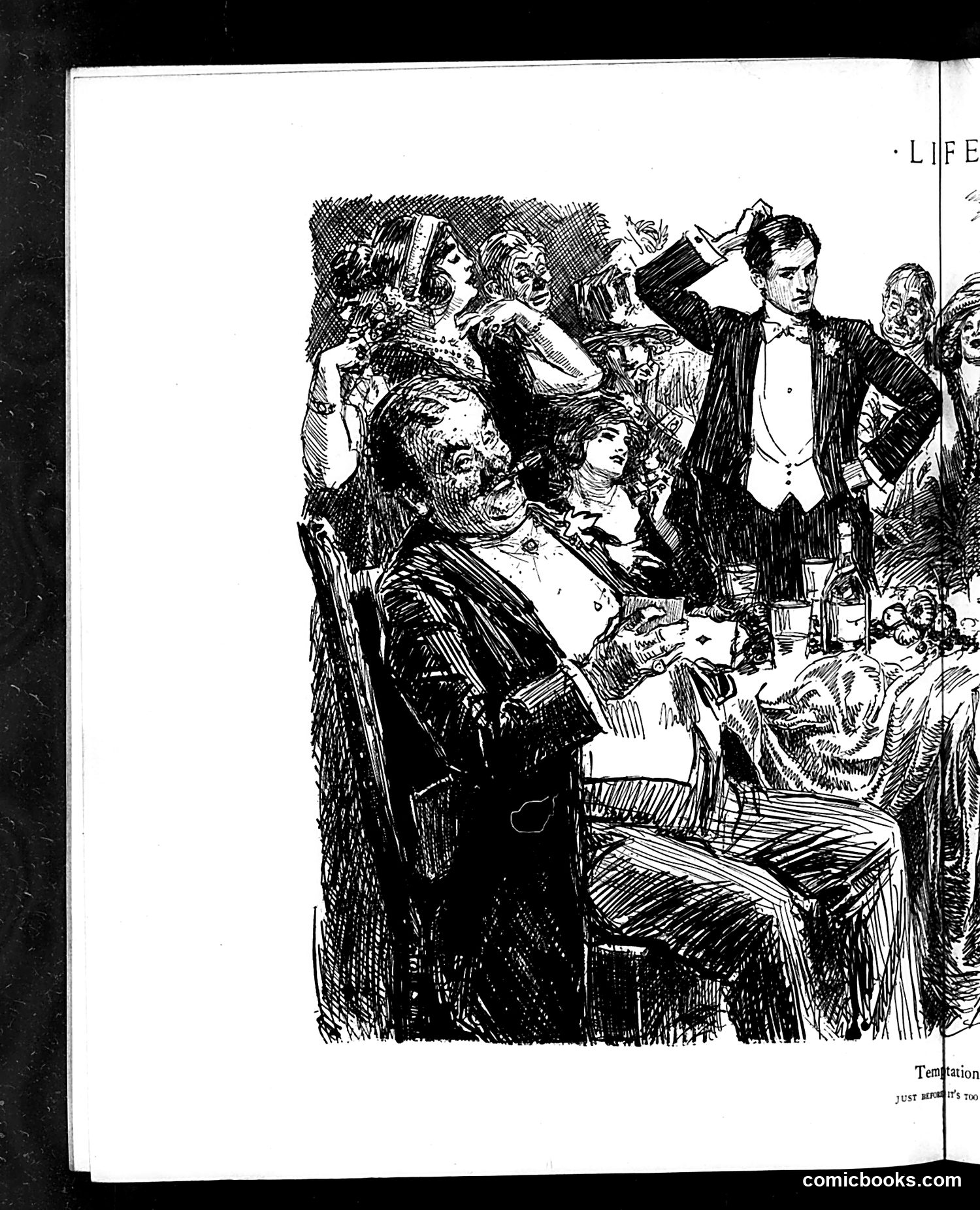
This illustration depicts an elegant social gathering—likely from the early 20th century based on the clothing and styling. The central figure is a well-dressed woman in formal attire, positioned prominently among well-heeled guests at what appears to be a high-society event with bottles and glasses visible. The title "Temptation" suggests satirical commentary on moral weakness or social vice among the wealthy classes. The detailed cross-hatching and dramatic positioning emphasize the woman as a focal point of attention, possibly critiquing either feminine allure, social climbing, or the indulgences of the upper class. The specific identities of figures remain unclear without additional context, though the composition clearly mocks aristocratic pretension and the temptations of high society.
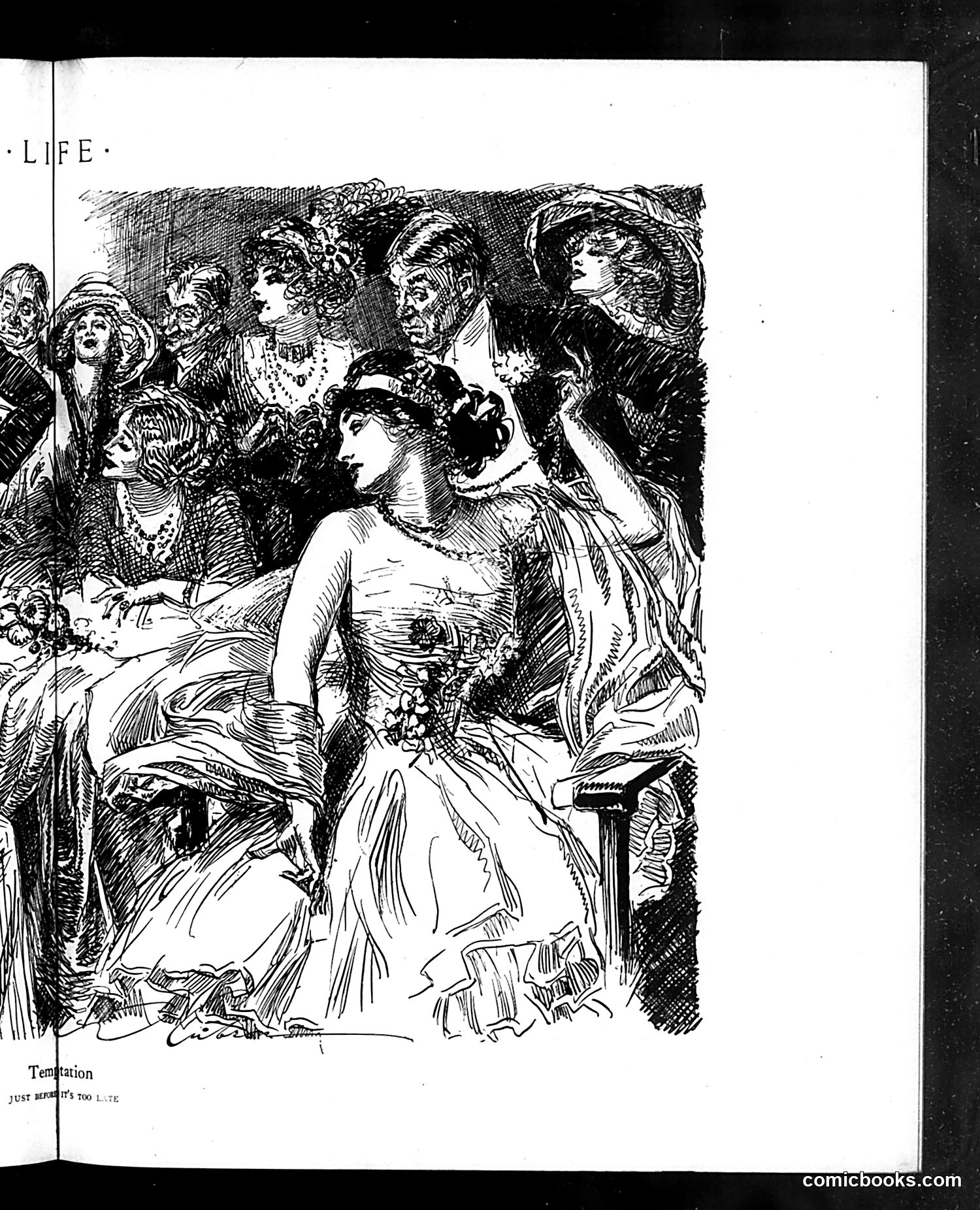
This page is titled "LIFE" with a cartoon labeled "Temptation" (subtitle reads "JUST RESIST IT'S TOO LATE"). The sketch depicts a well-dressed woman in an elegant gown seated among what appears to be society figures at a formal gathering. The composition and title suggest social satire about temptation in high society—likely commentary on the moral hazards of wealth, leisure, or romantic entanglement among the upper classes. The artistic style and subject matter are typical of Life magazine's early satirical content mocking aristocratic social conventions. However, without additional context or clearer text, the specific social or political target remains unclear.
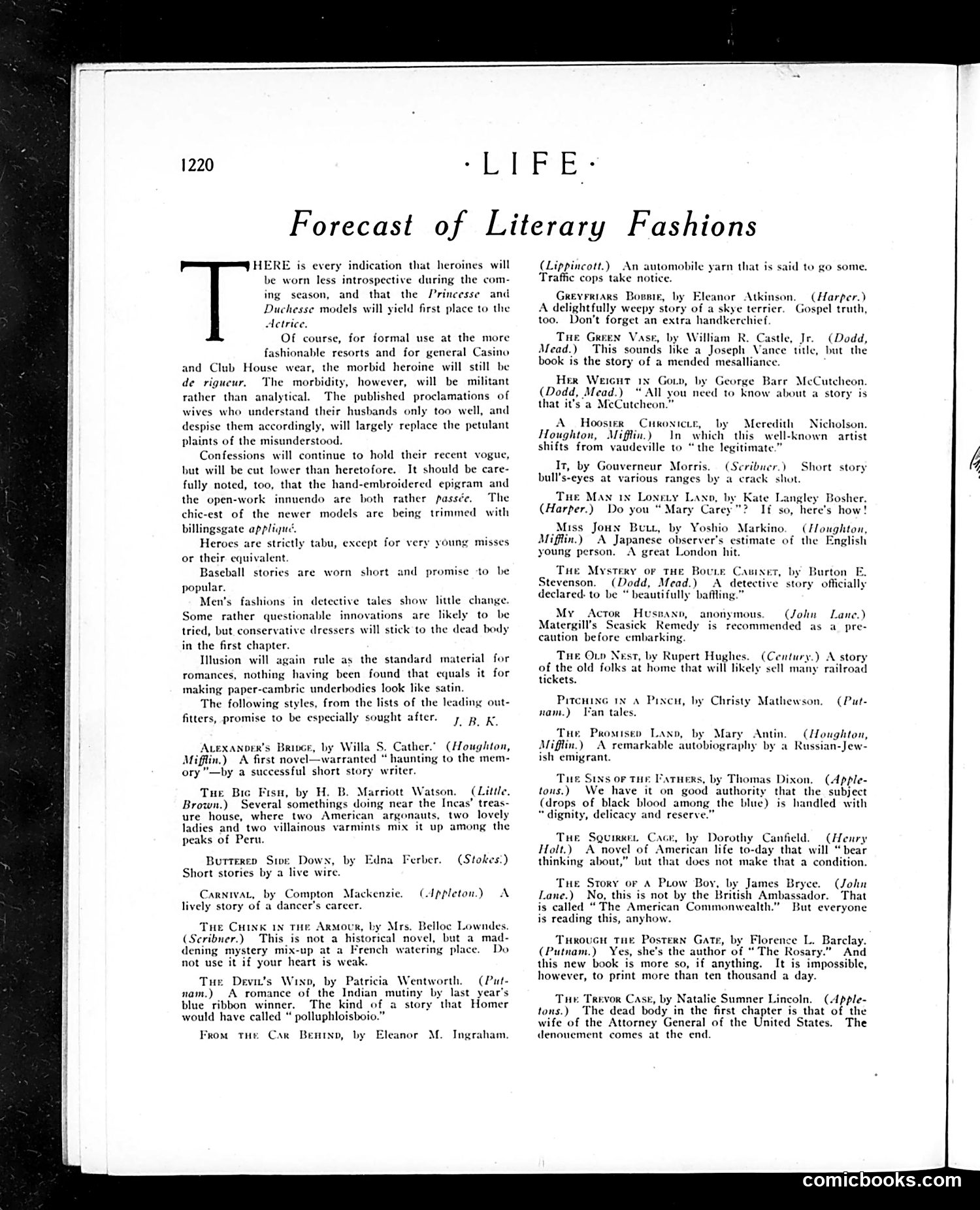
This satirical piece treats upcoming literary trends as if they were fashion collections—using clothing terminology ("models," "trimmed," "worn") for fictional genres and character types. The author predicts that introspective heroines ("Princesse and Duchesse models") will be replaced by more active ones ("Actrice"), and that "morbid" heroines will remain fashionable but become more "militant" rather than passively suffering. The humor lies in the extended metaphor: literary conventions are presented as seasonal clothing styles, complete with warnings that certain tropes are "passé" (hand-embroidered epigrams, open-work innuendo) and that detective stories' standard feature—the dead body in chapter one—remains timeless as satin. The page then reviews current and forthcoming books, maintaining this tongue-in-cheek tone. It's essentially a witty preview of 1912-era popular fiction trends dressed in fashion-industry language.
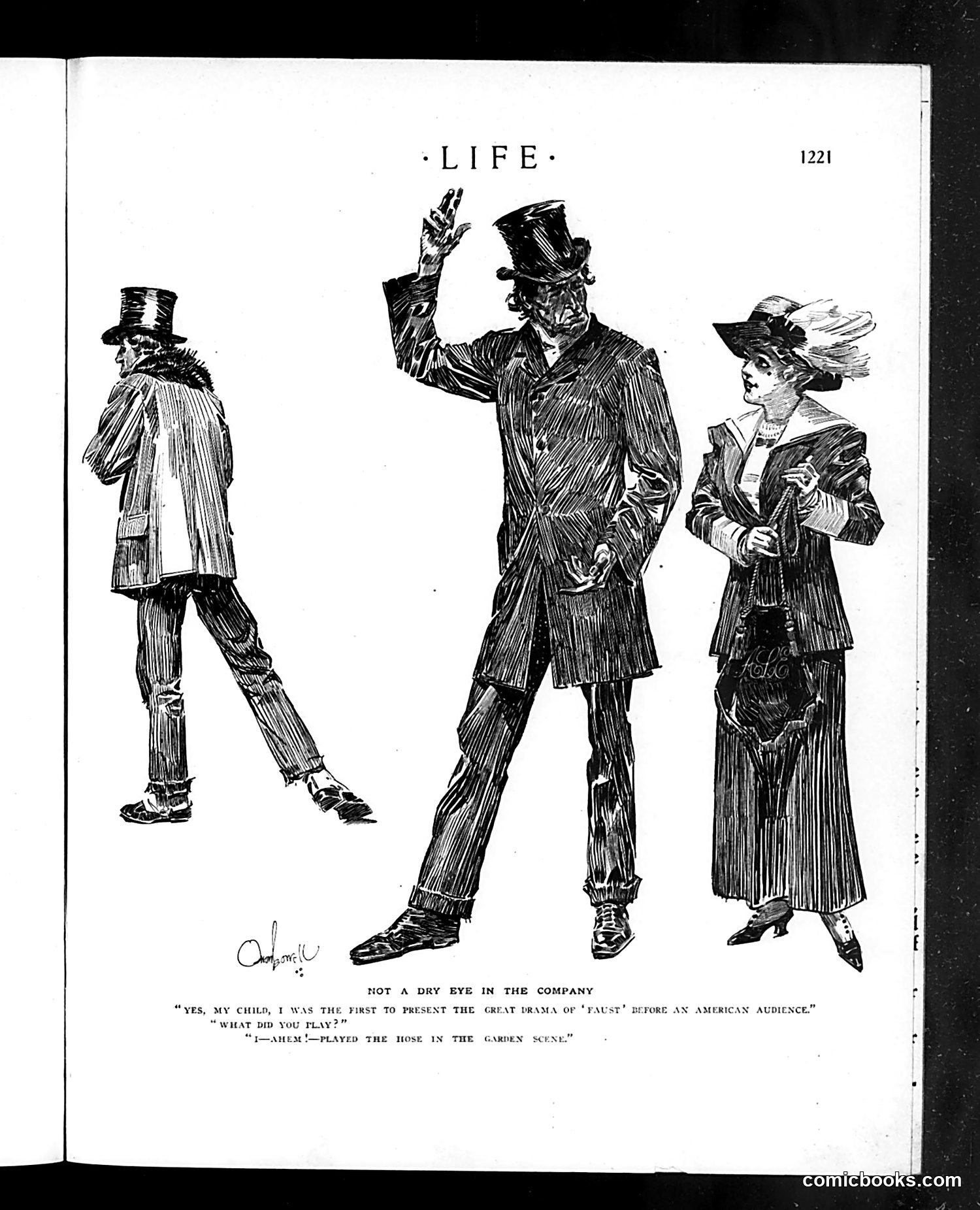
This is a satirical cartoon titled "Not a Dry Eye in the Company" from Life magazine. The image shows three well-dressed figures in early 20th-century attire reacting emotionally to a theatrical performance. The caption indicates someone is boasting about being "the first to present the great drama of 'Faust' before an American audience" and claiming to have "played the hose in the garden scene." The humor lies in the malapropism—the speaker apparently meant "played the *role*" but said "hose," suggesting either pretentious ignorance or comic incompetence about theatrical terminology. The cartoon satirizes self-important theater-goers who exaggerate their cultural significance and theatrical knowledge while inadvertently revealing their lack of sophistication through verbal blunders. The emotional reactions of the three figures suggest they're struggling to maintain composure while hearing this absurd claim.
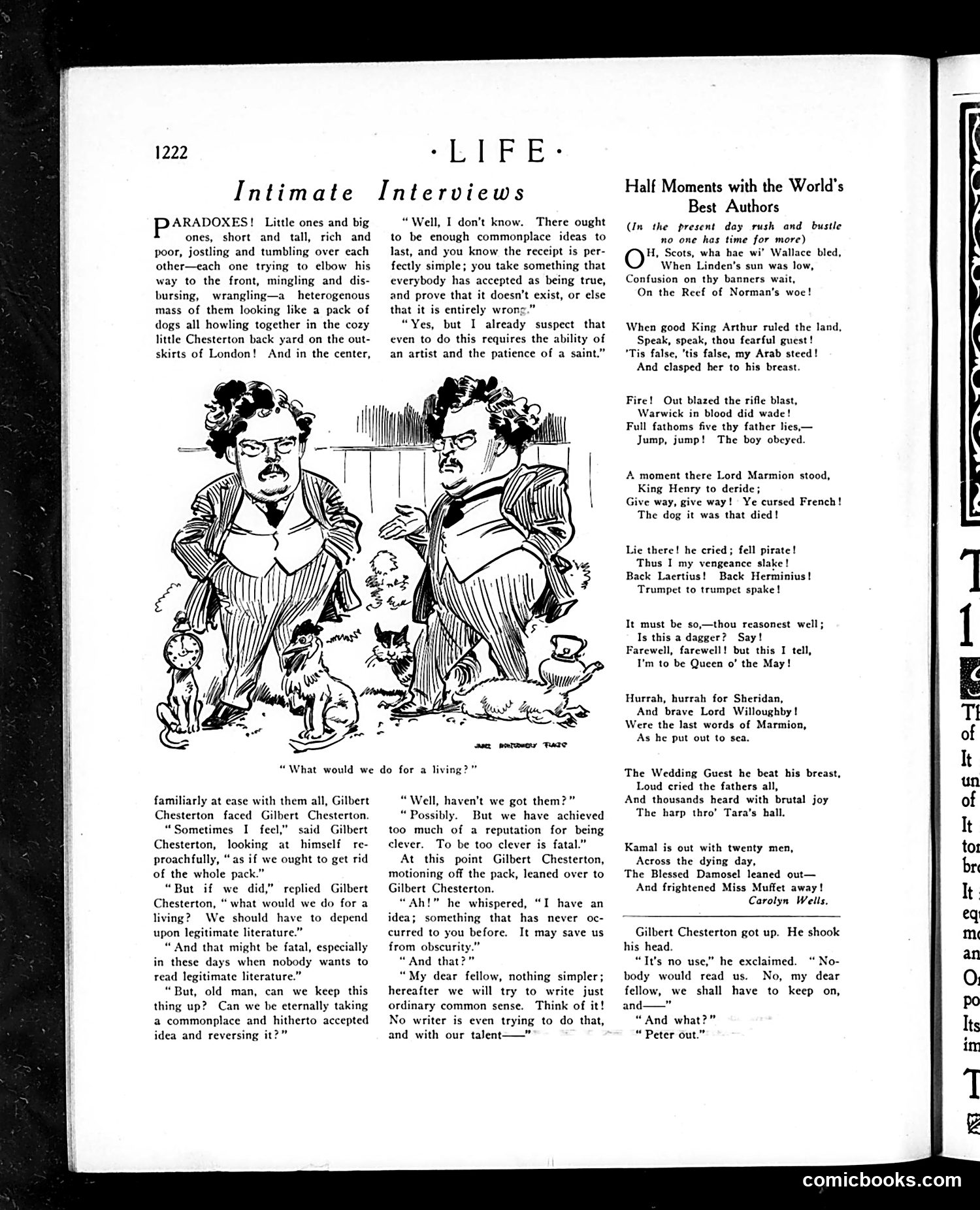
This page features two pieces satirizing **G.K. Chesterton**, the famous British writer and paradox-loving intellectual. **Main Cartoon**: Shows Chesterton in conversation with himself (his double), with chaotic dogs representing "ideas" surrounding them in his London backyard. The joke critiques Chesterton's reputation for clever paradoxes—his literary method of taking accepted truths and "proving" them wrong. His alter ego warns that being "too clever is fatal," and they joke about whether they can sustain this act or must resort to "legitimate literature" and "common sense" instead. **Right Column**: "Half Moments with the World's Best Authors" is a parody mixing famous literary passages (Scott, Tennyson, Shakespeare) in absurd juxtaposition—parodying how literary allusions get scrambled in contemporary writing. The satire targets Chesterton's intellectual celebrity and the worry that constant paradox-spinning might exhaust its appeal, forcing even brilliant writers toward mediocrity.
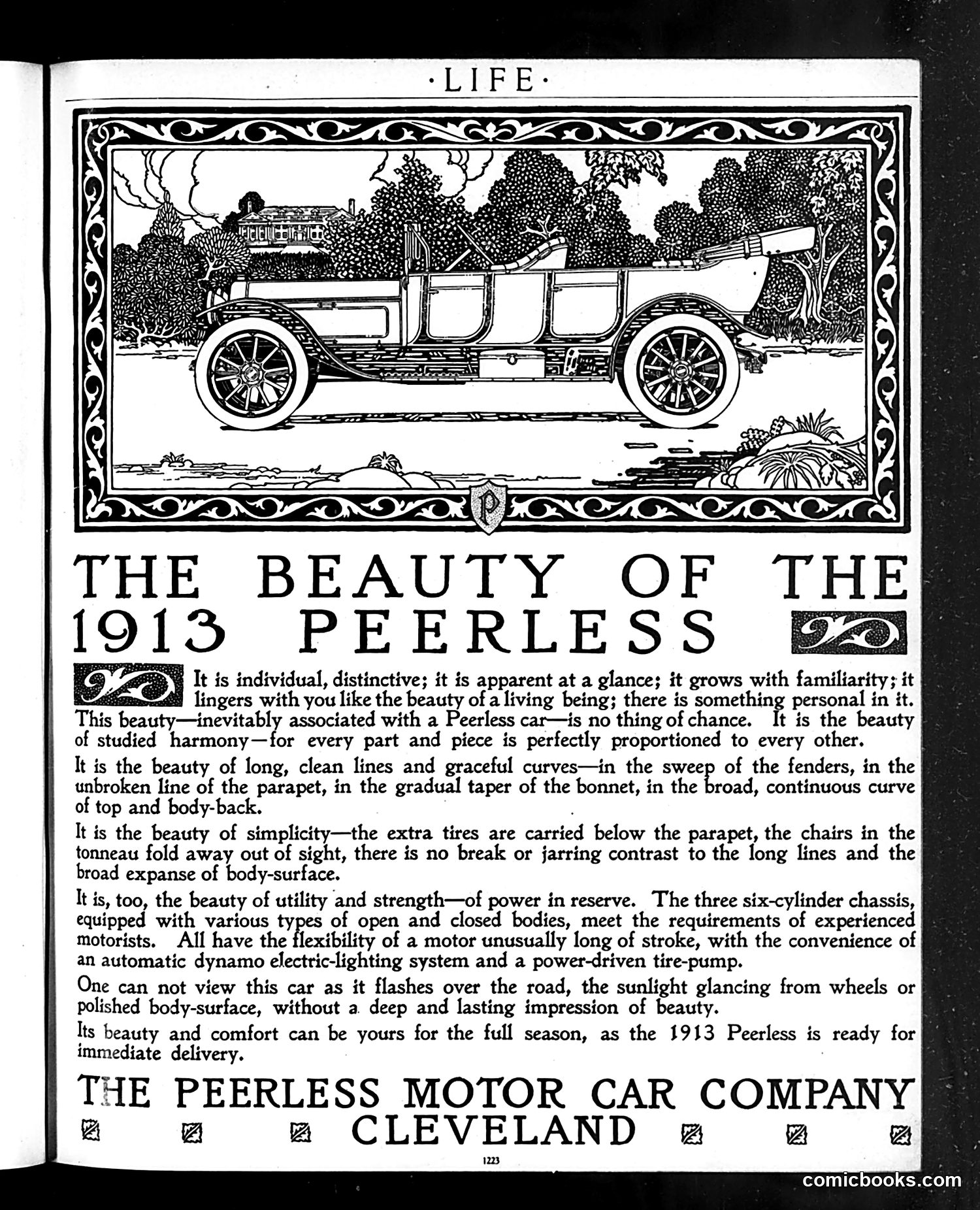
This is **not a cartoon or satire**—it's a straightforward automobile advertisement from Life magazine's 1913 issue. The page features an elegant illustration of a Peerless motor car at the top, with decorative Art Nouveau border framing. The text is a luxury car advertisement emphasizing aesthetic and mechanical qualities: harmonious proportions, clean lines, simplicity (hidden spare tires and folding chairs), and modern conveniences like electric lighting and power-driven tire pumps. The writing employs poetic language comparing the car's beauty to "a living being." Life magazine, though satirical in other content, regularly published advertisements. This represents the aspirational consumer culture of the 1910s, targeting wealthy motorists. The Peerless Motor Car Company of Cleveland was a legitimate manufacturer of high-end automobiles during this era. There is no political commentary or joke visible on this page—it functions purely as period advertising rhetoric.
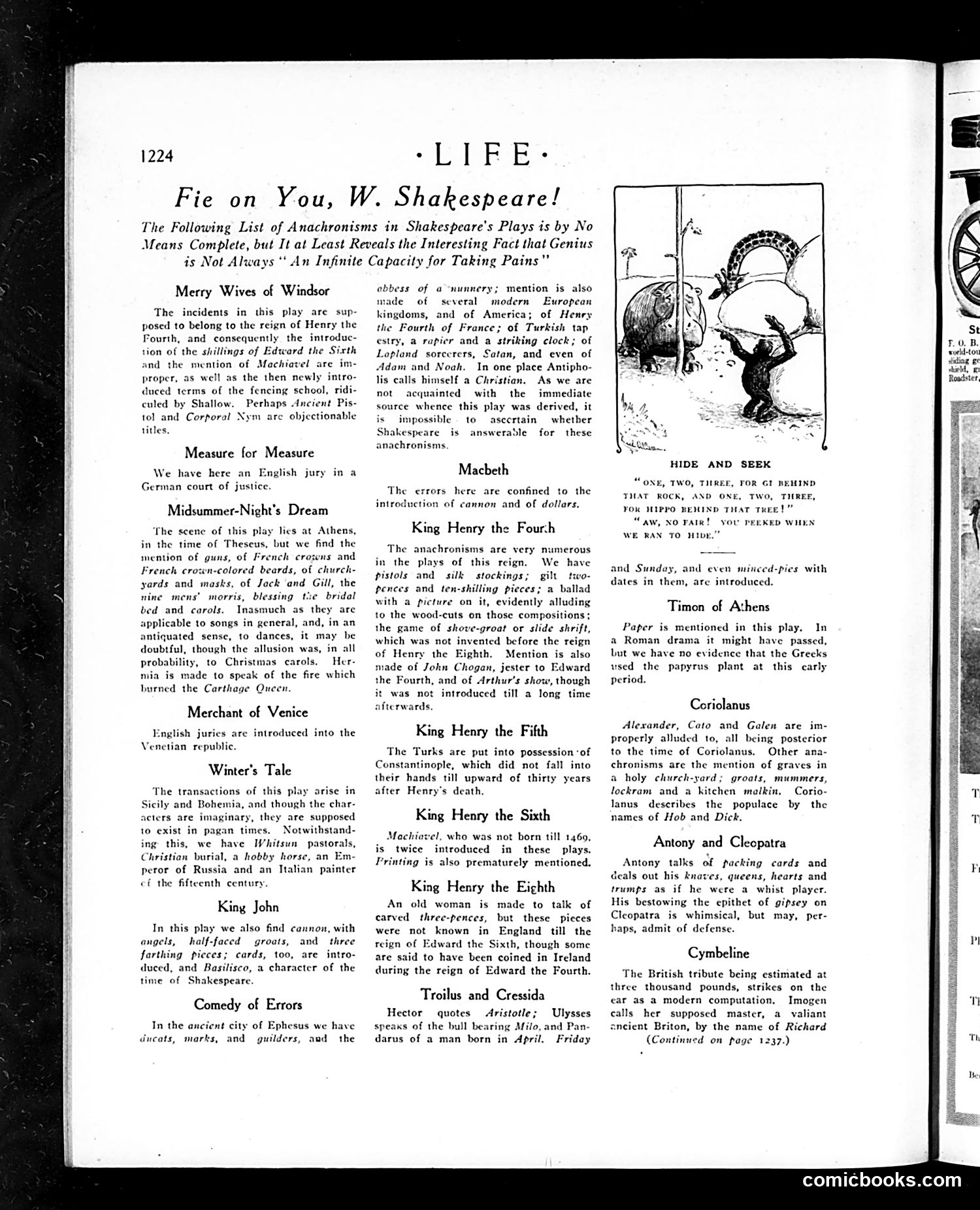
This page satirizes Shakespeare's historical inaccuracies—anachronisms appearing in his plays. The accompanying cartoon (titled "Hide and Seek") shows children playing, likely illustrating how Shakespeare himself was careless with historical details, like a child playing rather than studying. The text catalogs factual errors across multiple plays: *Midsummer-Night's Dream* references guns in ancient Athens; *Winter's Tale* includes Christian elements in pagan times; *King Henry the Fifth* places Turks in Constantinople decades before they actually conquered it; *King Henry the Sixth* mentions Machiavelli before his birth in 1460. The satire's point, stated in the subtitle, is that **genius doesn't guarantee meticulous accuracy**—Shakespeare's literary brilliance didn't require historical precision. For modern readers, this reflects how Renaissance dramatists prioritized dramatic effect over factual authenticity, a practice modern audiences might find surprising given Shakespeare's revered status.
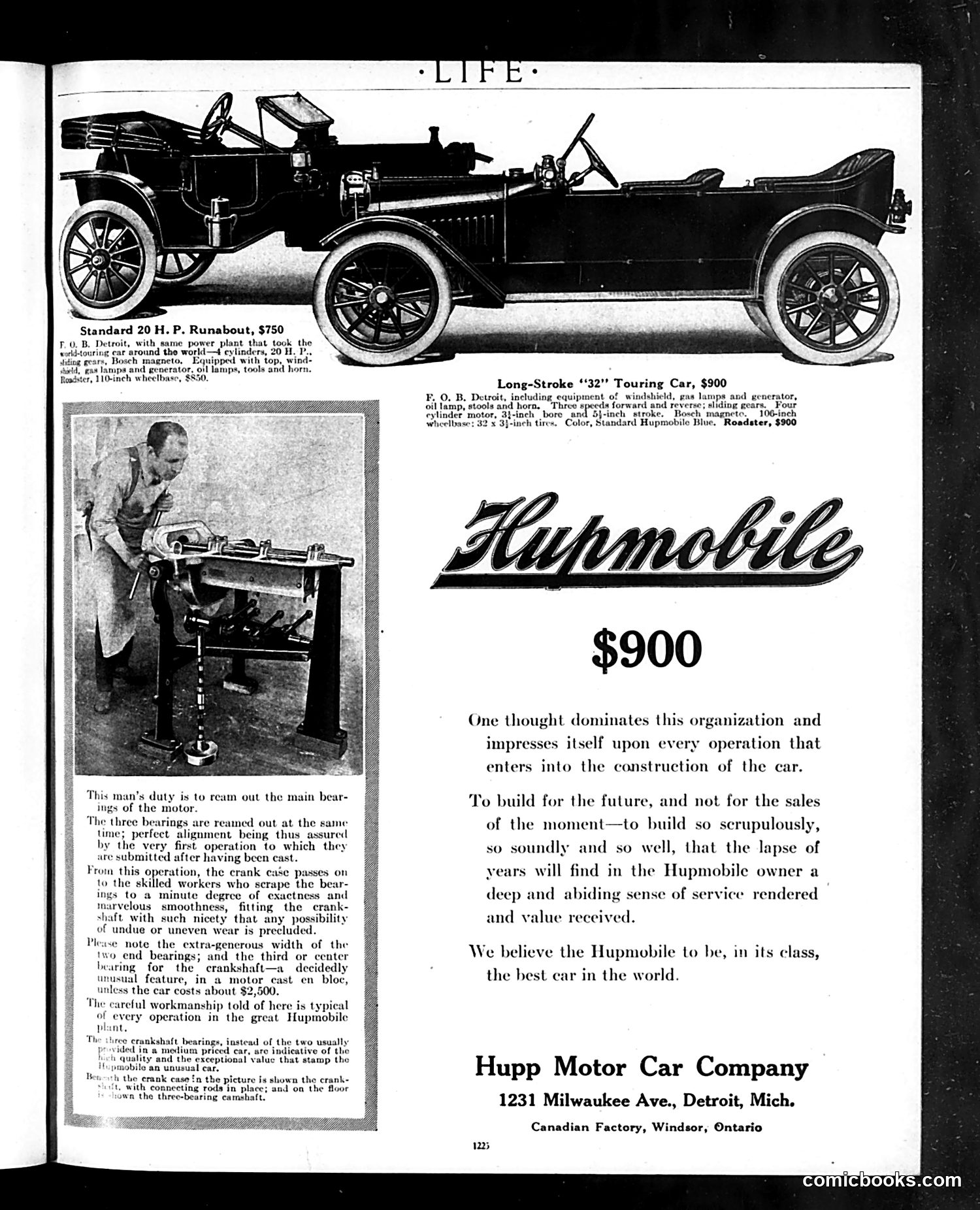
This is primarily an **automobile advertisement** for the Hupmobile car, not a political cartoon. The page showcases two car models ($750 and $900) and emphasizes manufacturing quality through detailed imagery. The centerpiece is a photograph of a factory worker reaming out engine bearings, accompanied by lengthy technical explanation. This demonstrates the company's quality-control philosophy: meticulous craftsmanship that ensures longevity rather than quick sales. The advertising message emphasizes durability and value—"to build for the future, and not for the sales of the moment." By highlighting the three-bearing crankshaft (typically found only in expensive $2,500+ cars), Hupmobile positions itself as offering luxury-level engineering at mid-market prices. This reflects early automotive industry competition, where manufacturers differentiated through claimed superior construction rather than style or performance. The page targets buyers valuing reliability and long-term value over fashion.
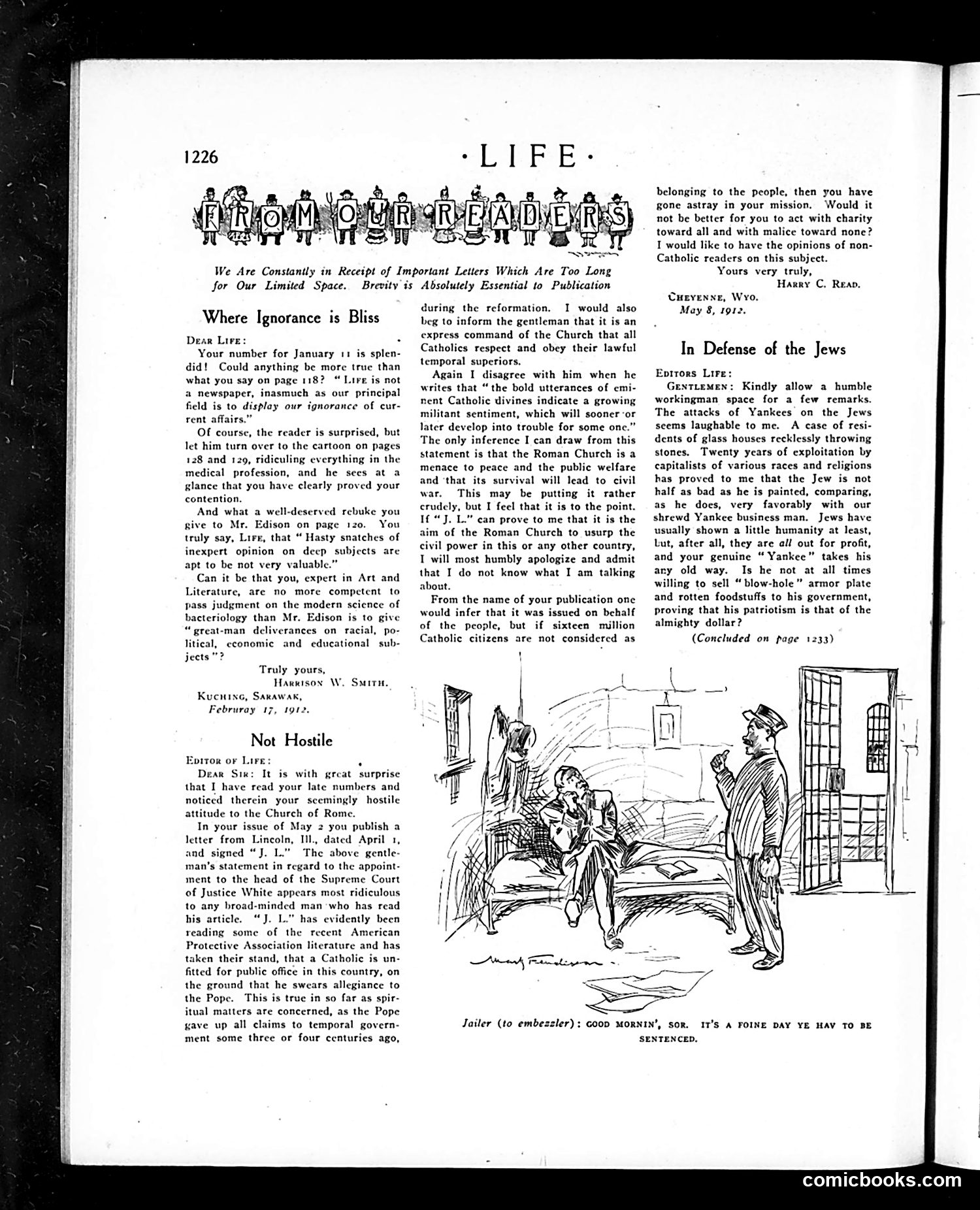
This page contains reader letters debating Life's editorial stance on religion and social issues, plus one cartoon. **The Letters:** Readers critique Life for claiming ignorance while commenting on serious topics like medicine and bacteriology. More significantly, two lengthy letters defend Catholicism and Judaism against what writers perceive as Life's hostile coverage. One defends Catholics' fitness for public office (referencing a Supreme Court appointment controversy), countering the American Protective Association's anti-Catholic sentiment. Another defends Jews against what the writer calls hypocritical "Yankee" attacks. **The Cartoon:** Shows a jailer telling an embezzler facing sentencing: "Good mornin', sir. It's a fine day ye hav to be sentenced." It's a dark humor joke about making light of criminal consequences—the jailer treats a serious moment as pleasant small talk. **Context:** The page reflects 1912 religious and ethnic tensions in America, with immigrant Catholic and Jewish communities defending themselves against nativist prejudice and stereotyping in the press.
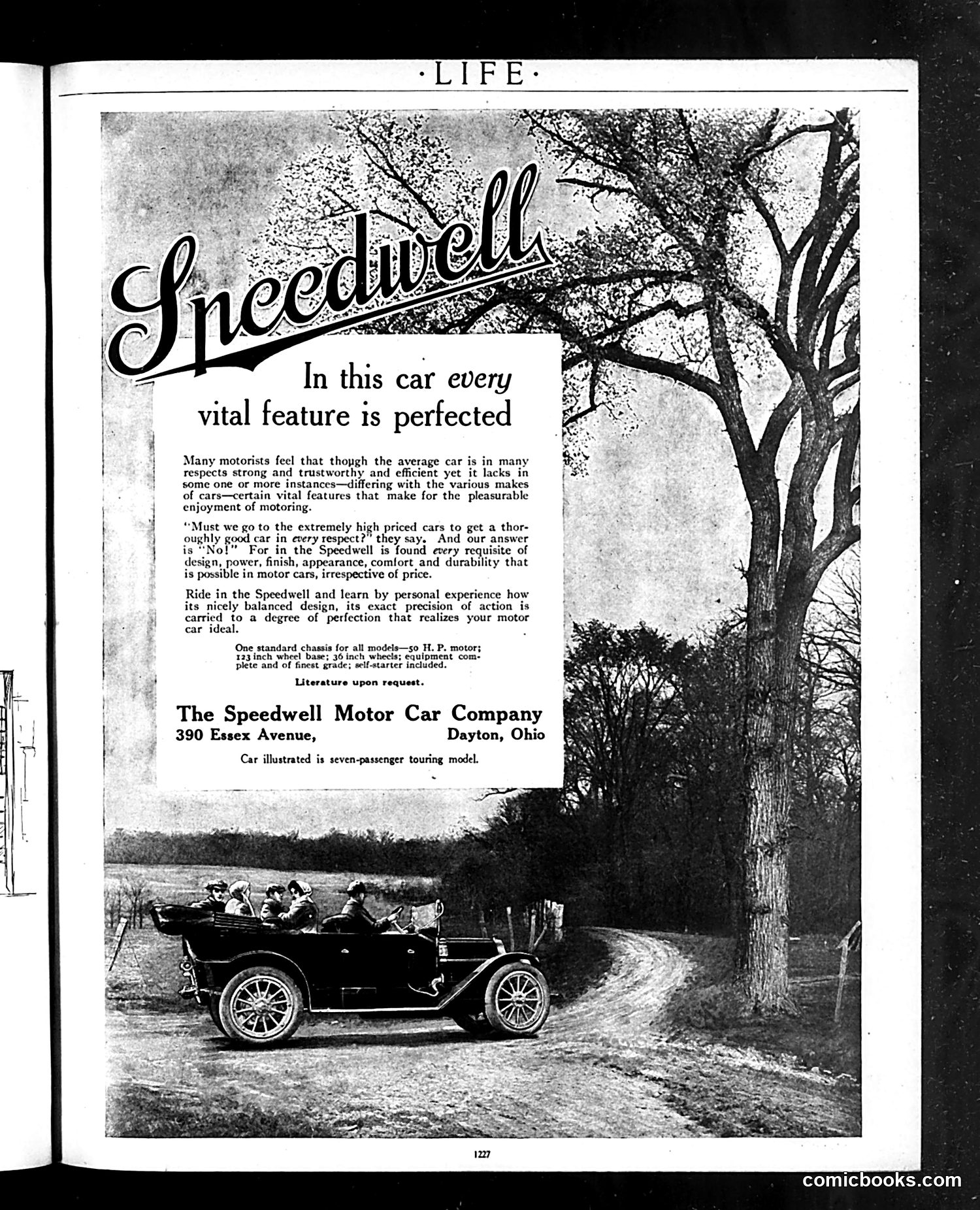
This is a **straightforward automobile advertisement**, not political satire or a cartoon. The Speedwell Motor Car Company is marketing their seven-passenger touring model to early 20th-century motorists. The ad addresses a common consumer concern: that affordable cars sacrifice quality in some vital feature. Speedwell's pitch claims their car achieves perfection across all requisites—design, power, finish, comfort, durability—regardless of price point, challenging the assumption that only expensive cars are thoroughly good. The accompanying photograph shows the vehicle in use on a rural road with passengers, meant to demonstrate its practical reliability and comfort. The large tree and natural landscape evoke leisure and freedom—standard automobile advertising imagery of the era. There is no satire here. This is period marketing rhetoric typical of competitive early automotive manufacturing, when the industry was still establishing consumer trust and standardizing features like self-starters.
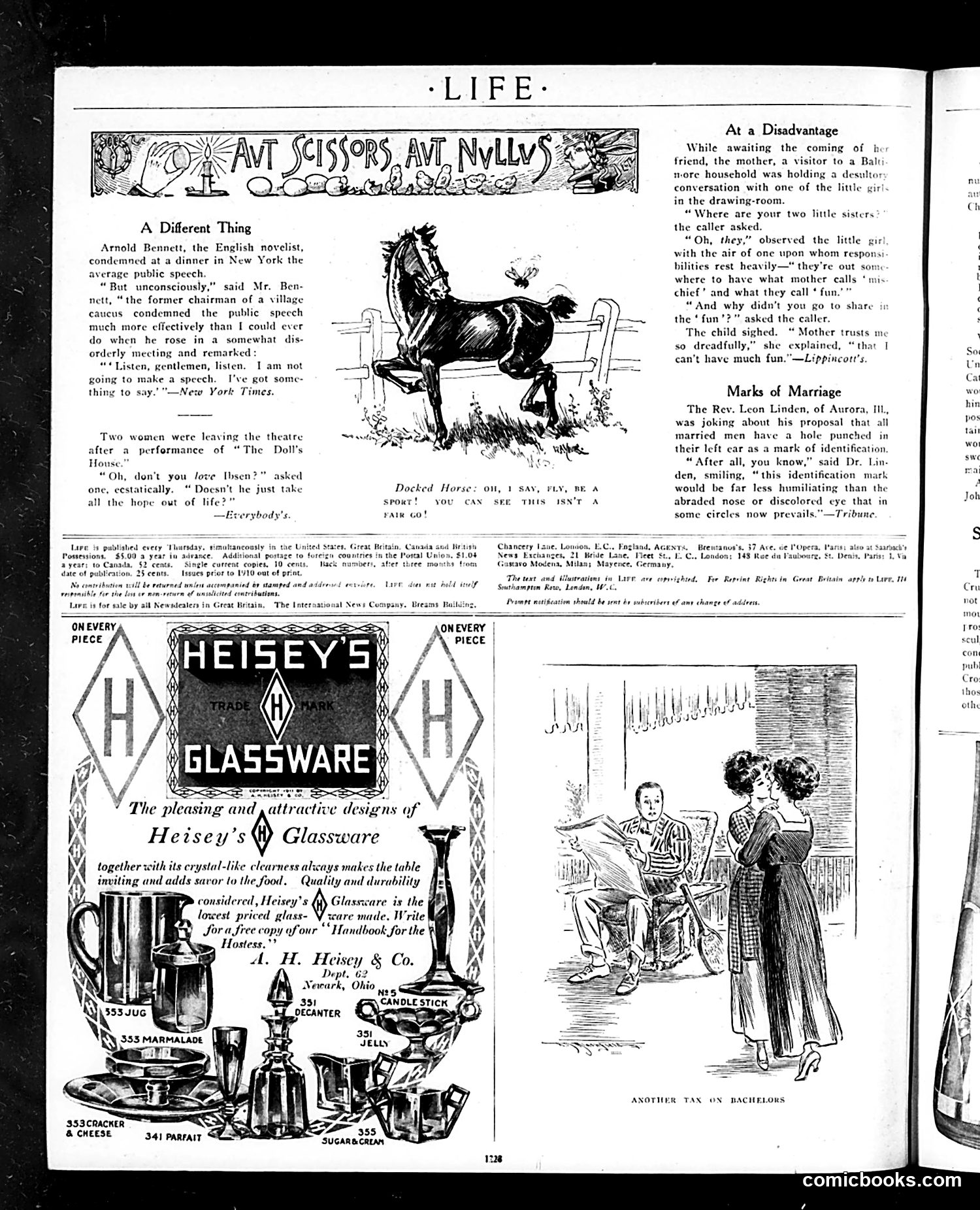
This page contains several brief humorous anecdotes typical of *Life* magazine's satirical content: **"A Different Thing"** quotes English novelist Arnold Bennett mocking public speeches, using a village chairman's rambling remarks as an example of unintentional effectiveness. **"Docked Horse"** is a cartoon caption about a horse that "can see this isn't a racetrack" — a visual joke about the animal's obvious awareness of its non-racing situation. **"At a Disadvantage"** presents a child's paradox: she cannot join her siblings' mischief because her mother trusts her too much, making responsibility itself a punishment. **"Marks of Marriage"** reports on Reverend Linden's tongue-in-cheek proposal to punch holes in married men's ears as identification, comparing it unfavorably to the "abraded nose" of unmarried men (presumably from frequent socializing). The page is primarily **humorous social commentary** on everyday life, speech, parenting, and marriage — typical *Life* content from this era. A Heisey Glassware advertisement occupies the lower left.
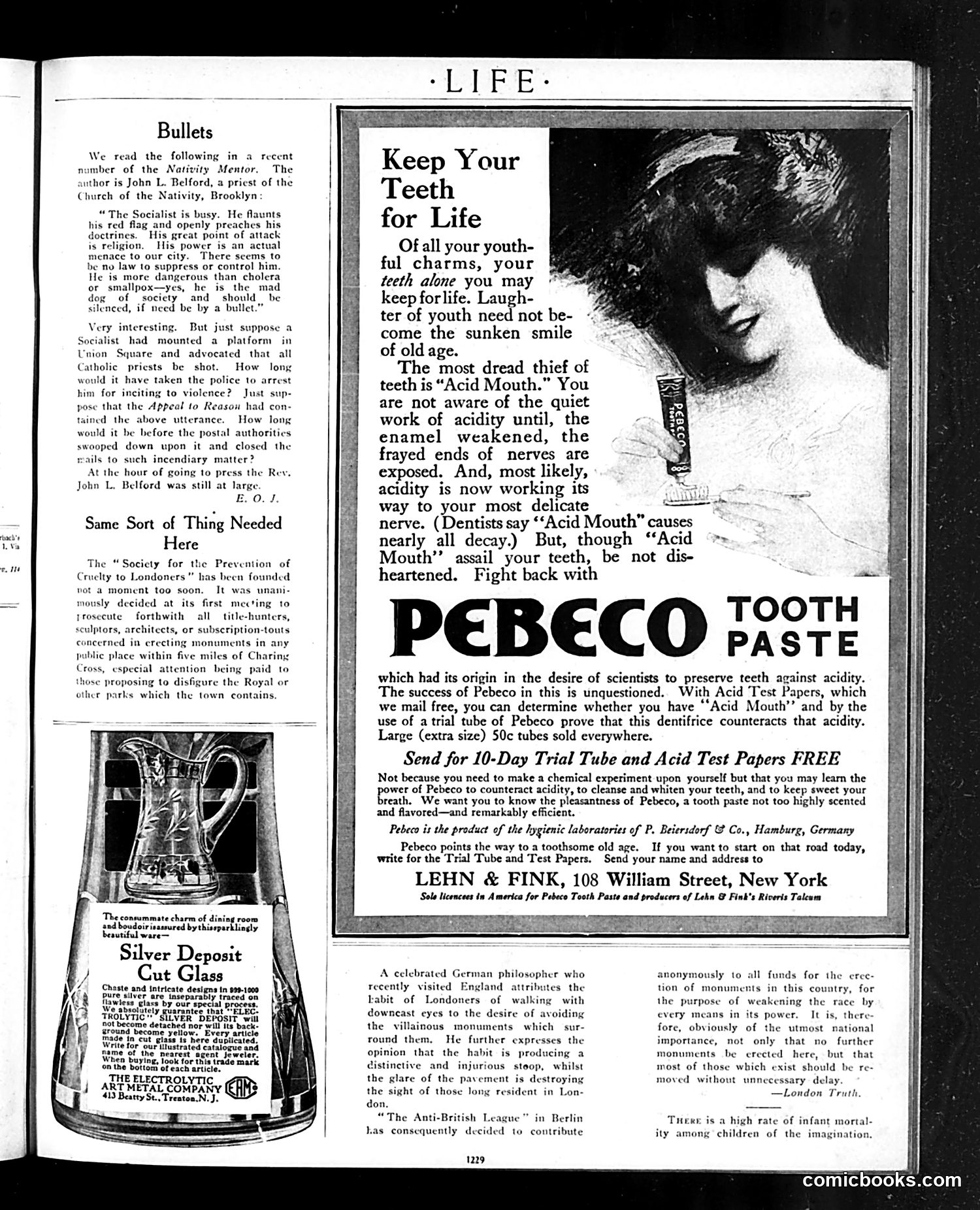
This page contains early 20th-century American satirical commentary on free speech and religious hypocrisy, alongside period advertisements. **"Bullets" section**: Life reprints inflammatory rhetoric from John L. Belford, a Catholic priest in Brooklyn, who called Socialists "mad dogs" requiring silencing "by a bullet." The satire's point: Life highlights the double standard in how authorities treat incitement to violence. If a Socialist had published similar calls to shoot Catholic priests, he'd face immediate arrest. Yet Belford "was still at large," exposing the privileged position of religious figures in espousing violence against political opponents. **"Same Sort of Thing Needed Here"**: A brief joke about a new London society prosecuting monument-erectors and "title-hunters" cluttering public spaces—social satire on bureaucratic absurdity. **Advertisements**: The page is largely filled with product ads (Pebeco toothpaste, silver-deposit glassware), typical of Life's mixed editorial-commercial format. The central satire critiques unequal application of sedition laws based on social power and religious status.
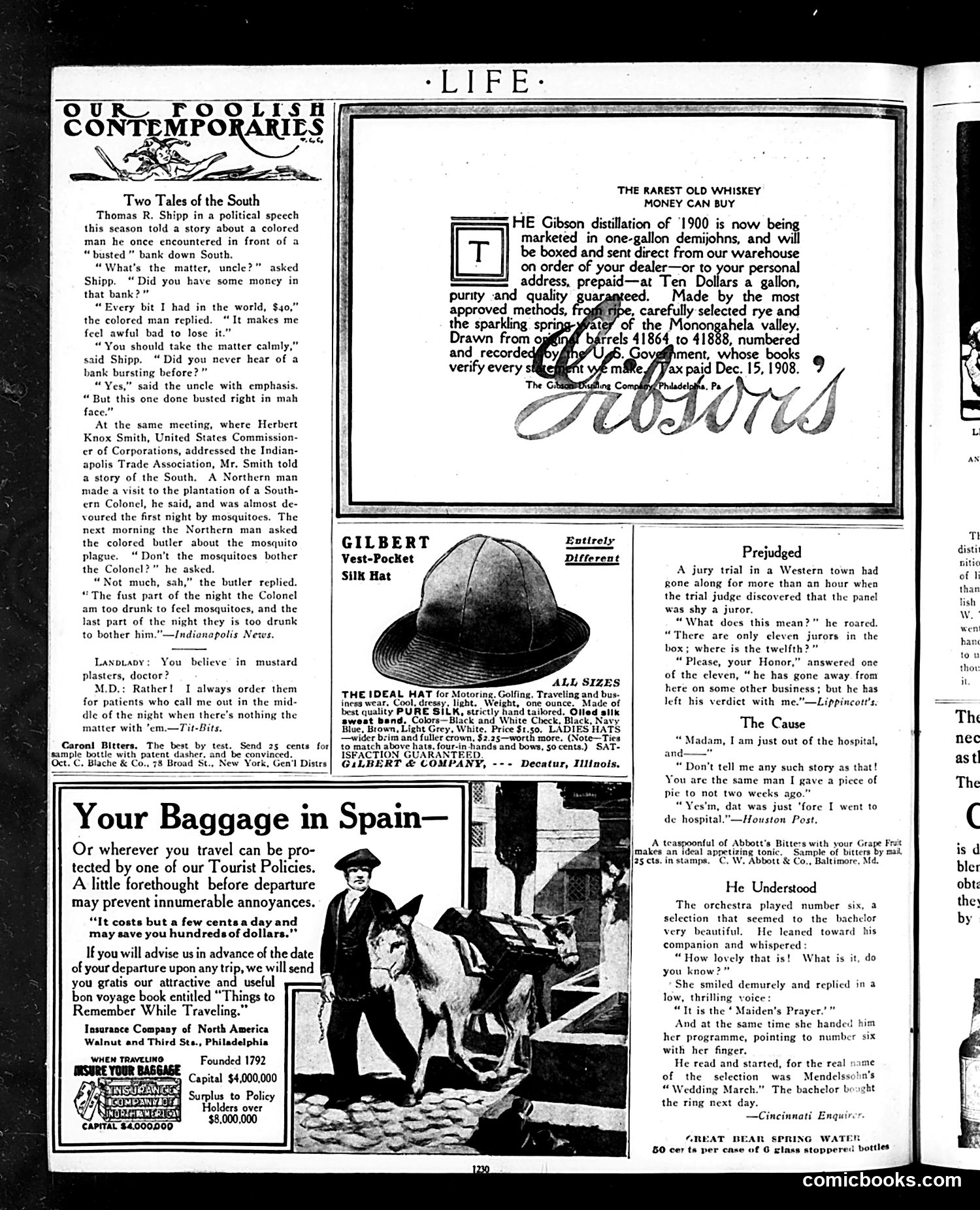
This page from *Life* magazine (a satirical publication) mixes humor, advertisements, and social commentary typical of the early 1900s. **"Two Tales of the South"** presents racist dialect humor common to the era. Both anecdotes stereotype Black servants ("uncle," "sah") as comic figures—one who lost bank savings, another portrayed as a drunk-enabler. The humor relies on exaggerated dialect and the assumption that Black people were foolish or servile. **The cartoons and jokes below** ("Prejudged," "The Cause," "He Understood") are brief, generic humor unrelated to politics—about courtroom bungling, hospital visits, and romantic misunderstandings. **The advertisements** (Gibson whiskey, Gilbert hats, insurance, doctor's plasters) represent typical early-1900s marketing, with the whiskey ad emphasizing "purity and quality" and "carefully selected" ingredients—standard luxury positioning. The page reflects *Life*'s satirical voice, but the racial humor is period-typical offensive material that reveals contemporary attitudes rather than critiquing them.
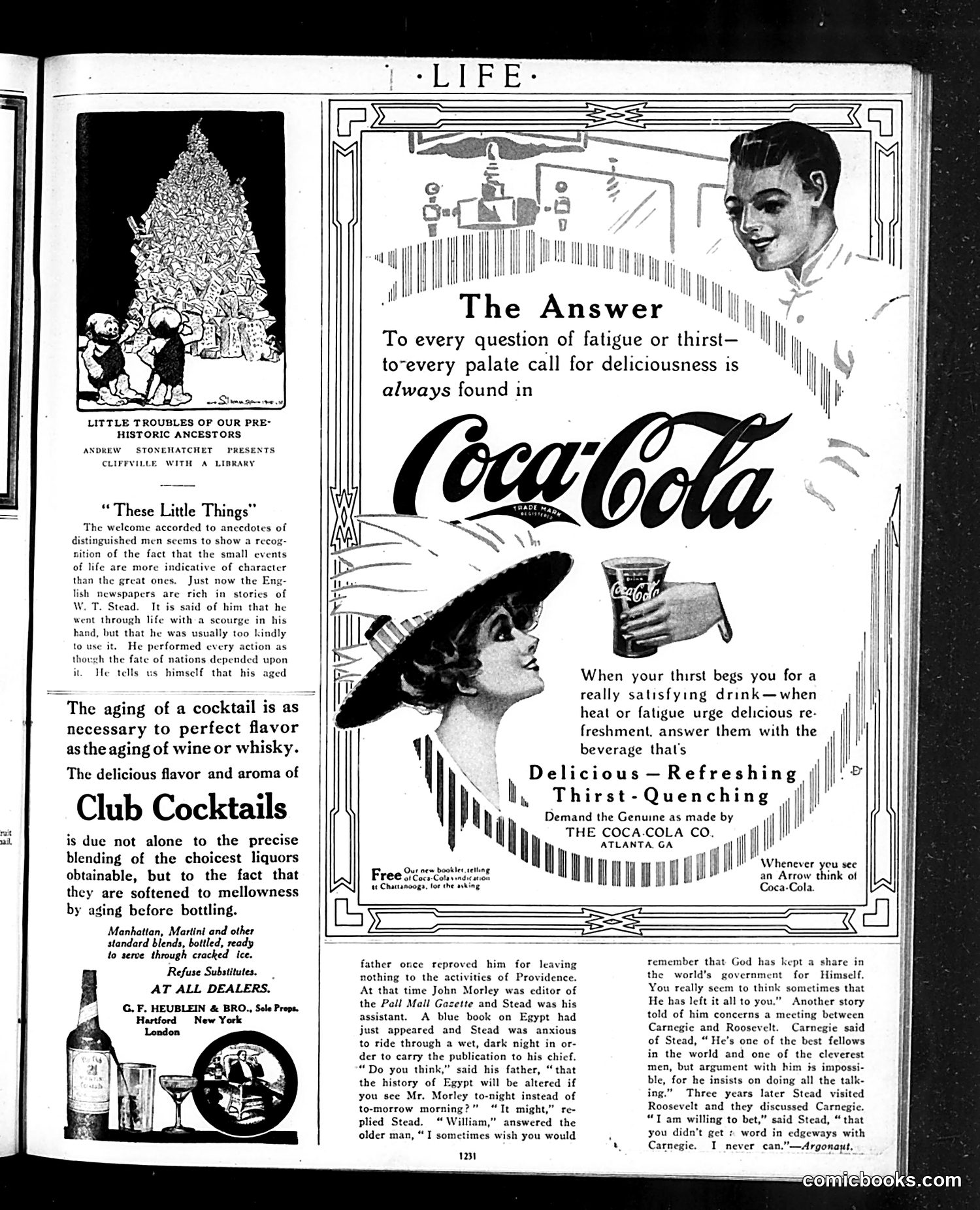
This page mixes a historical anecdote with period advertising. The main content is a biographical sketch of **W. T. Stead**, a prominent English newspaper editor and activist, illustrating his obsessive work ethic and sense of moral urgency through two anecdotes. The first describes his father rebuking him for assuming he must personally deliver news to his boss—suggesting God manages the world without his intervention. The second, a humorous coda, shows Stead's reputation for dominating conversations with both Andrew Carnegie and Theodore Roosevelt, each unable to get a word in. The "Little Troubles" cartoon at left appears to be a separate feature satirizing prehistoric ancestors donating to a library—a joke about civilization's pretensions. The page is otherwise filled with period advertisements: Club Cocktails (emphasizing aging for "mellowness") and Coca-Cola, both marketed as answers to fatigue and thirst—reflecting early 20th-century product messaging.
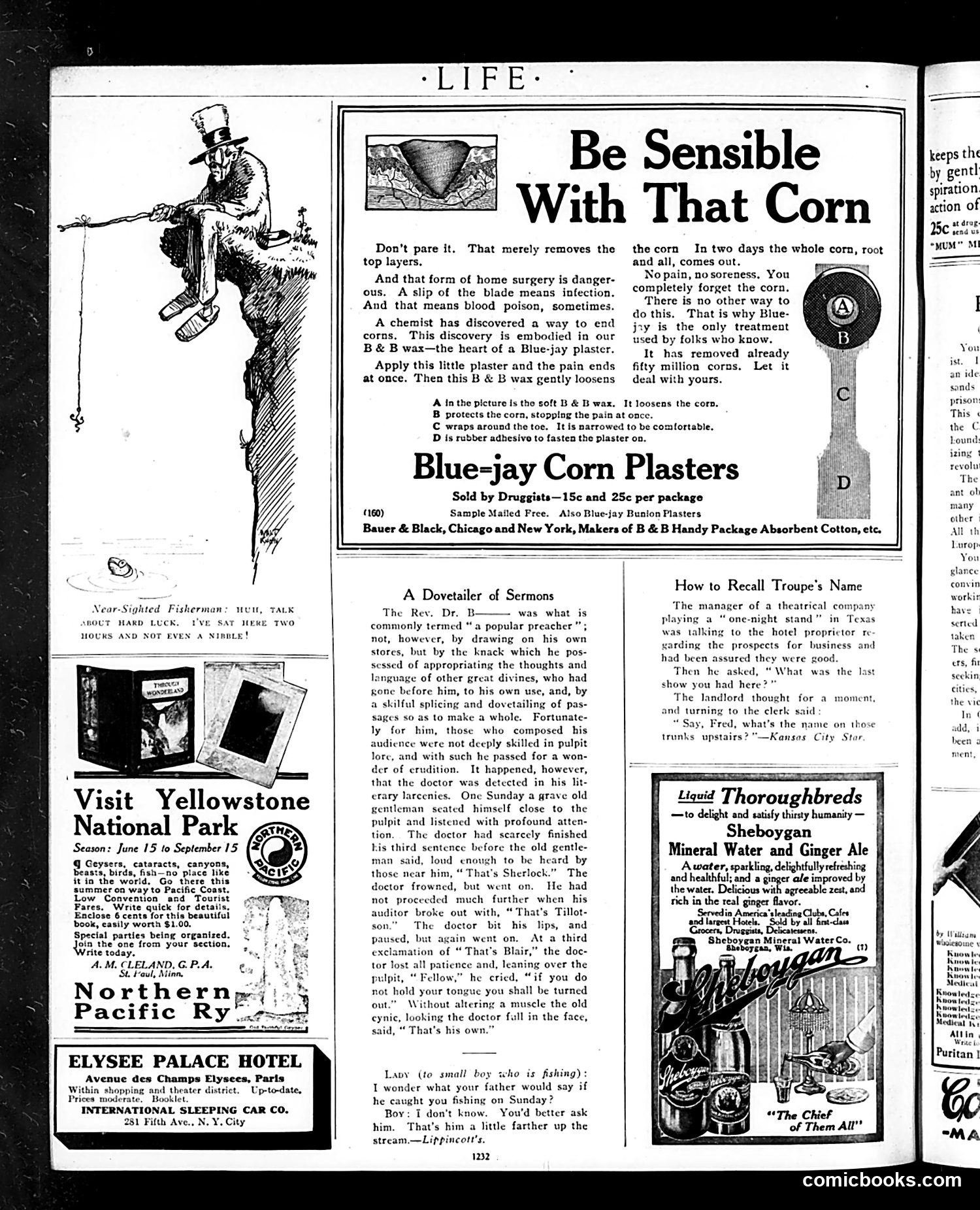
This page consists primarily of **advertisements** rather than political content. The main cartoon—"Near-Sighted Fisherman"—is a simple visual joke about a fisherman who hasn't caught anything despite sitting for hours, unaware someone is fishing right behind him. The dominant content is a **Blue-jay Corn Plasters advertisement** warning against dangerous home treatment of corns (foot calluses) and promoting this commercial product instead. It claims to have "removed already fifty million corns." Secondary ads advertise Yellowstone National Park tourism, a Paris hotel, and the Northern Pacific Railway. The page also includes two brief humorous anecdotes: one about a clergyman caught plagiarizing other preachers' sermons, and another about a boy fishing on Sunday. These are mild social humor rather than satire. There is no significant political content on this page—it's a typical early 20th-century magazine mix of light entertainment and consumer advertising.
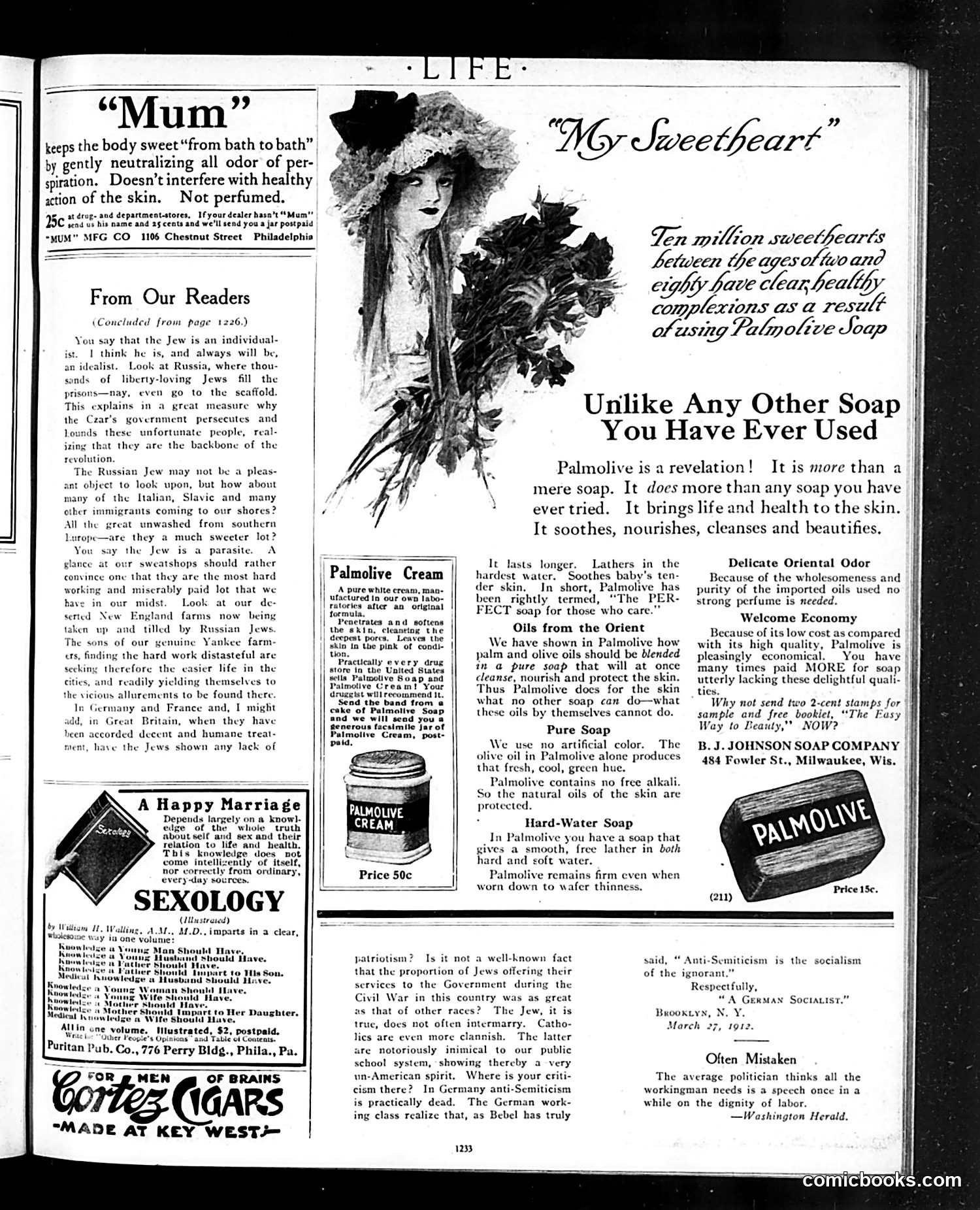
This page mixes advertising with reader correspondence about antisemitism. The "From Our Readers" section presents a rebuttal defending Jewish immigrants against stereotypes circulating at the time. The writer argues Jews are individualistic idealists (citing Russian revolutionaries), hardworking rather than parasitic (pointing to sweatshops and abandoned farms now farmed by Russian Jews), and historically productive when treated decently in other countries. The letter counters contemporary prejudices: that Jews were physically unappealing, lazy, or exploitative. It's historical evidence of 1920s American antisemitism and efforts to combat it through reasoned argument in a mainstream magazine. The rest—advertisements for "Mum" deodorant, Palmolive soap, a sexology book, and Cortez cigars—is typical period advertising using gendered appeals and product claims standard for early 20th-century magazines.
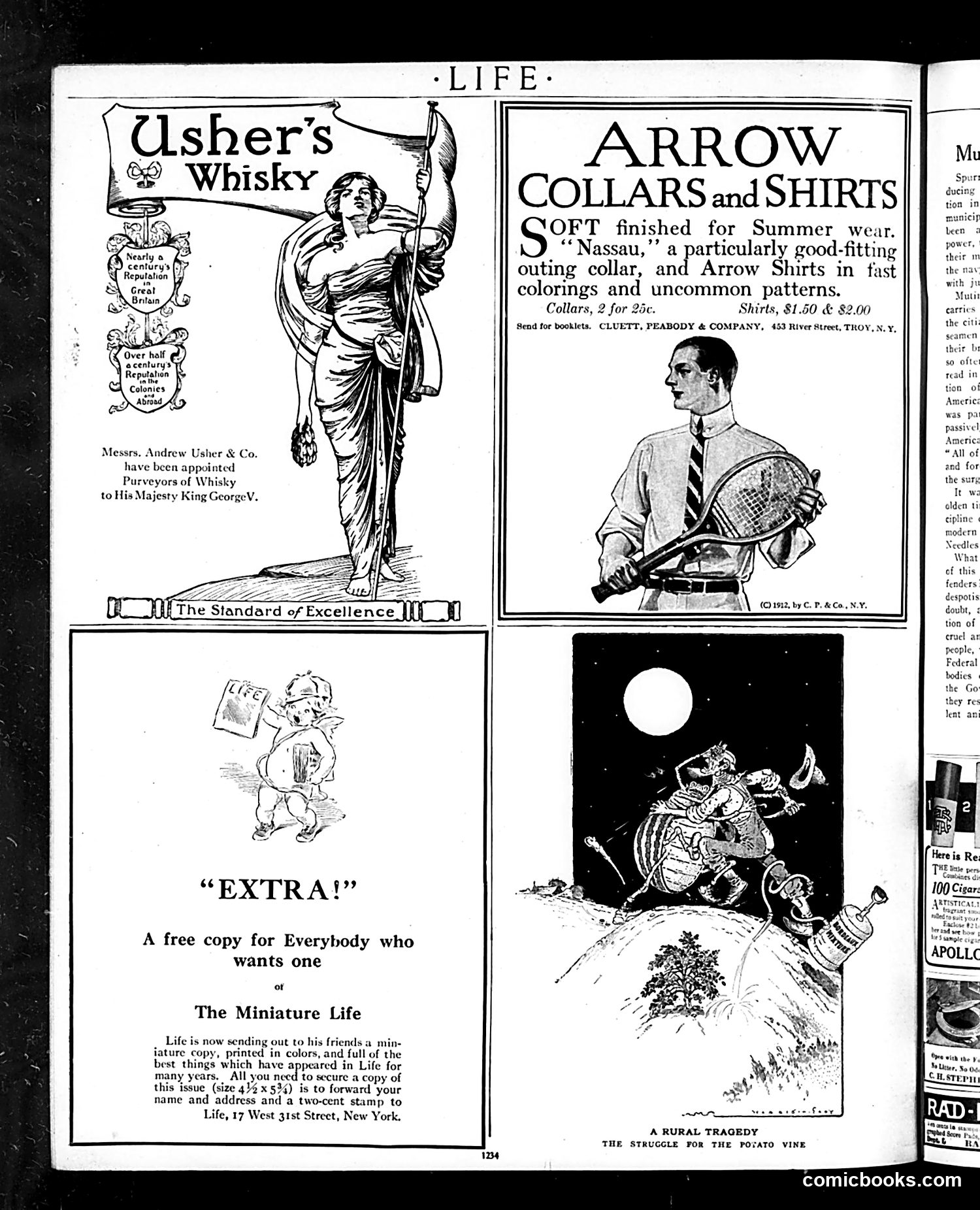
This page contains three separate advertisements and promotional content, not political satire. **Top left:** Usher's Whisky ad features a classical allegorical female figure (likely representing quality or excellence) holding a bottle. Text notes the brand has served as "Purveyors of Whisky to His Majesty King George V"—a royal warrant claim common in British luxury advertising. **Top right:** Arrow Collars and Shirts advertisement shows a man in athletic wear (holding a tennis racket), promoting summer menswear with "Nassau" collars and patterned shirts. **Bottom left:** Life magazine promotion offering a free miniature colored copy to readers who send name, address, and postage. **Bottom right:** A darkly humorous illustration titled "A Rural Tragedy: The Struggle for the Potato Vine" depicts anthropomorphized insects/creatures fighting over vegetation under moonlight—a whimsical nature scene rather than social commentary. This is primarily an advertising page with decorative illustrations, not political cartoons.
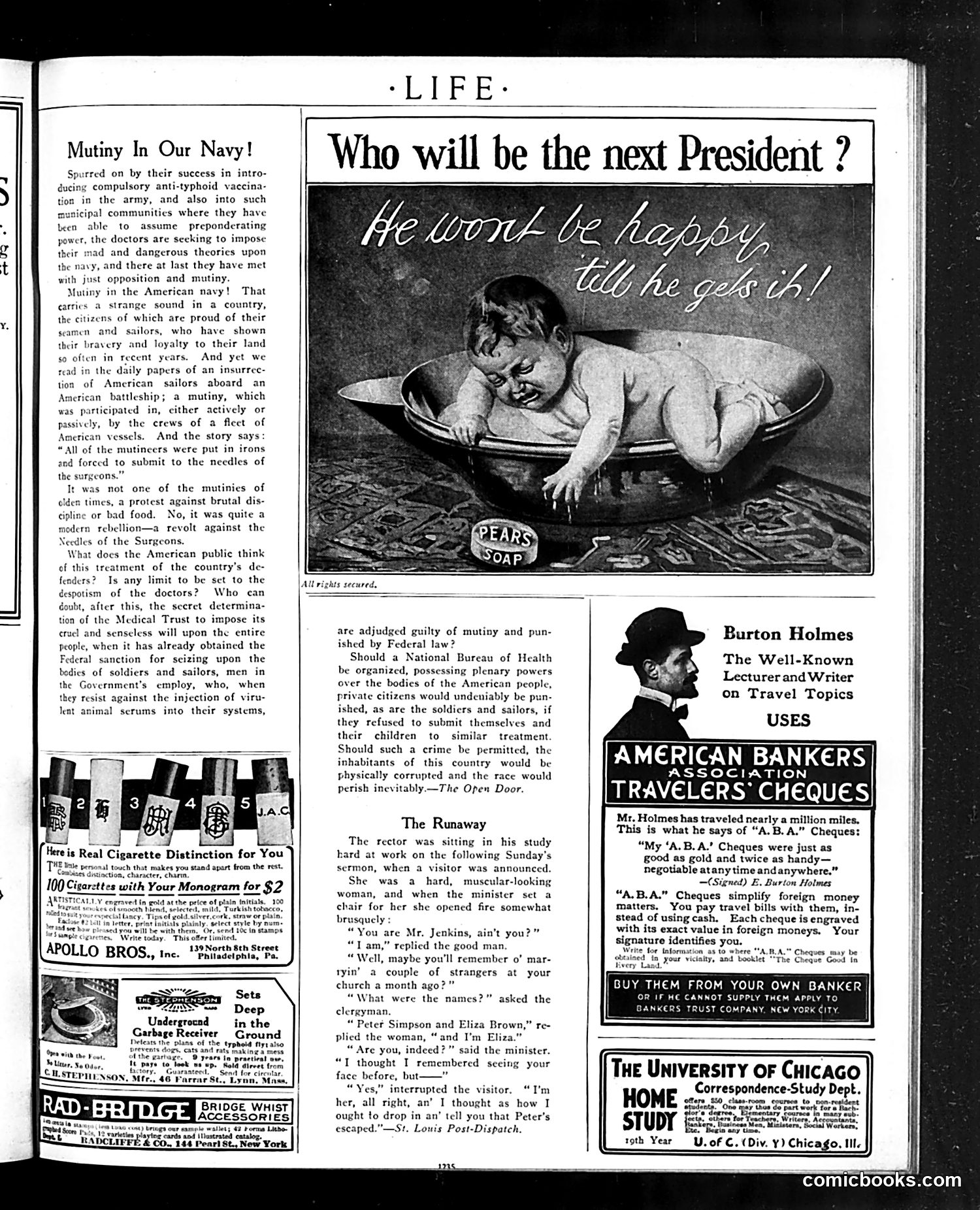
This page contains anti-vaccination propaganda disguised as political commentary. The lead article, "Mutiny In Our Navy," argues that doctors and a "Medical Trust" are tyrannically forcing sailors to undergo compulsory typhoid vaccinations against their will. The author frames vaccination as government despotism, claiming it will "physically corrupt" Americans and "perish inevitably." The accompanying cartoon (top right) depicts a man cowering before Pears Soap, captioned "He won't be happy till he gets it!"—a crude visual equating vaccination with soap, mocking those who accept medical treatment. The article represents early 20th-century anti-vaccination sentiment, when mandatory immunization programs faced significant resistance from those who viewed them as governmental overreach. The "Medical Trust" conspiracy theory reflects broader anxieties about medical professionalization and state authority over bodies. The page also contains unrelated content: "The Runaway" (a humor piece about a woman confronting a clergyman), advertisements, and an endorsement by travel writer Burton Holmes.
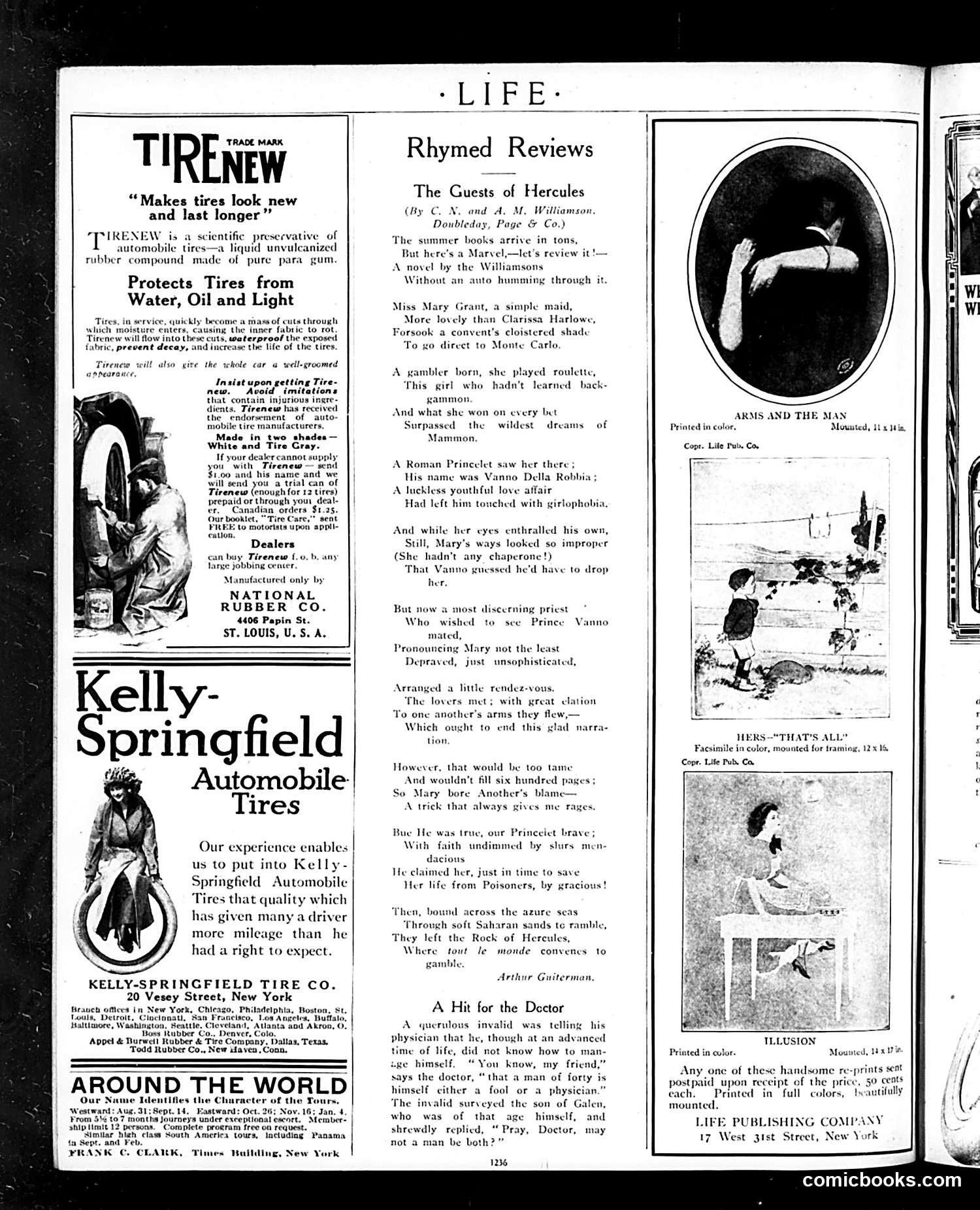
This page is primarily **advertising and literary content**, not political satire. The dominant elements are commercial ads for tire products (Tirenew, Kelly-Springfield, National Rubber Co.) alongside a book review section. The "Rhymed Reviews" section offers a humorous verse summary of *The Guests of Hercules* by the Williamsons—a romantic novel about Mary Grant, a gambler who travels to Monte Carlo, falls for an Italian nobleman (Prince Vanno), and eventually marries him after various melodramatic complications. The reviewer (Arthur Guiterman) mocks the novel's plot conventions in rhyme, particularly criticizing the trope where the heroine accepts blame for another's wrongdoing. The small joke feature "A Hit for the Doctor" presents a witty exchange: a 40-year-old man tells his doctor that at that age, a man must be either a fool or a physician—implying the doctor himself must be one or the other. The page images labeled "Arms and the Man," "Hers," and "Illusion" appear to be unrelated film or theatrical stills. This is straightforward early-20th-century magazine content mixing commerce and light entertainment.
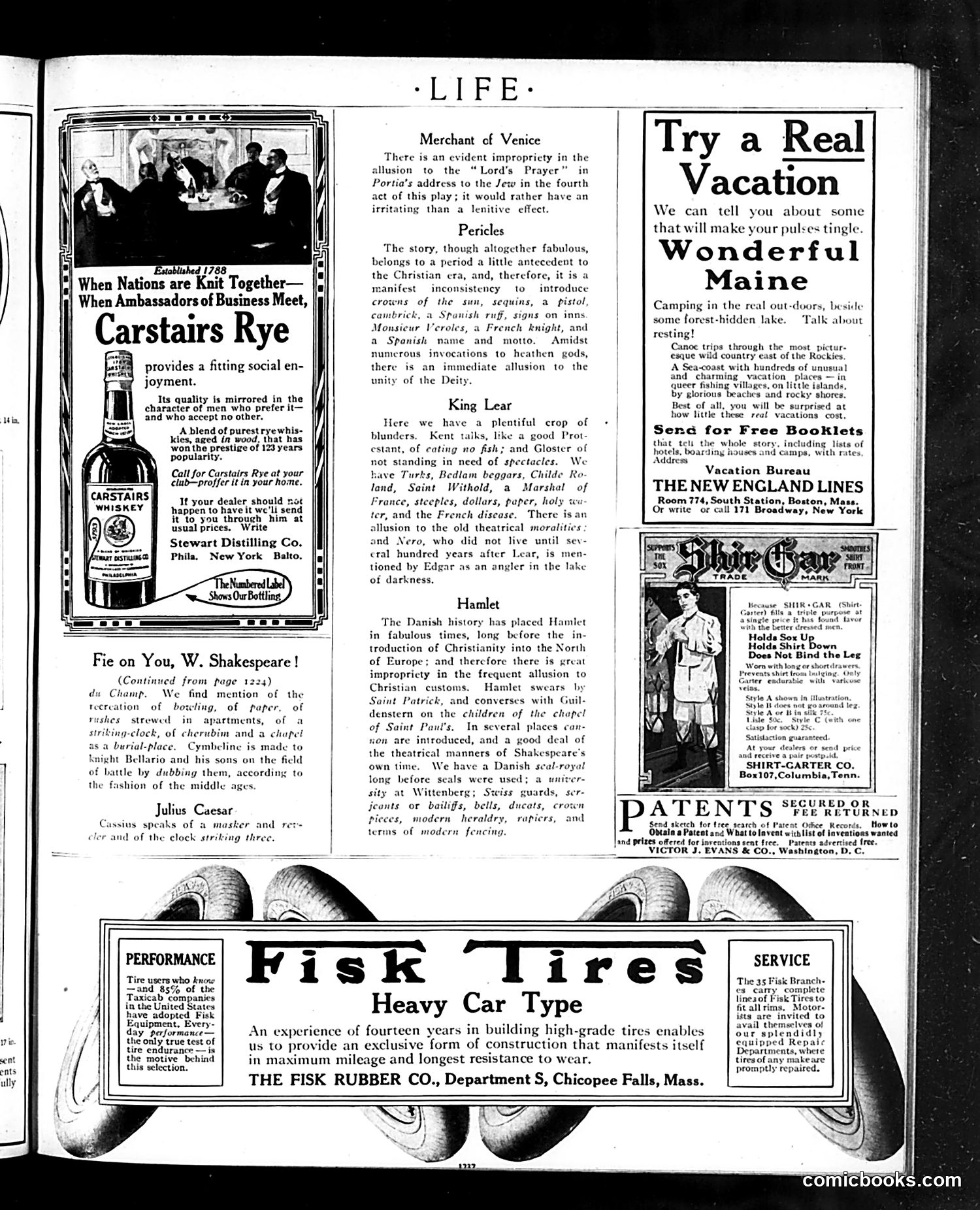
This page is primarily **literary criticism and advertising**, not political satire. The main content critiques Shakespeare's historical inaccuracies. A writer argues that plays like *Hamlet*, *King Lear*, and *Merchant of Venice* anachronistically include objects and references that didn't exist in their supposed time periods—for example, *Hamlet* mentions Christianity and St. Paul's Chapel in supposedly pre-Christian Denmark, or *King Lear* references "the French disease" (syphilis) centuries before it existed. The title "Fie on You, W. Shakespeare!" sarcastically condemns Shakespeare for these errors. The rest is **advertising**: Carstairs Rye whiskey (emphasizing prestige and social refinement), Maine vacation tourism, a shirt-collar product, and Fisk Tires. These ads are typical of *Life* magazine's revenue model and target affluent, educated readers.
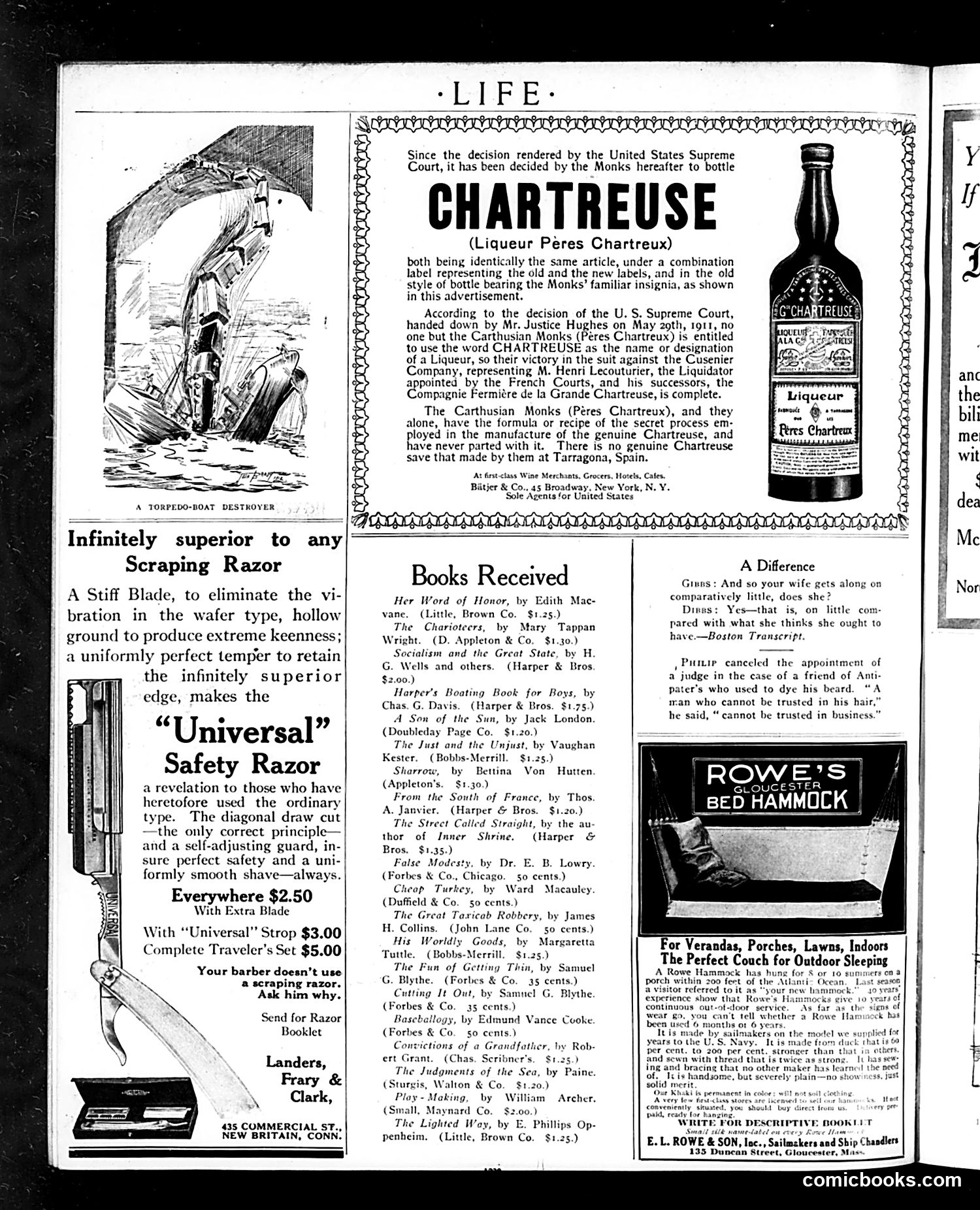
This page contains primarily **advertisements and book reviews**, not political satire. However, the notable content is: **Chartreuse Advertisement**: A legal victory announcement. The U.S. Supreme Court (Justice Hughes, May 29, 1911) ruled that only Carthusian Monks in Tarragona, Spain can use the name "Chartreuse" for their liqueur. A French company (Cusenier/Lecouturier) had been producing a competing version. The monks' monopoly on the name is now legally protected. This appears to be a legitimate business announcement disguised as advertisement. **"Torpedo-Boat Destroyer" Cartoon**: The left image captioned "A Torpedo-Boat Destroyer" shows a warship destroying another vessel. This appears to be a visual pun—the Universal Safety Razor advertisement below uses militaristic language ("destroyer") to mock competing razors, comparing shaving superiority to naval warfare. The remaining content consists of book reviews and a Standard Safety Razor advertisement promoting its superiority over older scraping-style razors.
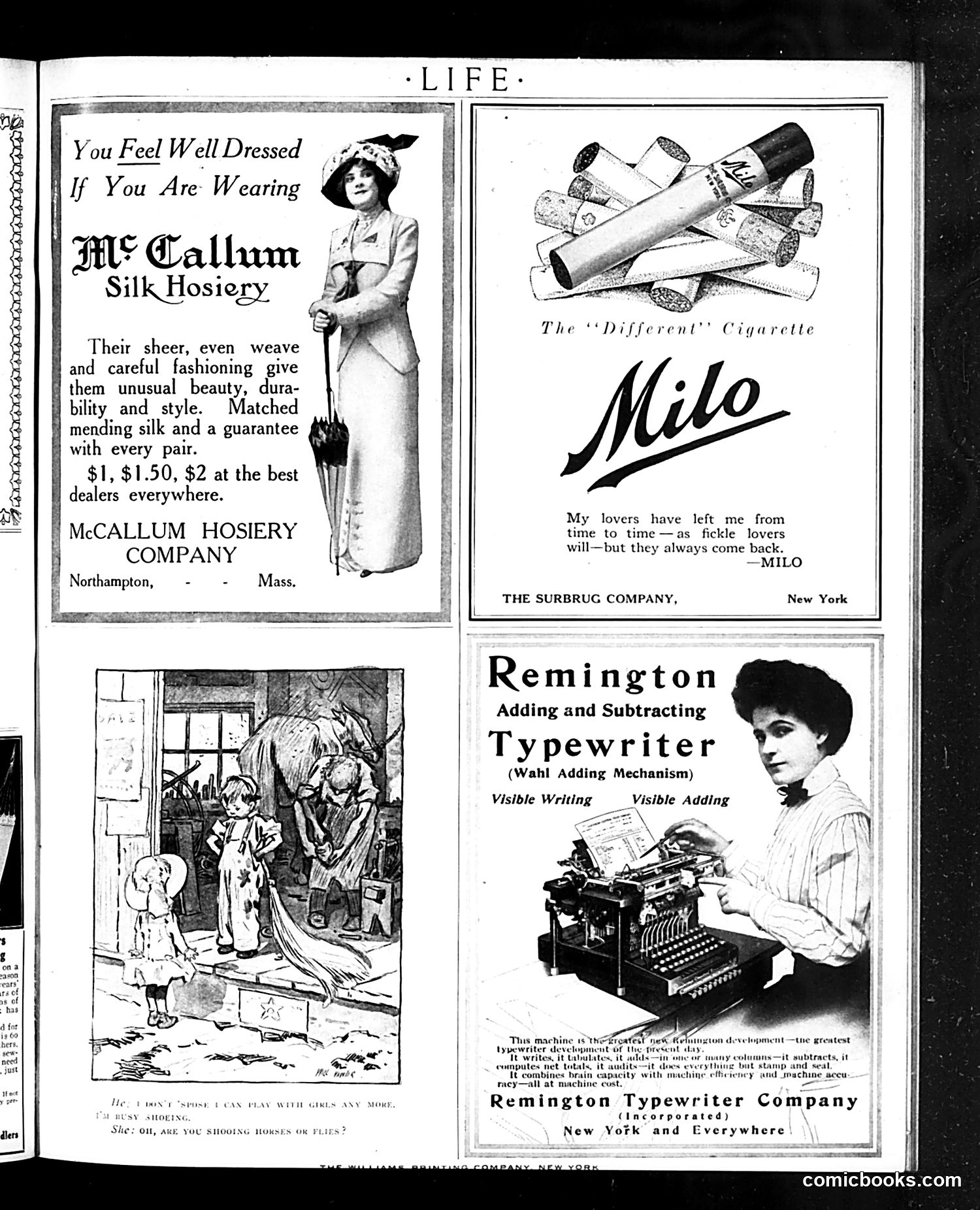
This page is primarily **advertising**, not editorial satire. It contains four product advertisements typical of early 20th-century magazines: 1. **McCallum Silk Hosiery**: Targets well-dressed women with promises of durability and guaranteed matching mending silk. 2. **Milo Cigarettes**: Uses a personified cigarette brand ("lovers have left me...but they always come back") as suggestive romantic innuendo—common advertising trope of the era. 3. **A cartoon** (lower left): Shows a child asking adults about "shooting horses or flies," likely a domestic humor vignette unrelated to satire. 4. **Remington Typewriter**: Markets an "Adding and Subtracting" model featuring "Visible Writing" and "Visible Adding" mechanisms to businesswomen—emphasizing modern office technology. The page reflects **1910s-1920s consumer culture** targeting middle-class women entering workforces and consumer markets. No political satire is evident here; this is straightforward period advertising.
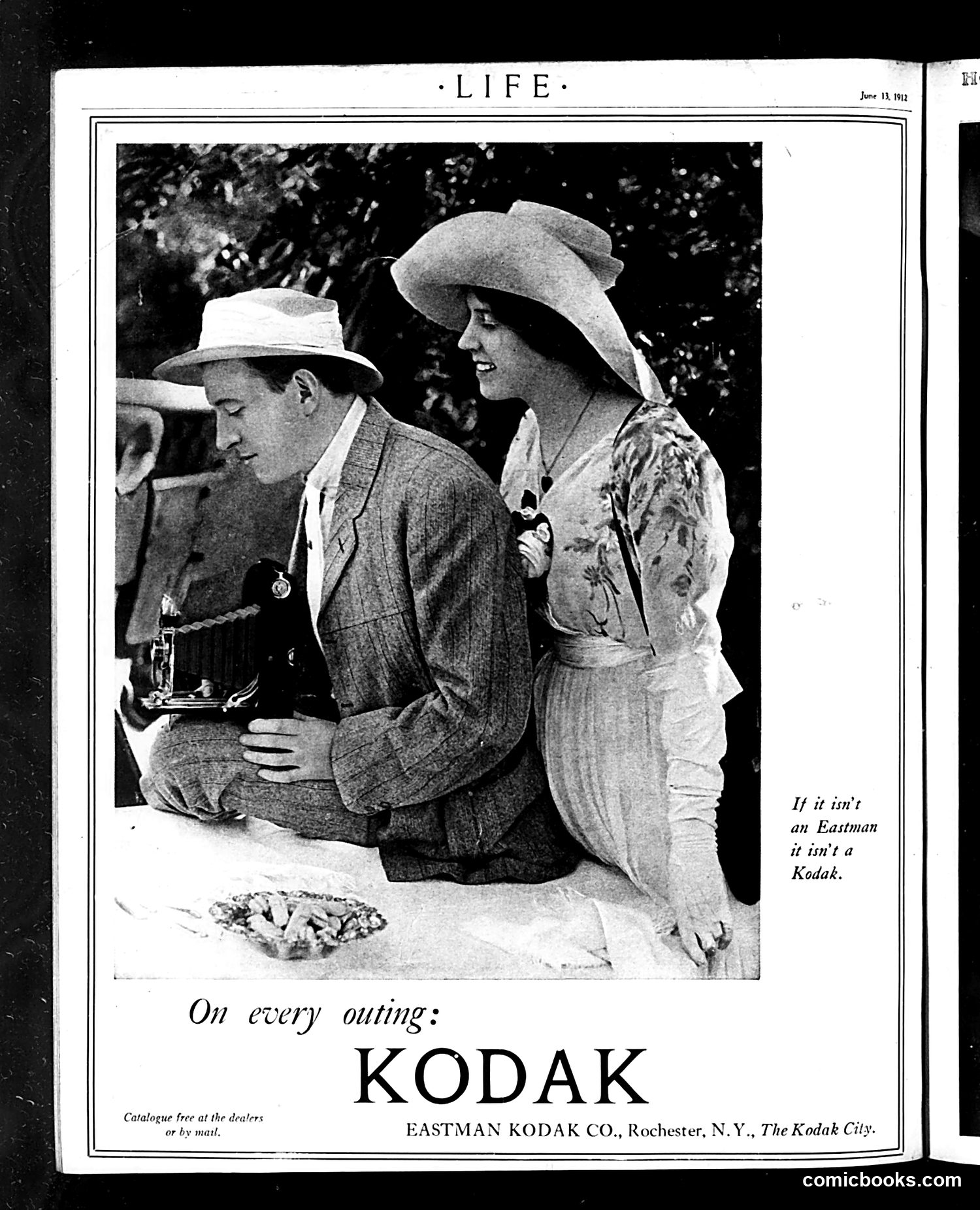
This is a **Kodak advertisement** from Life magazine (June 13, 1912), not political satire. The image shows a couple on an outdoor outing—the man operating an Eastman Kodak camera while a woman watches approvingly. The advertisement's tagline, "If it isn't an Eastman it isn't a Kodak," emphasizes brand exclusivity and quality. The joke/message is social rather than political: photography has become so essential to leisure activities that serious photographers should bring a Kodak camera on every outing. The stylish clothing and outdoor setting reflect the emerging leisure culture of the era. This is straightforward commercial advertising promoting cameras as must-have accessories for modern, affluent couples.