
Life, 1912-06-13 · page 39 of 44
Life — June 13, 1912 — page 39: what you’re looking at
What you’re looking at
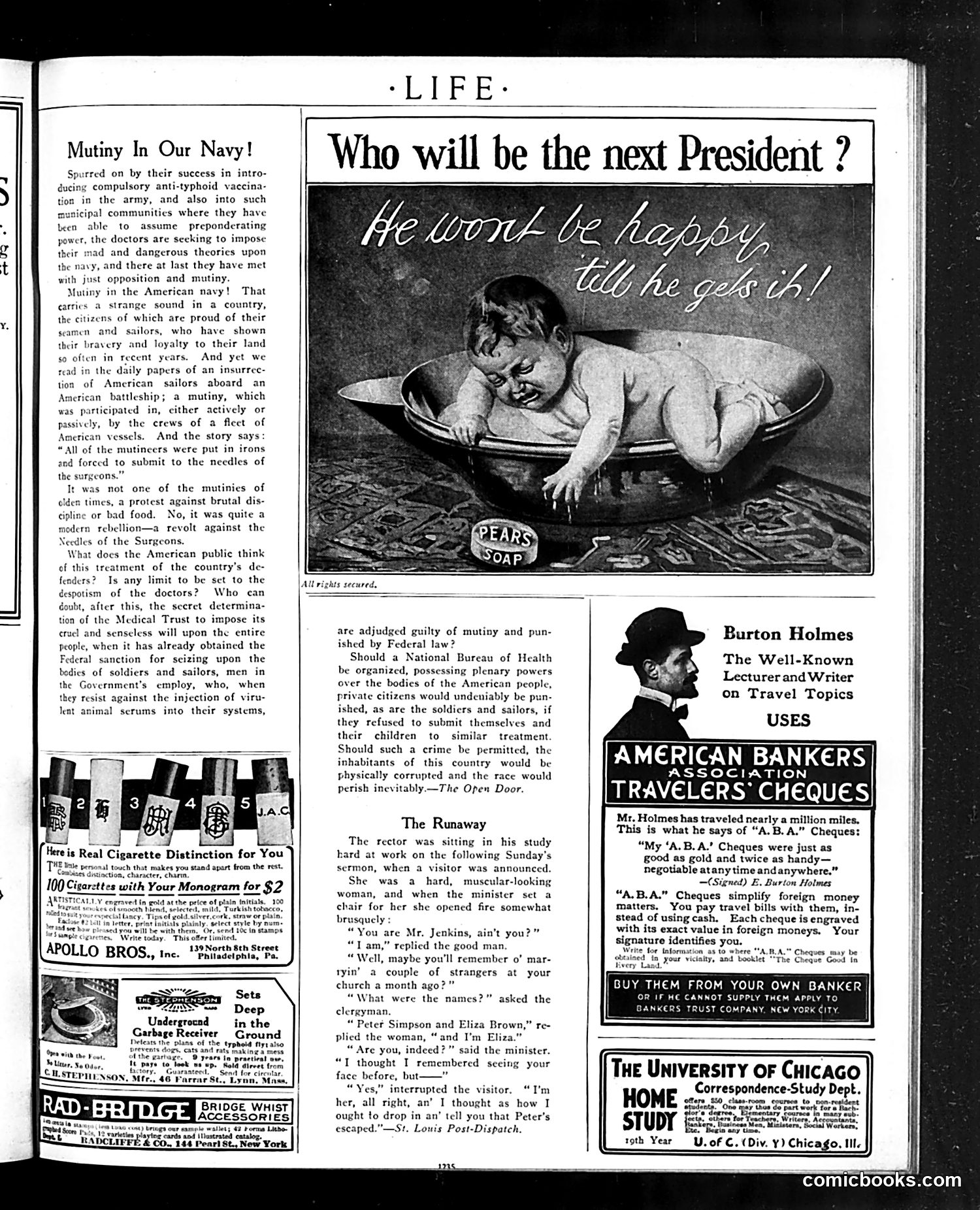
This page contains anti-vaccination propaganda disguised as political commentary. The lead article, "Mutiny In Our Navy," argues that doctors and a "Medical Trust" are tyrannically forcing sailors to undergo compulsory typhoid vaccinations against their will. The author frames vaccination as government despotism, claiming it will "physically corrupt" Americans and "perish inevitably." The accompanying cartoon (top right) depicts a man cowering before Pears Soap, captioned "He won't be happy till he gets it!"—a crude visual equating vaccination with soap, mocking those who accept medical treatment. The article represents early 20th-century anti-vaccination sentiment, when mandatory immunization programs faced significant resistance from those who viewed them as governmental overreach. The "Medical Trust" conspiracy theory reflects broader anxieties about medical professionalization and state authority over bodies. The page also contains unrelated content: "The Runaway" (a humor piece about a woman confronting a clergyman), advertisements, and an endorsement by travel writer Burton Holmes.
📄 Transcribed text from this page (OCR, searchable)
Machine-transcribed from the original scan — historical spelling and the odd misread are preserved.
Mutiny In Our Navy! red on by their success in intro- compulsory anti-typhoid vaccina- n the army, and also into such icipal communities where they have ble to assume preponderating power, the doctors are secking to impose their mad and dangerous theories upon the navy, and there at last they have met with just opposition and mutiny. Mutiny in the American navy! That aarries & strange sound in a country, the citizens of which are proud of their seamen and sailors, who have shown their bravery and loyalty to their land so often in recent years. And yet we read in the daily papers of an insurree- tion of American sailors aboard an American battleship; a mutiny, which was participated in, cither actively or passively, by the crews of a ficet of American vessels. And the story says: “All of the mutincers were put in irons and forced to submit to the needles of the surgeons. It was not one of the mutinies of nes, a protest against brutal dis- or bad food. No, it was quite a modern rebellion—a revolt against the Needles of the Surgeons. What does the American public think treatment of the country's de- fenders? Is any limit to be set to the despotism of the doctors? Who can Goubt, after this, the sceret determina- 0 of the Medical Trust to impose its cracl and senseless will upon the entire people, when it has already obtained the Federal sanction for seizing upon the bodies of soldiers and sailors, men in the Government's employ, who, when they resist against the injection of viru- lent animal scrums into their systems, Character, chaten ettes with Your Monogram for §, 2 CALL engraved in goat the ce ot pain tae 300 Pmt, Furdian totace Undergrocnd Garbage Receiver Deters eo vo gy out ele lit 6 Fea Labo ‘cards and illastrated catalog. DCLIFEE £ Gn 144 Pearl Se; New York secured, are adjudged guilty of mutiny and pun- ished by Federal law? Should a National Bureau of Health be organized, possessing plenary powers over the bodies of the American people, private citizens would undeniably be pun- shed, as are the soldicrs and sailors, if they refused to submit themselves and their children to similar treatment Should such a crime be permitted, the inhabitants of this country would be physically corrupted and the race would perish inevitably—The Open Door. The Runaway The rector was sitting in his study hard at work on the following Sunday's mon, when a visitor was announced. She was a hard, muscular-looking woman, and when the minister set a chair for her she opened fire somewhat brusquely : “You are Mr. Jenkins, ain't you?” “Tam,” replied the good man, “Well, maybe you'll remember o’ mar- tryin’ a couple of strangers at your church a month ago?” What were the names?” asked the clergyman. “ Peter Simpson and Eliza Brown,” Te plied the woman, “and I’m Eliz: “Are you, indeed?” said the minister. “TI thought I remembered seeing your face before, but——" ay interrupted the visitor. “I'm her, all’ right, an’ I thought as how I ought to drop in an’ tell you that Peter's escaped.”—St. Louis Post-Dispatch. Burton Holmes The Well-Known Lecturer and Writer on Travel Topics USES AMERICAN BANKERS ASSOCIATION TRAVELERS’ CHEQUES Mr. Holmes has traveled nearly a This is what he says of “A.B. A.” Cheques: “My ‘A.B. A.’ Cheques were just as good as gold and twice as handy— negotiable atany time andanywhere.” (Signed) E, Burton Holmes “A.B.A.” Cheques simplify foreign money matters, You pay travel bills with them, in- stead of using cash. Each cheque is engraved with its exact value in foreign moneys. Your signature identifies you. Write for Information as {0 where “A.BLA." Cheques may be ed in your vicity, and booklet “The Cheque Good ta BUY THEM FROM YOUR OWN BANKER | OR IF HE CANNOT SUPPLY THEM APPLY TO __BANKERS TRUST COMPANY. NEW YORK CITY. | THE UNIVERSITY OF CHICAGO di “Stud; D t. HOME : ote iewaees ui we pa a fare 800, clase roth Year ud oF c. ey ichicng fo. te