
Life, 1912-06-13 · page 9 of 44
Life — June 13, 1912 — page 9: what you’re looking at
What you’re looking at
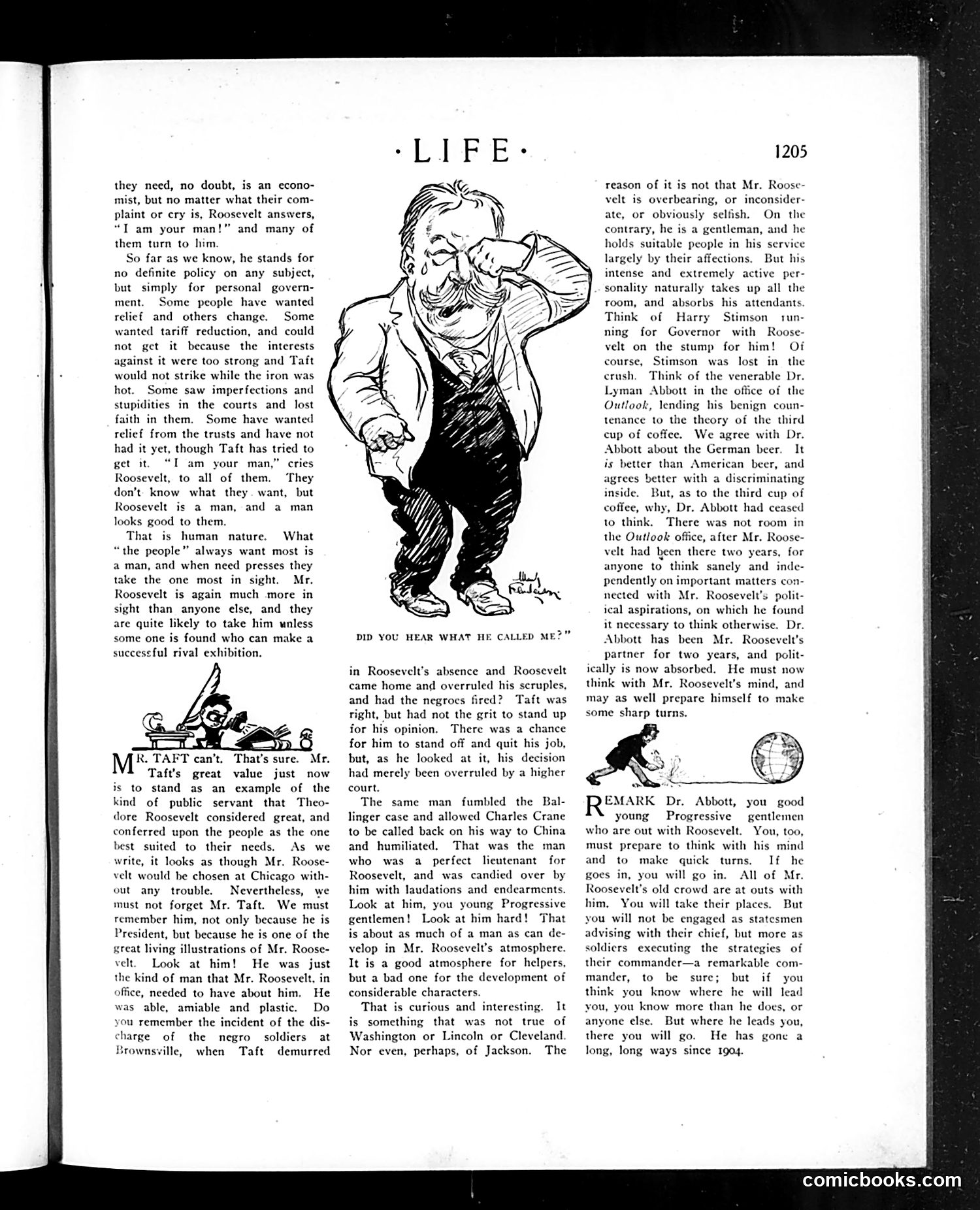
The cartoon depicts a caricatured figure labeled "DID YOU HEAR WHAT HE CALLED ME?" The exaggerated facial features and body language suggest mockery of a public figure. The surrounding text discusses Roosevelt's character and leadership style, praising his ability to select capable people despite personal differences. It references President Taft's position as "an example of the kind of public servant" and mentions Taft's handling of various political matters, including disputes with subordinates and the "Ballinger case." The satire appears to criticize political appointees' sensitivity to criticism while commenting on Roosevelt's pragmatic management style. The cartoon likely mocks someone's oversensitivity to being called out, contrasting with Roosevelt's more thick-skinned approach to governance and public service.
📄 Transcribed text from this page (OCR, searchable)
Machine-transcribed from the original scan — historical spelling and the odd misread are preserved.
they need, no doubt, is an econo- mist, but no matter what their com- plaint or cry is, Roosevelt answers, “Tam your man!” and many of them turn to him So far as we know, he stands for no definite policy on any subject, but simply for personal govern- ment. Some people have wanted relief and others change. Some wanted tariff reduction, and could not get it because the interests against it were too strong and Taft would not strike while the iron was hot. Some saw imperfections and stupidities in the courts and lost faith in them. Some have wanted relief from the trusts and have not had it yet, though Taft has tried to get it. “I am your man,” cries Roosevelt, to all of them. They don’t know what they. want, but Roosevelt is a man, and a man looks good to them. That is human nature. What “the people” always want most is a man, and when need presses they take the one most in sight. Mr. Roosevelt is again much more in sight than anyone else, and they are quite likely to take him unless some one is found who can make a successful rival exhibition. R. TAFT can’t. That's sure. Mr. Taft’s great value just now is to stand as an example of the kind of public servant that Theo- dore Roosevelt considered great, and conferred upon the people as the one best suited to their needs. As we write, it looks as though Mr. Roose- velt would be chosen at Chicago with- out any trouble. Nevertheless, we must not forget Mr. Taft. We must remember him, not only because he is President, but because he is one of the great living illustrations of Mr. Roose- velt. Look at him! He was just the kind of man that Mr. Roosevelt, in office, needed to have about him. He was able, amiable and plastic. Do you remember the incident of the dis- charge of the negro soldiers at Brownsville, when Taft demurred DID YOU HEAR WHAT HE CALLED ME in Roosevelt’s absence and Roosevelt came home and overruled his scruples, and had the negroes fired? Taft was right, but had not the grit to stand up for his opinion. There was a chance for him to stand off and quit his job, but, as he looked at it, his decision had merely been overruled by a higher court. The same man fumbled the Bal- linger case and allowed Charles Crane to be called back on his way to China and humiliated. That was the man who was a perfect lieutenant for Roosevelt, and was candied over by him with laudations and endearments. Look at him, you young Progressive gentlemen! Look at him hard! That is about as much of a man as can de- velop in Mr. Roosevelt's atmosphere. It is a good atmosphere for helpers, but a bad one for the development of considerable characters. That is curious and interesting. It is something that was not true of Washington or Lincoln or Cleveland Nor even, perhaps, of Jackson. The 1205 reason of it is not that Mr. Roose- velt is overbearing, or inconsider- ate, or obviously selfish. On the contrary, he is a gentleman, and he holds suitable people in his service largely by their affections. But his intense and extremely active per- sonality naturally takes up all the room, and absorbs his attendants. Think of Harry Stimson run- ning for Governor with Roose- velt on the stump for him! Of course, Stimson was lost in the Think of the venerable Dr. Lyman Abbott in the office of the Outlook, lending his benign coun- tenance to the theory of the third cup of coffee. We agree with Dr. Abbott about the German beer. It is better than American beer, and agrees better with a discriminating inside. But, as to the third cup of coffee, why, Dr. Abbott had ceased to think. There was not room in the Outlook office, after Mr. Roose- velt had heen there two years, for anyone to think sanely and inde- pendently on important matters con- nected with Mr. Roosevelt's polit- ical aspirations, on which he found it necessary to think otherwise. Dr. Abbott has been Mr. Roosevelt's partner for two years, and_polit- ically is now absorbed. He must now think with Mr. Roosevelt's mind, and may as well prepare himself to make some sharp turn: crush, EMARK Dr. Abbott, you good young Progressive gentlemen who are out with Roosevelt. You, too, must prepare to think with his mind and to make quick turns. If he goes in, you will go in. All of Mr. Roosevelt's old crowd are at outs with him, You will take their places. But you will not be engaged as statesmen advising with their chief, but more as soldiers executing the strategies of their commander—a remarkable com- mander, to be sure; but if you think you know where he will lead you, you know more than he does, or anyone else. But where he leads you, there you will go. He has gone a long, long ways since 1904. comicbooks.com