
Life, 1912-06-13 · page 35 of 44
Life — June 13, 1912 — page 35: what you’re looking at
What you’re looking at
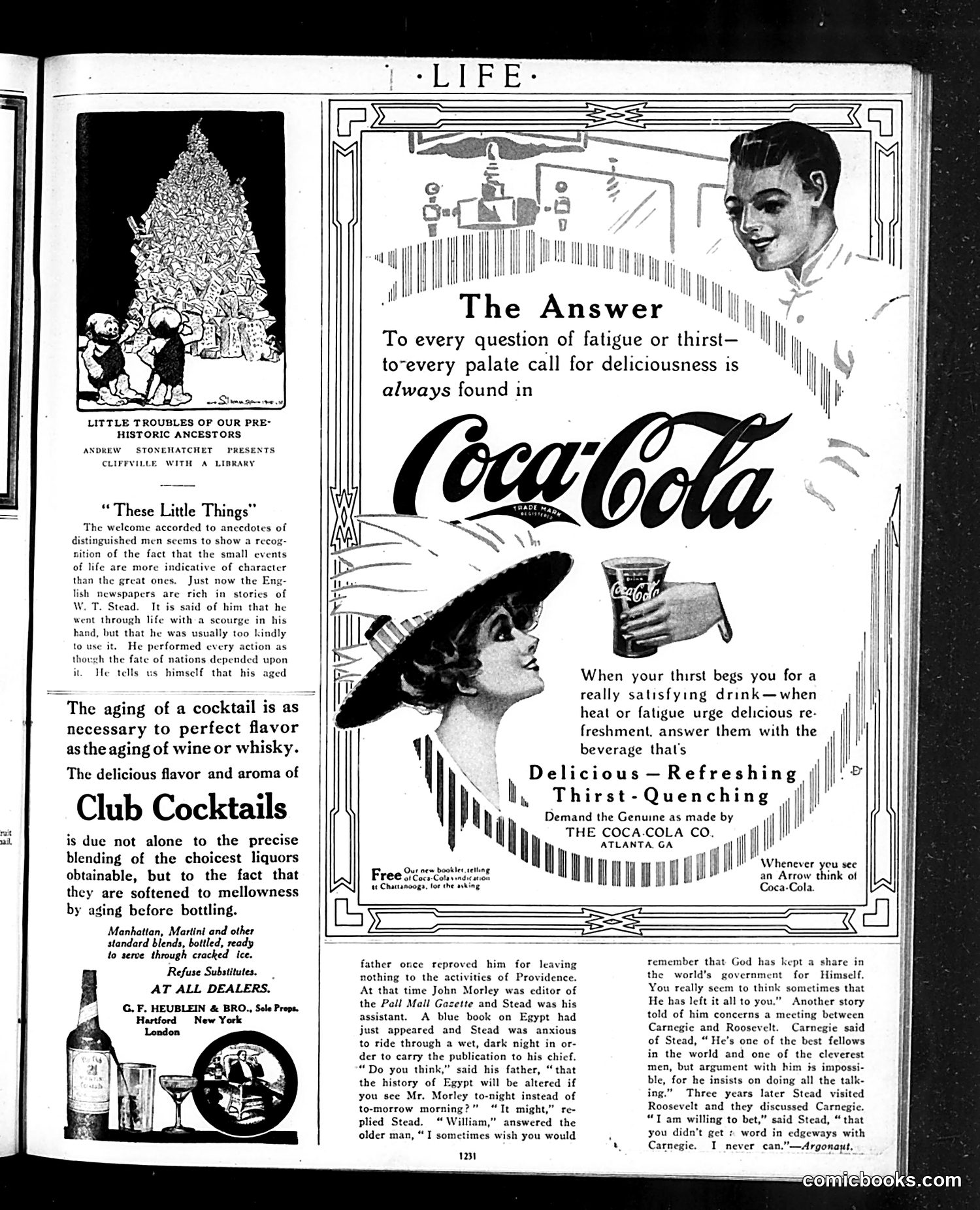
This page mixes a historical anecdote with period advertising. The main content is a biographical sketch of **W. T. Stead**, a prominent English newspaper editor and activist, illustrating his obsessive work ethic and sense of moral urgency through two anecdotes. The first describes his father rebuking him for assuming he must personally deliver news to his boss—suggesting God manages the world without his intervention. The second, a humorous coda, shows Stead's reputation for dominating conversations with both Andrew Carnegie and Theodore Roosevelt, each unable to get a word in. The "Little Troubles" cartoon at left appears to be a separate feature satirizing prehistoric ancestors donating to a library—a joke about civilization's pretensions. The page is otherwise filled with period advertisements: Club Cocktails (emphasizing aging for "mellowness") and Coca-Cola, both marketed as answers to fatigue and thirst—reflecting early 20th-century product messaging.
📄 Transcribed text from this page (OCR, searchable)
Machine-transcribed from the original scan — historical spelling and the odd misread are preserved.
LITTLE TROUBLES OF OUR PRE- HISTORIC ANCESTORS ANDREW STONEHATCHET PRESENTS CLIPFVILLE WITH A LIBRARY “ These Little Things” The weleome accorded to ancedotes of distinguished men seems to show a recog- nition of the fact that the small events of life are more indicative of character than the great ones. Just now the Eng- lish newspapers are rich in stories of W. T. Stead. It is said of him that he went through life with a scourge in his hand, but that he was usually too kindly to use it, He performed every action as thorzh the fate of nations depended upon it. He tells us himself that his aged ~The aging of a cocktail is as necessary to perfect flavor as the aging of wine or whisky. The delicious flavor and aroma of Club Cocktails is due not alone to the precise blending of the choicest liquors obtainable, but to the fact that they are softened to mellowness by aging before bottling. Manhattan, Martini and other standard blends, bottled, ready to serve through cracked ice. Refuse Substitutes. AT ALL DEALERS. G. F. HEUBLEIN & BRO.., Sele Props, Hartford New York it iia | It tht ill “The Answer To every question of fatigue or thirst— to-every palate call for deliciousness is always found in { \ Deli li b Thirst-Quenching | Out new booker tein Free (cor coissininaos a Chattanooga, for the asking. Demand the Genuine as made by THE COCA.COLA CO. | i! ill ATLANTA GA Winnungal When your thirst begs you for a really satisfying drink—when heat or fatigue urge delicious re- freshment. answer them with the beverage that's cious — Refreshing. | Mt: yi! il" ih tI iL Whenever you see ii an Arrow think of a-Cola. father once reproved him for leaving nothing to the activities of Providence. At that time John Morley was editor of the Pall Mall Gazette and Stead was his assistant. A blue book on Egypt had just appeared and Stead was anxious to ride through a wet, dark night in or- der to carry the publication to his chief. “Do you think,” said his father, “that the history of Egypt will be altered if you see Mr. Morley to-night instead of to-morrow morning?” “It might,” re- plied Stead. “ William,” answered the older man, “I sometimes wish you would 1231 remember that God has kept a share in the world’s government for Himself. You really seem to think sometimes that He has left it all to you.” Another story told of him concerns a meeting between Carnegie and Roosevelt. Carnegie said of Stead, “ He’s one of the best fellows in the world and one of the cleverest men, but argument with him is impossi- ble, for he insists on doing all the talk- ing.” Three years later Stead visited Roosevelt and they discussed Carnegie. “Tam willing to bet,” said Stead, “ that you didn’t get + word in edgeways with Carnegie. I never can.”—Argonaut.