
Life, 1912-06-13 · page 21 of 44
Life — June 13, 1912 — page 21: what you’re looking at
What you’re looking at
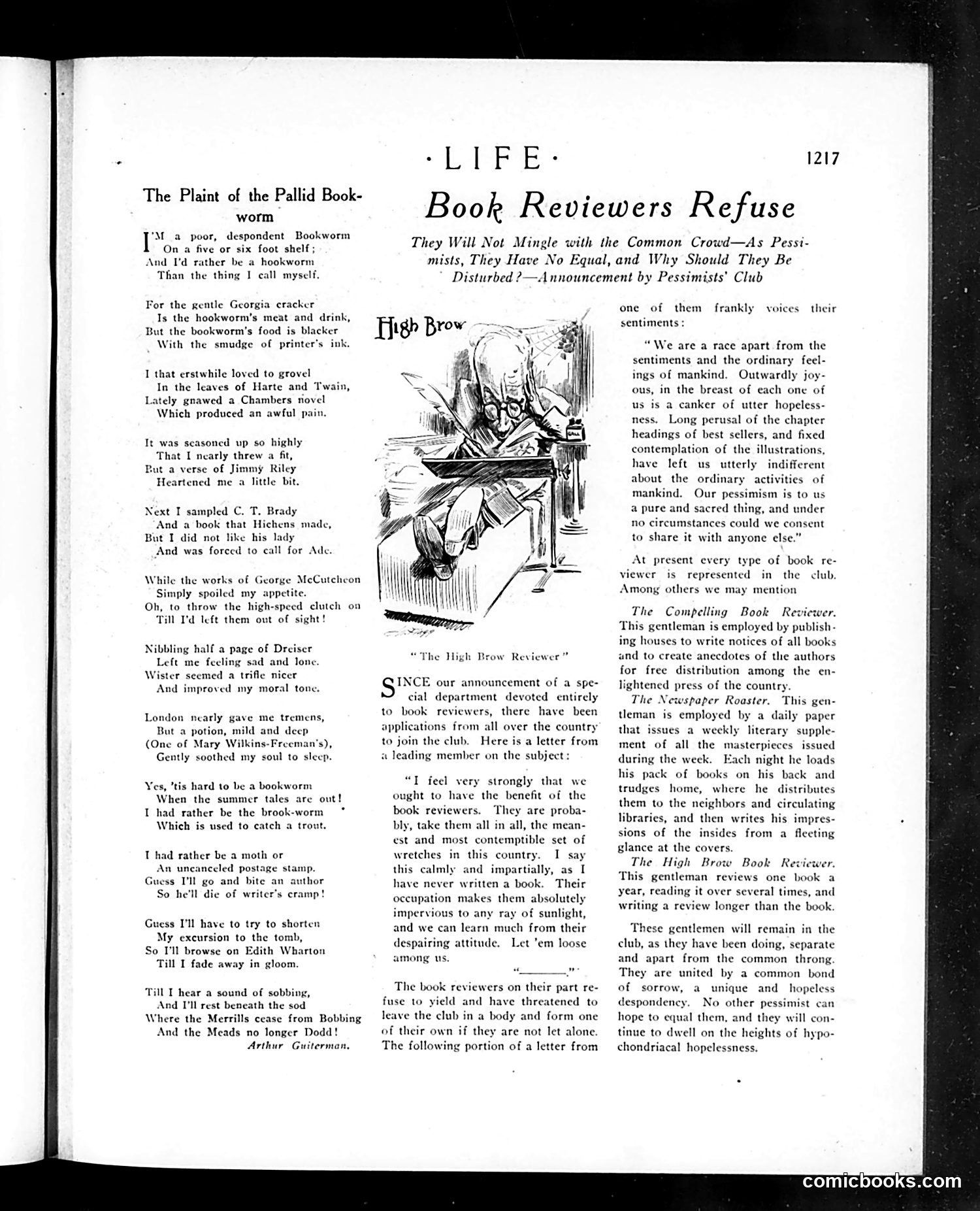
This page satirizes professional book reviewers as an elite, self-important, and perpetually miserable class. The main cartoon depicts "The High Brow Reviewer"—a thin, hunched figure absorbed in reading, representing the stereotype of the pretentious literary critic. The accompanying article mocks reviewers' refusal to socialize with ordinary people, claiming they constitute "a race apart" bound by shared pessimism and hopelessness. It catalogs different reviewer types: those hired by publishers to manufacture praise and anecdotes, and newspaper reviewers who treat literature with grim solemnity. The adjacent poem "The Plaint of the Pallid Bookworm" humorously lists contemporary authors (George McCutcheon, Theodore Dreiser, Owen Wister, Jack London, Edith Wharton, etc.), suggesting modern popular fiction is so poorly written it causes physical distress—a complementary jab at both reviewers' disdain for commercial literature and authors' perceived mediocrity. The satire targets early 20th-century literary snobbery and critics' affected superiority.
📄 Transcribed text from this page (OCR, searchable)
Machine-transcribed from the original scan — historical spelling and the odd misread are preserved.
The Plaint of the Pallid Book- worm ‘Ma poor, despondent Bookworm On a five or six foot shelf; And I'd rather be a hookworm Than the thing I call myself. For the gentle Georgia cracker Is the hookworm’s meat and drink, But the bookworm’s food is blacker With the smudge of printer's ink. I that erstwhile loved to grovel In the leaves of Harte and Twain, Lately gnawed a Chambers tiovel Which produced an awful pain. It was seasoned up so highly That I nearly threw a fit, But a verse of Jimmy Riley Heartened me a little bit. Next I sampled C. T. Brady And a book that Hichens made, But I did not like his lady And was forced to call for Ade. While the works of George McCutcheon Simply spoiled my Oh, to throw the high-speed clutch on ill I'd left them out of sight! Nibbling half a page of Dreiser Left me feeling sad and lone. Wister seemed a trifle nicer And improved my moral tone. London nearly gave me tremens, But a potion, mild and deep (One of Mary Wilkins-Freeman’s), Gently soothed my soul to sleep. Yes, ’tis hard to be a bookworm When the summer tales are out! I had rather be the brook-worm Which is used to catch a trout. T had rather be a moth or An uncanceled postage stamp. Guess I'll go and bite an author So he'll die of writer's cramp! Guess I'll have to try to shorten My excursion to the tomb, So I'll browse on Edith Wharton Till I fade away in gloom. Till I hear a sound of sobbing, And I'll rest beneath the sod Where the Merrills cease from Bobbing And the Meads no longer Dodd! Arthur Guiterman, ‘LEPE* Book Reviewers Refuse They Will Not Mingle ith the Common Crowd—As Pessi- mists, They Have No Equal, and Why Should They Be Disturbed ?—Announcement by Pessimists’ Club The High Brow Reviewer” INCE our announcement of a spe- cial department devoted entirely to book reviewers, there have been applications from all over the country to join the club. Here is a letter from a leading member on the subject: “I feel very strongly that we ought to have the benefit of the book reviewers. They are proba- bly, take them all in all, the mean- est and most contemptible set of wretches in this country. I say this calmly and impartially, as I ‘¢ never written a book, Their occupation makes them absolutely impervious to any ray of sunlight, and we can learn much from their despairing attitude, Let 'em loose among us. The book reviewers on their part re- fuse to yield and have threatened to leave the club in a body and form one of their own if they are not let alone. The following portion of a letter from one of them voices their sentiments : frankly “We are a race apart from the sentiments and the ordinary feel- ings of mankind. Outwardly joy- in the breast of each one of us is a canker of utter hopeless- ness. Long perusal of the chapter headings of best sellers, and fixed contemplation of the illustrations, have left us utterly indifferent about the ordinary activities of mankind. Our pessimism is to us a pure and sacred thing, and under no circumstances could we consent to share it with anyone else.” At present every type of book re- viewer is represented in the club. Among others we may mention The Compelling Book Reviewer. This gentleman is employed by publish- ing houses to write notices of all books und to create anecdotes of the authors for free distribution among the en- lightened press of the country. The Newspaper Roaster. This gen- tleman is employed by a daily paper that issues a weekly literary supple- ment of all the masterpieces issued during the week. Each night he loads his p; of books on his back and trudges home, where he distributes them to the neighbors and circulating libraries, and then writes his impres- sions of the insides from a fleeting glance at the covers. The High Brow Book Reviewer. This gentleman reviews one book a year, reading it over several times, and writing a review longer than the book These gentlemen will remain in the club, as they have been doing, separate and apart from the common throng. They are united by a common bond of sorrow, a unique and despondency, No other pessimist can hope to equal them, and they will con- tinue to dwell on the heights of hypo- chondriacal hopelessness. hopeless comicbooks.com