
Life, 1912-06-13 · page 28 of 44
Life — June 13, 1912 — page 28: what you’re looking at
What you’re looking at
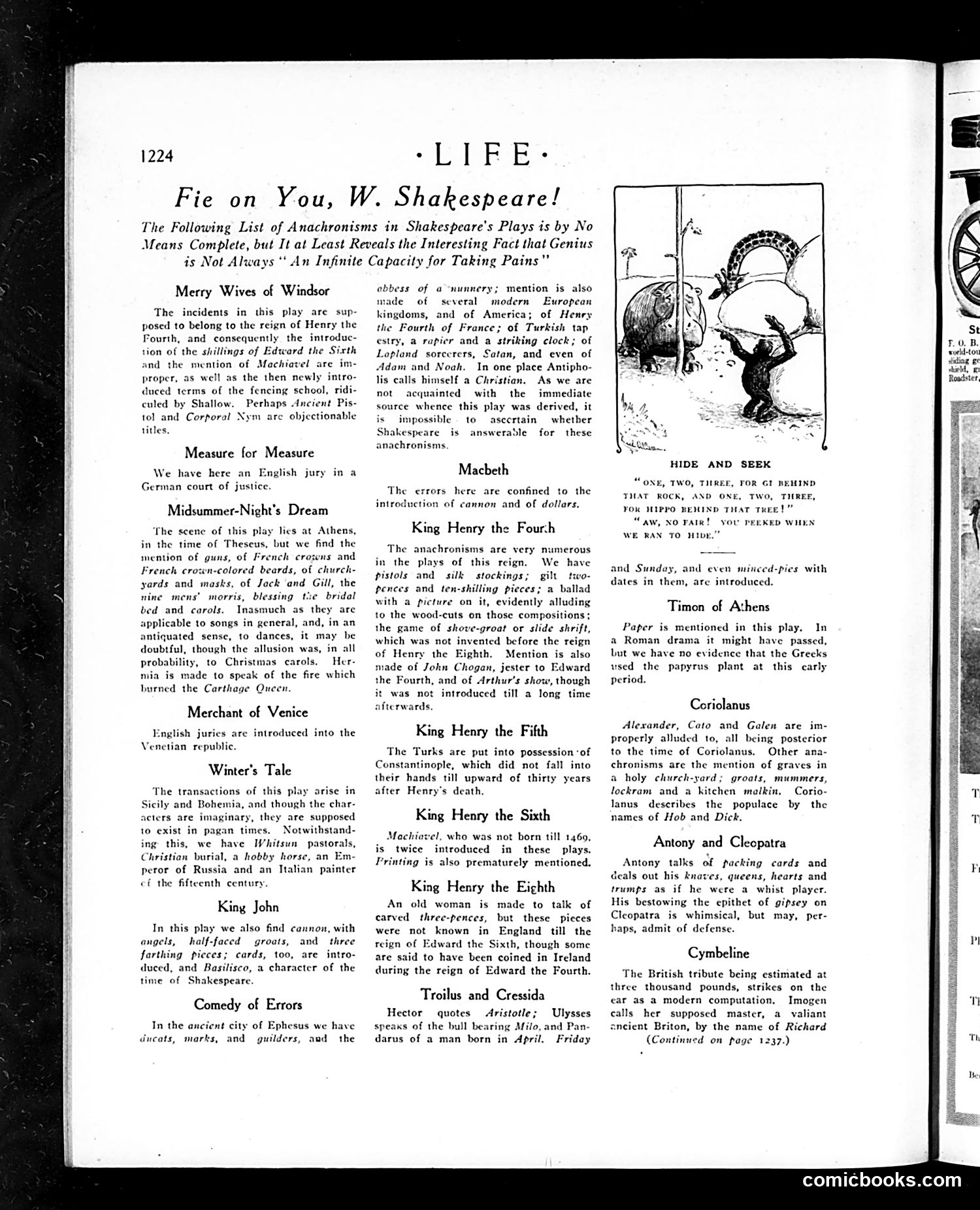
This page satirizes Shakespeare's historical inaccuracies—anachronisms appearing in his plays. The accompanying cartoon (titled "Hide and Seek") shows children playing, likely illustrating how Shakespeare himself was careless with historical details, like a child playing rather than studying. The text catalogs factual errors across multiple plays: *Midsummer-Night's Dream* references guns in ancient Athens; *Winter's Tale* includes Christian elements in pagan times; *King Henry the Fifth* places Turks in Constantinople decades before they actually conquered it; *King Henry the Sixth* mentions Machiavelli before his birth in 1460. The satire's point, stated in the subtitle, is that **genius doesn't guarantee meticulous accuracy**—Shakespeare's literary brilliance didn't require historical precision. For modern readers, this reflects how Renaissance dramatists prioritized dramatic effect over factual authenticity, a practice modern audiences might find surprising given Shakespeare's revered status.
📄 Transcribed text from this page (OCR, searchable)
Machine-transcribed from the original scan — historical spelling and the odd misread are preserved.
1224 ze Wel eid oie Fie on You, W. Shakespeare! The Following List of Anachronisms in Shakespeare's Plays is by No Means Complete, but It at Least Reveals the Interesting Fact that Genius is Not Always ‘‘ An Infinite Capacity for Taking Pains’ Merry Wives of Windsor The incidents in this play posed to belong to the reign of Henry the Fourth, and consequently the introduc- tion of the shillings of Edward the Sixth and the mention of Machiavel are proper, as well as the then newly intro- duced terms of the fencing school, ridi- culed by Shallow, Perhaps Ancient Pis- tol and Corporal Nym are objectionable titles. are sup- Measure for Measure We have here an glish jury in a German court of justice. Midsummer-Night’s Dream ‘The scene of this play lies at Athens, in the time of Theseus, but we find the mention of guns, of French crowns and French crown-colored beards, of church- yards and masks, of Jock and Gill, the nine mens’ morris, blessing the bridal bed and carols. Inasmuch as they are applicable to songs in general, and, in an antiquated sense, to dances, it may be doubtful, though the allusion was, in all probability, to Christmas carols. Her- mia is made to speak of the fire which burned the Carthage Queen. Merchant of Venice English juries are introduced into the Venetian republic. Winter's Tale The transactions of this play arise in Sicily and Bohemia, and though the char- are imaginary, they are supposed to exist in pagan times. Notwithstand- ing this, we have IMWhitsun pastorals, Christian burial, a hobby horse, an Em- peror of Russia and an Italian painter cf the fifteenth century. King John In this play we also find cannon, with angels, half-faced groats, and three farthing picces; cards, too, are intro- duced, and Basilisco, a character of the time of Shakespeare. Comedy of Errors In the ancient city of Ephesus we have ducats, marks, and guilders, aud the mention is also le of several modern European kingdoms, and of America; of Henry the Fourth of France; of Turkish tap estry, a rapier and a striking clock; of Lopland sorcerers, Satan, and even of Adam and Noak. In one place Antipho- lis calls himself a Christian. As we are not acquainted with the immediate source whence this play derived, it is impossible 10 ascertain whether answerable for these abbess of a nunnery; Shakespeare is anachronisms. Macbeth The errors here are confined to the introduction of cannon and of dollars. King Henry the Fourch The anachronisms are very numerous in the plays of this reign. We have pistols and silk stockings; gilt. two- Pences and ten-shilling pieces; a ballad with a picture on it, evidently alluding to the wood-cuts on those compositions ; the game of shove-groat or slide shrift, which was not invented before the reign of Henry the Eighth. Mention is also made of John Chogan, j ‘dward the Fourth, and of Arthur’s show, though it was not introduced till a long time afterwards, King Henry the Fifth The Turks are put into possession ‘of Constantinople, which did not fall into their hands till upward of thirty years after Henry's death. King Henry the Sixth Machiavel, who was not born till 1460, is twice introduced in these plays. Printing is also prematurely mentioned. King Henry the Eighth An old woman is made to talk of carved three-pences, but these pieces were not known in England till the reign of Edward the Sixth, though some are said to have been coined in Ireland during the reign of Edward the Fourth. Troilus and Cressida Hector quotes Aristotle ; speaxs of the bull bearing Milo, darus of a man born in April. Ulysses Serene HIDE AND SEEK “ONE, TWO, THREE, TOR GI KEMIND THAT ROCK, AND ONE, TWO, THREE, FOR MIPPO REMIND THAT TK “aw, NO FAIR! YOU PEEKED WHEN WE RAN TO IDE.” and Sunday, and even minced-pies with dates in them, are introduced. Timon of Athens Paper is mentioned in this play. In a Roman drama it might have passed, but we have no evidence that the Greeks used the papyrus plant at this carly period. Coriolanus Alexander, Coto and Galen are im- properly alluded to, all being posterior to the time of Coriolanus. Other ana- chronisms are the mention of graves in a holy church-yard; groats, mummers, lockram and a kitchen malkin, Corio- lanus describes the populace by the names of Hob and Dick. Antony and Cleopatra Antony talks of packing cards and deals out his knaves, queens, hearts and trumps as if he were a whist player. His bestowing the epithet of gipsey on Cleopatra is whimsical, but may, per- haps, admit of defen Cymbeline The British tribute being estimated at three thousand pounds, strikes on the ear as a modern computation. Imogen calls her supposed master, a valiant ancient Briton, by the name of Richard (Continued on page 1237.) comicbooks.com