
Life, 1912-06-13 · page 19 of 44
Life — June 13, 1912 — page 19: what you’re looking at
What you’re looking at
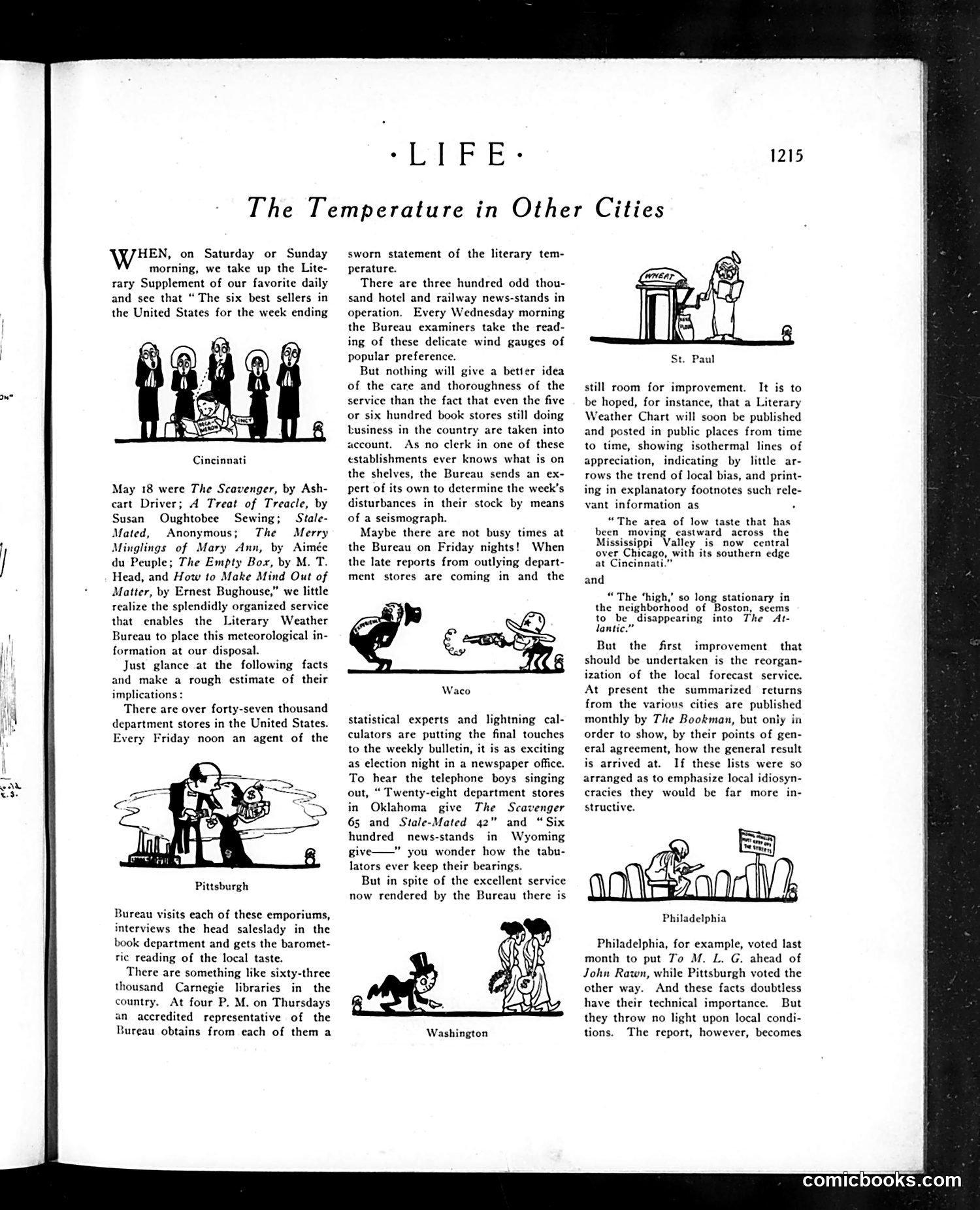
This satirical piece mocks the "Literary Weather Bureau"—a fictional organization that tracks weekly bestseller lists as if they were meteorological data. The joke: Life treats book sales with absurd scientific precision, deploying agents to 47,000+ department stores, libraries, and newsstands weekly to measure "literary temperature." The cartoons accompanying the text show cities (Cincinnati, Pittsburgh, Waco, Washington, Philadelphia, St. Paul) personified as locations receiving these weather forecasts, complete with illustrated characters. The satire targets the era's obsession with quantifying culture and publishing trends. By weaponizing scientific methodology against something inherently subjective—taste—Life ridicules both the publishing industry's marketing apparatus and readers' tendency to follow bestseller lists uncritically. The piece also gently mocks regional literary preferences, noting Philadelphia and Pittsburgh's diverging votes on book rankings, suggesting local "bias" in reading habits.
📄 Transcribed text from this page (OCR, searchable)
Machine-transcribed from the original scan — historical spelling and the odd misread are preserved.
HEN, on Saturday or Sunday morning, we take up the Lite- rary Supplement of our favorite daily and see that “ The six best sellers in the United States for the week ending Cincinnati May 18 were The Scavenger, by Ash- cart Driver; A Treat of Treacle, by Susan Oughtobee Sewing; Stale- Mated, Anonymous; The Merry Minglings of Mary Ann, by Aimée du Peuple; The Empty Box, by M. T. Head, and How to Make Mind Out of Matter, by Ernest Bughouse,” we little realize the splendidly organized service that enables the Literary Weather Bureau to place this meteorological in- formation at our disposal. Just glance at the following facts and make a rough estimate of their implications : There are over forty-seven thousand department stores in the United States. Every Friday noon an agent of the Pittsburgh Bureau visits each of these emporiums, interviews the head saleslady in the book department and gets the baromet- ric reading of the local taste. There are something like sixty-three thousand Carnegie libraries in the country. At four P. M. on Thursdays an accredited representative of the Bureau obtains from each of them a -LIFE: The Temperature in Other sworn statement of the literary tem- perature. There are three hundred odd thou- sand hotel and railway news-stands in operation. Every Wednesday morning the Bureau examiners take the read- ing of these delicate wind gauges of popular preference. But nothing will give a better idea of the care and thoroughness of the service than the fact that even the five or six hundred book stores still doing business in the country are taken into uccount. As no clerk in one of these establishments ever knows what is on the shelves, the Bureau sends an ex- pert of its own to determine the week’s disturbances in their stock by means of a seismograph. Maybe there are not busy times at the Bureau on Friday nights! When the late reports from outlying depart- ment stores are coming in and the statistical experts and lightning cal- culators are putting the final touches to the weekly bulletin, it is as exciting as election night in a newspaper office. To hear the telephone boys singing out, “ Twenty-eight department stores in Oklahoma give The Scavenger 65 and Stale-Mated 42" and “Six hundred news-stands in Wyoming give——" you wonder how the tabu- lators ever keep their bearings. But in spite of the excellent service now rendered by the Bureau there is Washington still room for improvement. It is to be hoped, for instance, that a Literary Weather Chart will soon be published and posted in public places from time to time, showing isothermal lines of appreciation, indicating by little ar- rows the trend of local bias, and print- ing in explanatory footnotes such rele- vant information as “The area of low taste that has been moving eastward across the Mississippi Valley is now central over Chicago, with its southern edge at Cincinnati.” and “The ‘high,’ so long stationary in the neighborhood of Boston, seems to be disappearing into The At- lantic.” But the first. improvement that should be undertaken is the reorgan- ization of the local forecast service. At present the summarized returns from the various cities are published monthly by The Bookman, but only in order to show, by their points of gen- eral agreement, how the general result is arrived at. If these lists were so arranged as to emphasize local idiosyn- cracies they would be far more in- structive. Philadelphia Philadelphia, for example, voted last month to put To M. L. G. ahead of John Rawn, while Pittsburgh voted the other way. And these facts doubtless have their technical importance. But they throw no light upon local condi- tions. The report, however, becomes. comicbooks.com