
Life, 1912-06-13 · page 14 of 44
Life — June 13, 1912 — page 14: what you’re looking at
What you’re looking at
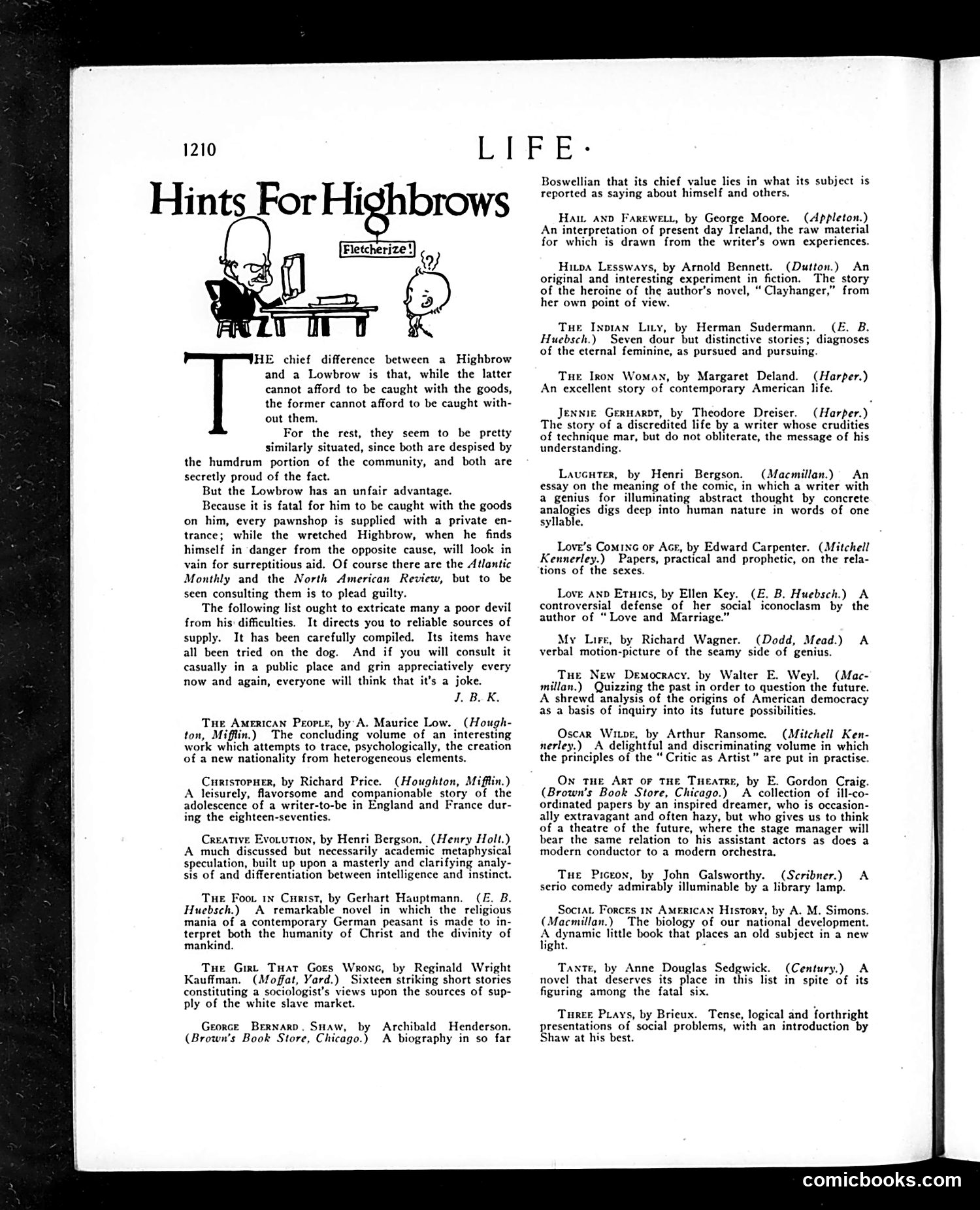
This page is a book review section, not a political cartoon. The small illustration at top shows two figures labeled "Fletcherize" — a man and woman at a dining table, demonstrating a contemporary dietary fad. "Fletcherizing" referred to thorough mastication (chewing) of food, promoted by nutritionist Horace Fletcher in the early 1900s. The accompanying essay humorously contrasts "Highbrows" and "Lowbrows," suggesting highbrows cannot be caught consuming goods publicly (appearing refined), while lowbrows eat unself-consciously. The joke: highbrows must pretend not to eat, creating awkward social performance. The page then lists book reviews of contemporary literature, mostly focusing on social themes and character studies popular in that era.
📄 Transcribed text from this page (OCR, searchable)
Machine-transcribed from the original scan — historical spelling and the odd misread are preserved.
1210 Hints JHE chief difference between a Highbrow and a Lowbrow is that, while the latter cannot afford to be caught with the goods, the former cannot afford to be caught with- out them. For the rest, they seem to be pretty similarly situated, since both are despised by the humdrum portion of the community, and both are secretly proud of the fact. But the Lowbrow has an unfair advantage. Because it is fatal for him to be caught with the goods on him, every pawnshop is supplied with a private en- trance; while the wretched Highbrow, when he finds himself in danger from the opposite cause, will look in vain for surreptitious aid. Of course there are the Atlantic Monthly and the North American Review, but to be seen consulting them is to plead guilty. The following list ought to extricate many a poor devil from his: difficulties. It directs you to reliable sources of supply. It has been carefully compiled. Its items have all been tried on the dog. And if you will consult it casually in a public place and grin appreciatively every now and again, everyone will think that it's a joke. J. BLK. Tue American Peopte, by’A. Maurice Low. (Hough- ton, Mifflin.) The concluding volume of an interesting work which attempts to trace, psychologically, the creation of a new nationality from heterogencous elements. CuristorHer, by Richard Price. (Houghton, Mifflin.) A leisurely, flavorsome and companionable story of the adolescence of a writer-to-be in England and France dur- ing the cighteen-seventies. Creative Evo.ution, by Henri Bergson. (Henry Holt.) A much discussed but necessarily academic metaphysical speculation, built up upon a masterly and clarifying analy- sis of and differentiation between intelligence and instinct. Tue Foot 1n Curtst, by Gerhart Hauptmann. (E. B. Huebsch.) A remarkable novel in which the religious mania of a contemporary German peasant is made to in- terpret both the humanity of Christ and the divinity of mankind. Tue Girt THat Goes Wronc, by Reginald Wright Kauffman. (Moffat, Yard.) Sixteen striking short stories constituting a sociologist’s views upon the sources of sup- ply of the white slave market. Georce Bernarp. SHaw, by Archibald Henderson. (Brown’s Book Store, Chicago.) A biography in so far L.PFE Boswellian that its chief value lies in what its subject is reported as saying about himself and others. Hau. anv Farewett, by George Moore. (dppleton.) An interpretation of present day Ireland, the raw material for which is drawn from the writer’s own experiences. Hitpa Lessways, by Arnold Bennett. (Dutton.) An original and interesting experiment in fiction. The story of the heroine of the author’s novel, “ Clayhanger,” from her own point of view. Tue Inptan Lity, by Herman Sudermann. (E. B. Huebsch.) Seven dour but distinctive stories; diagnoses of the eternal feminine, as pursued and pursuing. Tur Iron Wosan, by Margaret Deland. (Harper.) An excellent story of contemporary American life. Jennie Gernarvt, by Theodore Dreiser. (Harper.) The story of a discredited life by a writer whose crudities of technique mar, but do not obliterate, the message of his understanding. Laucuter, by Henri Bergson. (Macmillan.) An essay on the meaning of the comic, in which a writer with a genius for illuminating abstract thought by concrete analogies digs deep into human nature in words of one syllable. Love’s Cominc or Ace, by Edward Carpenter. (Mitchell Kennerley.) Papers, practical and prophetic, on the rela- tions of the sexes. Love anv Eruics, by Ellen Key. (E. B. Huebsch.) A controversial defense of her social iconoclasm by the author of “Love and Marriage.” My Lire, by Richard Wagner. (Dodd, Mead.) A verbal motion-picture of the seamy side of genius. Tue New Democracy. by Walter E. Weyl. (Mac- millan.) Quizzing the past in order to question the future. A shrewd analysis of the origins of American democracy as a basis of inquiry into its future possibilities. Oscar Witpe, by Arthur Ransome. (Mitchell Ken- nerley,) A delightful and discriminating volume in which the principles of the “Critic as Artist” are put in practise. On tHE Art or THE THeatTrE, by E. Gordon Craig. (Brown's Book Store, Chicago.) A collection of ill-co- ordinated papers by an inspired dreamer, who is occasion- ally extravagant and often hazy, but who gives us to think of a theatre of the future, where the stage manager will bear the same relation to his assistant actors as does a modern conductor to a modern orchestra. Tue Picton, by John Galsworthy. (Scribner.) A serio comedy admirably illuminable by a library lamp. Soctat. Forces 1s American History, by A. M. Simons. (Macmillan.) The biology of our national development. fy dyaamic little book that places an old subject in a new ight. Tante, by Anne Douglas Sedgwick. (Century.) A novel that deserves its place in this list in spite of its figuring among the fatal six. Turce Prays, by Brieux. Tense, logical and forthright presentations of social problems, with an introduction by Shaw at his best. comicbooks.com