
A complete issue · 58 pages · 1912
Life — May 2, 1912
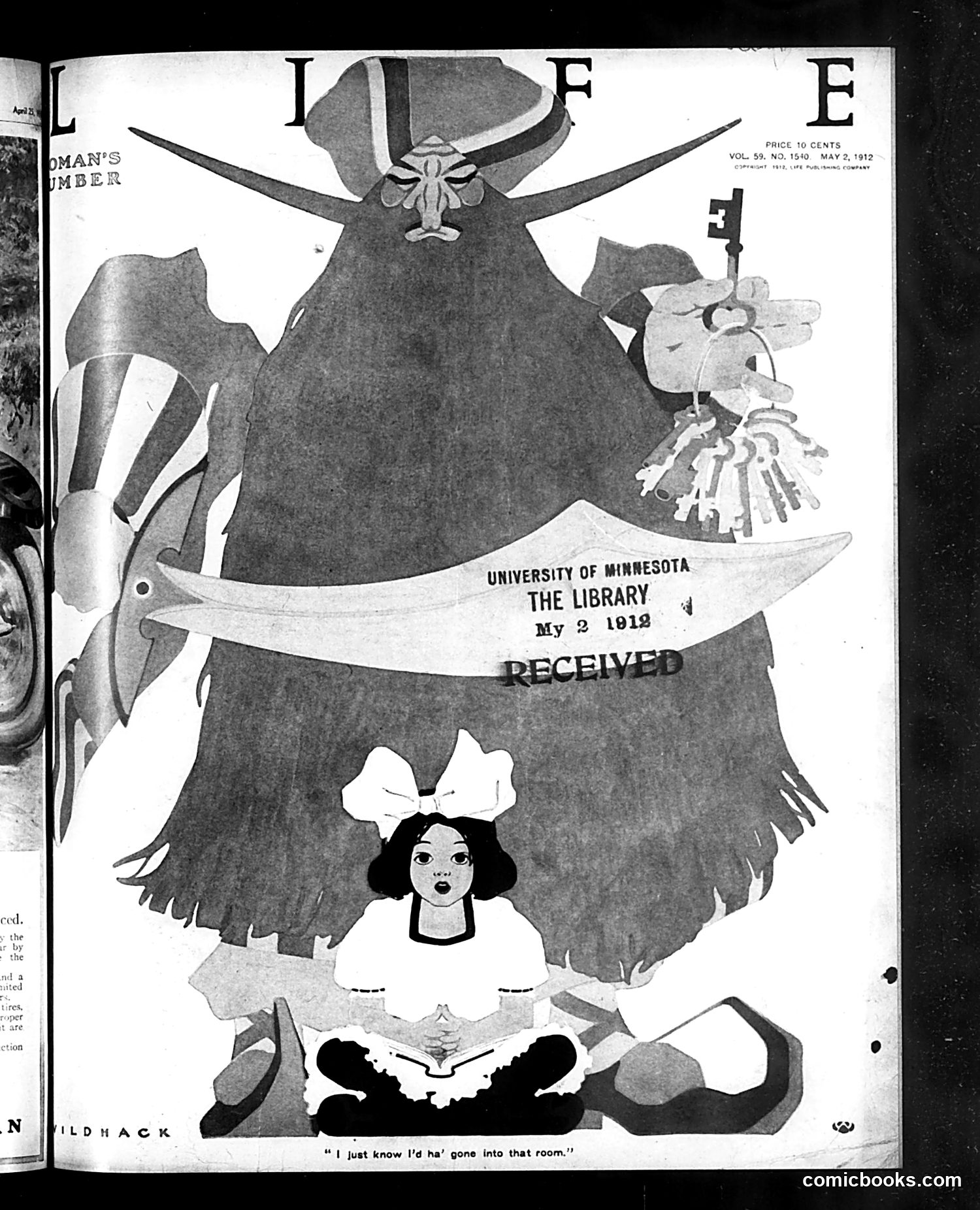
This satirical cover depicts a large, menacing woman in dark clothing towering over a small frightened girl. The large figure wears an elaborate hat and holds what appears to be keys or a large ring of implements, suggesting authority or control. The small girl below wears a large bow and looks terrified. The caption reads: "I just know I'd ha' gone into that room." This appears to be social satire about maternal authority and domestic discipline—likely depicting a stern mother figure threatening punishment. The exaggerated scale emphasizes the child's vulnerability and fear. The "room" reference may allude to punishment or confinement, common disciplinary practices of the era. The overall message satirizes strict Victorian-era parenting approaches.
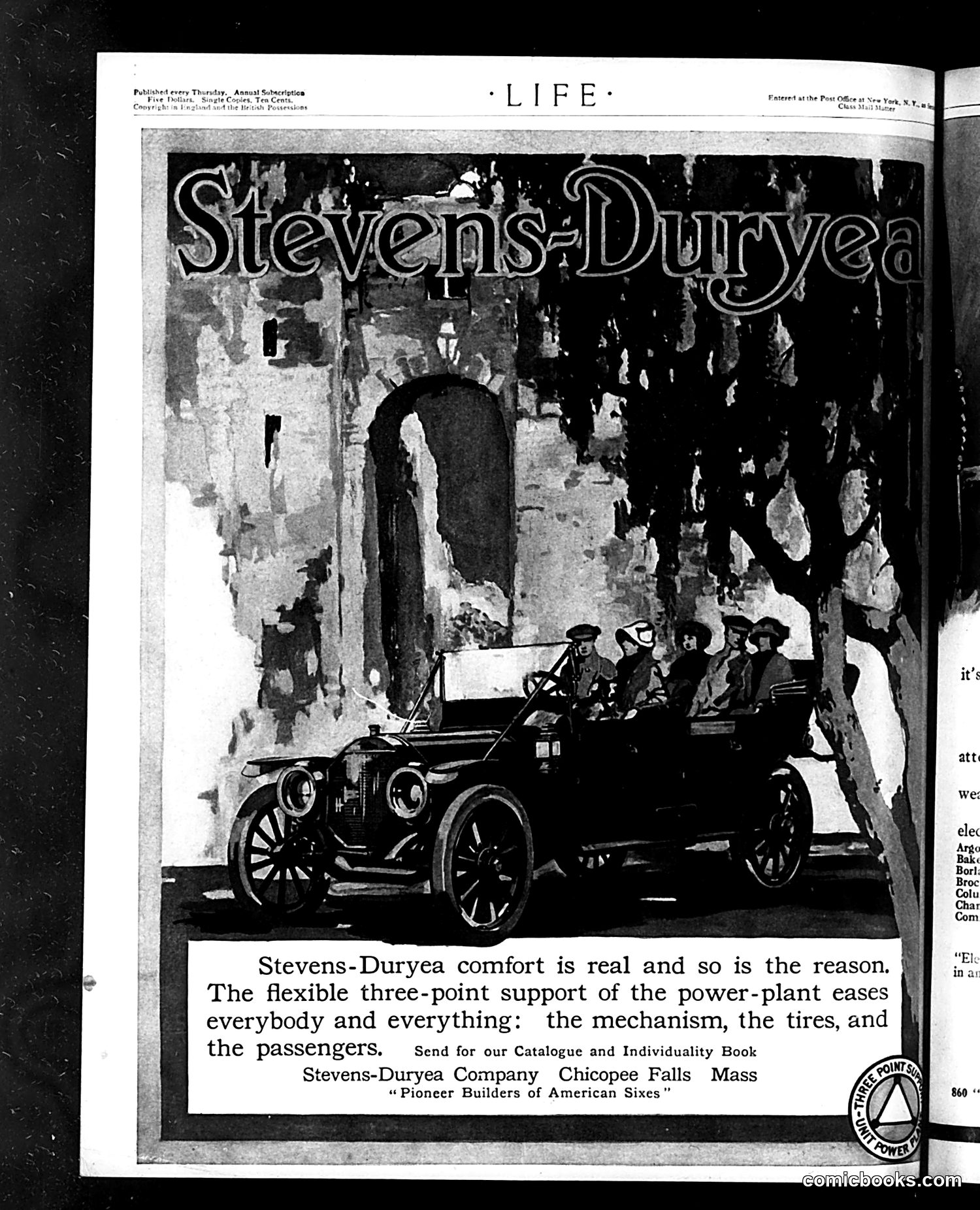
This page is primarily a **commercial advertisement**, not political satire. It features a Stevens-Duryea automobile driving through what appears to be a historic European archway or fortification. The ad emphasizes the car's comfort features, specifically highlighting its "flexible three-point support of the power-plant" that supposedly eases stress on "the mechanism, the tires, and the passengers." The dramatic castle/fortress backdrop suggests prestige and durability. The Stevens-Duryea Company, based in Chicopee Falls, Massachusetts, markets itself as "Pioneer Builders of American Sixes"—referring to six-cylinder engines. This represents early automotive advertising from Life magazine's tradition of combining humor with commercial messaging, though this particular page leans heavily toward straightforward product promotion rather than satire.
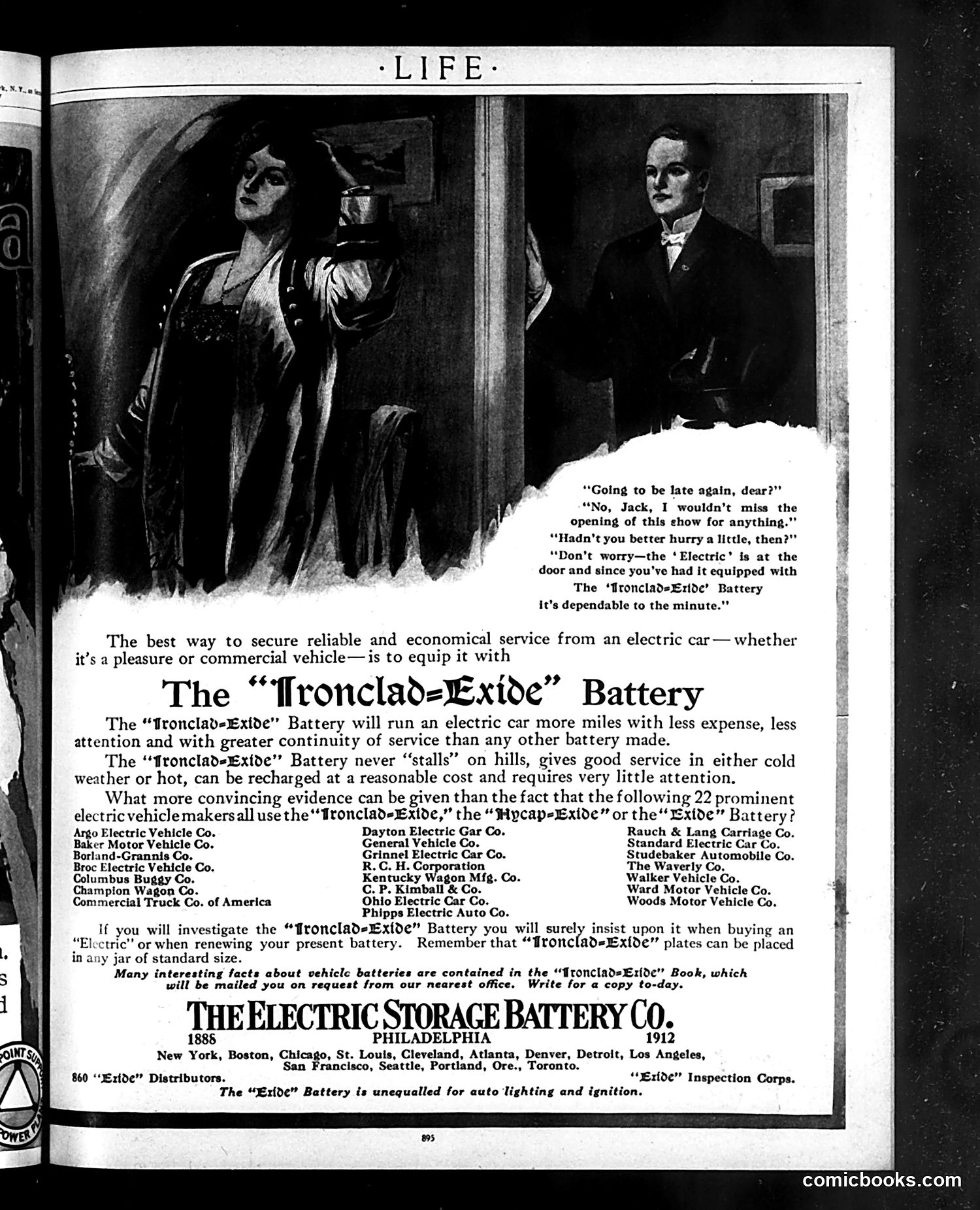
This page is primarily **advertising, not satire or political commentary**. The small illustrated scene at the top depicts a domestic conversation between a well-dressed couple about attending a theater show. The woman worries about being late; the man reassures her they have time because their electric car has a "Ironcalad-Exide" battery—implying reliable, punctual transportation. The illustration serves as a framing device for the advertisement below, which promotes Ironcalad-Exide batteries for electric vehicles. The ad lists dozens of electric car manufacturers and distributors who used these batteries, emphasizing reliability and longevity. This reflects the early 1900s context when electric vehicles were common luxury items before gasoline engines dominated the market. The "LIFE" magazine page demonstrates how advertisements in this era used genteel domestic scenarios to market products to affluent readers.
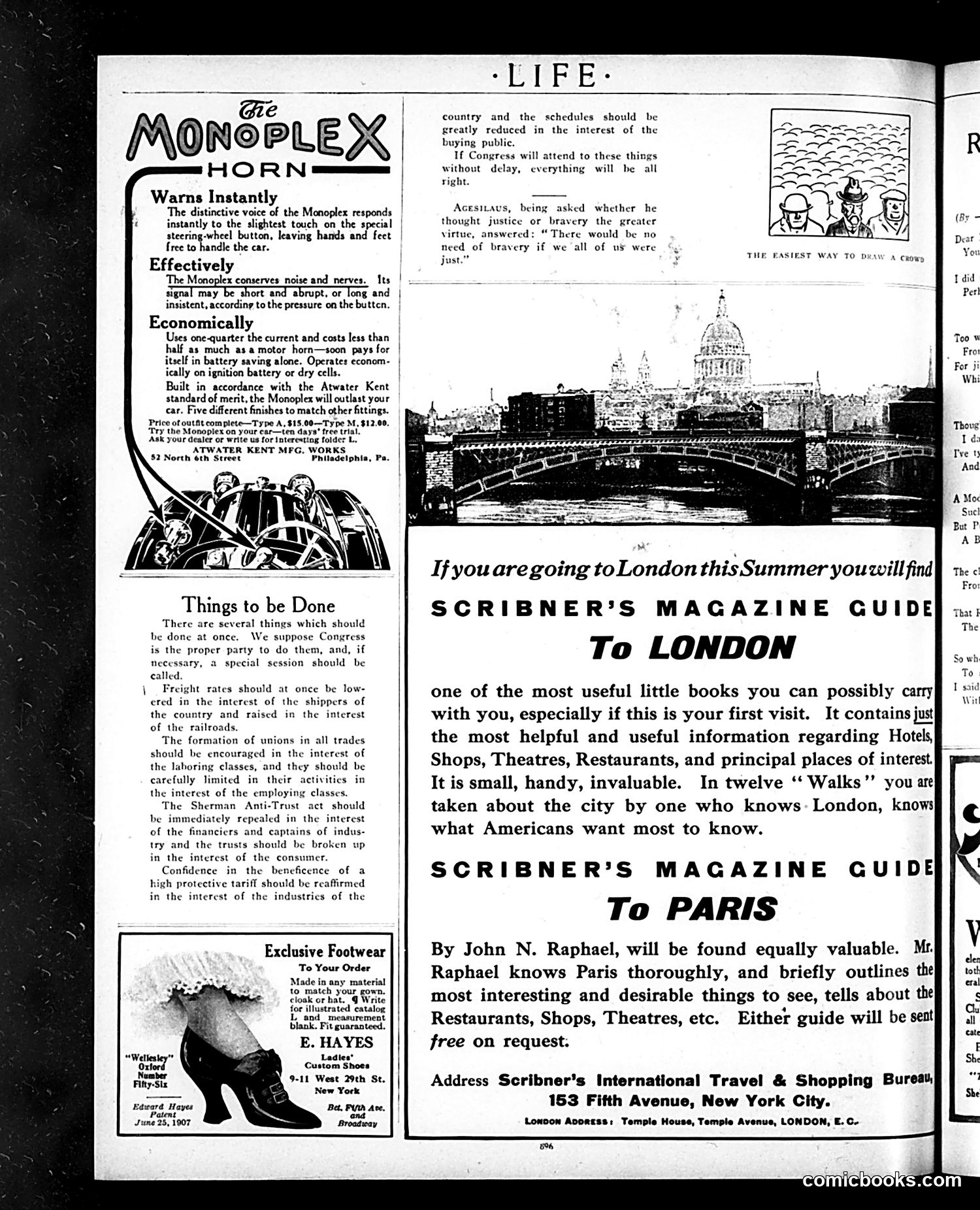
This page is primarily **advertising** rather than political satire. The left side promotes the Monoplex Horn (an automobile horn made by Atwater Kent), emphasizing its loud, effective warning capabilities. The center features a scenic photograph of London with the Capitol building visible, advertising **Scribner's Magazine Guide to London** and **Guide to Paris**. These are travel guides marketed to Americans planning European summer trips. The bottom left advertises **E. Hayes Ladies' Custom Shoes** ("Whiteley" oxford style). The right side contains partial text from editorial content, including a quote from **Agesilaos** about bravery, though the full political or satirical context is cut off and unclear from this image alone.
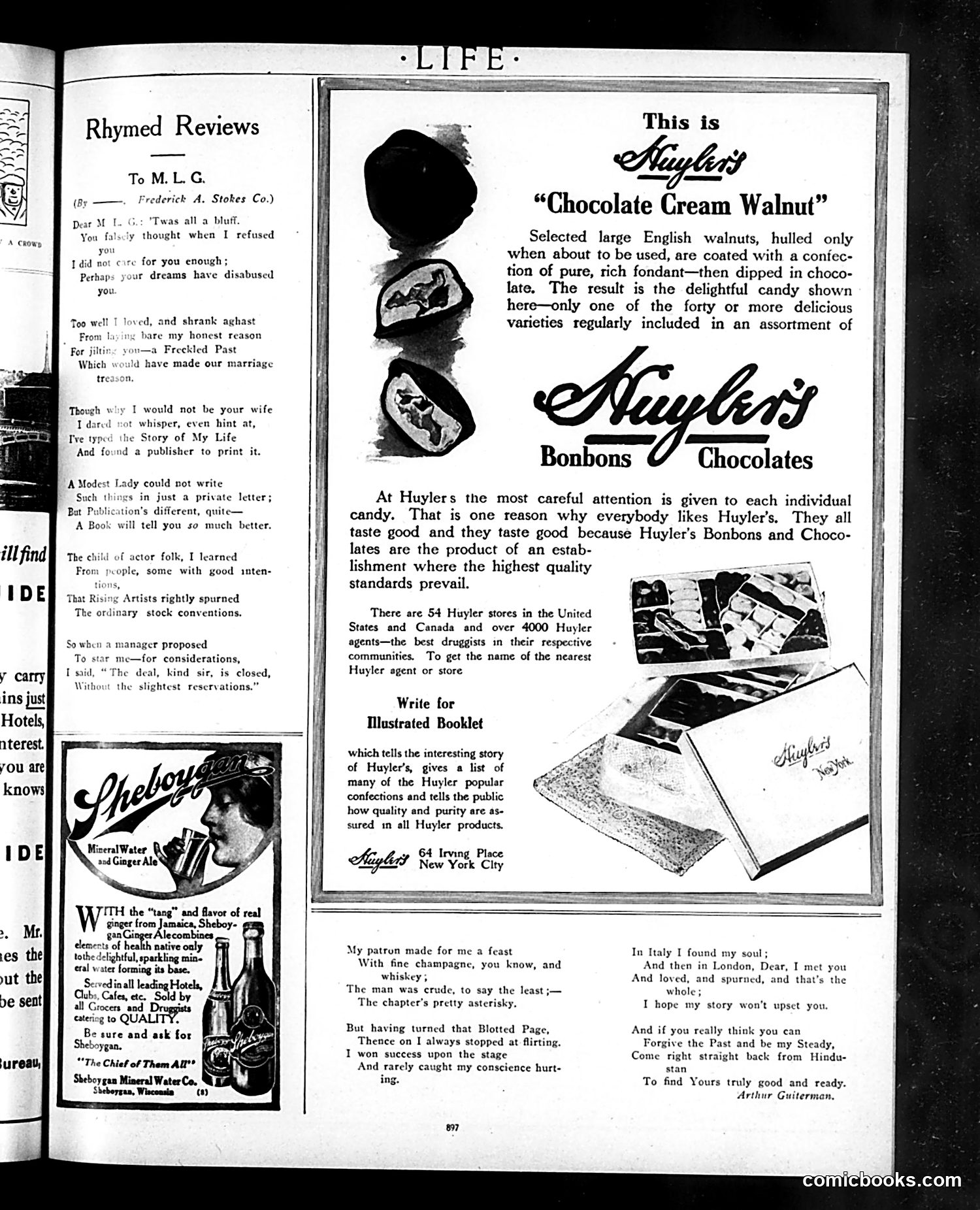
This page is **primarily advertising**, not political satire. The right side features a large Huyler's Bonbons and Chocolates advertisement showcasing their "Chocolate Cream Walnut" candy, with product images and text about quality standards and distribution. The left side contains two distinct elements: a "Rhymed Reviews" poem (a regular Life magazine feature) addressed "To M.L.G." that appears to be a personal satirical verse about a refused marriage proposal, and below it, a Sheboygan Mineral Water advertisement. The "Rhymed Reviews" section uses humorous verse to mock someone's romantic rejection and their attempt to publish their story—a social commentary on spurned suitors and vanity publishing. However, without additional context identifying "M.L.G.," the specific target remains unclear.
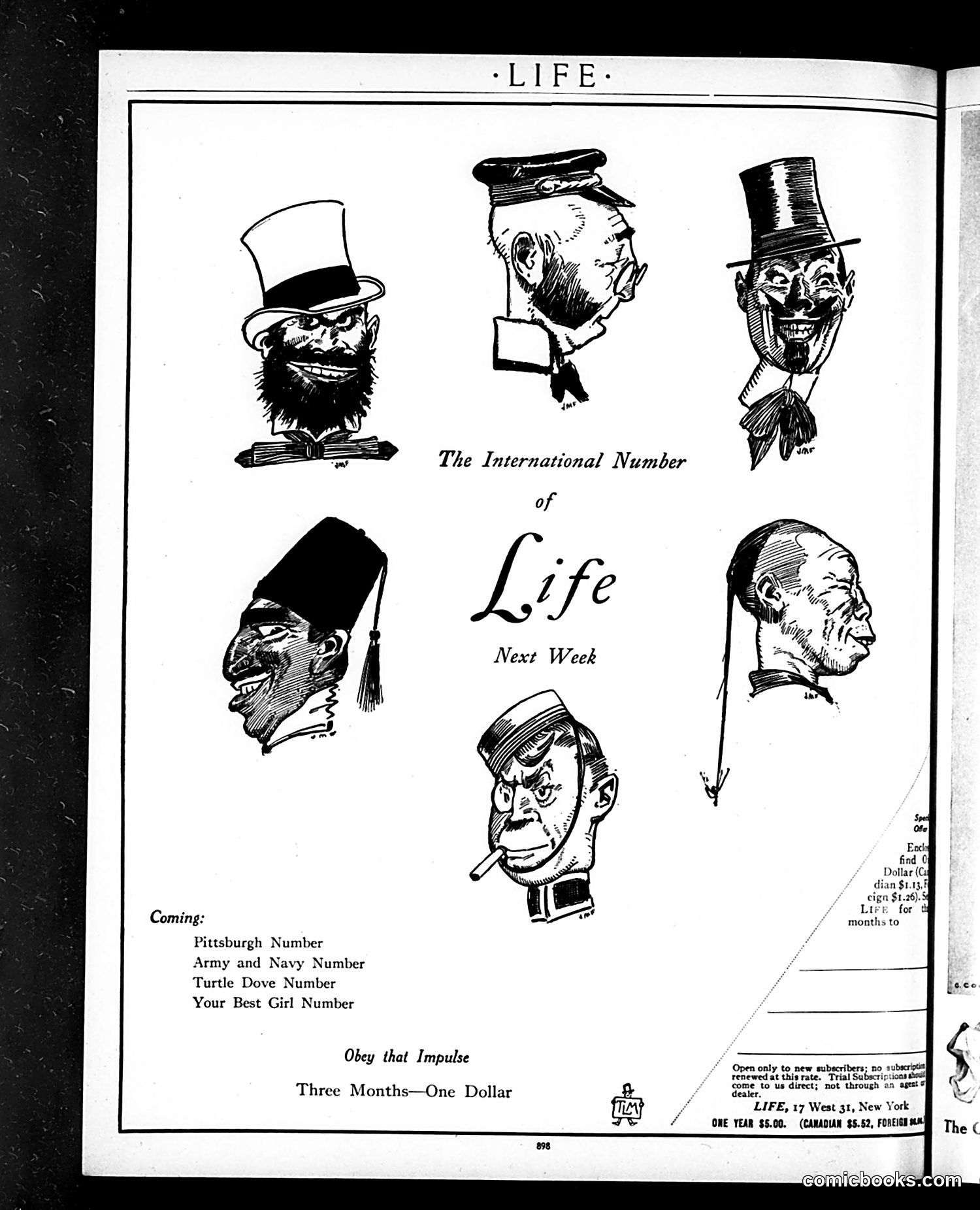
This is primarily a **promotional advertisement** for *Life* magazine's upcoming issues, not political commentary. The page features six caricatured male heads wearing various formal hats (top hats, military caps, fez), arranged around text announcing "The International Number of Life Next Week." The heads appear to represent different **international or ethnic types**—suggested by their distinct facial features and headwear styles. This reflects early 20th-century *Life* magazine's satirical approach to depicting global figures and cultures through exaggerated caricature. The advertisement promotes upcoming special issues (Pittsburgh, Army and Navy, Turtle Dove, "Your Best Girl") and subscription rates. The phrase "Obey that Impulse / Three Months—One Dollar" serves as a sales pitch. The caricatures were typical of the era's satirical humor, though such ethnic stereotyping would be considered offensive today.
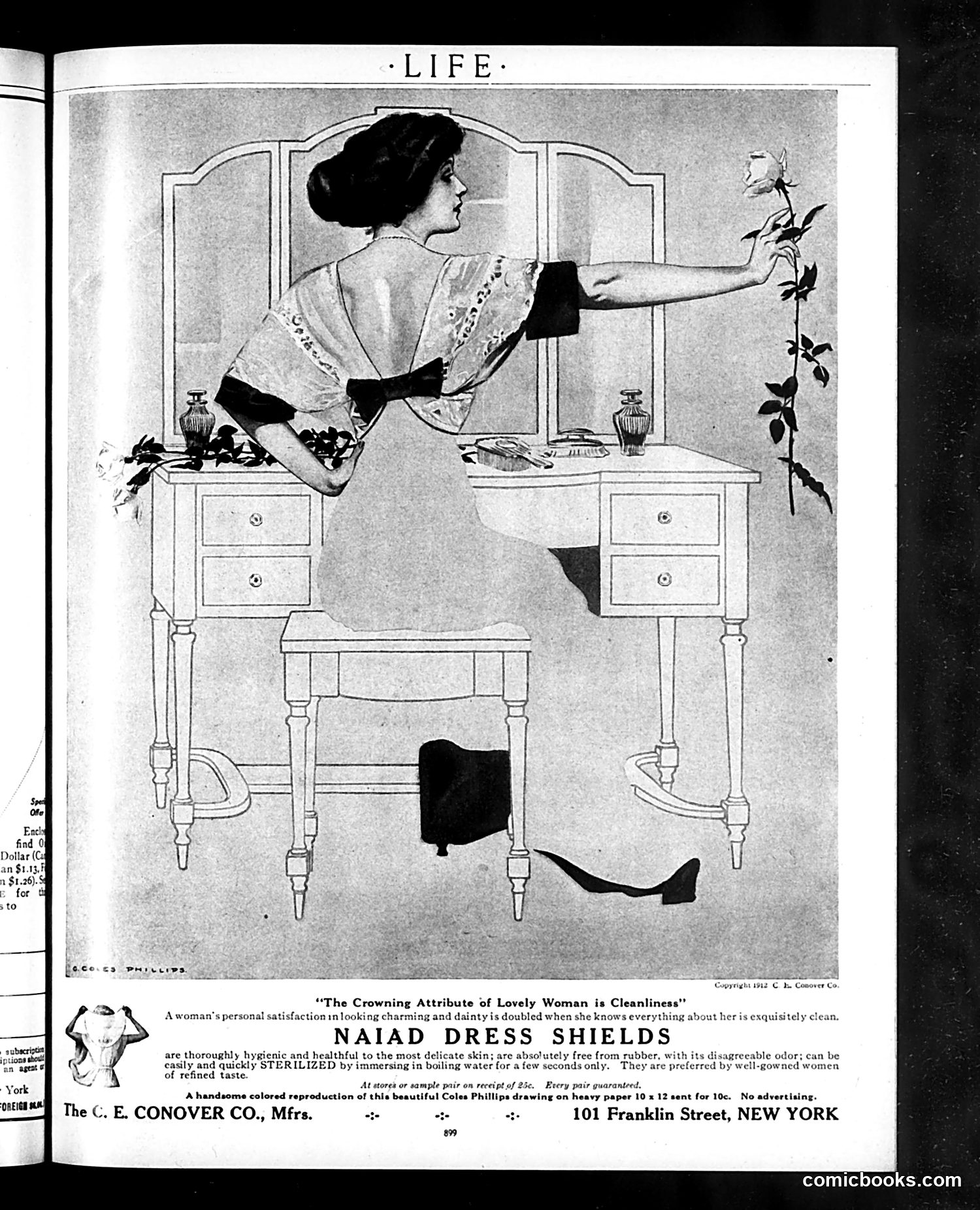
This is primarily **advertising content**, not political satire. The page features a Cole Phillips illustration for "Naiad Dress Shields"—underarm protective garments worn under clothing. The advertisement's headline claims "The Crowning Attribute of Lovely Woman is Cleanliness," promoting dress shields as hygienic products that prevent sweat stains and odor. The woman at her vanity table represents the aspirational modern woman concerned with personal appearance and cleanliness. The text emphasizes the shields are "thoroughly hygienic," can be sterilized by boiling, and are "preferred by well-gowned women of refined taste." This reflects early 20th-century advertising strategy: marketing practical products by appealing to women's anxieties about social acceptability and feminine propriety. The elaborate illustration and refined setting reinforce the product's association with gentility and respectability.
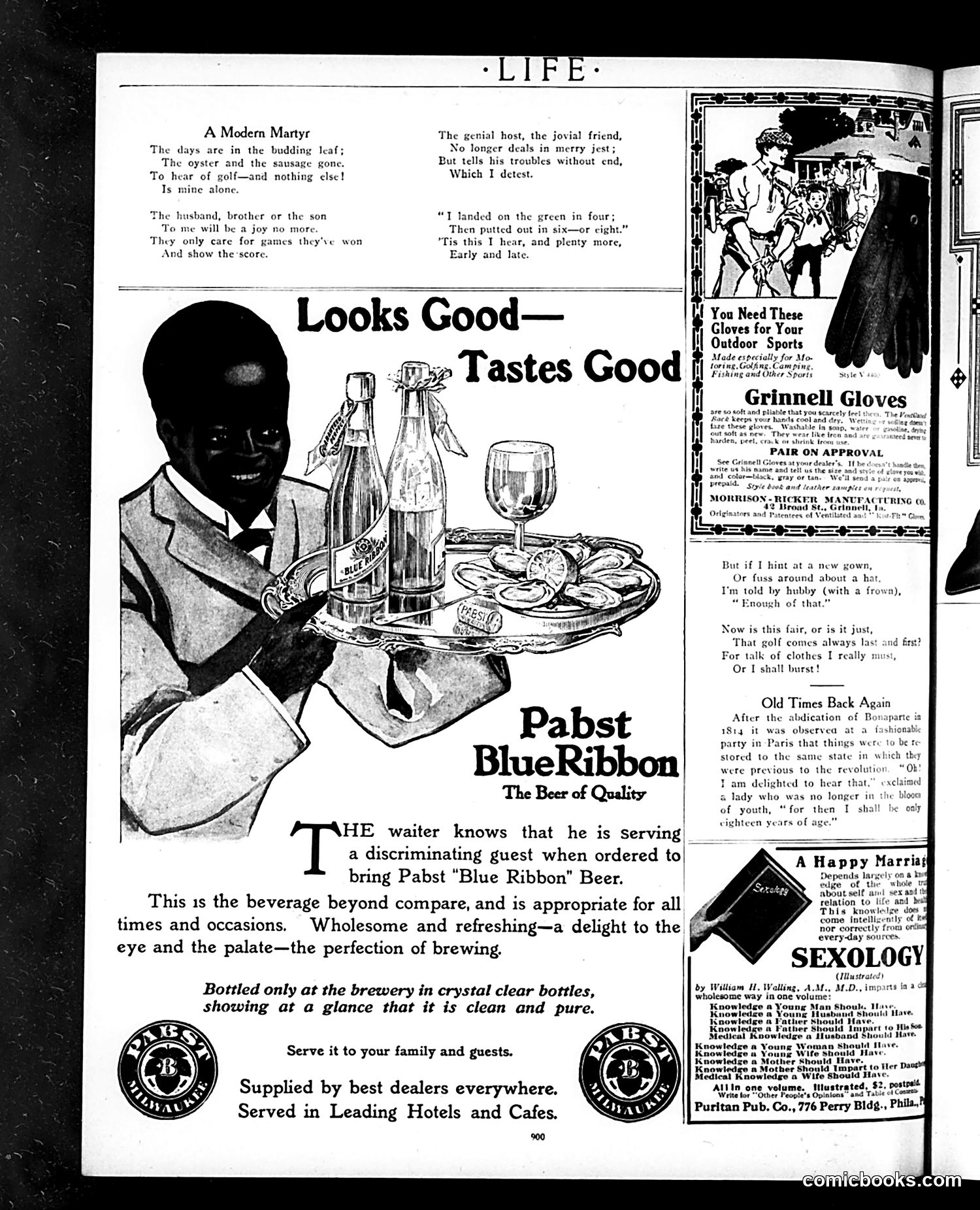
This page is primarily **advertising**, not political satire. The dominant image is a **Pabst Blue Ribbon beer advertisement** featuring a Black male waiter in formal attire serving oysters and champagne, with the slogan "Looks Good—Tastes Good." The ad claims the beer is "appropriate for all times and occasions" and marketed toward affluent diners at "Leading Hotels and Cafes." By modern standards, the imagery is strikingly offensive: the exaggerated facial features and servile pose reflect deeply racist caricature conventions common in early-20th-century American advertising. This representation reinforced degrading racial stereotypes, presenting Black Americans exclusively in subservient service roles. The surrounding page contains poetry and advertisements for gloves and a book on sexual education, typical of *Life* magazine's mixed editorial/commercial content.
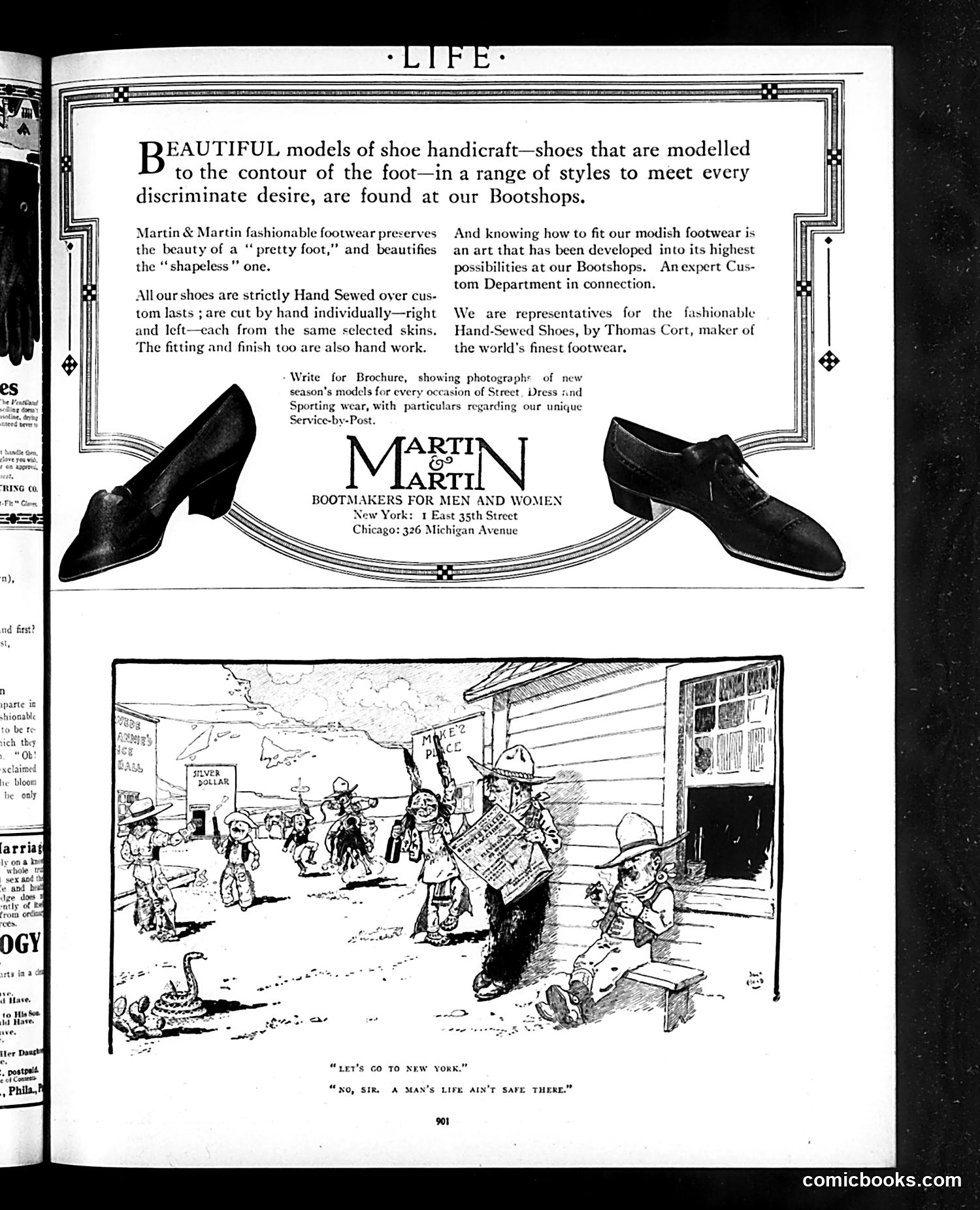
This is primarily a **Martin & Martin bootmakers advertisement** for hand-sewn shoes, occupying the upper portion of the page. Below is a **cartoon commentary on crime and urban safety**. The illustration shows children playing in a street scene marked "SILVER DOLLAR" (suggesting a rough neighborhood). One figure says "LET'S GO TO NEW YORK," to which another responds "NO, SIR. A MAN'S LIFE AIN'T SAFE THERE." The joke satirizes **New York City's reputation for crime and danger** in the early 20th century. It's darkly humorous—even children know the city is unsafe. This reflects contemporary anxieties about urban lawlessness, suggesting that cities were perceived as genuinely threatening places where personal safety couldn't be guaranteed, even for visitors.
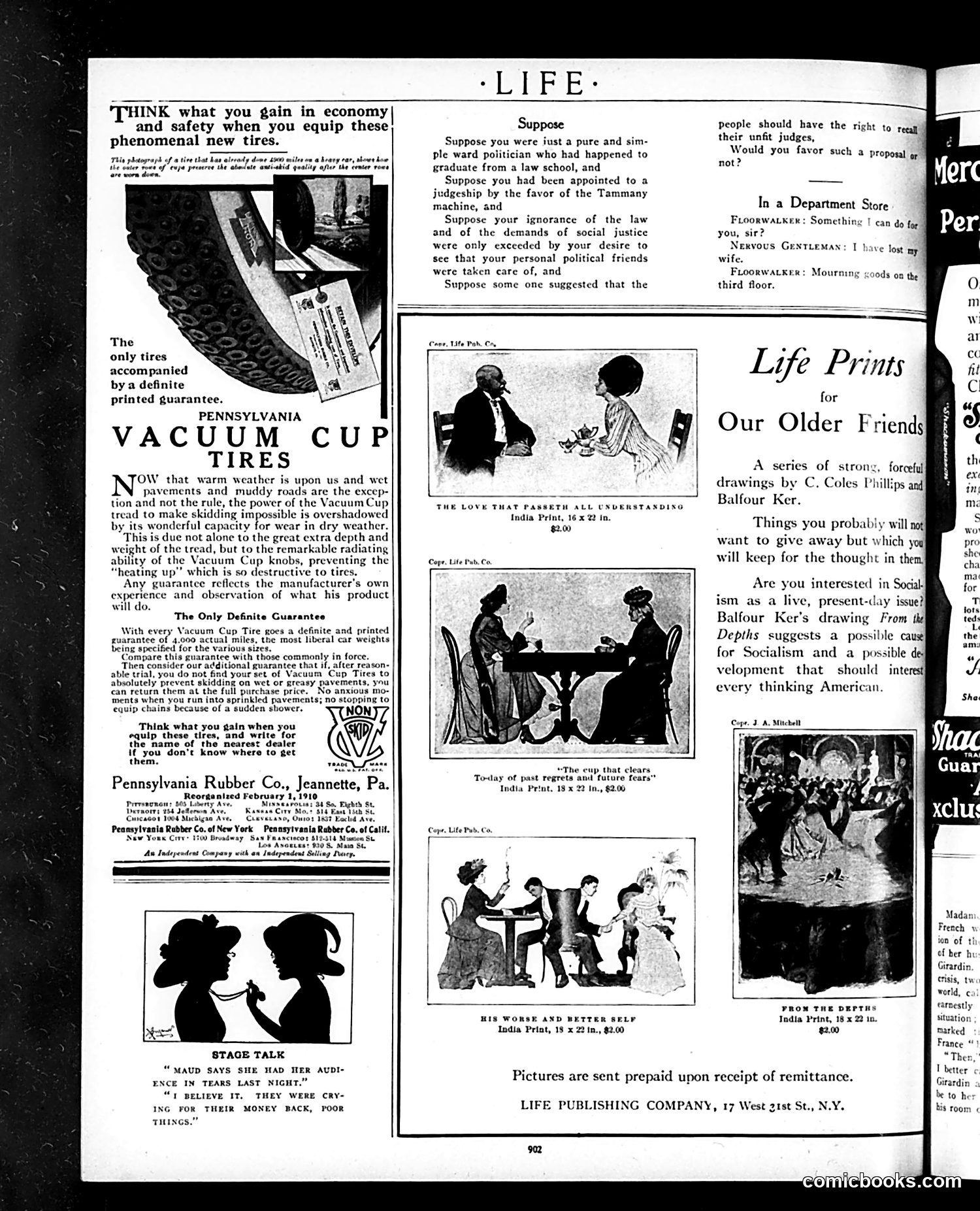
This page is primarily **advertising and product promotion**, not political satire. The dominant left section advertises **Pennsylvania Vacuum Cup Tires**, emphasizing their superior tread design for safety and economy in wet weather. The text appeals to practical consumer concerns about tire reliability. The right section promotes **"Life Prints for Our Older Friends"**—drawings by C. Coles Phillips and Balfour Ker, available through Life Publishing Company. These appear to be sentimental or socially-themed artwork targeting older readers. The small "Stage Talk" cartoon at bottom left is a joke about theatrical audiences, unrelated to political content. The page reflects early 20th-century magazine business: mixing commercial advertising with light social humor and art sales to support publishing operations.
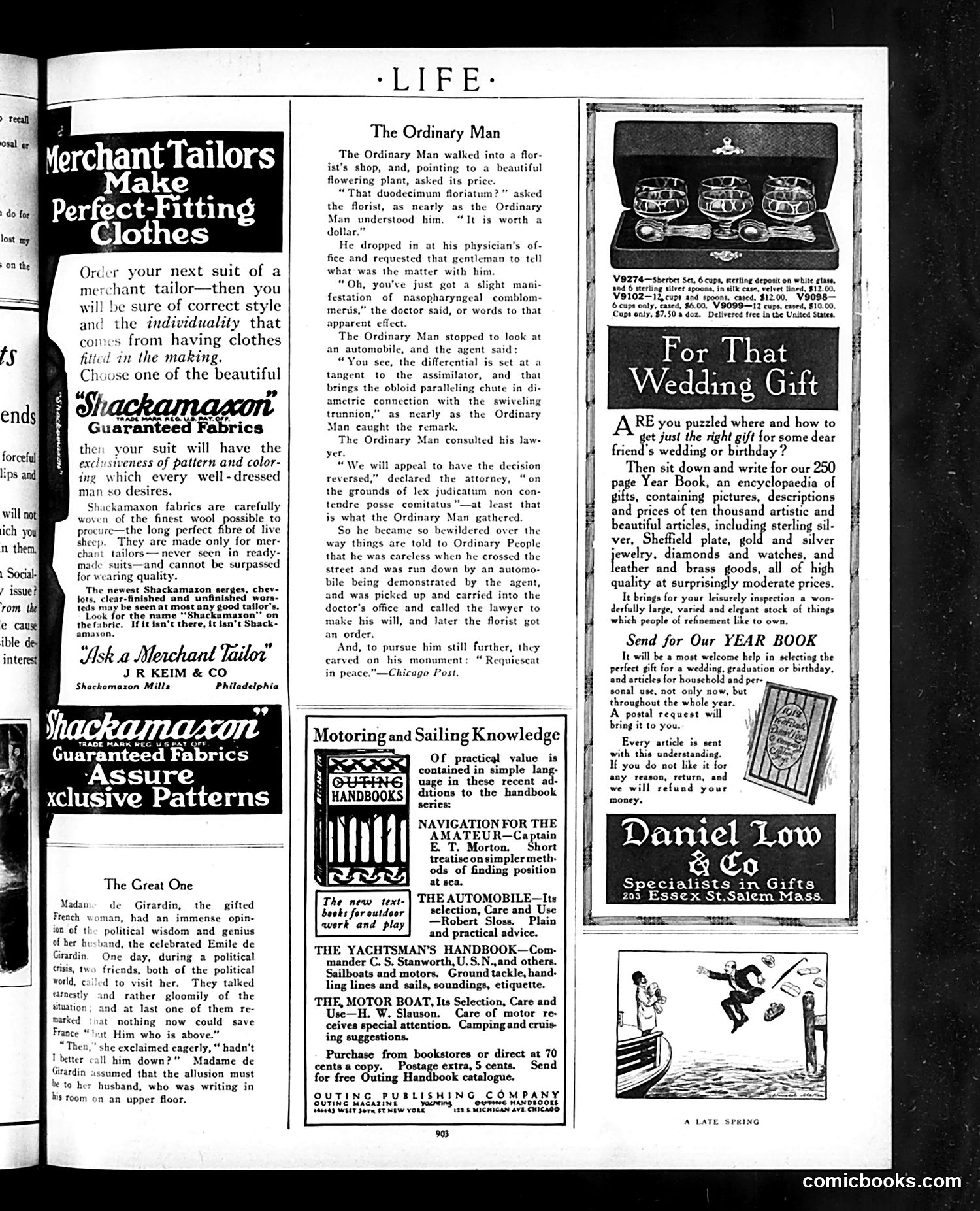
This page is primarily **advertising and commercial content** rather than political satire. The main elements include: - **Merchant tailor advertisements** (Shackamazon fabrics) promoting custom-fitted suits - **"The Ordinary Man" story** — a satirical narrative about a working-class man who enters a florist's shop, gets medical/legal advice, and becomes entangled in bureaucratic absurdity. The satire targets how ordinary people encounter condescension from professionals and become victims of institutional complexity. - **Gift guides** (Daniel Low & Co., Year Book) - **How-to handbooks** on motoring, sailing, and automobiles The "Ordinary Man" piece appears to mock class pretension and professional gatekeeping of the era, but the page overall functions as a magazine's commercial content rather than editorial commentary.
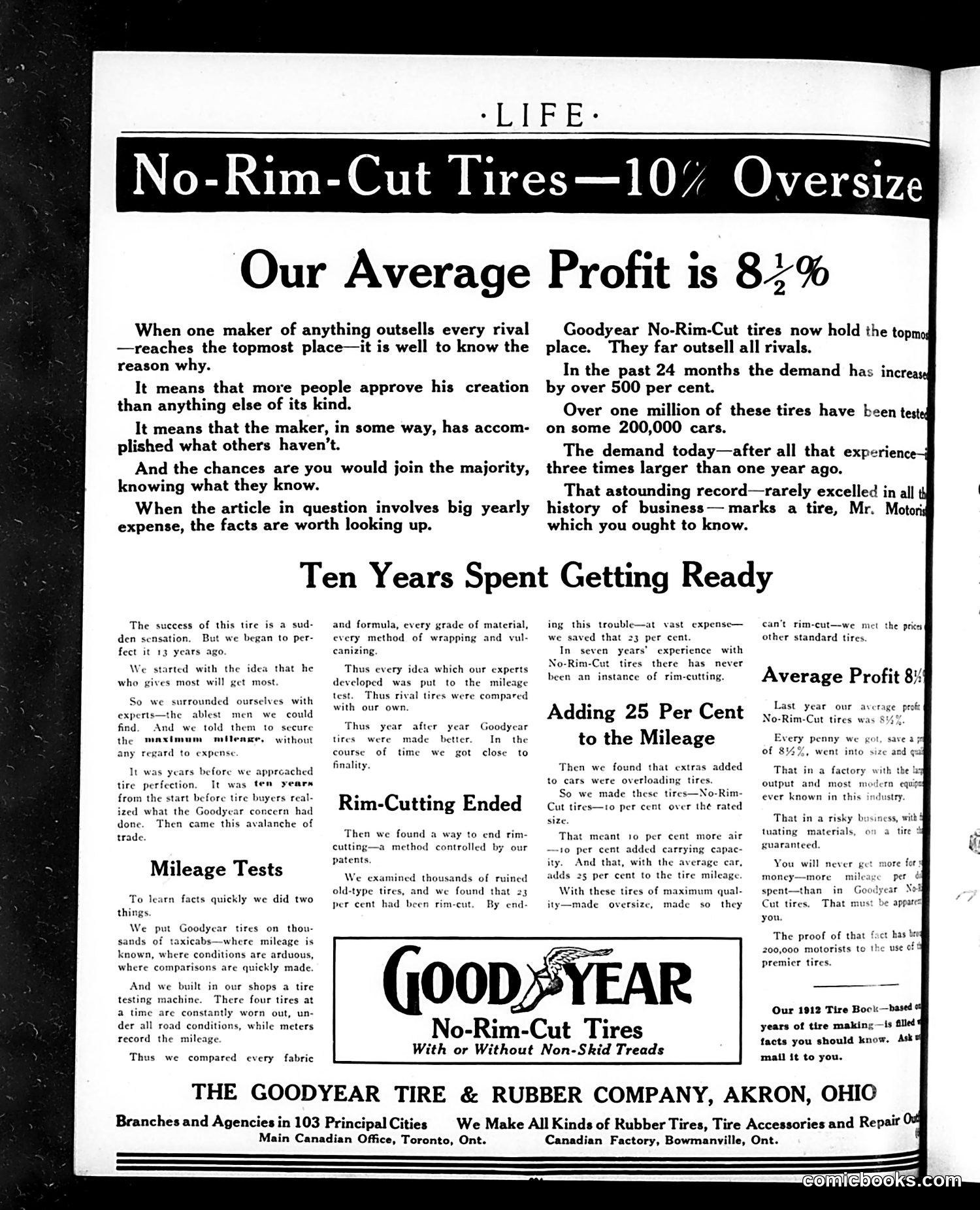
This is **not a cartoon or satirical content** — it's a straightforward **advertisement** for Goodyear No-Rim-Cut Tires, occupying an entire page in *Life* magazine. The ad promotes Goodyear's tire innovation by emphasizing: - 10% larger tire size than competitors - An 8.5% average profit margin for dealers - A decade of development before market release - Superior mileage (25% better than standard tires) - Extensive real-world testing on 200,000 cars The "Rim-Cutting Ended" section describes patented technology solving a common tire problem. The Goodyear logo and company details appear at the bottom. **No satire or political commentary is present** — this is simply premium advertising space in a major American publication, typical of early 20th-century magazine commercials.
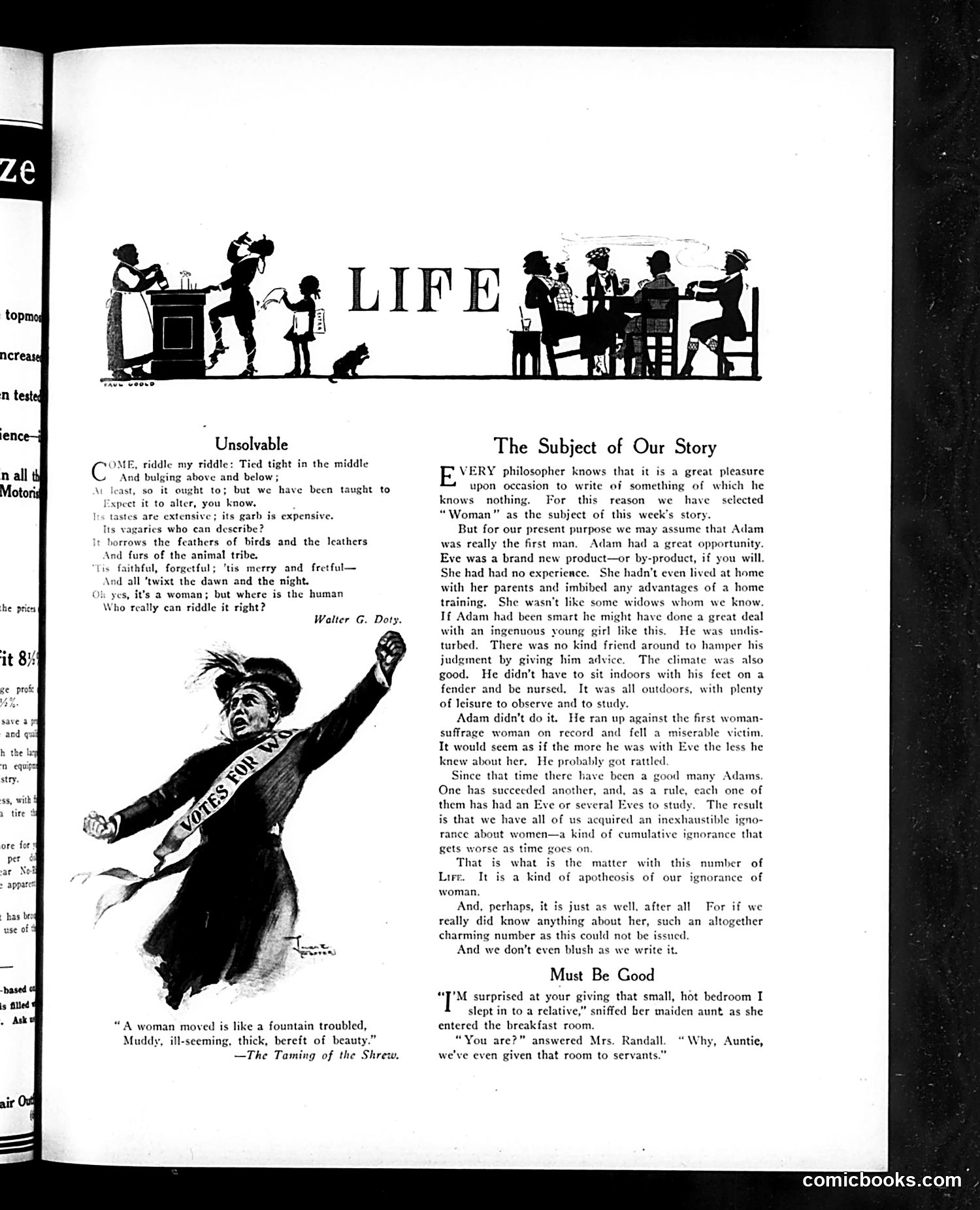
This page contains social commentary about women's rights and gender relations. The left side features an "Unsolvable" riddle by Walter G. Doty mocking women's nature, accompanied by a cartoon of a suffragette (identifiable by the "VOTES FOR WOMEN" banner) in an exaggerated, aggressive pose—satirizing the women's suffrage movement as unfeminine and unreasonable. The main article, "The Subject of Our Story," ironically uses the Biblical Adam and Eve narrative to argue that women's ignorance about themselves is universal and inevitable. The piece dismisses women's complaints about inequality as inherent to their nature. The "Must Be Good" anecdote at bottom depicts class condescension toward servants. Overall, the page uses humor to ridicule women's suffrage activism and resist expanding women's rights—typical anti-feminist satire from the early twentieth century.
This editorial page discusses the sinking of the *Titanic* and its moral lessons. The text emphasizes that the tragedy revealed character—how people behaved when facing death. The article then pivots to contemporary politics, mentioning "the Boston Gentleman" (likely Theodore Roosevelt) and criticizing what appears to be the 1912 presidential race involving Debs (likely socialist Eugene V. Debs) and Haywood (likely labor activist Bill Haywood). Life's editors suggest these figures represent "unjust" positions that won't truly improve society. The cartoon vignettes at top and bottom are small decorative illustrations without clear satirical targets identifiable from this image alone. The page uses the *Titanic* disaster as a springboard for discussing American values and political ideology.
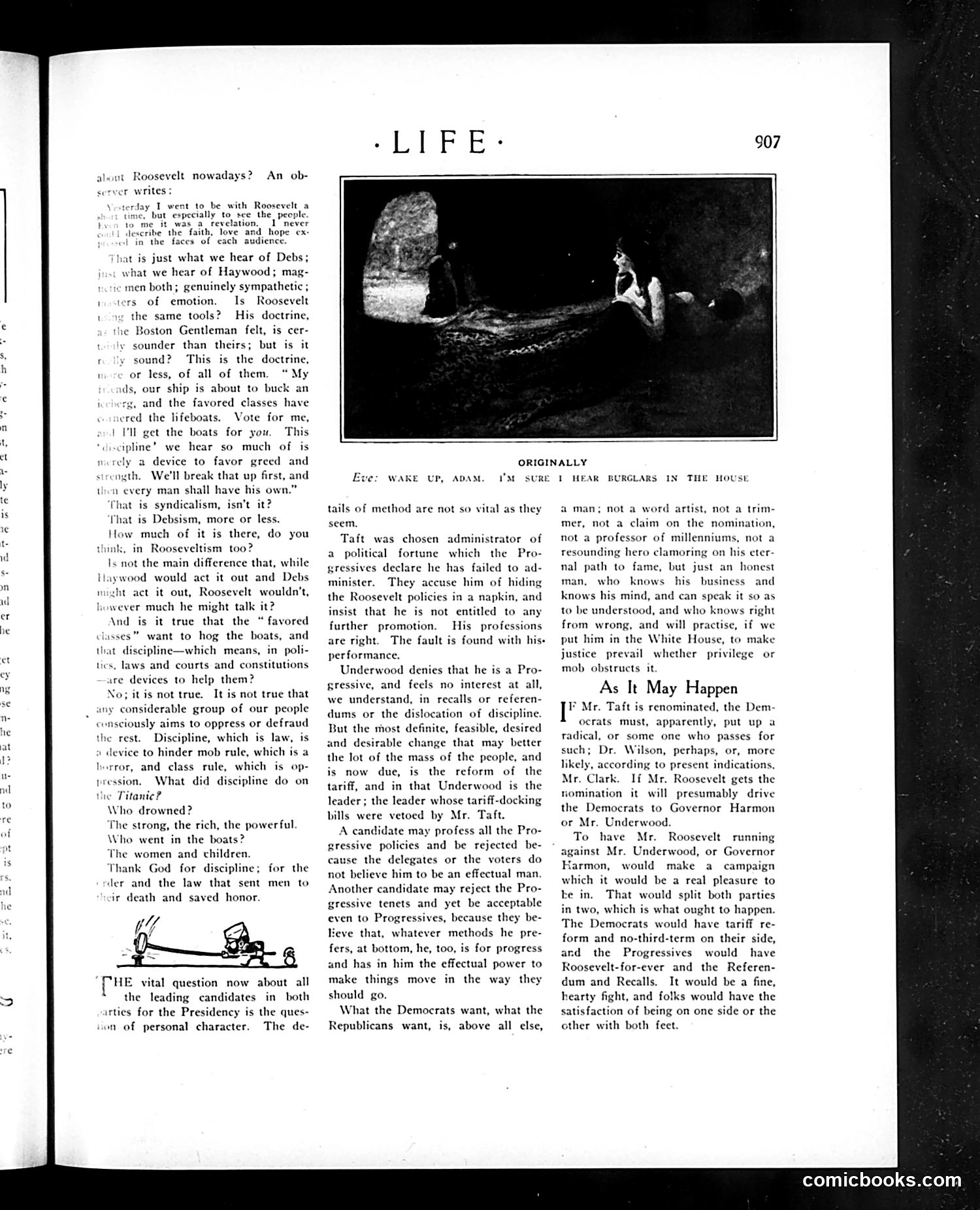
This page discusses the 1912 presidential race, comparing candidates Taft, Underwood, and Roosevelt on their character and effectiveness rather than mere rhetoric. The cartoon caption "Wake up, Adam. I'm sure I hear burglars in the house" appears to be a domestic scene—likely satirizing complacency or warning of threats, though the specific political reference is unclear from the visible image alone. The text critiques Roosevelt's "syndicalism" (redistribution doctrine) as philosophically similar to radical leaders like Eugene Debs and Big Bill Haywood, yet Roosevelt wouldn't *act* on it—making him a safer alternative. The author argues voters should prioritize an effectual, honest administrator over ideological purity or rhetorical flourish. The Titanic reference mocks those claiming discipline/law protects the weak—discipline on the Titanic meant the poor drowned while the wealthy escaped. The satire's point: judge candidates by honest competence and actual values, not flowery Progressive promises.
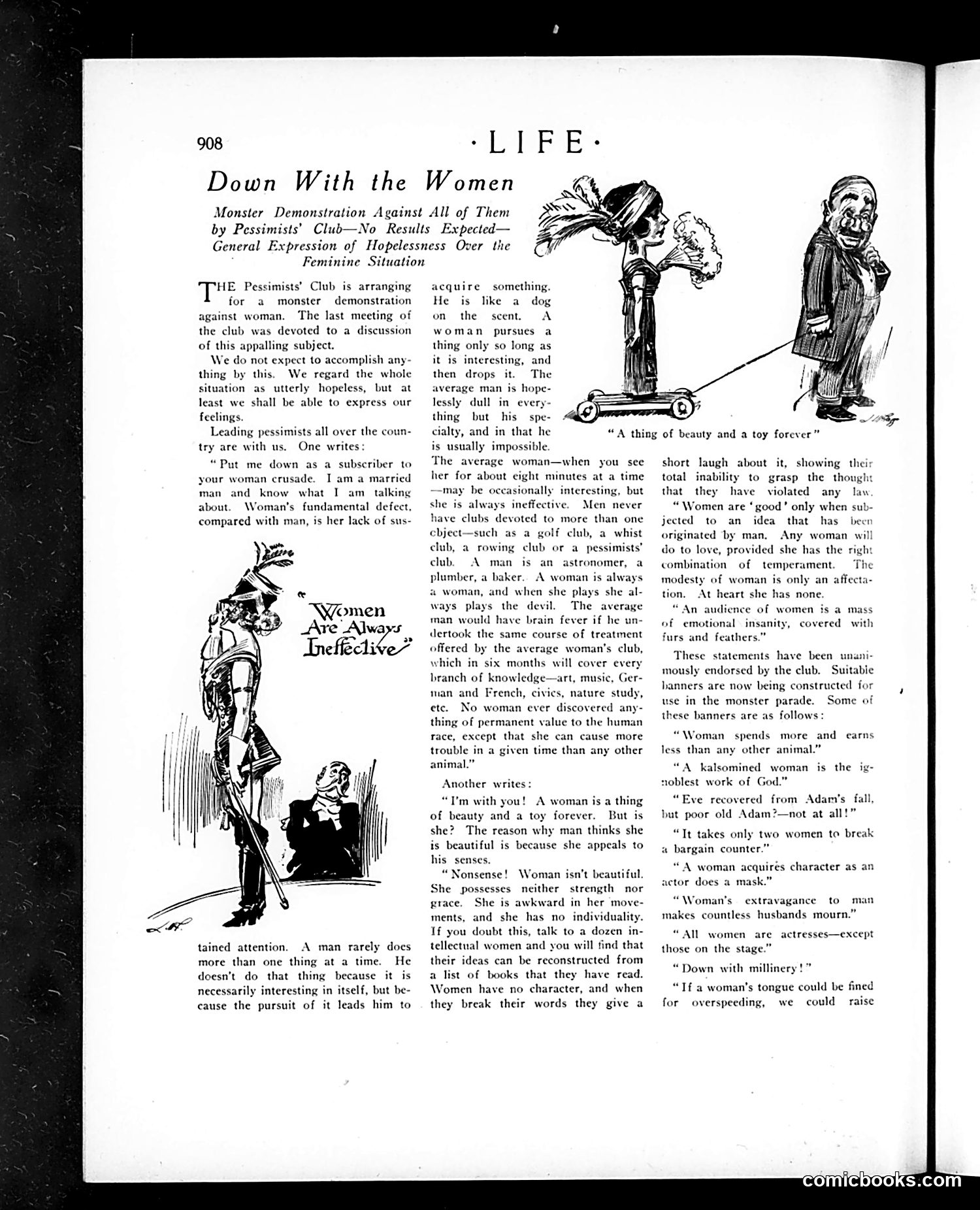
This 1908 *Life* magazine article satirizes a fictional "Pessimists' Club" organizing a misogynistic demonstration against women. The piece mocks extreme anti-feminist rhetoric of the era through exaggeration. The accompanying cartoons and quoted "club members" present deliberately absurd complaints: women lack focus, never make discoveries, are emotionally unstable, and exist primarily as objects of beauty. Proposed protest banners escalate the mockery with ridiculous slogans like "A kalsomined woman is the noblest work of God." The satire works by presenting these arguments so over-the-top—claiming women cause "more trouble than any other animal" or comparing them to scent-following dogs—that their irrationality becomes apparent. The magazine is ridiculing misogynistic attitudes by making them laughably extreme, not endorsing them. This was *Life*'s typical approach: using caricature and exaggeration to critique social attitudes rather than promote them.
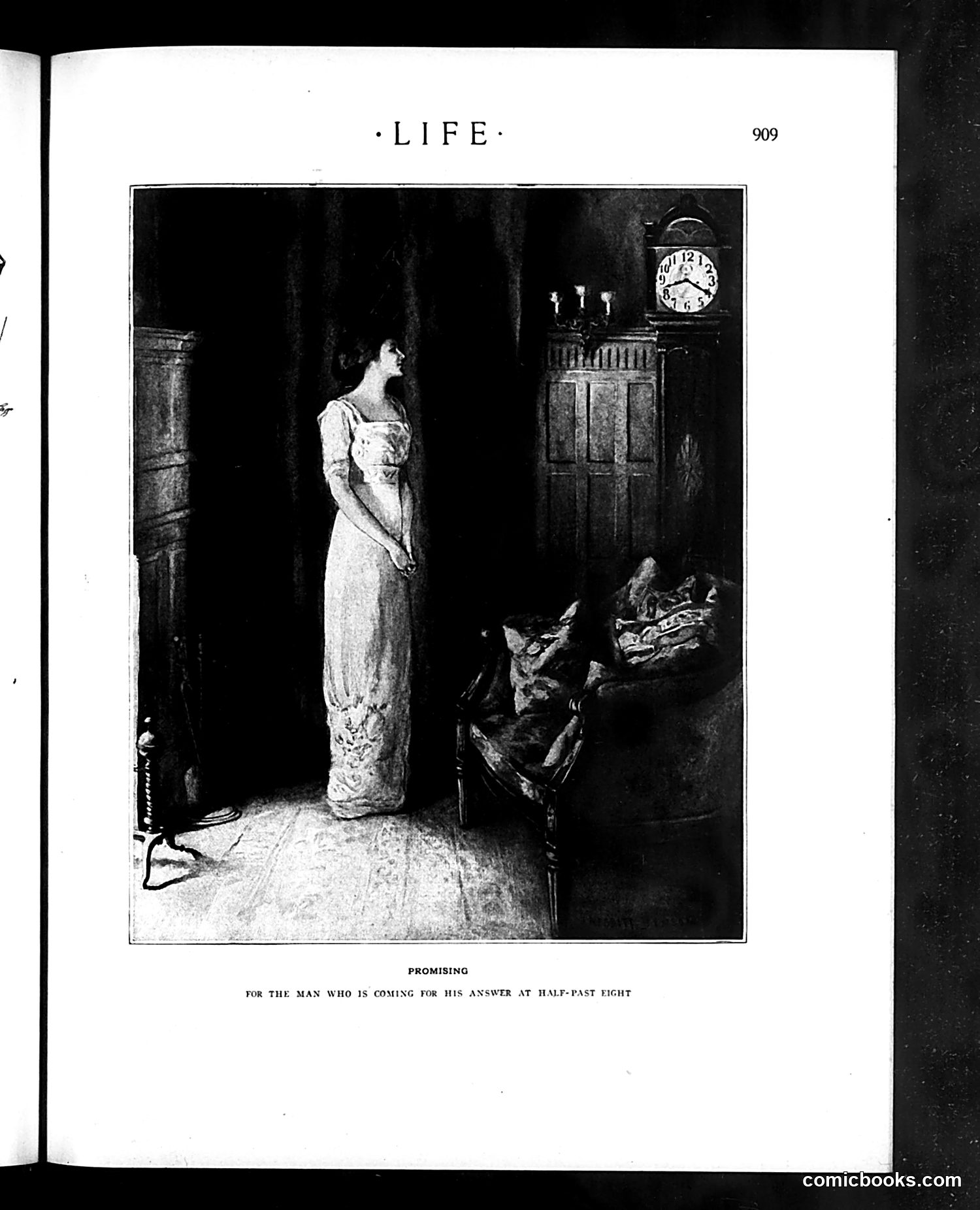
This illustration depicts a woman in an elegant white evening gown standing in a darkened interior, gazing toward a grandfather clock showing 7:30. The caption indicates she awaits a man arriving at 8:30 for an important answer—likely a marriage proposal response. The satire plays on Victorian-era romantic conventions: the woman's formal dress, the formal hour, and the dramatic staging all suggest a consequential romantic moment. The humor lies in the tension between her anxious anticipation and the theatrical setup. The clock's prominence emphasizes time passing before this crucial encounter. This reflects early 20th-century *Life* magazine's frequent satirical commentary on courtship rituals and romantic expectations of the era, poking gentle fun at both the solemnity couples invested in such moments and the dramatic performance romance required in polite society.
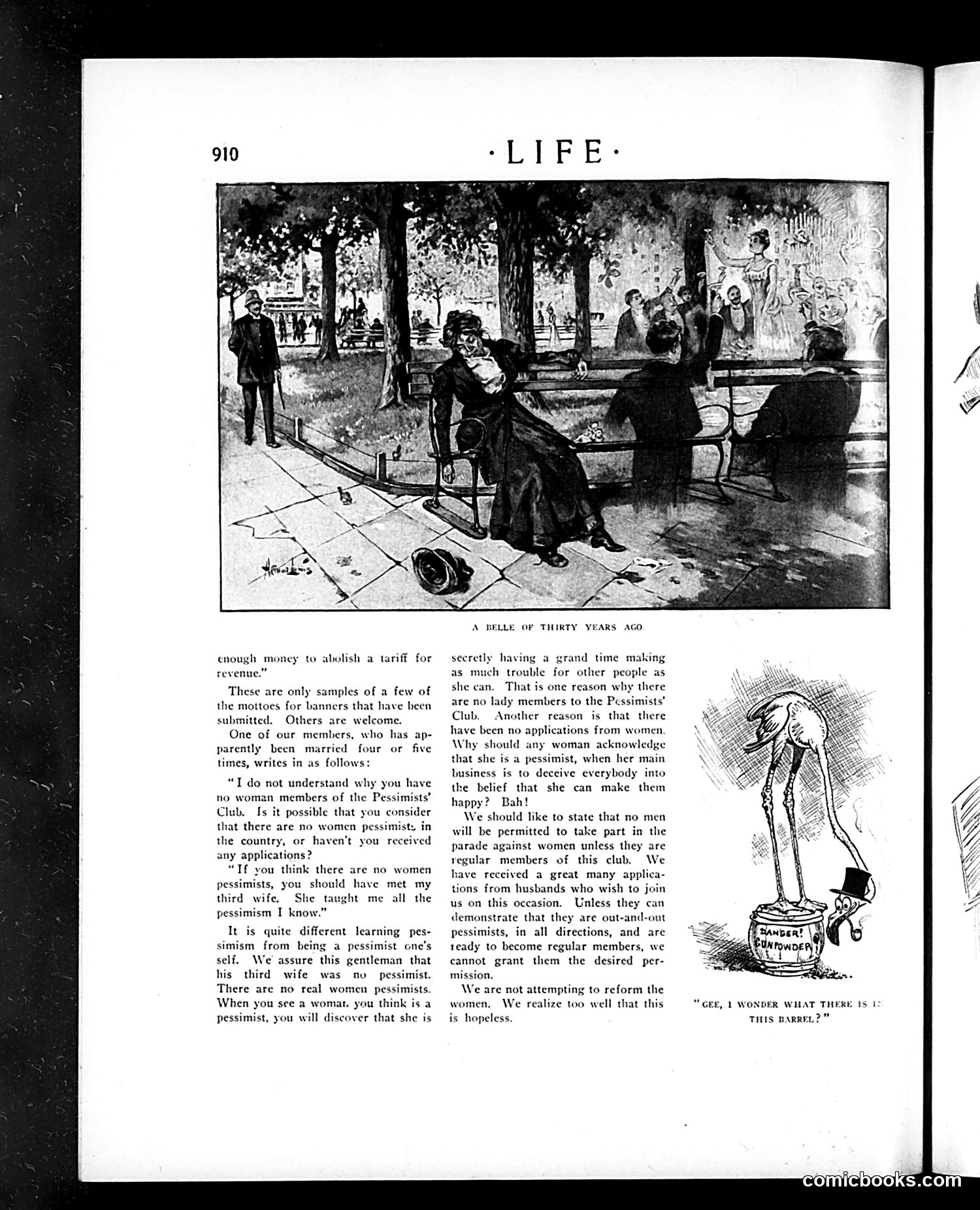
This page satirizes a fictional "Pessimists' Club" that excludes women—despite the obvious irony that women, according to the text, are natural pessimists. The humor relies on misogynistic stereotypes: the author argues women cannot be *real* pessimists because their "main business is to deceive everybody" into thinking they can make men happy. The accompanying illustration titled "A Belle of Thirty Years Ago" shows a woman in a park, likely depicting an idealized romantic figure from the past. The cartoon at bottom—a man asking about a barrel labeled "Barrels of Gunpowder"—appears to be unrelated humor about curiosity. The piece mocks men's paranoia about women while simultaneously perpetuating the very stereotypes it pretends to satirize: women are manipulative, deceptive, and impossible to reform. The tone suggests early 20th-century cynicism about both gender relations and marriage.
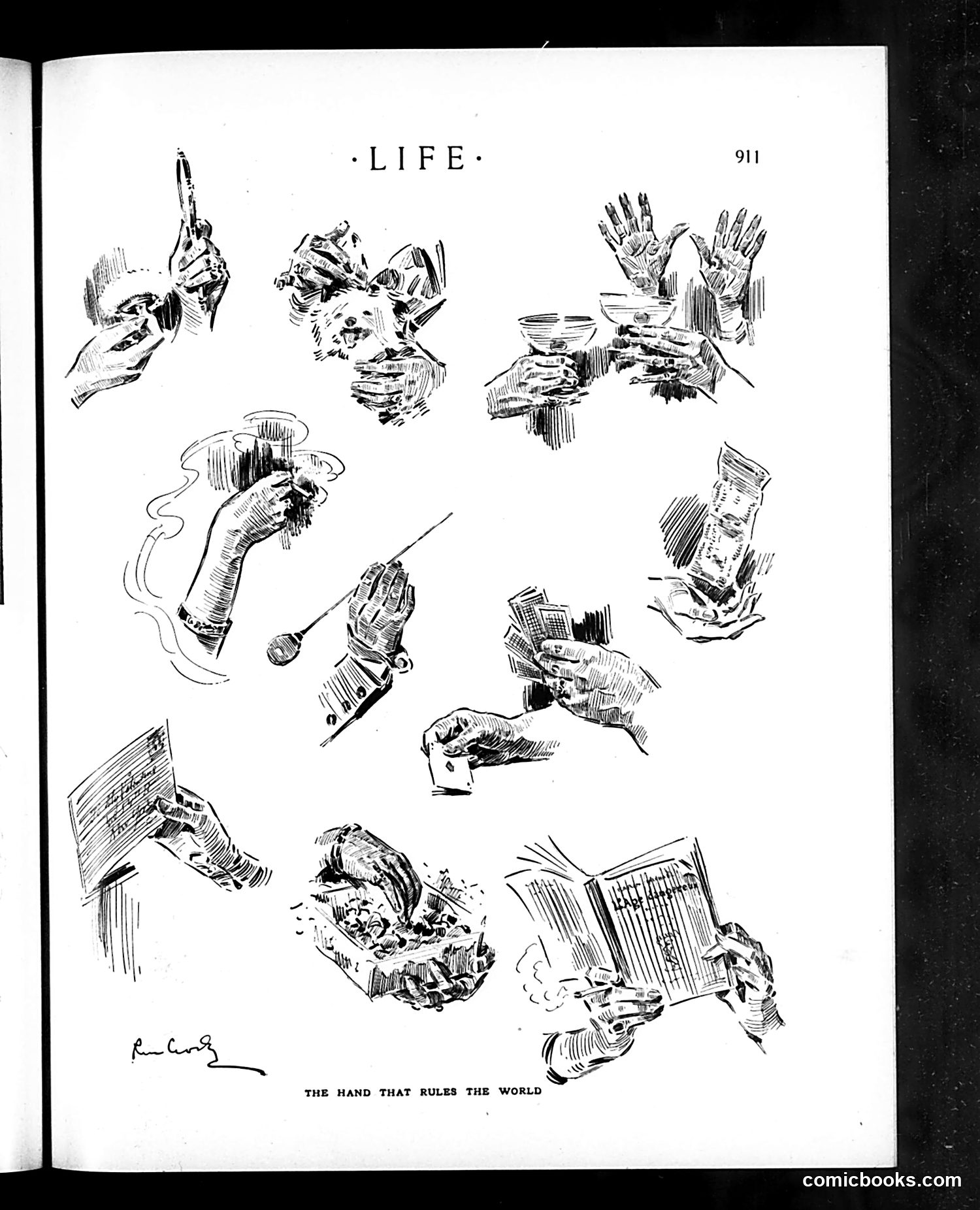
This editorial cartoon depicts various hands engaged in different activities of power and influence: wielding weapons, holding money and documents, controlling media (newspapers), conducting orchestras, making toasts, and manipulating objects. The title sarcastically suggests these hands "rule the world." The satire critiques how different forces—military power, financial interests, political authority, media control, and social influence—actually govern society rather than democratic ideals or public welfare. Each vignette represents a different sphere of world power. The cartoon's message is that true control lies with these shadowy institutional forces rather than with the people themselves, presenting a cynical view of who actually holds authority in the world.
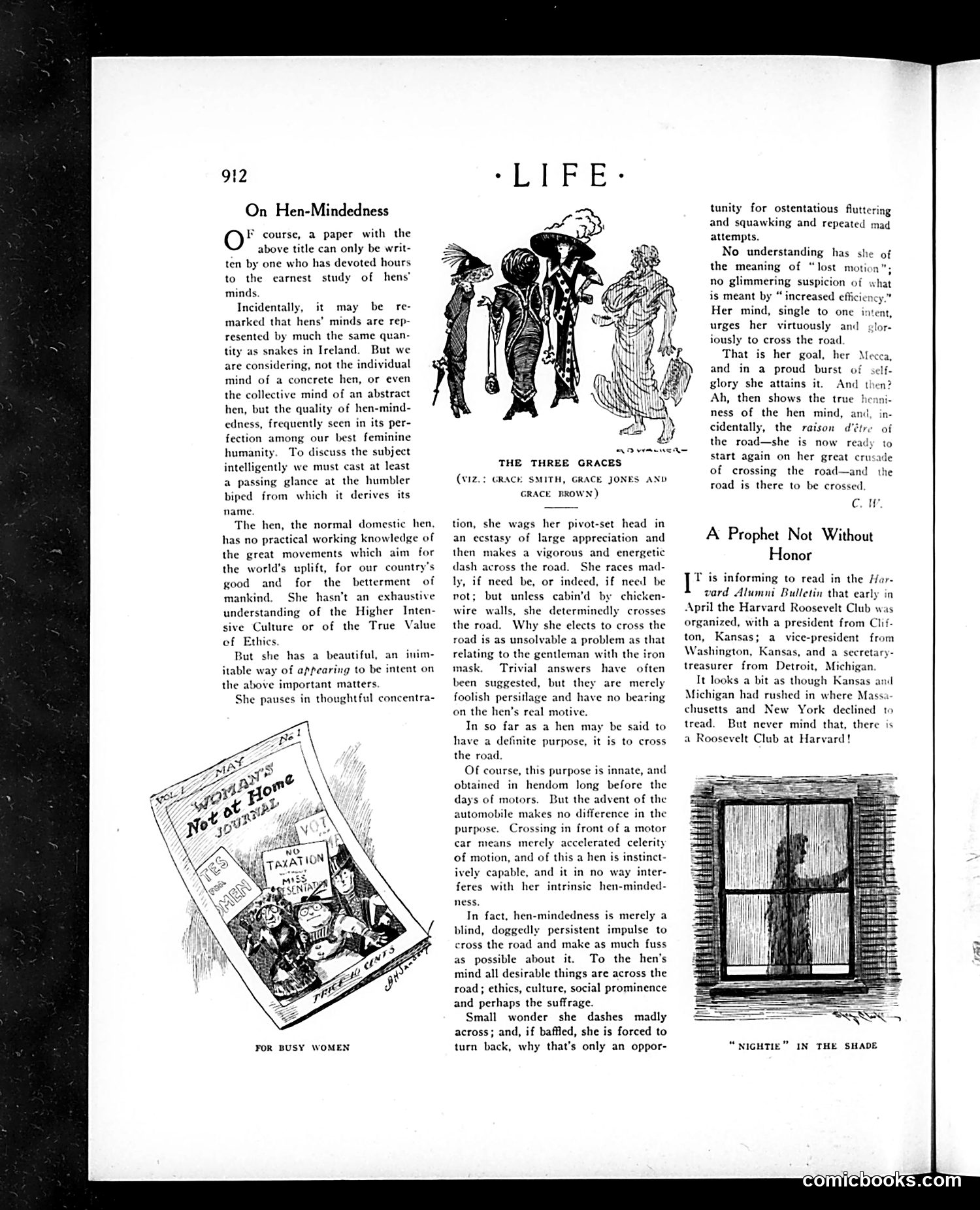
This page from Life magazine satirizes suffragism and women's rights activism through two unrelated pieces. **"On Hen-Mindedness"** uses a hen's compulsion to cross the road (a joke concept) as metaphor for women activists. The author dismisses suffragists and women pursuing "culture," "ethics," and "social prominence"—explicitly mentioning "suffrage" as something hens want—as mindless, obsessive creatures making "fuss" without real purpose. The satire mocks women's reform movements as instinctive rather than intellectually justified. **"A Prophet Not Without Honor"** reports on a Harvard Roosevelt Club founded by students from Kansas and Michigan while students from Massachusetts and New York—presumably more prestigious regions—avoided membership. The implication ridicules the club's supporters as provincial outsiders, suggesting support for Roosevelt (likely Theodore) came from less sophisticated areas. Both pieces express conservative skepticism toward progressive movements and those driving them. The magazine's satire targets both women's activism and geographic/class assumptions about who counts as culturally legitimate.
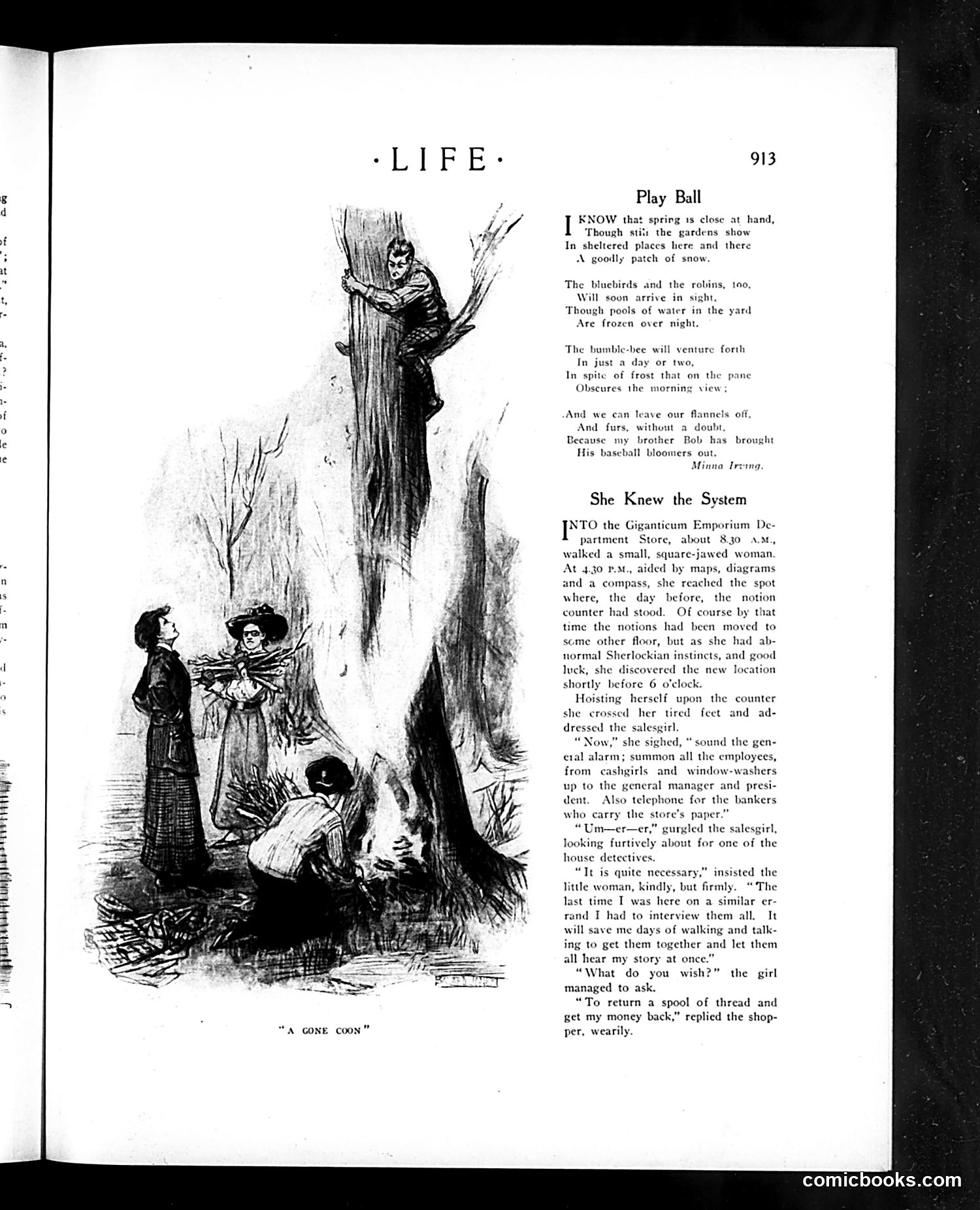
The page contains two pieces of satirical content: **"A Gone Coon"** (illustration): A sketch showing figures near a bare tree in winter, appearing to depict a racial caricature. The title uses a period racial slur; the exact satirical point is unclear from the image alone, though it likely comments on seasonal hardship or displacement. **"Play Ball"** (poem): A light spring poem celebrating the return of warm weather and baseball season, authored by Minna Irving. No satire detected—straightforward seasonal verse. **"She Knew the System"** (story): Satirizes the chaos of large department stores, where merchandise relocates frequently without customer notice. A determined woman spends an entire day (8:30 AM to 6 PM) searching for a notions counter, only to need help from management to return a spool of thread. The satire mocks both the store's inefficiency and the woman's exhausted persistence in navigating it. The page reflects early 20th-century American magazine content mixing seasonal humor, poetry, and consumer-culture satire.
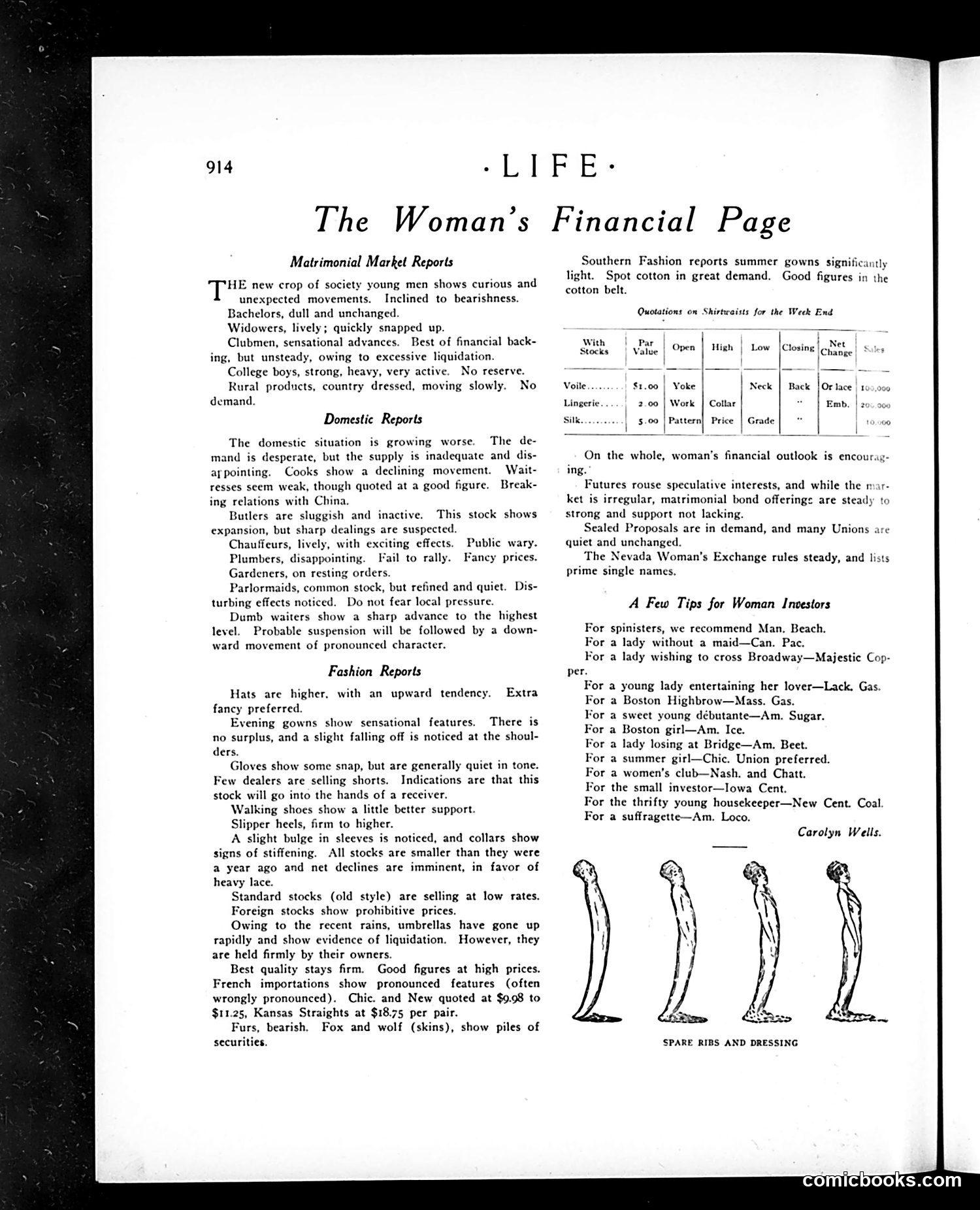
This satirical piece parodies financial market reports by applying stock-market language to marriage prospects and domestic servants—both domains where women had limited economic agency. The "Matrimonial Market Reports" treats eligible men as tradeable commodities ("Bachelors, dull and unchanged"; "Widowers, lively; quickly snapped up"), while "Domestic Reports" discusses servants using bull/bear market terminology. A "Dumb waiters" pun plays on the furniture item. The "Fashion Reports" section extends the joke to women's clothing, treating garments as financial instruments ("net declines are imminent"). The final section, "A Few Tips for Woman Investors," offers tongue-in-cheek stock recommendations using puns on company names (e.g., recommending "Am. Loco" railroad stock for suffragettes, the word "loco" meaning crazy). The humor satirizes both women's limited financial independence and their reduction to objects of speculation and exchange in early-20th-century society.
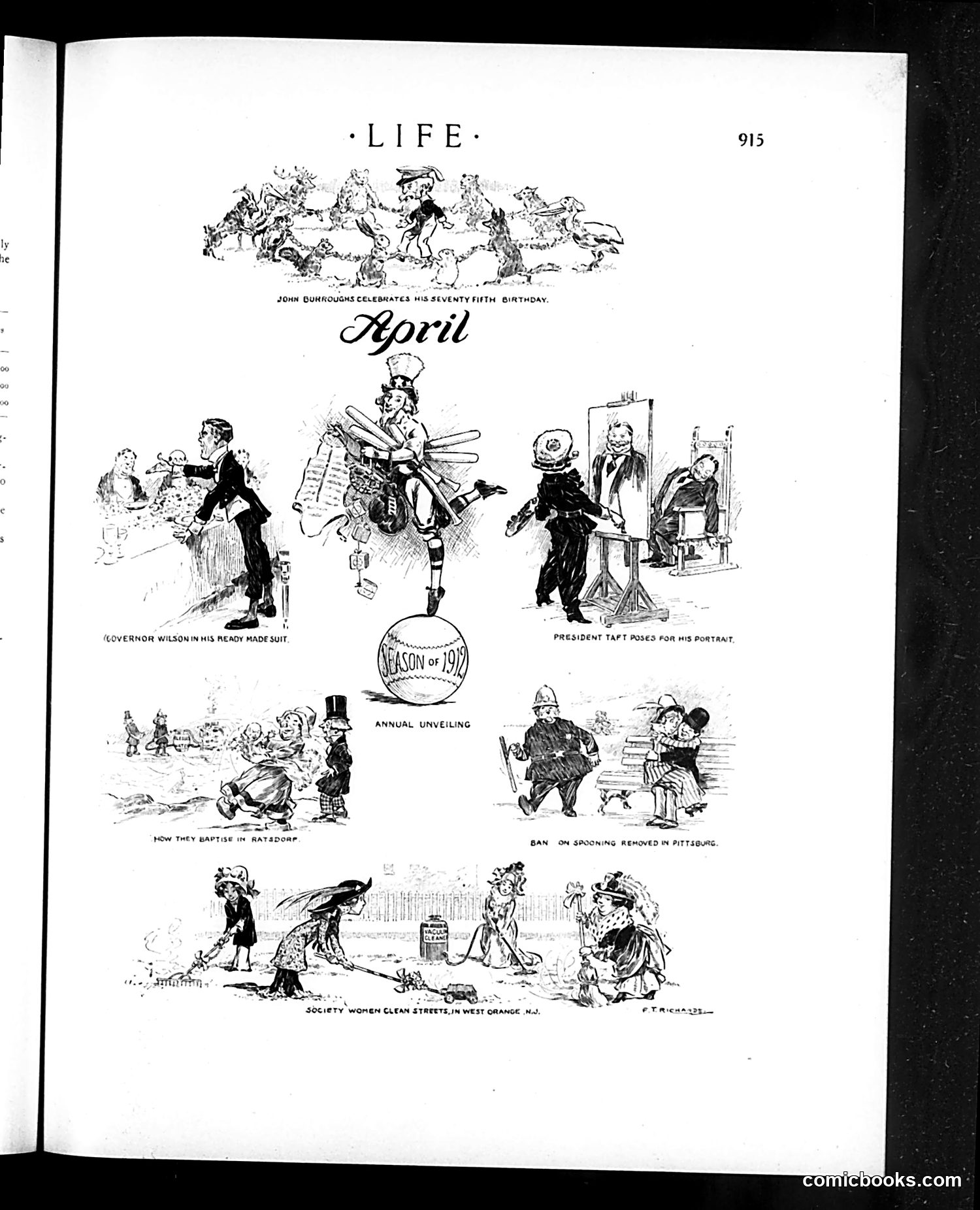
This page celebrates John Burroughs' 75th birthday with six satirical vignettes about April events and contemporary issues: 1. **Governor Wilson's ready-made suit** - likely mocking New Jersey Governor Woodrow Wilson's appearance or political positioning 2. **Season of 1912 unveiling** - appears to reference baseball's opening season 3. **President Taft poses for portrait** - satirizes President William Howard Taft 4. **Baptism in Ratscore** - unclear reference, possibly local/obscure 5. **Ban on grooming removed in Pittsburgh** - social regulation satire 6. **Society women clean streets in West Orange, NJ** - likely mocks progressive-era women's civic activism as performative The cartoons use exaggerated character drawings typical of early 1900s political humor, targeting politicians and social movements of the Progressive Era with gentle ridicule about pretension, vanity, and well-intentioned but questionable reforms.
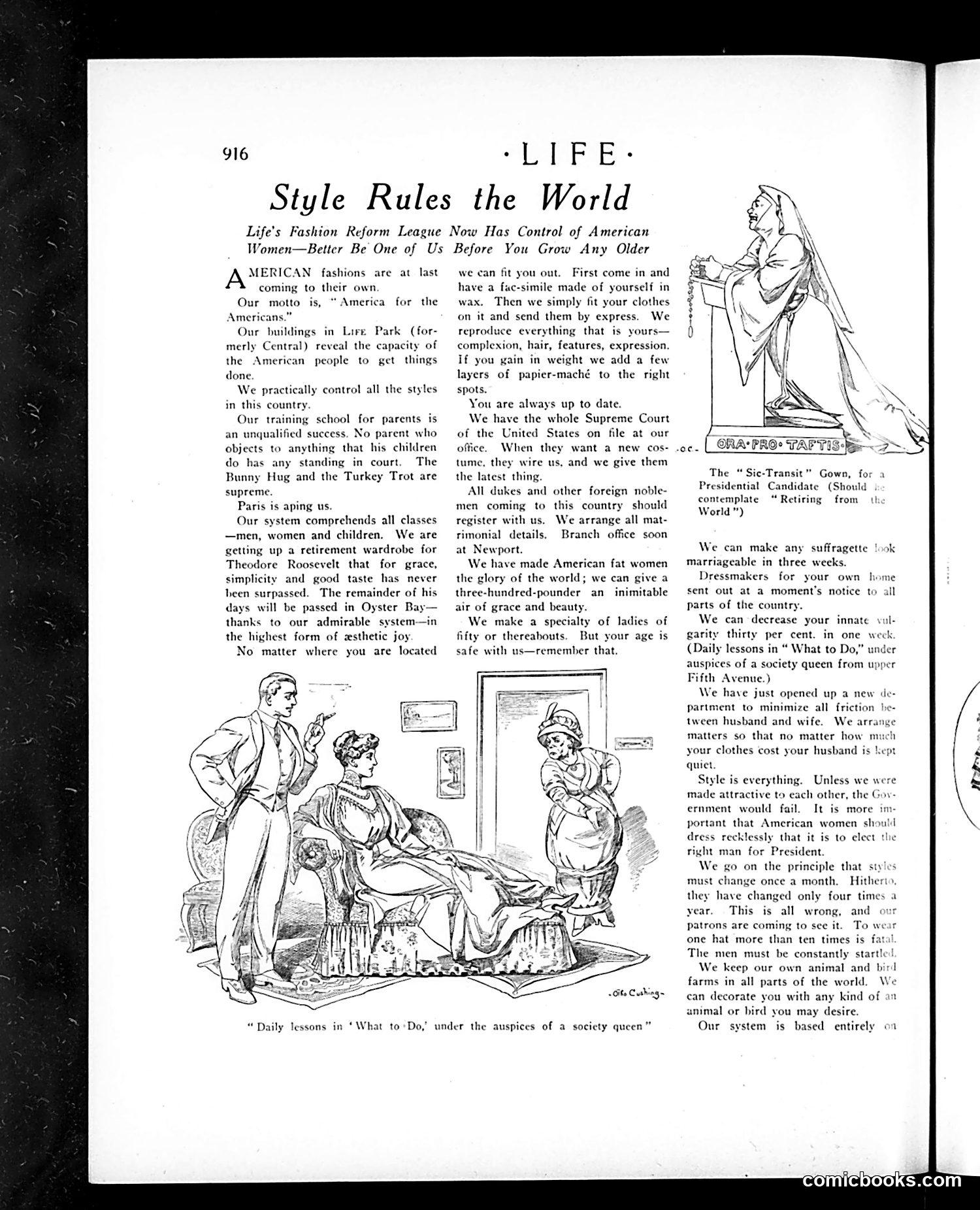
This satirical article mocks America's growing consumer culture and fashion obsession through a fake "Fashion Reform League" that claims total control over American style and taste. **The satire targets:** 1. **American cultural arrogance**: The League's motto "America for the Americans" parodies nationalist rhetoric while applying it absurdly to fashion, suggesting American society is dominated by fashion rather than substance. 2. **Vanity and consumerism**: The organization offers ridiculous services—wax replicas of clients, constant wardrobe updates, even "decreasing innate vulgarity"—mocking wealthy Americans' pursuit of perpetual fashionability. 3. **Social hierarchy**: References to dressing the Supreme Court, foreign nobility, and society queens satirize how fashion reinforces class distinctions. 4. **Misplaced priorities**: The closing lines—that dressing women recklessly matters "more important" than electing the right president—mock society's shallow values during an election year (likely Theodore Roosevelt's era, given his mention). The cartoons show a wealthy couple receiving fashion instruction, reinforcing the message that style, not character or politics, "rules the world."
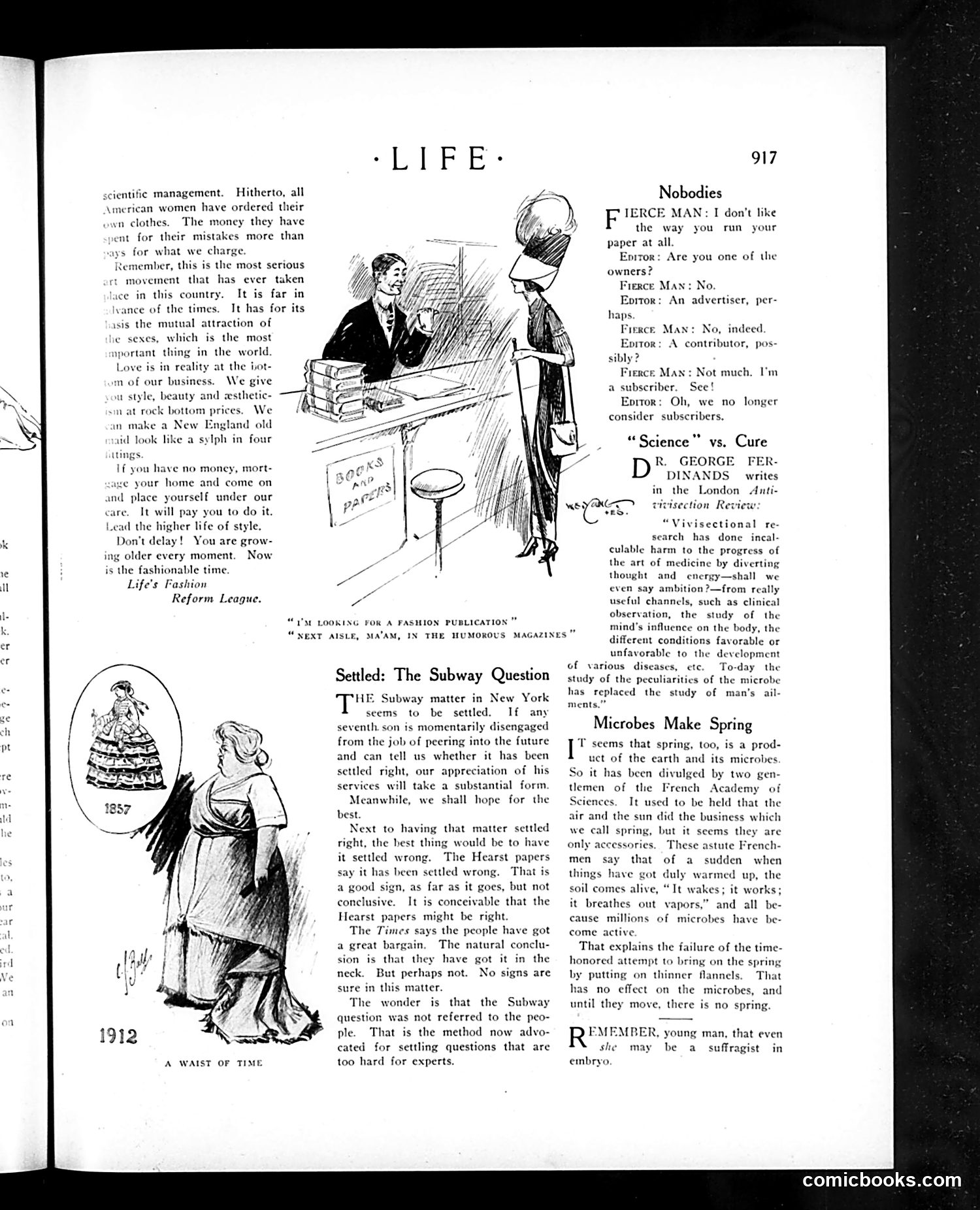
**"Nobodies" Cartoon:** A fierce man complains to a newspaper editor about editorial quality. The joke's punchline reveals the editor dismisses him entirely—he's merely a *subscriber*, a category the editor claims they "no longer consider." This satirizes newspapers' shifting priorities toward wealthy advertisers and contributors while ignoring ordinary paying readers. The "fierce man's" indignation at being deemed insignificant reflects early 20th-century anxieties about the common person's voice mattering less in commercial media. **"Settled: The Subway Question":** This section mockingly addresses New York City's recently settled subway dispute. Life sarcastically notes that both the *Times* (claiming it's good) and *Hearst papers* (claiming it's bad) contradict each other, making resolution impossible to verify. The real jab: authorities never consulted "the people"—yet the public now favors referendums for deciding complex issues "too hard for experts." This critiques both democratic overreach and expert dismissal. The page reflects Progressive-Era tensions: public participation versus expertise, and consumer invisibility in commercial institutions.
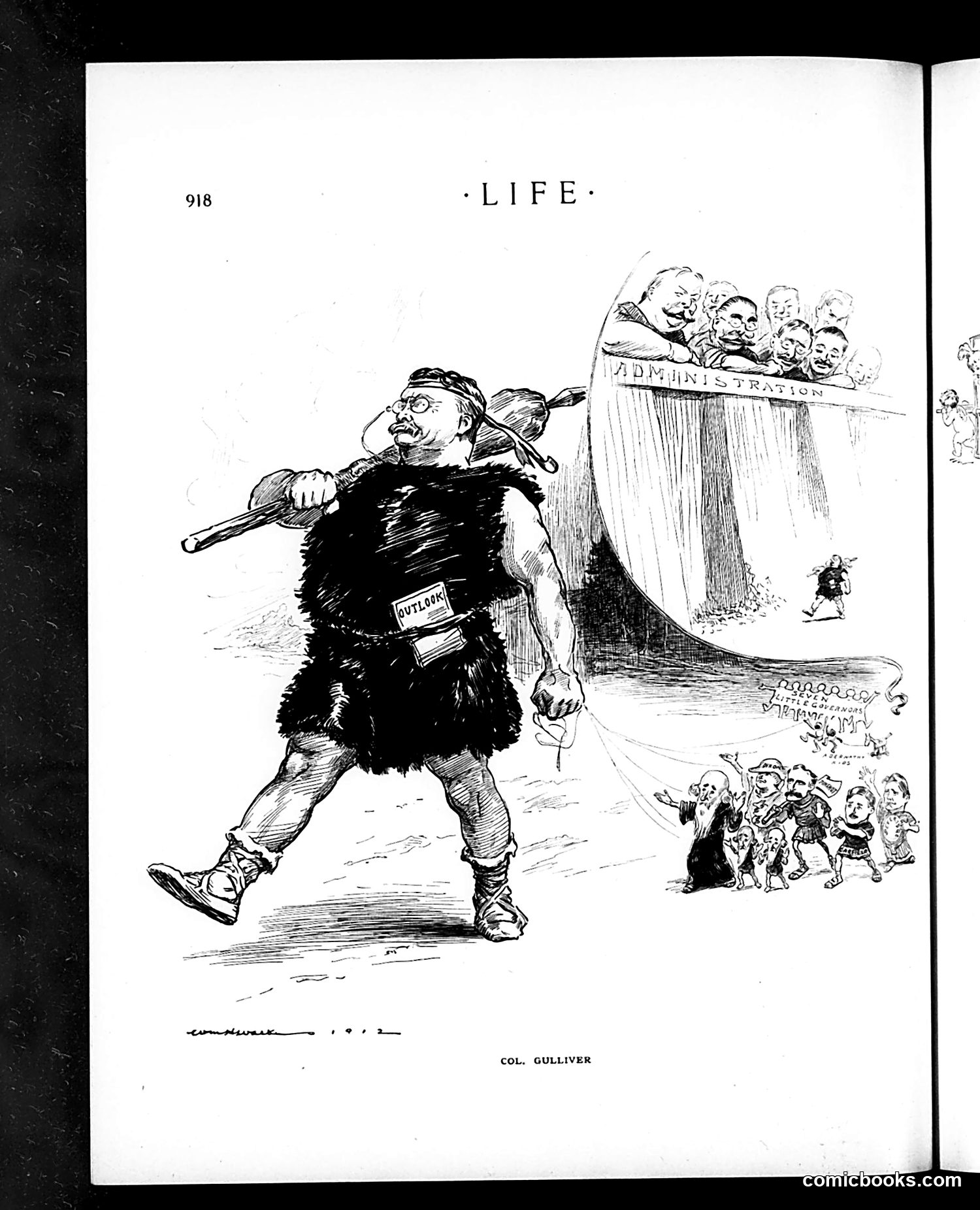
This is a political cartoon titled "Col. Gulliver," referencing Jonathan Swift's *Gulliver's Travels*. The central figure is labeled "OUTLAWS" and appears to be a large, brutish man wielding a club, surrounded by tiny figures representing various groups or institutions—notably including one labeled "ADMINISTRATION." The satire suggests that lawlessness or criminal elements ("outlaws") are overwhelming governmental authority and proper institutions, which are depicted as helpless Lilliputians. The Gulliver reference implies these "outlaws" are giant problems that conventional administration cannot control or restrain. The specific historical context remains unclear without additional dating, but likely reflects concerns about organized crime, gangsterism, or civil disorder during a particular period of American unrest.
This is a drama criticism page reviewing spring musical theater productions heading toward summer. The satirical point is straightforward: the critic mocks musical shows for their formulaic construction and reliance on chorus girls over genuine theatrical merit. The main review discusses "The Rose Maid" at the Globe, sarcastically noting that the show's formula is entirely predictable—"chorus girls, comedians, chorus girls, a tenor, chorus girls" repeated endlessly. The critic suggests that if you removed the chorus girls, "there would be not much left." He's contemptuous of the comedians' unfunny dialogue and dismissive of most of the cast's acting abilities. A secondary review covers "The Wall Street Girl" with Blanche Ring, which at least provides an American setting (a Wall Street office and Reno prize-fight venue) and more agreeable music by legitimate composers. The underlying satire targets both the entertainment industry's cynical formulas and audience tastes—implying summer theater audiences have intellectually "addled brains" that can't handle serious drama. The decorative "DRAMA" masthead and classical illustrations frame the scathing criticism with ironic formality.
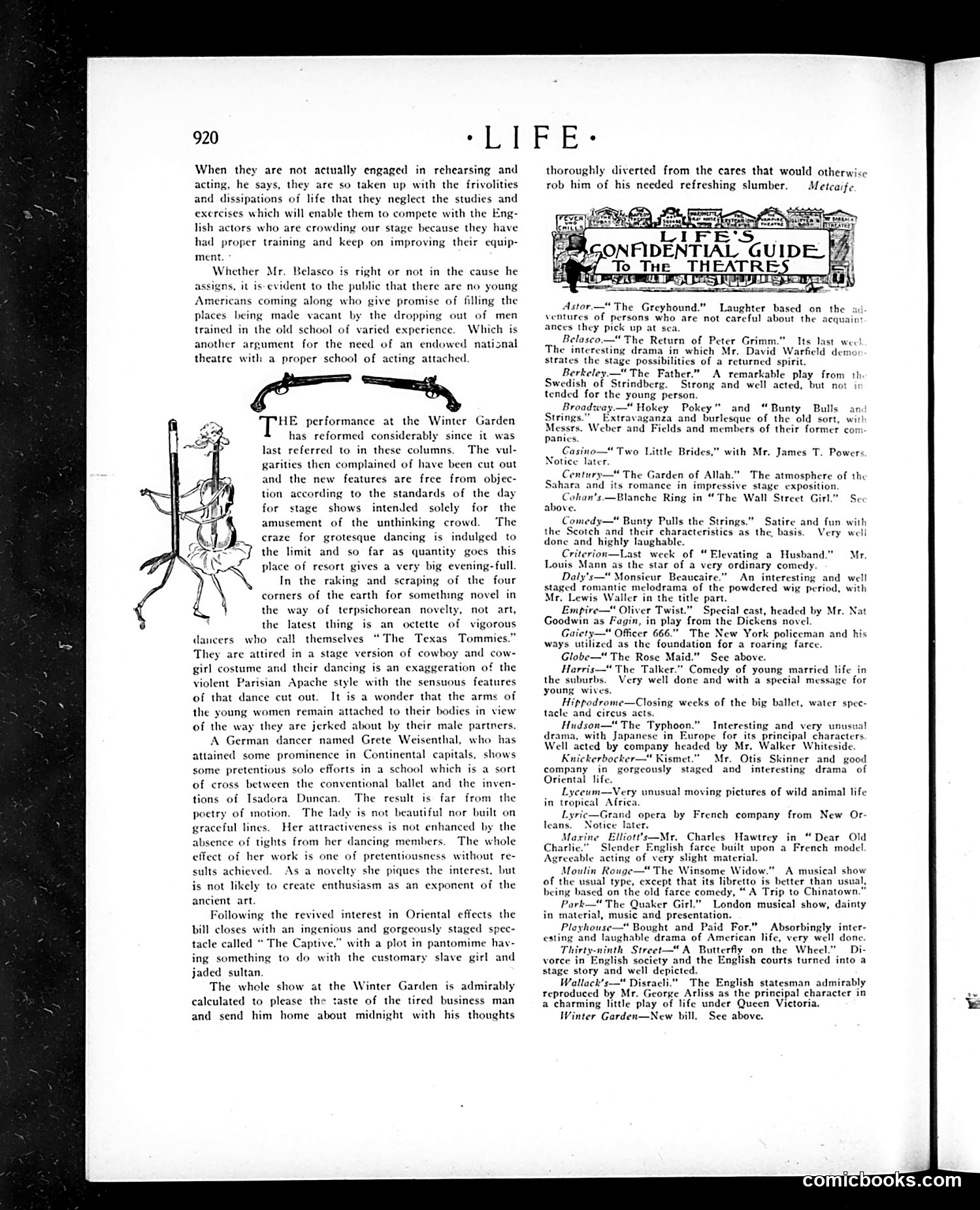
This page from *Life* magazine contains theatre criticism and a cartoon mocking actors' physical exertion. The cartoon depicts an extremely elongated, skeletal figure performing vigorous dance movements—a visual exaggeration meant to ridicule the "Texas Tommies," an octette of dancers at the Winter Garden theatre. The accompanying text critiques their "Apache style" dancing as lacking artistic merit, describing it as sensationalistic entertainment for "the unthinking crowd" rather than genuine art. The cartoonist emphasizes the dancers' violent jerking motions by depicting a body seemingly stretched and contorted beyond human limits—satirizing both the dance style's vulgarity and the physical toll it demands. The page also reviews various theatrical productions, indicating this reflects early 20th-century debates about theatrical standards: elite critics dismissing popular entertainment as crude while praising serious drama.
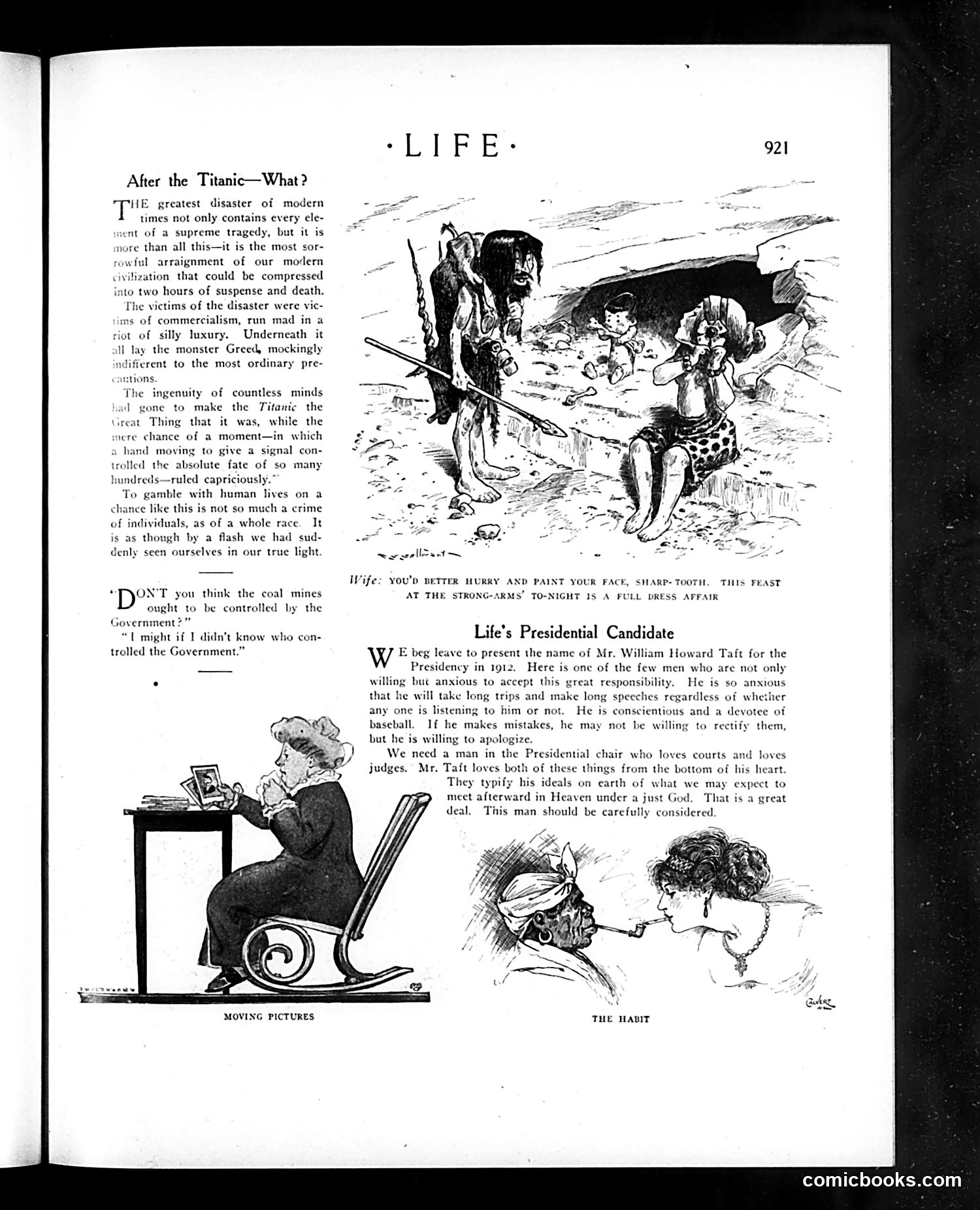
This page from *Life* magazine contains several satirical pieces critiquing American society and politics: **"After the Titanic—What?"** The main article argues the ship's disaster reveals systemic moral failure—victims were sacrificed to commercialism and greed. The accompanying illustration shows wolves feasting, sarcastically captioned "sharp-tooth," equating wealthy society to predators. **"Moving Pictures"** cartoon mocks commercial interests controlling government, via dialogue about coal mine regulation. **"Life's Presidential Candidate"** is heavy irony. The text presents William Howard Taft as presidential material, but the backhanded "compliments" are devastating: he makes mistakes he won't fix (only apologize), loves courts/judges obsessively, and gives long speeches nobody listens to. The satire suggests Taft is unfit—a puppet of judicial/commercial interests rather than a leader serving the public. The page overall criticizes wealthy elites' indifference to human welfare and their control of government.
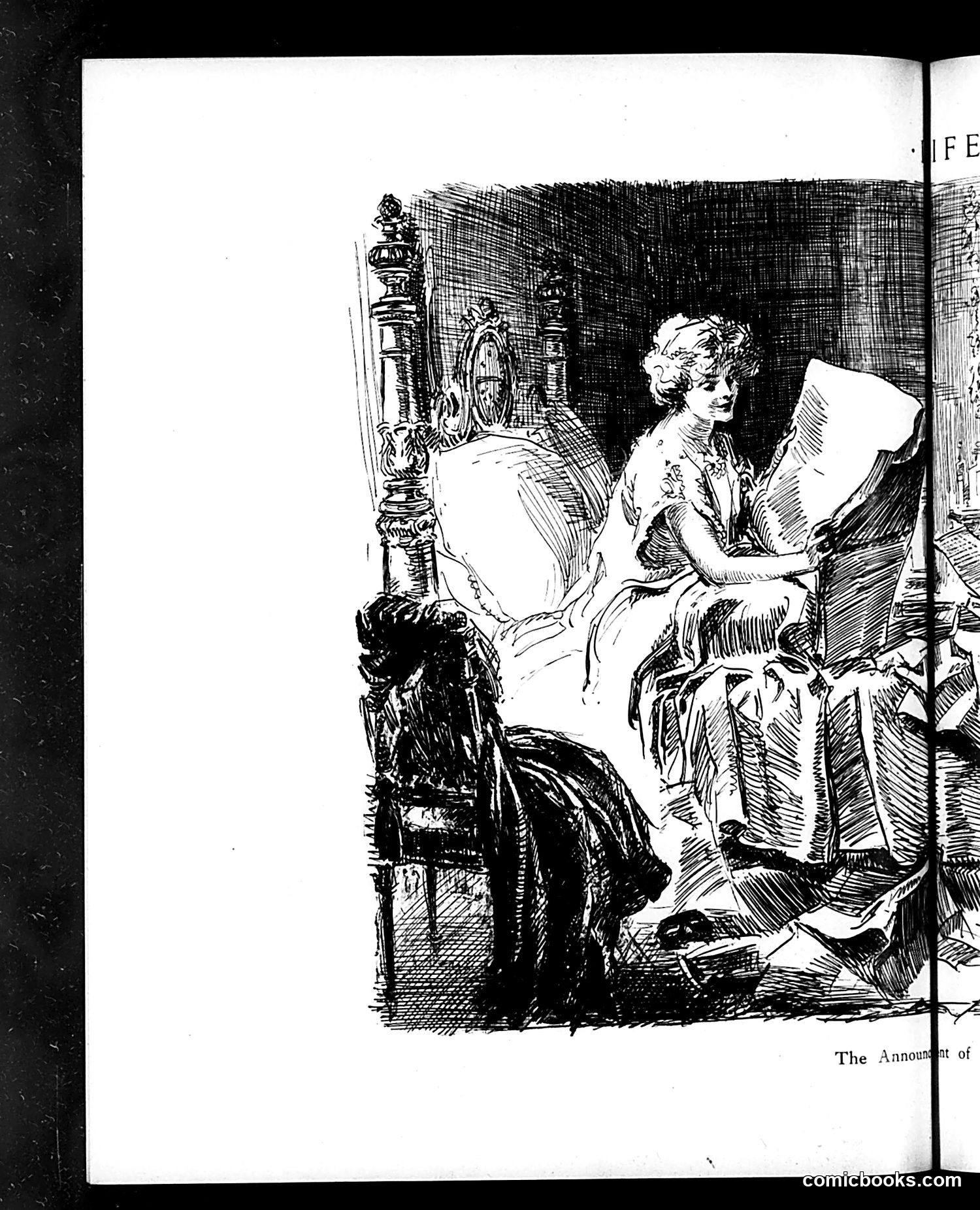
This page appears to be from an early issue of *Life* magazine, showing an illustration titled "The Annunciat[ion]" (the text is cut off). The sketch depicts a woman in period dress seated indoors, holding what appears to be a letter or document, with ornate furniture visible in the background. A dark figure—possibly a servant or messenger—stands to the left. Without the complete title and caption text, I cannot definitively identify the specific political or social satire intended. The classical art reference in the title suggests the illustration may be making an ironic commentary by applying religious or high-art language to a domestic scene. However, the exact point of satire remains unclear from the visible image alone.
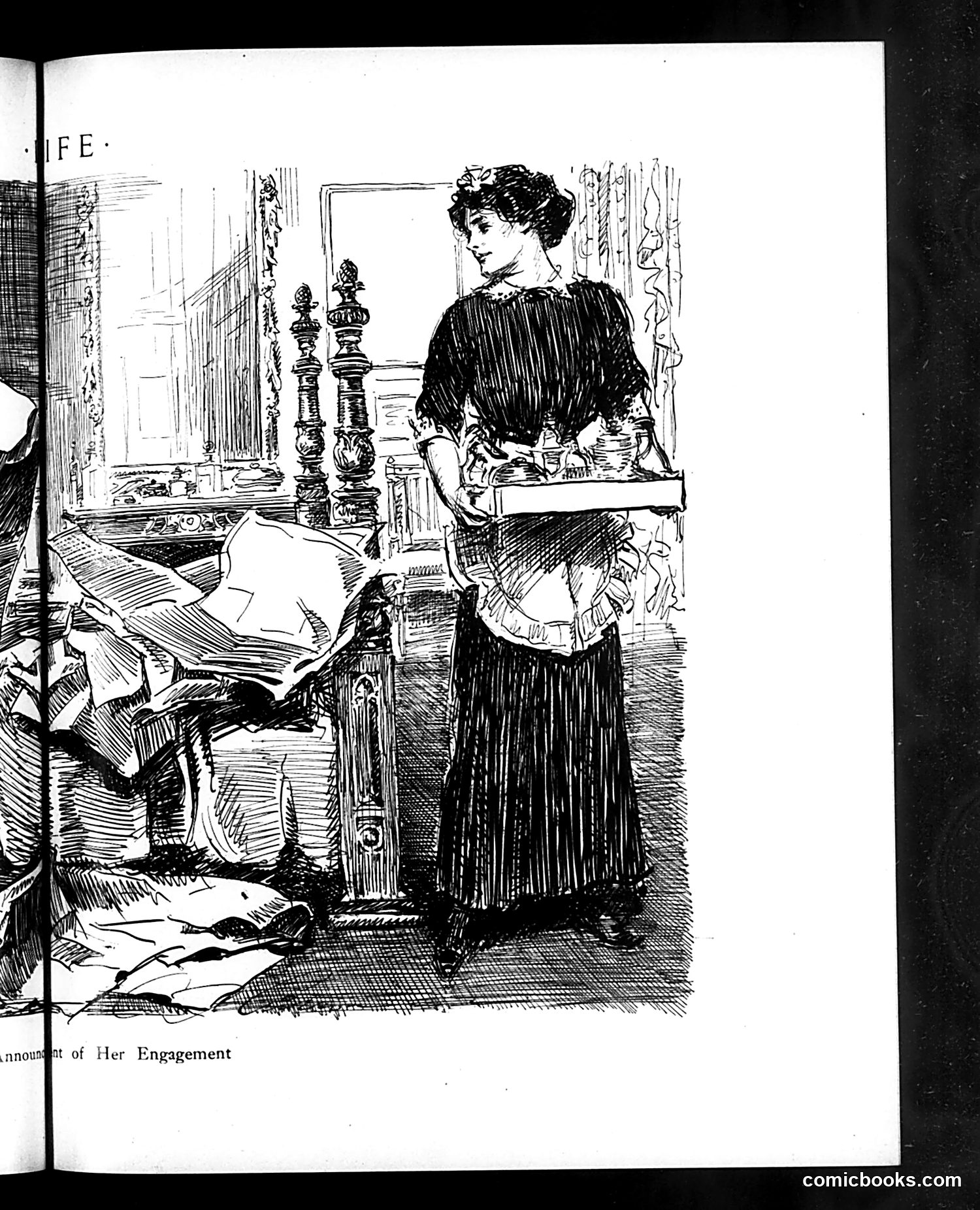
This appears to be an illustration titled "Announcement of Her Engagement" from *Life* magazine. The image shows a domestic scene with a woman standing and holding what appears to be a serving tray, while a man sits reading a newspaper. The scene depicts a Victorian-era interior with ornate candlesticks and period furnishings. The satire likely comments on engagement announcements and domestic expectations of the era. The woman's formal posture and the man's absorbed attention to his newspaper may mock the formality of such announcements or suggest commentary on gender roles and marital dynamics—perhaps implying the woman's excitement about her engagement contrasts with the man's indifference. Without additional context or visible byline, the specific satirical target remains somewhat unclear, though the composition suggests social commentary on Victorian courtship customs.
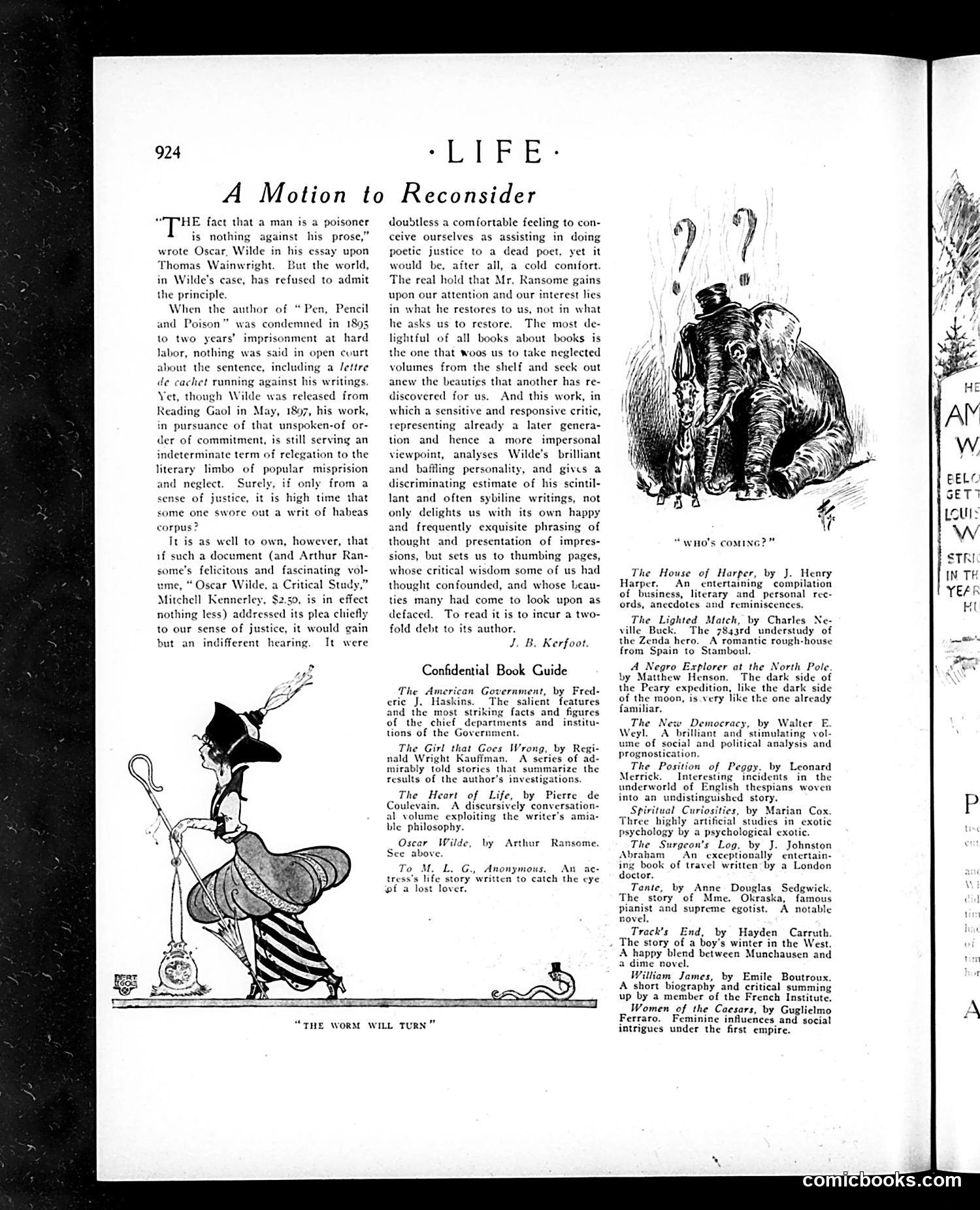
This page discusses Oscar Wilde's literary reputation following his 1895 imprisonment for homosexuality. The article argues that Wilde's work has been unfairly neglected—relegated to literary obscurity as an unspoken punishment beyond his sentence. **The cartoons** illustrate this theme: - "The Worm Will Turn" (bottom left): Shows a worm in formal dress, likely representing society's outcast or downtrodden, suggesting eventual vindication or reversal of fortune. - "Who's Coming?" (right): Depicts figures waiting anxiously, appearing to reference social ostracism or anticipation of judgment. The piece reviews Arthur Ransome's critical study of Wilde, praising it for restoring attention to Wilde's "brilliant" but dismissed writings. The author argues we should reconsider Wilde based on his literary merit rather than his personal conduct—a progressive stance for 1911, when Wilde's disgrace remained culturally toxic.
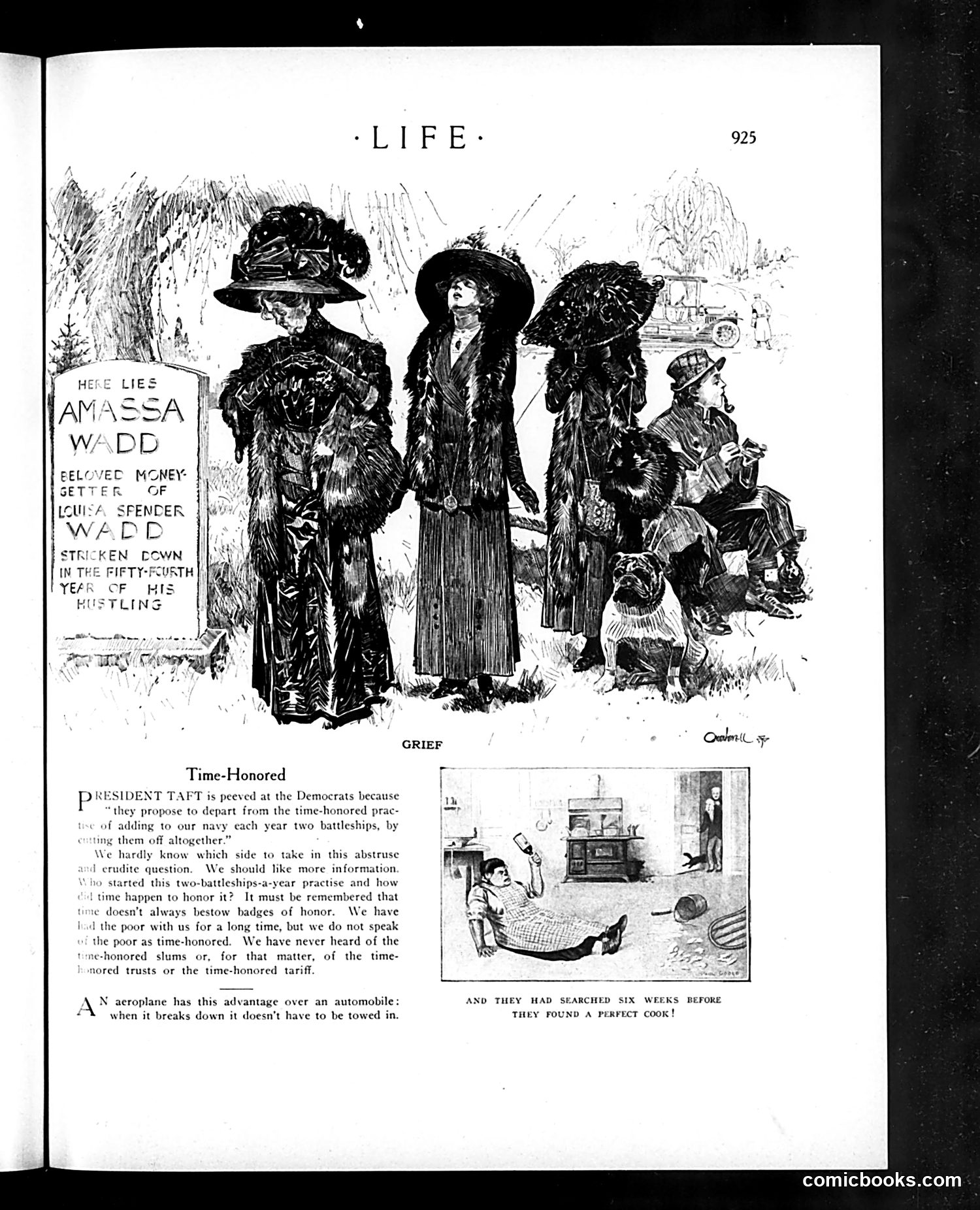
**Top Cartoon - "Grief":** Shows mourners at a grave marker for "Amassa Wadd," a wealthy moneylender. The satire mocks the funeral of a despised figure—suggesting that even his death brings no genuine sorrow, only formal appearance. The elaborate dress and umbrellas contrast with the evident lack of authentic grief. **"Time-Honored" Editorial Section:** Critiques President Taft's objection to Democrats abandoning a two-battleships-per-year naval expansion practice. Life's editors sarcastically question why this practice deserves respect merely because it's old, pointing out that age doesn't automatically confer honor (noting "time-honored slums" and "time-honored trusts" as absurd examples). This attacks both Taft and the notion of tradition-based arguments in policy. **Bottom Comic:** A domestic humor joke: a couple celebrates finding a perfect cook after six weeks of searching—typical early-20th-century servant-shortage humor reflecting middle-class anxieties about household help. The page reflects Progressive Era skepticism toward both established wealth and traditional arguments for maintaining status quo policies.
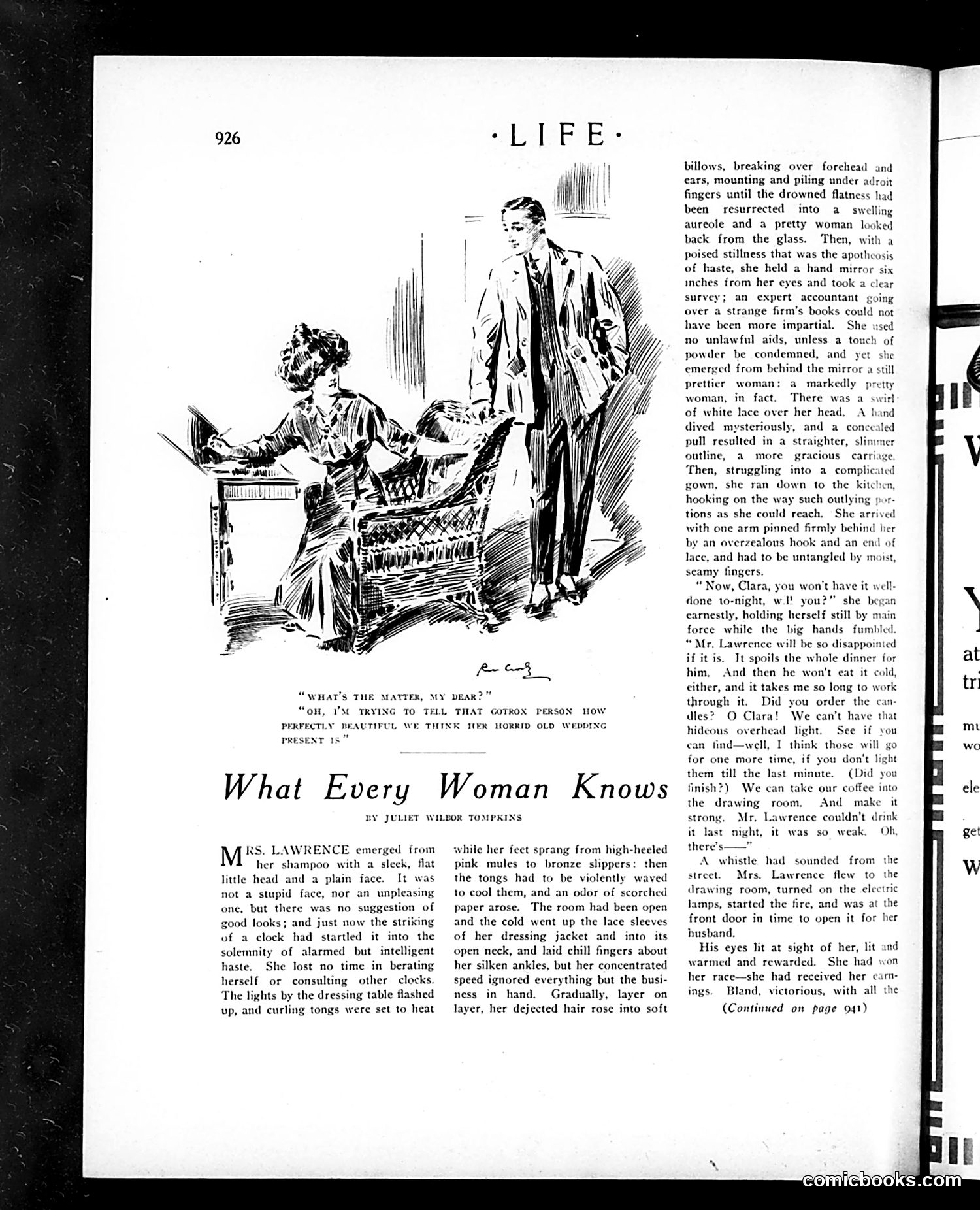
This is a short story by Juliet Wilsor Tompkins about Mrs. Lawrence's frantic preparation for her husband's arrival home. The cartoon shows a domestic scene where a man stands while a woman sits at her dressing table. The satirical point targets the labor and manipulation underlying "feminine" domesticity. Mrs. Lawrence rushes through an elaborate beauty regimen (hair styling, makeup, corseting), then frantically manages household details—instructing the cook, adjusting lighting, starting fires—all to present herself as effortlessly attractive and her home as perfectly comfortable when her husband arrives. The story's title ironically suggests that "what every woman knows" is the performative nature of domestic life: that a wife's value depends on invisible work that must appear natural and unstudied. Her "race" won when he rewards her with warm approval reveals the transactional nature of marriage. This critiques early 20th-century expectations that women's labor—both physical and emotional—should go unacknowledged.
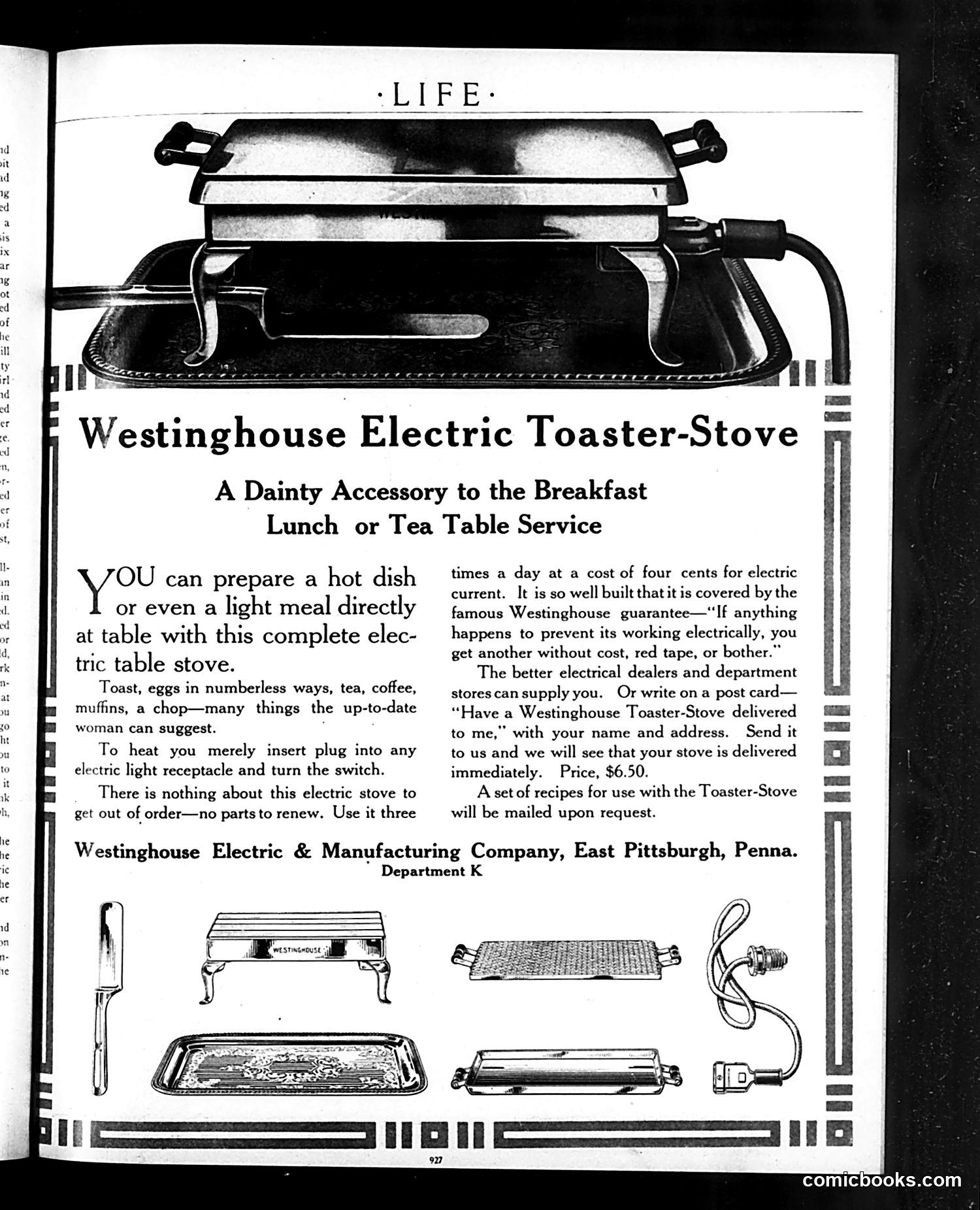
This page is primarily a **product advertisement** for the Westinghouse Electric Toaster-Stove, not political satire. Life magazine, while known for humor and social commentary, also carried commercial ads. The ad targets "the up-to-date woman" of the early 20th century, marketing convenient table-top cooking as a modern luxury. Key selling points: it operates simply (plug and switch), costs only four cents per use, requires no maintenance, and comes with Westinghouse's famous guarantee. The price ($6.50) and recipe offer suggest aspirational middle-class appeal. The only social commentary is *implicit*: the ad reflects era-specific gender assumptions—that women would appreciate labor-saving kitchen devices—and the broader technological optimism about electricity as transforming domestic life. There are no political figures, caricatures, or satirical jokes visible on this page.
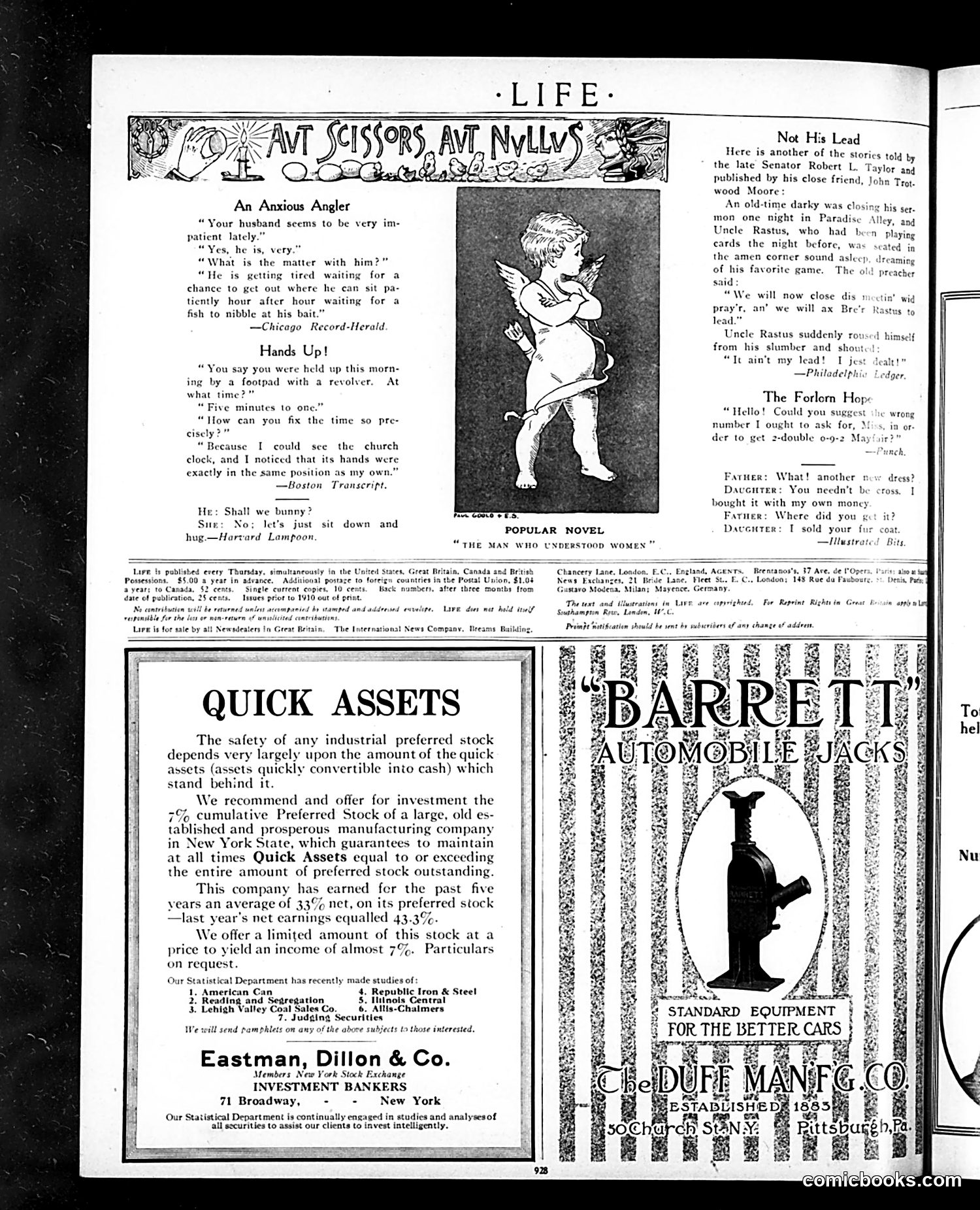
This page contains several short humorous items typical of early 20th-century American satire magazines: **"An Anxious Angler"** jokes about a husband eager to fish but forced to wait patiently—ironic commentary on male leisure pursuits. **"Hands Up!"** plays on a mugging victim's precise recollection of time via a church clock, with the punchline that the robber's raised gun hand mimicked the clock's position—absurdist humor about coincidence. **"The Forlorn Hop"** and other brief items mock contemporary social situations: courtship awkwardness, domestic finance disputes (a wife selling her husband's possessions to buy a dress), and miscommunication with telephone operators. The central illustration depicts a cherub or cupid figure—labeled "The Man Who Understood Women"—referencing a popular novel, suggesting ironic commentary on male-female relationships. The page is primarily **humor and light satire** rather than political content, reflecting Life magazine's focus on social observation and domestic comedy during this era.
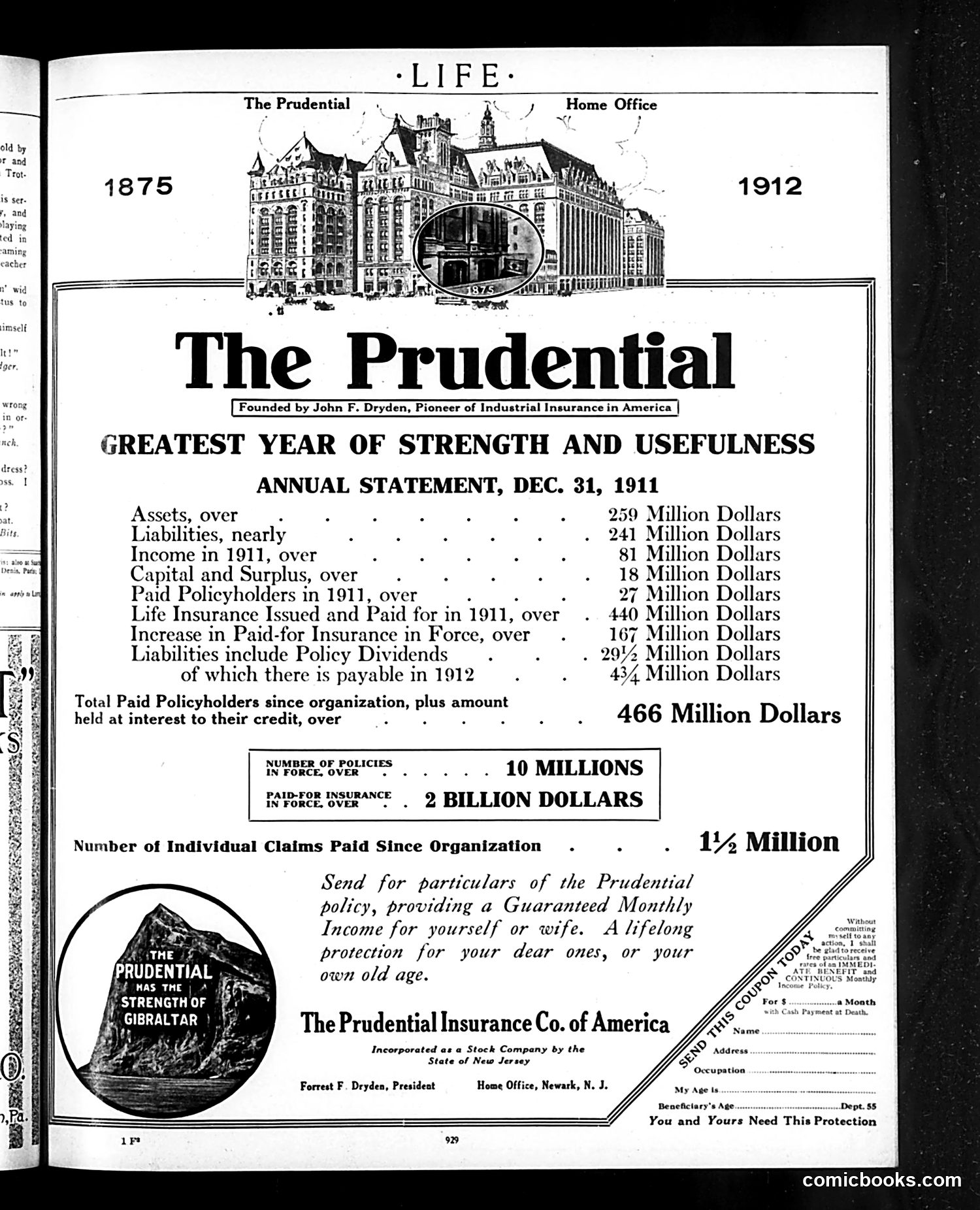
This is primarily a **corporate advertisement**, not political satire. The Prudential Insurance Company uses this full Life magazine page to showcase its 1911 financial performance and promote life insurance policies. **Key content:** - Founding narrative: John F. Dryden pioneered "industrial insurance" (affordable policies for working-class Americans) - Impressive statistics: $259 million in assets, $2 billion in insurance force, 1.5 million claims paid - Product pitch: "Guaranteed Monthly Income" policies for family protection and old age security - Iconic branding: The Rock of Gibraltar logo (representing stability and strength) **Historical context:** This reflects early-20th-century industrial insurance's legitimacy and growth. The detailed financial statements aim to build consumer confidence in an industry that had faced skepticism about financial reliability. There is no political cartoon or satire on this page—it's a straightforward corporate advertisement exploiting Life's credibility to reach middle-class readers concerned about economic security.
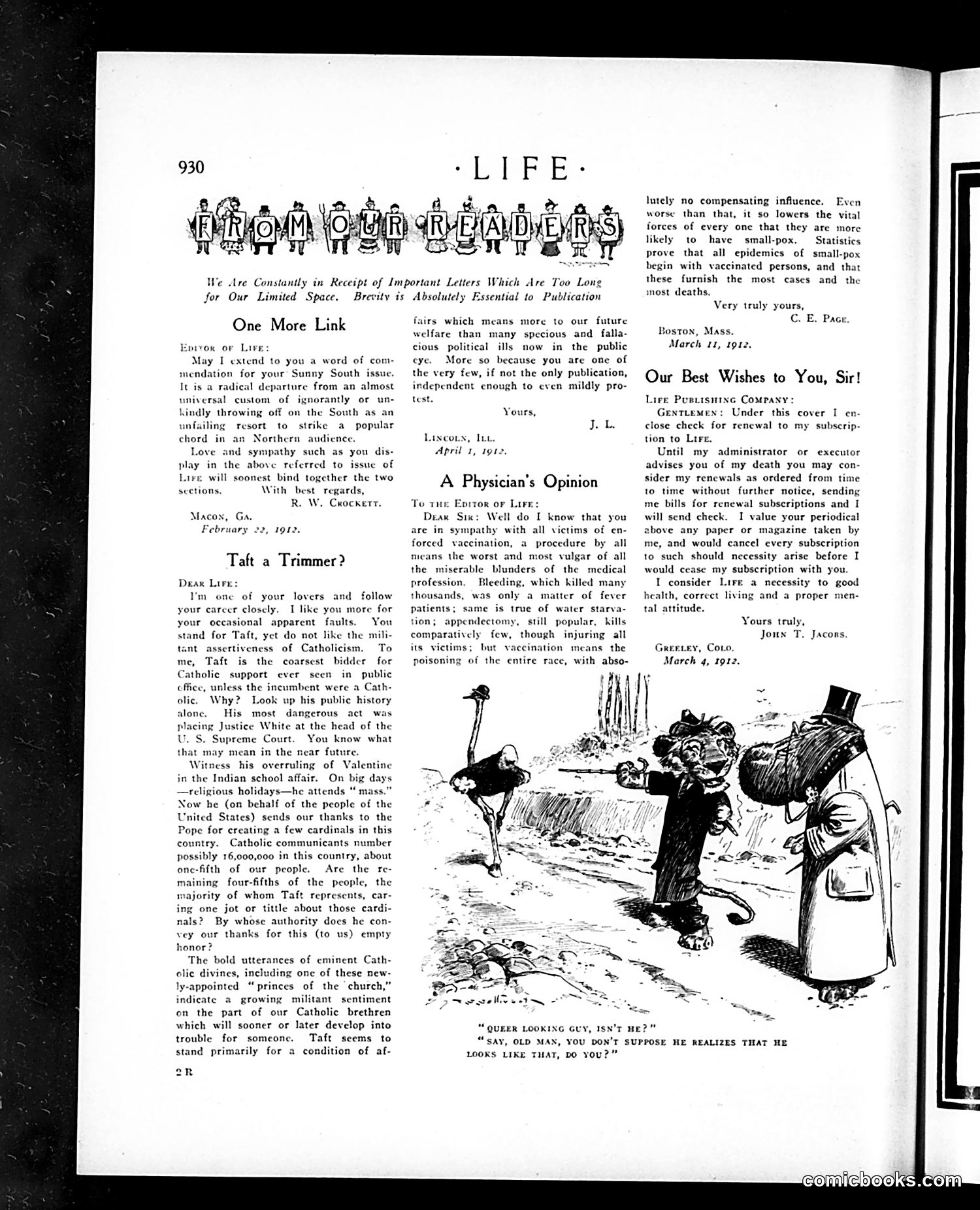
This page consists primarily of **reader letters** to the editor—not political cartoons. The single illustration depicts a peculiar-looking figure on a beach or seaside setting, with onlookers commenting on his odd appearance. The caption reads: "Queer looking guy, isn't he?" / "Say, old man, you don't suppose he realizes that he looks like that, do you?"—a simple humor piece about social self-awareness. The letter section covers three topics: **regional reconciliation** (praising Life's sympathetic coverage of the South); **Taft's Catholicism** (criticizing President Taft for appearing too favorable to Catholic interests—appointing Justice White, attending mass, thanking the Pope—when Catholics constitute only one-fifth of Americans); and **anti-vaccination sentiment** (a physician arguing vaccination weakens public health and causes small-pox epidemics). These reflect genuine 1912 political anxieties about religious influence and medical authority.
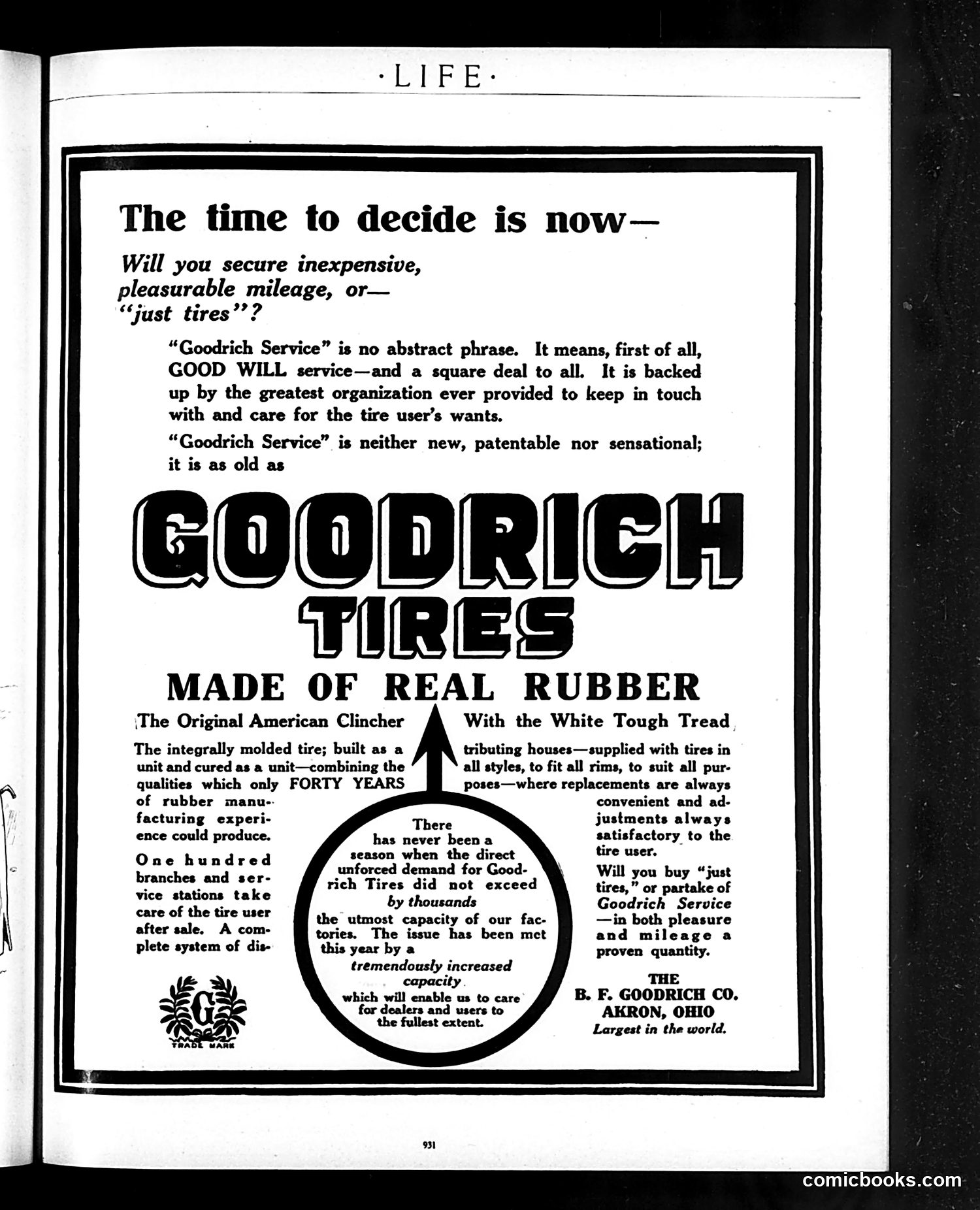
This is a **tire company advertisement**, not satire or political content. B.F. Goodrich Co. (Akron, Ohio) uses this full-page spread to promote their tires and service network. The ad contrasts buying cheap, generic "just tires" versus choosing Goodrich's complete service ecosystem—100+ branches offering ongoing customer support, convenient replacements, and adjustments. The implicit argument: quality costs slightly more but delivers better long-term value and reliability. Key selling points emphasized: - 40 years of rubber manufacturing experience - "Made of real rubber" (suggesting competitors might use inferior materials) - Massive distribution network ensuring accessibility - Consistently high demand exceeding factory capacity The circular graphic stresses their factories have expanded production to meet demand—a confidence signal about both popularity and supply reliability. This appears to be early 20th-century advertising, likely pre-1920s, when tire quality and distribution were genuine competitive advantages.
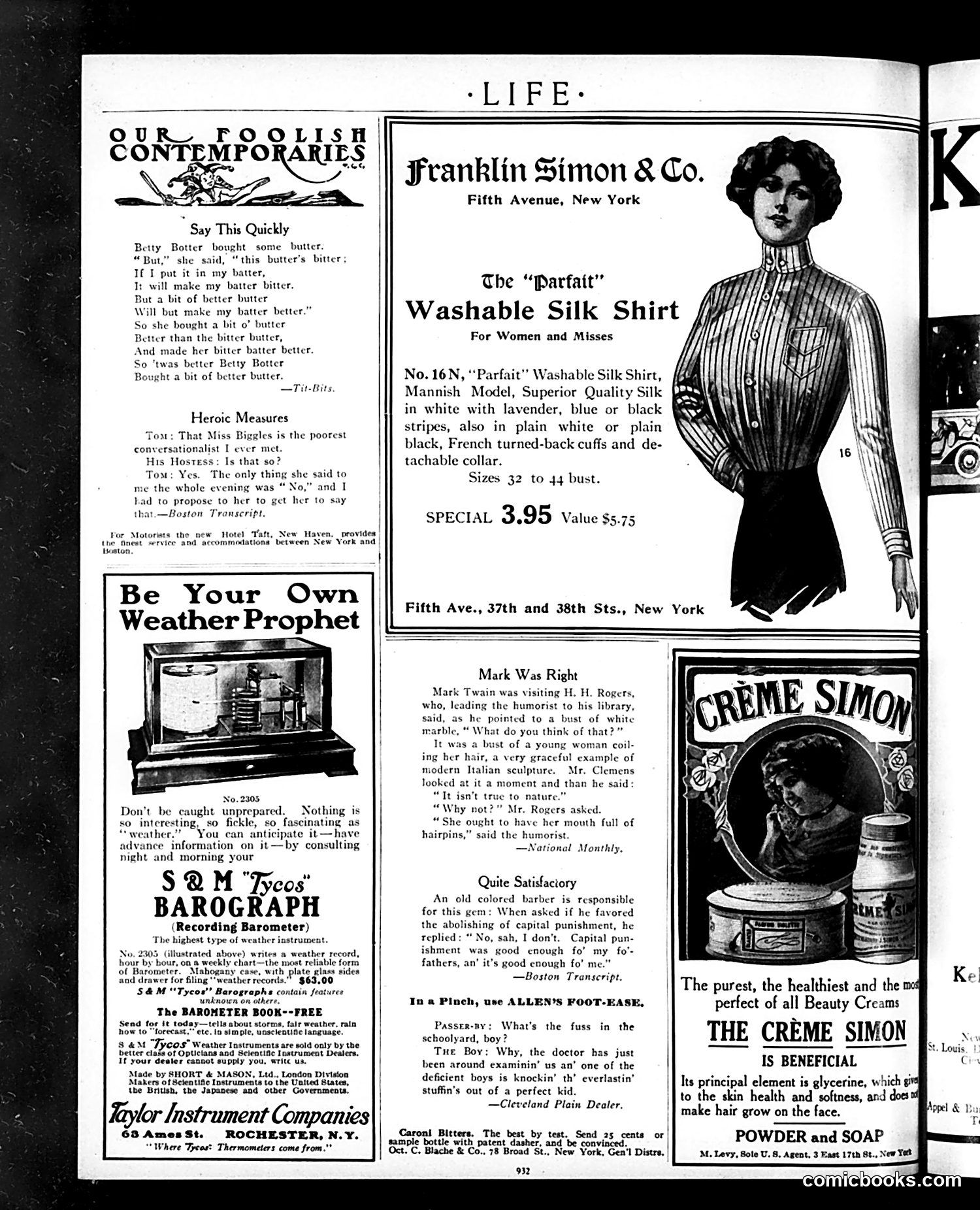
This page is primarily **advertising** with interspersed **humor columns** typical of early-20th-century satirical magazines. The humor pieces are brief, pun-based jokes: "Say This Quickly" is a tongue-twister about butter quality; "Heroic Measures" jokes that a woman's single word "No" as a marriage proposal response; "Mark Was Right" presents Mark Twain criticizing a marble sculpture for anatomical implausibility (a woman's head should have hairpins); "In a Pinch" features a dialect joke about a poor schoolboy attacking a healthy one during a medical exam. These are **not political satire** but rather **genteel wordplay humor**—puns and observations on social situations, a standard format for Life magazine's humor section in this era. The page fills remaining space with product advertisements: a "Barograph" (weather recording device), washable silk shirts, and cosmetics. These reflect early 1900s consumer culture targeting middle-class readers.
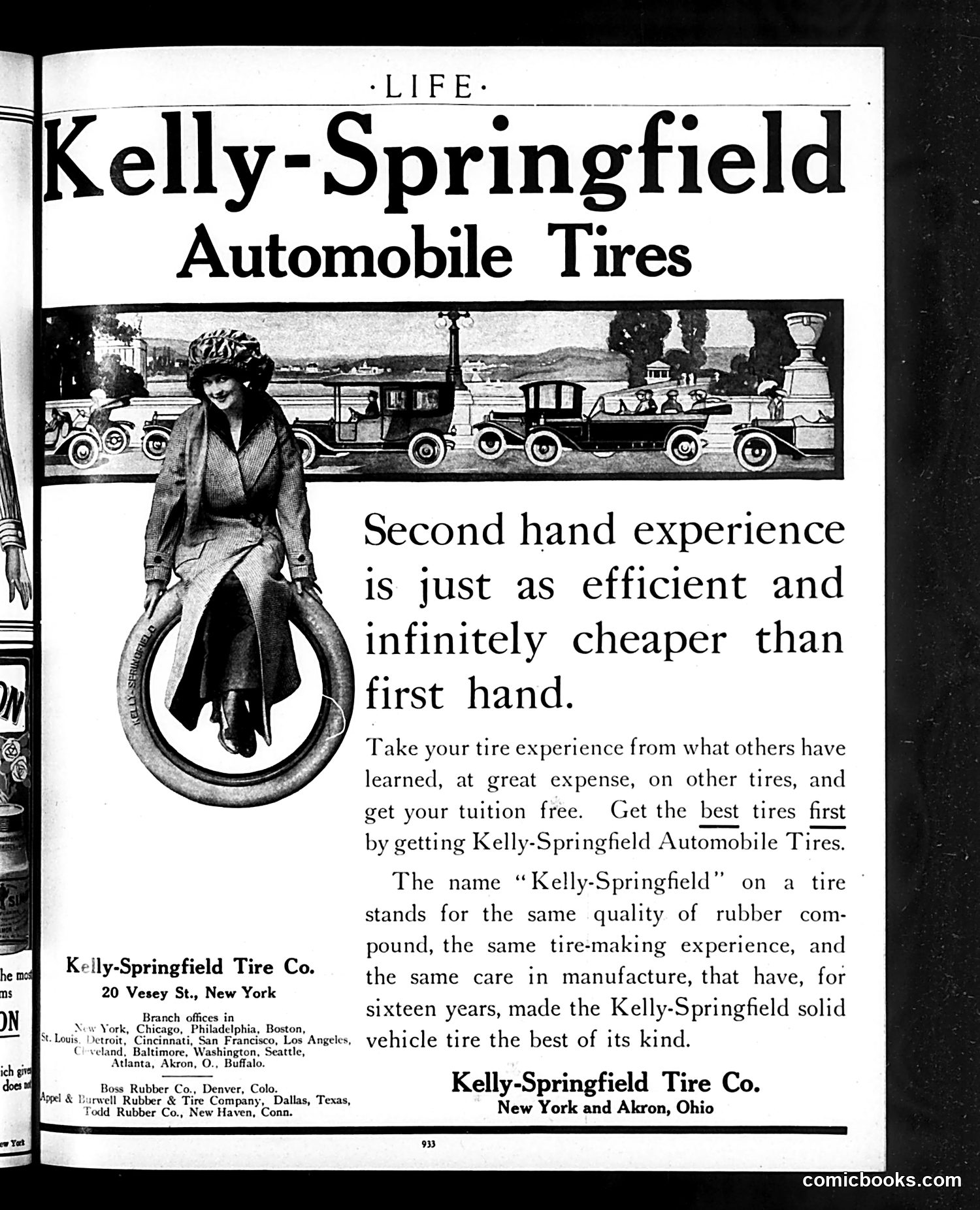
This is primarily a **tire company advertisement**, not political satire. The page features a woman seated on a large automobile tire, used as visual product placement. The ad's central pitch plays on a practical paradox: buyers can benefit from others' expensive tire failures without paying premium prices themselves. The slogan "Second hand experience is just as efficient and infinitely cheaper than first hand" suggests that Kelly-Springfield tires perform as reliably as competitors' products while costing less—essentially claiming the buyer gets proven quality at bargain rates. The illustration of vintage automobiles and the woman's fashionable 1920s-era clothing establish this as aspirational consumer marketing to middle-class car owners. The extensive list of branch offices emphasizes the company's national reach and stability, lending credibility to their durability claims established over sixteen years of manufacturing.
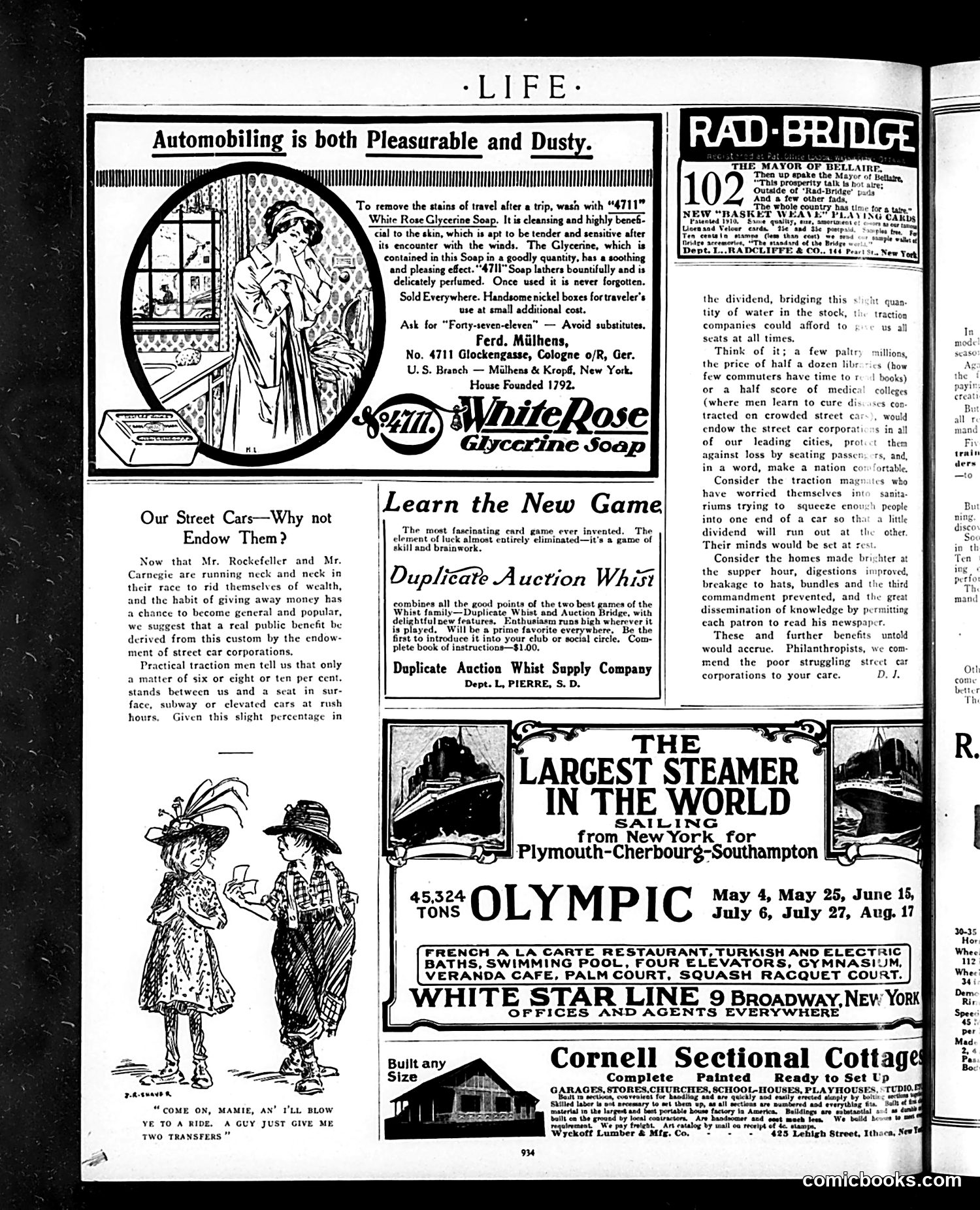
This page is primarily **advertising and light satire** rather than political commentary. The main cartoon (bottom left) shows two working-class figures discussing street car transfers—a joke about getting free rides. The accompanying article "Why not Endow Them?" is **satirical social commentary**: Life sarcastically proposes that wealthy philanthropists like Rockefeller and Carnegie should endow street car corporations to guarantee seats during rush hours. The satire targets both the overcrowded transit system and the era's ostentatious charitable giving by the ultra-wealthy—suggesting their "generosity" could solve mundane public problems like commuter comfort. The page otherwise contains **period advertisements**: 4711 soap (marketed to dusty automobile travelers), a card game called "Duplicate Auction Whist," the RMS Olympic luxury liner, and modular cottage kits. These ads reflect 1910s-era consumer goods and leisure activities. No specific political figures are caricatured. The satire is directed at systemic issues (transit congestion) and wealthy industrialists' philanthropic priorities rather than named individuals.
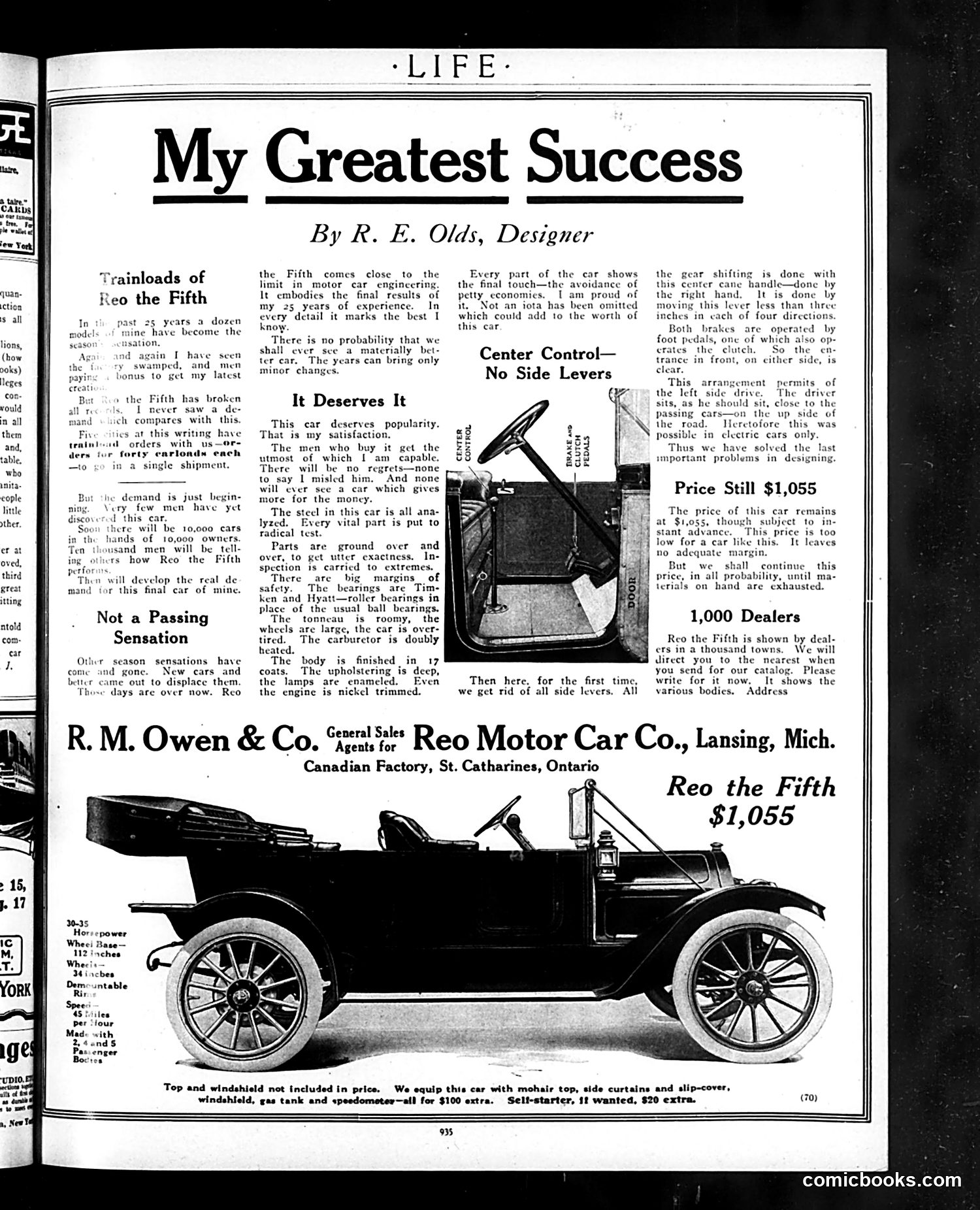
This is **not a cartoon or satire**—it's a straightforward automobile advertisement disguised as an article. R. E. Olds, the designer of the Reo Fifth automobile, presents it as his "greatest success" in motor car engineering. The piece celebrates specific technical innovations: center control (no side levers for gear shifting), advanced bearings, precision-ground parts, and a $1,055 price point. The large photograph and technical diagram showcase the car's design. The framing as a first-person testimonial by the designer was a common early 20th-century advertising tactic—lending credibility and personal prestige to the product. The emphasis on engineering rigor and quality reflects how automobiles were marketed to consumers in the 1910s-1920s as precision mechanical achievements rather than lifestyle accessories. This appears in *Life* magazine's advertising section, not its satirical editorial content.
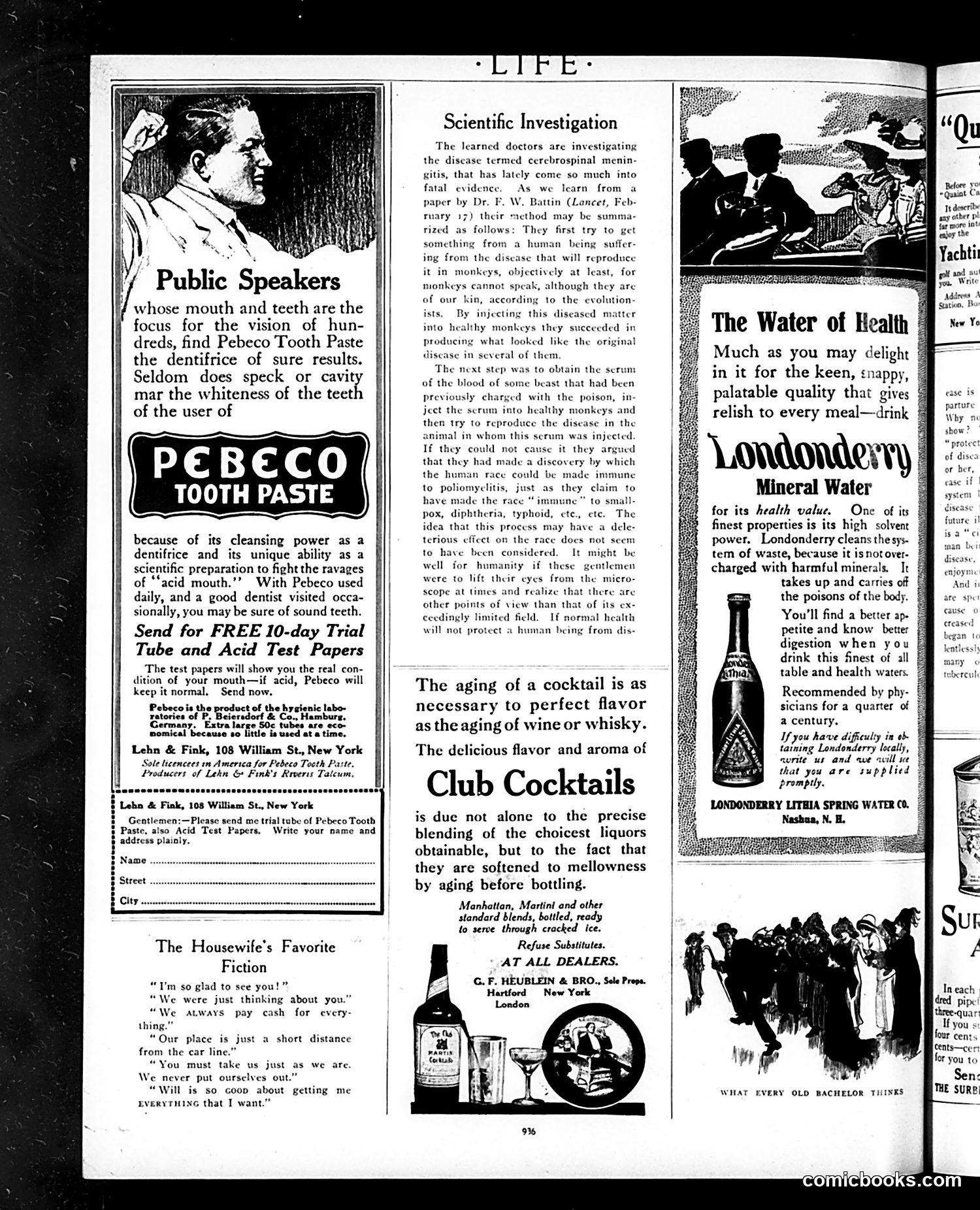
This Life magazine page is primarily **advertising**, not satire or political commentary. It features three commercial ads typical of the 1910s-20s era: 1. **Pebeco Tooth Paste**: Markets to public speakers concerned about dental appearance, offering a "free trial" and "acid test papers"—reflecting early 20th-century enthusiasm for scientific approaches to hygiene. 2. **Club Cocktails**: Advertises pre-bottled cocktails, comparing their aging to fine spirits. This appears during Prohibition era (though exact date unclear), when such products existed in legal gray areas. 3. **Londonderry Mineral Water**: Promotes health benefits, claiming to "cleanse" the system of "poisons." The small section titled "The Housewife's Favorite Fiction" appears to gently mock domestic small-talk clichés—not addressing the ads themselves. The "Scientific Investigation" column discusses cerebrospinal meningitis research using animal testing, presenting it straightforwardly without obvious satire. This is a typical advertising-heavy magazine page of its era.
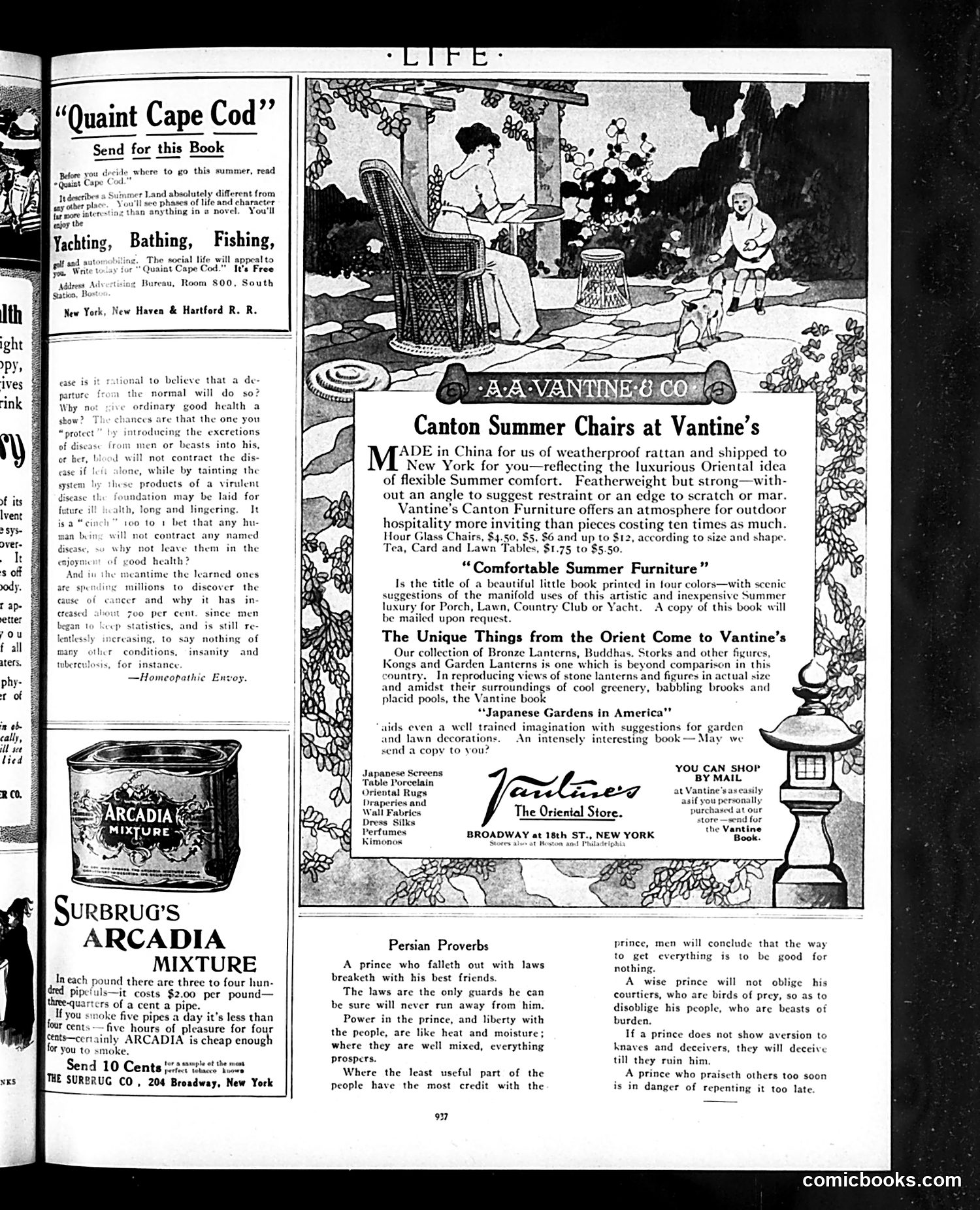
This page is primarily **advertising**, not satire or political commentary. The main content features two large advertisements: 1. **Vantine's Oriental Furniture**: Marketed as luxury summer chairs and décor imported from China, emphasizing affordable elegance for outdoor entertaining. 2. **Surbrugg's Arcadia Mixture**: A tobacco product advertisement claiming economic value—five pipefuls daily costs less than four hours of pleasure. The page also includes a "Quaint Cape Cod" book advertisement promoting summer leisure activities, and a column of **Persian Proverbs** about governance and princes (likely filler content). The small homeopathic essay criticizes disease prevention measures—a common anti-vaccination/anti-public-health stance of the era. **No political cartoons or satirical figures appear on this page.** The content reflects early 20th-century consumer culture targeting affluent readers seeking exotic imports and leisure goods.
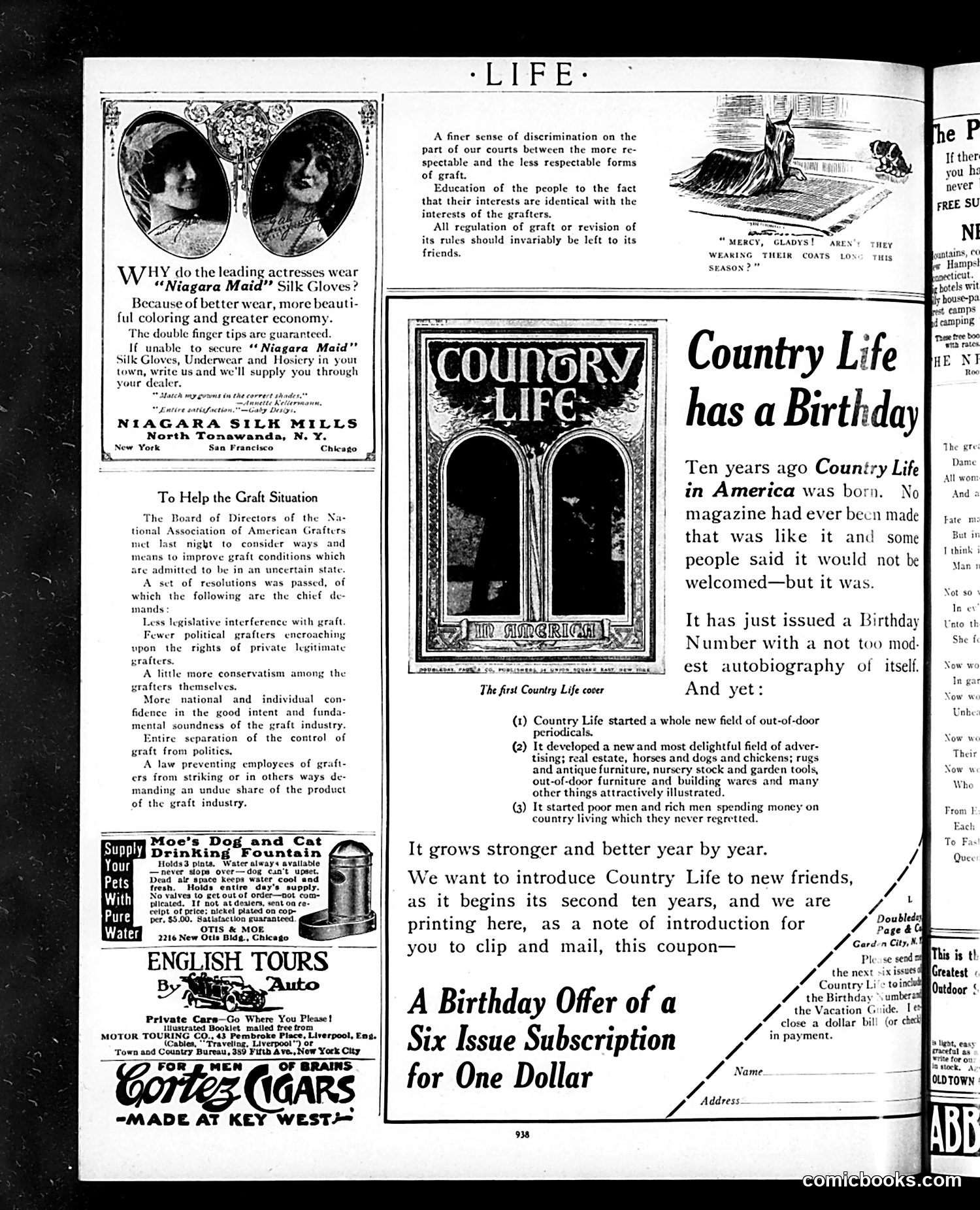
This page mixes advertising with satirical editorial content typical of Life magazine's early 20th-century format. **The main satire** is "To Help the Graft Situation," which mocks corrupt politicians and business practices. It presents a fake "National Association of American Grafters" meeting that ironically demands "less legislative interference with graft" and "separation of graft from politics"—obviously absurd requests. The joke is that graft (bribery, corruption) was so endemic to American politics that the magazine satirizes it as an established industry with legitimate grievances, exposing how normalized corruption had become. **The right side** announces Country Life magazine's tenth anniversary with a self-congratulatory "Birthday Number," including a subscription offer. **The left side** contains typical period advertisements for silk gloves, pet water fountains, and auto tours—commercial content that funded the magazine. The satire relies on readers recognizing contemporary graft scandals; the humor targets both corrupt officials and public cynicism about their inevitability.
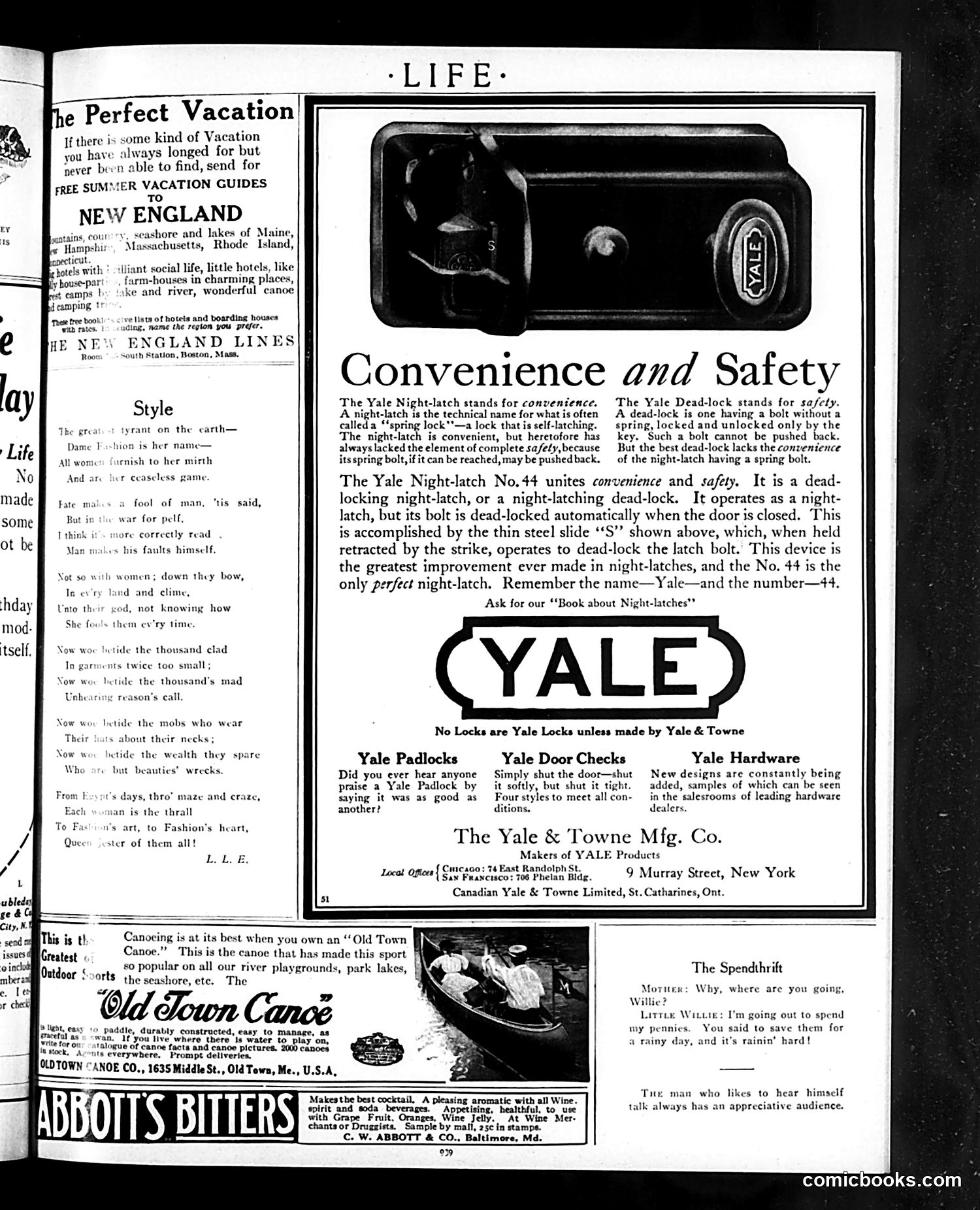
This page is primarily **advertising**, not political satire. It features: **Main Content:** - Yale lock company advertisement emphasizing the "Night-latch No. 44" as combining convenience and safety—a technical product pitch explaining how the lock's spring bolt operates automatically when doors close. - Old Town Canoe advertisement promoting recreational canoeing as a popular leisure activity. - Abbott's Bitters cocktail advertisement. **Sidebar Content:** A poem titled "Style" (author L.L.E.) offering conventional Victorian morality about women's behavior and fashion—satirizing female vanity and foolishness rather obliquely. A brief comic dialogue called "The Spendthrift" depicting a child asking permission to spend pennies, contrasting parental thriftiness advice with the child's immediate desire. **Overall:** This is a typical early 20th-century *Life* magazine page blending consumer advertisements with light moral/social commentary through poetry and humor—not political cartoons or sharp satire.
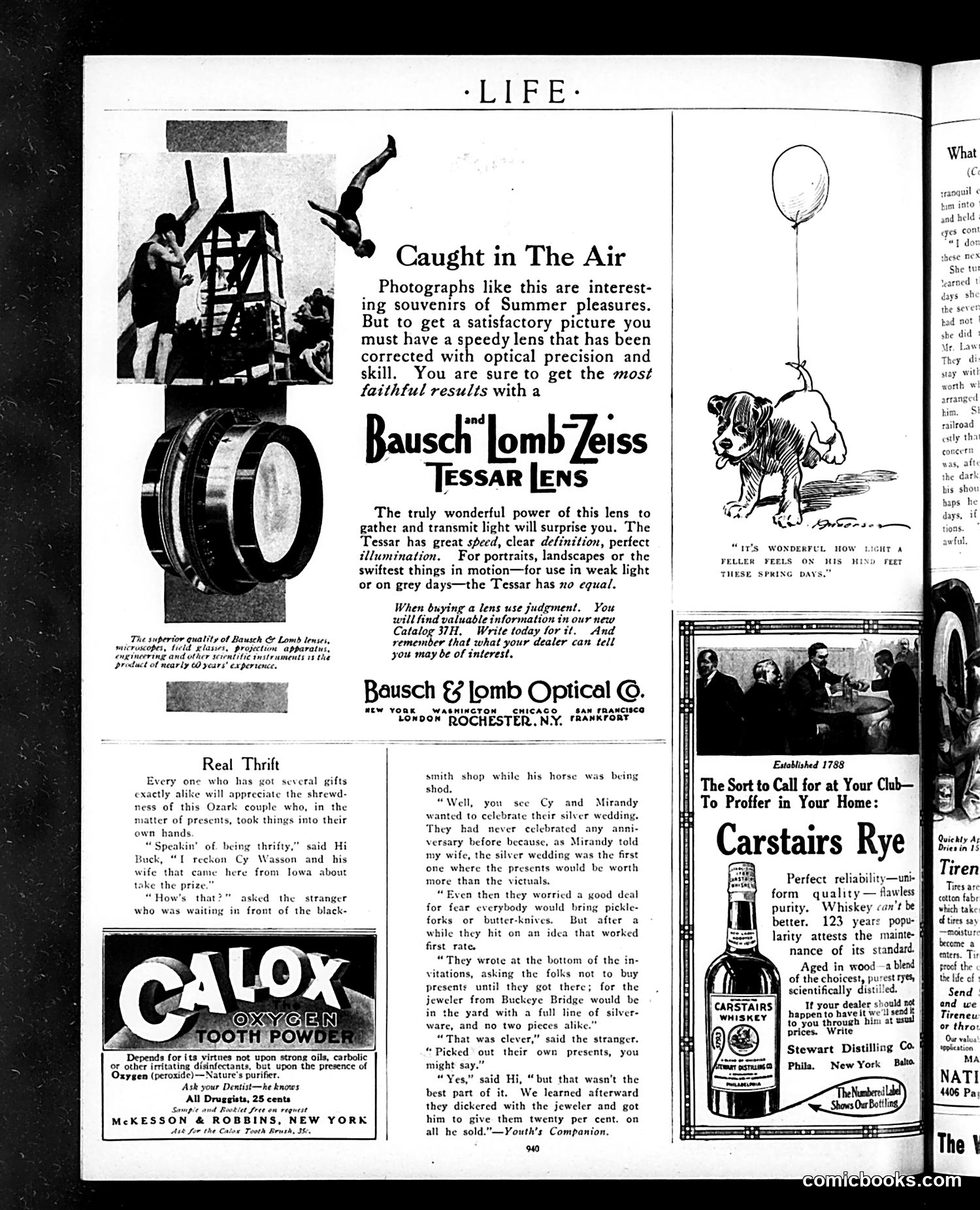
This page is primarily **advertising**, typical of Life magazine's revenue model. The main content is a humorous anecdote titled "Real Thrift" about an Ozark couple (Cy and Mirandy Wasson) celebrating their silver wedding anniversary. The joke: instead of guests buying presents beforehand, the couple arranged for a jeweler to come to their property with silverware samples, letting guests select items—then negotiated a 20% discount with the jeweler on the total sale. The humor derives from their shrewd practicality: they turned gift-giving into bulk purchasing to save money. The page also features period advertisements for camera lenses, tooth powder, rye whiskey, and other products—standard early-20th-century magazine content. There is a cartoon illustration of a dog with a balloon on the right side, unrelated to the main text. The "Ozark couple" reference suggests rural American stereotypes of the era—simple folk outsmarting conventional expectations through practical thinking.
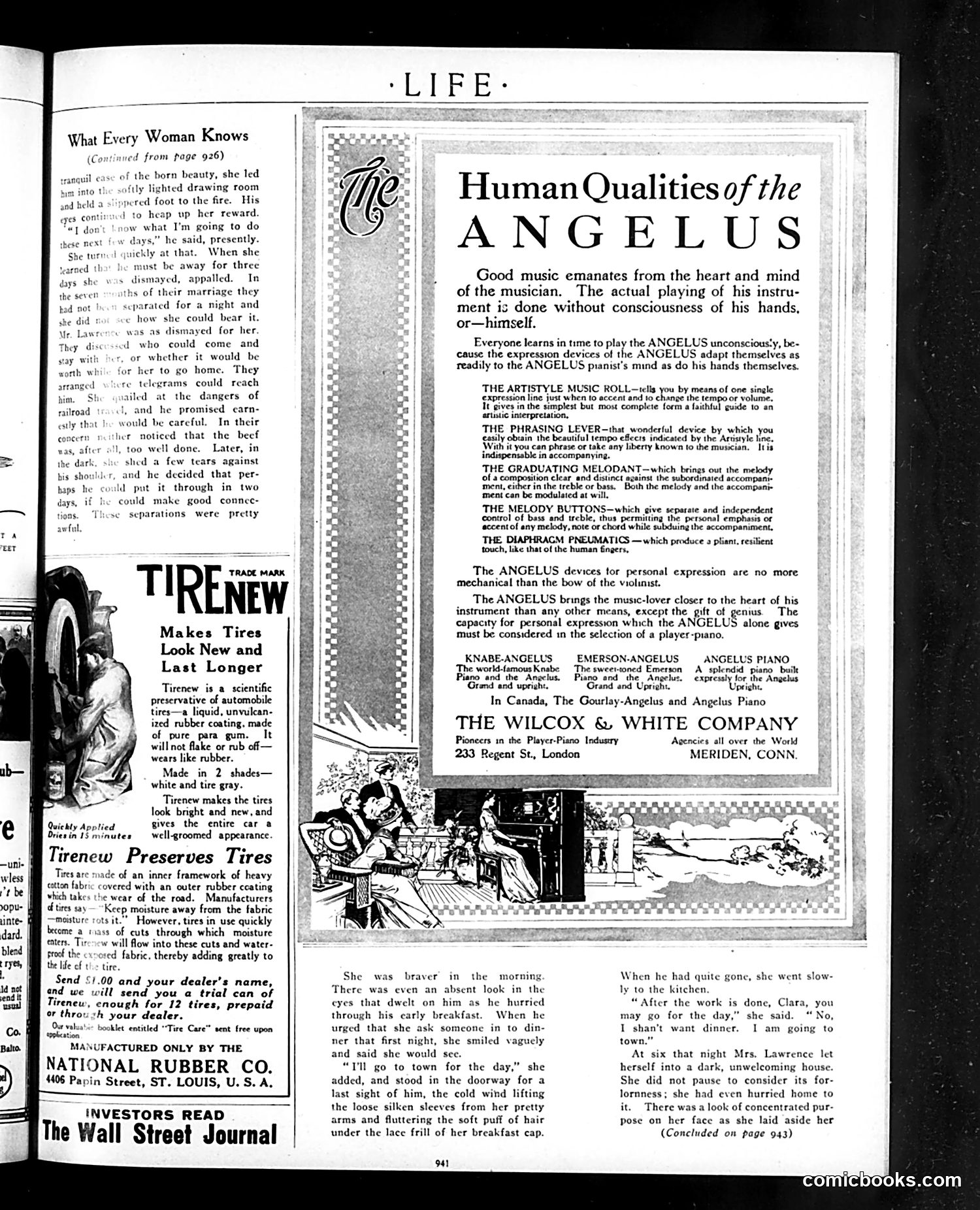
This page mixes advertising with serialized fiction. The main narrative, "What Every Woman Knows" (continued from page 926), occupies the left column—a domestic story about a woman whose husband initially dismisses her, then realizes her quiet worth when she briefly leaves him. It's sentimental fiction typical of the era's women's magazines. The right side features a large advertisement for the **Angelus player piano**, which uses technical language ("phrasing lever," "graduating melodant," "diaphragm pneumatics") to market itself as enabling personal musical expression—essentially claiming mechanical piano-playing could feel human and artistic. This reflects early 20th-century fascination with player pianos as accessible luxury goods. Bottom left advertises **Tirenew tire preservative** and the **National Rubber Company**, pitched as making old tires look new. The page is primarily commercial content interspersed with serialized entertainment—typical of *Life* magazine's mixed advertising-and-editorial model.
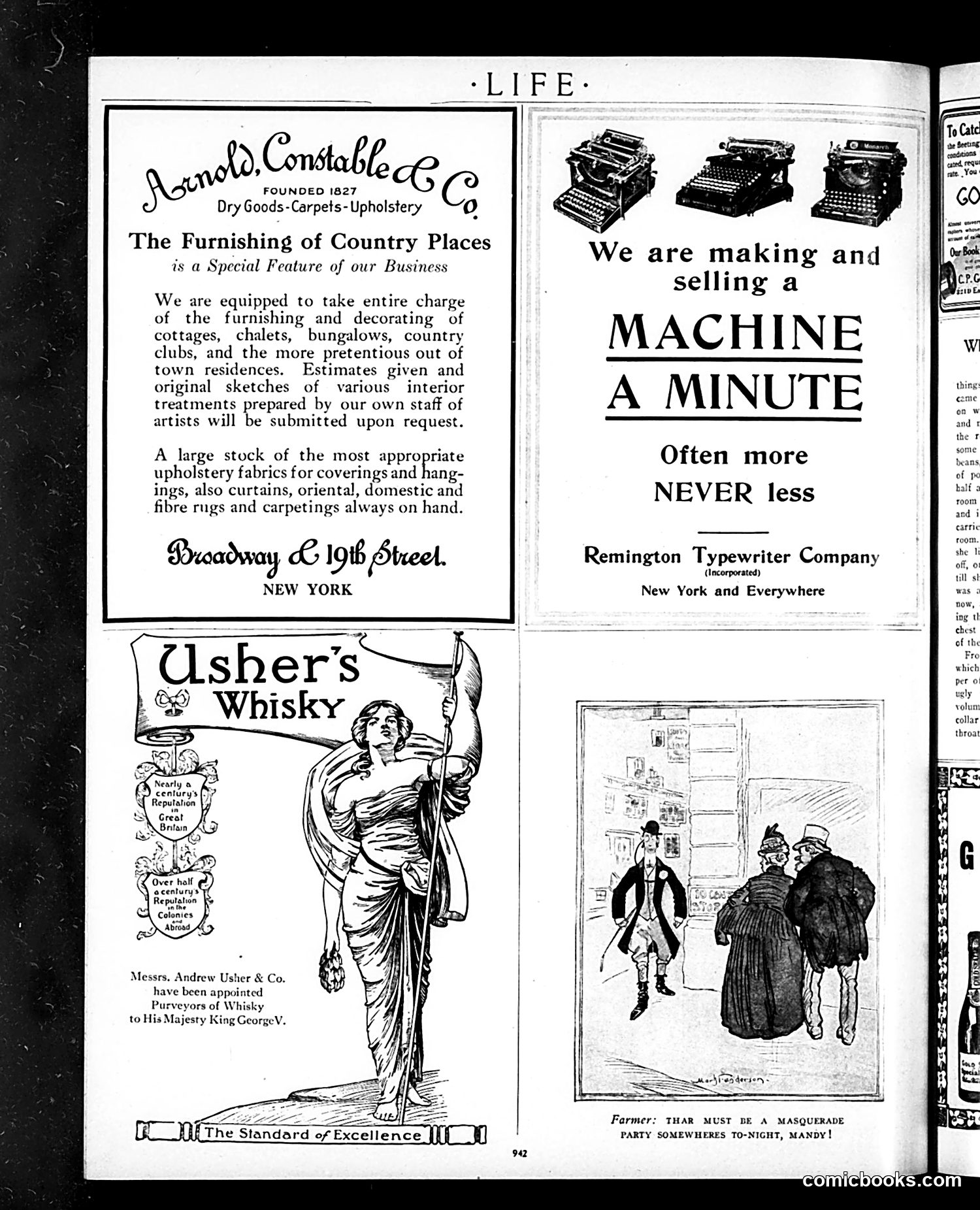
This is primarily an **advertising page** from an early 20th-century issue of *Life* magazine, containing four distinct advertisements with minimal satirical content. The **only cartoon** appears at the bottom: a rural scene where a farmer observes well-dressed city people in formal attire and concludes there must be "a masquerade party somewhere to-night." The humor relies on **class contrast**—the farmer assumes wealthy urbanites in fancy dress are in costume, not recognizing formal evening wear as normal city fashion. This reflects early 1900s rural-urban cultural divisions. The other ads promote: - **Arnold Constable & Co.** (upscale furnishings for country estates) - **Remington Typewriters** (selling "a machine a minute") - **Usher's Whisky** (with royal appointment to King George V) These advertisements target affluent readers and reinforce *Life*'s sophisticated audience, in contrast to the farmer's rural perspective depicted in the cartoon.
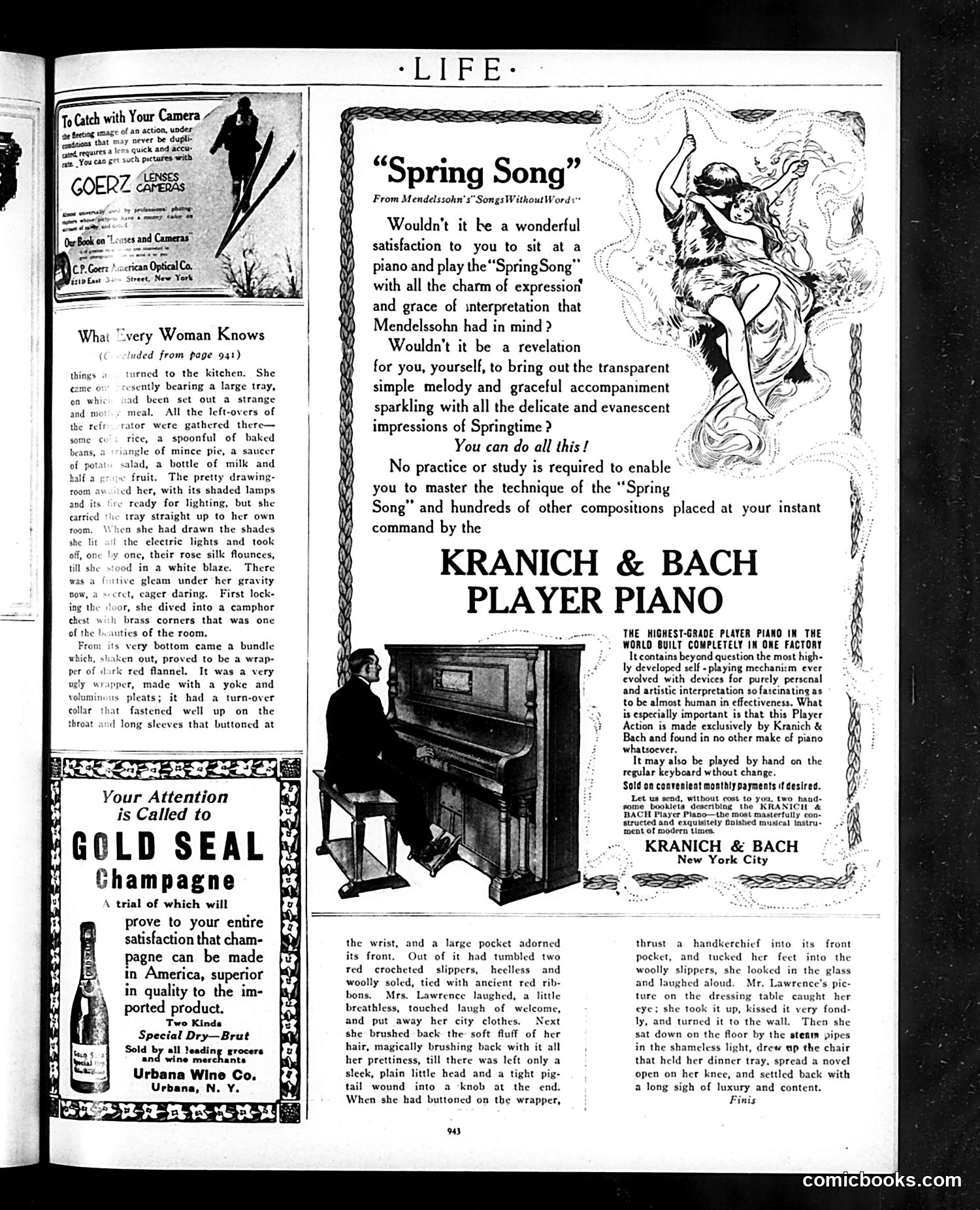
This page is primarily **advertisements and serialized fiction**, not political satire or cartooning. The main content includes: 1. **Camera advertisement** (Goerz lenses) - standard commercial promotion 2. **Player piano advertisement** (Kranich & Bach) - emphasizing that their mechanical piano requires "no practice or study" to play classical music like Mendelssohn's "Spring Song," appealing to aspirational consumers wanting cultural sophistication without effort 3. **Champagne advertisement** (Gold Seal) - promoting American-made champagne as equal to imports 4. **Serialized fiction** ("What Every Woman Knows," continued from page 941) - depicting a woman secretly retrieving a red flannel wrapper and slippers from a trunk, suggesting hidden romantic intrigue or a secret identity The page reflects **early 20th-century consumer culture**: advertisements targeting middle-class desires for leisure, culture, and status symbols. The fiction serial provides entertainment. There is no discernible political cartoon or satire present.
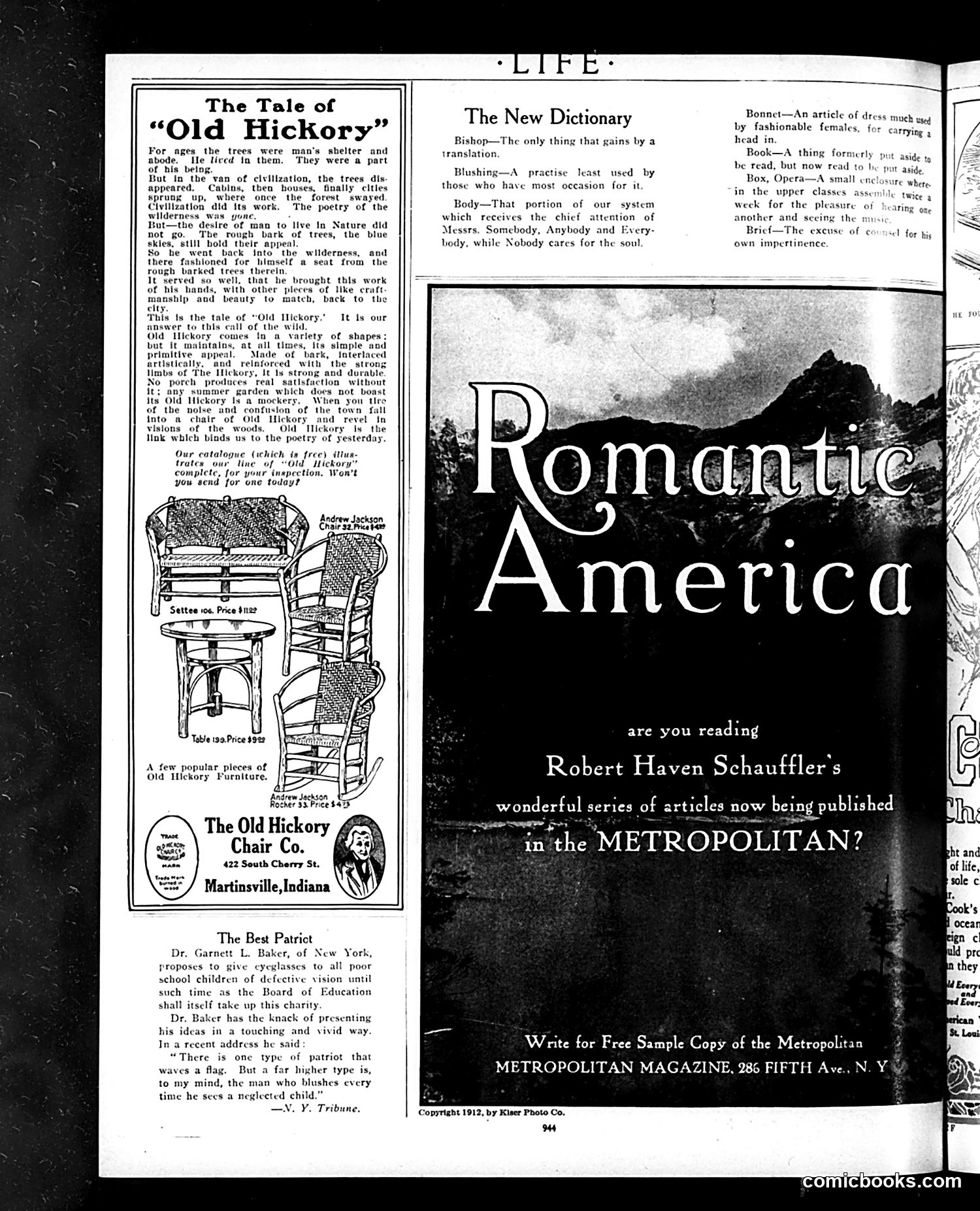
This page mixes advertising with editorial content. The left side advertises "Old Hickory" furniture—rustic bark-covered chairs and tables marketed as a romantic return to nature and frontier simplicity. The copy plays on nostalgia, referencing Andrew Jackson (nicknamed "Old Hickory") and positioning the furniture as an antidote to urban civilization's noise and confusion. The right page promotes Robert Haven Schauffler's articles in *Metropolitan* magazine, using the phrase "Romantic America" to appeal to the same nostalgia for wilderness and pioneer heritage. Below this is a brief editorial praising Dr. Garnett L. Baker's charity work providing eyeglasses to poor schoolchildren. The quote distinguishes "true" patriotism (helping neglected children) from mere flag-waving—a subtle jab at jingoistic nationalism, likely referencing contemporary debates about American imperialism versus domestic social responsibility. The overall theme: nostalgia for America's "authentic" past combined with progressive social reform messaging.
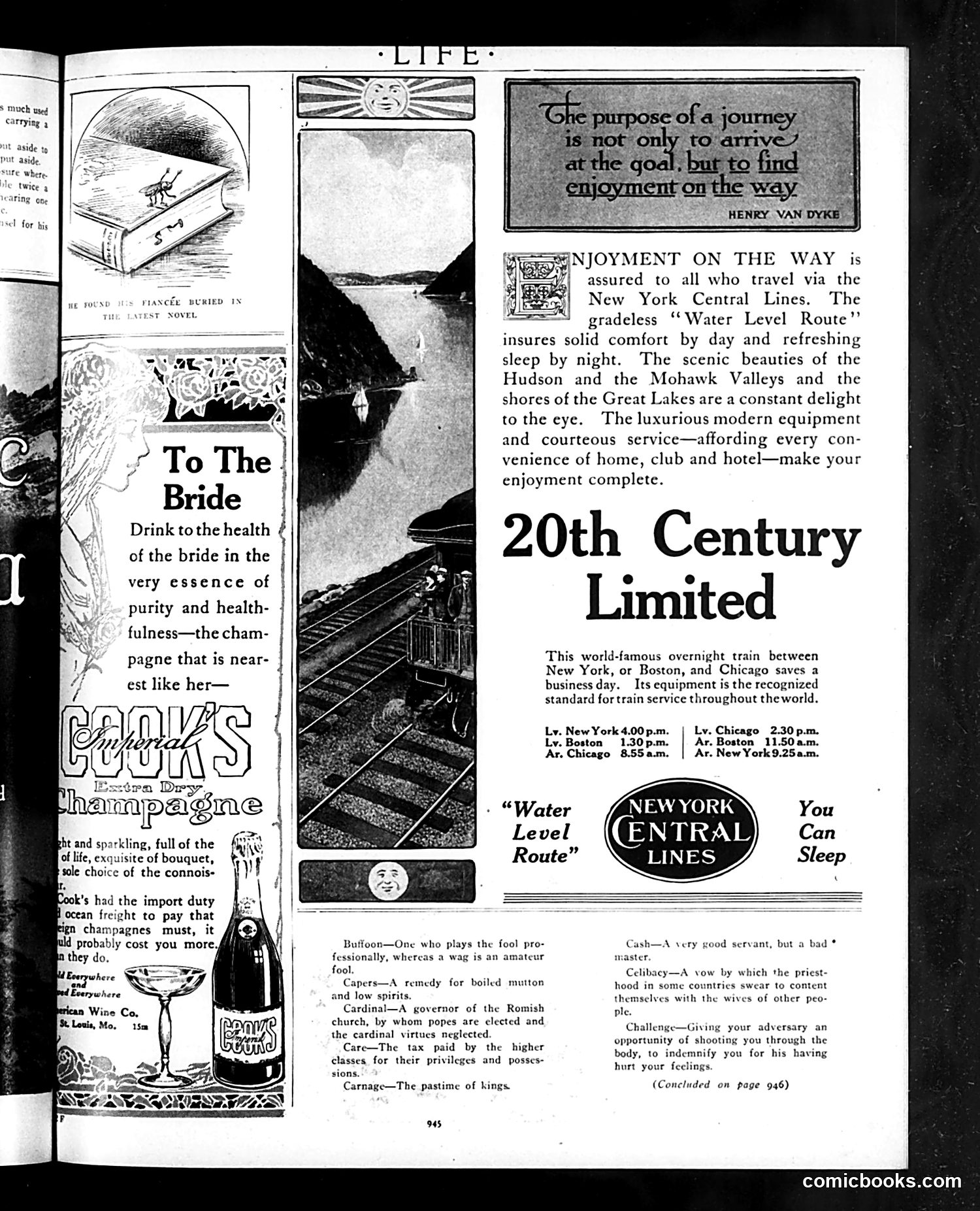
This page is primarily **advertising**, not political satire. The dominant content features two commercial advertisements: 1. **Cook's Champagne ad** (left): Appeals to wedding-related consumption, promoting champagne as the refined choice for toasting a bride. It mentions import duties on foreign champagnes—a practical economic reference suggesting domestic alternatives cost more due to tariffs. 2. **20th Century Limited train ad** (right): Promotes the famous New York Central Lines overnight passenger train between New York/Boston and Chicago, emphasizing luxury, speed, and scenic routes along the Hudson and Great Lakes. The page also includes a dictionary-style humor feature defining words like "Buffoon," "Cash," and "Challenge"—typical Life magazine filler content. **Historical context**: This appears early 20th century, when passenger trains and champagne were luxury goods marketed to affluent readers. There is no discernible political cartoon or satire on this particular page.
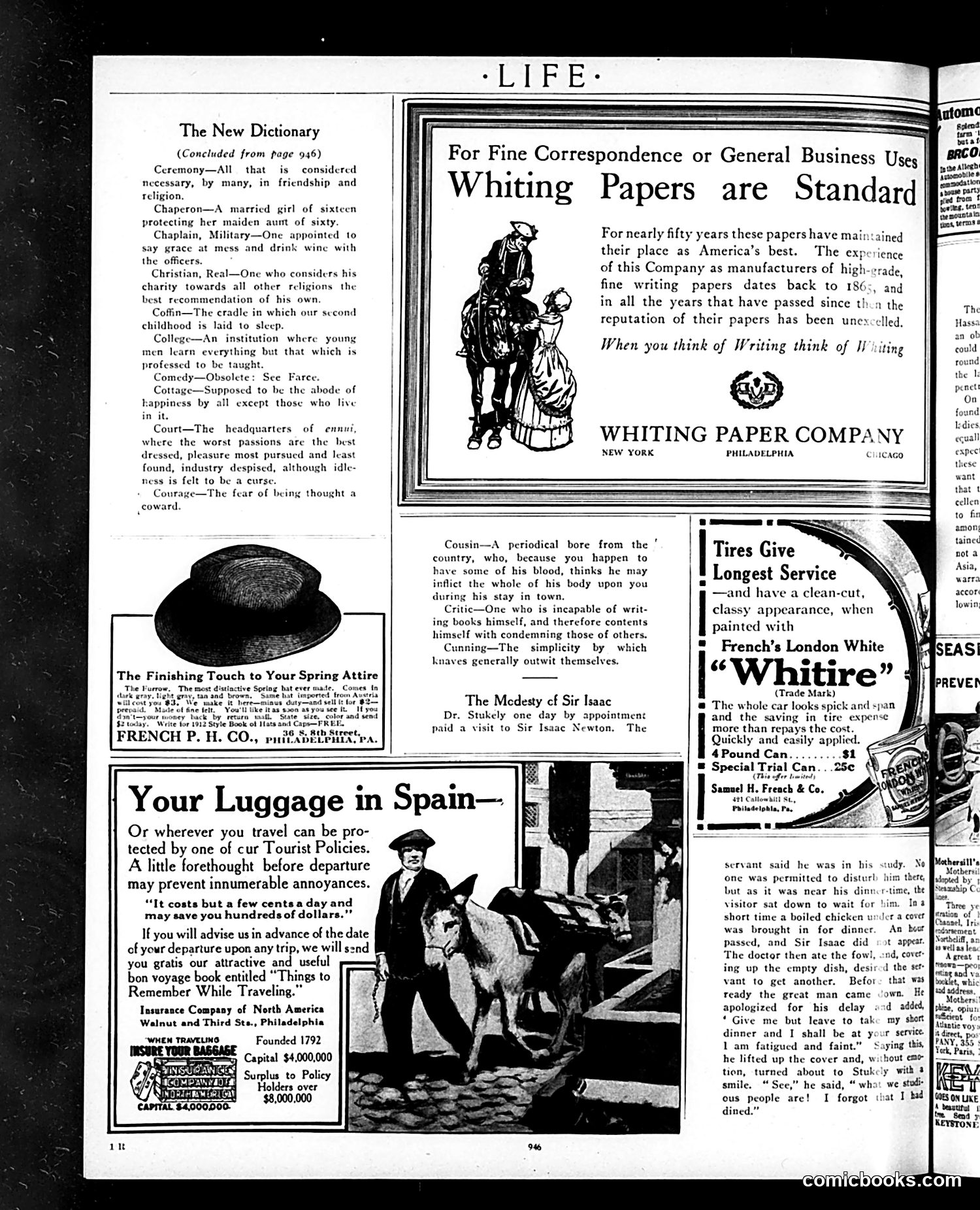
This page is primarily **advertising and miscellaneous content** rather than political satire. The main elements include: **"The New Dictionary"** (top left)—A satirical dictionary continuing from a previous page, offering humorous, cynical definitions of social types (Chaplain, Christian, Critic, Cousin, etc.). The humor relies on social observation rather than political commentary—mocking human pretension and folly through brief, barbed definitions. **Multiple advertisements** dominate the page: Whiting Papers, French hat company, tire polish ("Whitire"), travel insurance, and Spanish luggage protection. These represent typical early 20th-century consumer goods marketing. **"The Modesty of Sir Isaac"** (bottom)—An anecdote about the scientist Newton, illustrating absent-mindedness or social awkwardness, with no clear political dimension. The page contains **no identifiable political cartoons or caricatures of public figures**. It's a typical magazine layout mixing humor, practical advice, and commercial messaging for its era's educated, traveling middle-class readership.
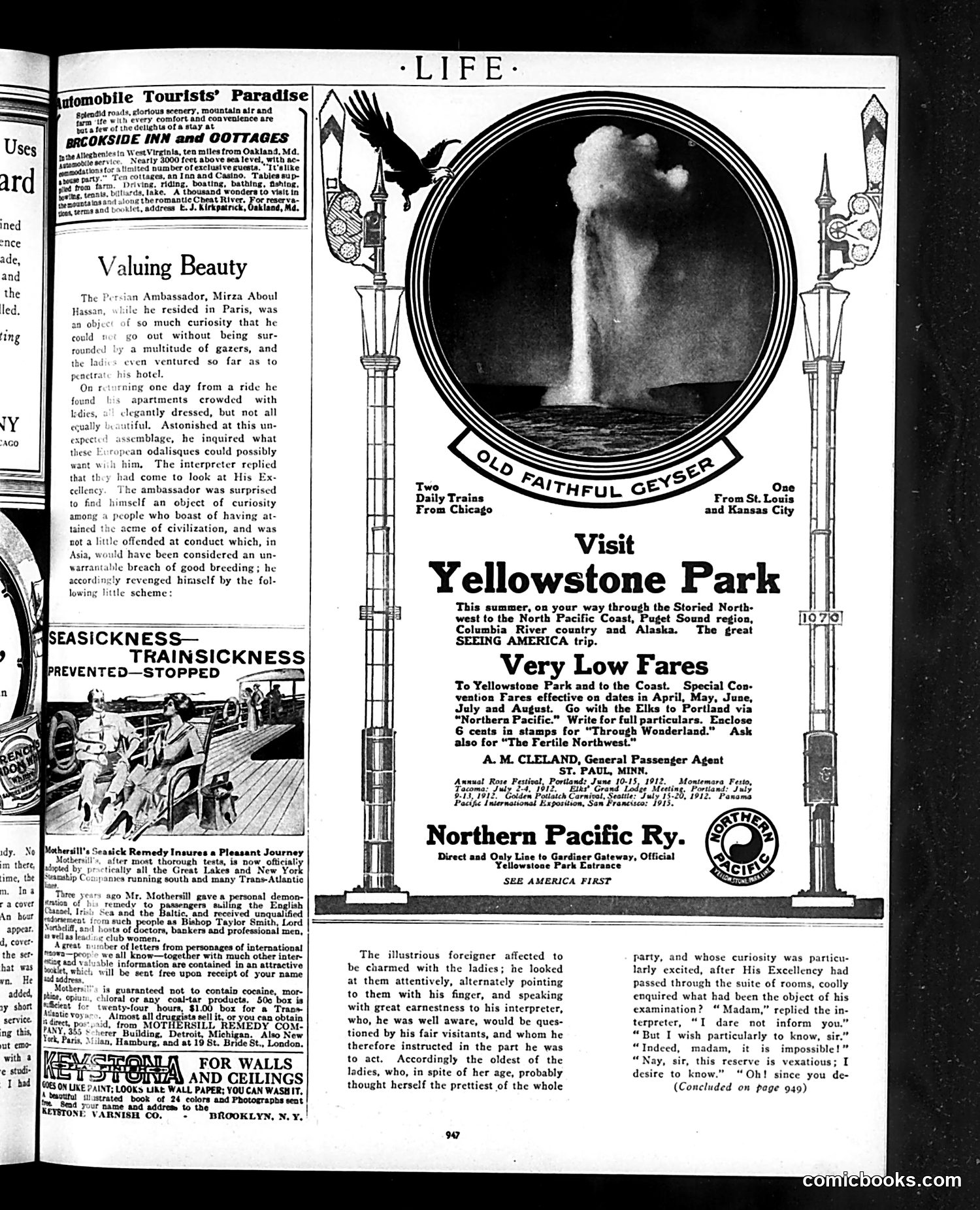
This page is primarily **advertising and travel promotion**, not political satire. The dominant content is a Northern Pacific Railway advertisement for Yellowstone Park featuring "Old Faithful Geyser" in an ornate circular frame with decorative towers. The only narrative content is "Valuing Beauty," a brief anecdote about a Persian Ambassador in Paris. The story describes how European ladies crowded his apartment out of curiosity to view him—behavior he found disrespectful. To "revenge himself," he devised a scheme involving his interpreter, though the text cuts off before revealing the punchline. The satire here targets **European (specifically French) society's treatment of foreigners**, portraying fashionable Parisian women as shallow and socially presumptuous. The ambassador's planned retaliation suggests he will teach them a lesson about proper etiquette. The page also includes advertisements for remedies (seasickness prevention, wall treatments) typical of early 1910s periodicals.
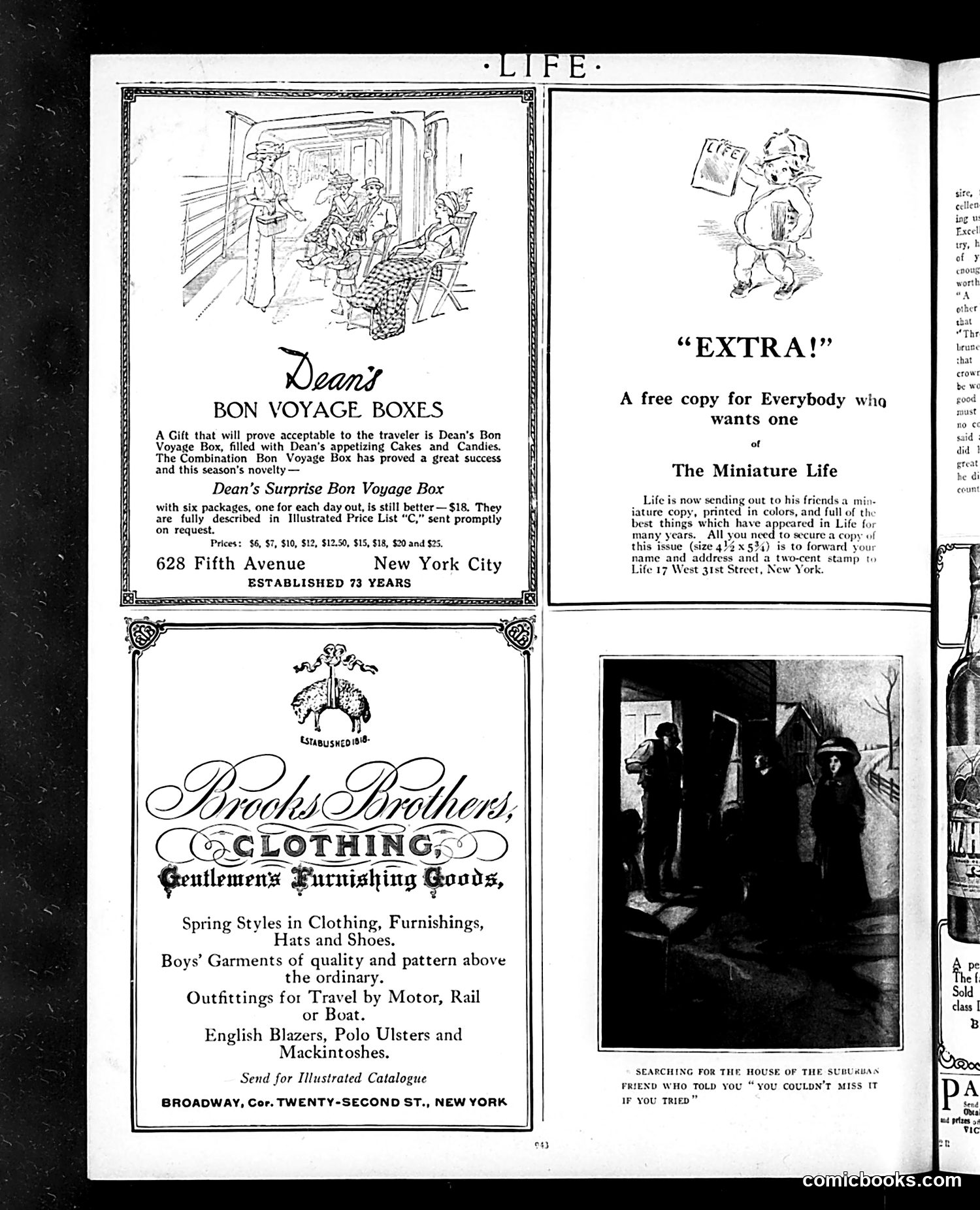
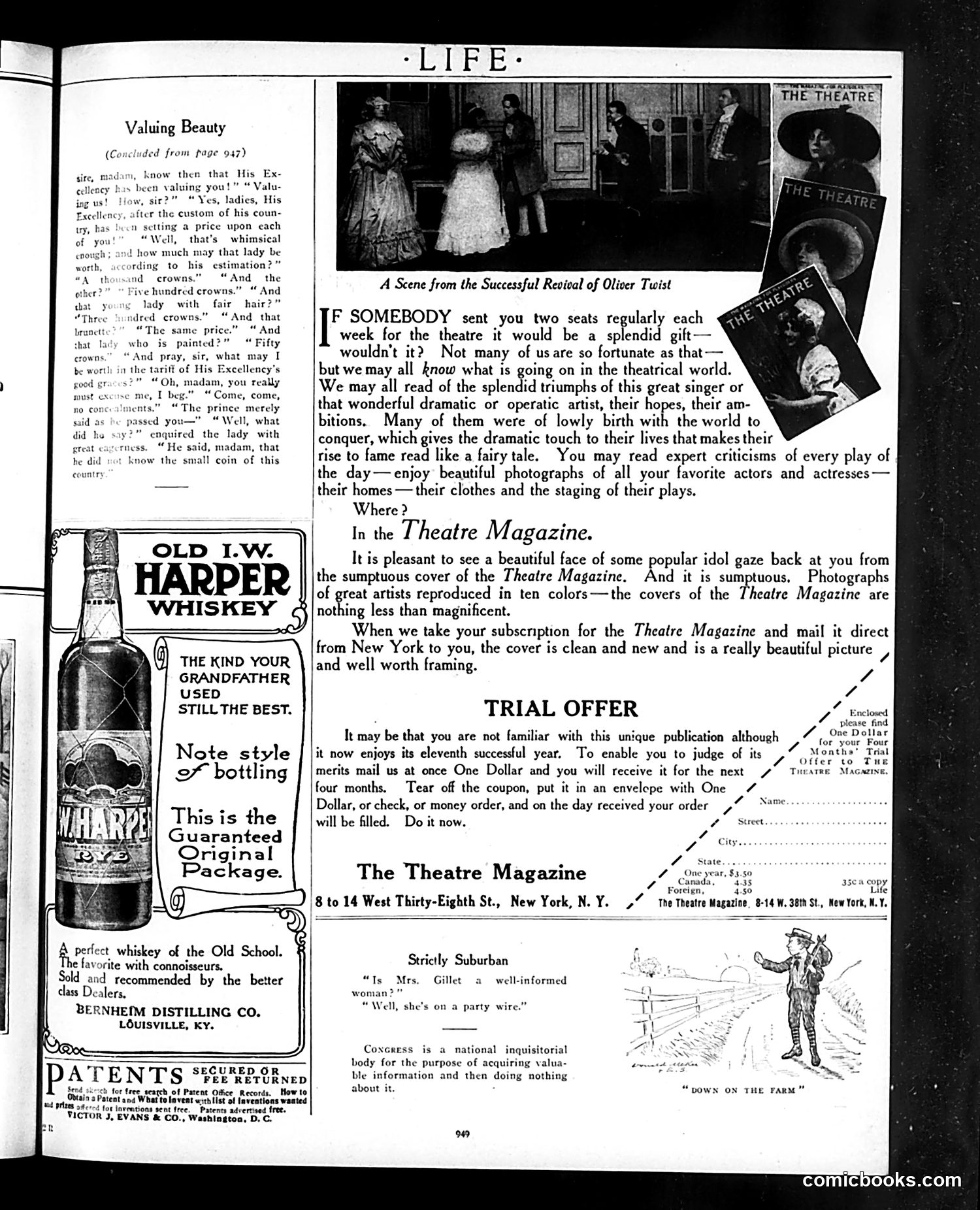
This page is primarily **advertising and promotional content** rather than political satire. The main elements include: **Top section:** A continuation of a humorous dialogue about "Valuing Beauty" where a foreign dignitary assigns monetary values to women based on appearance—a satirical critique of reducing women to commodities. **Center:** A theater scene photograph and promotion for *Theatre Magazine*, emphasizing its beautiful color covers featuring popular actors and actresses. **Bottom cartoons:** Two brief jokes: - "Strictly Suburban": A woman tells her friend another woman "is on a party wire"—referencing shared telephone lines common in suburban areas, a mild joke about gossip and lack of privacy. - A Congress joke: describing Congress as an "inquisitorial body" that gathers valuable information "and then does nothing about it"—standard early-20th-century cynicism about legislative ineffectiveness. The page also carries whiskey and patent advertisements. Overall, it's a typical Life magazine format mixing light social satire with commercial content.
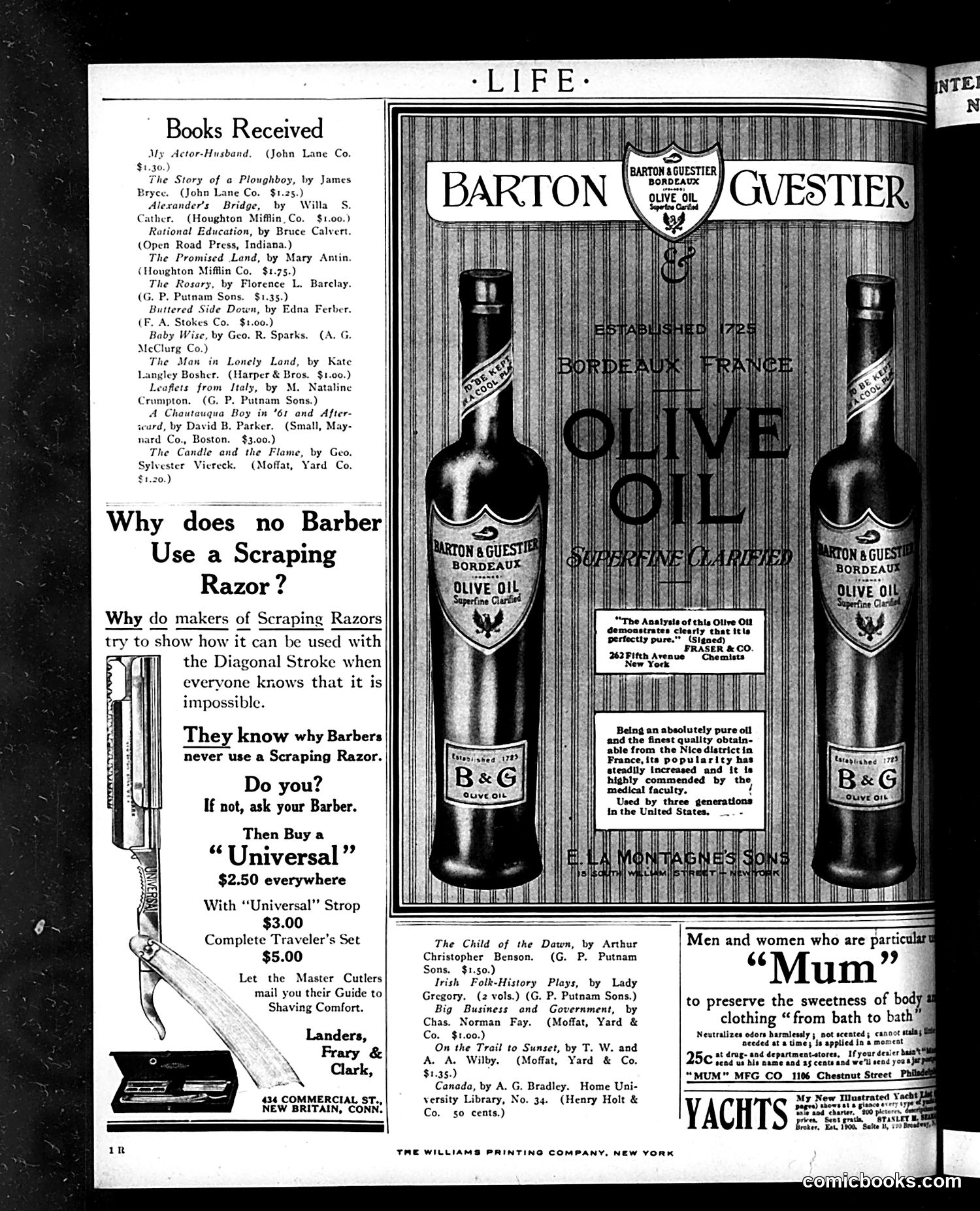
This is primarily an **advertising and book review page** from an early 20th-century Life magazine, not a political cartoon page. The left side features a **razor advertisement** for "Universal" brand scrapers—a practical commercial argument that barbers don't use scraping razors because they're ineffective for proper shaving technique, so consumers should buy "Universal" razors instead. The center showcases a large **Barton & Guestier olive oil advertisement** from Bordeaux, France, emphasizing purity and medical endorsement. The right side contains a **book review section** listing recent publications (works by Willa Cather, Mary Antin, Edna Ferber, etc.) and smaller advertisements for personal hygiene products ("Mum" deodorant) and yachts. There is **no political satire or cartoon content** visible on this page. It represents typical early-1900s magazine layout combining literature notices with consumer advertising.