
Life, 1912-05-02 · page 14 of 58
Life — May 2, 1912 — page 14: what you’re looking at
What you’re looking at
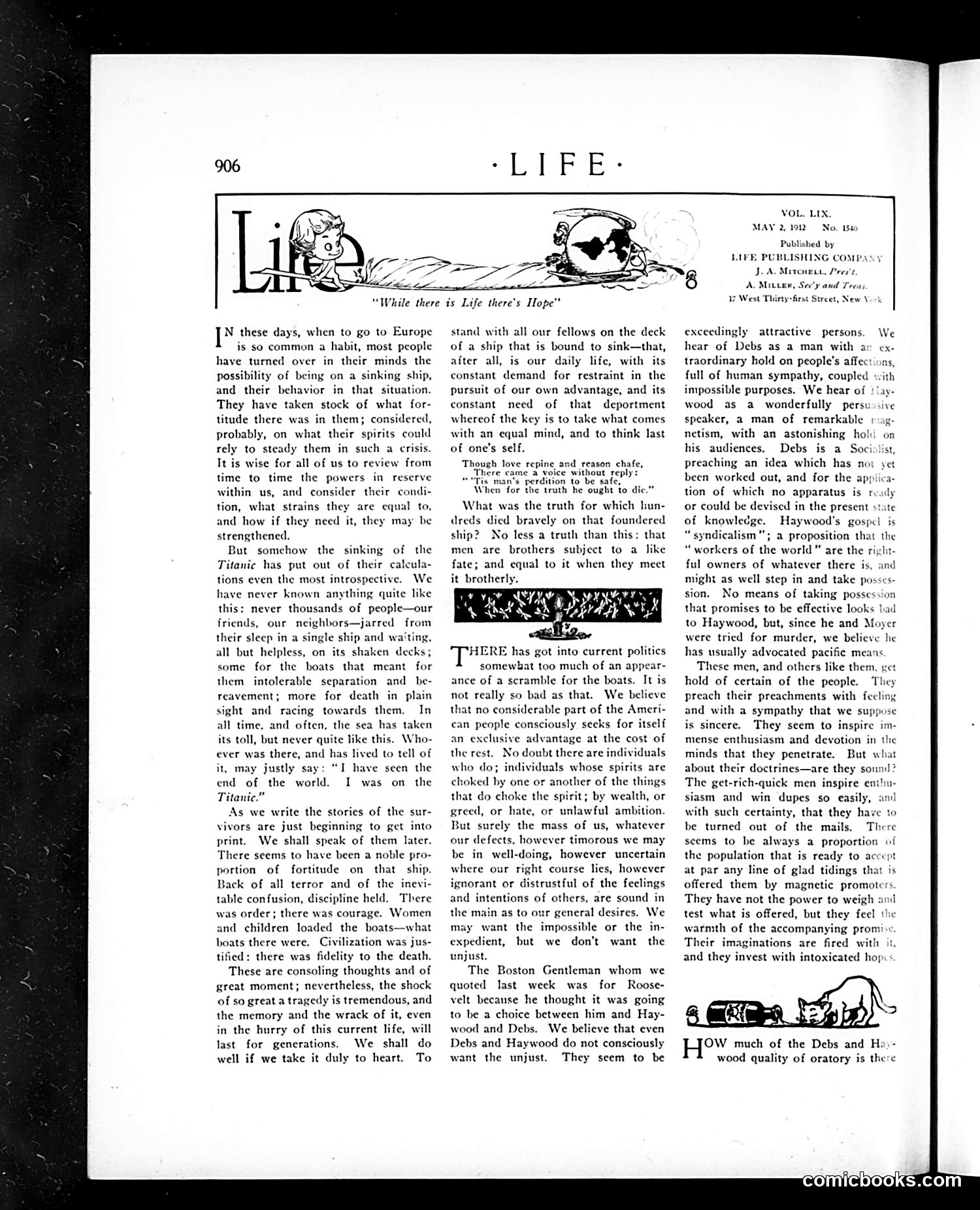
This editorial page discusses the sinking of the *Titanic* and its moral lessons. The text emphasizes that the tragedy revealed character—how people behaved when facing death. The article then pivots to contemporary politics, mentioning "the Boston Gentleman" (likely Theodore Roosevelt) and criticizing what appears to be the 1912 presidential race involving Debs (likely socialist Eugene V. Debs) and Haywood (likely labor activist Bill Haywood). Life's editors suggest these figures represent "unjust" positions that won't truly improve society. The cartoon vignettes at top and bottom are small decorative illustrations without clear satirical targets identifiable from this image alone. The page uses the *Titanic* disaster as a springboard for discussing American values and political ideology.
📄 Transcribed text from this page (OCR, searchable)
Machine-transcribed from the original scan — historical spelling and the odd misread are preserved.
“While there is Life there's Hope” ]% these days, when to go to is so common a habit, most people have turned over in their minds the possibility of being on a sinking ship, and their behavior in that situation. They have taken stock of what for- titude there was in them; considered, probably, on what their spirits could rely to steady them in such a crisis. It is wise for all of us to review from time to time the powers in reserve within us, and consider their condi- tion, what strains they are equal to, and how if they need it, they may be strengthened. But somehow the sinking of the Titanic has put out of their calcula- tions even the most introspective. We have never known anything quite like this: never thousands of people—our friends, our neighbors—jarred from their sleep in a single ship and watting, all but helpless, on its shaken decks; some for the boats that meant for them intolerable separation and be- reavement; more for death in plain sight and racing towards them. In all time, and often, the sea has taken its toll, but never quite like this. Who- ever was there, and has lived to tell of it, may justly say: “I have seen the end of the world. I was on the Titanic.” As we write the stories of the sur- vivors are just beginning to get into print. We shall speak of them later. There seems to have been a noble pro- portion of fortitude on that ship. Back of all terror and of the inevi- table confusion, discipline held. There was order; there was courage. Women and children loaded the boats—what boats there were. Civilization was jus- tified: there was fidelity to the death. These are consoling thoughts and of great moment; nevertheless, the shock of so great a tragedy is tremendous, and the memory and the wrack of it, even in the hurry of this current life, will last. for generations. We shall do well if we take it duly to heart. To stand with all our fellows on the deck of a ship that is bound to sink—that, after all, is our daily life, with its constant demand for restraint in the pursuit of our own advantage, and its constant need of that deportment whereof the key is to take what comes with an equal mind, and to think last of one’s self. Though love repine and reason ¢ ‘There came a voice without repl: s man’s perdition to be safe, When for the truth he ought to dic What was the truth for which hun- dreds died bravely on that foundered ship? No less a truth than this: that men are brothers subject to a like fate; and equal to it when they meet Ra one as Rae HERE has got into current politics somewhat too much of an appear- ance of a scramble for the boats. It is not really so bad as that. We believe that no considerable part of the Ameri- can people consciously secks for itself an exclusive advantage at the cost of the rest. No doubt there are individuals. who do; individuals whose spirits are choked by one or another of the things that do choke the spirit; by wealth, or greed, or hate, or unlawful ambition. But surely the mass of us, whatever our defects, however timorous we may be in well-doing, however uncertain where our right course lies, however ignorant or distrustful of the feelings and intentions of others, are sound in the main as to our general desires. We may want the impossible or the in- expedient, but we don’t want the unjust. The Boston Gentleman whom we quoted last week was for Roose- velt because he thought it was going to be a choice between him and Hay- wood and Debs. We believe that even Debs and Haywood do not consciously want the unjust. They seem to be VOL. LID MAY 2, 1912 Published by LIFE PUBLISHING COMPAS ¥ J. A. Merounin, Pres't, A. Mitten, Sec'y and Treas 17 West Thirty-first Street, New D. 1540 exceedingly attractive persons. hear of Debs as a man with a traordinary hold on people's affect full of human sympathy, coupled \ impossible purposes. We hear of | wood as a wonderfully persu speaker, a man of remarkable mag netism, with an astonishing hold on his audiences. Debs is a Socictist, preaching an idea which has not yer been worked out, and for the applica- tion of which no apparatus is ready or could be devised in the present state of knowledge. Haywood’s gospel is “ syndicalism”; a proposition that the “workers of the world” are the right- ful owners of whatever there is, and might as well step in and take posses- sion. No means of taking possession that promises to be effective looks bad to Haywood, but, since he and Moyer were tried for murder, we believe he has usually advocated pacific means These men, and others like them. get hold of certain of the people. They preach their preachments with feeling and with a sympathy that we suppose is sincere. They seem to inspire im- mense enthusiasm and devotion in the minds that they penetrate. But what about their doctrines—are they sound? The get-rich-quick men inspire enihu- siasm and win dupes so easily, and with such certainty, that they have to be turned out of the mails. There seems to be always a proportion the population that is ready to at par any line of glad tidings that is offered them by magnetic promot: They have not the power to weigh and test what is offered, but they feel the warmth of the accompanying promi-c Their imaginations are fired with and they invest with intoxicated hop OW much of the Debs and Hay- wood quality of oratory is there