
Life, 1912-05-02 · page 15 of 58
Life — May 2, 1912 — page 15: what you’re looking at
What you’re looking at
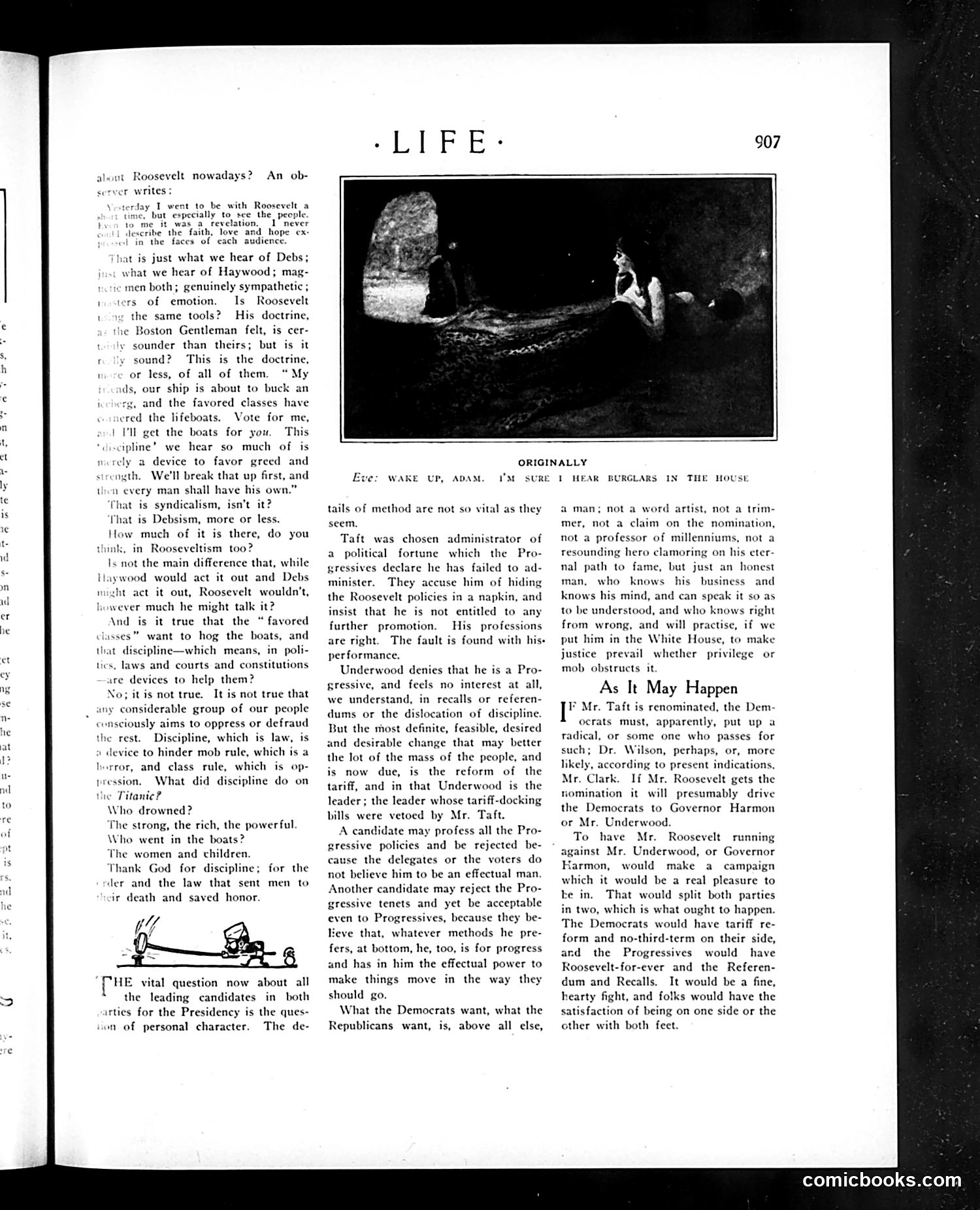
This page discusses the 1912 presidential race, comparing candidates Taft, Underwood, and Roosevelt on their character and effectiveness rather than mere rhetoric. The cartoon caption "Wake up, Adam. I'm sure I hear burglars in the house" appears to be a domestic scene—likely satirizing complacency or warning of threats, though the specific political reference is unclear from the visible image alone. The text critiques Roosevelt's "syndicalism" (redistribution doctrine) as philosophically similar to radical leaders like Eugene Debs and Big Bill Haywood, yet Roosevelt wouldn't *act* on it—making him a safer alternative. The author argues voters should prioritize an effectual, honest administrator over ideological purity or rhetorical flourish. The Titanic reference mocks those claiming discipline/law protects the weak—discipline on the Titanic meant the poor drowned while the wealthy escaped. The satire's point: judge candidates by honest competence and actual values, not flowery Progressive promises.
📄 Transcribed text from this page (OCR, searchable)
Machine-transcribed from the original scan — historical spelling and the odd misread are preserved.
alaut Roosevelt nowadays? An ob- server writes: erday T went to be with Roosevelt a Lime, but especially to see the peop! to me it was a revelation. I never Heseribe the faith, love and. hope ex: in the faces of each audience. hat is just what we hear of Debs; what we hear of Haywood; mag- men both; genuinely sympathetic; of emotion. Is Roosevelt the same tools? His doctrine, ie Boston Gentleman felt, is ce y sounder than theirs; but is it y sound? This is the doctrine, or less, of all of them. “My ds, our ship is about to buck an rg, and the favored classes have ered the lifeboats. Vote for me, | I'll get the boats for you. This ipline? we hear so much of is y a device to favor greed and sth. We'll break that up first, and 1 every man shall have his own.” Chat is syndicalism, isn’t it? Phat is Debsism, more or less. Htow much of it is there, do you in Rooseveltism too? Is not the main difference that, while Haywood would act it out and Debs ht act it out, Roosevelt wouldn’t, wever much he might talk it? And is it true that the “ favored want to hog the boats, and that discipline—which means, in poli- tics, laws and courts and constitutions ire devices to help them? No; itis not true. It is not true that any considerable group of our people consciously aims to oppress or defraud the rest. Discipline, which is law, is 1 device to hinder mob rule, which is a horror, and class rule, which is op- What did discipline do on the Titanic? pression, Who drowned? The strong, the rich, the powerful Who went in the boats? The women and children. Thank God for discipline; for the der and the law that sent men to ir death and saved honor. ey HE vital question now about all the leading candidates in both irties for the Presidency is the ques- wn of personal character. The de- ORIGINALLY WAKE UP, ADAM. tails of method are not so vital as they seem. Taft was chosen administrator of a political fortune which the Pro- gressives declare he has failed to ad- minister. They accuse him of hiding the Roosevelt policies in a napkin, and insist that he is not entitled to any further promotion. His professions are right. The fault is found with his: performance. Underwood denies that he is a Pro- gressive, and feels no interest at all, we understand, in recalls or referen- dums or the dislocation of discipline. But the most definite, feasible, desired and desirable change that may better the lot of the mass of the people, and due, is the reform of the tariff, and in that Underwood is the leader ; the leader whose tariff-docking bills were vetoed by Mr. Taft. A candidate may profess all the Pro- gressive policies and be rejected be- cause the delegates or the voters do not believe him to be an effectual man. Another candidate may reject the Pro- gressive tenets and yet be acceptable even to Progressives, because they be- Eeve that, whatever methods he pre- fers, at bottom, he, too, is for progress and has in him the effectual power to make things move in the way they should go. What the Democrats want, what the Republicans want, is, above all else, is now 1 HEAR BURGLARS IN THE HoUs¢ a man; not a word artist, not a trim- mer, not a claim on the nomination, not a professor of millenniums, not a resounding hero clamoring on his eter- nal path to fame, but just an honest who knows his business and knows his mind, and can speak it so as to be understood, and who knows right from wrong, and will practise, if wi put him in the White House, to make justice whether privilege or man, prevail mob obstructs it As It May Happen F Mr. Taft is renominated, the Dem ocrats must, apparently, put up a radical, or some one who passes for such; Dr. Wilson, perhaps, or, more likely, according to present indications, Mr. Clark. Ii Mr. Roosevelt gets the nomination it will presumably drive the Democrats to Governor Harmon or Mr. Underwood. To have Mr. Roosevelt running against Mr. Underwood, or Governor Harmon, would make a campaign which it would be a real pleasure to ke in. That would split both parties in two, which is what ought to happen. The Democrats would have tariff re- form and no-third-term on their side, and the Progressives would have Roosevelt-for-ever and the Referen- dum and Recalls. It would be a fine, hearty fight, and folks would have the satisfaction of being on one side or the other with both feet. comicbooks.co