
Life, 1912-05-02 · page 27 of 58
Life — May 2, 1912 — page 27: what you’re looking at
What you’re looking at
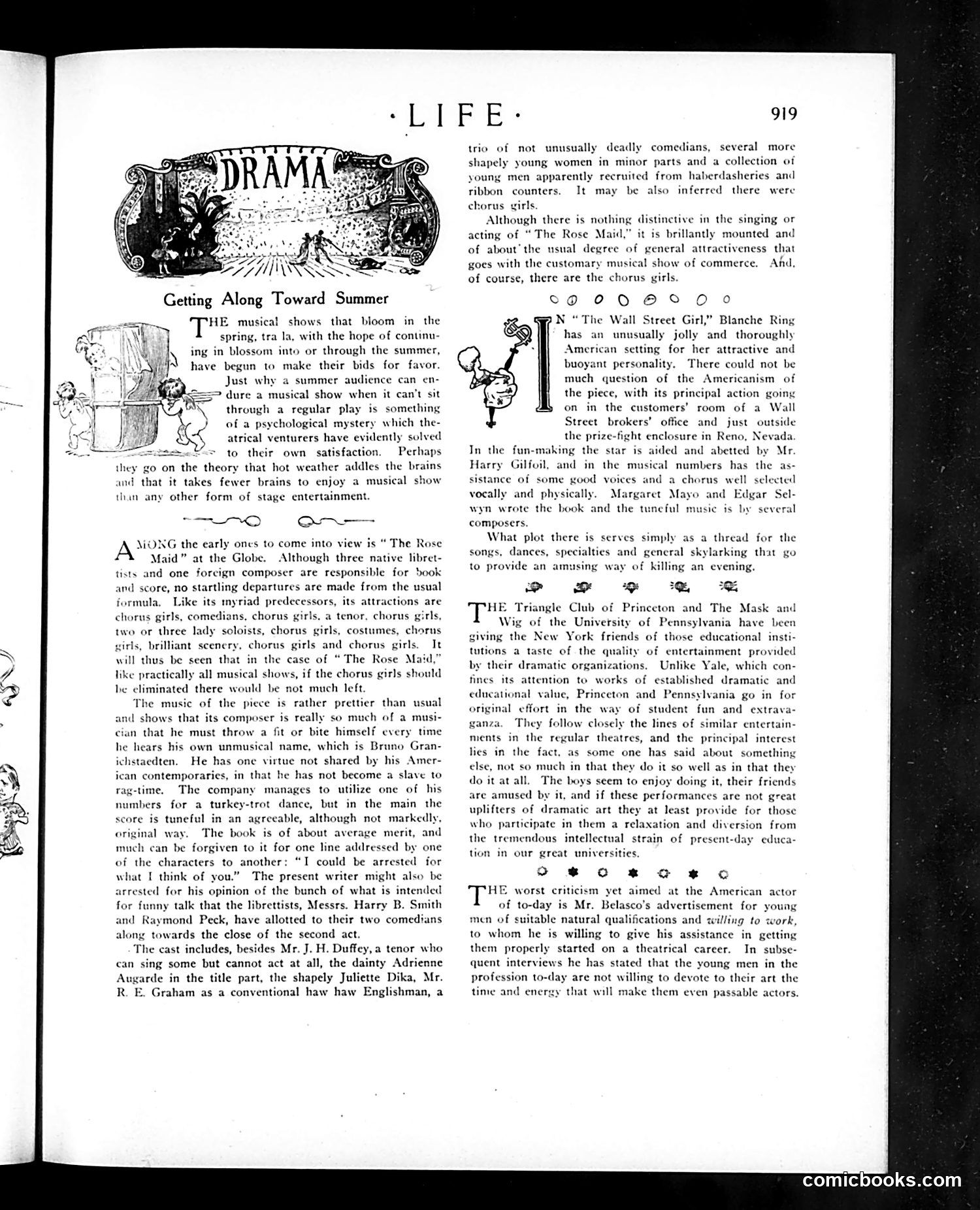
This is a drama criticism page reviewing spring musical theater productions heading toward summer. The satirical point is straightforward: the critic mocks musical shows for their formulaic construction and reliance on chorus girls over genuine theatrical merit. The main review discusses "The Rose Maid" at the Globe, sarcastically noting that the show's formula is entirely predictable—"chorus girls, comedians, chorus girls, a tenor, chorus girls" repeated endlessly. The critic suggests that if you removed the chorus girls, "there would be not much left." He's contemptuous of the comedians' unfunny dialogue and dismissive of most of the cast's acting abilities. A secondary review covers "The Wall Street Girl" with Blanche Ring, which at least provides an American setting (a Wall Street office and Reno prize-fight venue) and more agreeable music by legitimate composers. The underlying satire targets both the entertainment industry's cynical formulas and audience tastes—implying summer theater audiences have intellectually "addled brains" that can't handle serious drama. The decorative "DRAMA" masthead and classical illustrations frame the scathing criticism with ironic formality.
📄 Transcribed text from this page (OCR, searchable)
Machine-transcribed from the original scan — historical spelling and the odd misread are preserved.
-LIFE: Getting Along Toward Summer HE musical shows that bloom in the spring, tra la, with the hope of continu- ing in blossom into or through the summer, have begun to make their bids for favor. Just why a summer audience can en- = dure a musical show when it can’t sit through a regular play is something of a psychological mystery which the- atrical venturers have evidently solved - to their own. satisfaction. Perhaps they go on the theory that hot weather addles the brains that it takes fewer brains to enjoy a musical show than any other form of stage entertainment. TO on. MONG the early ones to come into view is “ The Rose Maid” at the Globe. Although three native libret- tists and one foreign composer are responsible for book and score, no startling departures are made from the usual formula, Like its myriad predecessors, its attractions are chorus girls, comedians, chorus girls, a tenor, chorus girls, two or three lady soloists, chorus girls, costumes, chorus girls, brilliant scenery, chorus girls and chorus girls. It will thus be seen that in the case of “ The Rose Maid,” like practically all musical shows, if the chorus girls should he eliminated there would be not much left, The music of the piece is rather prettier than usual and shows that its composer is really so much of a musi- cian that he must throw a fit or bite himself every time he hears his own unmusical name, which is Bruno Gran- ichstaedten. He has one virtue not shared by his Amer- ican contemporaries, in that he has not become a slave to rag-time. The company manages to utilize one of his numbers for a turkey-trot dance, but in the main the score is tuneful in an agreeable, although not markedly, original way. The book is of about average merit, and much can be forgiven to it for one line addressed by one of the characters to another: “I could be arrested for what I think of you.” The present writer might also be arrested for his opinion of the bunch of what is intended for funny talk that the librettists, Messrs. Harry B. Smith and Raymond Peck, have allotted to their two comedians along towards the close of the second act. The cast includes, besides Mr. J. H. Duffey, a tenor who can sing some but cannot act at all, the dainty Adrienne Augarde in the title part, the shapely Juliette Dika, Mr. R. E. Graham as a conventional haw haw Englishman, a 919 trio of not unusually deadly comedians, several more shapely young women in minor parts and a collection of young men apparently recruited from haberdasheries and ribbon counters, It may be also inferred there were chorus girls, Although there is nothing distinctive in the singing or acting of “The Rose Maid,” it is brillantly mounted and of about’ the usual degree of general attractiveness that goes with the customary musical show of commerce. Afd, of course, there are the chorus girls. cd 9070688 0 09 The Wall Street Girl,” Blanche Ring has an unusually jolly and thoroughly American setting for her attractive and buoyant personality, There could not be much question of the Americanism of the piece, with its principa on in the customers’ Street brokers’ office and just outside the prize-fight enclosure in Reno, Nevada. In the fun-making the star is aided and abetted by Mr. Harry Gilfoil, and in the musical numbers has the as- sistance of sood voices and a chorus well selected vocally and physically. Margaret Mayo and Edgar Sel- wyn wrote the book and the tuneful music is by several composers. What plot there is serves simply as a thread for the songs, dances, specialties and general skylarking that go to provide an amusing way of killing an evening. > Oo HE Triangle Club of Princeton and The Mask and Wig of the University of Pennsylvania have been giving the New York friends of those educational insti- tutions a taste of the quality of entertainment provided by their dramatic organizations. Unlike Yale, which con- fines its attention to works of established dramatic and educational value, Princeton and Pennsylvania go in for original eff action going room of a Wall some t in the way of student fun and extrava- They follow closely the lines of similar entertain- ments in the regular theatres, and the principal interest lies in the fact, as some one has said about something else, not so much in that they do it so well as in that they do it at all. The boys seem to enjoy doing it, their friends are amused by it, and if these performances are not great uplifters of dramatic art they at least provide for those who participate in them a relaxation and diversion from the tremendous intellectual strain of present-day educa- tion in our great universities. o € © * OG #€ co HE worst criticism yet aimed at the American actor of to-day is Mr. Belasco’s advertisement for young men of suitable natural qualifications and willing to work, to whom he is willing to give his assistance in getting them properly started on a theatrical career. In subse- quent interviews he has stated that the young men in the profession to-day are not willing to devote to their art the time and energy that will make them even passable actors. comicbooks.com