
Life, 1912-05-02 · page 13 of 58
Life — May 2, 1912 — page 13: what you’re looking at
What you’re looking at
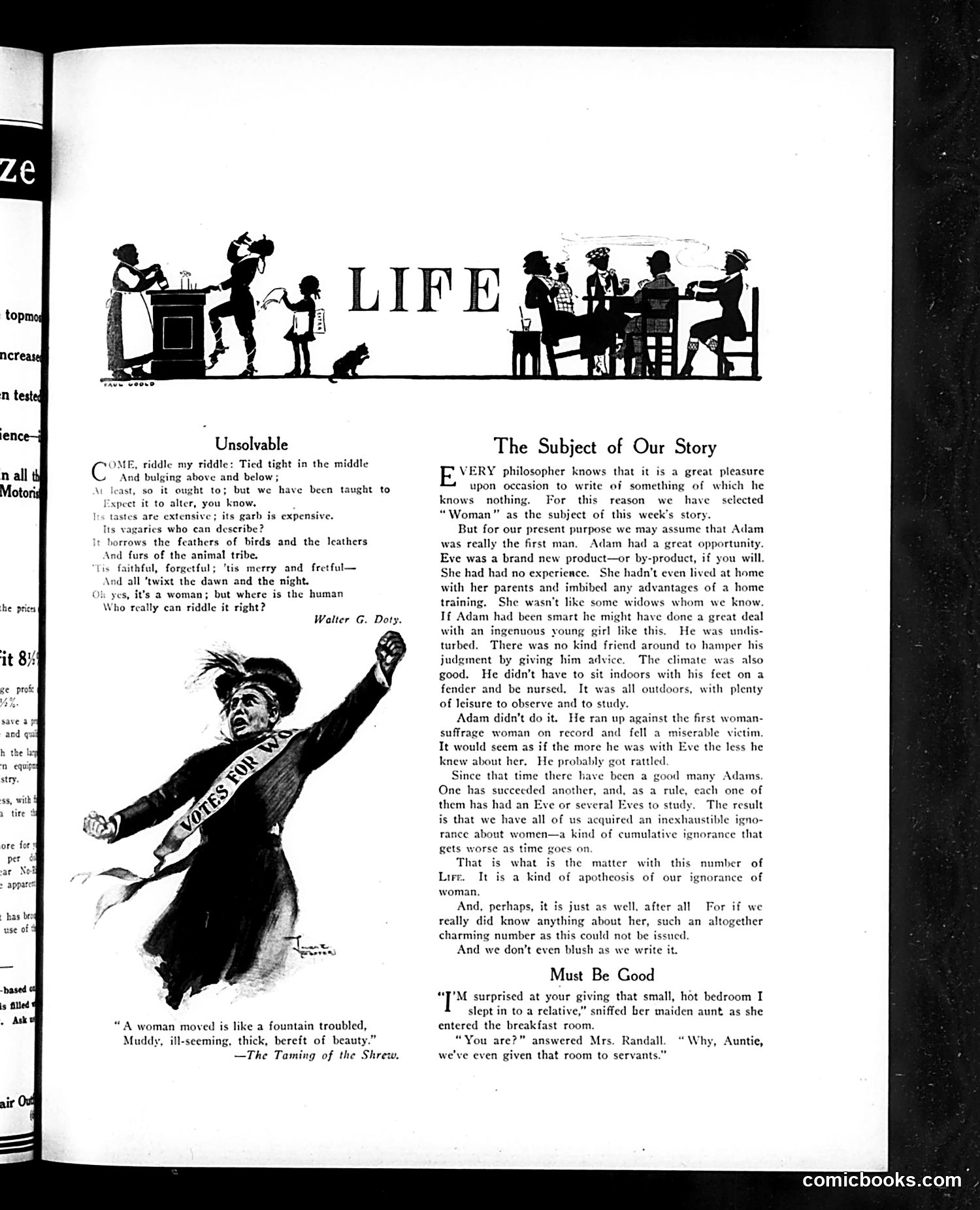
This page contains social commentary about women's rights and gender relations. The left side features an "Unsolvable" riddle by Walter G. Doty mocking women's nature, accompanied by a cartoon of a suffragette (identifiable by the "VOTES FOR WOMEN" banner) in an exaggerated, aggressive pose—satirizing the women's suffrage movement as unfeminine and unreasonable. The main article, "The Subject of Our Story," ironically uses the Biblical Adam and Eve narrative to argue that women's ignorance about themselves is universal and inevitable. The piece dismisses women's complaints about inequality as inherent to their nature. The "Must Be Good" anecdote at bottom depicts class condescension toward servants. Overall, the page uses humor to ridicule women's suffrage activism and resist expanding women's rights—typical anti-feminist satire from the early twentieth century.
📄 Transcribed text from this page (OCR, searchable)
Machine-transcribed from the original scan — historical spelling and the odd misread are preserved.
Unsolvable OME, riddle my riddle: Tied tight in the middle C And bulging above and below ; \t least, so it ought to; but we have been taught to Expect it to alter, you know, Its tastes are extensive; its garb is expensive. Its vagaries who can describe? t borrows the feathers of birds and the Icathers And furs of the animal tribe. is faithful, forgetful; ‘tis merry and fretful— And all 'twixt the dawn and the night. yes, it's a woman; but where is the human Who really can riddle it right? Walter G. Doty. “A woman moved is like a fountain troubled, Muddy, ill-seeming, thick, bereft of beauty.” —The Taming of the Shrew. The Subject of Our Story EY ZRY philosopher knows that it is a great pleasure upon occasion to write of something of which he knows nothing. For this reason we have selected “Woman” as the subject of this week's story. But for our present purpose we may assume that Adam was really the first man, Adam had a great opportunity. Eve was a brand new product—or by-product, if you will. She had had no experience. She hadn't even lived at home with her parents and imbibed any advantages of a home training. She wasn’t like some widows whom we know. If Adam had been smart he might have done a great deal with an ingenuous young girl like this. He was undis- turbed. There was no kind friend around to hamper his judgment by giving him advice. The climate was also good. He didn’t have to sit indoors with his feet on a fender and be nursed. It was all outdoors, with plenty of leisure to observe and to study. Adam didn’t do it. He ran up against the first woman- suffrage woman on record and fell a miserable victim. It would seem as if the more he was with Eve the less he knew about her, He probably got rattled. ce that time there hi been a good many Adams. One has succeeded another, and, as a rule, each one of them has had an Eve or several Eves to study. The result is that we have all of us acquired an inexhaustible igno- rance about women—a kind of cumulative ignorance that gets worse as tim eS On. That is what is the matter with this number of Lire. It is a kind of apotheosis of our ignorance of woman. And, perhaps, it is just as well, after all For if we really did know anything about her, such an altogether charming number as this could not be issued. And we don’t even blush as we write it. Must Be Good M surprised at your giving that small, hot bedroom I slept in to a relative,” sniffed ber maiden aunt as she entered the breakfast room. “You are?” answered Mrs. Randall we've even given that room to servants.” “Why, Auntie, comicbooks.com