
Life, 1912-05-02 · page 32 of 58
Life — May 2, 1912 — page 32: what you’re looking at
What you’re looking at
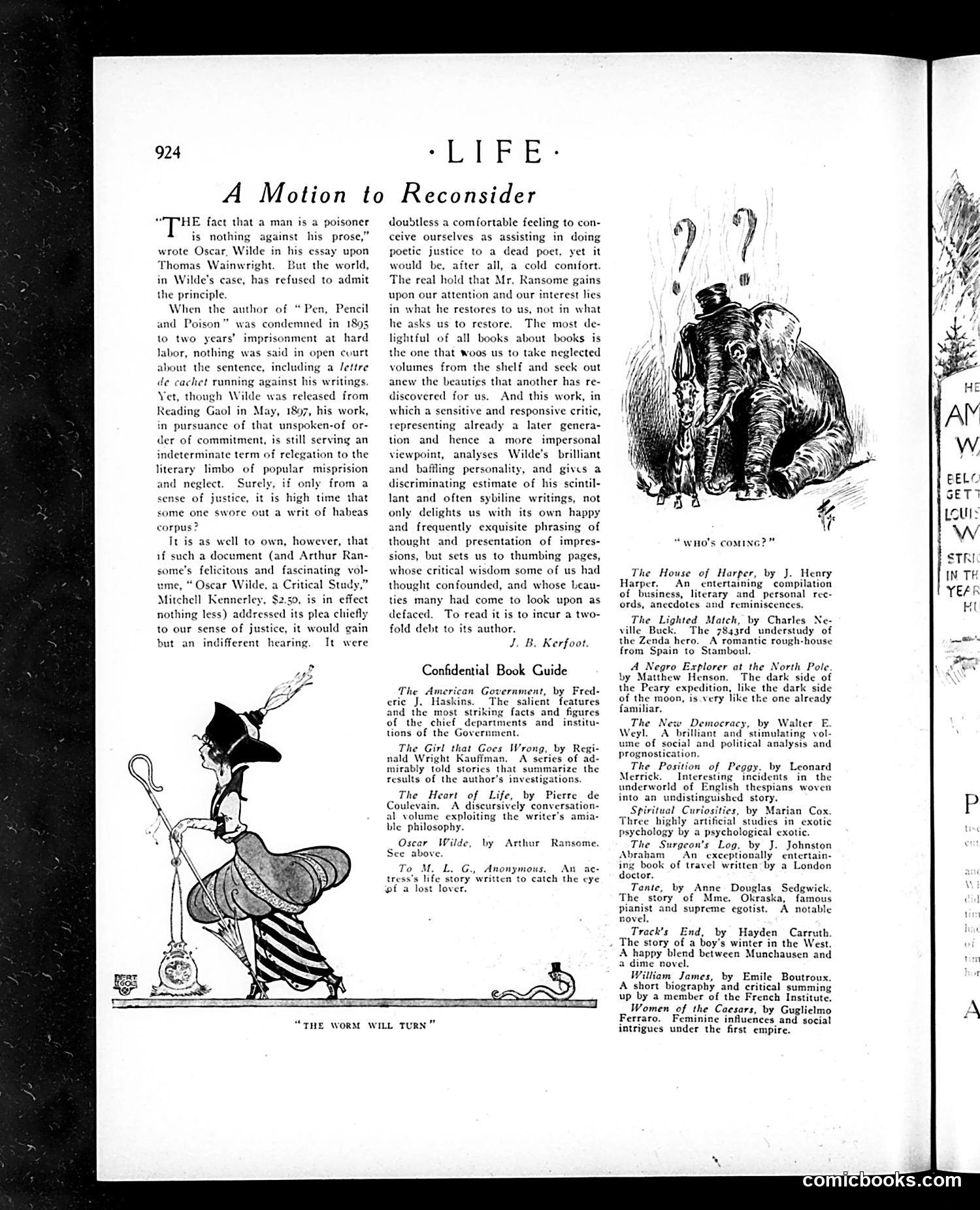
This page discusses Oscar Wilde's literary reputation following his 1895 imprisonment for homosexuality. The article argues that Wilde's work has been unfairly neglected—relegated to literary obscurity as an unspoken punishment beyond his sentence. **The cartoons** illustrate this theme: - "The Worm Will Turn" (bottom left): Shows a worm in formal dress, likely representing society's outcast or downtrodden, suggesting eventual vindication or reversal of fortune. - "Who's Coming?" (right): Depicts figures waiting anxiously, appearing to reference social ostracism or anticipation of judgment. The piece reviews Arthur Ransome's critical study of Wilde, praising it for restoring attention to Wilde's "brilliant" but dismissed writings. The author argues we should reconsider Wilde based on his literary merit rather than his personal conduct—a progressive stance for 1911, when Wilde's disgrace remained culturally toxic.
📄 Transcribed text from this page (OCR, searchable)
Machine-transcribed from the original scan — historical spelling and the odd misread are preserved.
‘LUPE: A Motion to Reconsider “THE fact that a man is a poisoner is nothing against his prose,” wrote Oscar, Wilde in his essay upon Thomas Wainwright. But the world, in Wilde's case, has refused to admit the principle. When the author of “Pen, Pencil and Poison” was condemned in 1895 to two years’ imprisonment at hard labor, nothing was said in open court about the sentence, including a lettre de cachet running against his writings. Yet, though Wilde was released from Reading Gaol in May, 1897, his work, in pursuance of that unspoken-of or- der of commitment, is still serving an indeterminate term of relegation to the literary limbo of popular misprision and neglect. Surely, if only from a sense of justice, it is high time that some one swore out a writ of habeas corpus? Tt is as well to own, however, that if such a document (and Arthur Ran- some’s felicitous and fascinating vol- ume, “ Oscar Wilde, a Critical Study,” Mitchell _Kennerle 50, is in effect nothing less) addressed its plea chiefly to our sense of justice, it would gain but an indifferent hearing. It were doubtless a comfortable feeling to con- ceive ourselves as assisting in doing poetic justice to a dead poet, yet it would be, after all, a cold comfort. The real hold that Mr. Ransome gains upon our attention and our interest lie in what he restores to us, not in what he asks us to restore. The most de- lightful of all books about books is the one that woos us to take neglected volumes from the shelf and seck out anew the beauties that another has re- discovered for us. And this work, in which a sensitive and responsive critic, representing already a later genera- tion and hence a more impersonal viewpoint, analyses Wilde's brilliant and bafiling personality, and gives a discriminating estimate of his scintil- lant and often sybiline writings, not only delights us with its own happy and frequently exquisite phrasing of thought and presentation of impr sions, but sets us to thumbing pag whose critical wisdom some of us had thought confounded, and whose Leau- ties many had come to look upon as defaced. To read it is to incur a two- fold debt to its author. J. B. Kerfoot. Confidential Book Guide The American Government, by Fred- eric J. Haskins. “The salient features and the most striking facts and figures of the chicf departments and institu- tions of the Government. The Girl that Goes Wrong, by Regi- nald Wright Kauffman. A series of ad- mirably told stories that summarize the results of the author's investigations The Heart of Life, by Pierre de Coulevain. A discursively conversation- al volume exploiting the writer's amia- ble philosophy. Oscar Wilde, by See above. To M, L. G., Anonymous. An ac- tress’s life story written’ to catch the eye of a lost lover. Arthur Ransome. “THE WORM WILL TUR: “wuo's COMING?” The House of Harper, by J. Henry Harper, An_ entertaining compilation of business, literary and personal ree- ords, anecdotes and reminiscences. The Lighted Match, by Charles Ne- ville Buck, The 7843rd understudy of the Zenda hero. A romantic rough-house from Spain to Stamboul. A Negro Explorer at the North Pole. by Matthew Henson, The dark side of the Peary expedition, like the dark side of the moon, is.very like the one already familiar. The New Democracy, by Walter E. Weyl. A brilliant and stimulating vol- ume of social and political analysis and prognostication, The Position of Peggy, by Leonard Merrick. Interesting incidents in the underworld of English thespians woven into an undistinguished story. Spiritual Curiosities, by Marian Cox. Three highly artificial’ studies in exotic psychology by a psychological exotic. The Surgcon’s Log, by J. Johnston Abraham An exceptionally entertain- ing book of travel written by a London by Anne Douglas Sedgwick. _story of Mme. Okraska, famous st and supreme egotist.. A notable novel. Track’s End, by Hayden Carruth. The story of a boy's winter in the West. A happy blend between Munchausen and a dime novel. William James, by Emile Boutroux. A short biography and critical summing up by a member of the French Institute. Women of the Caesars, by Guglielmo Ferraro. Feminine influences and social intrigues under the first empire. Ccomicbooks.com