
A complete issue · 44 pages · 1912
Life — March 14, 1912
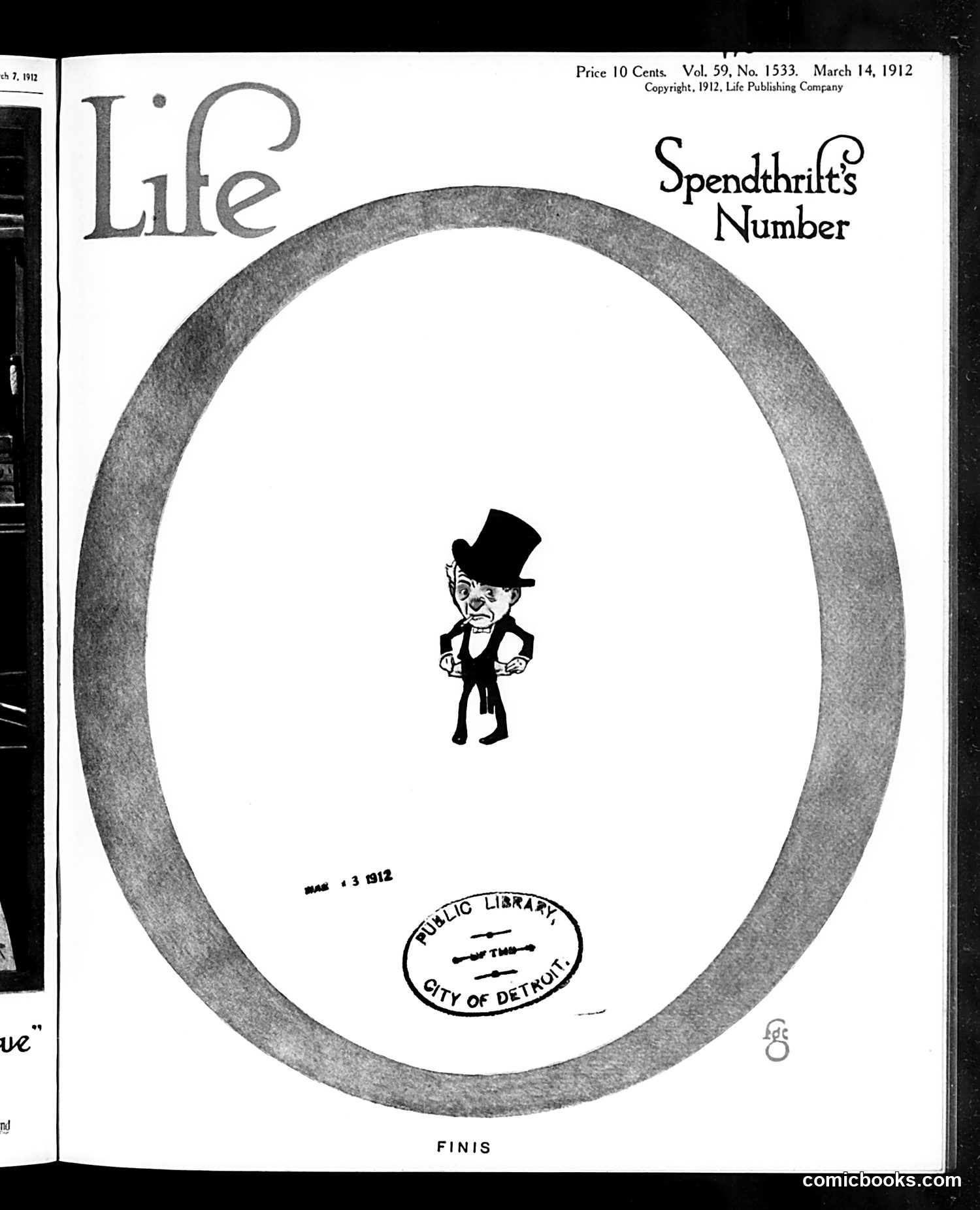
This is the cover of *Life* magazine's "Spendthrift's Number" from March 14, 1912. The central image features a small caricatured figure in formal dress (top hat and tails) standing alone within a large oval frame. The figure appears to be depicted as miserly or penny-pinching despite formal attire—a visual contradiction suggesting ironic commentary on wealth and spending habits. The "Spendthrift's Number" title indicates this issue focuses on satirizing wasteful spending or financial excess. The tiny, isolated figure emphasizes themes of miserliness or financial anxiety. The formal clothing contrasts with the character's apparent stinginess, likely mocking wealthy individuals who hoard money despite their means. The overall composition uses the stark oval framing for dramatic, comedic effect.
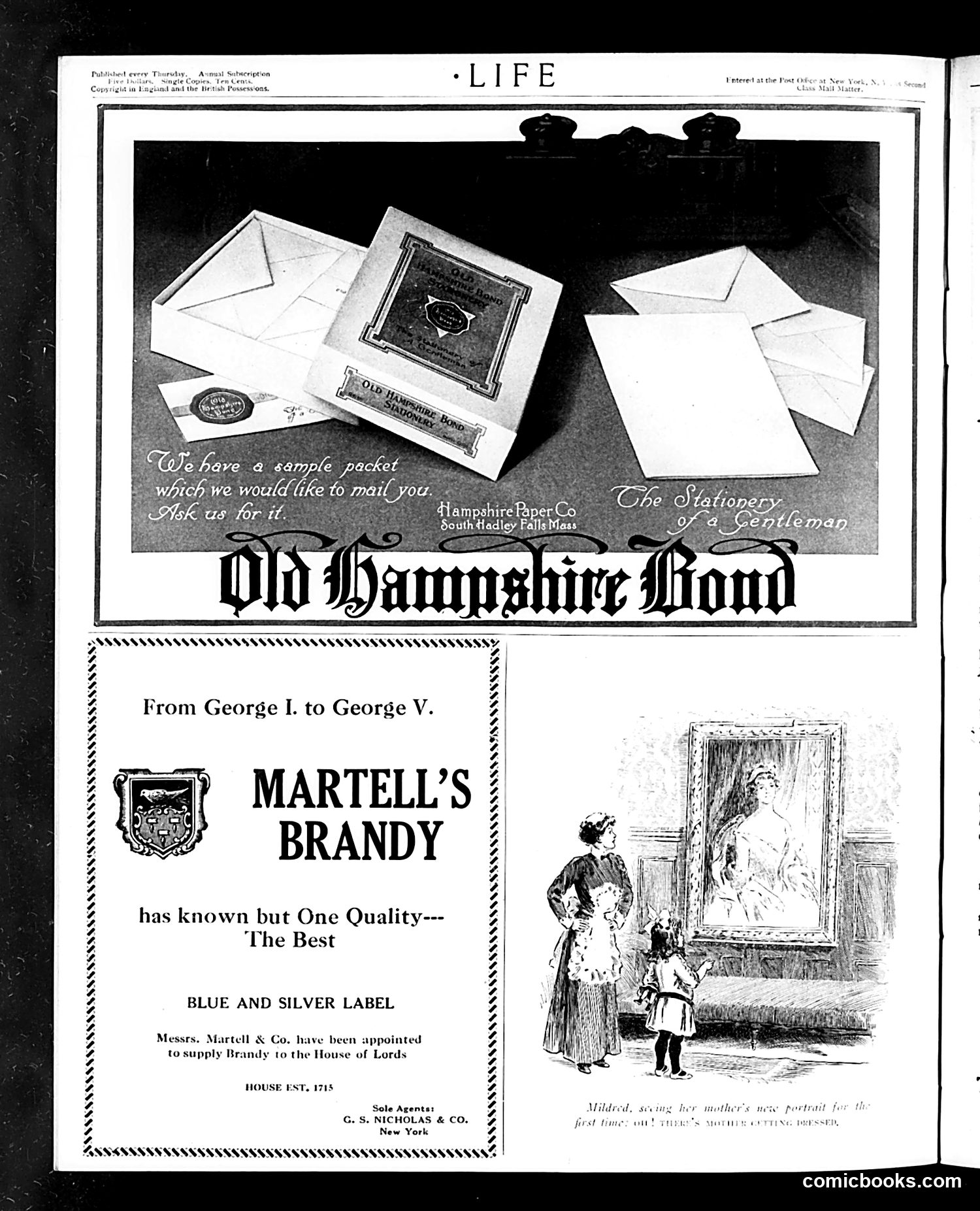
This page is primarily **advertising**, not political satire. The top advertisement promotes "Old Hampshire Bond" stationery from Hampshire Paper Co. in South Hadley Falls, Massachusetts. The image shows sample envelopes and letterhead, with text inviting customers to request a sample packet. Below is a Martell's Brandy advertisement emphasizing the product's consistent quality "From George I to George V"—referencing British monarchs to suggest long-standing excellence and tradition. The ad notes Martell & Co. supplied brandy to the House of Lords since 1715. The small illustration on the right shows a woman and child viewing a portrait, captioned about showing "mother's new portrait for the first time" in what appears to be a humorous domestic scene. No political commentary is evident here.
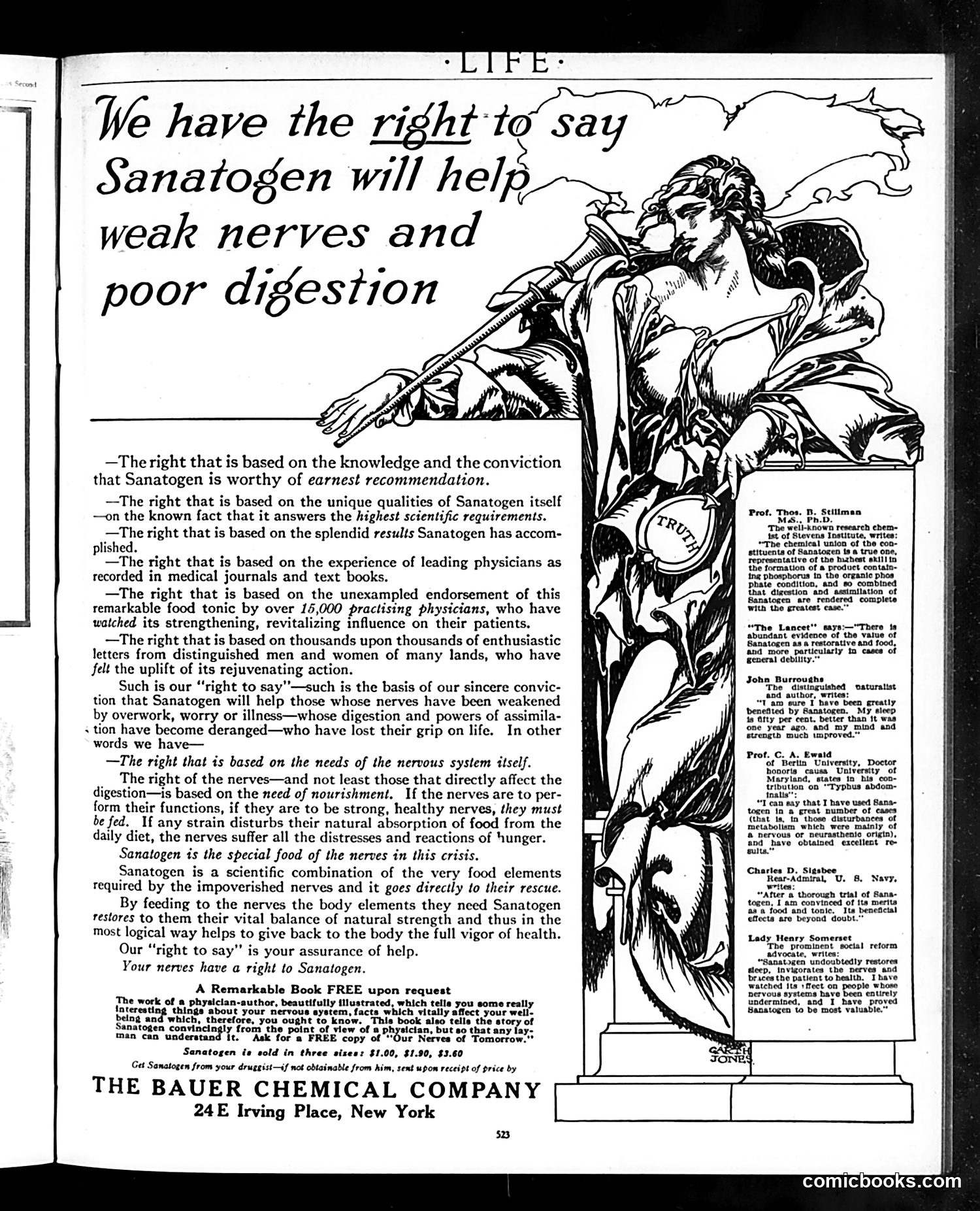
This page is primarily a **pharmaceutical advertisement** for Sanatogen, a nerve tonic, rather than satirical content. The large illustration depicts a classical female figure (likely representing Health or Vitality) holding a torch labeled "TRUTH." The ad claims Sanatogen helps "weak nerves and poor digestion" by providing essential nutrients the nervous system needs. It cites endorsements from physicians and prominent figures including John Burroughs and Charles D. Sigsbee. This reflects early 20th-century marketing practices: vague health claims, appeals to medical authority, and classical imagery suggesting legitimacy. Modern readers would recognize this as **misleading health advertising**—the kind now regulated by the FDA. The "nervous system crisis" rhetoric was common in that era's patent medicine industry.
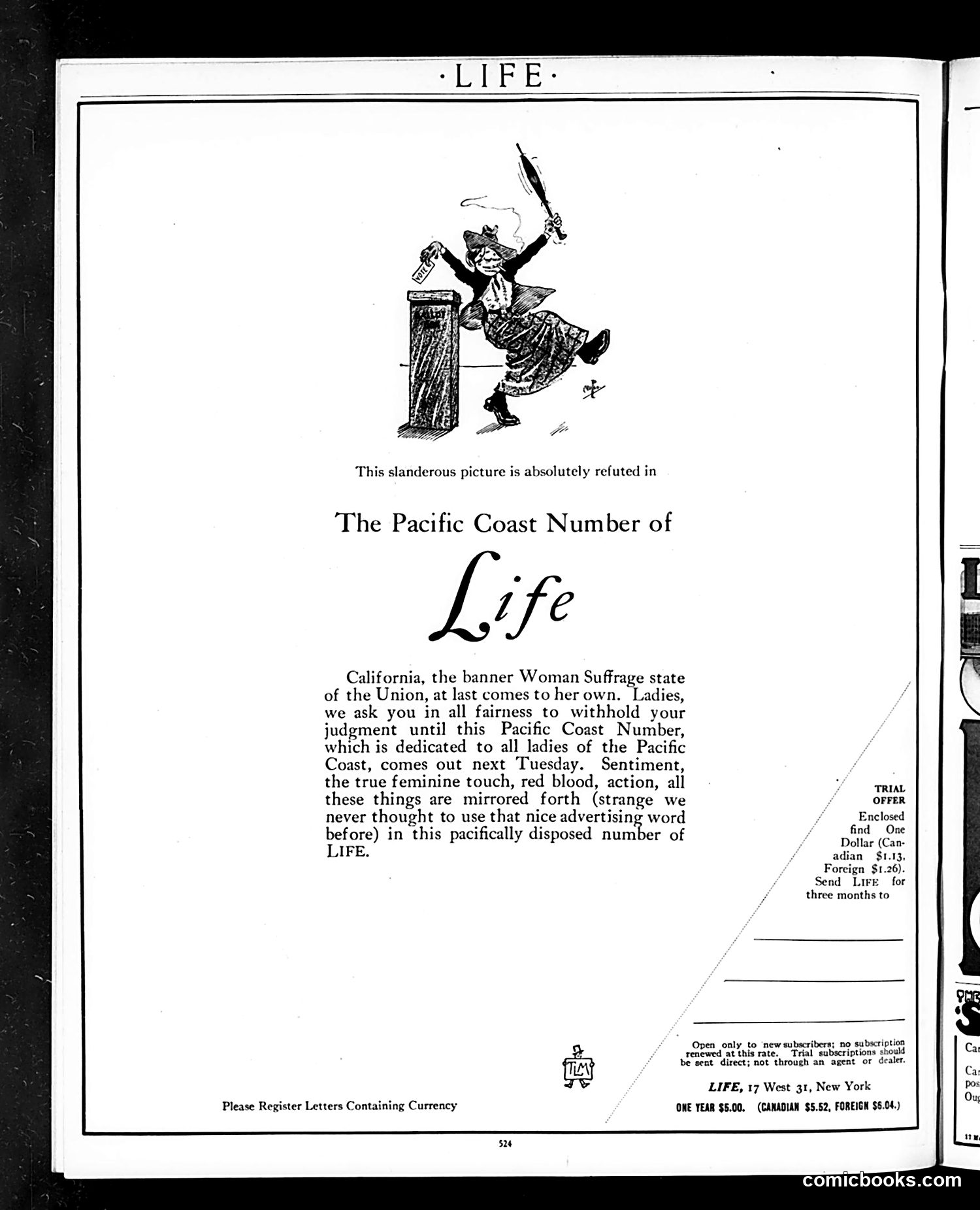
This is a **Life magazine advertisement refuting a caricature** rather than original satire. The text explicitly states the cartoon image above is "slanderous" and that this Pacific Coast issue of Life denies the depiction. The cartoon shows a figure wielding a sword in an aggressive, violent pose—apparently a stereotype or caricature intended to demean women's suffrage advocates. The ad appeals to California women, identifying the state as "the banner Woman Suffrage state," and requests fair judgment before condemning suffragists based on such imagery. The message suggests this cartoon appeared elsewhere and Life is using its platform to defend the suffrage movement's reputation against inflammatory anti-feminist propaganda. This reflects the heated rhetoric surrounding women's voting rights during the suffrage era.
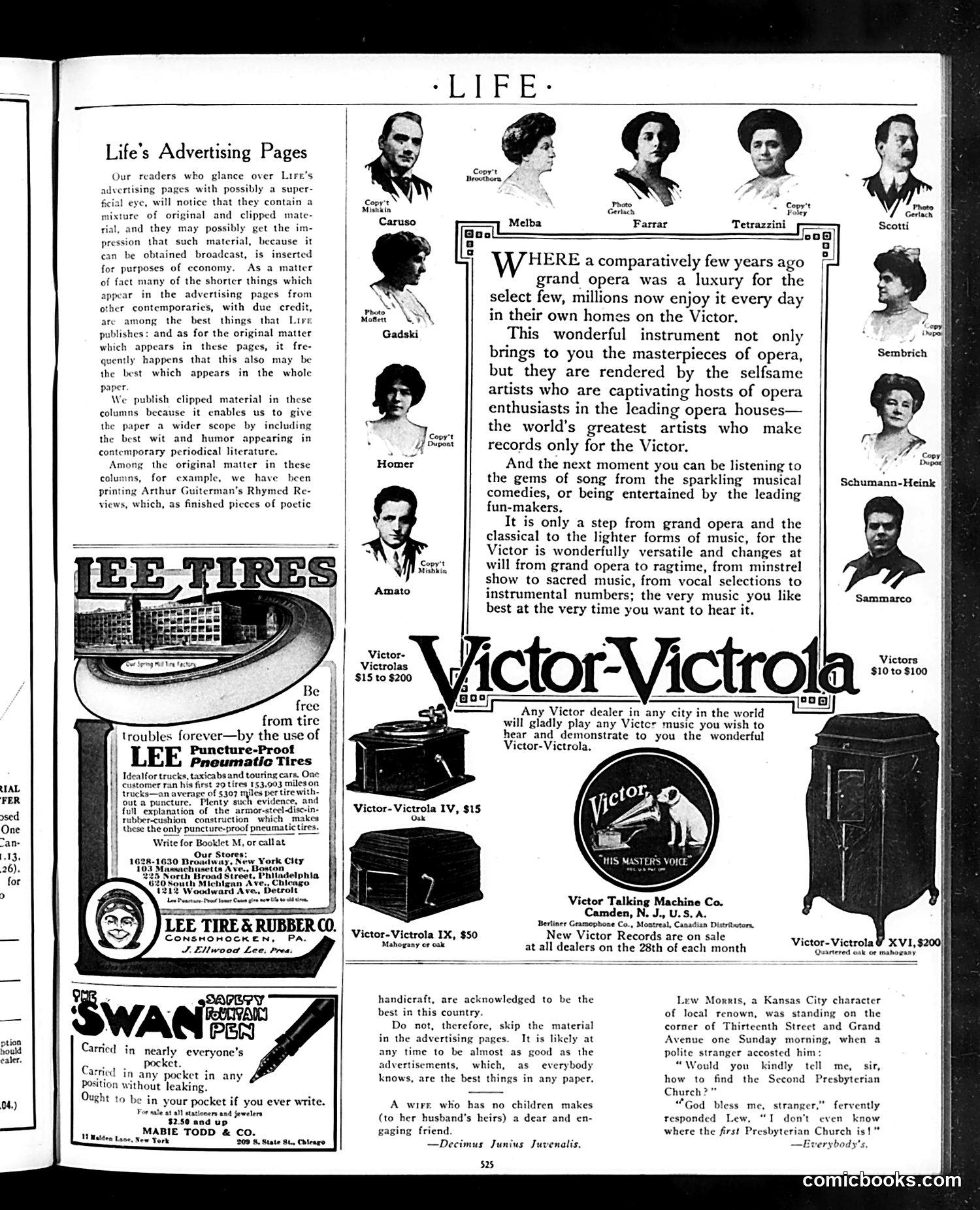
This page is primarily **advertising content**, not satire or political cartoons. The main feature is a large Victor-Victrola phonograph advertisement, showcasing various opera singers (Caruso, Melba, Farrar, Tetrazzini, Scott, Sembrich, Schumann-Heink, and Sammarco) whose recordings are available on Victor records. The advertisement emphasizes that grand opera—previously a luxury for the wealthy—is now accessible to ordinary homes through the Victor-Victrola. It's a straightforward sales pitch promoting the technology and the prestige of owning recordings by world-famous artists. The page also includes smaller ads for Lee Tires and Swan fountain pens. There is no apparent political satire or social commentary—this is a commercial advertising page from what appears to be an early 20th-century publication.
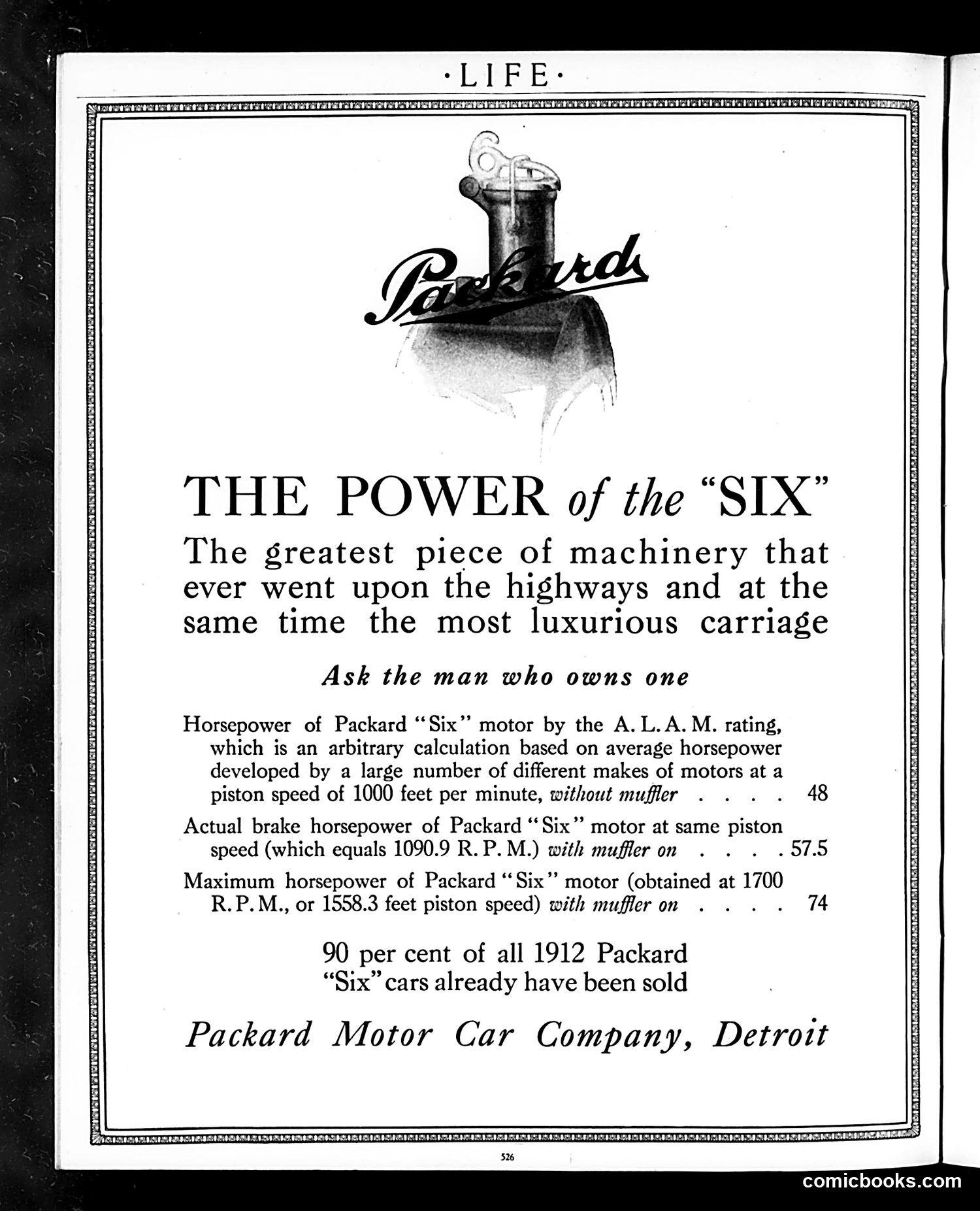
This is **not a cartoon or satirical content** — it's a straightforward **automobile advertisement** for the Packard Motor Car Company's "Six" model. The page promotes the Packard "Six" as "the greatest piece of machinery that ever went upon the highways and at the same time the most luxurious carriage." The ad emphasizes technical specifications (horsepower ratings at different RPMs) and claims that 90 percent of 1912 Packard "Six" cars had already sold. The only visual element is the Packard logo/emblem at the top. This appears in *Life* magazine, which regularly mixed satirical content with advertisements. However, this particular page is purely commercial promotional material, not satire or political commentary.
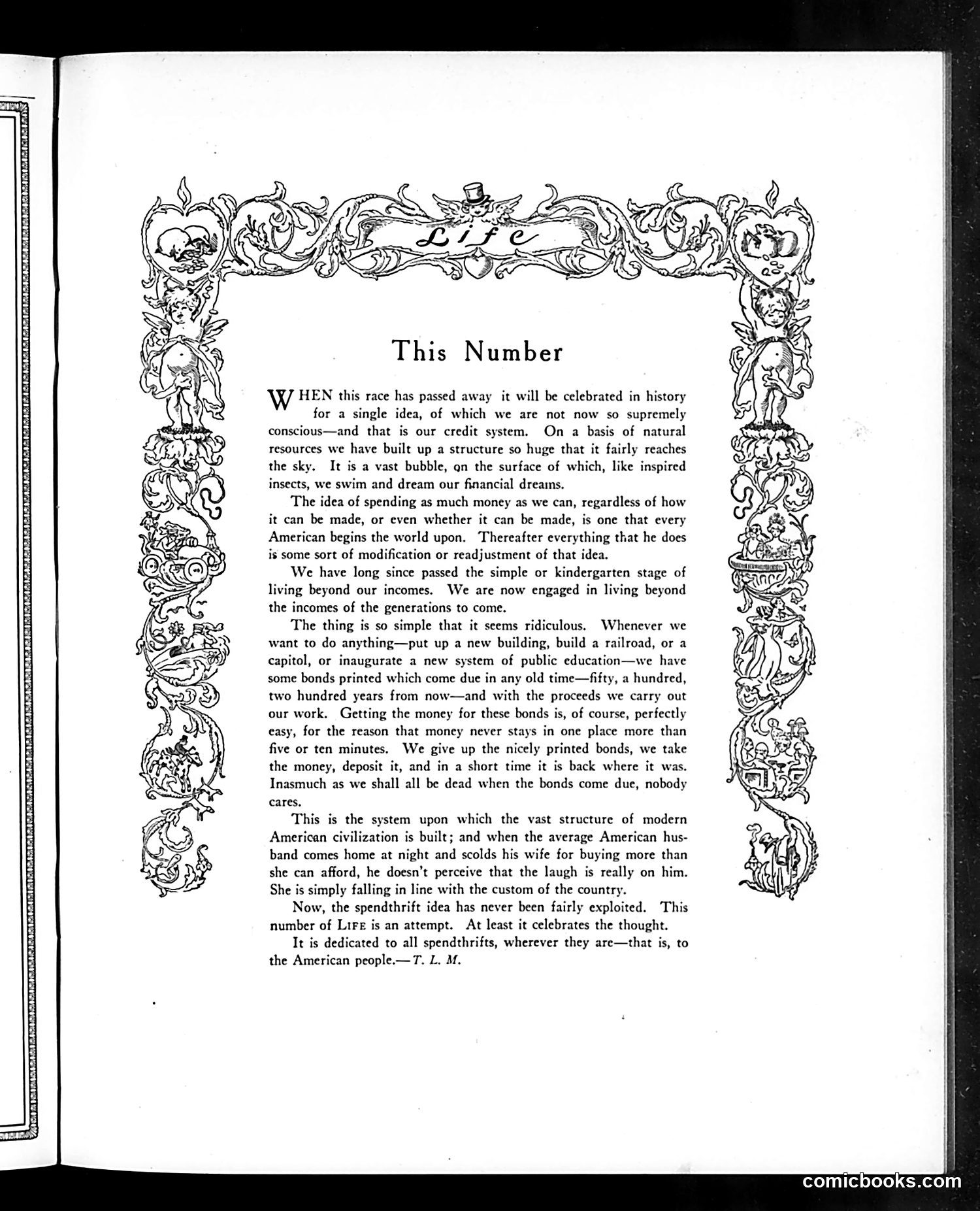
This is a title page/editorial essay rather than a cartoon. The ornate decorative border frames text signed "T. L. M." that satirizes American consumer culture and debt-based spending. The author mocks the "credit system" as the foundation of American civilization, where people spend money they don't have on things they can't afford. The satire targets the practice of issuing bonds for public projects (buildings, railroads, schools) that won't mature for decades—long after the current generation dies. The core joke: Americans justify endless spending and debt by claiming it will be "celebrated in history," while the average husband unknowingly supports this system by buying things his wife cannot afford, assuming she's simply "falling in line with custom." The piece critiques both personal overspending and government fiscal irresponsibility as interconnected aspects of American culture.
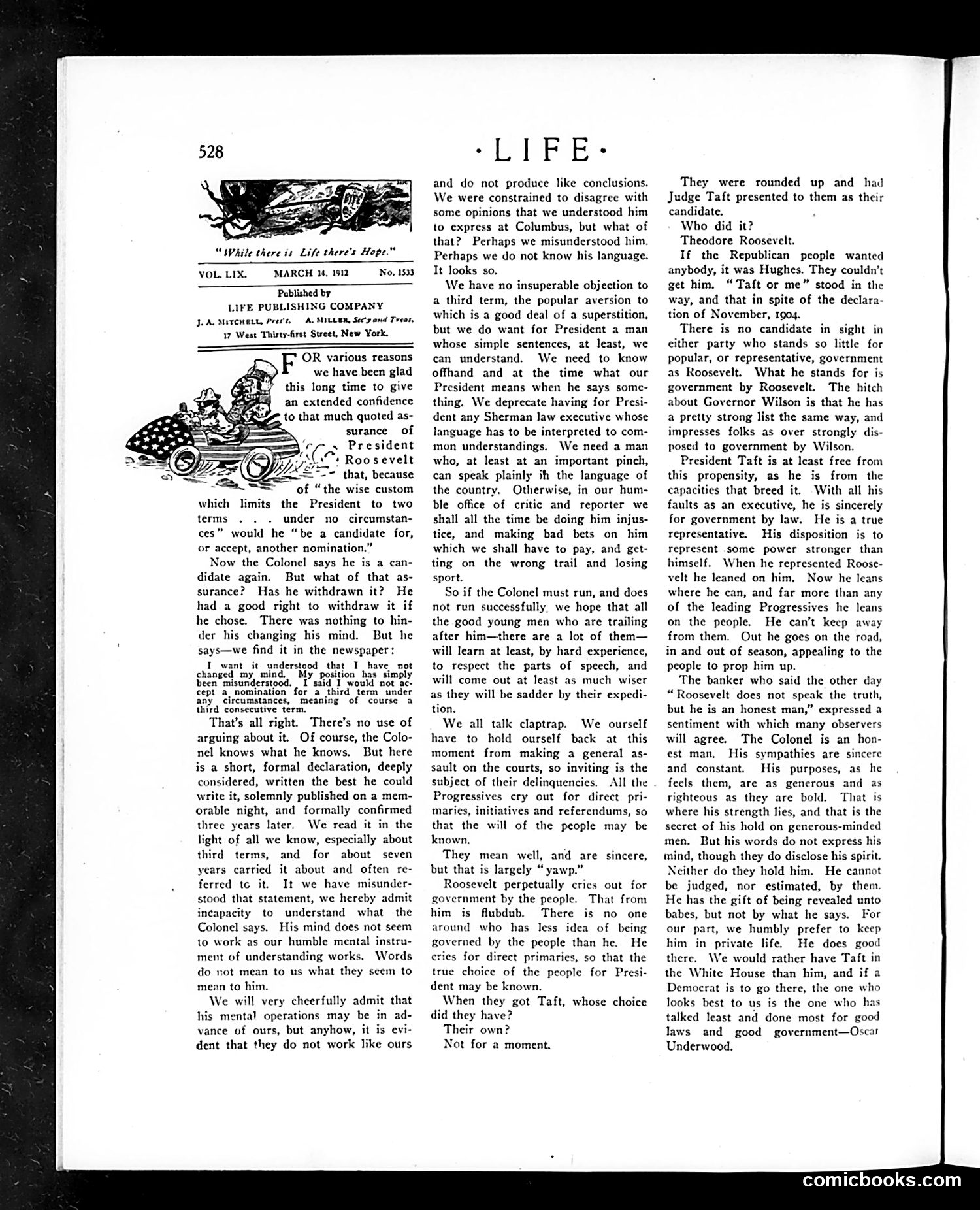
This page contains political commentary about the 1912 presidential election. The text discusses Colonel Theodore Roosevelt as a potential candidate, debating whether he should run again. It critiques Roosevelt's communication style, noting his simple, direct language appeals to ordinary citizens but sometimes lacks diplomatic nuance. The illustration shows a caricatured figure in a car, likely representing Roosevelt given the context about his candidacy. The article expresses concern about Roosevelt's temperament as an executive—his tendency to act impulsively and speak bluntly. It also compares him favorably to other candidates and discusses Republican Party divisions over who should represent them in the upcoming election, suggesting internal debate about Roosevelt's viability as their nominee.
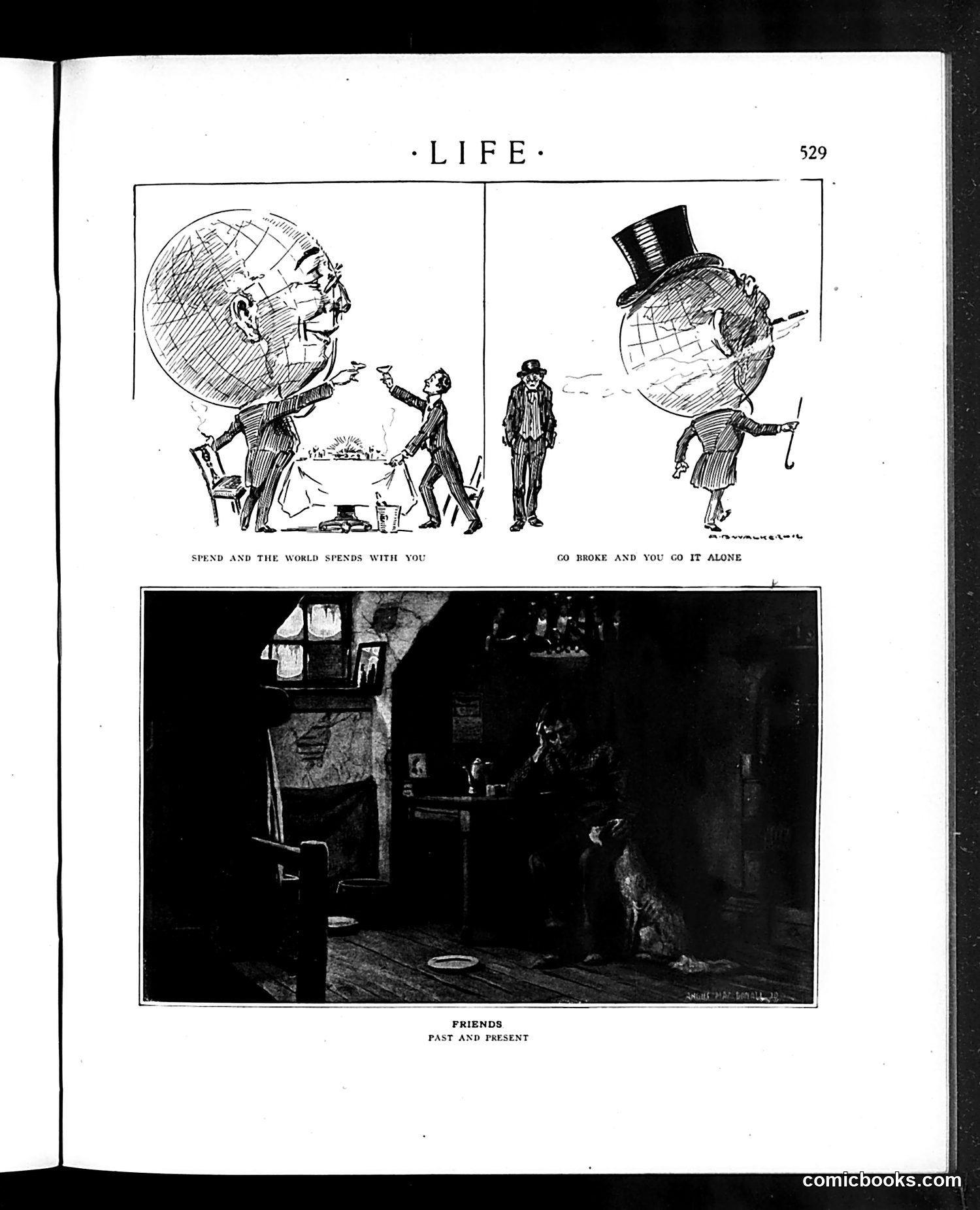
The top two cartoons present a contrast about wealth and social standing. The left panel shows a wealthy man with a globe-shaped head, entertained by companions at a table, captioned "Spend and the world spends with you"—suggesting that the rich enjoy constant social companionship and favor when they spend money lavishly. The right panel mirrors this composition but shows a man carrying a globe on his back alone, captioned "Go broke and you go it alone"—implying that financial ruin brings social abandonment and isolation. The bottom photograph, titled "Friends: Past and Present," appears to show a dog greeting a woman, likely illustrating that a pet's loyalty persists regardless of financial circumstances—contrasting with the fickle human friendships depicted above.
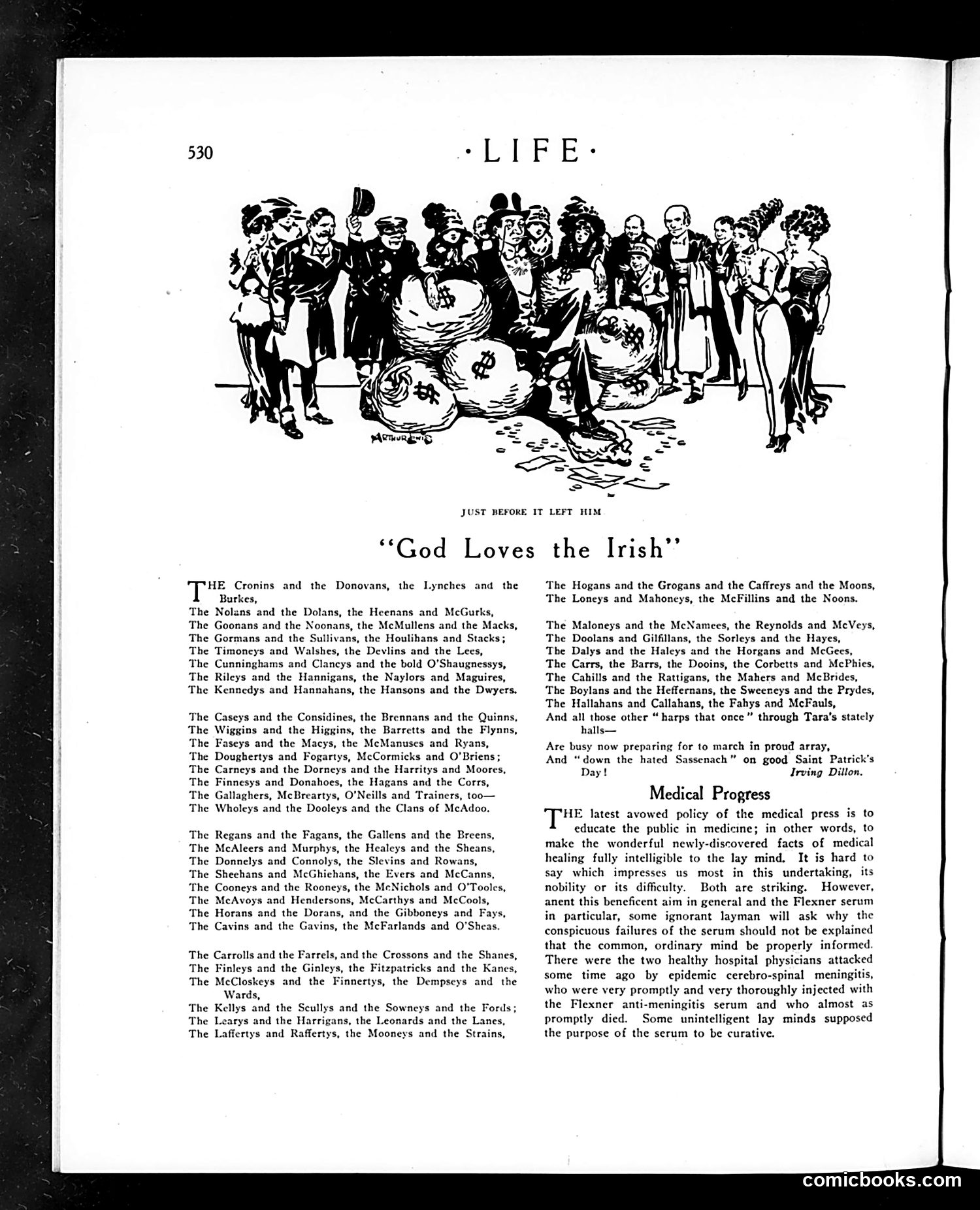
The main cartoon titled "God Loves the Irish" satirizes Irish immigration to America through an illustration labeled "Just Before It Left Him." It depicts figures standing around what appear to be money bags marked with dollar signs, suggesting wealth or financial dealings. Below this are extensive lists of Irish surnames (Cronins, Donovans, Lynches, etc.), seemingly cataloging Irish immigrants or their communities. The text references "Saint Patrick's Day" and marching "in proud array," connecting the imagery to Irish-American identity. The second article, "Medical Progress," discusses the medical establishment's education efforts and mentions a controversial episode involving hospital physicians and a Flexner serum injection that killed patients—indicating skepticism toward medical authority and experimental treatments.
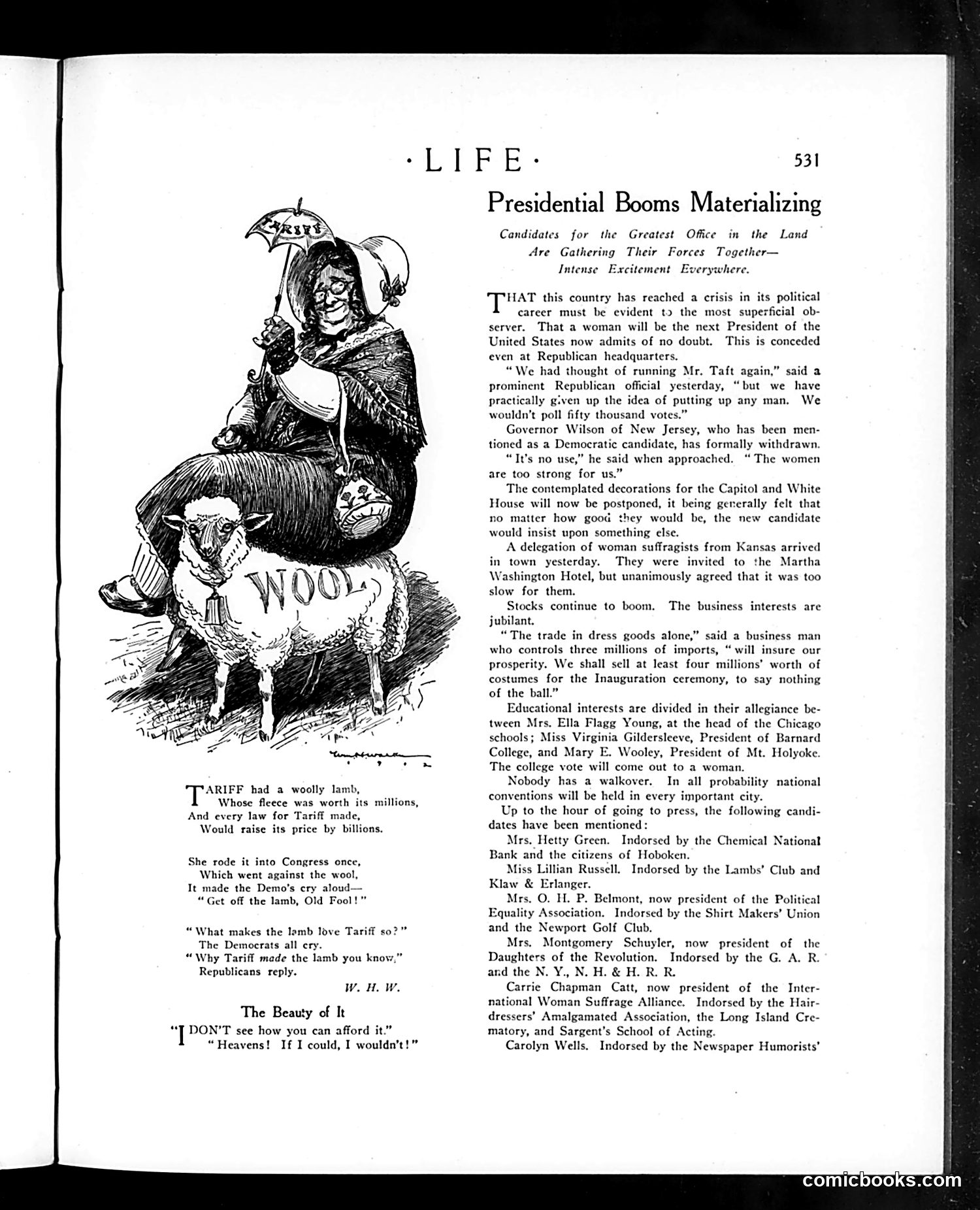
This satirical article discusses potential female presidential candidates, a prospect the text suggests is gaining serious consideration. The accompanying cartoon depicts **Lady Liberty or Columbia** (the female personification of America) riding a woolly lamb labeled "WOOL," referencing the protective tariff debate. The poem below the cartoon uses the lamb as metaphor: Republicans favored tariffs to protect domestic wool production, but the cartoon suggests this policy enriches business interests while ordinary citizens suffer ("Get of the lamb, Old Fool!"). The article lists female candidates endorsed by various organizations, treating female presidency as both inevitable and economically consequential—mocking how business interests mobilize around political change regardless of actual qualifications.
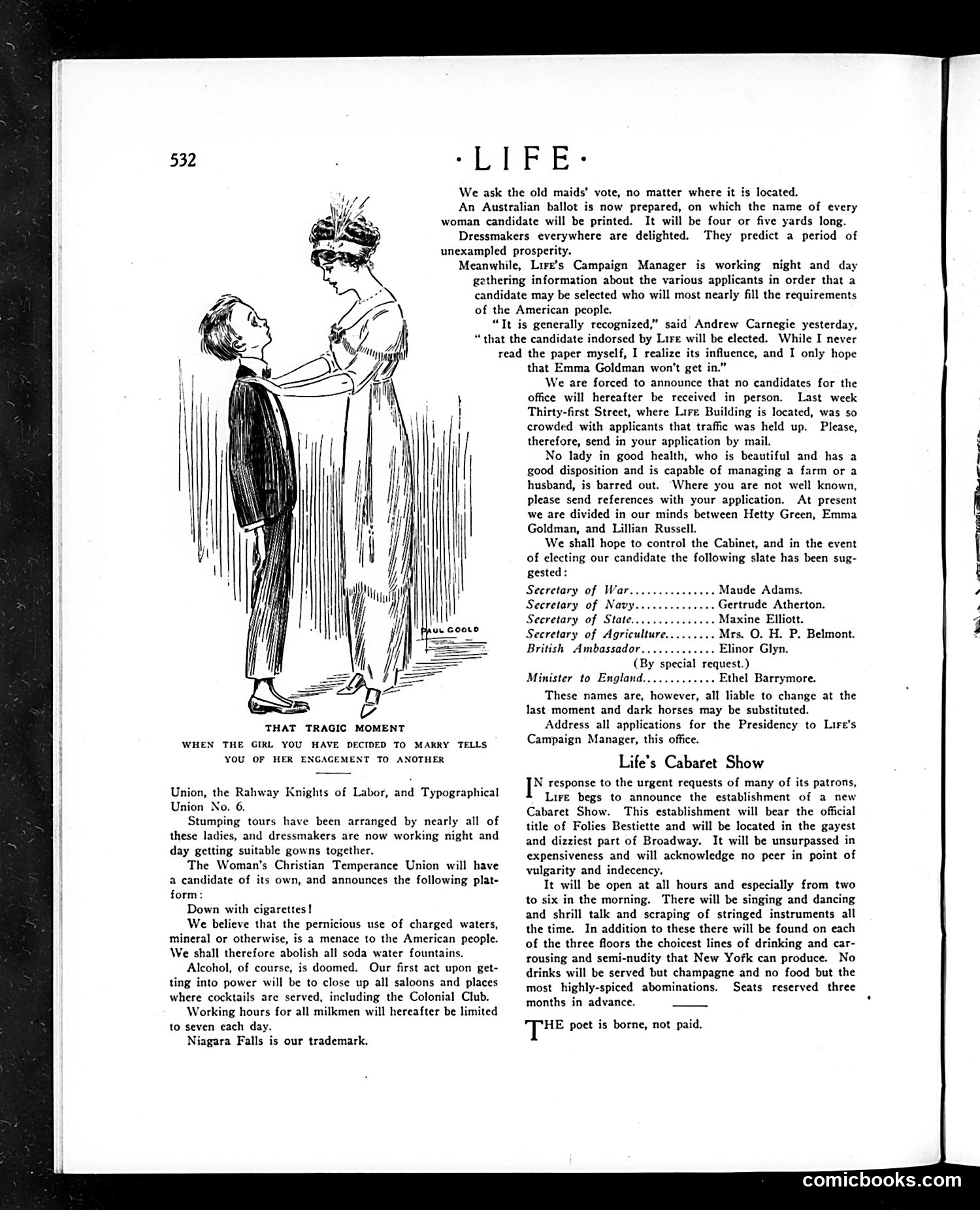
The cartoon titled "That Tragic Moment" depicts a woman telling a man she's decided to marry someone else—a common romantic scenario played for satire. The illustration is by Will Dyson. The accompanying text discusses Life magazine's satirical coverage of a presidential campaign, specifically mentioning candidates Emma Goldman, Hetty Green, and Lillian Russell. These were real public figures of the era being humorously proposed as potential leaders. The piece mocks the campaign process, ballot preparation, and the absurdity of suggesting unconventional female candidates for high office—reflecting early 20th-century attitudes toward women in politics. The page also announces Life's new "Cabaret Show" theatrical entertainment venue in New York.
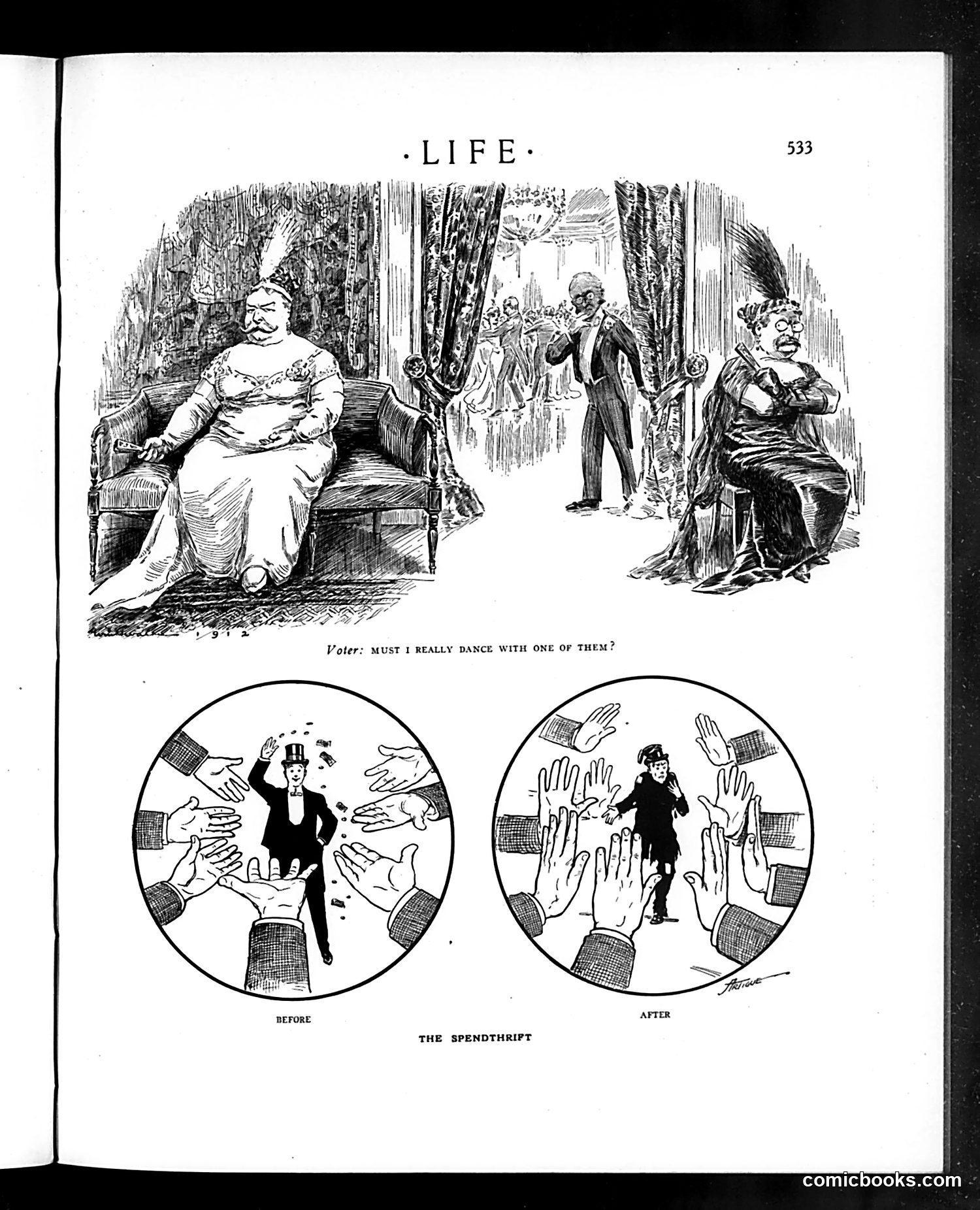
This page from *Life* magazine contains two satirical cartoons about voting and political participation. The top cartoon shows a well-dressed voter at a social gathering, asking "Must I really dance with one of them?" — suggesting reluctance about choosing between political candidates. The bottom cartoon, titled "The Spendthrift," uses a before-and-after comparison. The "before" shows a man surrounded by grasping hands seeking money. The "after" shows the same man surrounded by raised hands — apparently after he's spent his money, people no longer want anything from him. Together, these cartoons satirize voter apathy and the self-interested nature of political engagement. The humor relies on the viewer understanding that politicians and supporters pursue wealthy or influential people primarily for financial gain rather than genuine interest.
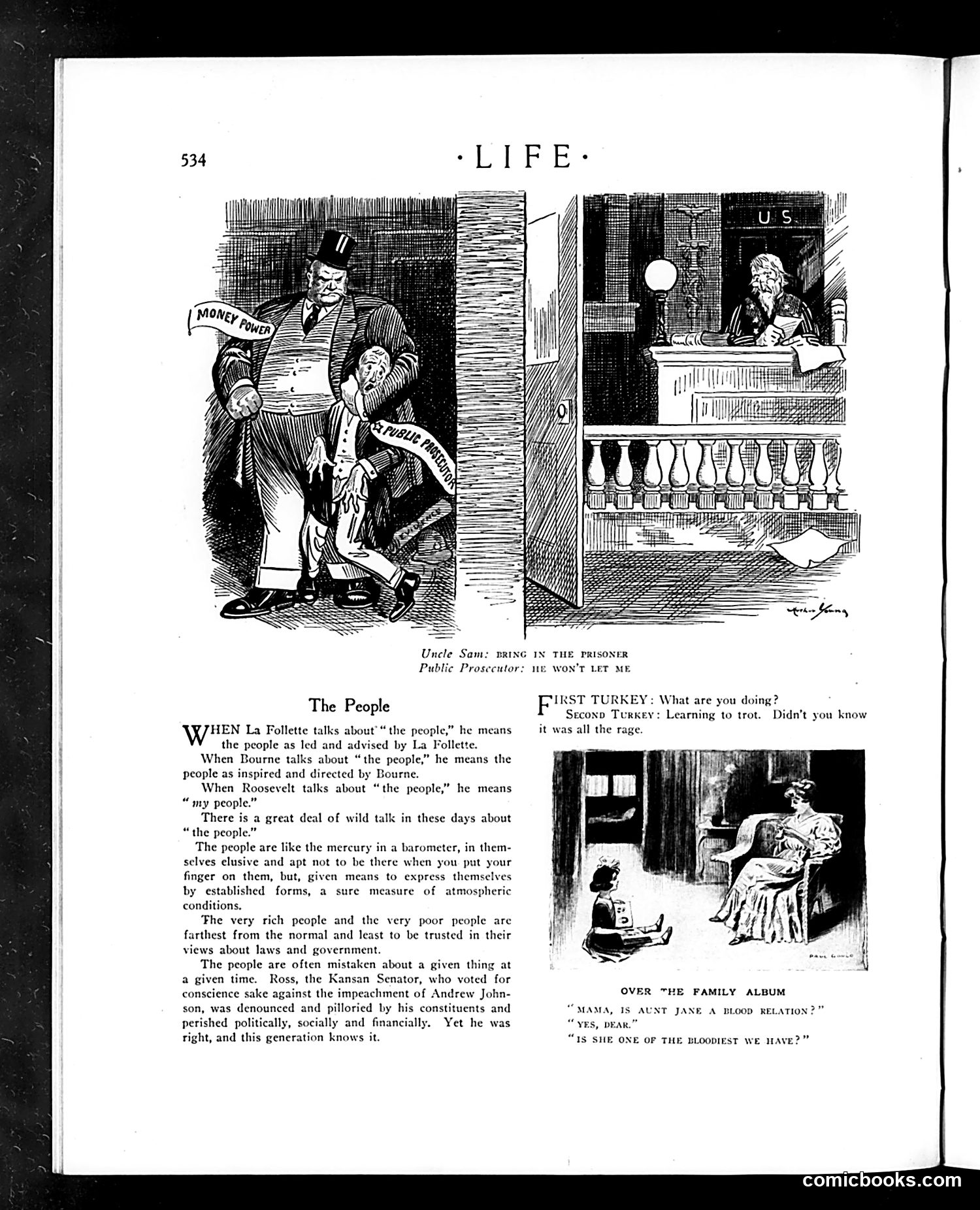
The top cartoon satirizes **political corruption and power dynamics**. A portly man labeled "Money Power" controls a smaller figure labeled "Public Interest," suggesting wealthy interests manipulate public welfare. The "Uncle Sam" caption references government authority being compromised by financial interests—a common Progressive Era critique of wealthy industrialists controlling politics through bribery and influence. The bottom cartoon, "Over the Family Album," is a domestic humor piece about genealogy—a child questions whether "Aunt Jane" is a blood relative, humorously implying questionable family legitimacy. This reflects satirical commentary on class and social respectability concerns. The page's essay "The People" discusses how politicians misrepresent public opinion, noting that rich and poor citizens are least trustworthy in political matters—supporting the visual satire above.
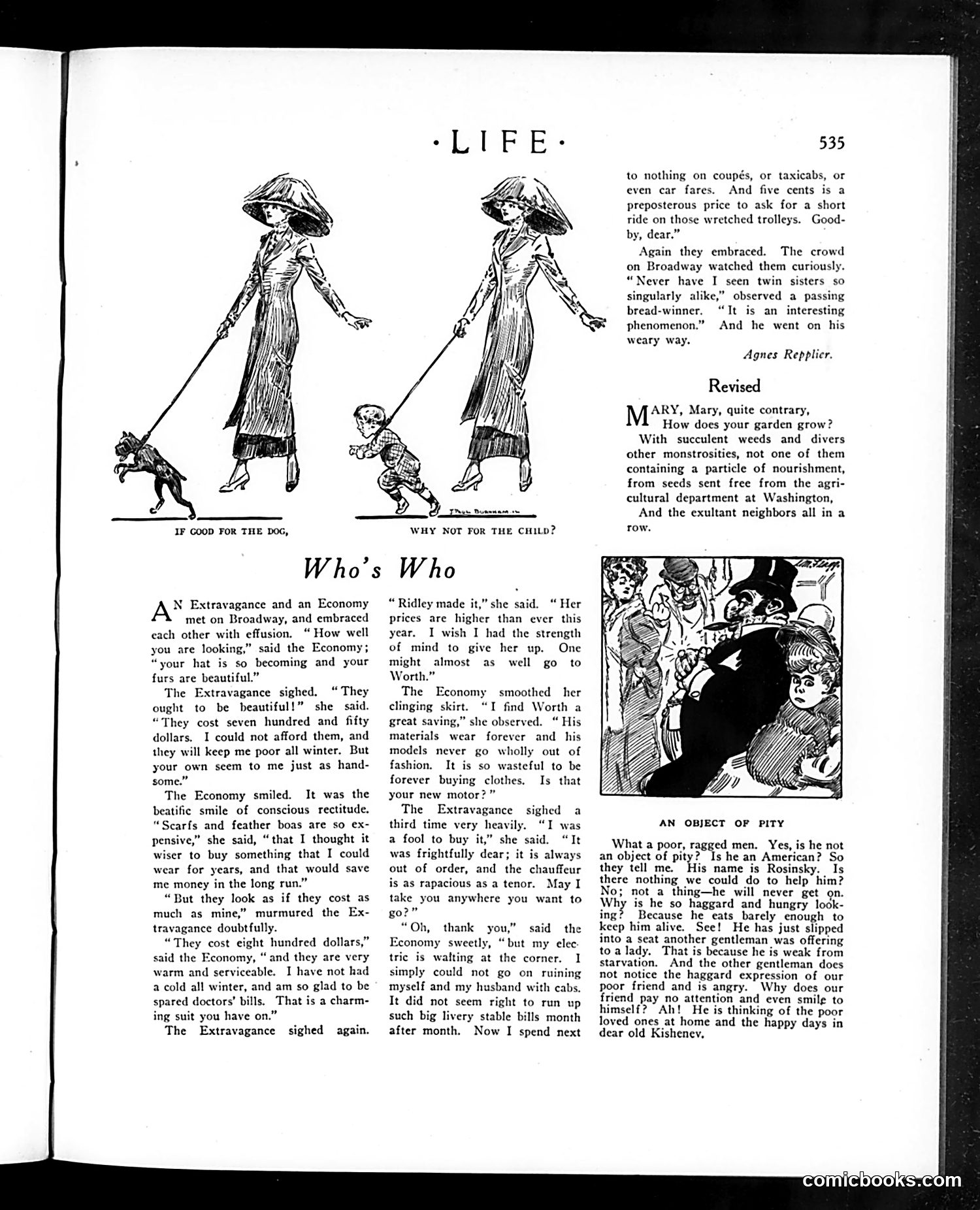
The top cartoon compares two wealthy women meeting on Broadway—"Extravagance" and "Economy"—who ironically spend the same or more money while congratulating themselves on opposite approaches. Extravagance buys expensive items she can't afford; Economy justifies equally costly purchases (Worth gowns, an electric car) as practical investments. The satire mocks how both women rationalize excessive spending through different rhetoric, revealing that wealth and self-deception go hand-in-hand regardless of one's claimed philosophy. The final section, "An Object of Pity," describes Rosinsky, a poor immigrant (likely Eastern European, given the reference to Kishenev) too weak from starvation to notice social courtesies. The piece sardonically observes he cannot be helped and will never succeed—exposing contemporary American indifference to immigrant suffering while he mentally escapes to memories of his homeland.
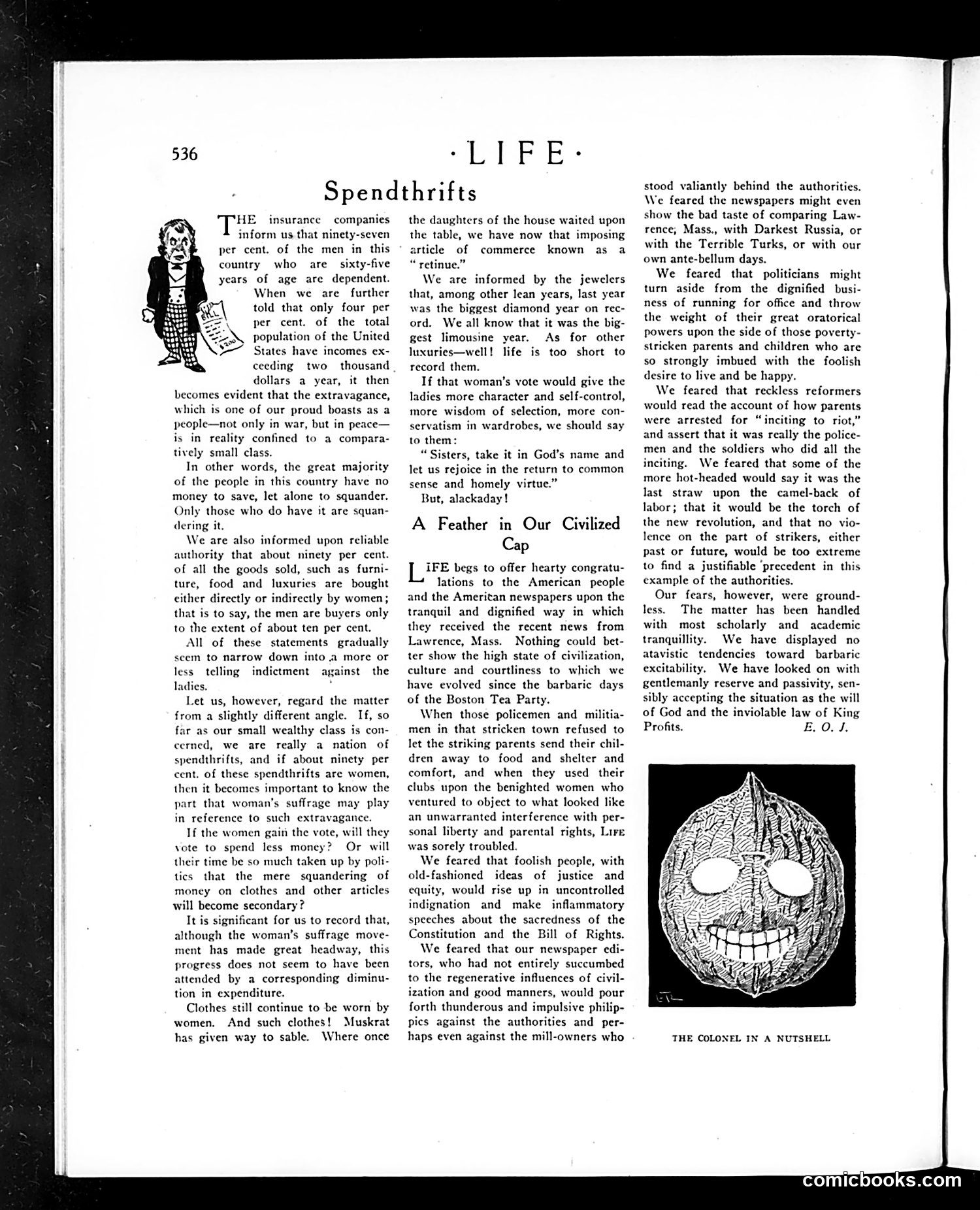
This page contains two satirical articles critiquing American society circa the early 20th century. **"Spendthrifts"** attacks the contradiction between women's newfound political power (women's suffrage) and their spending habits. The article notes that 90% of consumer goods are purchased by women, yet gaining voting rights hasn't reduced extravagance—diamond sales and luxury goods remain high. The accompanying caricature (left) depicts a disheveled spendthrift, visually reinforcing the critique. **"A Feather in Our Civilized Cap"** sarcastically praises America's "dignified" response to the Lawrence, Massachusetts textile strike (likely 1912). The irony is heavy: police and militia clubs used against striking parents and women are presented as signs of "civilization" and "courtliness." Life questions whether citizens will demand justice or merely accept authority's violence. **The Colonel in a Nutshell** (illustration, right) appears unrelated—a satirical portrait in a decorative nutshell frame. The page reflects Progressive Era tensions: women's empowerment, labor unrest, and institutional authority.
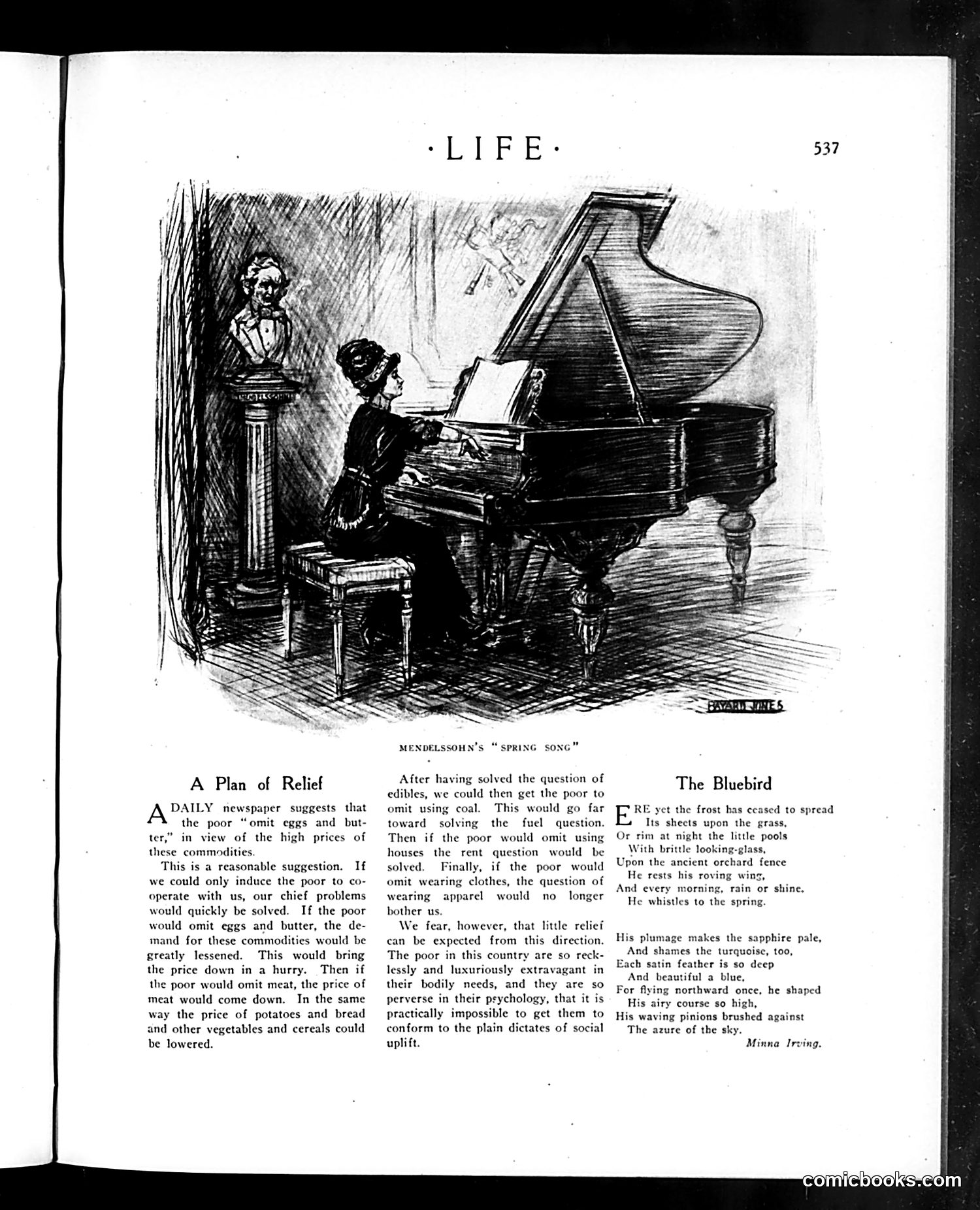
This satirical article mocks proposed solutions to poverty during a period of high commodity prices (likely early 20th century inflation). A newspaper suggests the poor simply "omit eggs and butter" to reduce demand and lower prices. Life's writer sarcastically extends this logic to absurdity: if the poor stop buying meat, potatoes, bread, coal, rent-paying, and clothing, all economic problems solve themselves. The satire targets the callousness of the wealthy and their advisors who blame poverty on the poor's supposed extravagance rather than acknowledging systemic economic inequality. By pushing the suggestion to ridiculous extremes—essentially suggesting the poor should cease existing as consumers—the article exposes how disconnected such proposals are from reality. The phrase "social uplift" is used mockingly, implying that denying oneself necessities constitutes moral improvement. The accompanying illustration of a woman at a grand piano emphasizes the class divide between those offering advice and those suffering economically.
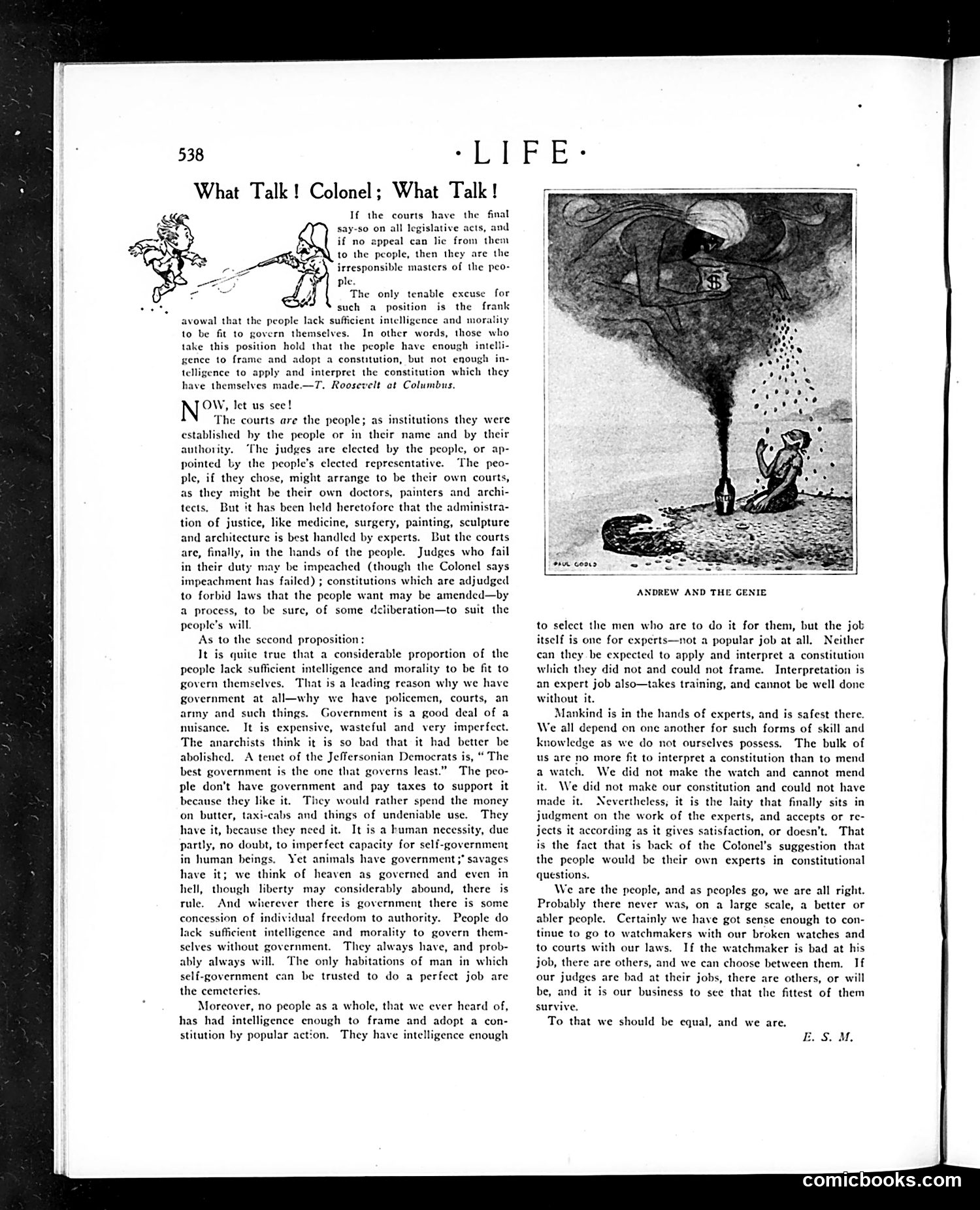
This page presents a political debate about judicial power and popular sovereignty, likely from the Progressive Era (early 1900s). **The Text Debate:** Theodore Roosevelt (identified as "the Colonel") is quoted arguing that if courts have final say over laws with no popular appeal, they become "irresponsible masters." The unnamed author responds by defending expert judgment, arguing that courts—like medicine or architecture—require specialized expertise. While ordinary people can *choose* their experts and *amend* constitutions, they lack the training to interpret them directly. **The Cartoon:** The small illustration labeled "Andrew and the Genie" (partially visible) appears to be a separate humorous piece, likely a fairy-tale reference unrelated to the main political argument. **The Point:** Life is satirizing Roosevelt's populism by suggesting that while democracy means *ultimate* popular control, day-to-day governance requires trained experts. The magazine argues common people sensibly delegate specialized tasks—accepting this applies to constitutional interpretation too.
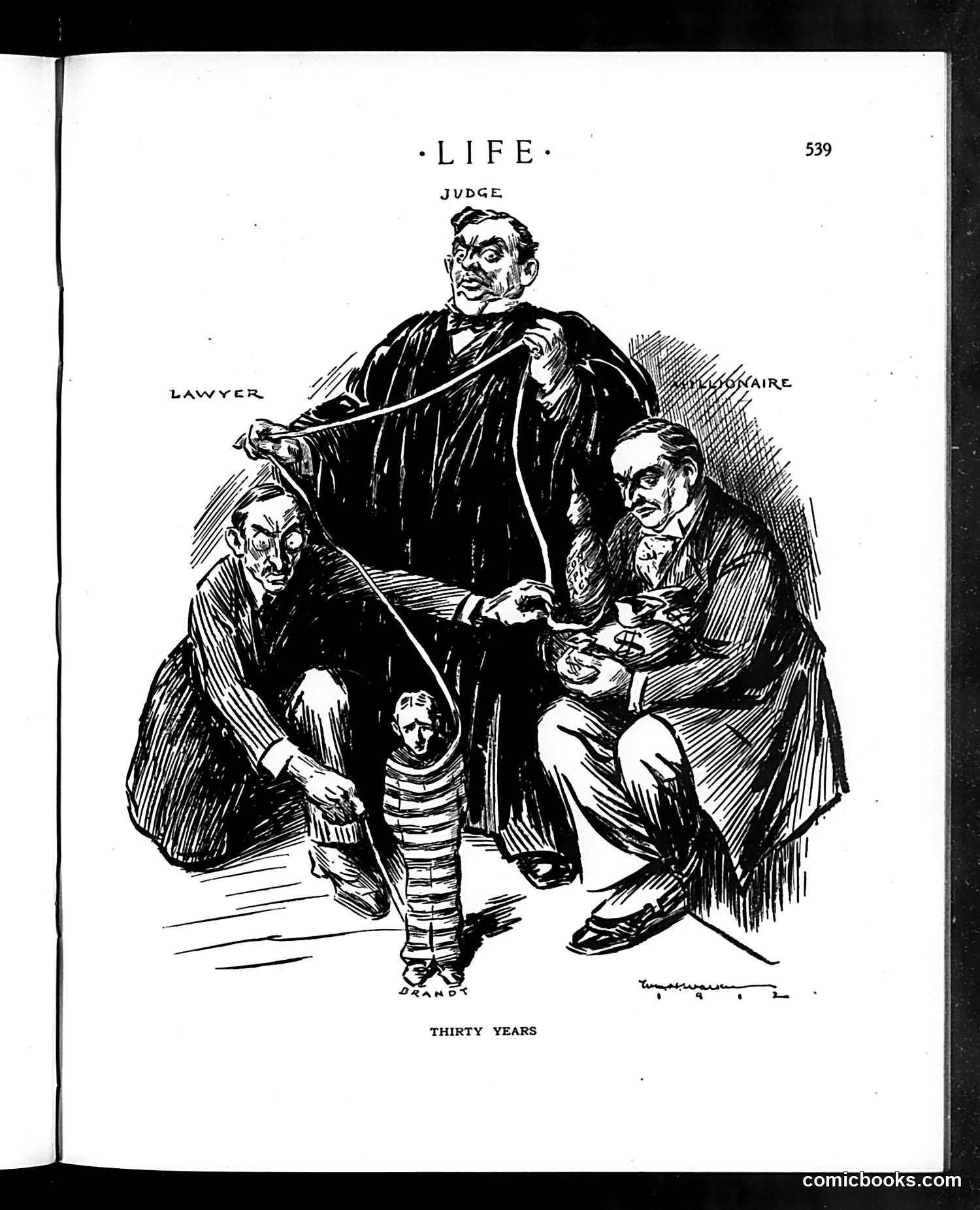
This Life magazine cartoon satirizes the American legal system's treatment of crime over a thirty-year period. The central figure is a **Judge**, depicted as controlling three figures labeled **Lawyer**, **Millionaire**, and what appears to be a small criminal or defendant at the bottom labeled "Scamper." The satire suggests that wealthy defendants ("Millionaire") and their expensive legal representatives ("Lawyer") have disproportionate power within the justice system, while the Judge—ostensibly impartial—manipulates outcomes. The small, constrained figure at bottom represents ordinary criminals or the poor, who lack resources for quality legal defense. The cartoon critiques systemic inequality: justice appears accessible only to the wealthy, while those without means face harsher treatment. The Judge's controlling posture implies the entire system perpetuates class-based injustice.
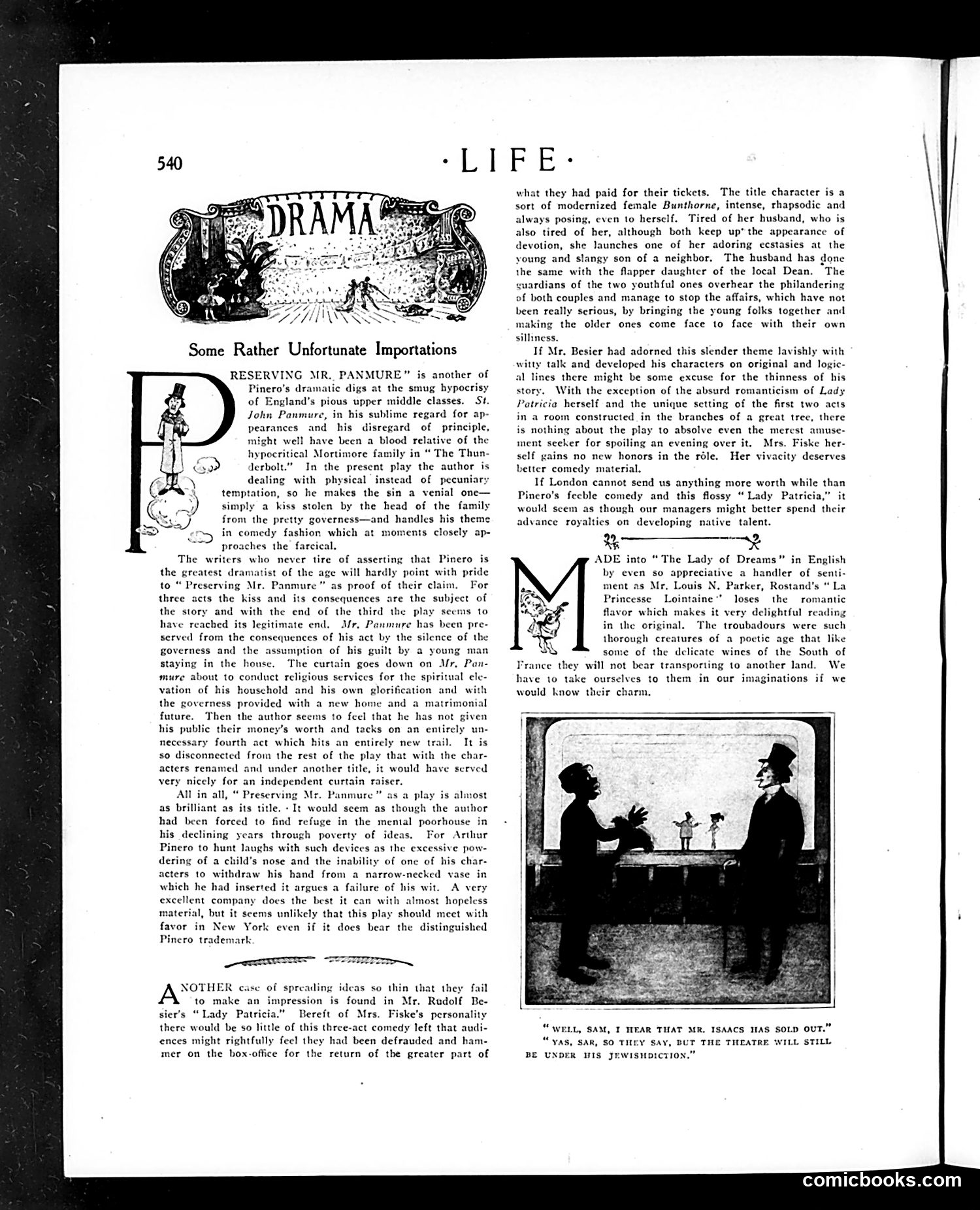
This page reviews two imported British plays—Pinero's "Preserving Mr. Panmure" and Besier's "Lady Patricia"—both performed by distinguished actors. The critic savagely dismisses both as artistically bankrupt. **The satire targets:** Pinero's play satirizes hypocritical upper-middle-class English morality (the protagonist conducts religious services while concealing adultery), but the critic finds the play itself lazy—artificially extending a three-act story into four acts with disconnected material. He mocks Pinero's tired comedic devices (excessive face-powdering, a hand stuck in a vase) as proof the aging playwright has run out of genuine wit. Besier's play depends entirely on star actress Mrs. Fiske's charm; without her, the critic argues, audiences would demand refunds—the actual dramatic material is that thin. **The implicit message:** Even prestigious foreign dramatists can produce hollow, idea-starved imports unworthy of American audiences' money. The accompanying photograph (silhouettes of two figures in dialogue) illustrates typical dramatic material—though uninspired.
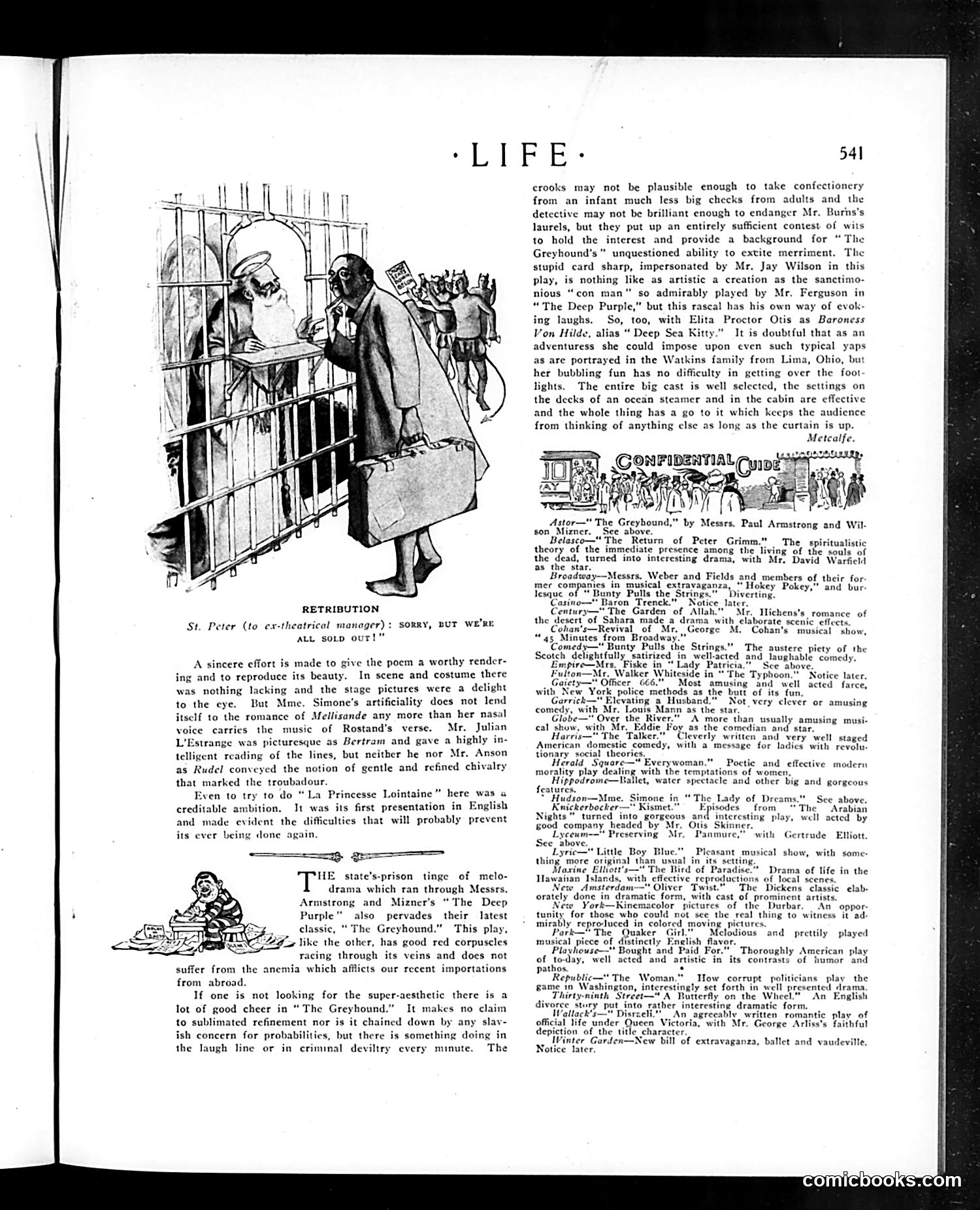
The main cartoon shows **St. Peter at heaven's gates** turning away an **ex-theatrical manager**, saying "Sorry, but we're all sold out!" This is a satirical **afterlife joke**: the manager, presumably guilty of some theatrical sin or fraud, arrives expecting entry to heaven but is rejected—heaven has no room for him. The humor lies in the irreverent suggestion that theatrical folk of questionable ethics don't make the cut for paradise. The rest of the page contains **theater reviews** critiquing contemporary stage productions, including "The Greyhound," "The Deep Purple," and others. The reviewer praises some performances while mocking others' artificiality and implausibility, particularly actress Mme. Simone's "nasal voice" and the predictable criminality plots. The cartoon's satire likely reflects broader **early 20th-century skepticism about theater managers' honesty**—possibly referencing actual theatrical scandals or financial improprieties common to that era.
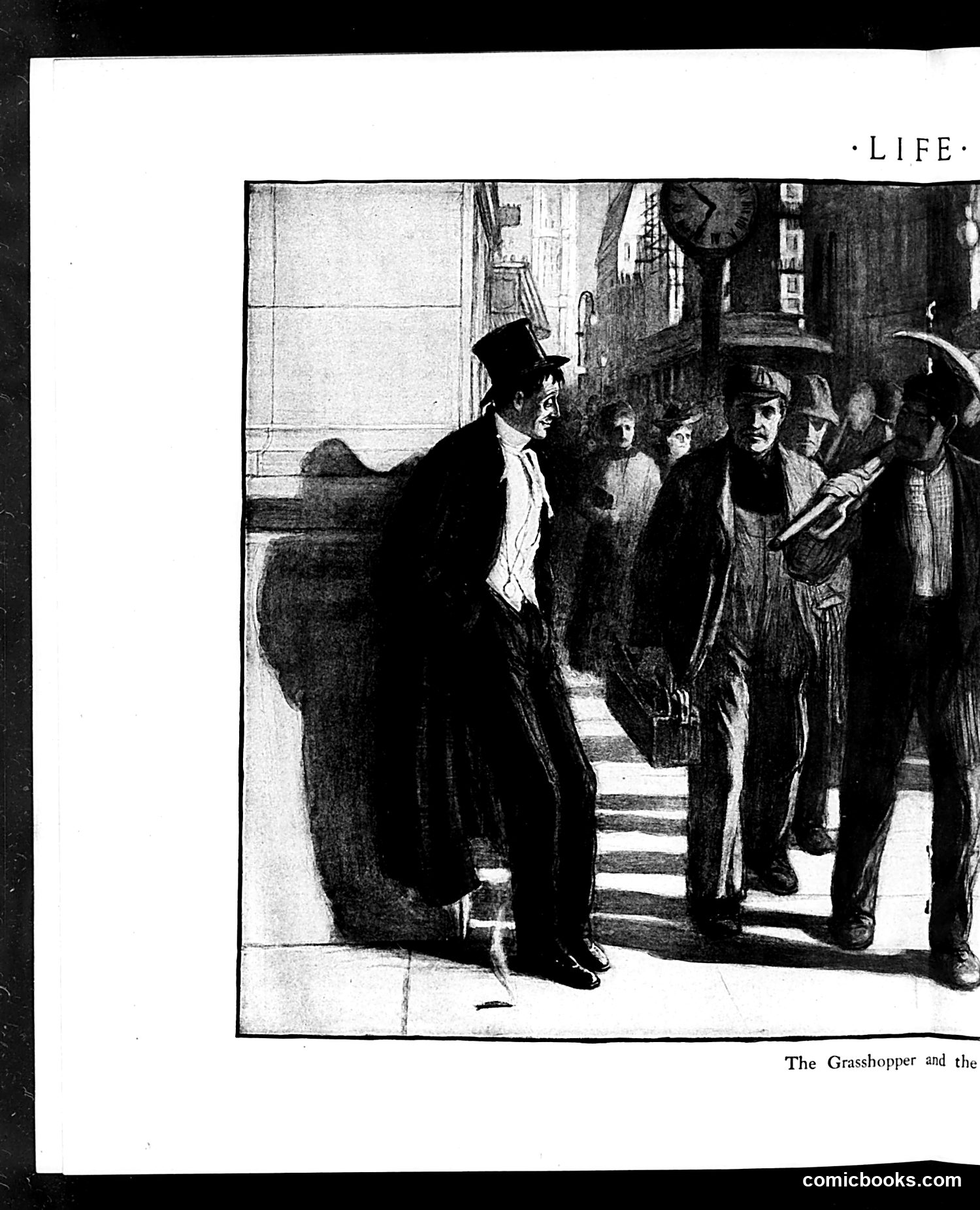
This appears to be an Aesop's Fable adaptation—likely "The Ant and the Grasshopper"—rendered as political satire. The image shows a well-dressed man (the Grasshopper, presumably) confronting a group of working-class figures in an urban alley setting. The traditional fable contrasts the grasshopper's idleness with the ant's industriousness. In this political cartoon version, the satire likely comments on class conflict, wealth inequality, or labor disputes—themes Life magazine frequently addressed. The Grasshopper appears to represent an idle wealthy person or capitalist, while the surrounding figures represent laborers or the working poor. The exact satirical point remains unclear without the complete caption and publication date.
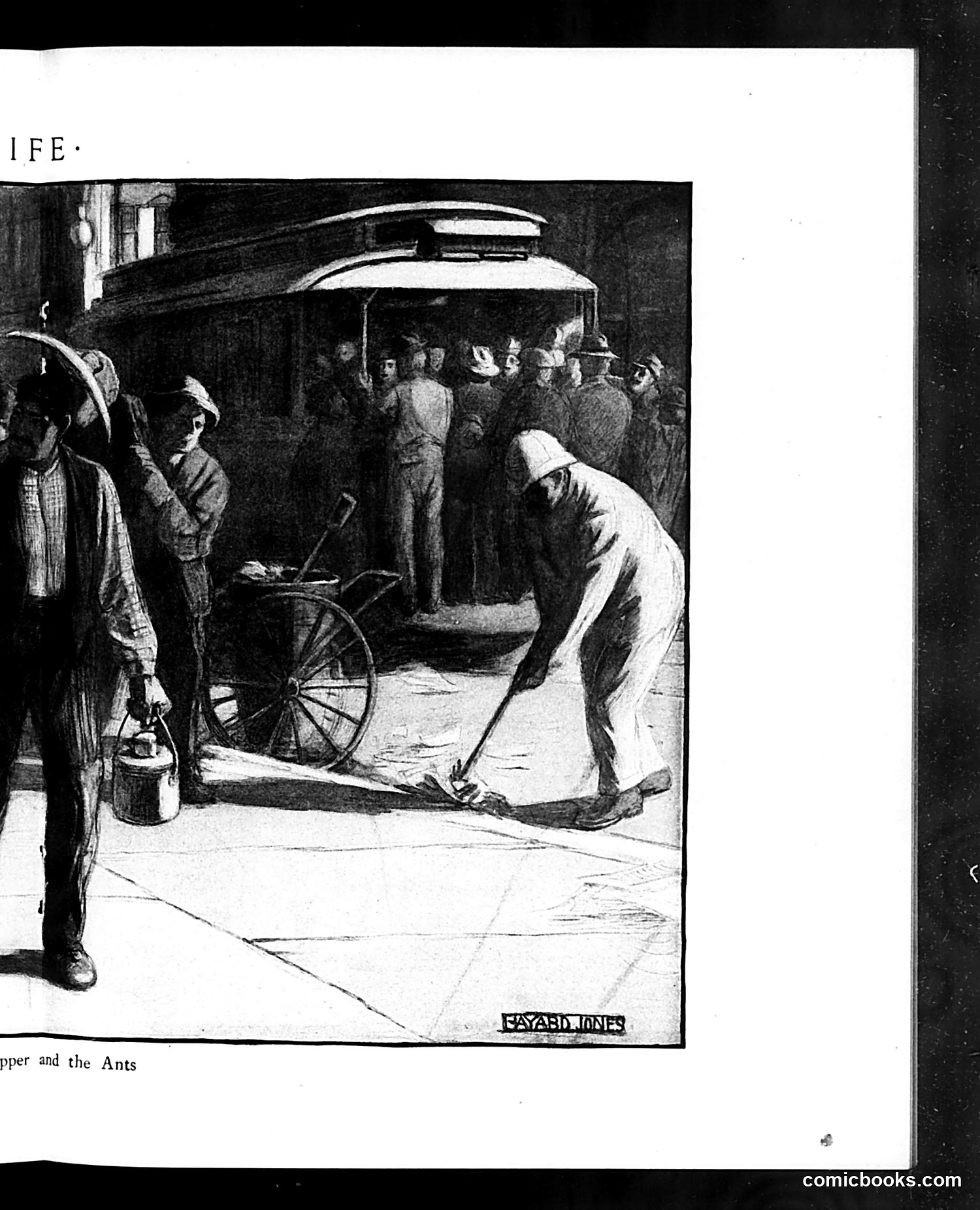
This appears to be an illustration titled "The Grasshopper and the Ants," referencing Aesop's classic fable. The scene depicts a street setting with a well-dressed man in white (the "grasshopper" figure) sweeping or working on pavement while onlookers and what appears to be a streetcar observe. The cartoon likely satirizes unemployment or economic hardship during a recession or depression era, using the fable's moral about idleness and poverty as social commentary. The contrast between the working poor man and the gathered crowd suggests commentary on public attitudes toward labor, poverty, or economic struggle. Without the full article text, the specific political target remains unclear, but the fable framework indicates critique of social inequality or work ethic themes.
This page is primarily a book review section titled "A Confab in Confidence." The opening uses a colloquial challenge to readers' curiosity ("Cross your heart! Honest, Injun!"), joking that they'd secretly peek at a scandalous book titled *The Girl That Goes Wrong* if left alone. The main review discusses Reginald Wright Kauffman's book of the same name—sixteen stories about poor women in urban slums. The reviewer praises Kauffman and his wife for living among the poor without pretense, neither as charity workers nor as outsiders, simply to understand their subjects authentically. The piece celebrates their work as honest sociological observation rather than sensationalist fiction. The review mocks the hypocrisy of "respectable" people who express curiosity about lower-class life but publicly condemn such interest as improper—comparing them to people returning from slumming tours with expressions conspicuously drained of genuine curiosity. The page concludes with capsule reviews of other contemporary books on various subjects (theater, bullfighting, exploration).
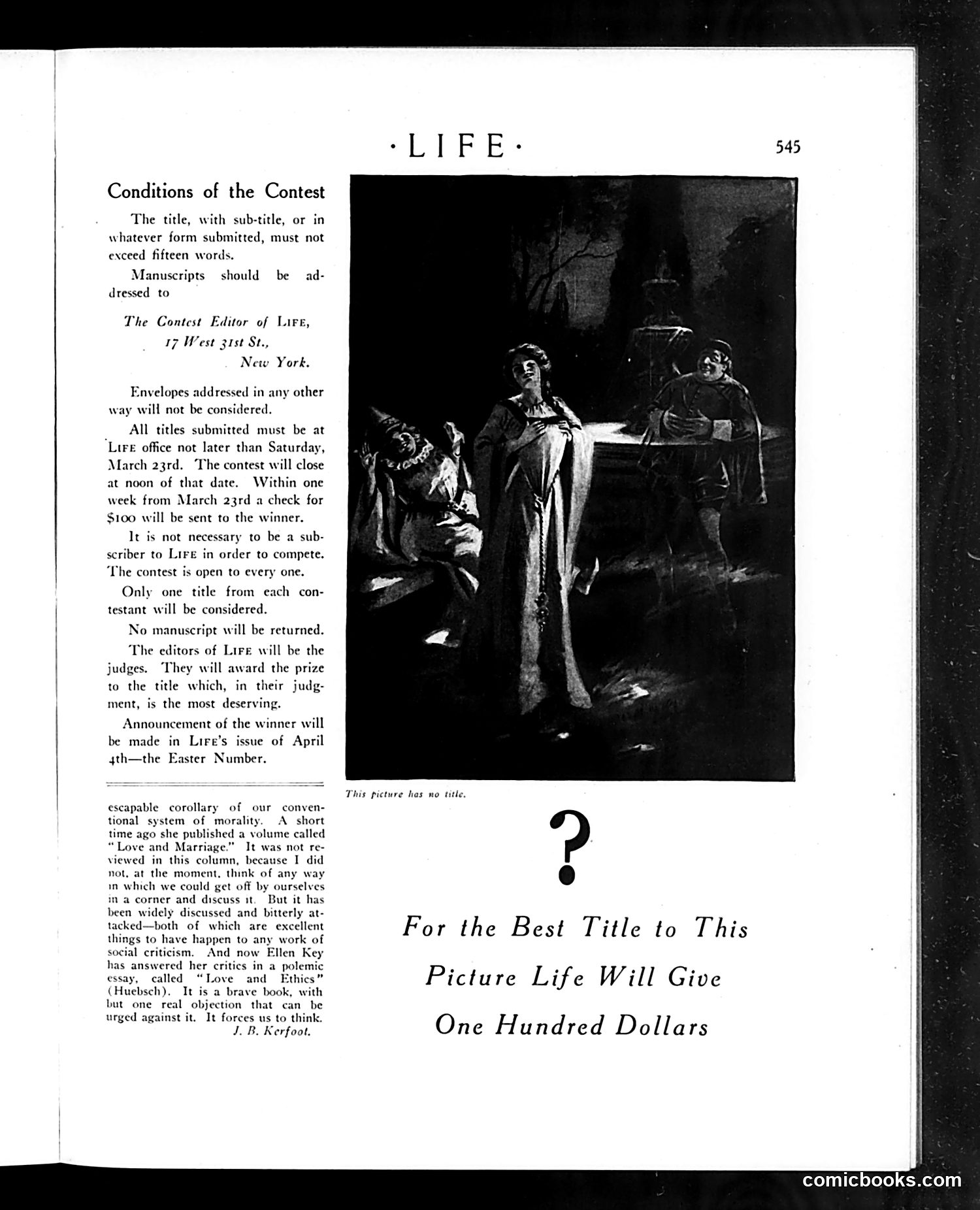
This page announces a **writing contest** rather than presenting a completed cartoon. Life magazine is soliciting reader submissions for the best title to accompany an untitled dramatic illustration showing what appears to be **figures in period costume in a theatrical or classical scene** — possibly depicting a historical or mythological moment. The contest rules are straightforward: submit a title in fifteen words or fewer by March 23rd to win $100. The page also includes **J.B. Kerfoot's book review** of Ellen Key's essay "Love and Ethics," which discusses morality and social criticism. The illustration itself remains mysterious without context — we cannot identify the specific scene or figures depicted, only that it appears serious and staged rather than comedic.
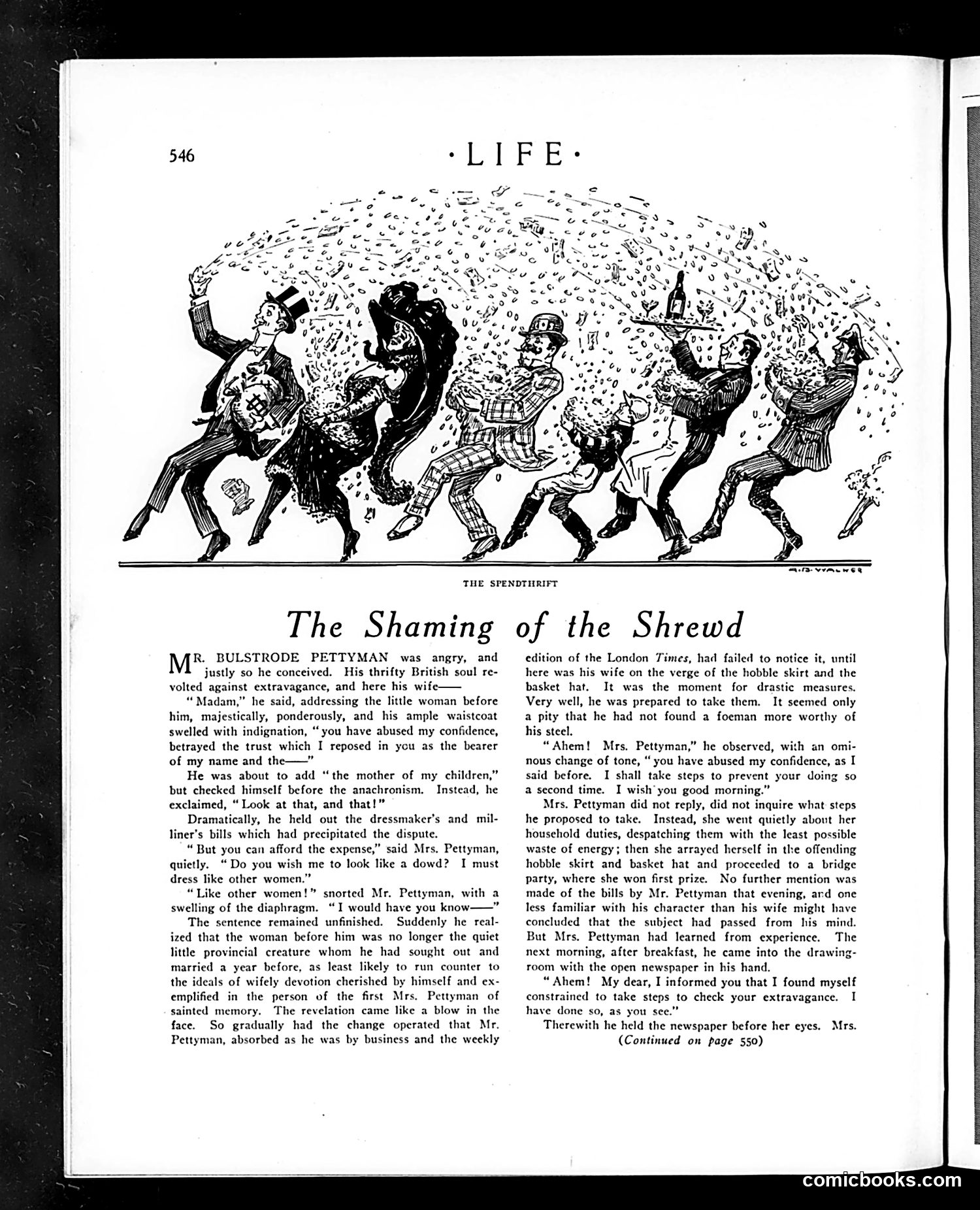
This satirical story mocks a self-righteous, penny-pinching husband (Mr. Bulstrode Pettyman) confronting his wife's spending on fashionable clothing—specifically the "hobble skirt" and elaborate hats then in vogue. The joke targets wealthy men who claim financial hardship while displaying obvious prosperity (his "ample waistcoat"). Pettyman threatens punishment but lacks actual leverage: his wife ignores his protests and attends a bridge party in her new outfit, winning first prize. The next morning, he attempts to shame her by displaying something in the newspaper—presumably a public notice or announcement meant to humiliate her socially. The satire reveals the absurdity of a husband's control tactics against a woman who simply refuses to be cowed. The cartoon above shows figures literally blown away by money, visualizing the theme of reckless spending. The story critiques both spousal domination and empty threats from men who cannot enforce compliance.
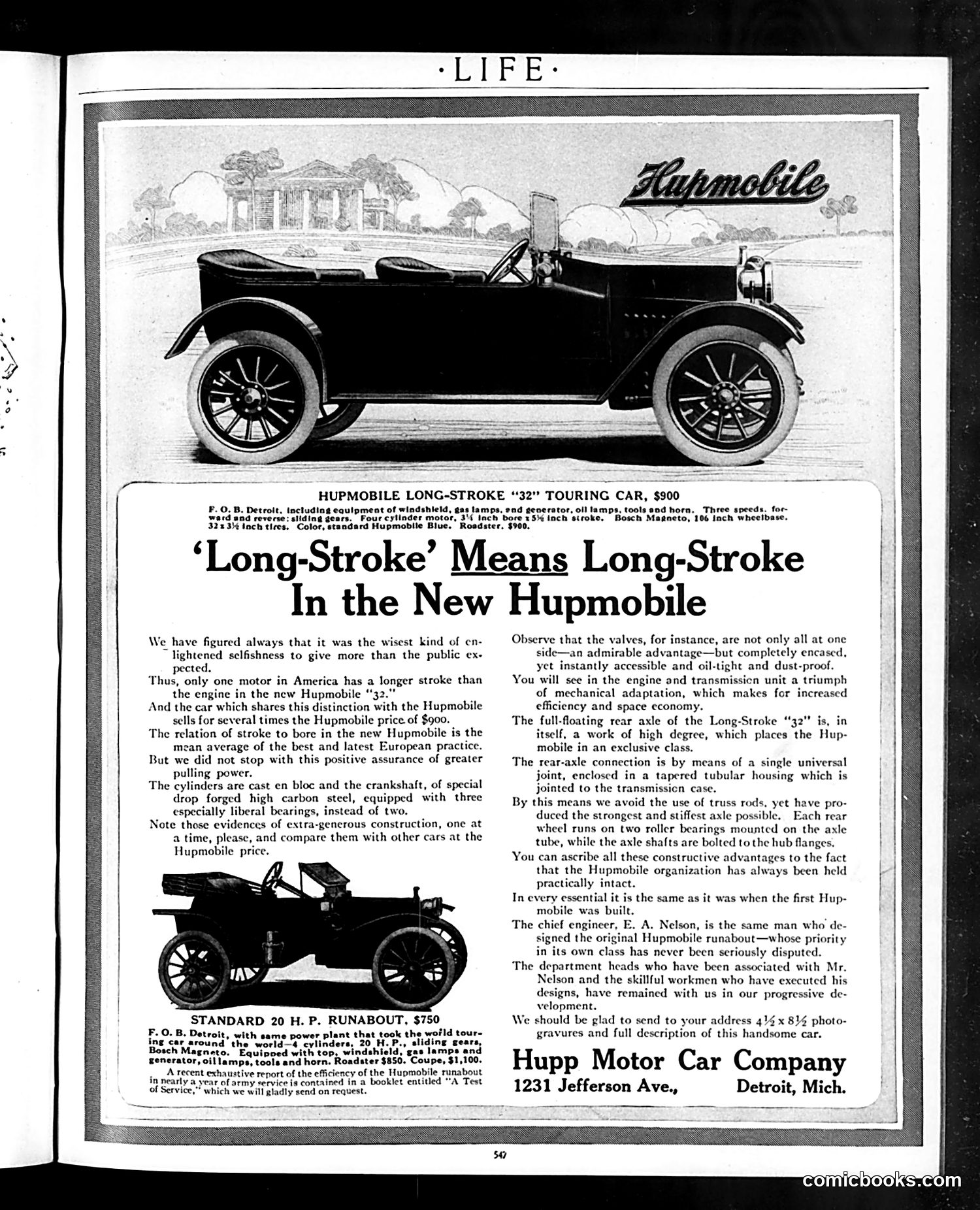
This is **not a cartoon or satire**—it's a straightforward automobile advertisement from Life magazine's early automotive era (likely 1910s-1920s). The page advertises the Hupmobile "32" touring car, priced at $900, manufactured by the Hupp Motor Car Company in Detroit. The ad employs technical specifications and engineering claims as its sales pitch, emphasizing the car's "long-stroke" engine design as superior to competitors. Key marketing points include: - Only one other American motor has a longer stroke (implying performance advantage) - European engineering standards at an affordable price - Superior construction details (enclosed valves, full-floating rear axle, roller bearings) - Organizational continuity—the original chief engineer and department heads still work there The advertisement appeals to buyers interested in mechanical innovation and value. There is no political or social satire present; this represents standard early-automotive marketing discourse emphasizing engineering sophistication to justify pricing.
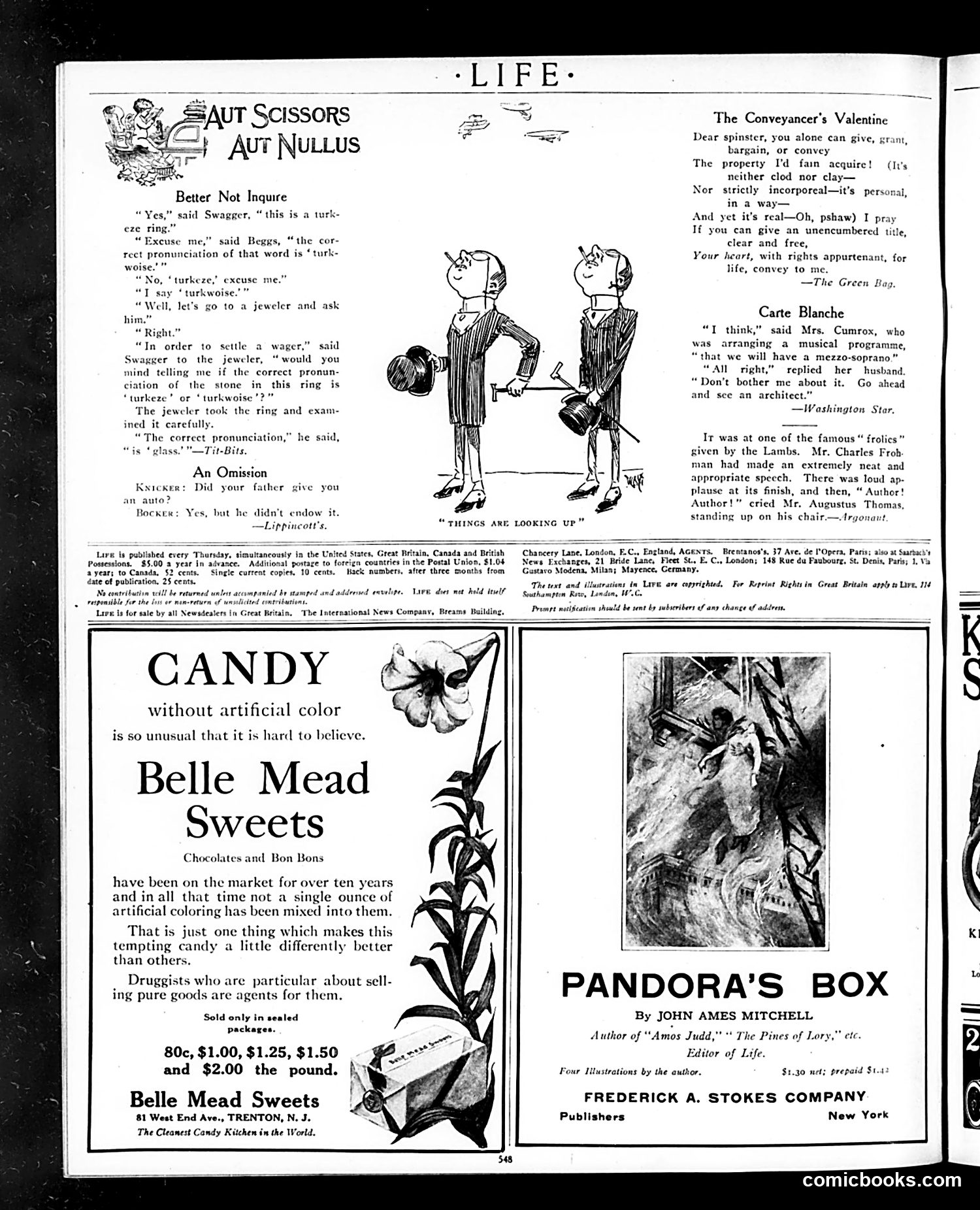
This page from *Life* magazine contains several short humorous pieces typical of early 20th-century American satire: **"Better Not Inquire"** mocks pedantic pronunciation disputes. Two characters argue whether a gemstone is called "turkeze" or "turkwoise," then ask a jeweler to settle it—who deflates their pretension by revealing it's actually "glass," making the entire argument pointless. **"An Omission"** jokes about a father's stinginess: he gave his son a car but didn't endow it (provide funds), a play on legal/financial terminology. **"The Conveyancer's Valentine"** uses legal property terminology as romantic metaphor—a lawyer proposes to a spinster using real-estate language ("convey," "unencumbered title"). **"Carte Blanche"** satirizes a husband's indifference to his wife's cultural decisions; he dismisses her musical program choice by telling her to consult an architect instead. The page also contains period advertisements for Belle Mead Sweets candy and a book announcement for *Pandora's Box*. The humor relies on wordplay, professional jargon, and social observation about marriage dynamics and pretension.
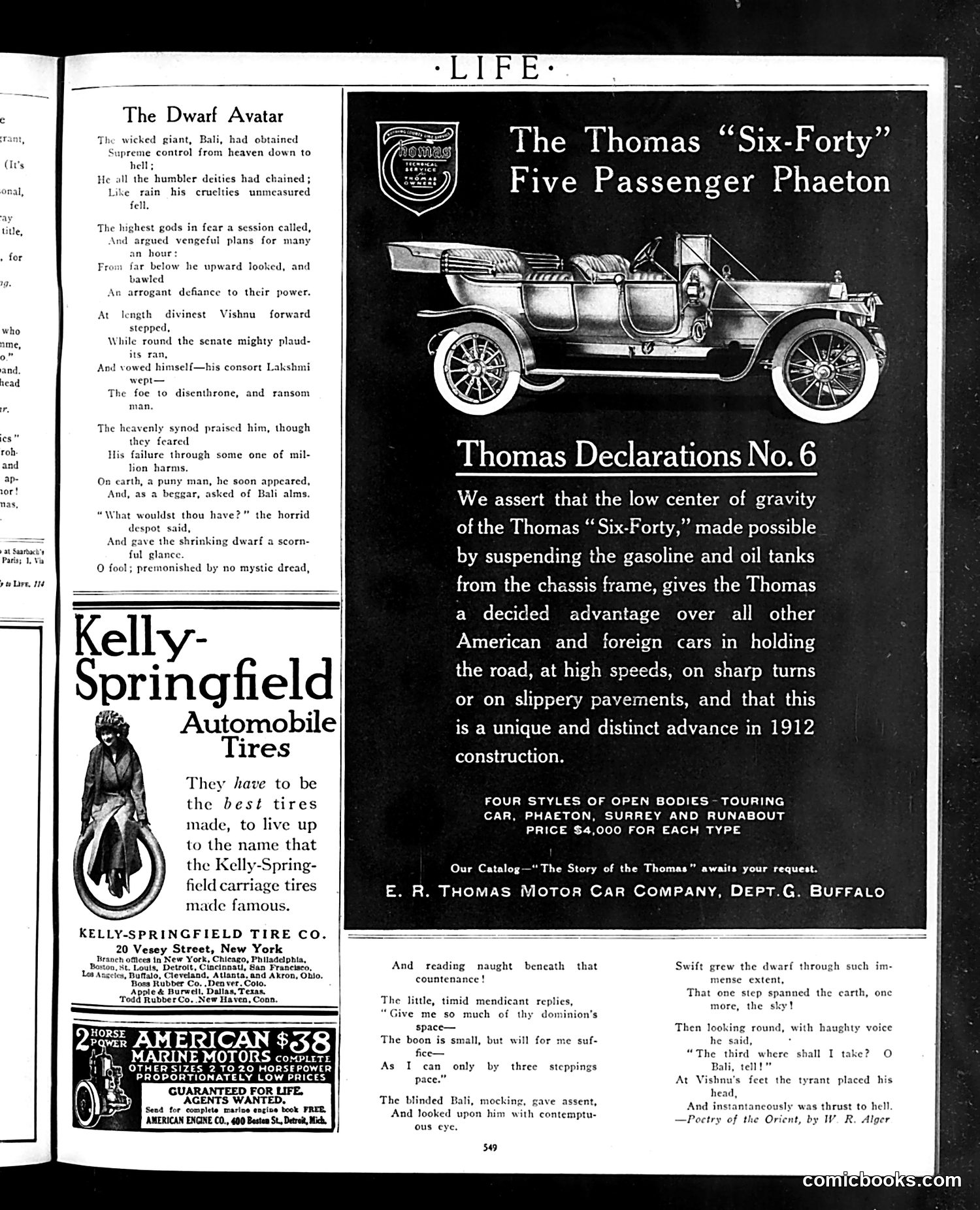
This page mixes literary content with period advertising. The left column presents "The Dwarf Avatar," a narrative poem retelling the Hindu myth of Vishnu's dwarf incarnation—a story where a seemingly powerless dwarf tricks a demon king into granting wishes, then uses three steps to span earth, sky, and underworld to vanquish him. The poem's moral—that humble appearance masks divine power—appears juxtaposed with vintage 1912 advertisements for Kelly-Springfield tires, American engines, and notably, the **Thomas "Six-Forty" automobile**. The Thomas ad's "Declaration No. 6" employs pseudo-scientific language to tout engineering superiority (low center of gravity), typical of early automotive marketing. The pairing suggests no deliberate satirical connection; rather, it reflects *Life* magazine's standard format: mixing serious literature with commercial content to attract diverse readers and advertisers, demonstrating the magazine's cultural range and advertising reach.
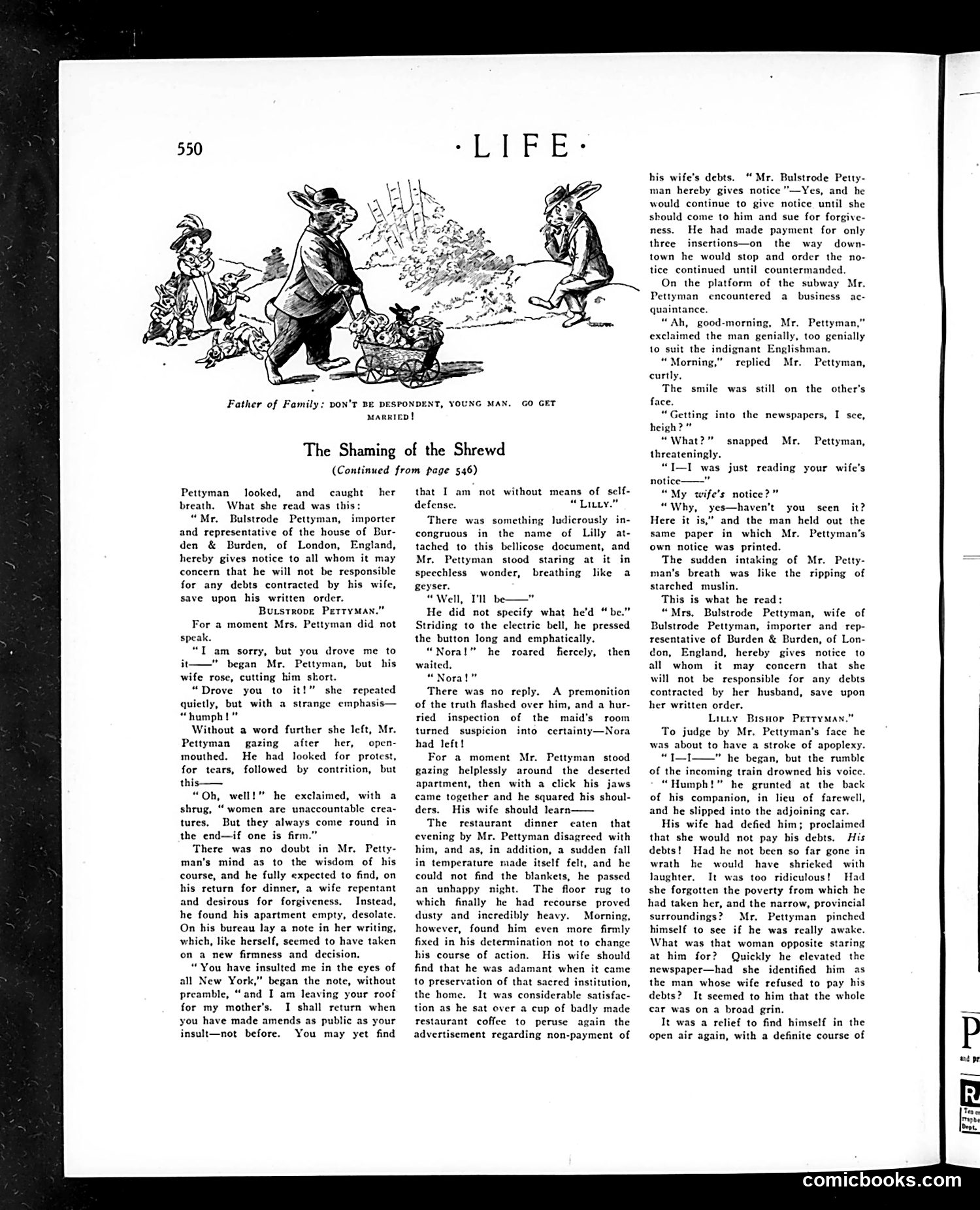
This story illustrates early 20th-century marital dynamics and legal vulnerability. Mr. Bulstrode Pettyman, an English importer, publishes a notice in newspapers denying financial responsibility for his wife's debts—a legal protection available to husbands but a public humiliation for her. His wife "Lilly" responds by leaving him and demanding public apology, demonstrating she possesses her own agency and resources (she has a mother to stay with, can direct the maid to leave). The satire mocks Pettyman's assumption that his "firmness" will force her submission. Instead, his cold authoritarianism backfires: he endures discomfort alone (no blankets, bad coffee, an empty home) while she escapes. The cartoon at top shows a father lecturing his children—visually reinforcing the story's theme that male authority figures, convinced of their righteous control, often provoke rebellion rather than obedience.
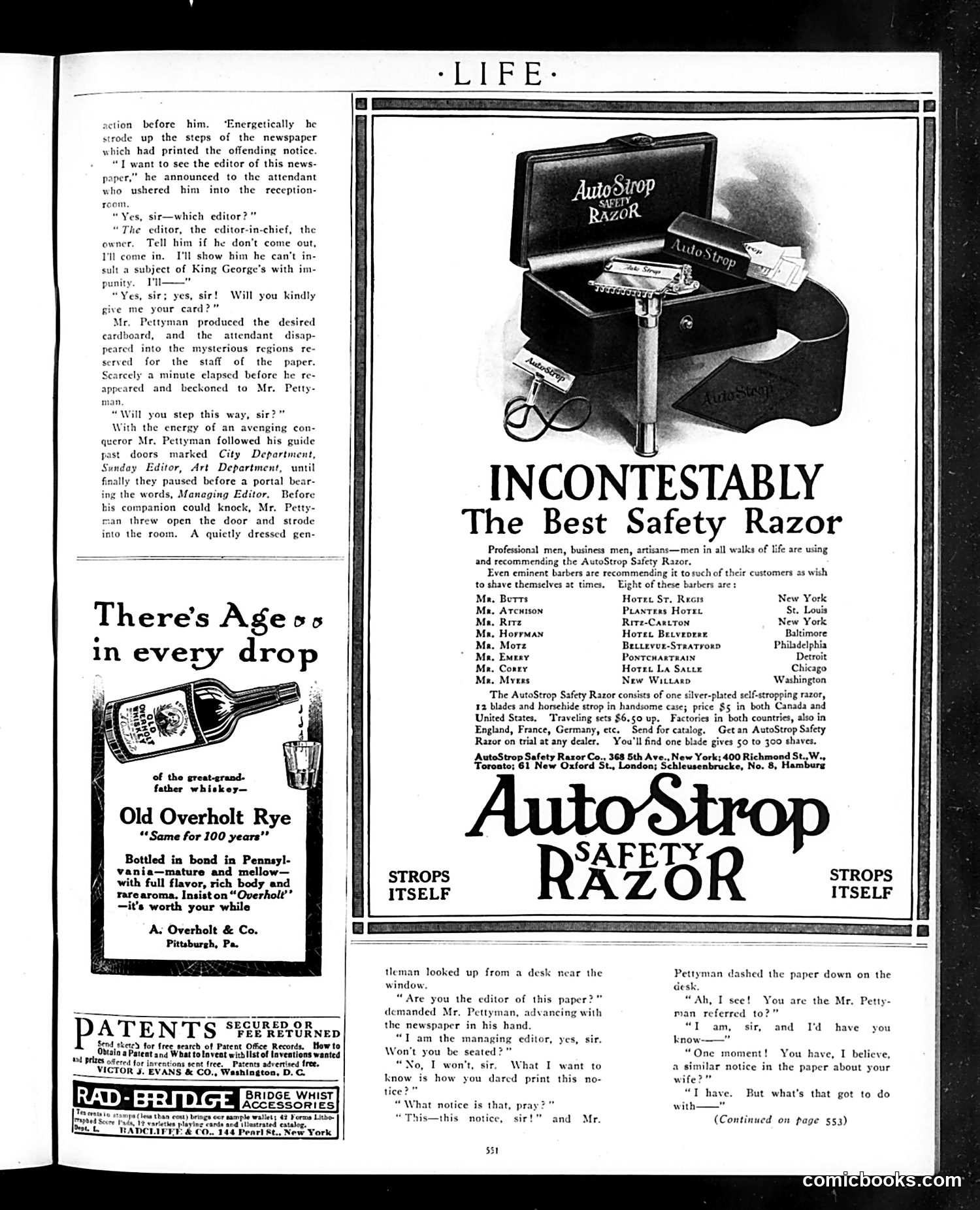
This page contains a serialized story about Mr. Pettyman, who angrily confronts a newspaper's managing editor over an insulting notice published about him. The narrative—visible in the text fragments—shows Pettyman demanding to see the editor, claiming the paper has insulted "a subject of King George" with impunity. The story appears humorous, likely depicting a British character's outraged indignation over some perceived affront. The page is dominated by **advertisements**: an AutoStrop Safety Razor ad (featuring the product's case and accessories), Old Overholt Rye whiskey, patent services, and bridge game accessories. These ads reflect early 20th-century consumer products targeted at professional men. The satire or joke of the *story itself* isn't fully clear from this excerpt alone, though Pettyman's pompous, theatrical outrage suggests comedic exaggeration of wounded pride.
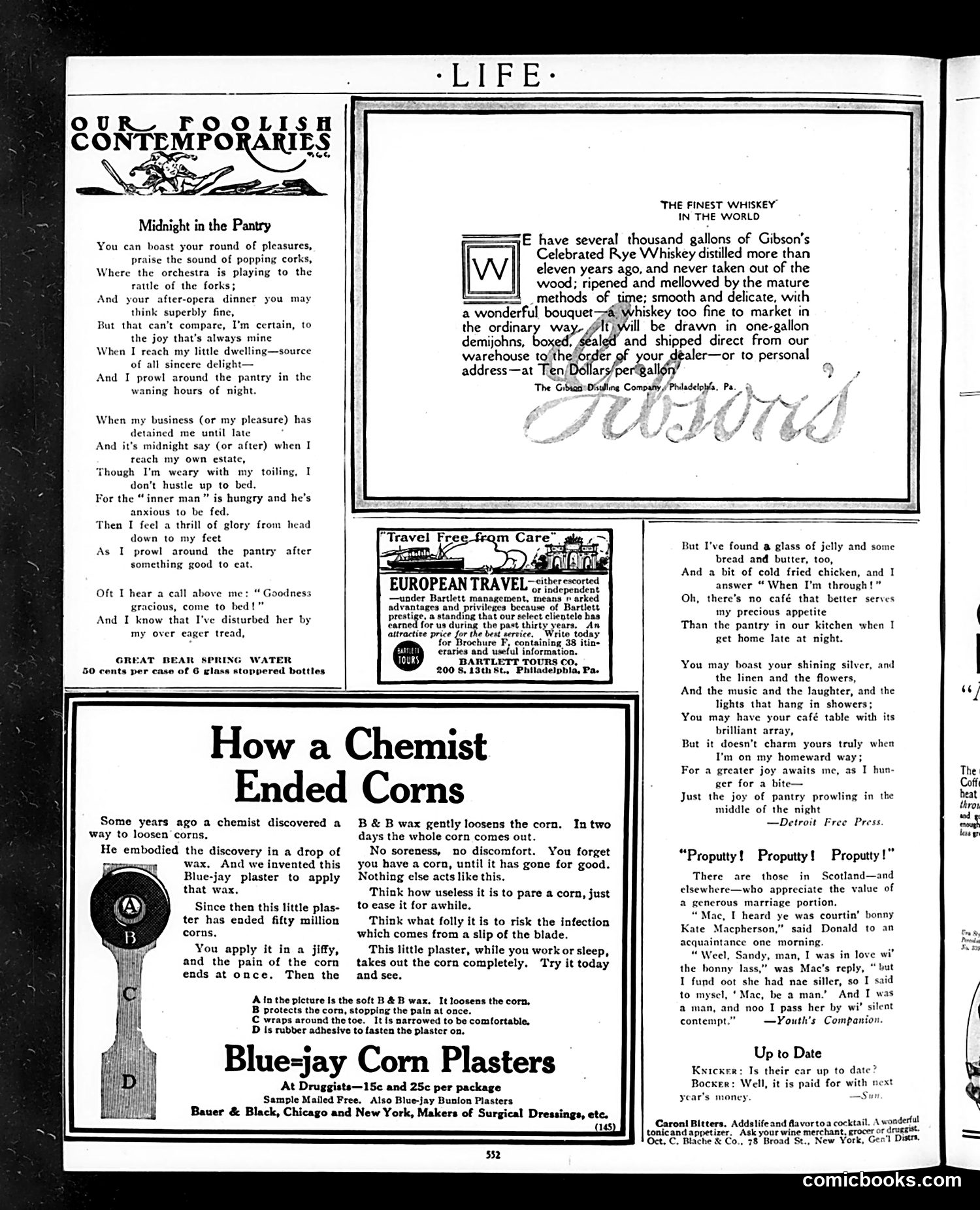
This page is primarily **advertising** interspersed with light satirical poetry and humor typical of early 20th-century Life magazine. The main content includes: **"Midnight in the Pantry"** — A humorous poem about a man returning home late who sneaks to the kitchen pantry for food and drink rather than going to bed, disturbing his wife. This reflects period class anxieties: the poem celebrates the "common man's" simple pleasure (pantry snacking) as superior to fancy restaurant dining or opera—a gentle jab at pretentious upper-class entertainments. **Advertisements dominate**: Gibson's Rye Whiskey, European travel tours, Great Bear spring water, and Blue-jay Corn Plasters occupy substantial space. **"How a Chemist Ended Corns"** is an advertorial presenting the origin story of Blue-jay plasters, framed as a medical discovery rather than pure marketing. The **"Proppy! Proppy!"** section appears to be humorous reader submissions about courtship and marriage. There are **no political cartoons** on this page—it's primarily consumer advertising aimed at middle-class readers, with light domestic humor as filler content.
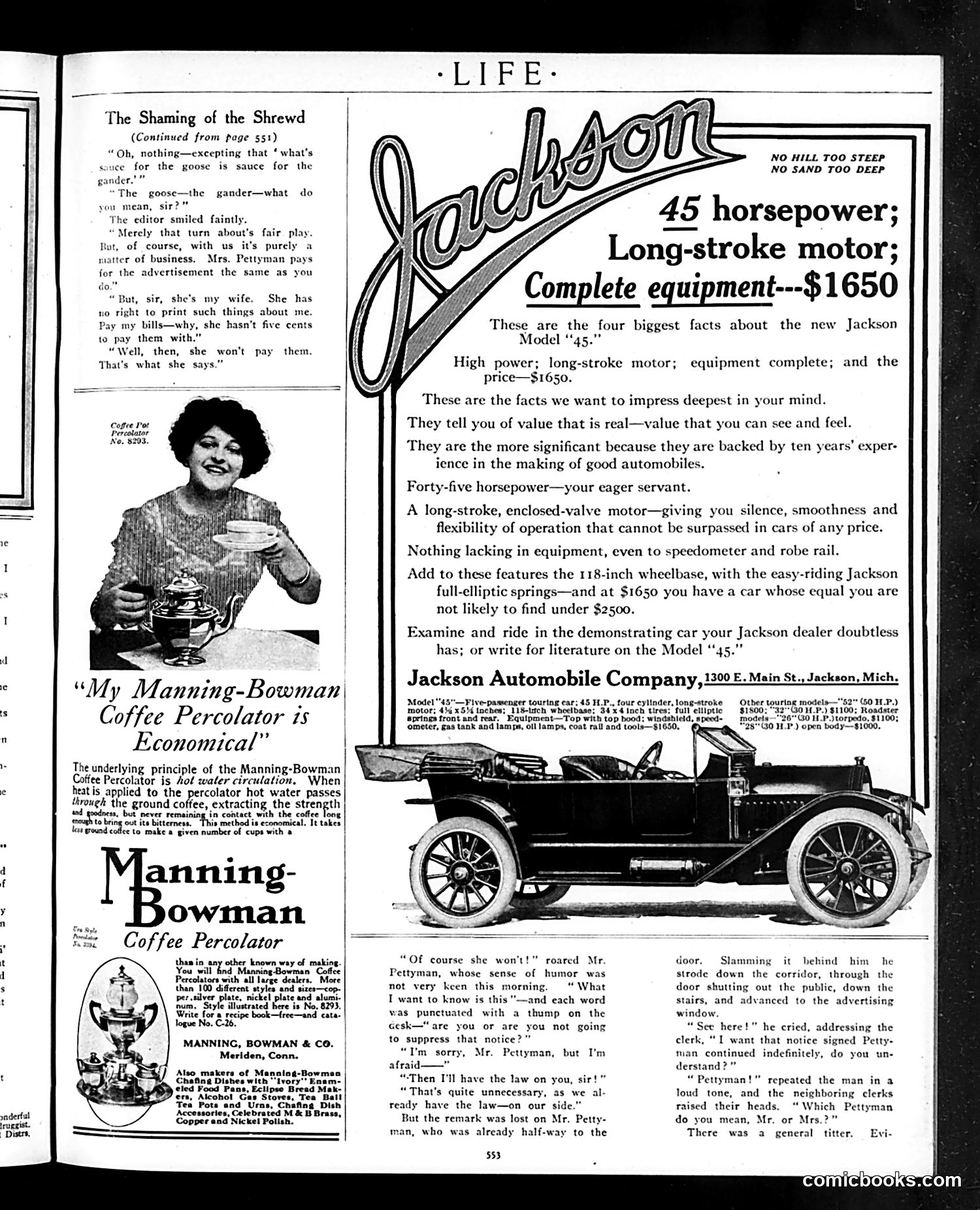
This page contains **two distinct sections**: a serialized story ("The Shaming of the Shrewd," continued from page 551) and commercial advertisements. **The Story**: The narrative depicts a confrontation between Mr. Pettyman and a clerk regarding a published advertisement. Pettyman, apparently a businessman who paid for an ad, discovers his wife placed a competing notice without his knowledge. His angry demand to suppress it is deflected by the clerk citing legal precedent ("we already have the law—on our side"), resulting in humiliation when multiple clerks of different surnames respond to his name, triggering mocking laughter. The satire targets a husband's loss of domestic control and business authority. **The Advertisements**: Jackson Automobile Company touts a Model "45" at $1,650 with 45 horsepower and long-stroke motor; Manning-Bowman Coffee Percolator emphasizes economical operation through hot-water circulation. The page exemplifies early 20th-century *Life* magazine's blend of domestic satire and consumer advertising.
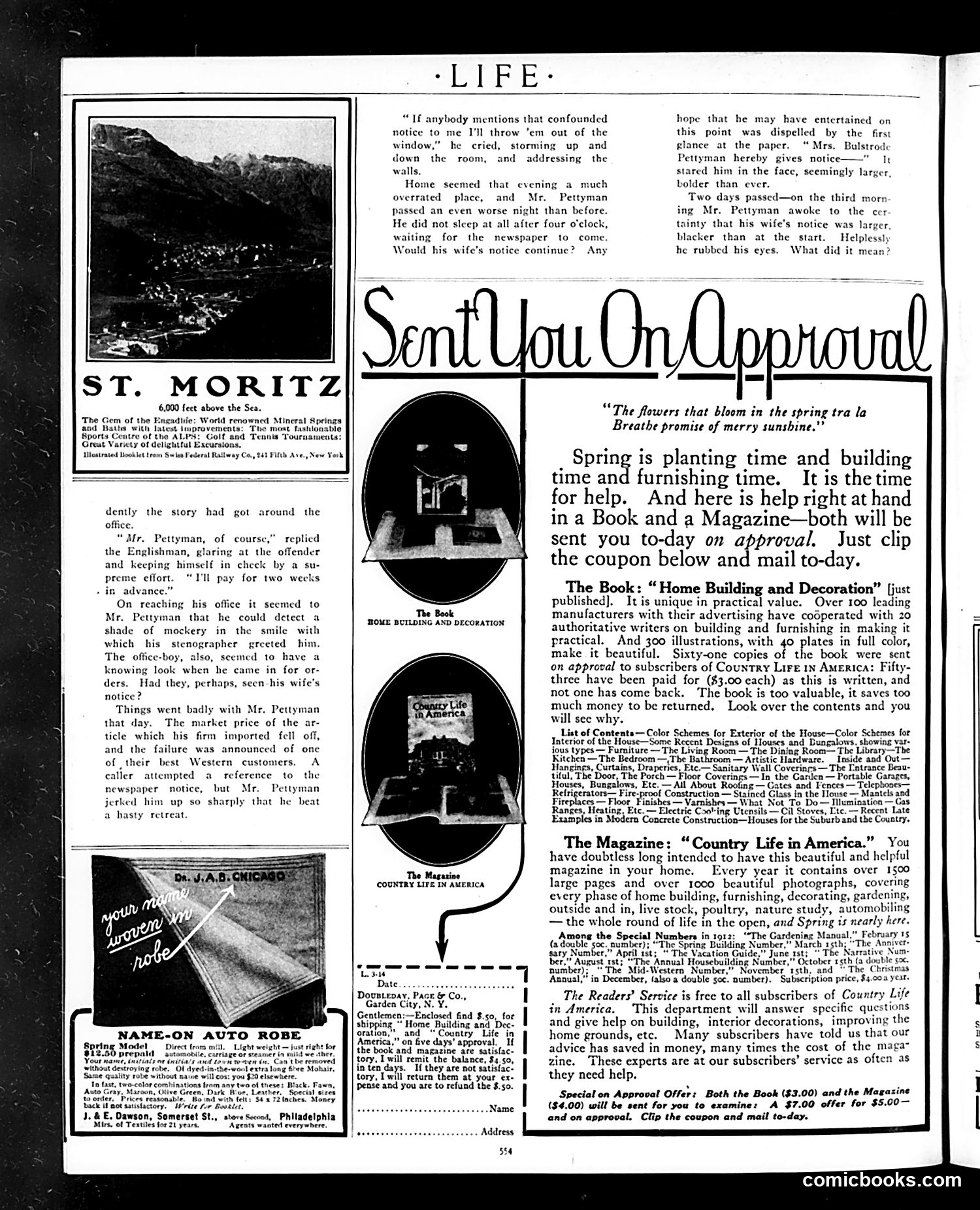
This page primarily contains **advertising and promotional content** rather than political satire. The main elements are: **The Story Excerpt** (top): A serialized narrative about Mr. Pettyman, whose wife has published a public notice in the newspaper—apparently about marital discord. The story satirizes **middle-class social embarrassment**: Pettyman is mortified that his private domestic trouble has become public gossip at his office, where employees now regard him with knowing mockery. The humor derives from Victorian-era anxieties about reputation and the shame of aired marital problems. **The Central Advertisement**: A large promotional push for two products—"Home Building and Decoration" (a book) and "Country Life in America" (a magazine)—sent on approval to readers. **Side Advertisements**: Including a St. Moritz travel ad and an auto robe advertisement. The page reflects **early 20th-century consumer culture** targeting middle-class homeowners interested in self-improvement through publications.
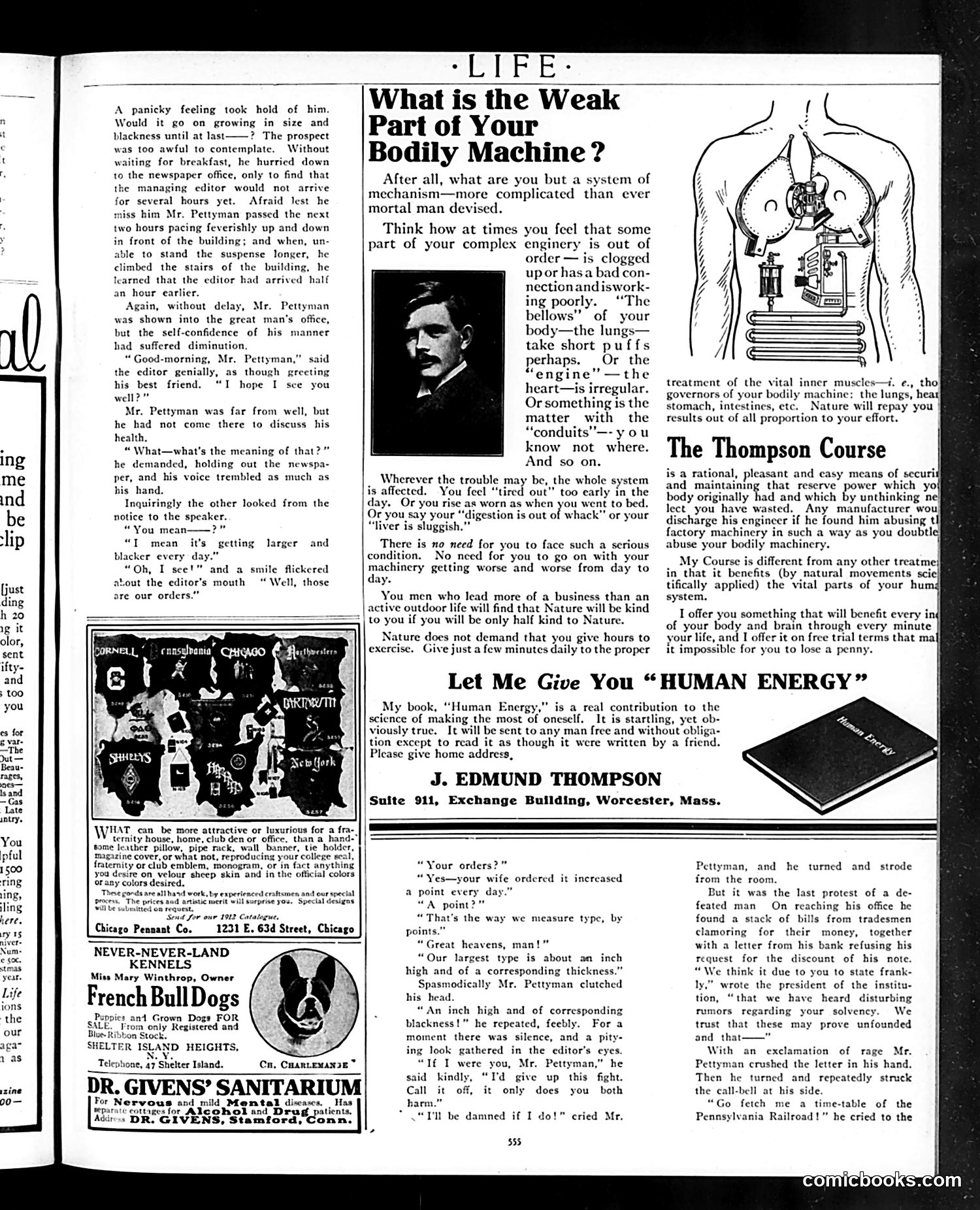
This page combines a serialized fiction excerpt with health-promotion advertising. The main narrative (left side) depicts Mr. Pettyman, apparently a businessman anxious about a growing "notice" in the newspaper—likely referring to some public embarrassment or scandal that's expanding in visibility and severity. The larger advertisement (center-right) by Edmund Thomson promotes "Human Energy," a self-help course comparing the human body to mechanical machinery requiring proper maintenance. This reflects early 20th-century mechanistic health philosophy, where the body's "engines" (lungs, heart, liver) needed scientific management and exercise. The surrounding ads (French bulldogs, leather goods, dental treatments) are typical period magazine content. **The satire**: Pettyman's panic over his newspaper "notice" mirrors the advertisement's anxiety about bodily neglect—both suggest modern anxieties about visibility, decline, and the need for corrective action through proper "management." The juxtaposition humorously equates personal reputation with physical health as mechanical systems requiring constant oversight.
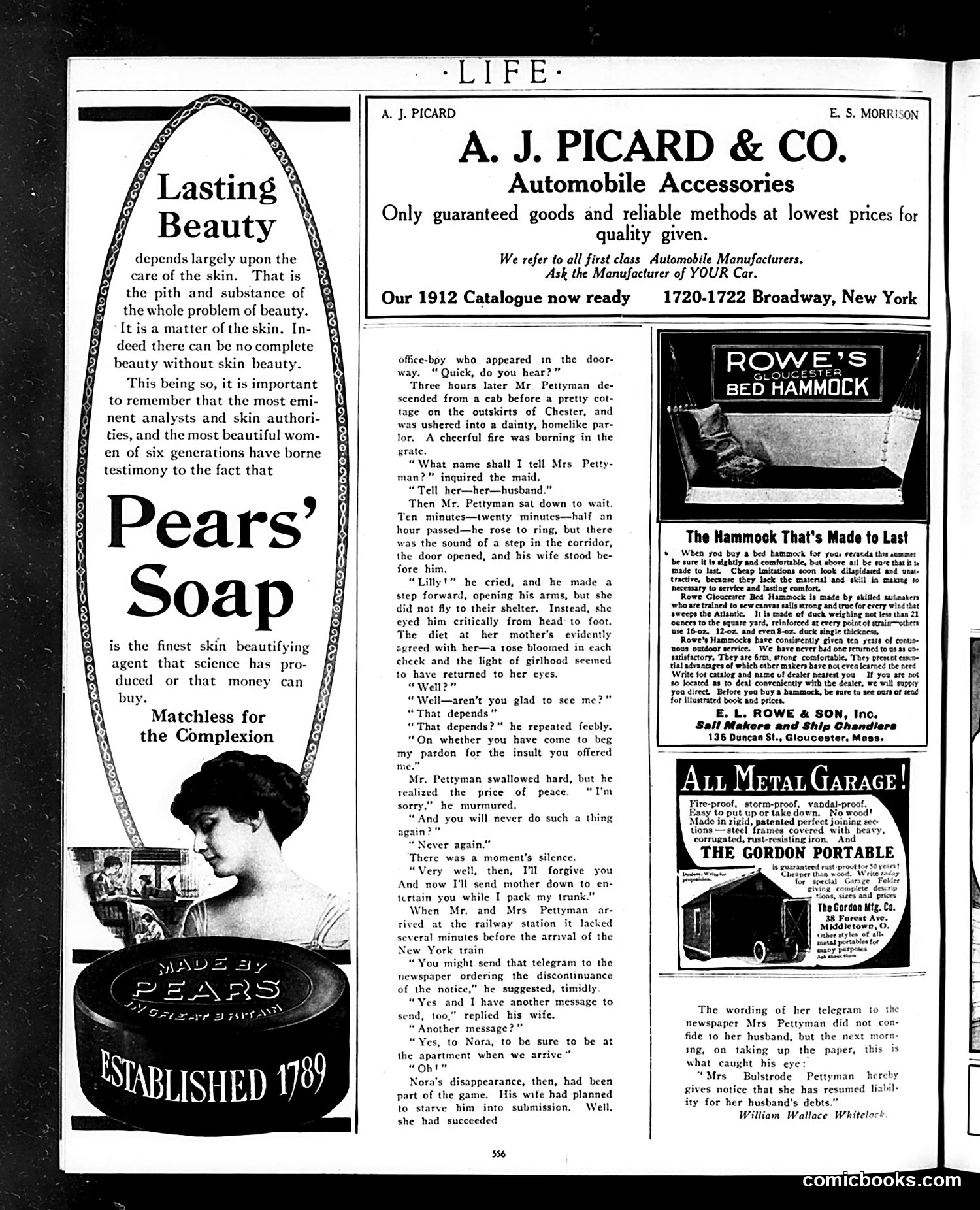
This page is primarily **advertisements and fiction**, not political satire. **Left side:** A Pears' Soap ad emphasizing skin care and beauty, established 1789. **Center:** A serialized short story about Mr. Pettyman, a husband who insulted his wife and was "starved into submission" when she left him. She planned his deprivation by disappearing, forcing him to apologize. The narrative satirizes **marital dynamics and domestic power struggles** — specifically, a wife using separation as leverage to discipline her husband into compliance. **Right side:** Advertisements for automobile accessories (A.J. Picard & Co.), Rowe's Gloucester Bed Hammock, and an all-metal garage. The story's satire reflects early 20th-century attitudes about marriage, gender relations, and domestic authority — showing wives as cunning strategists capable of controlling stubborn husbands through calculated absence rather than direct confrontation. It's lighthearted domestic comedy aimed at *Life* magazine's middle-class readership.
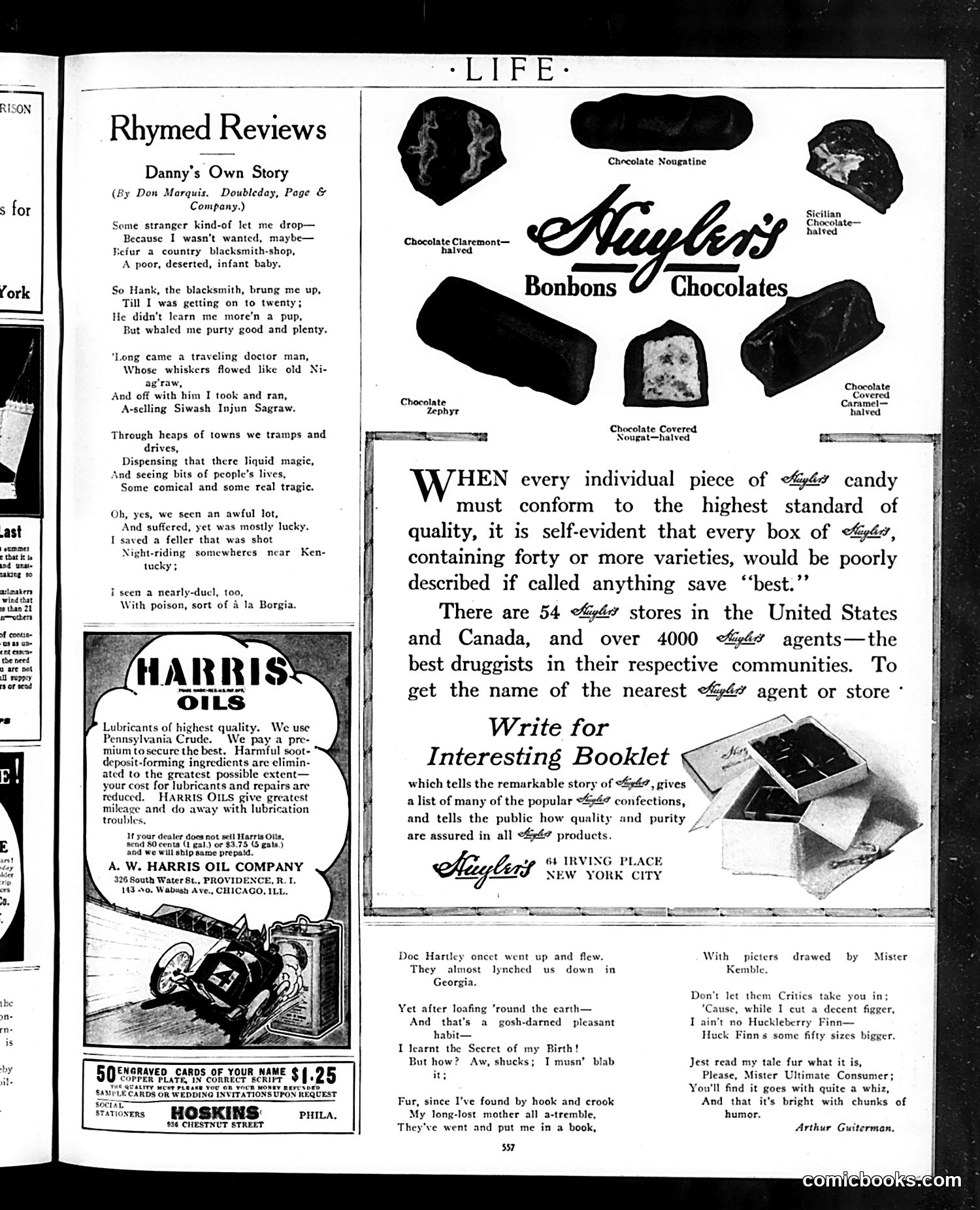
This page contains a **book review in verse** rather than a political cartoon. Don Marquis's *Danny's Own Story* is reviewed in rhymed couplets by Arthur Guiterman, mocking the sentimental orphan-to-adventure narrative typical of early 20th-century popular fiction. The reviewer satirizes the melodramatic plot—abandoned baby, rough upbringing, traveling with a medicine man, picaresque adventures—as overwrought sentimentality. The humor lies in Guiterman's deliberately crude doggerel verse and his closing self-aware joke: the book is illustrated by Mister Kemble, but Guiterman admits he himself "ain't no Huckleberry Finn" in appearance, making the comparison ridiculous. He defensively urges readers to enjoy the story anyway. The surrounding ads (Harris Oils, Skyler's Chocolates, Hoskins Stationery) are typical Life magazine commercial content from this era.
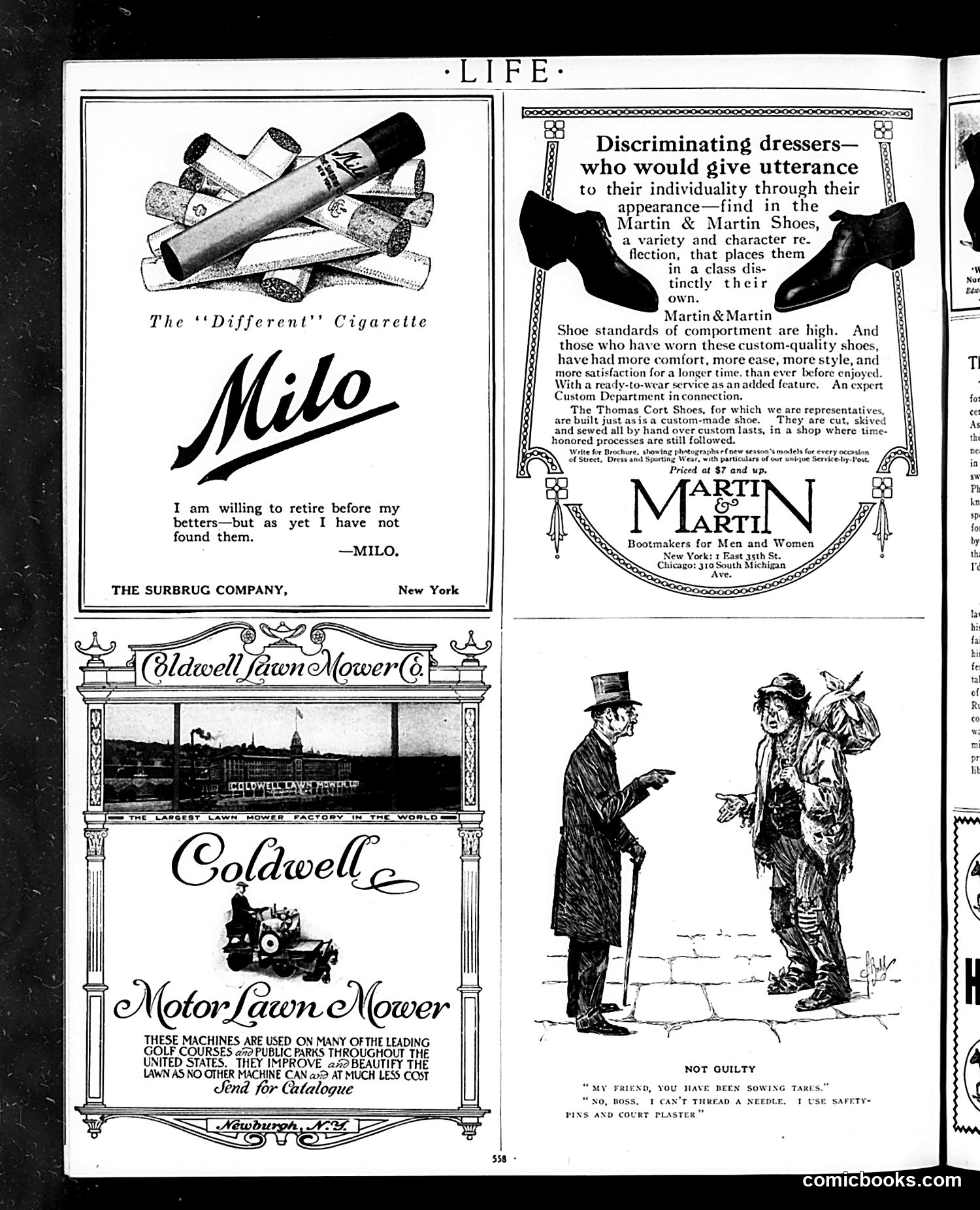
This page is primarily **advertisements** with one cartoon at the bottom. The cartoon titled "NOT GUILTY" depicts two men—one appearing to be working-class or rural (holding a scythe), the other better-dressed—in conversation. The rural figure claims he "can't thread a needle" and uses "safety-pins and court plaster" instead, responding to an accusation about "sowing tares" (weeds). The joke appears to satirize **class assumptions about competence**: the working man is accused of spreading corruption or problems ("sewing tares"), but deflects by claiming incompetence at fine, delicate work—implying only the educated could be responsible for such deliberate wrongdoing. It's a humorous commentary on how people might evade blame through feigned ignorance. The surrounding advertisements promote luxury goods (Milo cigarettes, Martin & Martin custom shoes, Coldwell lawn mowers)—products marketed to distinguish the wearer/user as refined and individualistic, which contrasts ironically with the cartoon's working-class character below.
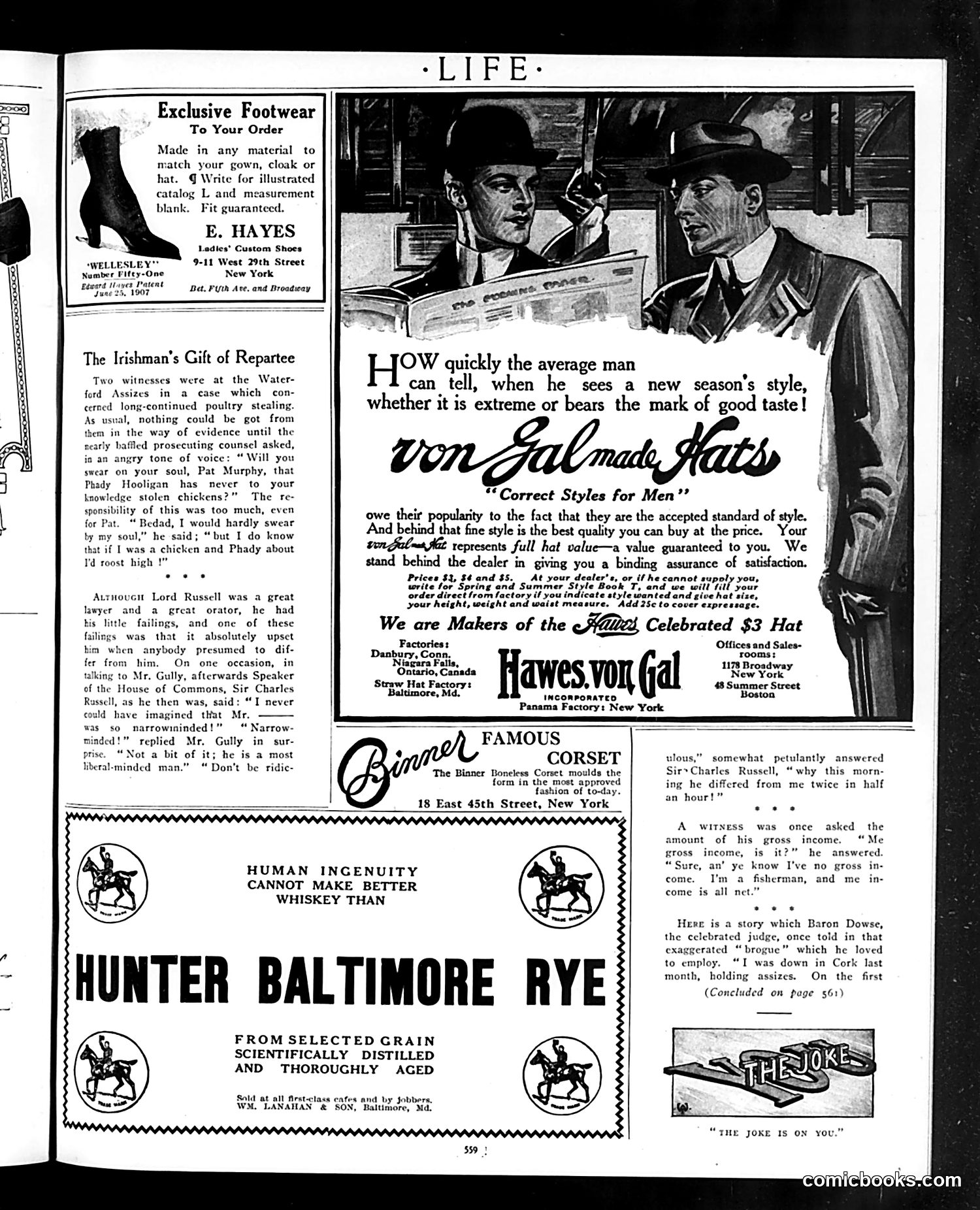
This page is primarily **advertising**, with three short anecdotes about Irish characters positioned as filler content—a common magazine format of the era. The featured content includes: **Von Gal Made Hats advertisement**: The large central image shows two men examining a newspaper, with copy emphasizing that quality hats reveal a man's taste and judgment. This was a major selling point in an era when hats were essential fashion items. **Three Irish Anecdotes**: Scattered throughout are brief comic stories featuring Irish characters (Pat Murphy, Paddy Hooligan, Sir Charles Russell, Baron Dowse). These rely on stereotyped "Irish brogue" humor and clever wordplay—popular entertainment of the era. The humor centers on wit overcoming social hierarchy or poking fun at Irish speech patterns and logic. **Supporting advertisements**: for footwear (E. Hayes), corsets (Binmer), and Hunter Baltimore Rye whiskey. The page reflects early 20th-century attitudes: casual ethnic stereotyping was standard magazine fare, while the hat advertisement represents period concerns about masculine presentation and social status.
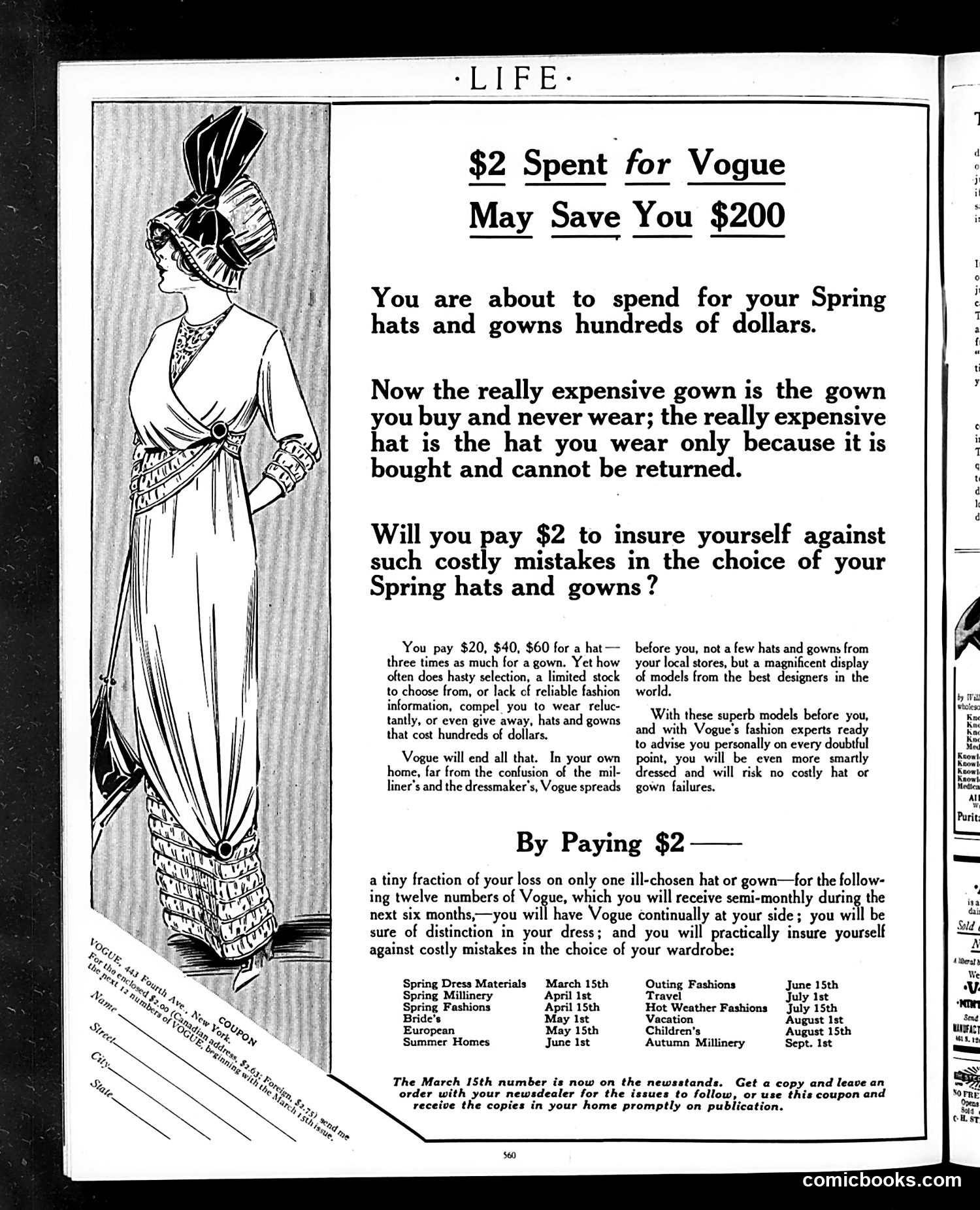
This is primarily a **Vogue magazine advertisement** rather than political satire. The page promotes a $2 subscription to Vogue by appealing to wealthy women's fashion anxieties. The illustration shows an elegantly dressed woman in high fashion, establishing aspirational context. The ad's argument is straightforward: women spend hundreds on spring clothing but often waste money on poorly-chosen items they never wear. For just $2, a Vogue subscription supposedly prevents these costly mistakes by providing expert fashion guidance and access to models from top designers—essentially "insuring" against bad purchases. The satire is subtle and self-aware: the ad acknowledges that the most expensive purchases are often those never worn, then sells a magazine subscription as the rational solution. It exploits female consumer anxiety about fashion choices while positioning Vogue as authoritative arbiter of taste—a common advertising strategy of the era for affluent readers. The specific issue listings (Spring Fashions, Bride's, European, Summer Homes, etc.) target upper-class concerns and seasonal interests.
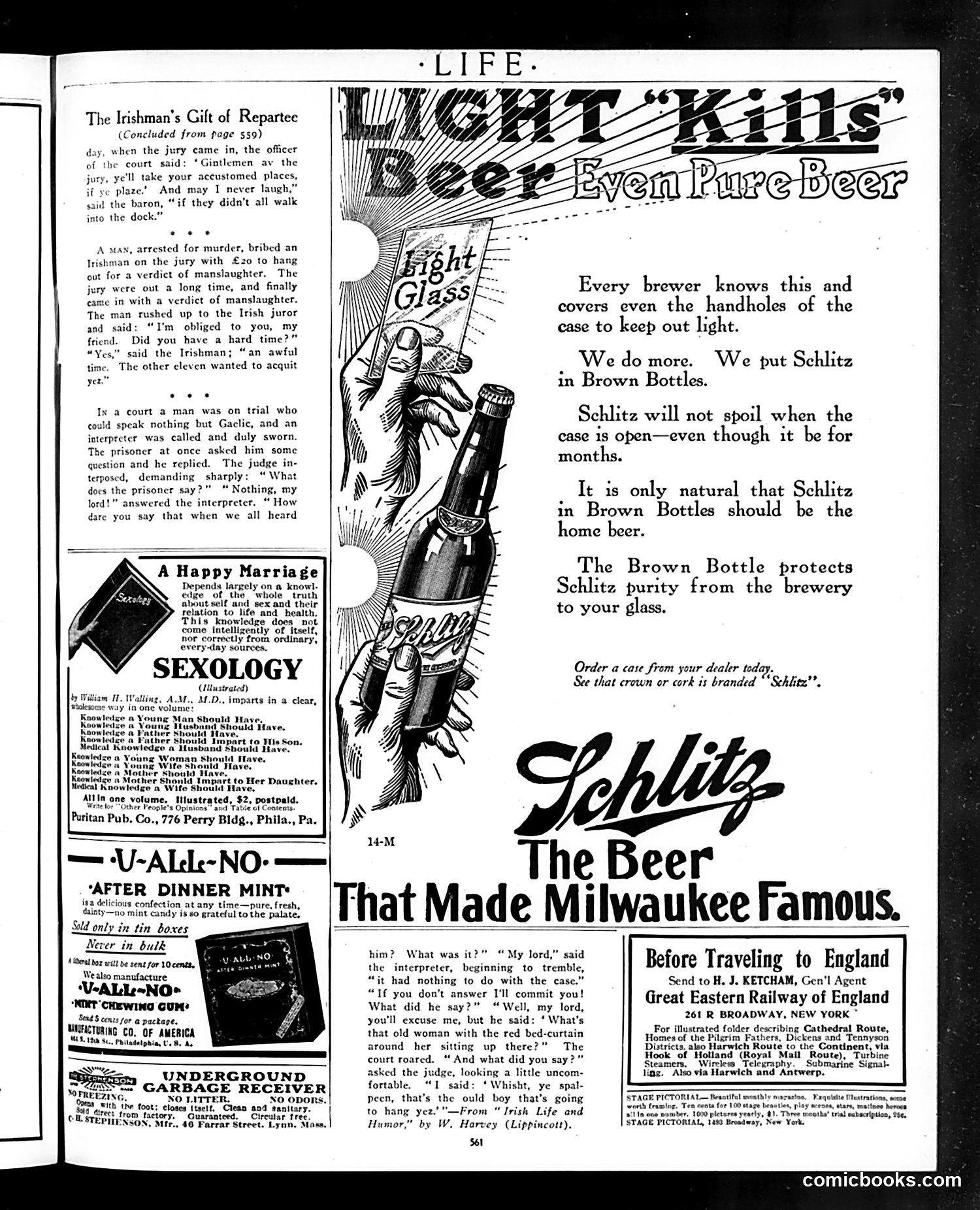
This page contains three Irish legal anecdotes emphasizing quick wit and verbal cleverness—a stereotype of Irish culture common in early 20th-century American humor. **The three jokes:** 1. Jurors walk into the defendant's dock instead of the jury box 2. A bribed juror holds out for manslaughter when others want acquittal 3. A Gaelic-speaking defendant's interpreter refuses to translate, saying it's irrelevant to the case Each relies on the "clever Irishman" trope popular in *Life* magazine's satirical humor of this era. The satire targets both Irish stereotypes and the legal system's absurdities. **The advertisements** (Schlitz beer, Sexology book, travel services) are unrelated editorial content typical of magazine layouts from this period and don't connect to the cartoons' themes.
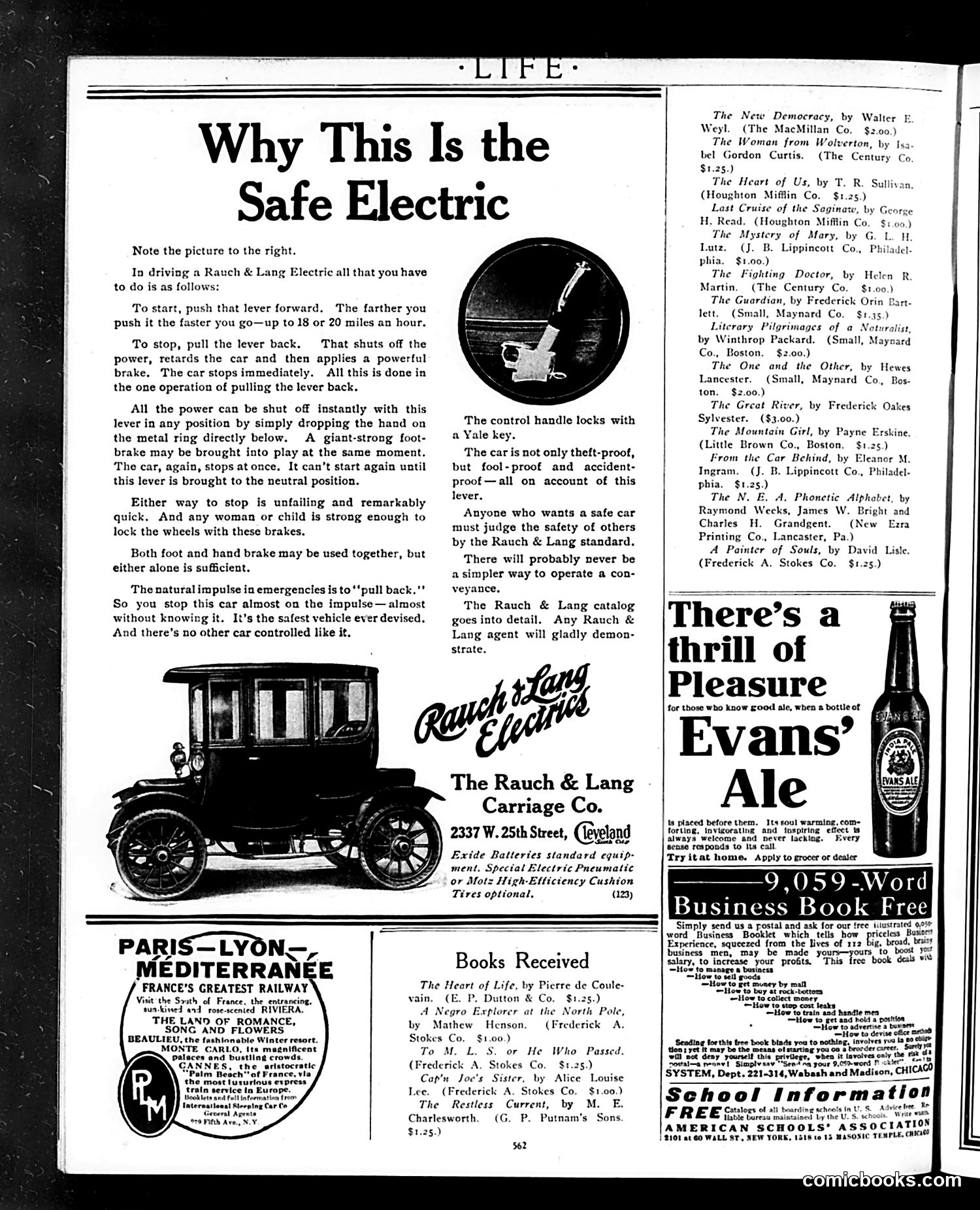
This page advertises the Rauch & Lang Electric automobile, emphasizing safety features designed to appeal to female drivers and cautious operators. The main cartoon/advertisement shows an early electric car with its simple control lever mechanism. The pitch targets anxieties about automobile safety in the early 1900s: the lever controls acceleration, braking, and has both foot and hand brakes with a Yale lock. The copy emphasizes that "any woman or child is strong enough" to operate it—reflecting contemporary assumptions that women lacked strength for mechanical vehicles. It claims the car is "fool-proof and accident-proof," addressing public concerns about dangerous new technology. The advertisement is straightforward product promotion rather than political satire. It includes a photo of the control mechanism and company address in Cleveland. The page also lists newly received books and a railway advertisement—typical Life magazine content from this era.
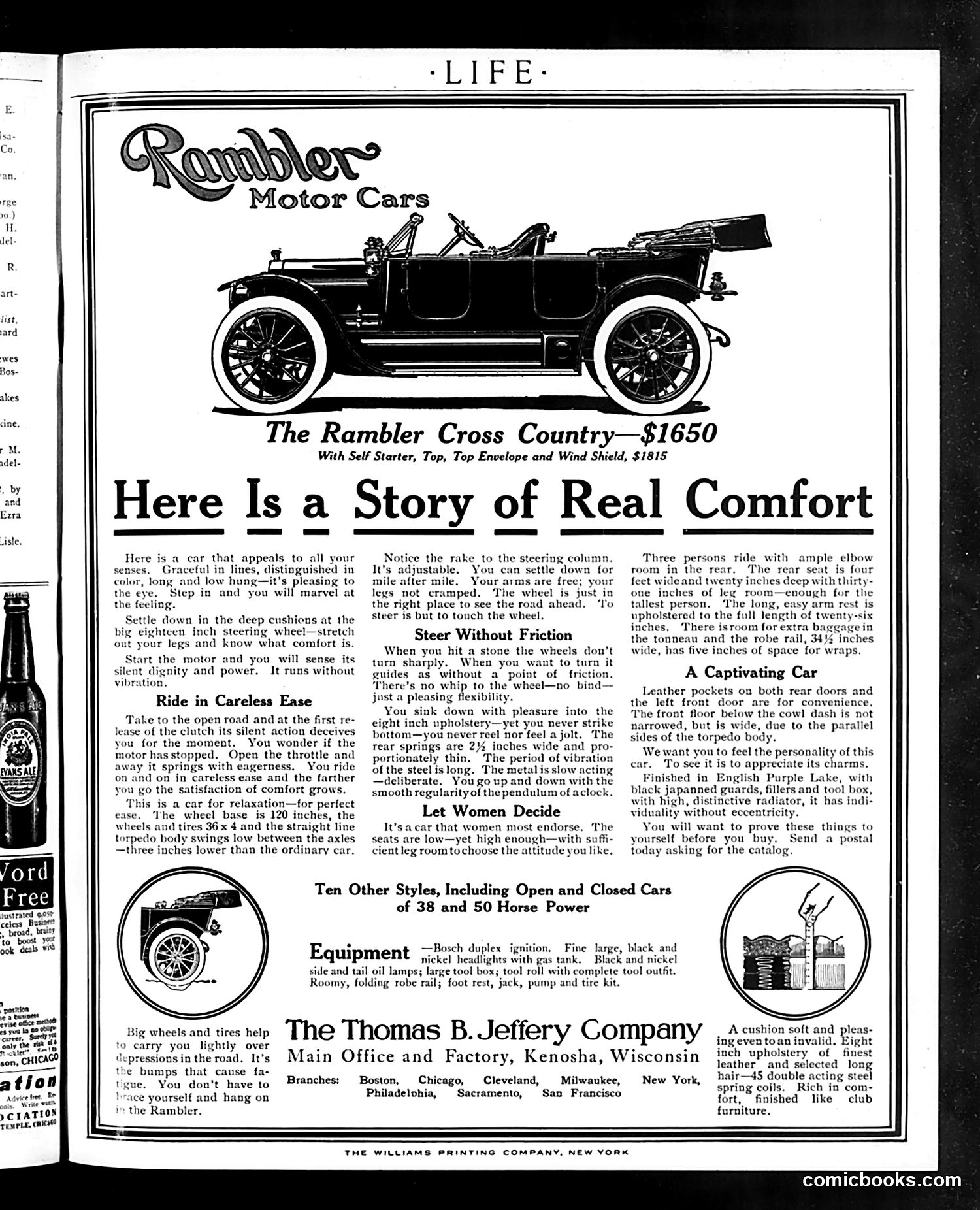
This is **not a political cartoon or satire** — it's a full-page advertisement for the Rambler Cross Country automobile, placed in *Life* magazine (likely early 1900s, based on the vehicle style). The ad uses *Life*'s characteristic approach of mixing commercial messaging with lifestyle appeal. Rather than hard-sell tactics, it describes the car's features through sensory language: comfort, ease, smooth operation. The "Let Women Decide" section notably appeals to female consumers—unusual for automotive advertising of this era, suggesting manufacturers were beginning to recognize women as purchasing decision-makers. The technical specifications (120-inch wheelbase, friction-free steering, pendulum-smooth suspension) are presented as comfort innovations. The widespread branch offices listed indicate this was a major American manufacturer. This reflects turn-of-the-century automotive competition where comfort and reliability were emerging selling points, not mechanical specifications alone.
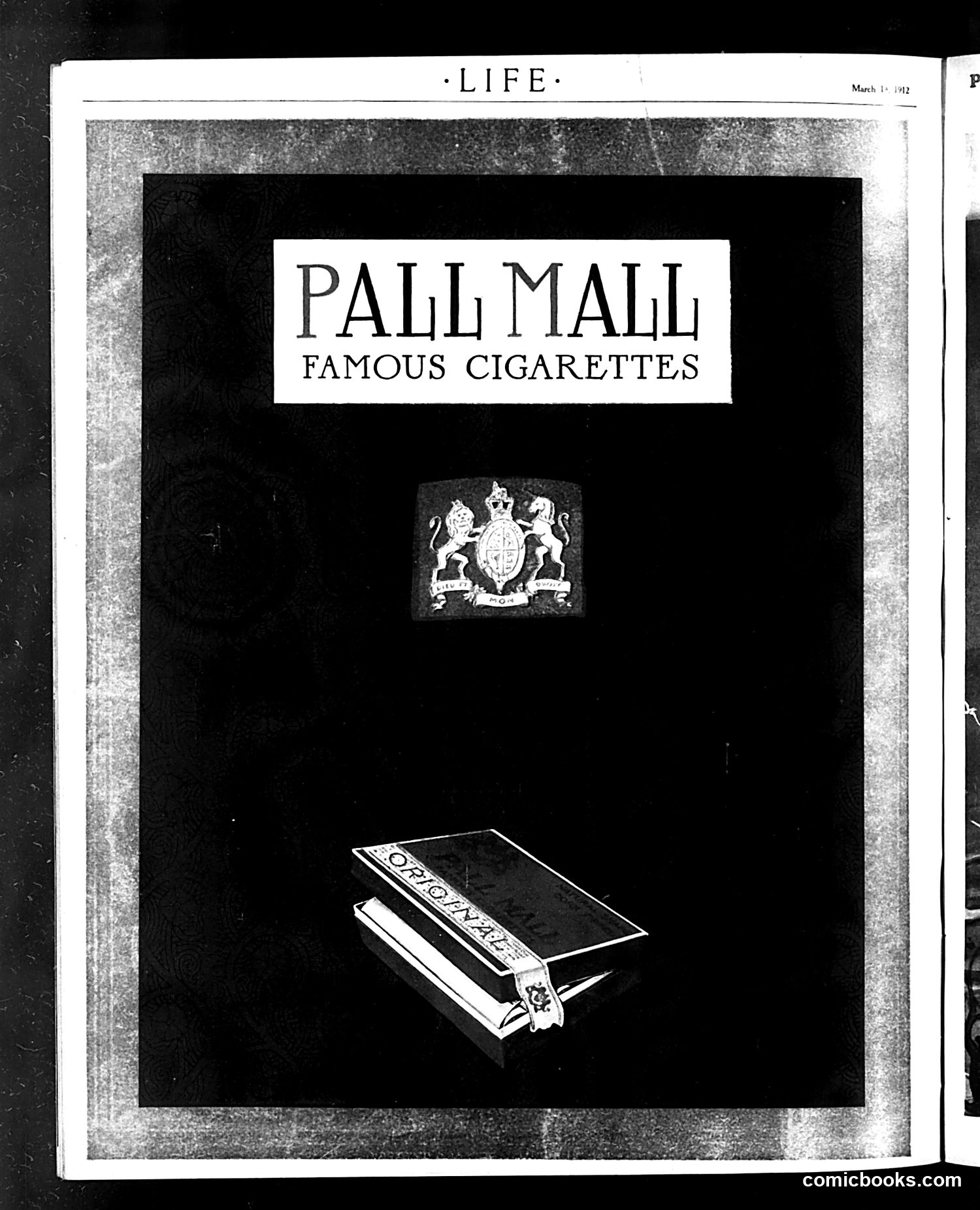
This is a Pall Mall cigarette advertisement from Life magazine (dated March 1, 1912). The page features the brand's logo and coat of arms with supporting lion and unicorn figures—heraldic imagery suggesting British prestige and tradition. A cigarette package is displayed prominently against a black background. This represents early 20th-century cigarette marketing using appeals to sophistication and class status. The "Famous Cigarettes" designation and royal heraldry would have suggested quality and exclusivity to contemporary readers. The advertisement appears in a major American satirical magazine, reflecting that cigarettes were then widely advertised and socially acceptable, before health warnings and advertising restrictions became standard. No cartoon satire is visible—this is straightforward commercial advertising.