
Life, 1912-03-14 · page 20 of 44
Life — March 14, 1912 — page 20: what you’re looking at
What you’re looking at
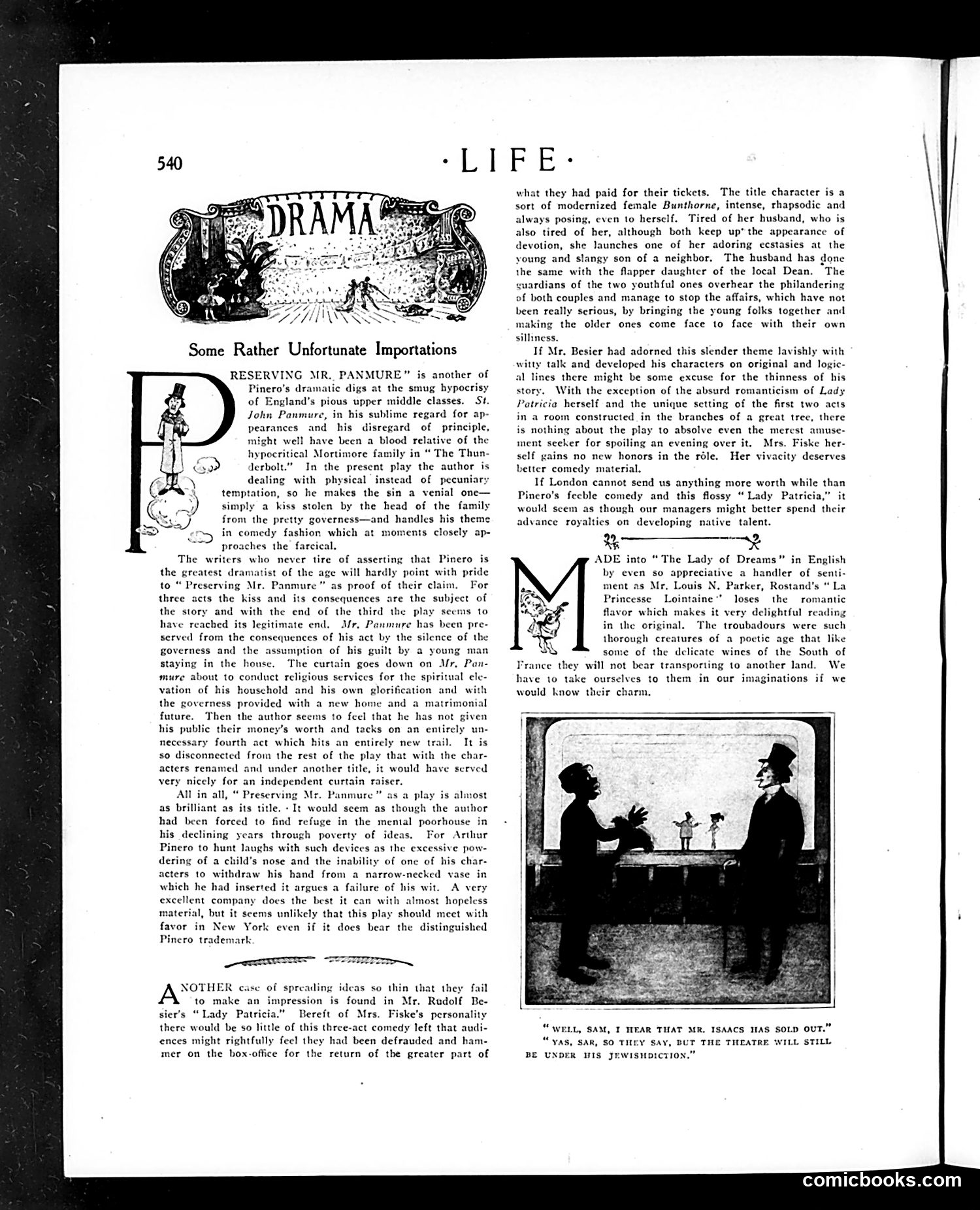
This page reviews two imported British plays—Pinero's "Preserving Mr. Panmure" and Besier's "Lady Patricia"—both performed by distinguished actors. The critic savagely dismisses both as artistically bankrupt. **The satire targets:** Pinero's play satirizes hypocritical upper-middle-class English morality (the protagonist conducts religious services while concealing adultery), but the critic finds the play itself lazy—artificially extending a three-act story into four acts with disconnected material. He mocks Pinero's tired comedic devices (excessive face-powdering, a hand stuck in a vase) as proof the aging playwright has run out of genuine wit. Besier's play depends entirely on star actress Mrs. Fiske's charm; without her, the critic argues, audiences would demand refunds—the actual dramatic material is that thin. **The implicit message:** Even prestigious foreign dramatists can produce hollow, idea-starved imports unworthy of American audiences' money. The accompanying photograph (silhouettes of two figures in dialogue) illustrates typical dramatic material—though uninspired.
📄 Transcribed text from this page (OCR, searchable)
Machine-transcribed from the original scan — historical spelling and the odd misread are preserved.
‘LIP Ee: Some Rather Unfortunate Importations RESERVING MR. PANMURE” is another of Pinero’s dramatic digs at the smug hypocrisy of England’s pious upper middle classes. St. John Panmure, in his sublime regard for ap- pearances and his disregard of principle, might well have been a blood relative of the hypocritical Mortimore family in “ The Thun- Jerbolt.” In the present play the author is dealing with physical’ instead of pecuniary temptation, so he makes the sin a venial one— simply a kiss stolen by the head of the family from the pretty governess—and handles his theme in comedy fashion which at moments closely ap- proaches the farcical. The writers who never tire of asserting that Pinero is greatest dramatist of the age will hardly point with p to “ Preserving Mr. Panmure” as proof of their claim. three acts the kiss and its consequences are the subject of the story and with the end of the third the play seems to have reached its legitimate end. Mr. Panmure has been pre- served from the consequences of his act by the silence of the governess and the assumption of his guilt by a young man staying in the house, The curtain goes down on Mr. mure about to conduct religious services for the spirity vation of his houschold and his own glorification and with the governess provided with a new home and a matrimonial future. Then the author seems to feel that he has not given his public their money's worth and tacks on an entirely un- necessary fourth act which hits an entirely new trail. It is So disconnected from the rest of the play that with the char- acters renamed and under another title, it would have served very nicely for an independent curtain raiser. All in all, “ Preserving Mr. Panmure” as a play is almost as brilliant as its title. «It would scem as though the author had been forced to find refuge in the menial poorhouse in his declining years through poverty of ideas, For Arthur Pincro to hunt laughs with such devices as the excessive pow- dering of a child’s nose and the inability of one of his char- acters to withdraw his hand from a narrow-necked vase in which he had inserted it argues a failure of his wit. A very excellent company docs the best it can with almost hopeless material, but it seems unlikely that this play should meet with favor in New York even if it does bear the distinguished Pincro trademark OTHER case of spreading ideas so thin that they fail to make an impression is found in Mr. Rudolf Be- sier’s “Lady Patricia.” Bereft of Mrs. Fiske’s personality there would be so little of this three-act comedy left that audi- ences might rightfully feel they had been defrauded and ham- mer on the box-office for the return of the greater part of oo what they had paid for their tickets. The title character is a sort of modernized female Bunthorne, intense, rhapsodic and ways posing, even to herself. Tired of her husband, who is also tired of her, although both keep up*the appearance of devotion, she launches one of her adoring ecstasies at the young and slangy son of a neighbor. The husband has done the same with the flapper daughter of the local Dean. “The guardians of the two youthful ones overhear the philandering of both couples and manage to stop the affairs, which have not been really serious, by bringing the young folks together and making the older ones come face to face with their own silliness. If Mr, Besier had adorned this slender theme lavishly with itty talk and developed his characters on original and logic- al lines there might be some excuse for the thinness of his story. With the exception of the absurd romanticism of Lady Potricia herself and the unique setting of the first two acts in a room constructed in the branches of a great tree, there is nothing about the play to absolve even the merest amuse- ment seeker for spoiling an evening over it. Mrs. Fiske her- self gains no new honors in the role. Her vivacity deserves better comedy material. If London cannot send us anything more worth while than inero's fecble comedy and this flossy “Lady Patricia,” it would scem as though our managers might better spend their advance royalties on developing native talent. % —% ADE into “The Lady of Dreams” in English by even so appreciative a handler of senti- ment as Mr. Louis N. Parker, Rostand’s “La Princesse Lointaine’ loses the romantic flavor which makes it very delightful reading in the original. The troubadours were such thorough creatures of a poetic age that like some of the delicate wines of the South of France they will not bear transporting to another land. We have to take ourselves to them in our imaginations if we would know their charm, “WELL, SAM, I HEAR THAT MR. ISAACS IAS SOLD OU “YAS, SAR, SO THEY SAY, BUT THE THEATRE WILL STILL BE UNDER WIS JrWISHDICTION, comicbooks.com