
Life, 1912-03-14 · page 18 of 44
Life — March 14, 1912 — page 18: what you’re looking at
What you’re looking at
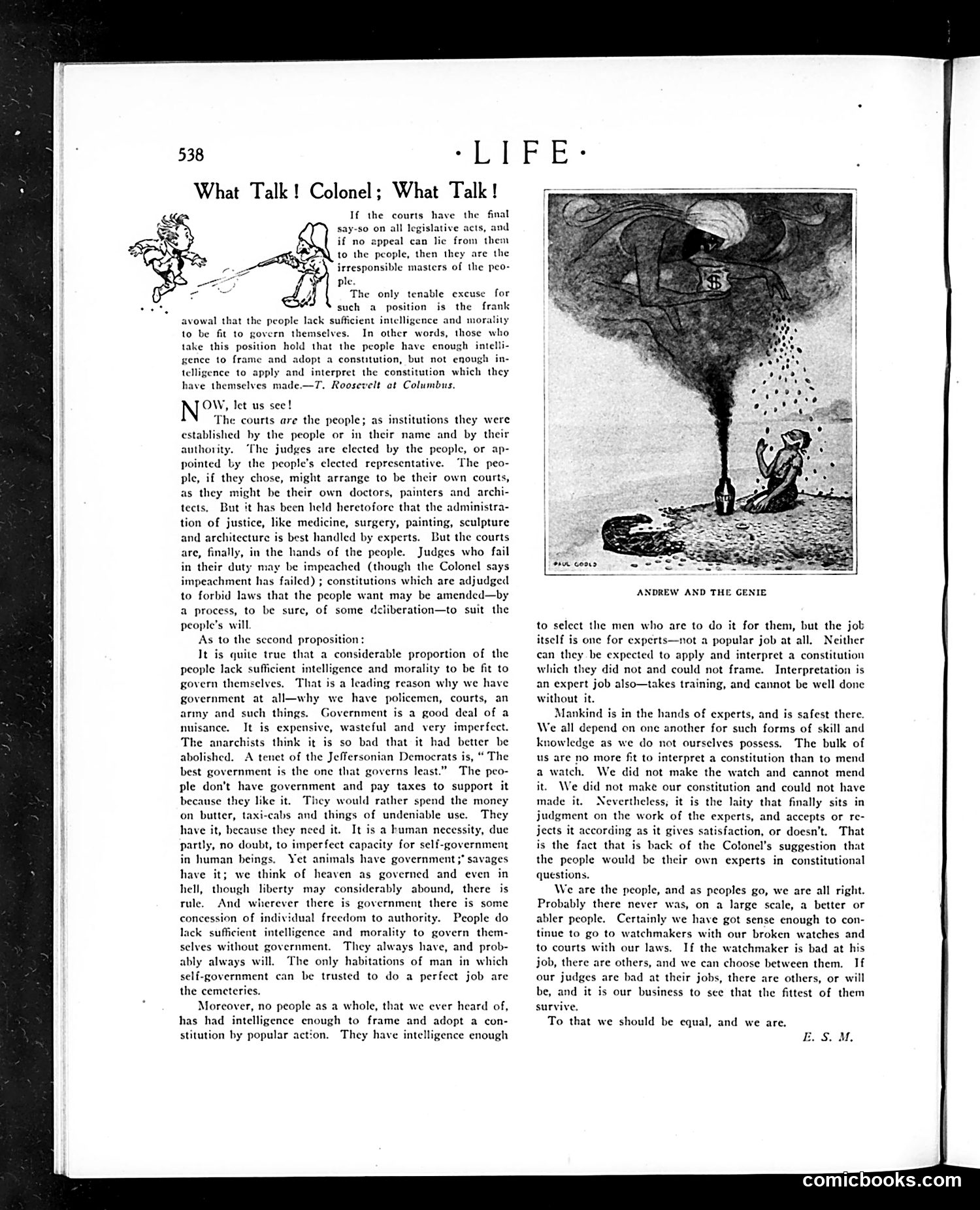
This page presents a political debate about judicial power and popular sovereignty, likely from the Progressive Era (early 1900s). **The Text Debate:** Theodore Roosevelt (identified as "the Colonel") is quoted arguing that if courts have final say over laws with no popular appeal, they become "irresponsible masters." The unnamed author responds by defending expert judgment, arguing that courts—like medicine or architecture—require specialized expertise. While ordinary people can *choose* their experts and *amend* constitutions, they lack the training to interpret them directly. **The Cartoon:** The small illustration labeled "Andrew and the Genie" (partially visible) appears to be a separate humorous piece, likely a fairy-tale reference unrelated to the main political argument. **The Point:** Life is satirizing Roosevelt's populism by suggesting that while democracy means *ultimate* popular control, day-to-day governance requires trained experts. The magazine argues common people sensibly delegate specialized tasks—accepting this applies to constitutional interpretation too.
📄 Transcribed text from this page (OCR, searchable)
Machine-transcribed from the original scan — historical spelling and the odd misread are preserved.
538 -LIFE- What Talk! Colonel; What Talk! If the courts have the final say-so on all legislative acts, and if no appeal can lic from them to the people, then they are the irresponsible masters of the peo- ple. The only tenable excuse for such a position is the frank avowal that the people lack sufficient intelligence and morality to be fit to govern themselves. In other words, those who take this position hold that the people have enough intel gence to frame and adopt a constitution, but not enough in- telligence to apply and interpret the constitution which they have themselves made—T. Roosevelt at Columbus. OW, Iet us see! The courts are the people; as institutions they were established by the people or in their name and by their authority. ‘The judges are clected by the people, or ap- pointed by the people’s elected representative. The peo- ple, if they chose, might arrange to be their own courts, as they might be their own doctors, painters and archi- tects, But it has been held heretofore that the administra- tion of justice, like medicine, surgery, painting, sculpture and architecture is best handled by experts. But the courts are, finally, in the hands of the people. Judges who fail in their duty may be impeached (though the Colonel says impeachment has failed) ; constitutions which are adjudged to forbid laws that the people want may be amended—by a process, to be sure, of some dcliberation—to suit the people's will As to the second proposition: It is quite true that a considerable proportion of the people lack sufficient intelligence and morality to be fit to govern themselves, That is a leading reason why we have government at all—why we have policemen, courts, an army and such things. Government is a good deal of a nuisance. It is expensive, wasteful and very imperfect. The anarchists think it is so bad that it had better be abolished. A tenet of the Jefferson Democrats is, “ The best government is the one that governs least.” The peo- ple don't have government and pay taxes to support it because they like it. They would rather spend the money ‘on butter, taxi-cabs and things of undeniable use. They have it, because they need it. It is a human necessity, due partly, no doubt, to imperfect capacity for self-government in human beings. Yet animals have government ;* savages have it; we think of heaven as governed and even in hell, though liberty may considerably abound, there is rule. And wherever there is government there is some concession of individual freedom to authority. People do lack sufficient intelligence and morality to govern them- selves without government. They always have, and prob- ably always will, The only habitations of man in which self-government can be trusted to do a perfect job are the cemeteries. Moreover, no people as a whole, that we ever heard of, has had intelligence enough to frame and adopt a con- stitution by popular action. They have intelligence enough ANDREW AND THE GE: to select the men who are to do it for them, but the job itself is one for experts—not a popular job at all. Neither can they be expected to apply and interpret a constitution which they did not and could not frame. Interpretation is an expert job also—takes training, and cannot be well done without it. Mankind is in the hands of experts, and is safest there. We all depend on one another for such forms of skill and knowledge as we do not ourselves possess. The bulk of us are no more fit to interpret a constitution than to mend a watch. We did not make the watch and cannot mend it. We did not make our constitution and could not have made it. Nevertheless; it is the laity that finally sits in judgment on the work of the experts, and accepts or re- jects it according as it gives satisfaction, or doesn’t. That is the fact that is back of the Colonel’s suggestion that the people would be their own experts in constitutional questions. We are the people, and as peoples go, we are all right. Probably there never was, on a large scale, a better or abler people. Certainly we have got sense enough to con- tinue to go to watchmakers with our broken watches and to courts with our laws. If the watchmaker is bad at his job, there are others, and we can choose between them. If our judges are bad at their jobs, there are others, or will be, and it is our business to sce that the fittest of them survive, To that we should be equal, and we are. E. S. M. comicbooks.com