
Life, 1912-03-14 · page 8 of 44
Life — March 14, 1912 — page 8: what you’re looking at
What you’re looking at
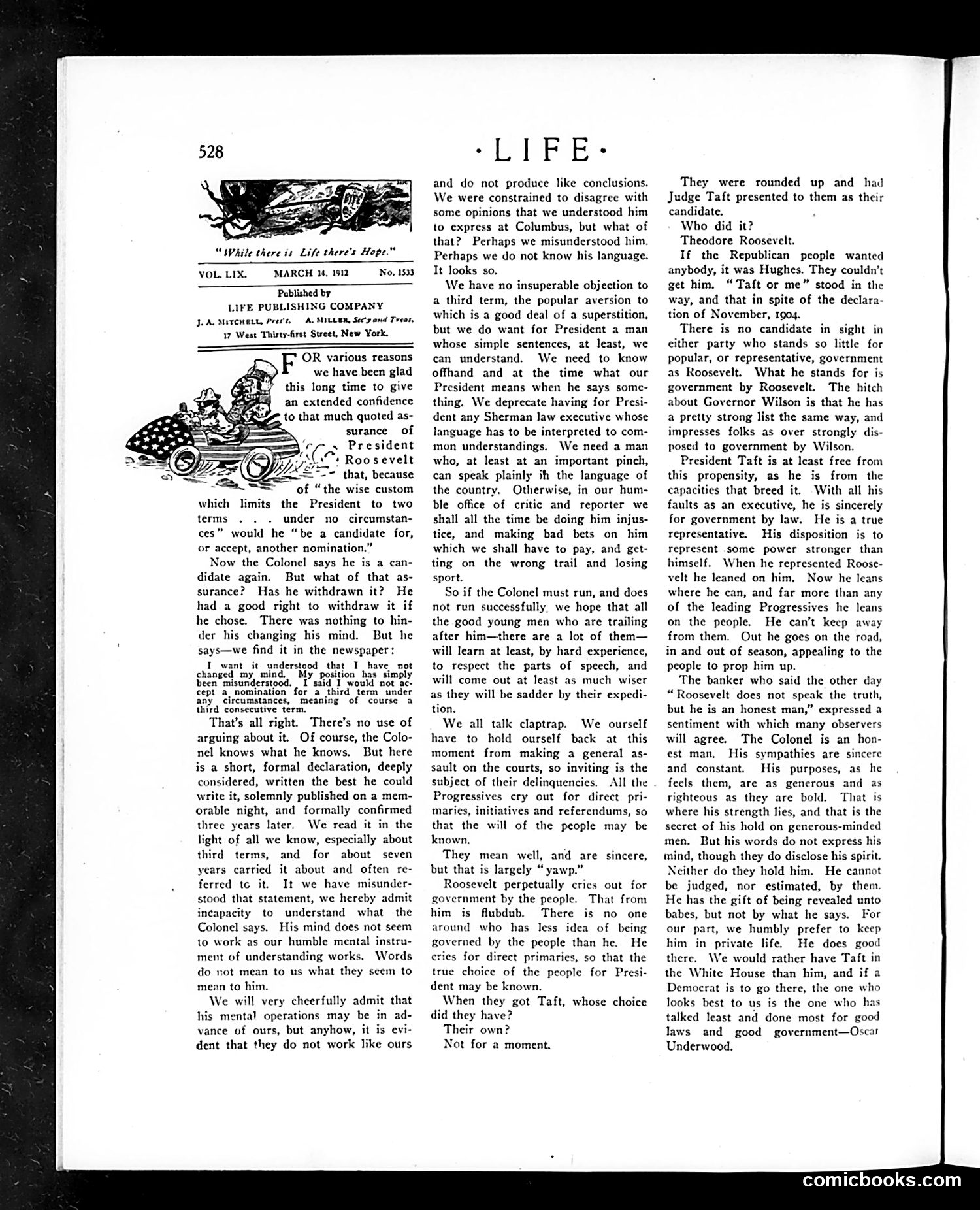
This page contains political commentary about the 1912 presidential election. The text discusses Colonel Theodore Roosevelt as a potential candidate, debating whether he should run again. It critiques Roosevelt's communication style, noting his simple, direct language appeals to ordinary citizens but sometimes lacks diplomatic nuance. The illustration shows a caricatured figure in a car, likely representing Roosevelt given the context about his candidacy. The article expresses concern about Roosevelt's temperament as an executive—his tendency to act impulsively and speak bluntly. It also compares him favorably to other candidates and discusses Republican Party divisions over who should represent them in the upcoming election, suggesting internal debate about Roosevelt's viability as their nominee.
📄 Transcribed text from this page (OCR, searchable)
Machine-transcribed from the original scan — historical spelling and the odd misread are preserved.
“While there is Life there's Hop: No, 1533 VOL. LIX. MARCH 16. 1912 Published by LIFE PUBLISHING COMPANY JA Mivenett, Prete A. MILLER, Sec’y and Treas, 17 West Thirty-first Street, New York, OR various reasons we have been glad this long time to give an extended confidence to that much quoted as- surance of ~ President 1 Roosevelt -7 that, because of “the wise custom limits the President to two under no circumstan- which terms ces” would he “be a candidate for, or accept, another nomination.” Now the Colonel says he is a can- didate again. But what of that as- surance? Has he withdrawn it? He had a good right to withdraw it if he chose. There was nothing to hin- der his changing his mind. But he says—we find it in the newspaper: I want it understood that I. have not changed my mind. My position has simply been misunderstood. I said 1 would not ac- cept a nomination for a third term under any circumstances, meaning of course a third consecutive term. That’s all right. There’s no use of arguing about it. Of course, the Colo- nel knows what he knows. But here is a short, formal declaration, deeply considered, written the best he could write it, solemnly published on a mem- orable night, and formally confirmed three years later. We read it in the light of all we know, especially about third terms, and for about seven years carried it about and often re- ferred tc it. It we have misunder- stood that statement, we hereby admit incapacity to understand what the Colonel says. His mind does not seem to work as our humble mental instru- ment of understanding works. Words do not mean to us what they seem to mean to him. We will very cheerfully admit that his mental operations may be in ad- vance of ours, but anyhow, it is evi- dent that they do not work like ours *L1PE= and do not produce like conclusions. We were constrained to disagree with some opinions that we understood him to express at Columbus, but what of that? Perhaps we misunderstood him. Perhaps we do not know his language. It looks so, We have no insuperable objection to a third term, the popular aversion to which is a good deal of a superstition, but we do want for President a man whose simple sentences, at least, we can understand. We need to know offhand and at the time what our President means when he says some- thing. We deprecate having for Presi- dent any Sherman law executive whose language has to be interpreted to com- mon understandings. We need a man who, at least at an important pinch, can speak plainly ih the language of the country. Otherwise, in our hum- ble office of critic and reporter we shall all the time be doing him injus- tice, and making bad bets on him which we shall have to pay, and get- ting on the wrong trail and losing sport. So if the Colonel must run, and does not run successfully, we hope that all the good young men who are trailing after him—there are a lot of them— will learn at least, by hard experience, to respect the parts of speech, and will come out at least as much wiser as they will be sadder by their expedi- tion. We all talk claptrap. We ourself have to hold ourself back at this moment from making a general as- sault on the courts, so inviting is the subject of their delinquencies. All the Progressives cry out for direct pri- maries, initiatives and referendums, so that the will of the people may be known. They mean well, and are sincere, but that is largely “ yawp.” Roosevelt perpetually cries out for government by the people. That from him is flubdub. There is no one around who has less idea of being governed by the people than he. He ies for direct primaries, so that the true choice of the people for Presi- dent may be known. When they got Taft, whose choice did they have? Their own Not for a moment. They were rounded up and had Judge Taft presented to them as their candidate. Who did it? Theodore Roosevelt. If the Republican people wanted anybody, it was Hughes. They couldn't get him. “Taft or me” stood in the way, and that in spite of the declara- tion of November, 1904. There is no candidate in sight in either party who stands so little for popular, or representative, government as Roosevelt. What he stands for is government by Roosevelt. The hitch about Governor Wilson is that he has a pretty strong list the same way, and impresses folks as over strongly dis- posed to government by Wilson. President Taft is at least free from this propensity, as he is from the capacities that breed it. With all his faults as an executive, he is sincerely for government by law. He is a true representative. His disposition is to represent some power stronger than himself. When he represented Roose- velt he leaned on him. Now he leans where he can, and far more than any of the leading Progressives he leans on the people. He can’t keep away from them. Out he goes on the road, in and out of season, appealing to the people to prop him up. The banker who said the other day “ Roosevelt does not speak the truth, but he is an honest man,” expressed a sentiment with which many observers will agree. The Colonel is an hon- est man. His sympathies are sincere and constant. His purposes, as he feels them, are as generous and as righteous as they are bold. That is where his strength lies, and that is the secret of his hold on generous-minded men. But his words do not express his mind, though they do disclose his spirit. Neither do they hold him. He cannot be judged, nor estimated, by them. He has the gift of being revealed unto babes, but not by what he says. For our part, we humbly prefer to keep him in private life. He does good there. We would rather have Taft in the White House than him, and if a Democrat is to go there, the one who looks best to us is the one who has talked least and done most for good laws and good government—Oscar Underwood. comicbooks.com