
Life, 1912-03-14 · page 21 of 44
Life — March 14, 1912 — page 21: what you’re looking at
What you’re looking at
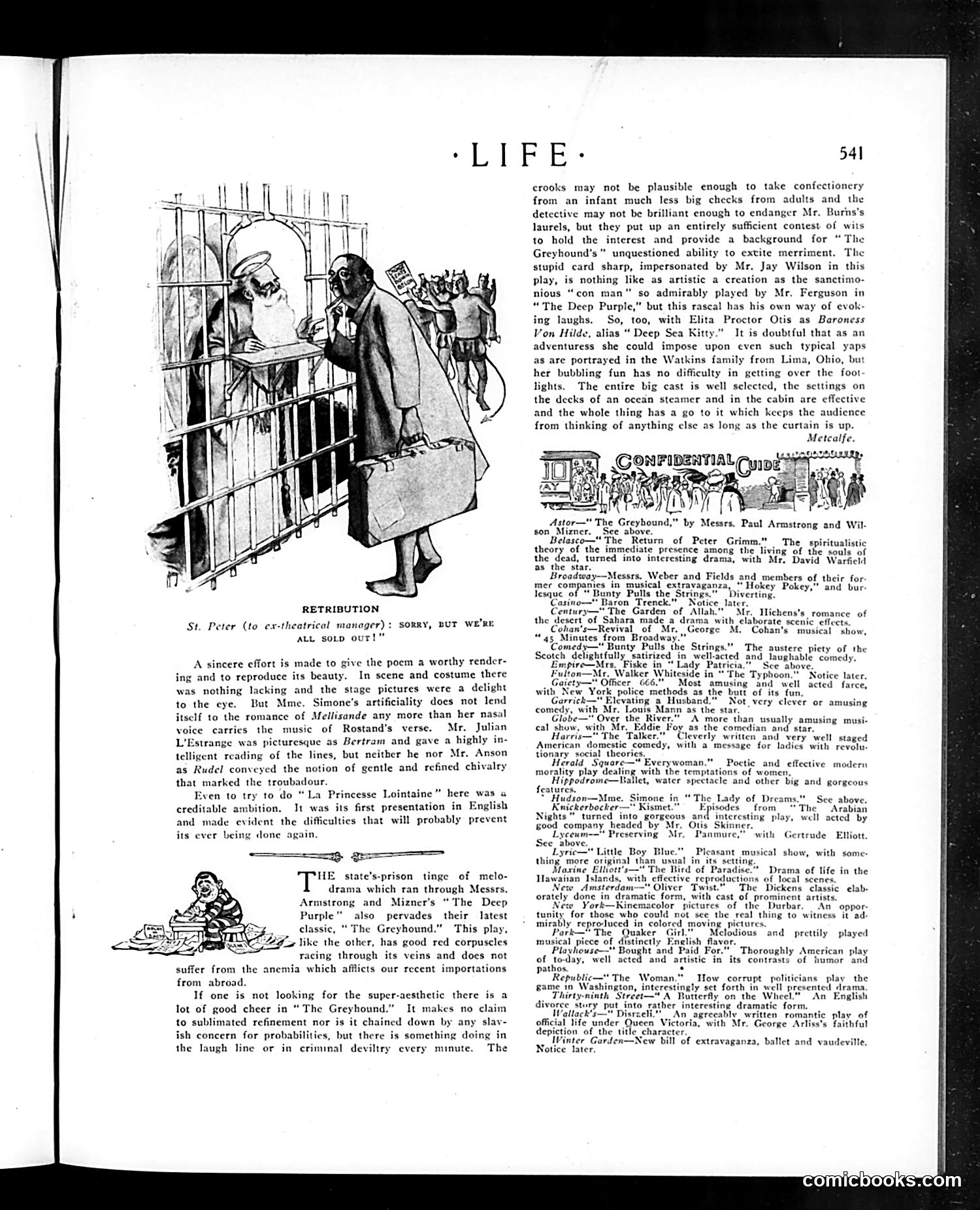
The main cartoon shows **St. Peter at heaven's gates** turning away an **ex-theatrical manager**, saying "Sorry, but we're all sold out!" This is a satirical **afterlife joke**: the manager, presumably guilty of some theatrical sin or fraud, arrives expecting entry to heaven but is rejected—heaven has no room for him. The humor lies in the irreverent suggestion that theatrical folk of questionable ethics don't make the cut for paradise. The rest of the page contains **theater reviews** critiquing contemporary stage productions, including "The Greyhound," "The Deep Purple," and others. The reviewer praises some performances while mocking others' artificiality and implausibility, particularly actress Mme. Simone's "nasal voice" and the predictable criminality plots. The cartoon's satire likely reflects broader **early 20th-century skepticism about theater managers' honesty**—possibly referencing actual theatrical scandals or financial improprieties common to that era.
📄 Transcribed text from this page (OCR, searchable)
Machine-transcribed from the original scan — historical spelling and the odd misread are preserved.
»-LIFE: 54 RETRIBUTION St. Peter (to ex-theatrical manager): SORRY, BUT WE'RE ALL soLp out!” A sincere effort is made to give the poem a worthy render- ing and to reproduce its beauty. In scene and costume there was nothing lacking and the stage pictures were a delight to the eye. But Mme. Simone’s artificiality does not lend itself to the romance of Mellisande any more than her nasal voice carries the music of Rostand’s verse. Mr. Julian L’Estrange was picturesque as Bertram and gave a highly in- telligent reading of the lines, but neither he nor Mr. Anson as Rudel conveyed the notion of gentle and refined chivalry that marked the troubadour. Even to try to do “La Princesse Lointaine” here was « creditable ambition, It was its first presentation in English and made evident the difficulties that will probably prevent its ever being done again. HE. state’s-prison tinge of melo- drama which ran through Messrs. Aristrong and Mizner’s “The Deep Purple” also pervades their latest classic, “The Greyhound.” This play, like the other, has good red corpuscles racing through its veins and does not suffer from the anemia which afflicts our recent importations from abroad. If one is not looking for the super-aesthetic there is a lot of good cheer in “The Greyhound.” It makes no claim to sublimated refinement nor is it chained down by any slav- h concern for probabilities, but there is something doing in the laugh line or in crimimal deviltry every minute. The crooks may not be plausible enough to take confectionery from an infant much less big checks from adults and the detective may not be brilliant enough to endanger Mr. Burhs's laurels, but they put up an entirely sufficient contest of wits to hold the interest and provide a background for “The Greyhound’s " unquestioned ability to extite merriment. The stupid card sharp, impersonated by Mr. Jay Wilson in this play, is nothing like as artistic a creation as the sanctimo- nious “con man” so admirably played by Mr. Ferguson in “The Deep Purple,” but this rascal has his own way of evok- ing laughs. So, too, with Elita Proctor Otis as Baroness Von Hilde, alias “ Deep Sea Kitty.” It is doubtful that as an adventures she could impose upon even such typical yaps as are portrayed in the Watkins family from Lima, Obio, but her bubbling fun has no difficulty in getting over the foot lights. The entire big cast is well selected, the settings on the decks of an ocean steamer and in the cabin are effective and the whole thing has a go to it which keeps the audience from thinking of anything else as long nis up. Metcalfe. Astor—" The Greyhound,” by Messrs, Paul Armstrong and Wil- son’ Mizner. | See above. Belasco" The Return of Peter Grimm.” The. spiritualistic theory of the immediate presence among the living of the sealo ut the dead, turned into interesting drama, with Mrs David’ Warfield as the star. Broadway-—Messrs. Weber and Fields and members of their for mer companies in musical extravaganza, “Hokey Pokey,” ‘and bor lesque o! Bunty Pulls the String: Diverting. Casino" Baron Teepe | Notice, tater Contury—" The Garden of Allah." My. Hichens's romance o the desert of Sahare sade a drama with elgborsse weenie omens, Cohan's—Revival of Mr., George M. Cohan's musical “ 45. Minutes, from Broadway . Comedy—"" Bunty Pulls the Strings." The austere piety of the Scotch delightfully ‘satirized in well-acted and laughable comedy, EmpireMrs, Fiske in“ Lady Patricia.” See above, , Fulton—Mr. Walker Whiteside in" The Typhoon.” Notice late _ Gaiety —" Officer 666." Most amusing and well acted fare witt'New, York police methods as the batt of ts fun, jarrick—" Elevating a Husband.” Not, very clever i comedy, with Mr. Lou's Manp as the star 2 oes slobe— A more than usually iy usi- cal show, with Mr, Eddie Foy as the comedian and stares Harris—" The Talker.” Cleverly written and very well staged American domestic comedy, with a message for ladies with revolu- tionary social theories. Herald Square—* Everywoman.” Poetic and elf morality play dealing with the temptations of women. Hippodrome—Hallet, water spectacle and other big and gorgcous feature ng sadictr *"Hudson—Mme. § ady of Dreams." Sce above. Ni Remiehey becker isodes from “The Arabian Nights” turned into gorgeous and interesting play, well act good company headed by Mr. Otis Skinner. © ets Lyceum=—" Preserving Mr, Panmure,” “with Gertrude Elliott. ve modern Little Boy Blue.” Pleasant musical show, with some- thing more original than usual in its sett Maxine Eliiott’s—" The Bird of Parad Drama of life in the Hawaiian Islands, with effective reproductions of local scenes. Amsterdam—" Oliver Twist.” The Dickens classic elab- done in dramatic form, with cast of prominent artists « York—Kinemacolor pictures. of the Durbar. An’ oppor- tunity for those who could not see the real thing to witness it ad- mirably reproluced in colored moving pictures “The Quaker Girl.” Melodious and prettily played musical piece of distinetly Enelish flavor. i Playhouse— Bought and Paid For. Thoroughly American play of today, well acted and artistic in its contrasts of humor and pathos : Republic—* The Woman.” Tow corrupt politicians play the game in Washington, interestingly set forth in well presented drama Thirty-ninth Street—* A Butterfly on the Wheel.” An Engl force stury put into rather interesting dramatic form. Watlack'’s—" Disrz An agreeably written romantic play of official life under Queen Victoria, with Mr. George Arliss’s faithful depiction of the title character . Winter Garden—New bill of extravaganza, ballet and vaudeville, Notice later.