
Life, 1912-03-14 · page 7 of 44
Life — March 14, 1912 — page 7: what you’re looking at
What you’re looking at
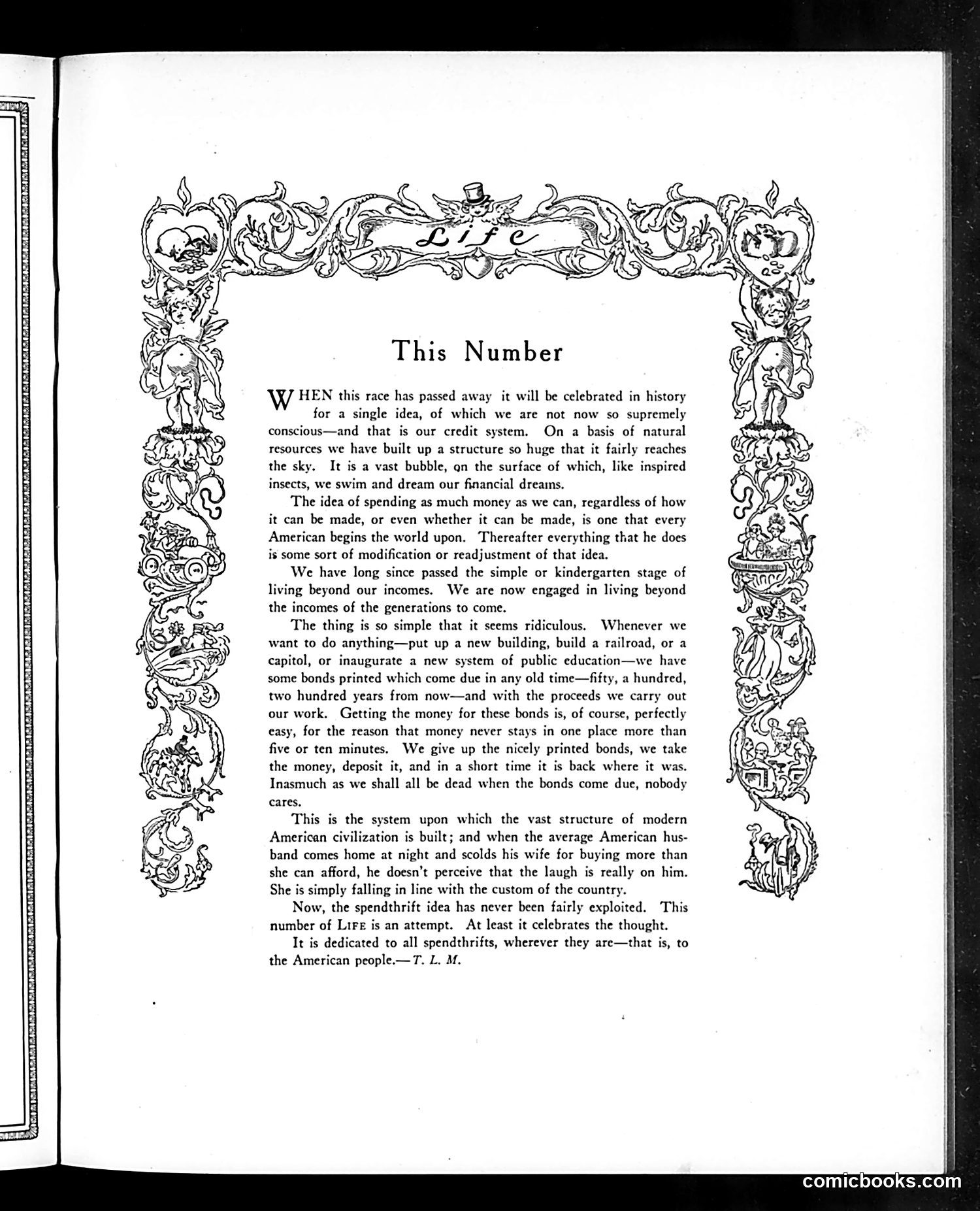
This is a title page/editorial essay rather than a cartoon. The ornate decorative border frames text signed "T. L. M." that satirizes American consumer culture and debt-based spending. The author mocks the "credit system" as the foundation of American civilization, where people spend money they don't have on things they can't afford. The satire targets the practice of issuing bonds for public projects (buildings, railroads, schools) that won't mature for decades—long after the current generation dies. The core joke: Americans justify endless spending and debt by claiming it will be "celebrated in history," while the average husband unknowingly supports this system by buying things his wife cannot afford, assuming she's simply "falling in line with custom." The piece critiques both personal overspending and government fiscal irresponsibility as interconnected aspects of American culture.
📄 Transcribed text from this page (OCR, searchable)
Machine-transcribed from the original scan — historical spelling and the odd misread are preserved.
This Number W HEN this race has passed away it will be celebrated in history for a single idea, of which we are not now so supremely conscious—and that is our credit system. On a basis of natural resources we have built up a structure so huge that it fairly reaches the sky. It is a vast bubble, an the surface of which, like inspired insects, we swim and dream our financial dreams. The idea of spending as much money as we can, regardless of how it can be made, or even whether it can be made, is one that every American begins the world upon. Thereafter everything that he does is some sort of modification or readjustment of that idea. We have long since passed the simple or kindergarten stage of living beyond our incomes. We are now engaged in living beyond the incomes of the generations to come. The thing is so simple that it seems ridiculous. Whenever we want to do anything—put up a new building, build a railroad, or a capitol, or inaugurate a new system of public education—we have some bonds printed which come due in any old time—fifty, a hundred, two hundred years from now—and with the proceeds we carry out our work. Getting the money for these bonds is, of course, perfectly easy, for the reason that money never stays in one place more than five or ten minutes. We give up the nicely printed bonds, we take the money, deposit it, and in a short time it is back where it was. Inasmuch as we shall all be dead when the bonds come due, nobody cares, This is the system upon which the vast structure of modern American civilization is built; and when the average American hus- band comes home at night and scolds his wife for buying more than she can afford, he doesn’t perceive that the laugh is really on him. She is simply falling in line with the custom of the country. Now, the spendthrift idea has never been fairly exploited. This number of Lire is an attempt. At least it celebrates the thought. It is dedicated to all spendthrifts, wherever they are—that is, to the American people.—T. L. M. comicbooks.com