
Life, 1912-03-14 · page 15 of 44
Life — March 14, 1912 — page 15: what you’re looking at
What you’re looking at
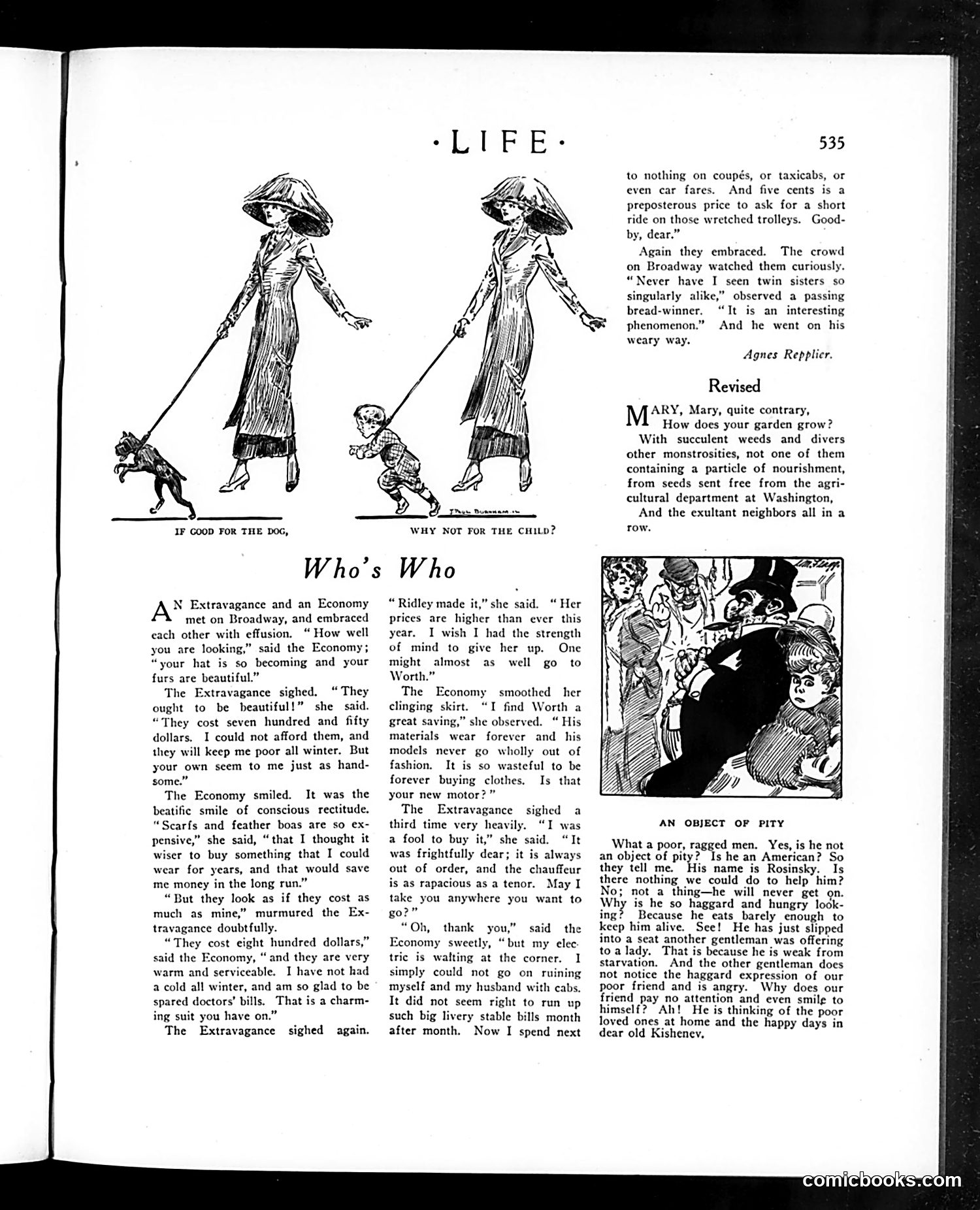
The top cartoon compares two wealthy women meeting on Broadway—"Extravagance" and "Economy"—who ironically spend the same or more money while congratulating themselves on opposite approaches. Extravagance buys expensive items she can't afford; Economy justifies equally costly purchases (Worth gowns, an electric car) as practical investments. The satire mocks how both women rationalize excessive spending through different rhetoric, revealing that wealth and self-deception go hand-in-hand regardless of one's claimed philosophy. The final section, "An Object of Pity," describes Rosinsky, a poor immigrant (likely Eastern European, given the reference to Kishenev) too weak from starvation to notice social courtesies. The piece sardonically observes he cannot be helped and will never succeed—exposing contemporary American indifference to immigrant suffering while he mentally escapes to memories of his homeland.
📄 Transcribed text from this page (OCR, searchable)
Machine-transcribed from the original scan — historical spelling and the odd misread are preserved.
IF GOOD FOR THE DOG, The beens WHY NOT FOR THE CHILD? Who’s Who AN Extravagance and an Economy met on Broadway, and embraced each other with effusion. “How well you are looking,” said the Economy; “your hat is so becoming and your furs are beautiful.” The Extravagance sighed. “They ought to be beautiful!” she said. “They cost seven hundred and fifty dollars. I could not afford them, and they will keep me poor all winter. But your own seem to me just as hand- some.” The Economy smiled. It was the beatific smile of conscious rectitude. “Scarfs and feather boas are so ex- pensive,” she said, “that I thought it wiser to buy something that I could wear for years, and that would save me money in the long run.” “But they look as if they cost as much as mine,” murmured the Ex- travagance doubtfully. “They cost eight hundred dollars,” said the Economy, “and they are very warm and serviceable. I have not had a cold all winter, and am so glad to be spared doctors’ bills. That is a charm- ing suit you have on.” The Extravagance sighed again. “Ridley made it,” she said. “ Her prices are higher than ever this year. I wish I had the strength of mind to give her up. One might almost as well go to Worth.” The Economy smoothed her clinging skirt. “I find Worth a great saving,” she observed. “ His materials wear forever and his models never go wholly out of fashion. It is so wasteful to be forever buying clothes. Is that your new motor?” The Extravagance sighed a third time very heavily. “I was a fool to buy it,” she said. “It was frightfully dear; it is always out of order, and the chauffeur is as rapacious as a tenor. May I take you anywhere you want to go?” “Oh, thank you,” said the Economy sweetly, “but my elec: tric is wafting at the corner. 1 simply could not go on ruining myself and my husband with cabs. It did not seem right to run up such big livery stable bills month after month. Now I spend next 535 to nothing on coupés, or taxicabs, or even car fares. And five cents is a preposterous price to ask for a short ride on those wretched trolleys. Good- by, dear.” Again they embraced. The crowd on Broadway watched them curiously. “Never have I seen twin sisters so singularly alike,” observed a passing bread-winner. “It is an interesting phenomenon.” And he went on his weary way. Agnes Repplier. Revised ARY, Mary, quite contrary, How does your garden grow? With succulent weeds and divers other monstrosities, not one of them containing a particle of nourishment, from seeds sent free from the agri- cultural department at Washington, And the exultant neighbors all in a AN OBJECT OF PITY What a poor, ragged men. Yes, is he not an object of pity? Is he an American? So they tell me. His name is Rosinsky. Is there nothing we could do to help him? No; not a thing—he will never get on. Why is he so haggard and hungry look- ing? Because he eats barely enough to keep him alive. See! He has just slipped into a seat another gentleman was offering toalady. That is because he is weak from starvation. And the other gentleman does not notice the haggard expression of our poor friend and is angry. Why does our friend pay no attention and even smile to himself? Ah! He is thinking of the poor loved ones at home and the happy days in dear old Kishenev,