
Life, 1912-03-14 · page 16 of 44
Life — March 14, 1912 — page 16: what you’re looking at
What you’re looking at
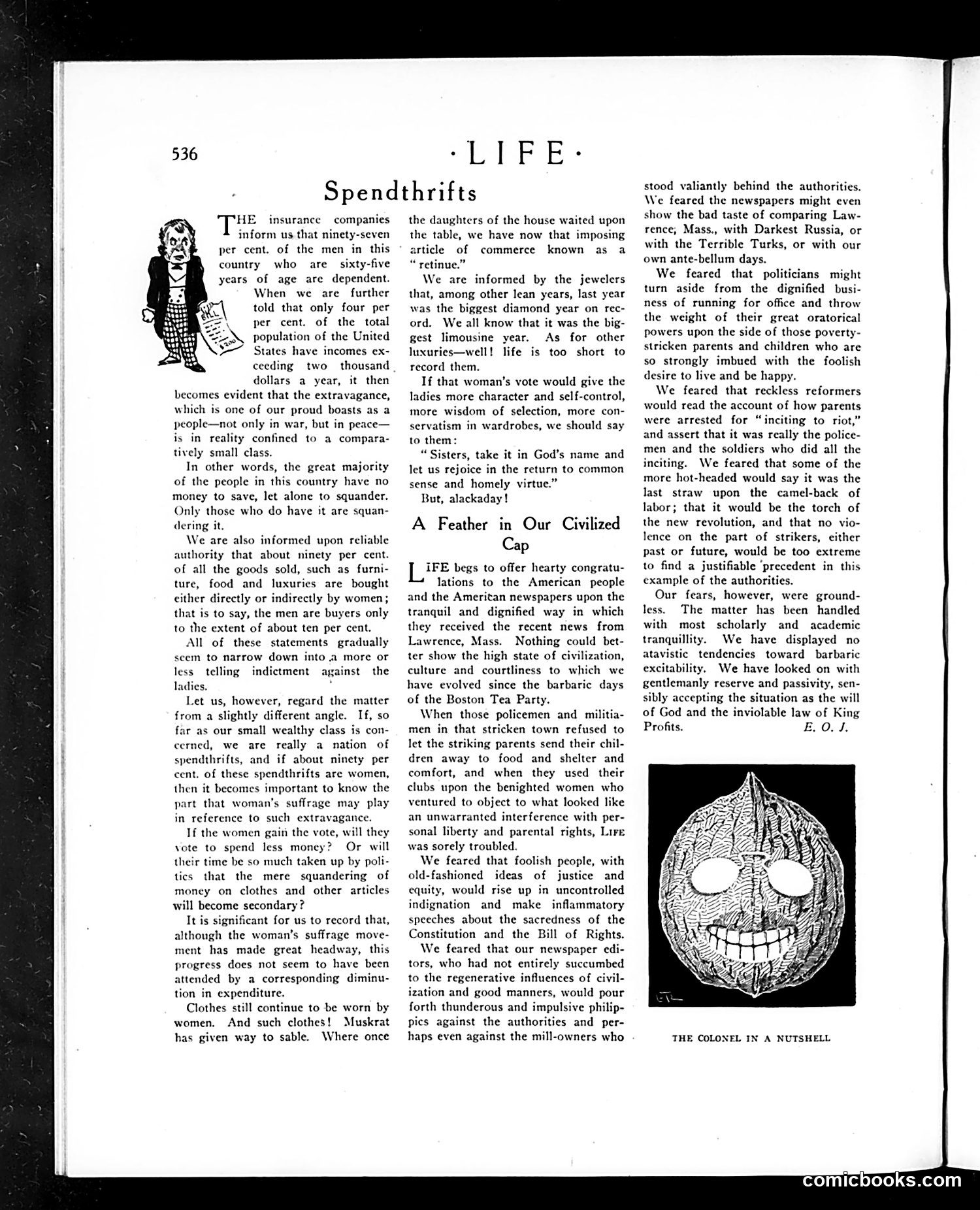
This page contains two satirical articles critiquing American society circa the early 20th century. **"Spendthrifts"** attacks the contradiction between women's newfound political power (women's suffrage) and their spending habits. The article notes that 90% of consumer goods are purchased by women, yet gaining voting rights hasn't reduced extravagance—diamond sales and luxury goods remain high. The accompanying caricature (left) depicts a disheveled spendthrift, visually reinforcing the critique. **"A Feather in Our Civilized Cap"** sarcastically praises America's "dignified" response to the Lawrence, Massachusetts textile strike (likely 1912). The irony is heavy: police and militia clubs used against striking parents and women are presented as signs of "civilization" and "courtliness." Life questions whether citizens will demand justice or merely accept authority's violence. **The Colonel in a Nutshell** (illustration, right) appears unrelated—a satirical portrait in a decorative nutshell frame. The page reflects Progressive Era tensions: women's empowerment, labor unrest, and institutional authority.
📄 Transcribed text from this page (OCR, searchable)
Machine-transcribed from the original scan — historical spelling and the odd misread are preserved.
HE insurance inform us that ninety-seven per cent. of the men in this country who are sixty-five years of age are dependent. When we are further told that only four per per cent. of the total population of the United States have incomes ex- ceeding two thousand dollars a year, it then becomes evident that the extravagance, which is one of our proud boasts as a people—not only in war, but in peace— is in reality confined to a compara- tively small class. In other words, the great majority of the people in this country have no money to save, let alone to squander. Only those who do have it are squan- dering it. We are also informed upon reliable authority that about ninety per cent. of all the goods sold, such as furni- ture, food and luxuries are bought cither directly or indirectly by women; that is to say, the men are buyers only to the extent of about ten per cent. All of these statements gradually scem to narrow down into a more or les telling indictment against the jadies, 7 Let us, however, regard the matter from a slightly different angle. If, so far as our small wealthy class is con- cerned, we are really a nation of spendthrifts, and if about ninety per cent. of these spendthrifts are women, then it becomes important to know the part that woman's suffrage may play in reference to such extravagance. If the women gain the vote, will they vote to spend less money? Or will their time be so much taken up by poli- tics that the mere squandering of money on clothes and other articles will become secondary? It is significant for us to record that, although the woman's suffrage move- ment has made great headway, this progress does not seem to have been attended by a corresponding diminu- tion in expenditure. Clothes still continue to be worn by And such clothes! Muskrat Where once women. has given way to sable. “LP E * Spendthrifts companies the daughters of the house waited upon the table, we have now that imposing article of commerce known as a “retinue.” We are informed by the jewelers that, among other lean years, last year was the biggest diamond year on rec- ord. We all know that it was the big- gest limousine year. As for other luxuries—well! life is too short to record them. If that woman's vote would give the ladies more character and self-control, more wisdom of selection, more con- servatism in wardrobes, we should say to them: “ Sisters, take it in God’s name and let us rejoice in the return to common sense and homely virtue.” But, alackaday! A Feather in Our Civilized Cap iFE begs to offer hearty congratu- lations to the American people and the Ameritan newspapers upon the tranquil and dignified way in which they received the recent news from Lawrence, Mass. Nothing could bet- ter show the high state of civilization, culture and courtliness to which we have evolved since the barbaric days of the Boston Tea Party. When those policemen and militia- men in that stricken town refused to let the striking parents send their chil- dren away to food and shelter and comfort, and when they used their clubs upon the benighted women who ventured to object to what looked like an unwarranted interference with per- sonal liberty and parental rights, Lire was sorely troubled. We feared that foolish people, with old-fashioned ideas of justice and equity, would rise up in uncontrolled indignation and make inflammatory speeches about the sacredness of the Constitution and the Bill of Rights. We feared that our newspaper edi- tors, who had not entirely succumbed to the regenerative influences of civil- ization and good manners, would pour forth thunderous and impulsive philip- pics against the authorities and per- haps even against the mill-owners who stood valiantly behind the authorities. We feared the newspapers might even show the bad taste of comparing Law- rence, Mass., with Darkest Russia, or with the Terrible Turks, or with our own ante-bellum days. We feared that politicians might turn aside from the dignified busi- ness of running for office and throw the weight of their great oratorical powers upon the side of those poverty- stricken parents and children who are so strongly imbued with the foolish desire to live and be happy. We feared that reckless reformers would read the account of how parents. were arrested for “inciting to riot,” and assert that it was really the police- men and the soldiers who did all the inciting. We feared that some of the more hot-headed would say it was the last straw upon the camel-back of labor; that it would be the torch of the new revolution, and that no vio- lence on the part of strikers, either past or future, would be too extreme to find a justifiable ‘precedent in this example of the authorities. Our fears, however, were ground- less. The matter has been handled with most scholarly and academic tranquillity. We have displayed no atavistic tendencies toward barbaric excitability. We have looked on with gentlemanly reserve and passivity, sen- sibly accepting the situation as the will of God and the inviolable law of King Profits. THE COLONEL IN A NUTSHELL comicbooks.com