
Life, 1912-03-14 · page 24 of 44
Life — March 14, 1912 — page 24: what you’re looking at
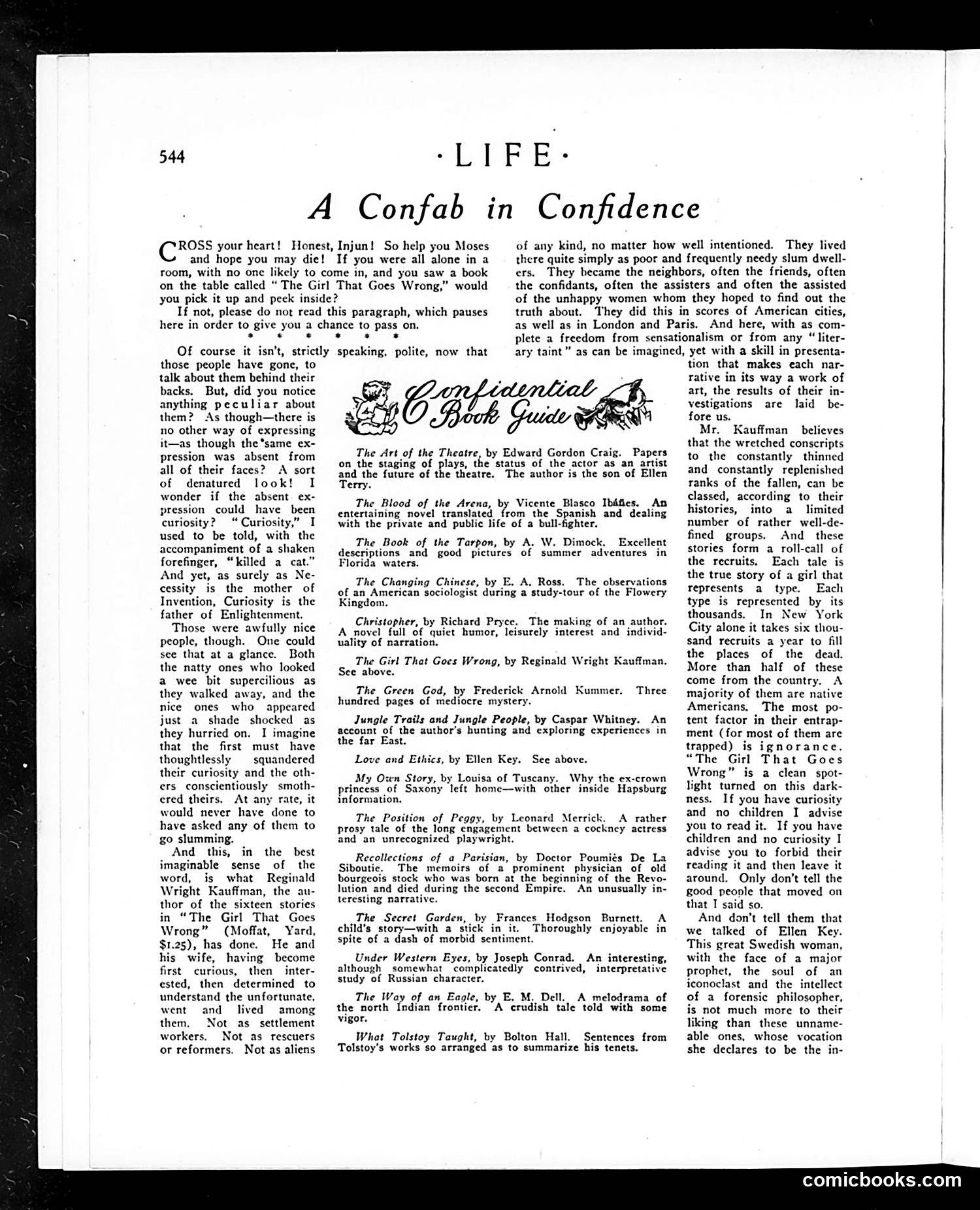
What you’re looking at
This page is primarily a book review section titled "A Confab in Confidence." The opening uses a colloquial challenge to readers' curiosity ("Cross your heart! Honest, Injun!"), joking that they'd secretly peek at a scandalous book titled *The Girl That Goes Wrong* if left alone. The main review discusses Reginald Wright Kauffman's book of the same name—sixteen stories about poor women in urban slums. The reviewer praises Kauffman and his wife for living among the poor without pretense, neither as charity workers nor as outsiders, simply to understand their subjects authentically. The piece celebrates their work as honest sociological observation rather than sensationalist fiction. The review mocks the hypocrisy of "respectable" people who express curiosity about lower-class life but publicly condemn such interest as improper—comparing them to people returning from slumming tours with expressions conspicuously drained of genuine curiosity. The page concludes with capsule reviews of other contemporary books on various subjects (theater, bullfighting, exploration).
📄 Transcribed text from this page (OCR, searchable)
Machine-transcribed from the original scan — historical spelling and the odd misread are preserved.
LiPPE A Confab in Confidence @ress your heart! Honest, Injun! So help you Moses and hope you may die! If you were all alone in a room, with no one likely to come in, and you saw a book on the table called “ The Girl That Goes Wrong,” would you pick it up and peek inside? If not, please do not read this paragraph, which pauses here in order to give you a chance to pass on. . © © 8 8 @ Of course it isn’t, strictly speaking, polite, now that of any kind, no matter how well intentioned. They lived there quite simply as poor and frequently needy slum dwell- ers. They became the neighbors, often the friends, often the confidants, often the assisters and often the assisted of the unhappy women whom they hoped to find out the truth about. They did this in scores of American cities, as well as in London and Paris. And here, with as com- plete a freedom from sensationalism or from any “liter- ary taint” as can be imagined, yet with a skill in presenta- those people have gone, to talk about them behind their backs. But, did you notice anything peculiar about them? As though—there is no other way of expressing it—as though the*same ex- pression was absent from all of their faces? A sort of denatured look! I wonder if the absent ex- pression could have been curiosity? “Curiosity,” I used to be told, with the accompaniment of a shaken forefinger, “killed a cat.” And yet, as surely as Ne- cessity is the mother of Invention, Curiosity is the father of Enlightenment. Those were awfully nice people, though. One could sce that at a glance. Both the natty ones who looked a wee bit supercilious as they walked away, and the nice ones who appeared just a shade shocked as they hurried on. I imagine that the first must have thoughtlessly squandered their curiosity and the oth- ers conscientiously smoth- ered theirs. At any rate, it would never have done to have asked any of them to go slumming. And this, in the best imaginable sense of the word, is what Reginald Wright Kauffman, the au- thor of the sixteen stories in “The Girl That Goes Wrong” (Moffat, Yard, $1.25), has done. He and his wife, having become first curious, then inter- ested, then determined to understand the unfortunate, went and lived among them. Not as settlement workers. Not as rescuers or reformers. Not as aliens O hick Guar The Art of the Theatre, by Edward Gordon Craig. Papers on the staging of plays, the status of the actor as an artist and the future of the theatre. The author is the son of Ellen Terry. The Blood of the Arena, by Vicente Blasco Ibdfes. An entertaining novel translated from the Spanish and dealing with the private and public life of a bull-fighter. The Book of the Tarpon, by A. W. Dimock, Excellent descriptions and good pictures of summer adventures in Florida waters. The Changing Chinese, by E. A. Ross. The observations of an American sociologist during a study-tour of the Flowery Kingdom. Christopher, by Richard Pryce, The making of an author. A novel full of quiet humor, leisurely interest and individ- uality of narration. The Girl That Goes Wrong, by Reginald Wright Kauffman. See above. The Green God, by Frederick Arnold Kummer. hundred pages of mediocre mystery. Three Jungle Trails and Jungle People, by Caspar Whitney. An account of the author's hunting and exploring experiences in the far East. Love and Ethics, by Ellen Key. See above. My Own Story, by Louisa of Tuscany, Why the ex-crown princess of Saxony left home—with other inside Hapsburg information. The Position of Peggy, by Leonard Merrick, A rather prosy tale of the long engagement between a cockney actress and an unrecognized playwright. Recollections of a Parisian, by Doctor Poumiés De La Siboutic. The memoirs of a’ prominent physician of old bourgeois stock who was born at the beginning of the Revo- lution and died during the second Empire, An unusually in- teresting narrative. The Secret Garden, by Frances Hodgson Burnett. A child's story—with a stick in it. Thoroughly enjoyable in spite of a dash of morbid sentiment. Under Western Eyes, by Joseph Conrad. An interesting, although somewhat complicatedly contrived, interpretative study of Russian character. The Way of an Eagle, by E. M. Dell. A melodrama of the north Indian frontier. “A crudish tale told with some vigor. What Tolstoy Taught, by Bolton Hall. Sentences from Tolstoy's works so arranged as to summarize his tenets. tion that makes each nar- tative in its way a work of art, the results of their in- vestigations are laid be- fore us. Mr. Kauffman believes that the wretched conscripts to the constantly thinned and constantly replenished ranks of the fallen, can be classed, according to their histories, into a limited number of rather well-de- fined groups. And_ these stories form a roll-call of the recruits. Each tale is the true story of a girl that represents a type. Each type is represented by its thousands. In New York City alone it takes six thou- sand recruits a year to fill the places of the dead. More than half of these come from the country. A majority of them are native Americans, The most po- tent factor in their entrap- ment (for most of them are trapped) is ignorance. “The Girl That Goes Wrong” is a clean spot- light turned on this dark- ness. If you have curiosity and no children I advise you to read it. If you have children and no curiosity I advise you to forbid their reading it and then leave it around. Only don’t tell the good people that moved on that T said so. And don’t tell them that we talked of Ellen Key. This great Swedish woman, with the face of a major prophet, the soul of an iconoclast and the intellect of a forensic philosopher, is not much more to their liking than these unname- able ones, whose vocation she declares to be the in- comicbooks.com