
A complete issue · 60 pages · 1912
Life — March 7, 1912
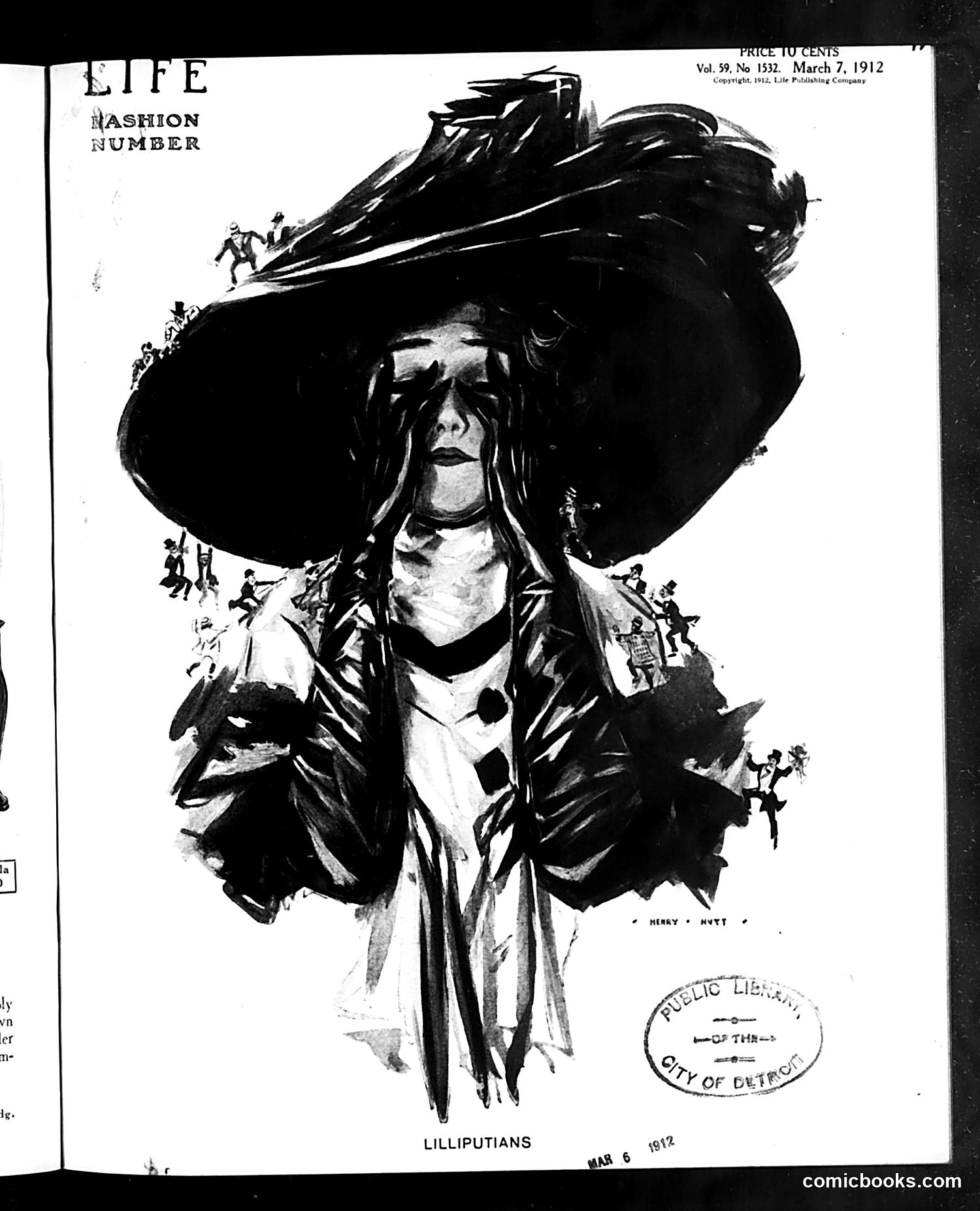
This is a Fashion Number cover titled "Lilliputians," depicting a woman wearing an enormous, elaborate hat decorated with tiny human figures crawling across it. The hat itself is oversized to the point of absurdity—dramatically wider than her head and shoulders. The satire targets the Edwardian-era fashion trend of extremely large, heavily decorated women's hats. These massive hats, sometimes adorned with feathers, flowers, and jewels, were fashionable but impractical and sometimes dangerous. By illustrating tiny people swarming across the hat like it's a landscape, the artist mocks the ridiculous scale and ostentation of high-fashion millinery. The cover critiques both the fashion industry's excess and women who adopted these impractical trends.
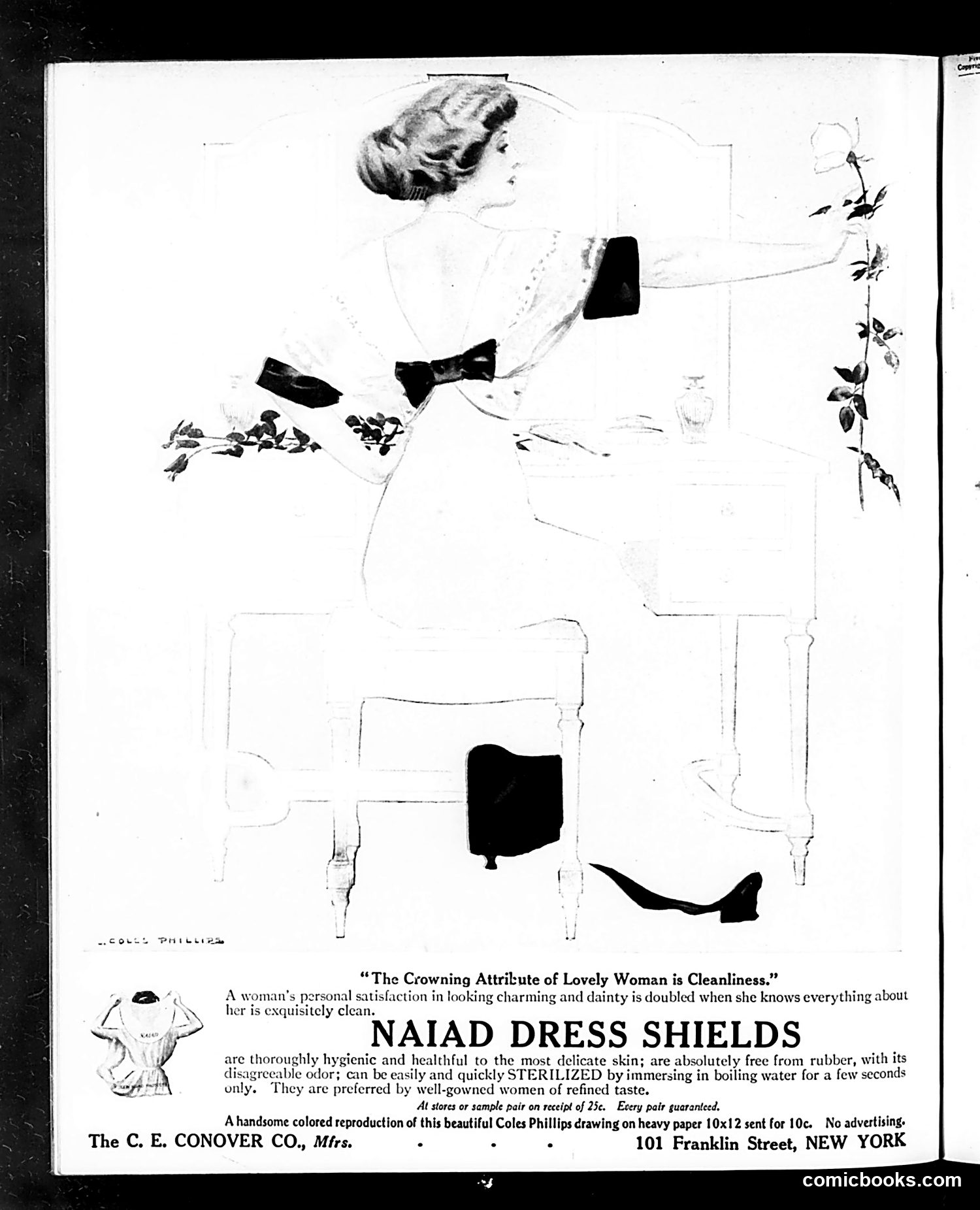
This page is primarily an **advertisement for Naiad Dress Shields**, not satire or political commentary. The drawing by Coles Phillips shows a fashionable woman in early 20th-century dress. The accompanying text promotes dress shields—absorbent fabric pads worn under clothing at the armpits—as essential for maintaining cleanliness and protecting garments from sweat stains and odor. The ad's tagline, "The Crowning Attribute of Lovely Woman is Cleanliness," reflects period attitudes linking femininity with hygiene. The product could be "sterilized" by boiling, addressing contemporary concerns about sanitation. This represents typical early-1900s advertising that capitalized on anxieties about bodily functions and social propriety, marketing practical undergarments as markers of refinement and taste.
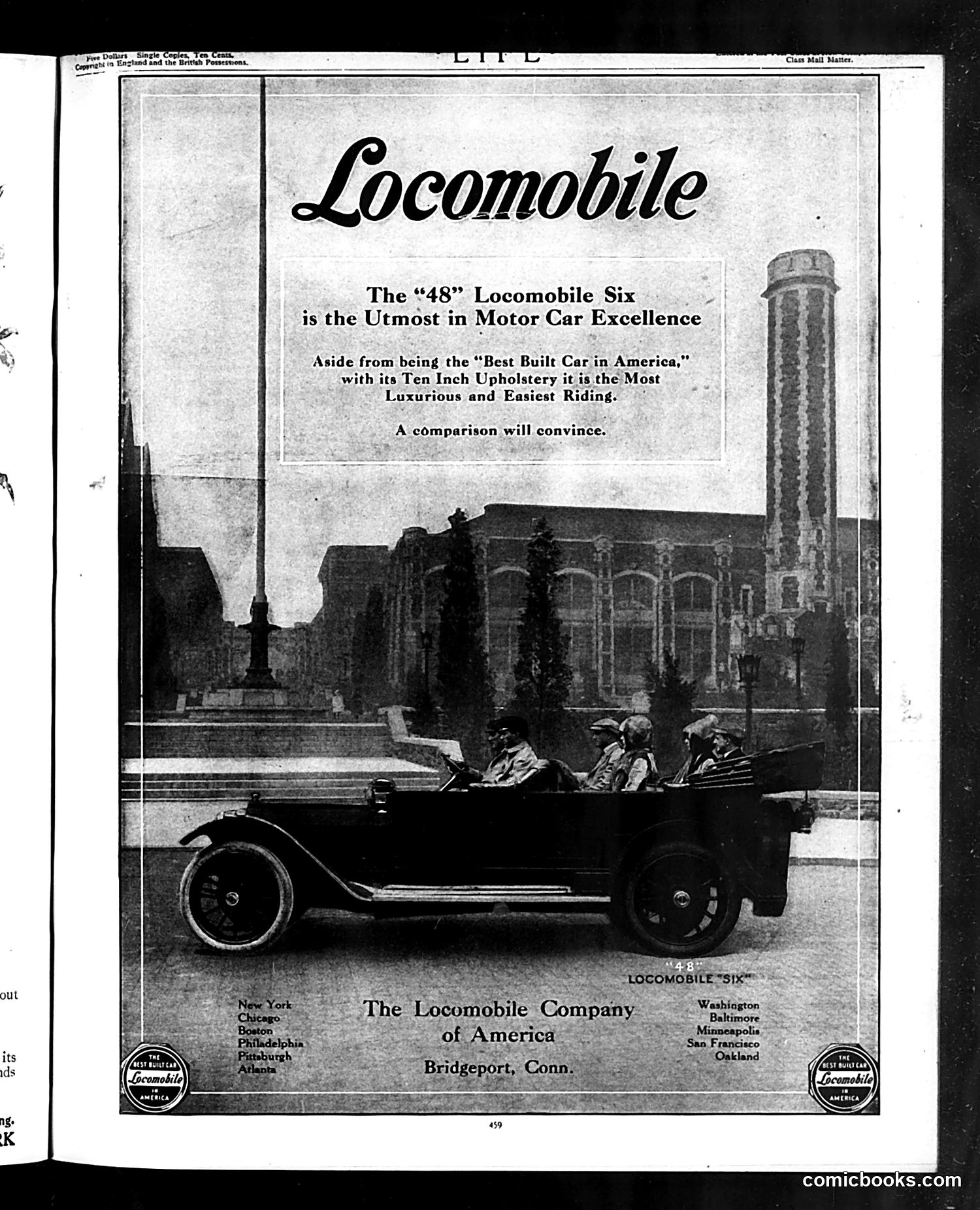
This page is **not a cartoon or satirical content** — it's a straightforward automobile advertisement for the Locomobile Company of America. The ad promotes the "48" Locomobile Six, claiming it represents "the Utmost in Motor Car Excellence" and "the Best Built Car in America." It emphasizes luxury features, specifically ten-inch upholstery for comfort. The image shows a well-dressed couple in an open-air automobile, positioned in front of an industrial building with a prominent smokestack — likely representing American manufacturing prowess and industrial progress. This appears in *Life* magazine, which by this era published both satirical content and advertising. This particular page is purely commercial, targeting affluent readers interested in premium automobiles during the early 20th century.
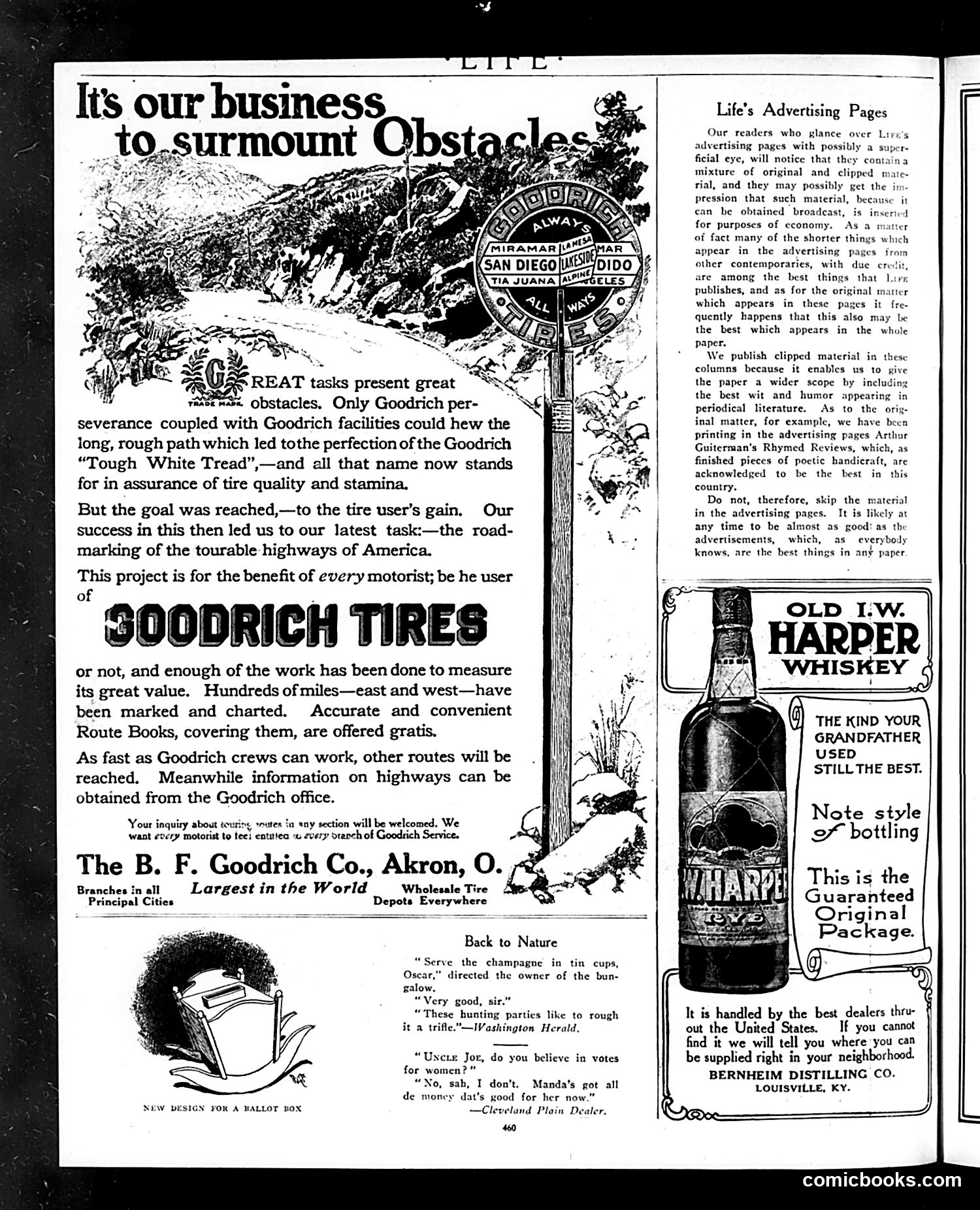
This page is primarily **advertising**, not political satire. The dominant content features: 1. **Goodrich Tires advertisement** (left): Emphasizes the company's role in marking America's highways as a public service. References overcoming obstacles and mentions the "Goodrich Tough White Tread" tire line. 2. **Old I.W. Harper Whiskey advertisement** (right): Promotes their product as "the kind your grandfather used," emphasizing authenticity and guaranteed original packaging. Distributed by Bernheim Distilling Co., Louisville, Kentucky. 3. **Small cartoon** (bottom left): Titled "New Design for a Ballot Box," shows a figure depositing something, likely satirizing women's suffrage—a contemporary political debate when this magazine published. The page reflects early 20th-century advertising alongside light political commentary on voting rights.
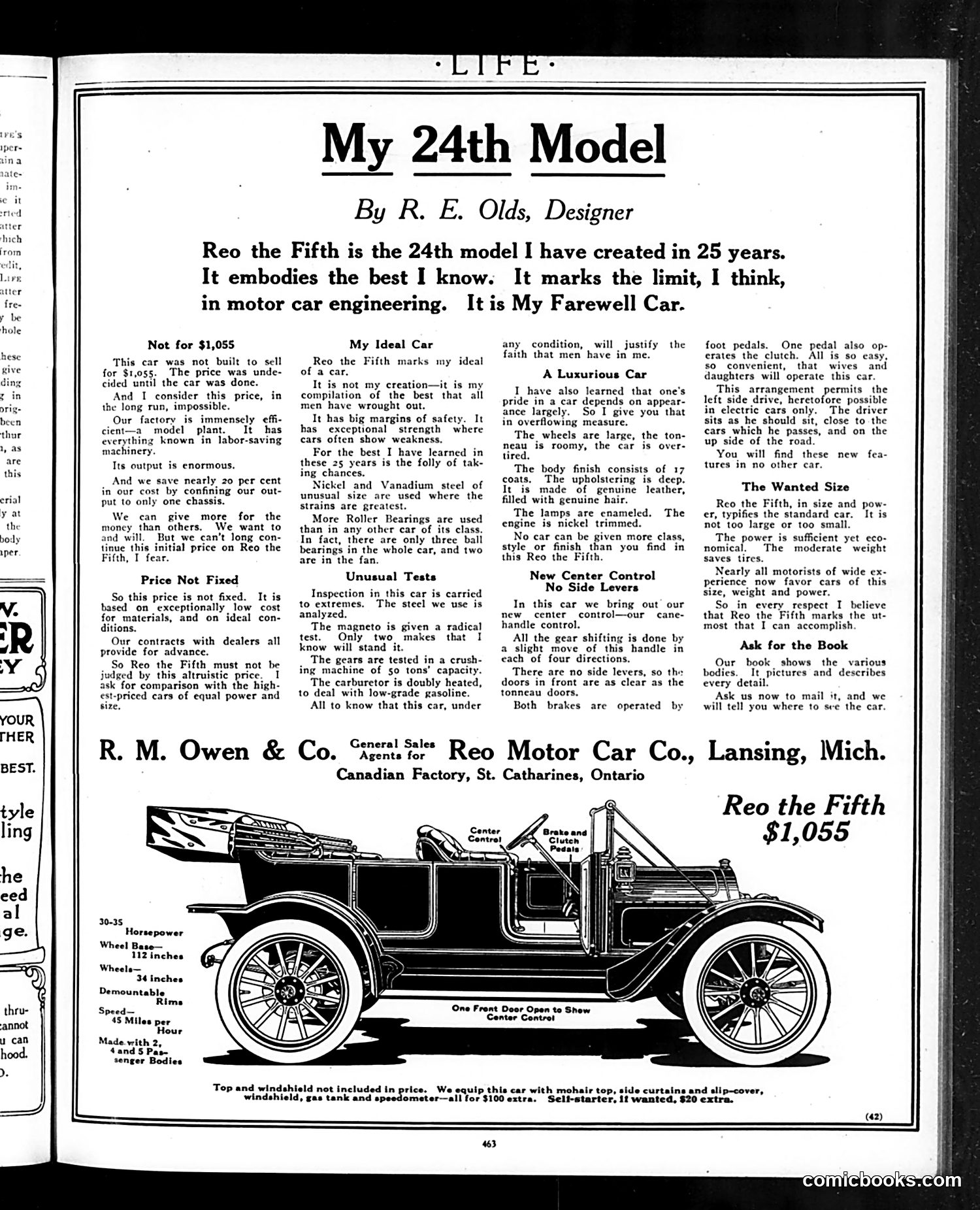
This is **not a political cartoon or satire**—it's a straightforward automobile advertisement from Life magazine. The page promotes the "Reo the Fifth," a 1920s motorcar priced at $1,055. Designer R. E. Olds presents this as his 24th model in 25 years and his "farewell car." The text emphasizes engineering innovations: nickel-vanadium steel, three ball bearings, heated carburetor, center control, and brake systems. The advertisement highlights practical features—foot pedals, left-side drive, no side levers—positioning the Reo as combining luxury with accessibility. The detailed technical specifications and the designer's personal endorsement were typical marketing strategies for competing automobiles in this era. R. M. Owen & Co. handled general sales; the Reo Motor Car Co. manufactured in Lansing, Michigan.
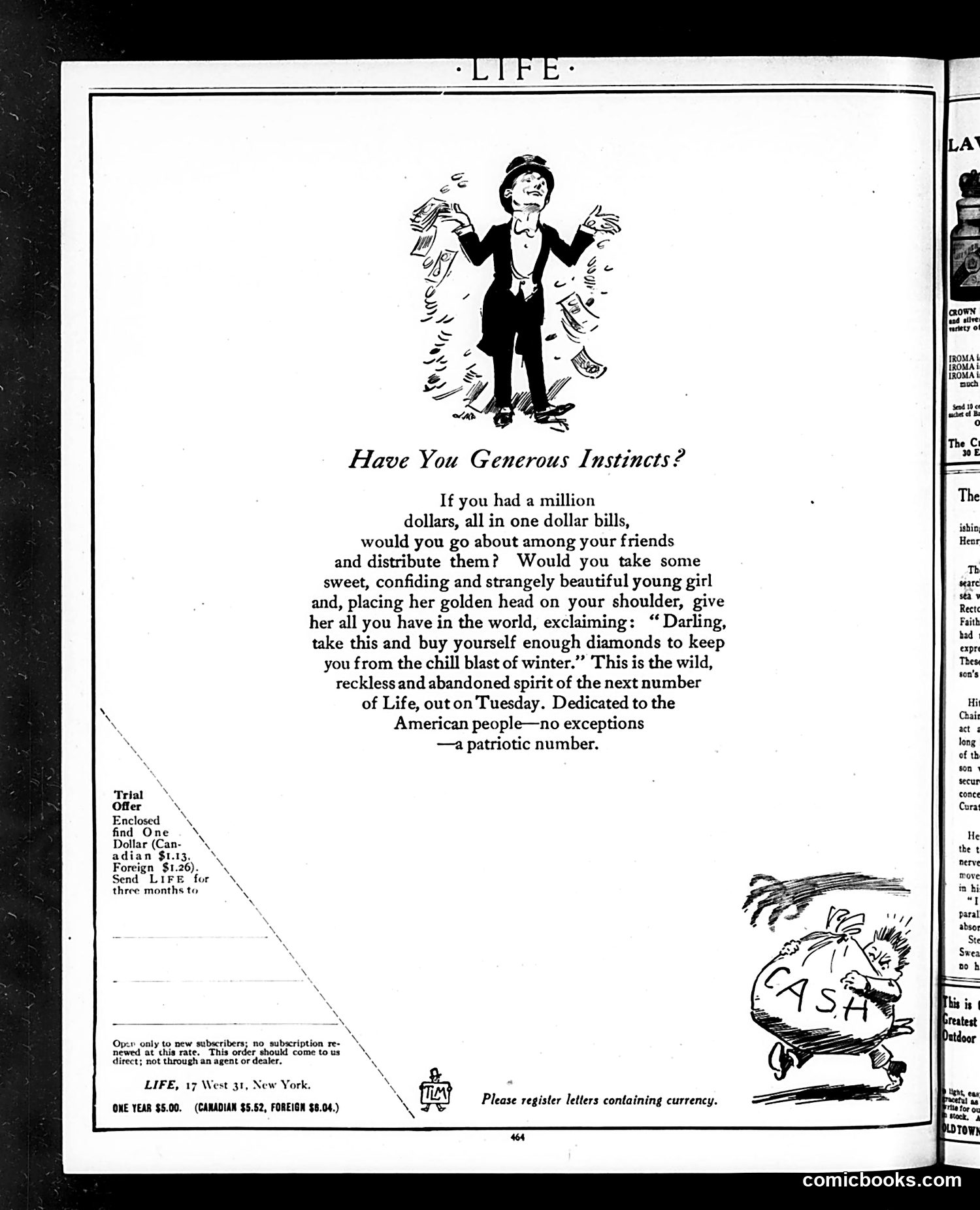
This is a subscription advertisement for *Life* magazine, not political commentary. The cartoon depicts a man showering money—specifically one-dollar bills—while juggling cash, illustrating a hypothetical scenario posed in the text. The ad asks readers: if given a million dollars in single bills, would they generously distribute money to friends and give everything to a romantic partner? The copy describes this as "the wild, reckless and abandoned spirit of the next number of Life, out on Tuesday"—promoting the upcoming issue as patriotic entertainment "dedicated to the American people—no exceptions." The illustration of a money bag labeled "CASH" at bottom-right reinforces the financial theme. This is primarily commercial advertising rather than satire.
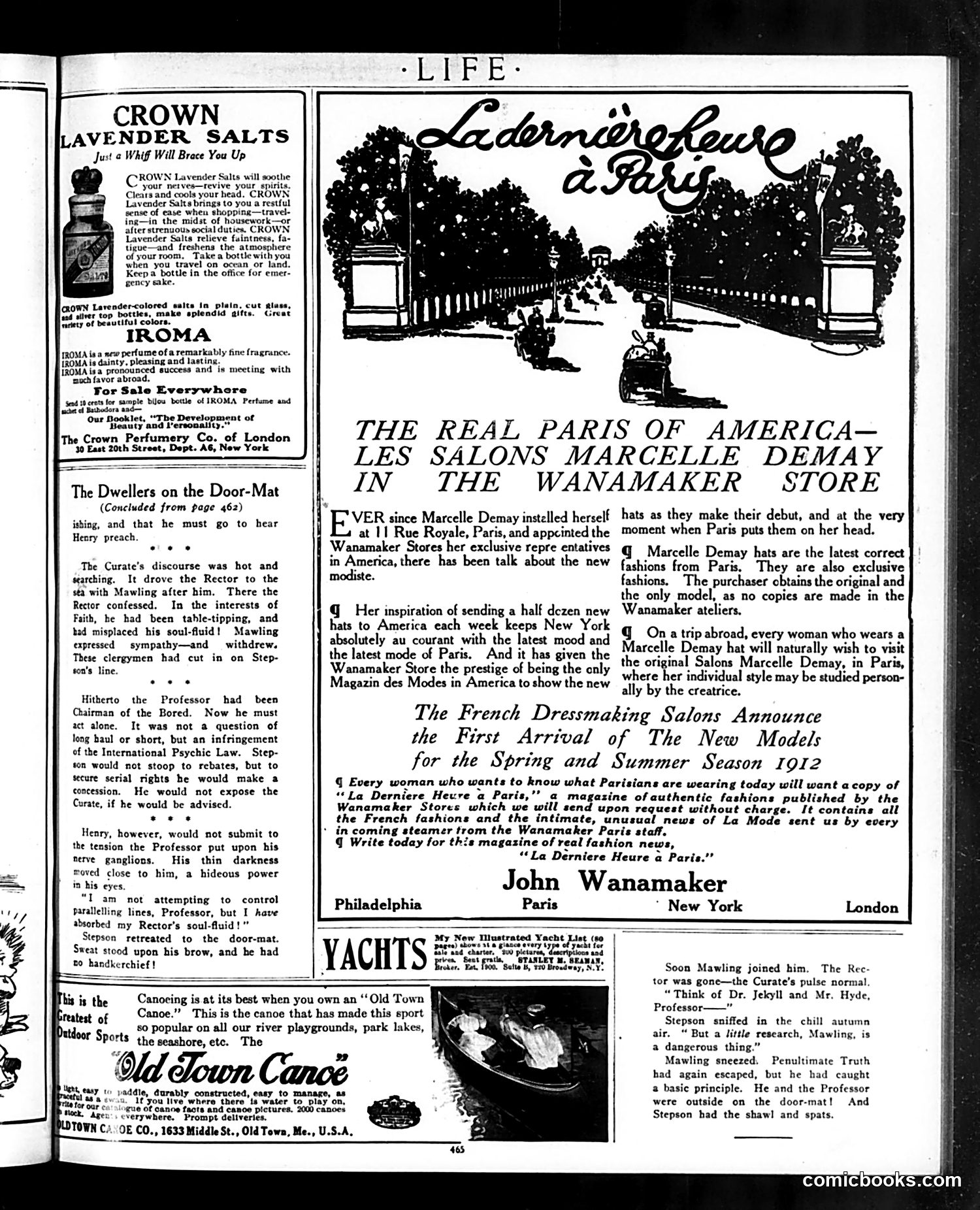
This page is primarily **advertising and serialized fiction** rather than political satire. The main content features: 1. **"Lachernoise à Paris"** - A romantic illustration advertising Paris fashion through the Wanamaker Store, promoting exclusive French designer models by Marcelle Demay 2. **"The Dwellers on the Door-Mat"** - Continued fiction about a Professor, Rector, and Curate in what appears to be a social comedy 3. **Product advertisements** for Crown Lavender Salts, Iroma perfume, Old Town Canoe, and a yacht listing The page reflects **1912 consumer culture**, marketing European sophistication and leisure activities to American readers. There is no evident political cartoon or satire—it's a commercial and entertainment page typical of Life's mixed format during this period.
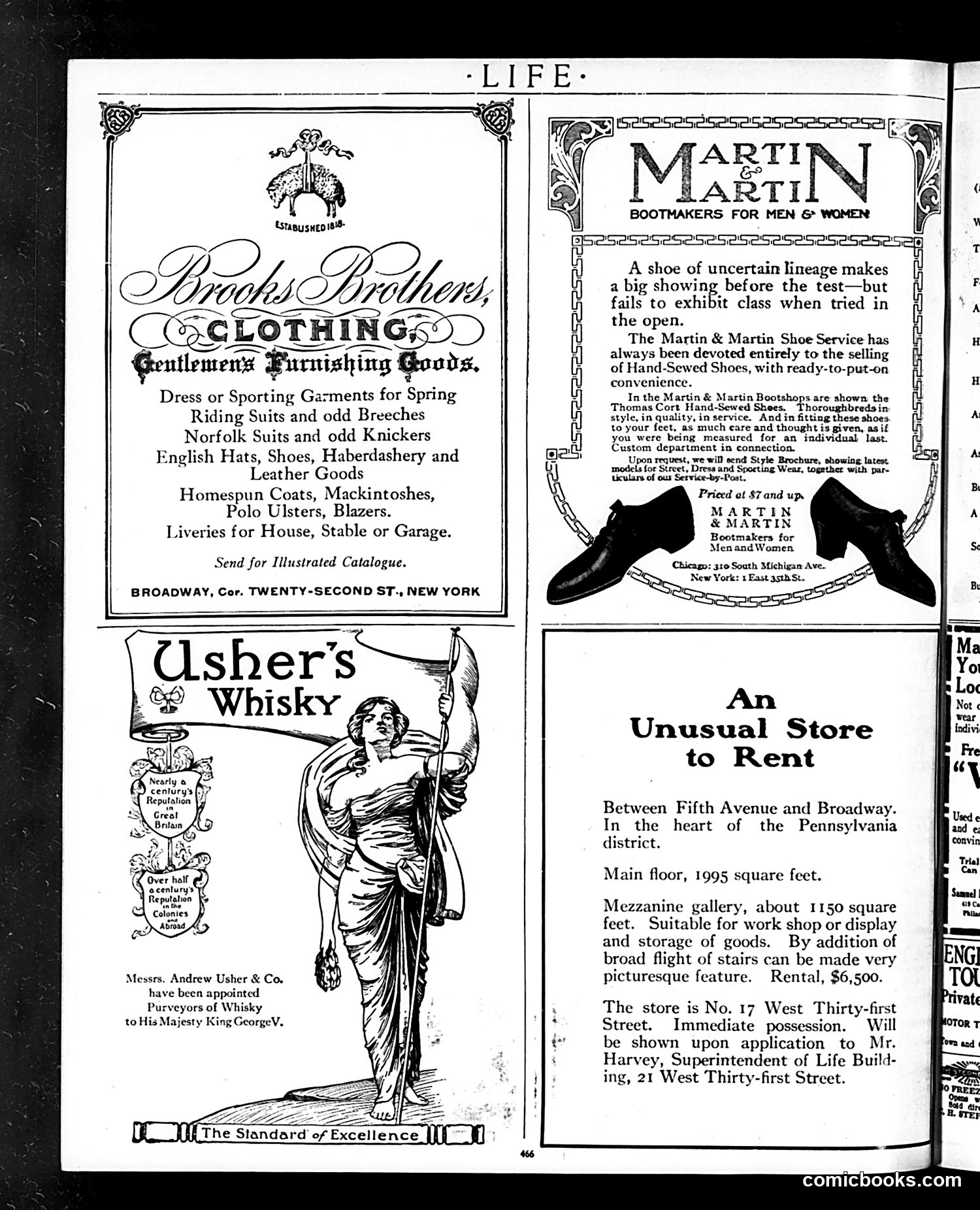
This page consists primarily of **advertisements rather than satirical content**. The visible ads include: 1. **Brooks Brothers** (top left) — clothing and gentlemen's furnishings at their Broadway location 2. **Martin & Martin** (top right) — bootmakers advertising hand-sewn shoes with ready-to-put-on convenience 3. **Usher's Whisky** (bottom left) — featuring a classical female figure, promoting "The Standard of Excellence" 4. **An Unusual Store to Rent** (bottom right) — commercial real estate listing for a space between Fifth Avenue and Broadway in Manhattan There is **no political cartoon or satirical content visible** on this page. It appears to be a standard advertising section from *Life* magazine, typical of early 20th-century publication layouts mixing commercial promotions with editorial content.
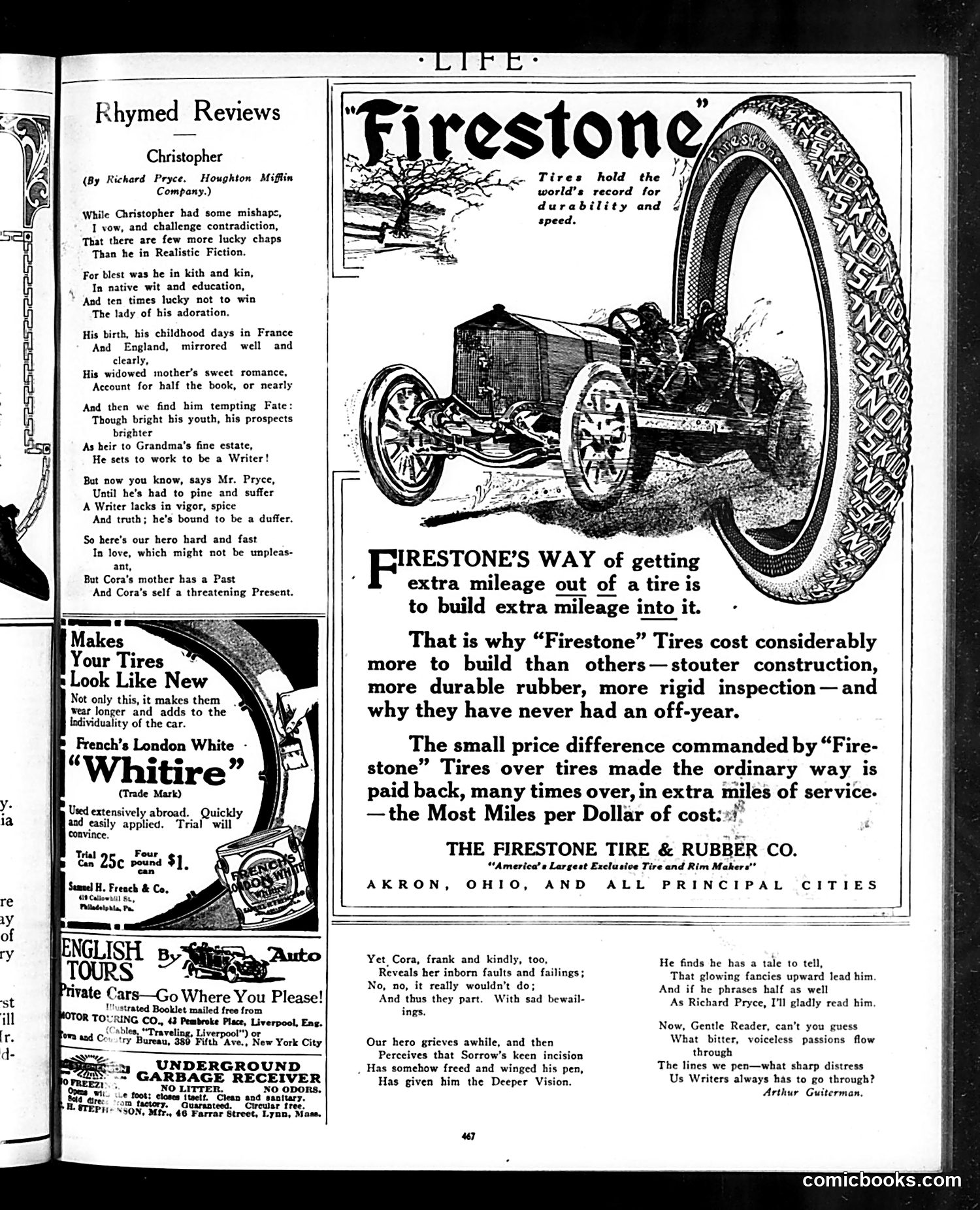
This page is primarily **advertising**, not satire or political commentary. The dominant content is a large Firestone Tire advertisement featuring an illustration of an early racing car with an oversized tire, promoting Firestone's manufacturing superiority and durability ("Most Miles per Dollar of cost"). The left column contains a **"Rhymed Review"** of a literary work called *Christopher* by Richard Pryce and Houghton Mifflin Company—a light, witty poem about a character's life and prospects. Below this are smaller advertisements for "Whitire" shoe polish and other products. The page's modest satirical content is the *Christopher* review itself, which gently jokes about the book's protagonist becoming a writer despite humble beginnings, but this is literary criticism rather than political satire.
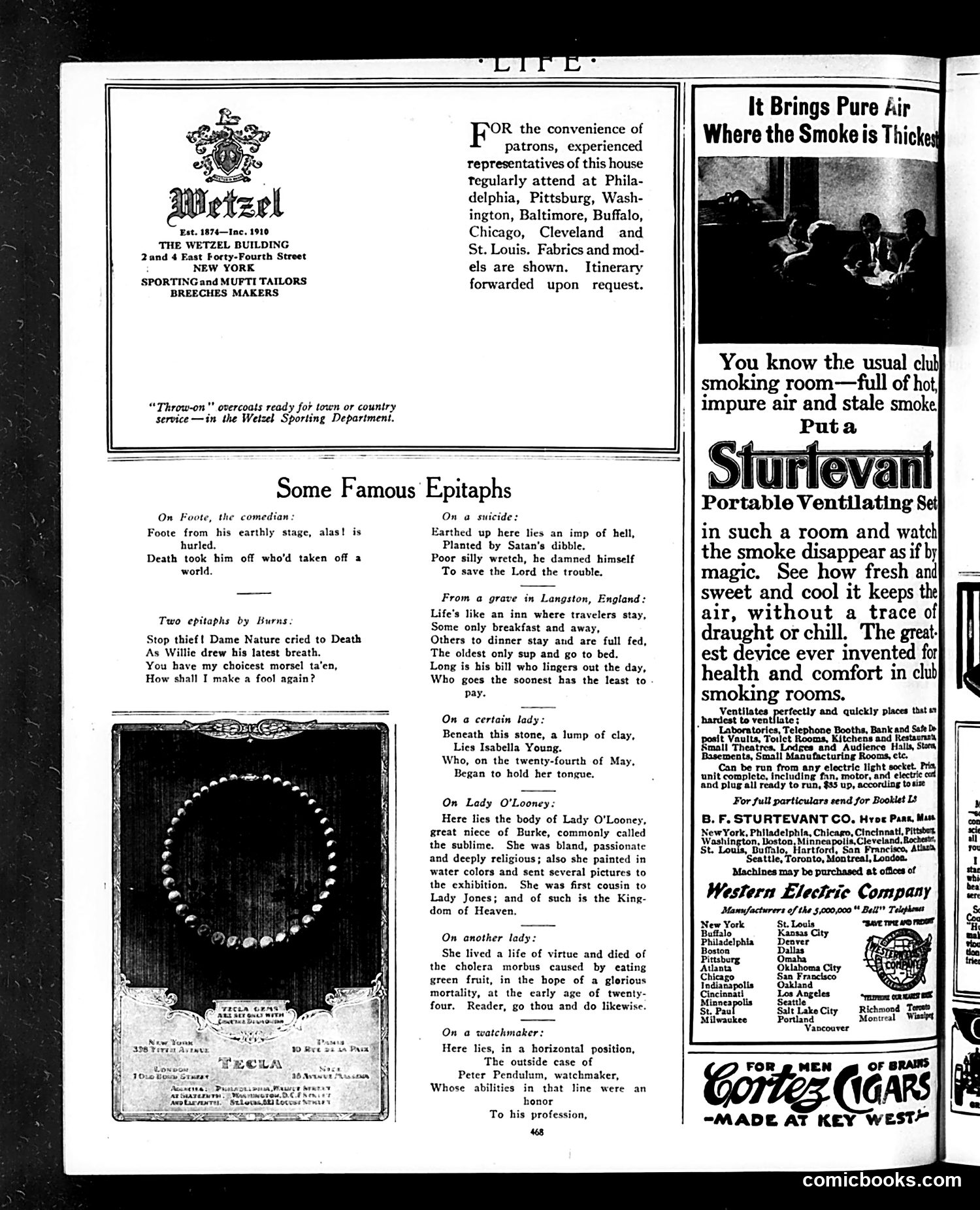
This page is primarily **advertising and editorial content** rather than political satire. The left side features: - A **Wetzel company advertisement** for sporting clothes and tailors (New York-based, established 1874) - A section titled "Some Famous Epitaphs" — **humorous mock gravestone inscriptions** for historical and literary figures like Foote (comedian), a suicide victim, and Lady O'Looney. These are witty, darkly comic verses playing on each person's notable characteristics or fate. The right side contains advertisements for the **Sturlevant Portable Ventilating Set** (promoting fresh air in smoking rooms) and **Cortes Cigars**. The epitaphs section represents typical early 20th-century *Life* magazine humor: clever wordplay on death, vice, and human folly aimed at educated readers.
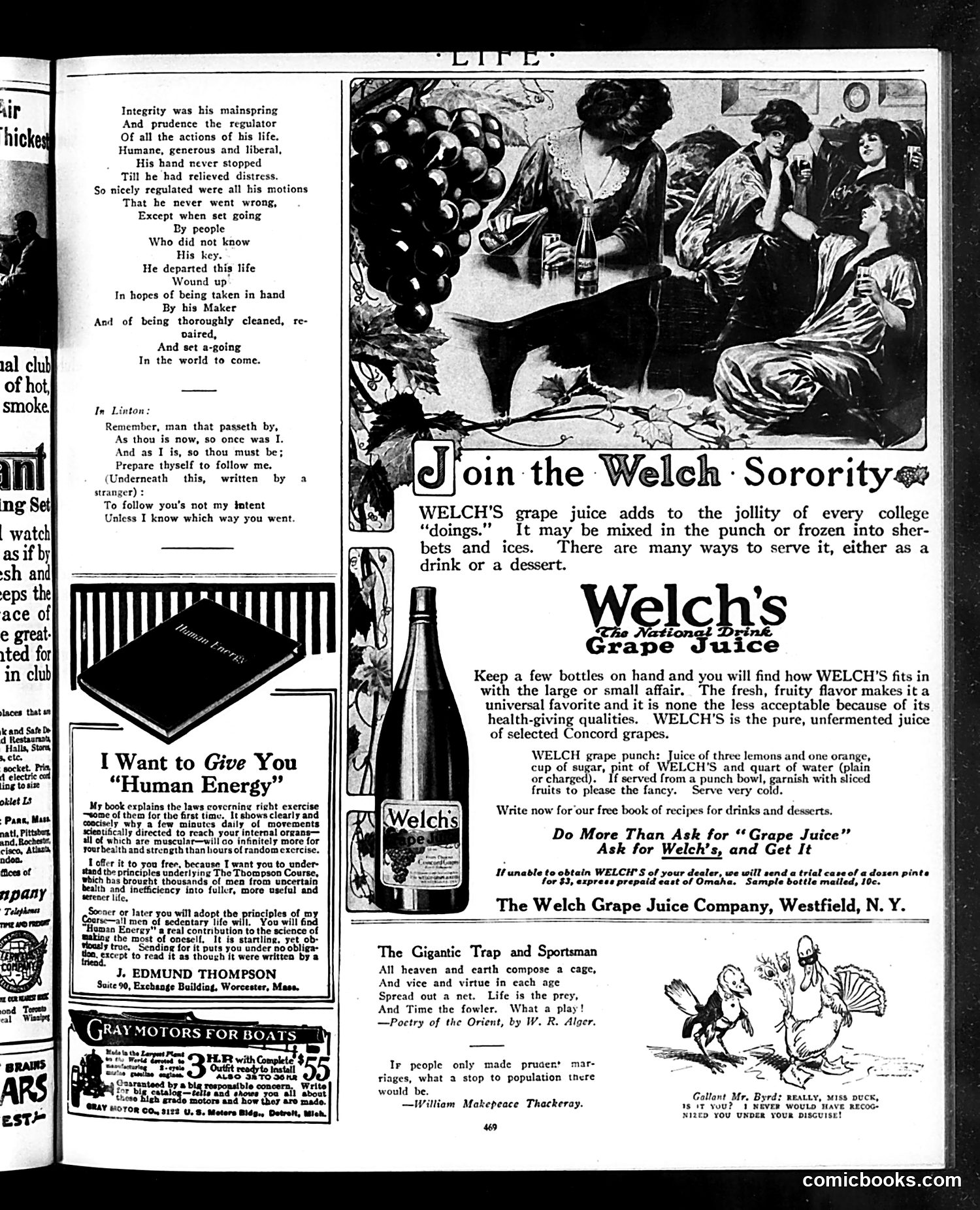
This page is **primarily advertising** rather than satire or political commentary. The dominant feature is a "Join the Welch Sorority" advertisement for Welch's Grape Juice, showing college women in a social gathering. The ad copy emphasizes the product's uses in punch, sherbets, and desserts—marketing grape juice as essential to college social events. The left side contains miscellaneous smaller ads and poetry, including Edmund Thompson's "I Want to Give You 'Human Energy'" promoting his exercise course. The bottom includes an unrelated poem about a "Gigantic Trap and Sportsman" and a cartoon showing figures hunting. This is a typical early-20th-century magazine page mixing editorial content with advertising, not a political cartoon page.
This is a **Packard Motor Car Company advertisement** from *Life* magazine. It's not a cartoon but rather a full-page ad for the Packard "Six" automobile model. The ad employs a clever marketing strategy, using the phrase "Ask the man who owns one" as its headline (visible at top in italics). The central message claims that owning and driving a Packard "Six" is itself the best proof of the car's quality—the experiential ride speaks louder than specifications. The advertisement targets wealthy readers of *Life*, positioning the Packard as a luxury vehicle where personal experience validates superiority. The ornate border design and prominent Packard branding reinforce the car's upscale positioning. This was typical early-20th-century automotive advertising emphasizing owner satisfaction over technical details.
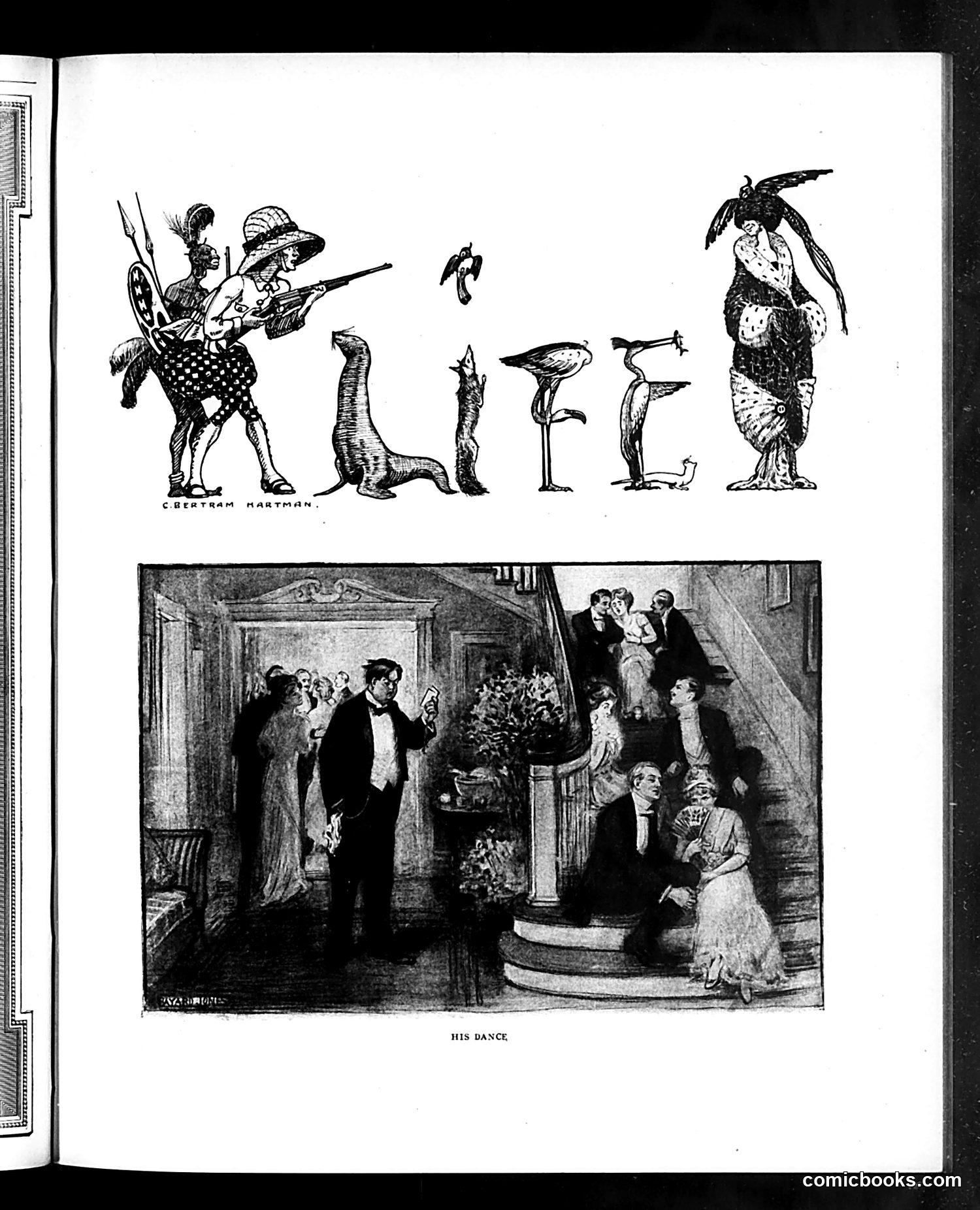
This page contains two distinct elements: **Top:** A decorative header spelling "LIFE" using anthropomorphic animal and human figures. Signed "Chertham Hartman," it's a playful visual pun rather than political commentary. **Bottom:** A scene titled "HIS DANCE" depicting a formal indoor gathering. A man in evening dress appears to be dancing or performing while well-dressed guests watch from various positions around an elegant room with a fireplace and classical architecture. The signature reads "Jno. Ames" (or similar). Without additional context or caption text explaining the specific social or political reference, the cartoon's precise satirical meaning is unclear. It may mock fashionable society behavior or a particular public figure's dancing, but the specific target and joke remain ambiguous to modern viewers without more information.
This Life magazine page (March 7, 1912) discusses potential Democratic and Republican candidates for the upcoming presidential election. The article debates whether Charles Evans Hughes might be nominated by Republicans as an alternative to President Taft, and whether Democrats could run Hughes against their own candidate. The small cartoon shows a figure (likely representing a political operative or candidate) emerging from or associated with a basket, suggesting deception or hidden dealings in candidate selection. The broader text argues for a multi-party system rather than just two parties, and includes commentary on Colonel Roosevelt's political activities and the need for clearer campaign finance laws—notably, a quote opposing politicians who haven't "fairly earned" their dollars, reflecting Progressive Era concerns about money in politics.
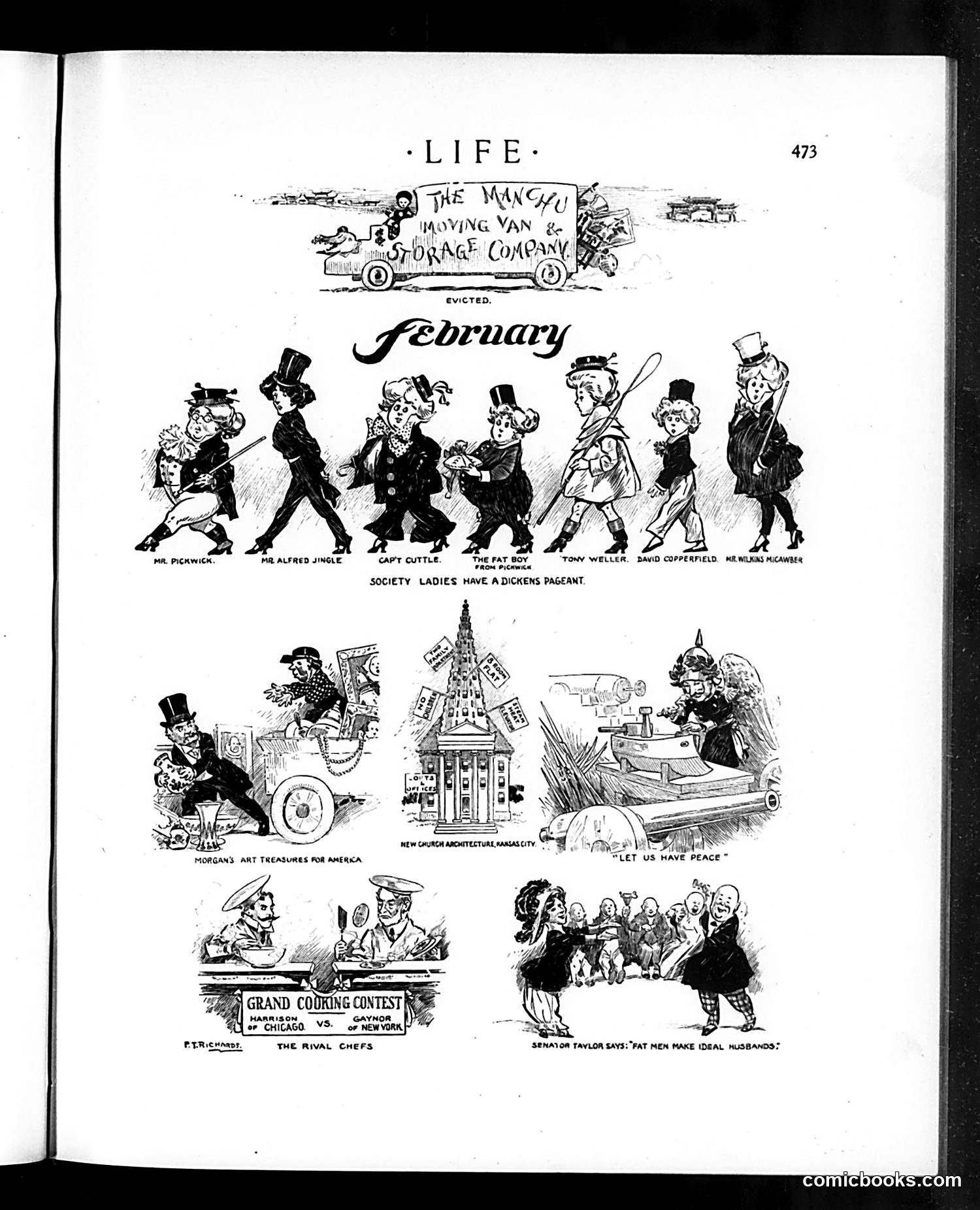
This page features satirical cartoons mocking contemporary events: **Top section**: "Society Ladies Have a Dickens Pageant" shows figures dressed as Dickens characters (Pickwick, Alfred Jingle, Captain Cuttle, etc.) in a theatrical procession—likely satirizing wealthy women's elaborate costume pageants as pretentious social theater. **Middle cartoons** reference topical issues: "Morgan's Art Treasures for America" (likely about J.P. Morgan's art collecting), "New Church Architecture Mania City," and "Let Us Have Peace" (possibly referencing political calls for peace). **"Grand Cooking Contest"** shows "Harrison of Chicago vs. Gaynor of New York"—appears to be rival chefs, likely satirizing famous culinary competition or prominent public figures. **Bottom**: Senator Taylor's quote "Fat Men Make Ideal Husbands" accompanies a domestic scene—satirizing contemporary advice columns or social commentary about marriage and masculinity. The overall tone mocks upper-class pretension, commercial excess, and dubious social wisdom of the era.
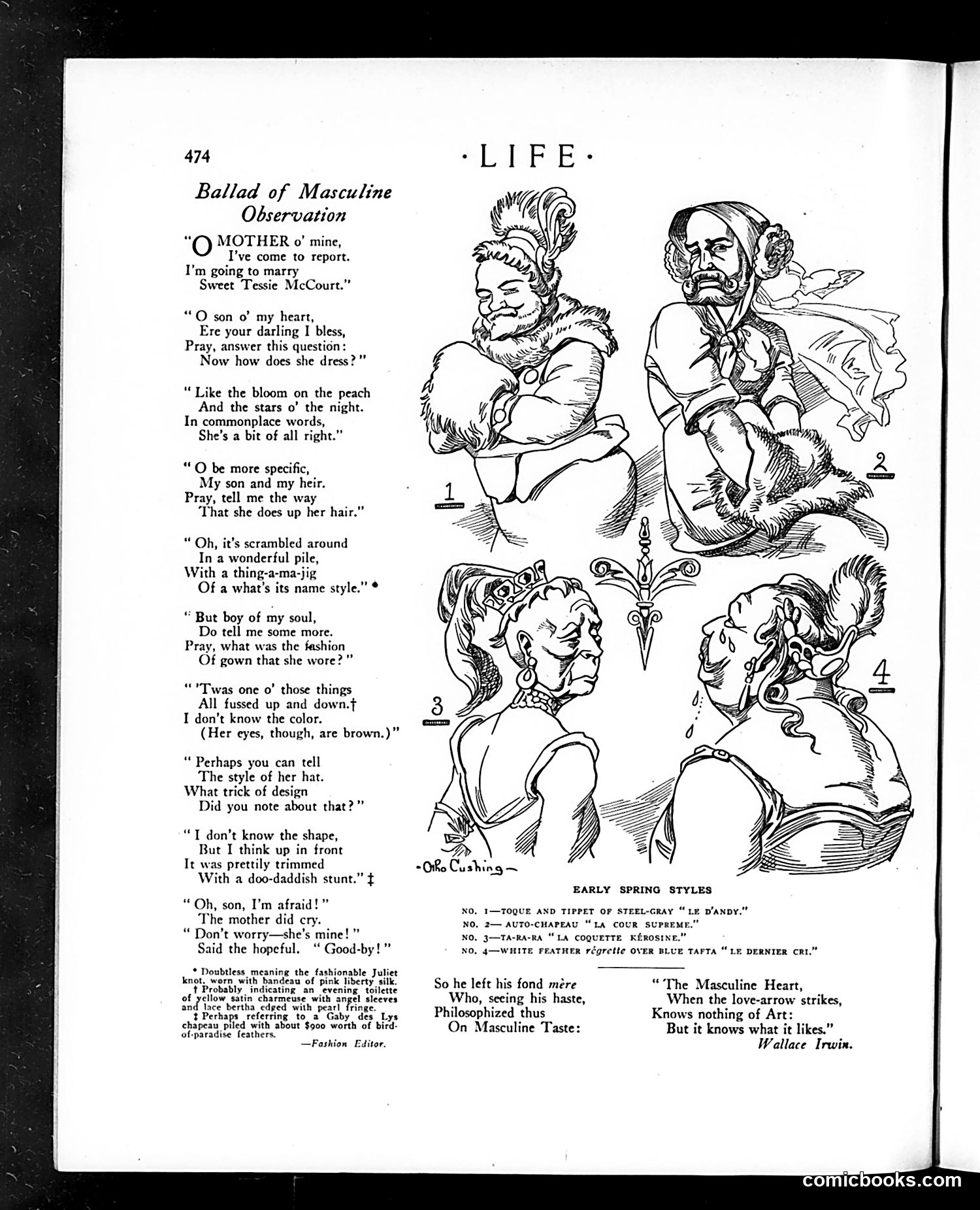
This 1910s *Life* magazine page satirizes masculine obliviousness to fashion. A son announces his engagement to "Sweet Tessie McCourt," but when his mother questions him about her appearance—her dress, hair, hat style—he cannot provide specifics, using vague phrases like "a thing-a-ma-jig" and "doo-daddish stunt." The satire targets men's perceived indifference to women's elaborate clothing and fashion details, which the era considered vitally important. The footnotes mock this gap: the mother's cryptic questions likely reference specific, expensive fashions (a "$900" hat trimmed with bird-of-paradise feathers), while the son notices only her brown eyes. The accompanying fashion illustrations (numbered 1-4) show actual "Early Spring Styles" with elaborate hats and trimmings—emphasizing the complexity men supposedly ignore. The closing quote from Wallace Irwin drives the point home: men's hearts know "what it likes" but nothing of "Art"—meaning they lack appreciation for fashion's sophistication.
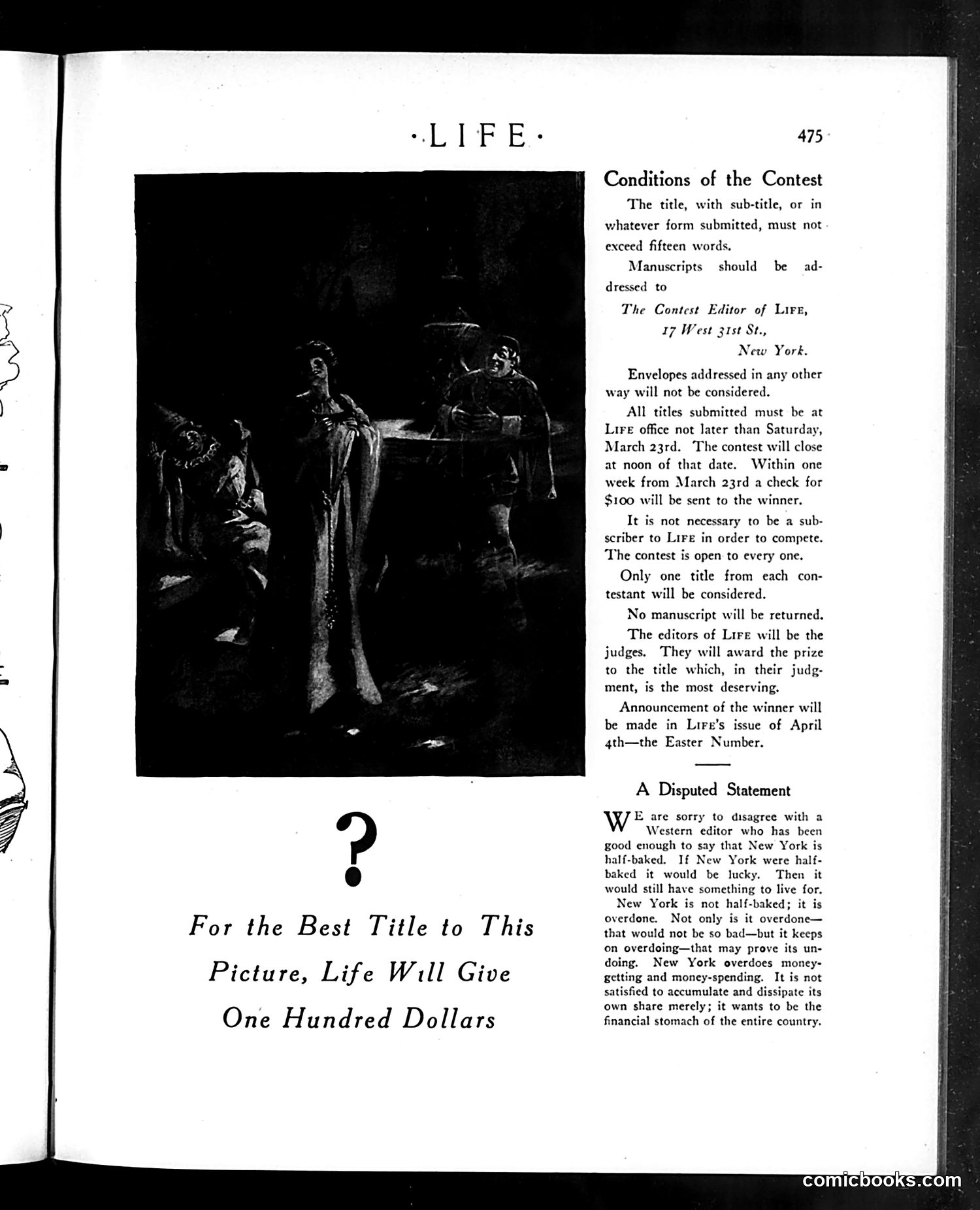
This page contains two distinct sections: **The Title Contest:** Life magazine displays a dramatic dark illustration (appears to show figures in classical or theatrical dress) and invites readers to submit captions for $100—a substantial prize in the early 20th century. The contest rules are clearly outlined, with deadline March 23rd. **"A Disputed Statement":** This is satirical commentary on New York City. Life defends the city against a Western editor's criticism that it's "half-baked." The satire's point: New York isn't *underdeveloped*—it's *overdone*. Life mocks the city's obsessive money-making and spending, suggesting New York's endless financial excess and ambition to dominate the nation's economy is self-destructive. The humor lies in the backhanded defense: agreeing the city has problems, just different ones than claimed. The piece reflects early 20th-century East Coast/West Coast cultural tensions and satirizes urban excess through financial critique.
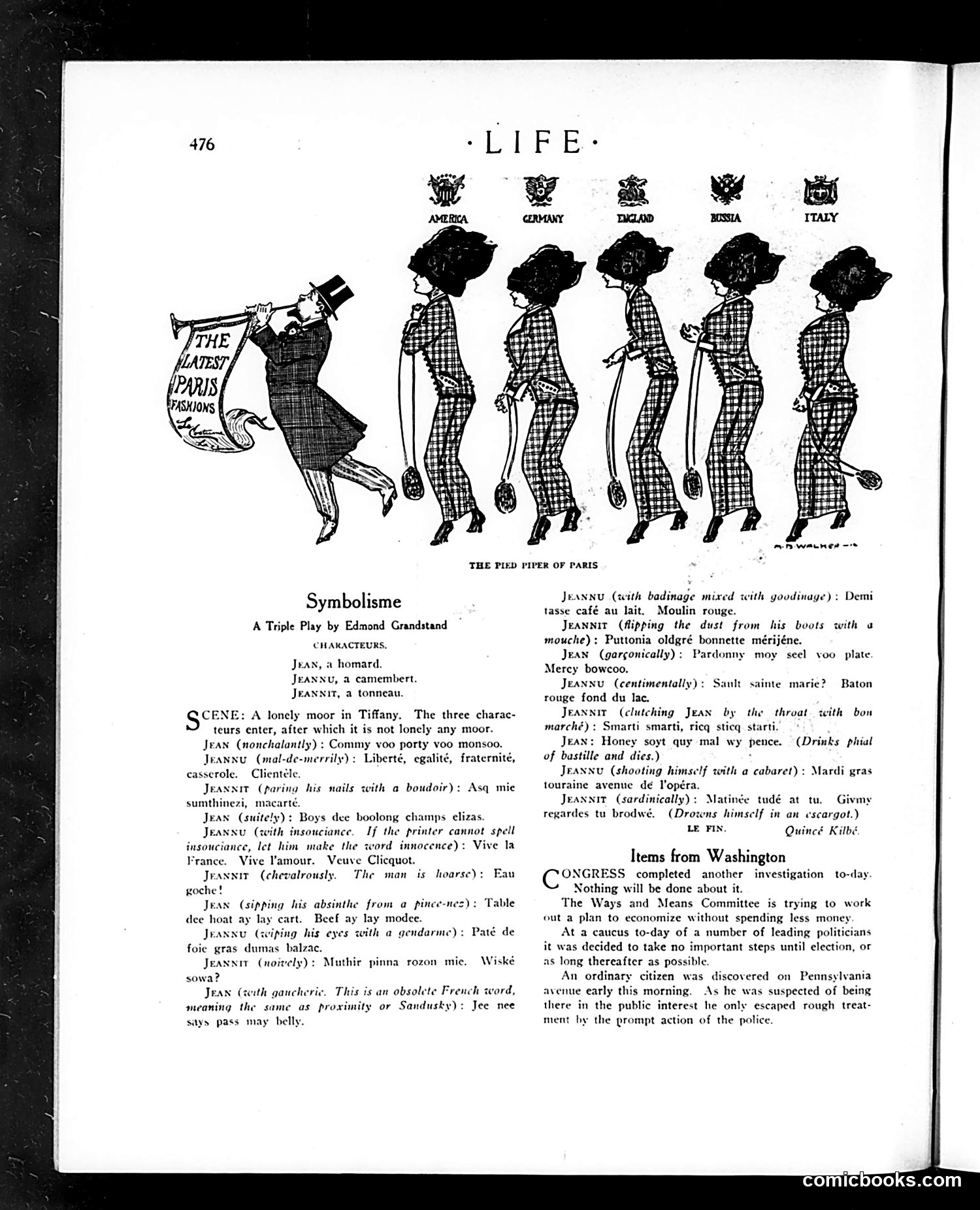
The top illustration shows a figure labeled "The Latest Fashions" playing a pipe while five women in identical checkered suits follow, each labeled with a major nation's emblem: America, Germany, England, Russia, and Italy. This is post-WWI political satire. The "Pied Piper" represents Paris (or French fashion/culture), and the five nations are depicted as mindlessly following French trends and influence, like the children in the fairy tale. The women's identical outfits suggest both fashion conformity and loss of national independence. Below is "Symbolisme," a farcical one-act play mocking pretentious French culture through absurdist dialogue filled with nonsensical pseudo-French and exaggerated stereotypes (absinthe, café au lait, dueling honor). It's a satire of bohemian Paris itself. The "Items from Washington" section provides domestic political commentary—Congress investigates nothing, politicians avoid action before elections, and ordinary citizens are treated roughly by authorities.
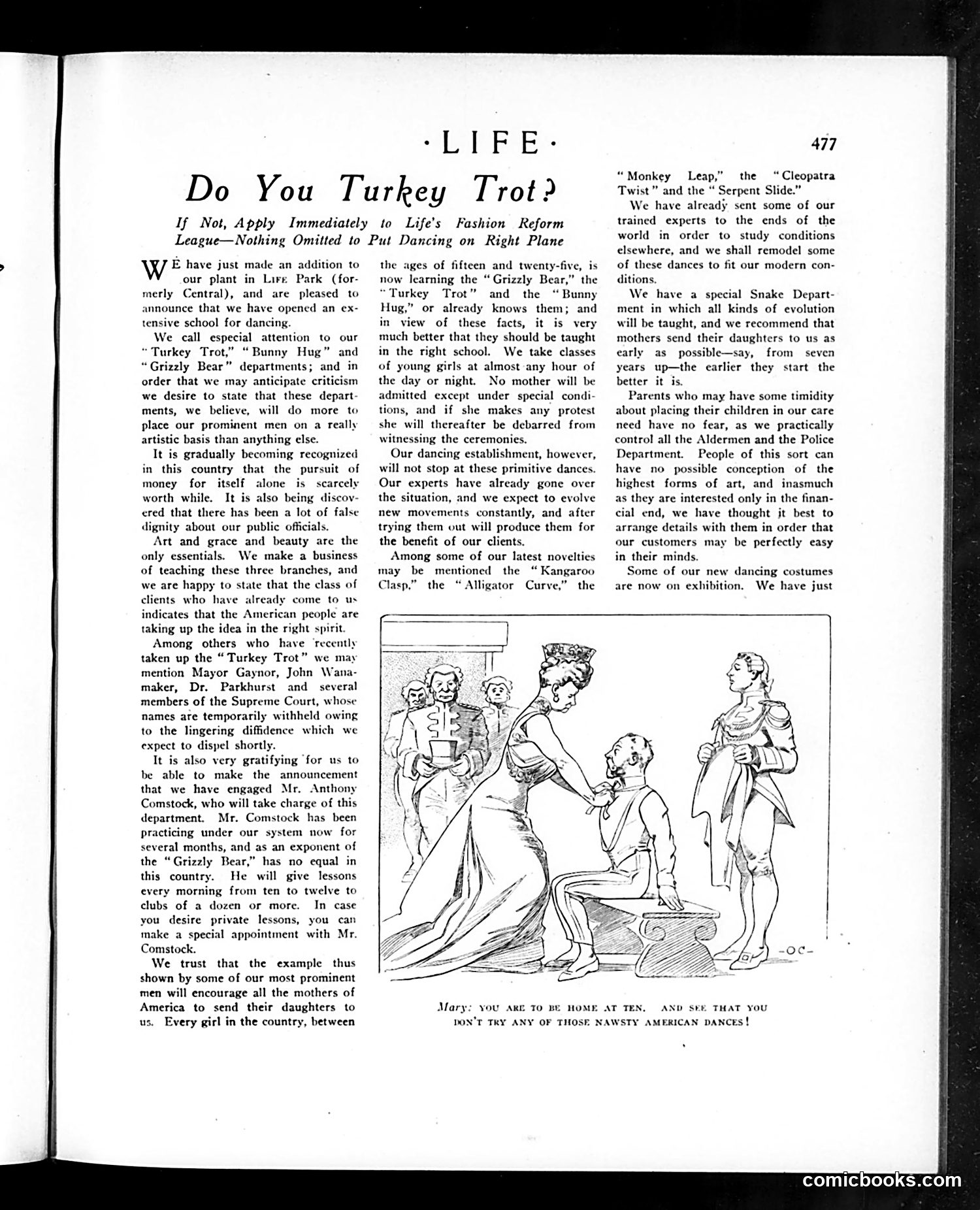
This is satirical commentary on the "Turkey Trot" and similar ragtime dances that scandalized 1910s America. Life mocks the dances' critics by pretending to establish a "Fashion Reform League" dancing school. The satire works through irony: the article claims these dances promote "art and grace and beauty" while naming real prominent figures—Mayor Gaynor, John Wanamaker, Dr. Parkhurst, and Supreme Court justices—as enthusiasts, implying even respectable leaders have embraced the controversial trend. The joke deepens by claiming Anthony Comstock (a real anti-vice crusader) now teaches the "Grizzly Bear." Comstock famously opposed such "immoral" dances, so attributing his endorsement is absurdly funny. The cartoon caption mockingly warns a girl named Mary against "naughty American dances," reinforcing that these dances were considered sexually improper and scandalous by conservative society. Life ridicules moral panic over modern dancing by treating it as inevitable and elite-approved.
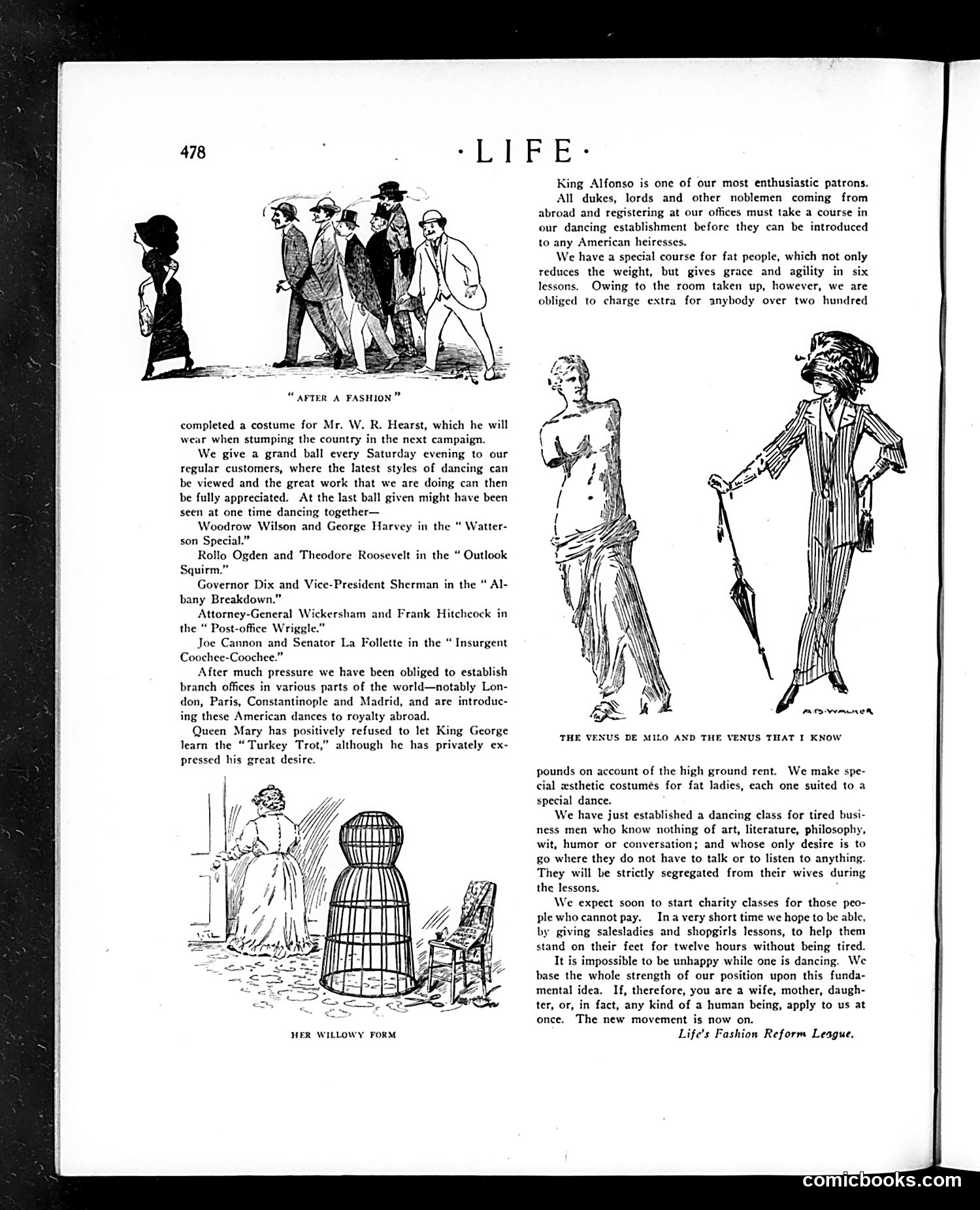
This Life magazine page satirizes the contemporary obsession with ballroom dancing as a tool for social advancement. The fictional "Life's Fashion Reform League" mocks how dancing studios marketed themselves to the wealthy and socially ambitious. Key targets include: **Social climbing**: The text jokes that foreign nobility must take dancing lessons before meeting American heiresses—suggesting American wealth trumps European titles. **Contemporary politicians as dancing partners**: The piece humorously pairs political rivals (Woodrow Wilson/Theodore Roosevelt, Joe Cannon/Senator La Follette) in dances with absurd names ("Turkey Trot," "Insurgent Coochee-Coochee"), mocking their public conflicts. **Body shaming**: A "special course for fat people" charges extra fees, satirizing the era's cruel commodification of weight loss. **Class pretension**: The cartoons contrast classical beauty ("Venus de Milo") with modern vanity. The "willowy form" illustration mocks artificial fashions. The overall joke: dancing studios promise happiness and social respectability to anyone willing to pay, exploiting human insecurity and social aspiration.
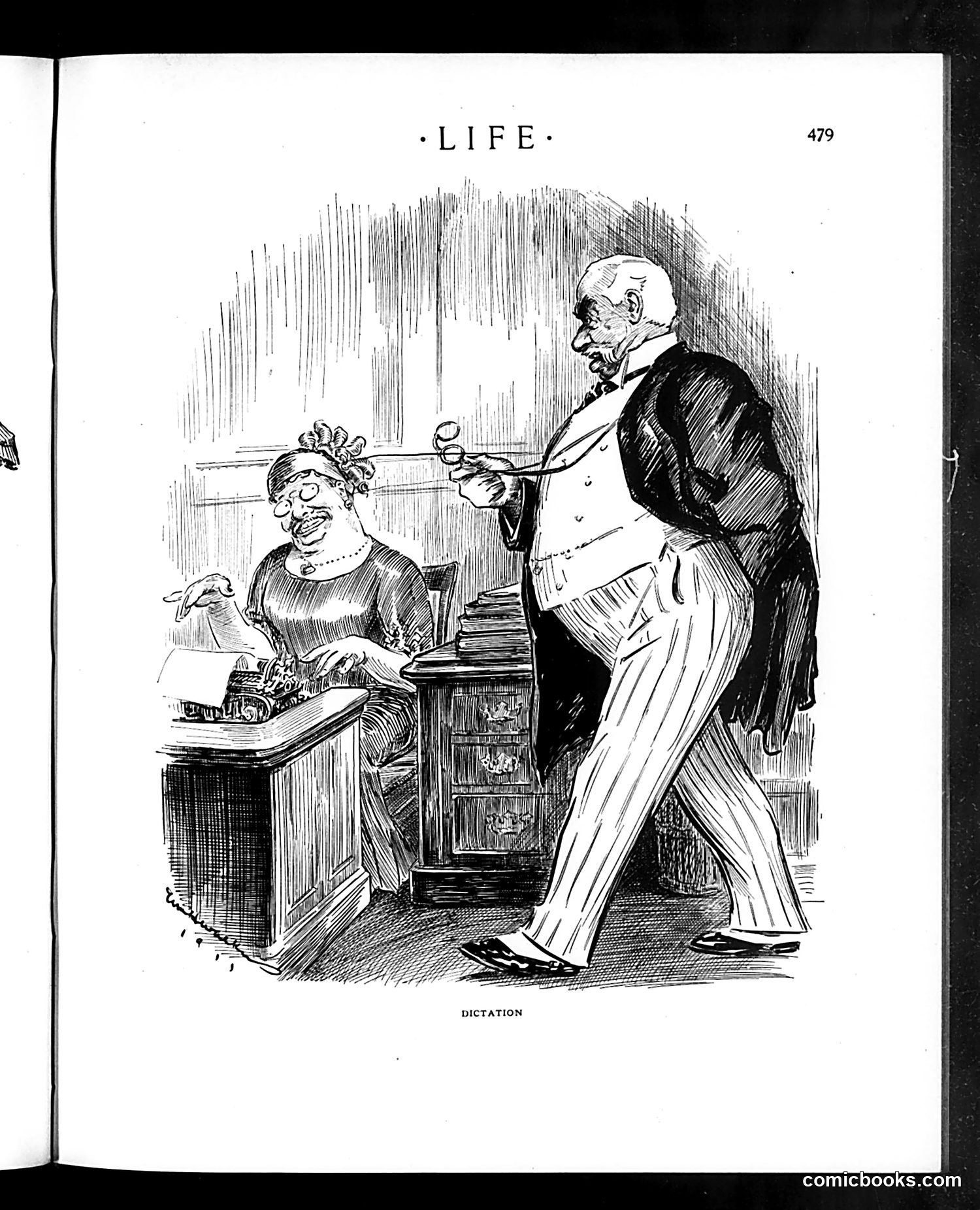
This cartoon satirizes the boss-secretary workplace dynamic. An elderly, well-dressed businessman stands over a seated female secretary, appearing to dictate while holding what looks like a stethoscope or pointer near her head. The exaggerated caricatures—his prominent nose and her plain features—suggest this is mocking pretentious workplace behavior. The satire likely targets either: (1) overbearing male authority in the office, or (2) the absurdity of overly formal "dictation" procedures. The stethoscope-like implement is unclear—it may reference medical examination or simply emphasize his intrusive manner. The cartoon reflects early-to-mid 20th century attitudes about gender roles in workplaces, where male bosses held complete authority over female clerical staff. The humor derives from exaggerating this power imbalance.
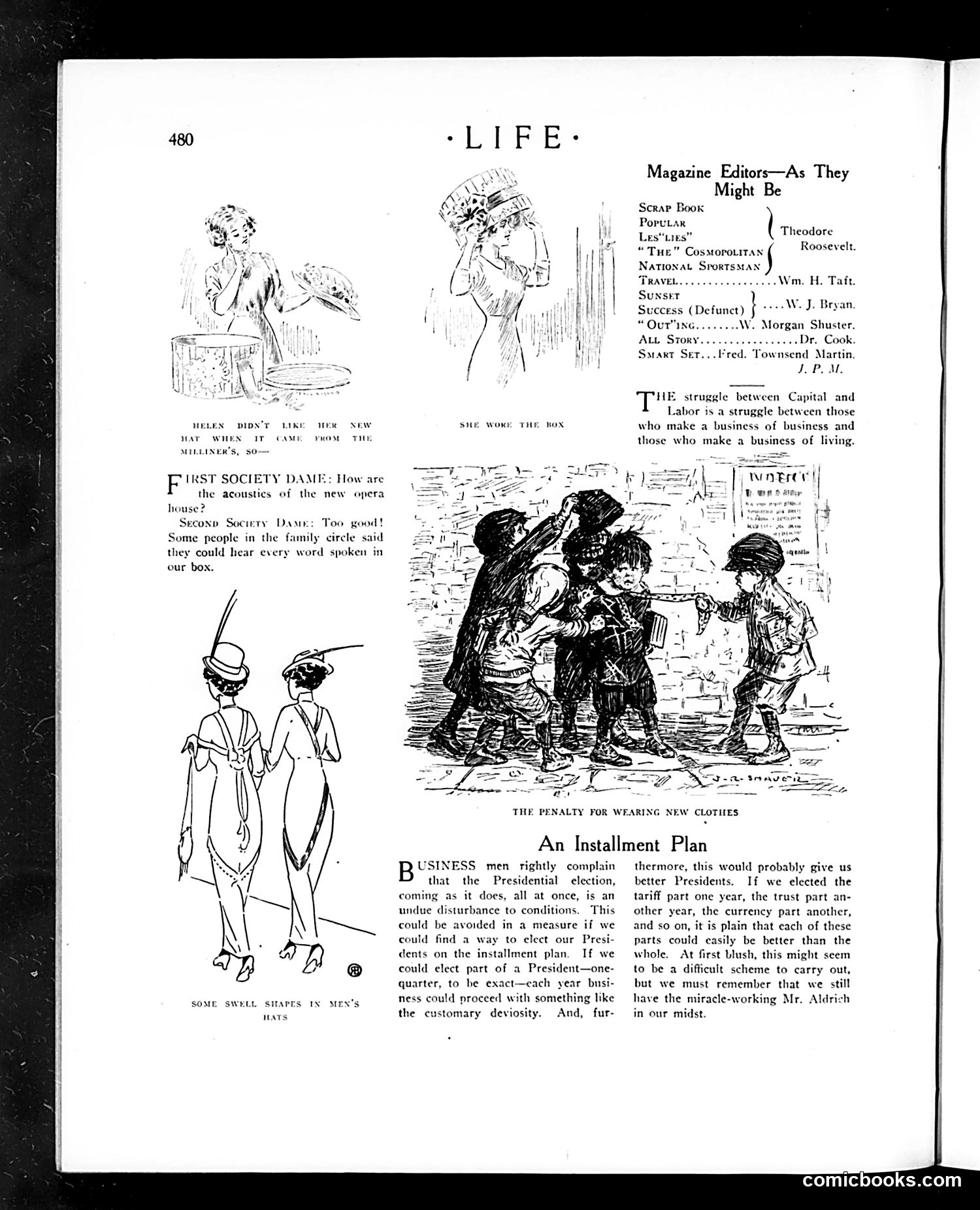
This page combines social satire with political commentary. The "Society Dame" joke mocks upper-class hypocrisy—the wealthy woman is horrified that an opera house's acoustics allow conversation to be heard, revealing she values exclusivity over quality. The "Magazine Editors" caricatures pair contemporary figures with publications, likely satirizing editorial bias (Theodore Roosevelt with "Scrap Book," William Howard Taft with "Travel," J.P. Morgan with financial interests). The main cartoon "Penalty for Wearing New Clothes" depicts street children mocking someone in new attire—satirizing class consciousness. "An Installment Plan" proposes electing Presidents piecemeal annually rather than wholesale every four years, claiming this would improve governance and reduce business disruption. The reference to "Mr. Aldrich" (likely Republican Senator Nelson Aldrich) sarcastically credits him with "miracle-working" financial manipulation—typical Progressive-era criticism of wealthy political insiders controlling tariffs and currency.
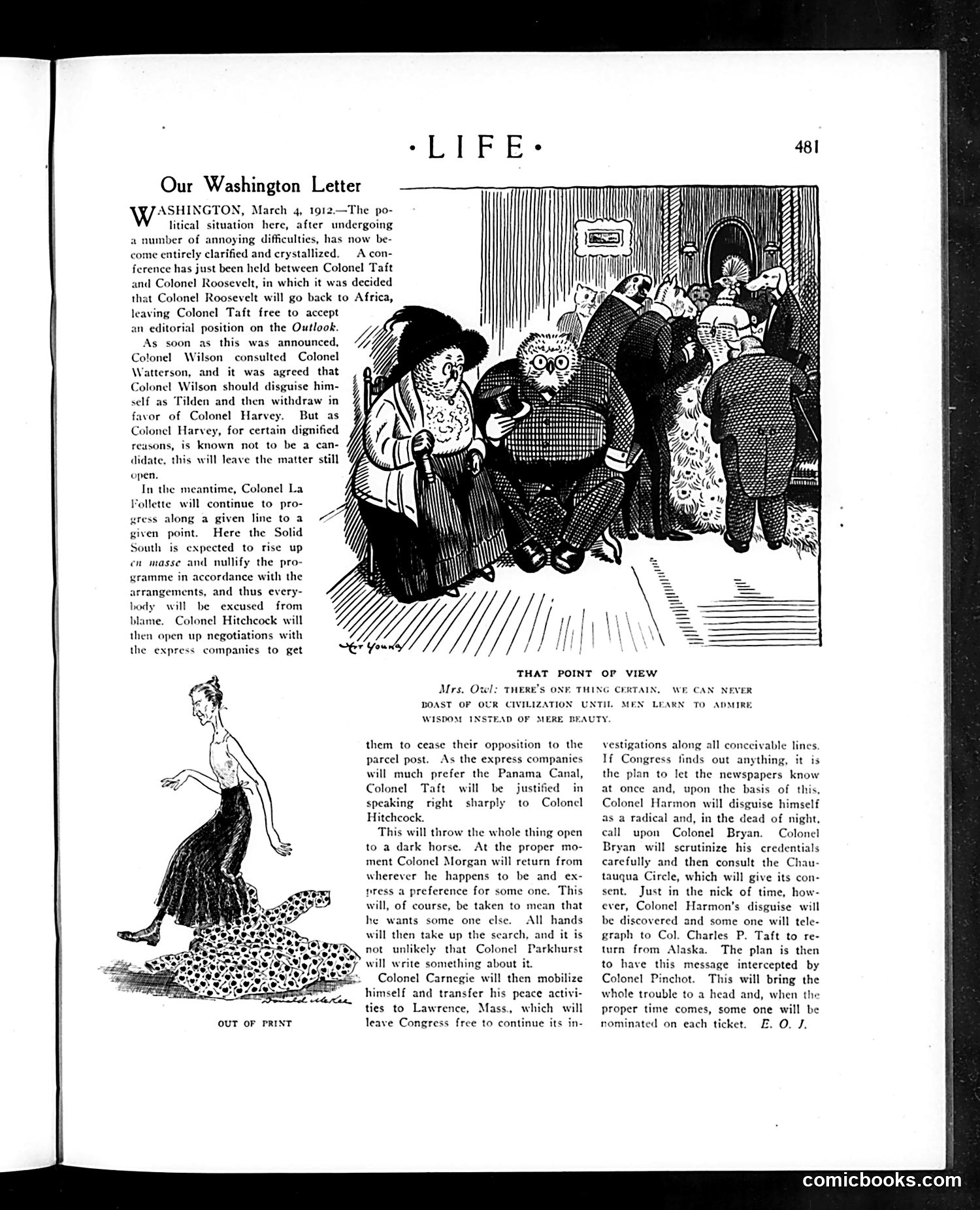
This is political satire about the 1912 presidential race. The "Washington Letter" mockingly describes an absurdly convoluted scenario where multiple prominent figures—Theodore Roosevelt, William Howard Taft, Woodrow Wilson, and various other political leaders—engage in circular maneuvering and backstabbing to determine the Republican nomination. The joke: the text satirizes how complicated and self-serving American politics had become, with powerful men constantly jockeying for position through elaborate schemes. References include Roosevelt going "back to Africa" (his famous 1909-1910 safari), Taft's editorial ambitions, and various senators and industrialists (Carnegie, Morgan, Pinchot) pulling strings behind scenes. The accompanying cartoons underscore this chaos: one shows a woman (Mrs. Owl) criticizing men's focus on superficial beauty over wisdom—a comment on politicians' shallow concerns. The lower cartoon labeled "OUT OF PRINT" depicts a woman tangled in a snake, suggesting political entanglement.
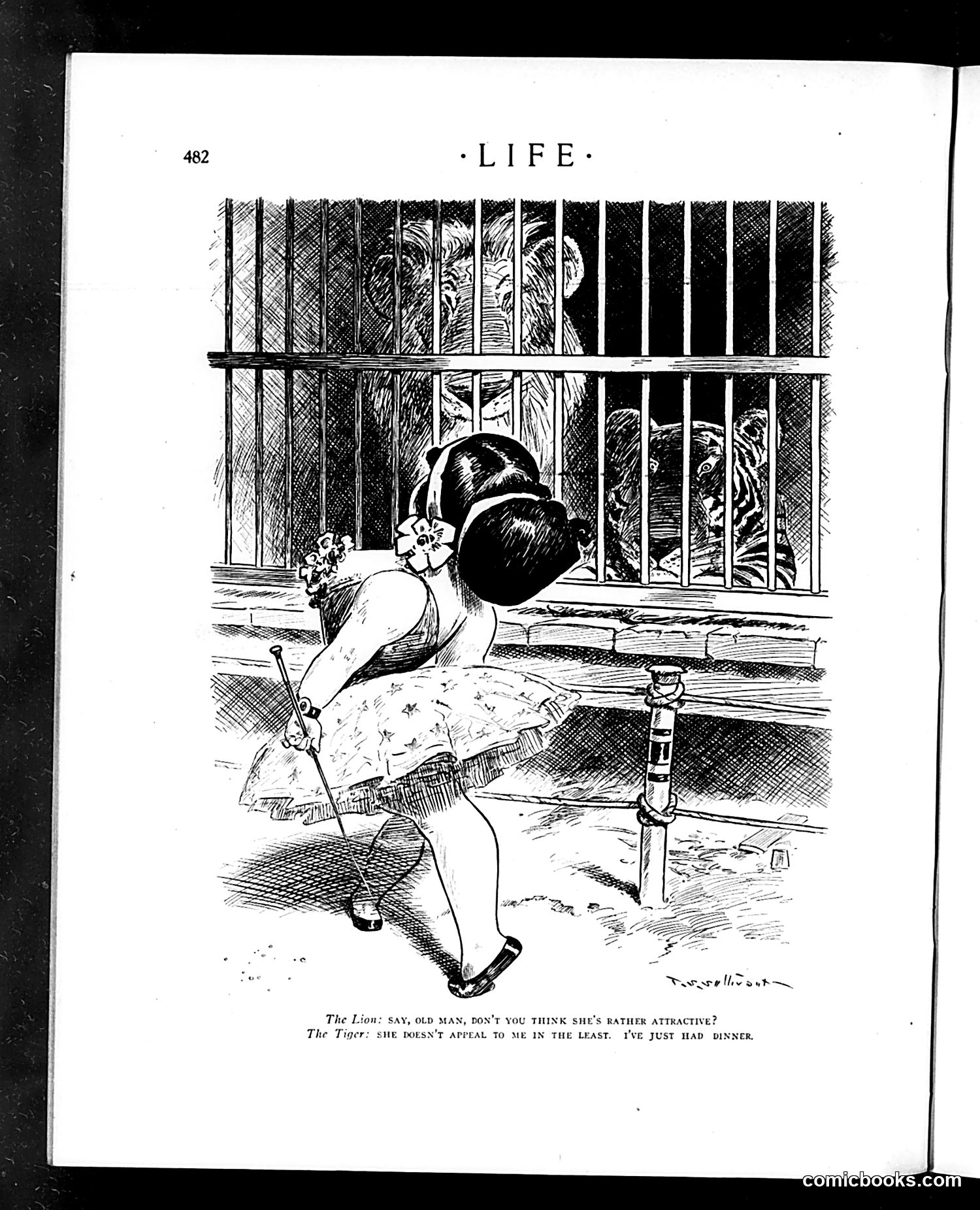
This is a zoo scene depicting a woman in fashionable dress posing before a lion and tiger's cage. The humor relies on a dated, dehumanizing premise: the animals are indifferent to the woman's appearance because they've recently eaten and view her purely as potential prey rather than as attractive. The joke reflects early 20th-century attitudes treating women as objects for male (and here, animal) visual consumption. The tiger's dismissive comment—that she holds no appeal because he's satiated—is the punchline, suggesting her value lies solely in her physical appearance to potential admirers. The cartoon is satirical about human vanity and courtship dynamics of the era, using the animals' perspective to mock conventional beauty standards.
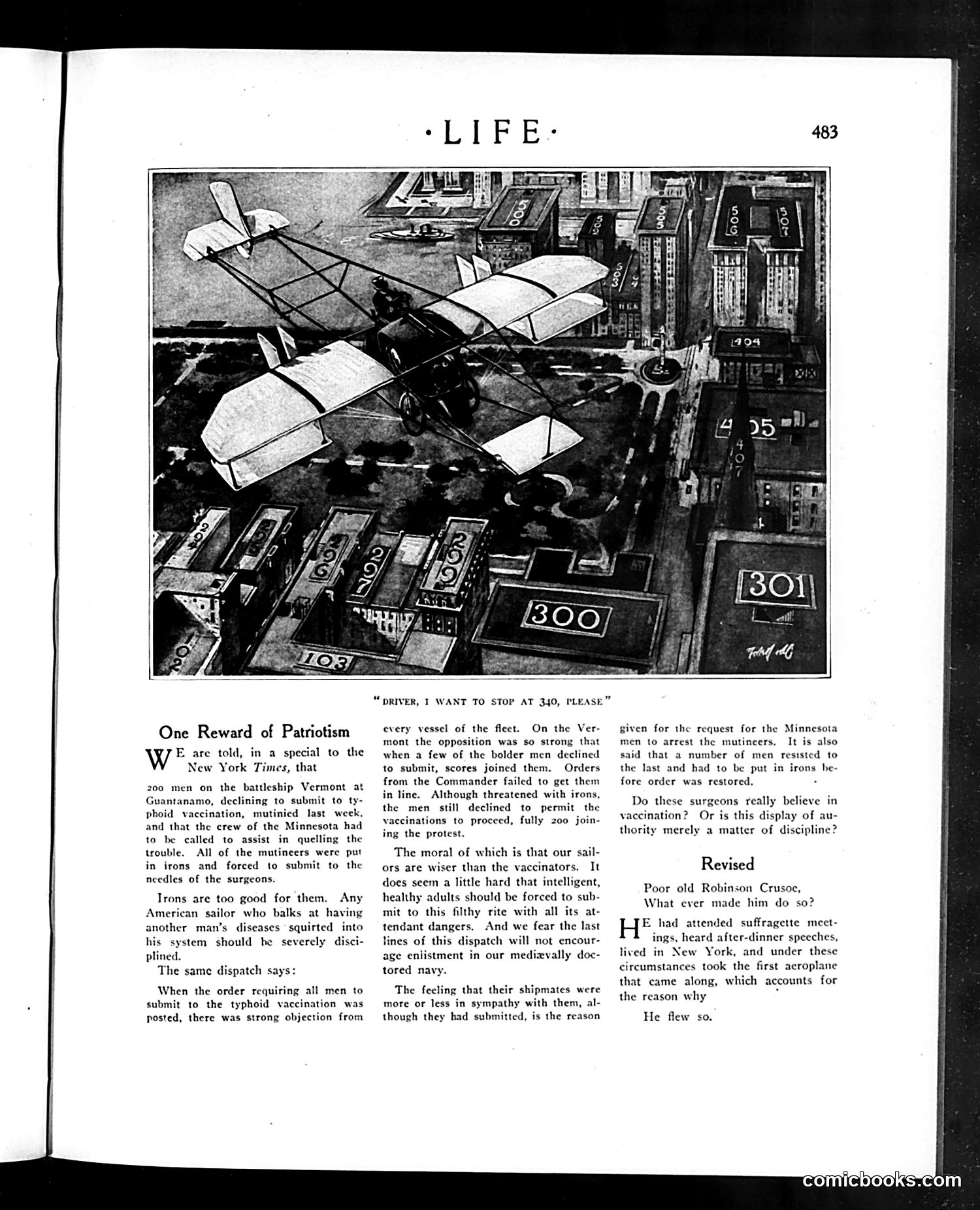
This page satirizes mandatory typhoid vaccination in the U.S. Navy. The cartoon depicts an early airplane labeled "340" with the caption "Driver, I want to stop at 340, please"—a visual joke about lack of control, suggesting sailors forced into medical procedures have no agency over their own bodies. The main article mocks Navy commanders who forced 200 mutinous sailors on the USS Vermont to submit to vaccination against their will, using irons and threats. Life's editors argue that the sailors were *right* to resist—claiming vaccinations are "filthy" and "dangerous," and that intelligent adults shouldn't be forced to undergo them. They criticize the Navy's "medieval" medical practices. The secondary piece, "Revised," appears unrelated—a humorous riff on Robinson Crusoe that connects his travels to exposure to suffragette speeches and aeroplanes, using similar themes of unexpected journeys. The satire targets military authoritarianism and forced medical procedures as violations of individual liberty.
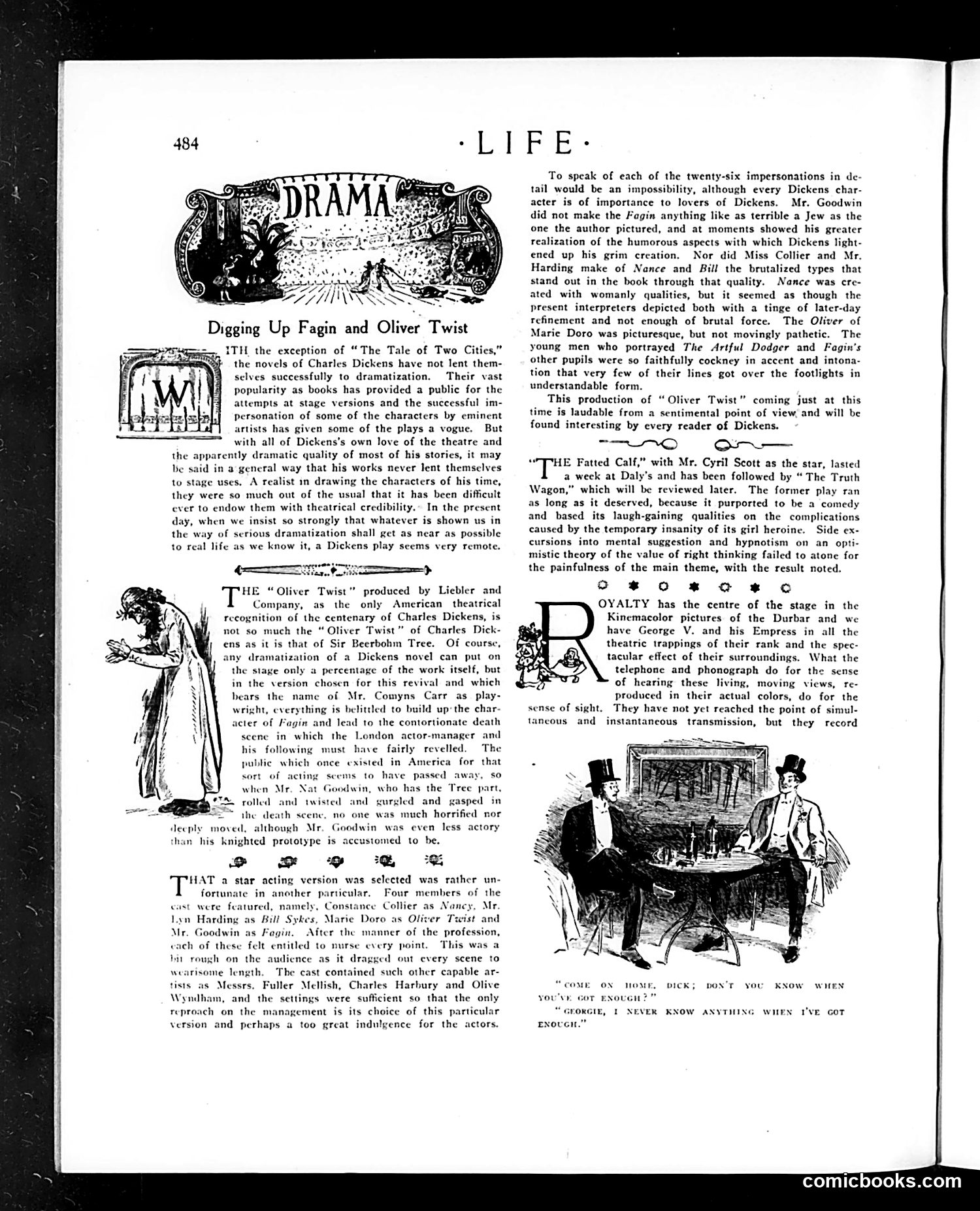
This is a theater review of an American production of *Oliver Twist* staged by Liebler and Company, presented as part of Charles Dickens's centenary celebration. The critic argues that Dickens's novels resist successful dramatization because his characters, though realistic for Victorian England, lack theatrical credibility on stage. The review critiques this particular adaptation—based on Sir Beerbohm Tree's earlier version—for overemphasizing Fagin's melodramatic death scene rather than faithfully representing Dickens's creation. The main complaint: the cast (including Mr. Goodwin as Fagin, Constance Collier as Nancy, and Marie Doro as Oliver) softened Dickens's brutal characters with excessive "refinement" and insufficient brutality. The critic particularly notes that the young actors playing pickpockets spoke such authentic cockney that audiences couldn't understand them. The cartoon (bottom right) depicts a social scene, though its specific satirical point remains unclear from the visible image and caption alone.
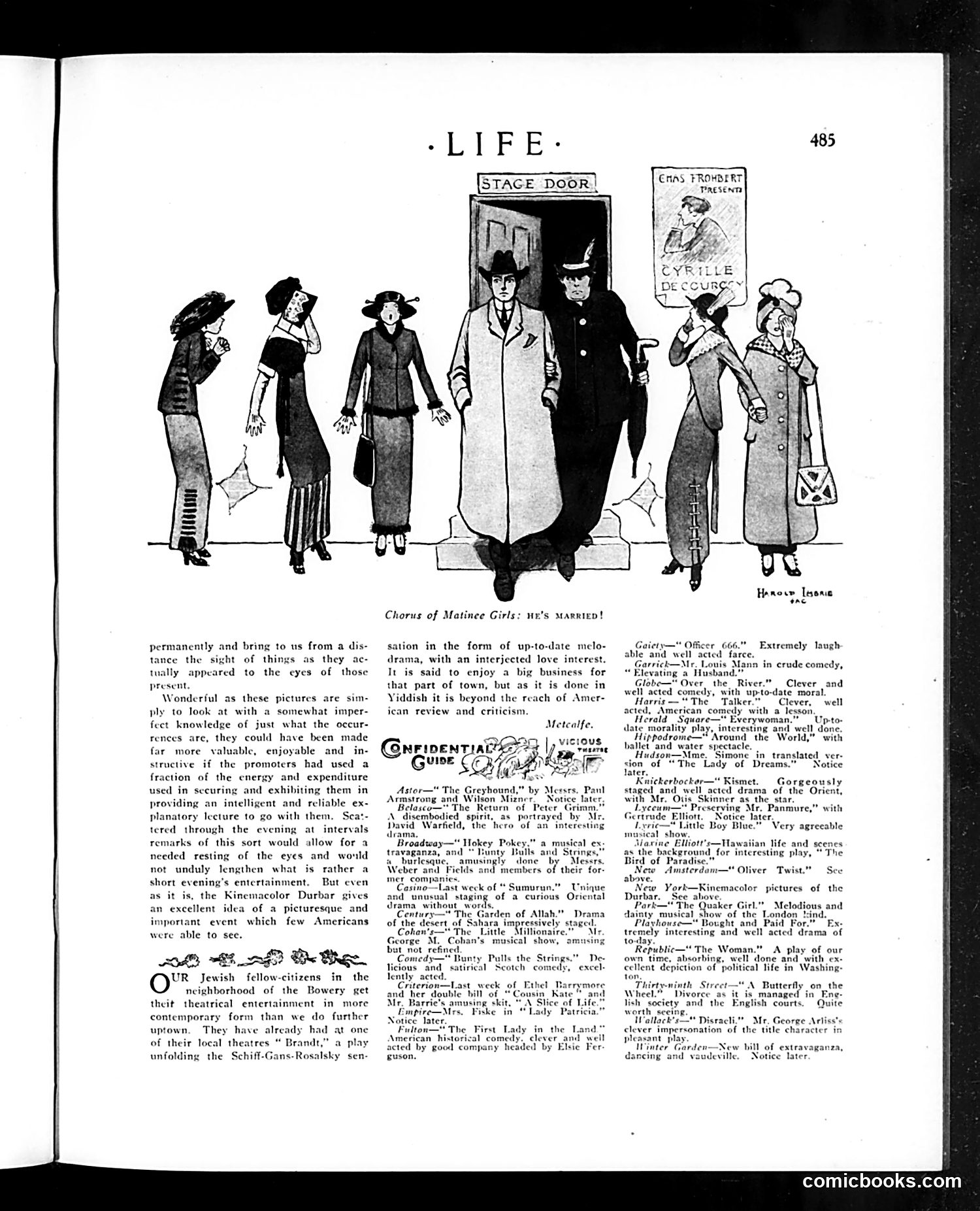
This page from *Life* magazine features a theatrical review section typical of early 20th-century American periodicals. The prominent illustration depicts "Chorus of Matinee Girls: He's Married!" — a satirical commentary on theatrical productions aimed at working-class audiences, particularly in New York's entertainment districts. The cartoon mocks popular Broadway entertainments of the era, showing elegantly dressed theatergoers and performers. The text below reviews current theatrical productions, including shows at major venues like the Astor, Belasco, and Casino theaters, many featuring melodramas and comedies with moral lessons. The satire critiques how theatrical producers presented spectacle without substance — the opening paragraphs note that impressive visual productions (like the "Kinemacolor Durbar" film footage mentioned) would benefit from intelligent explanatory lectures for audiences. The piece gently mocks both the entertainment industry's priorities and contemporary audiences' appetite for shallow amusement over educational value.
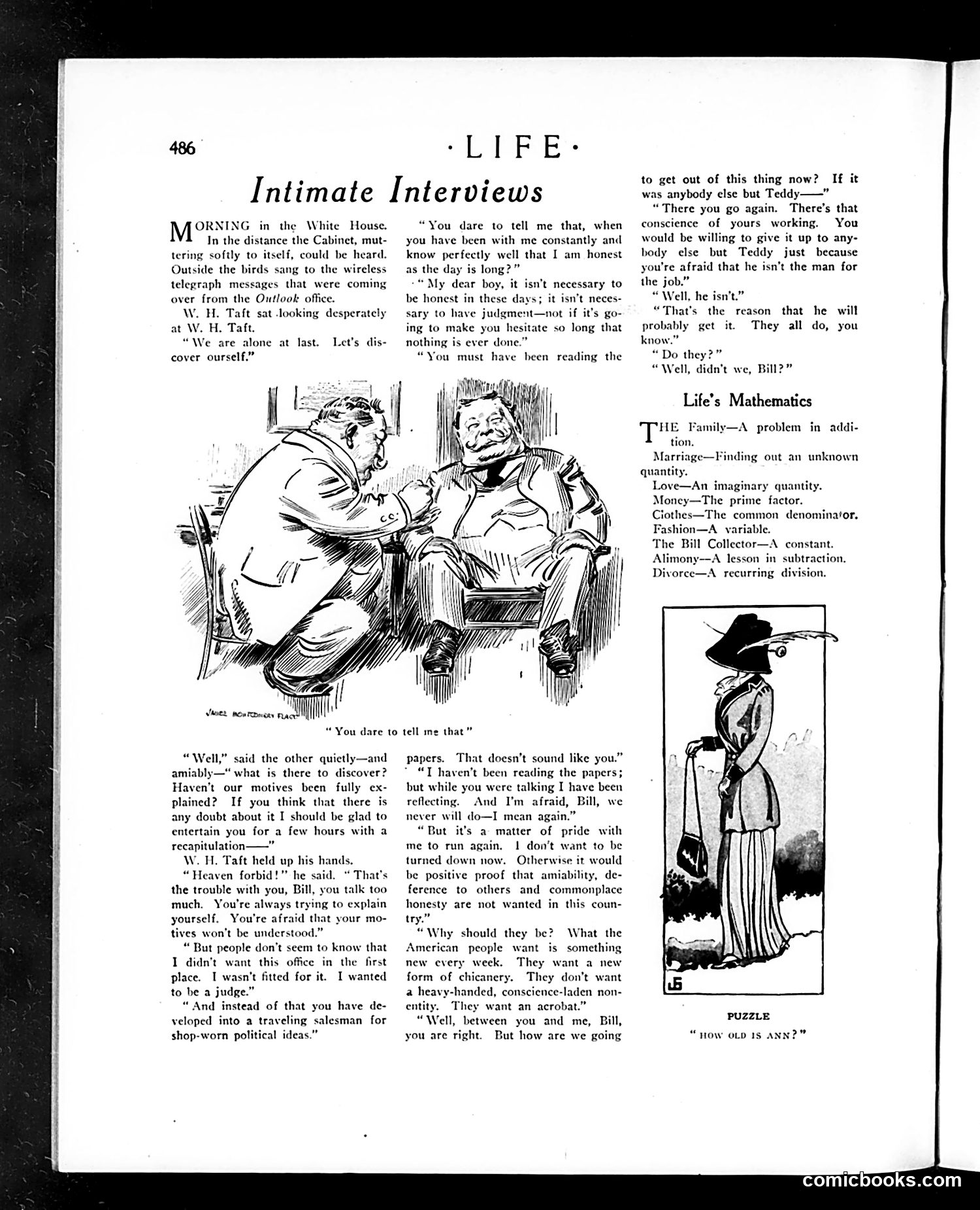
This dialogue depicts President **William Howard Taft** conversing with himself—a device satirizing his indecision and internal conflict. The "Bill" he addresses appears to be his alter ego or conscience. The satire centers on **Taft's reluctance to run for re-election** against **Theodore Roosevelt**, his predecessor. Taft's companion accuses him of being ineffectual ("traveling salesman for shop-worn political ideas") and suggests that Americans don't actually want honest, conscientious leaders—they want novelty and "acrobats" (likely alluding to Roosevelt's dynamic personality). The joke's bitter point: Taft won't withdraw because he fears looking weak, yet his very conscientiousness proves he's unfit for politics. The final exchange—"Well, didn't we, Bill?"—implies both men (Taft and Roosevelt) succeeded precisely because they weren't qualified. This reflects the real 1912 Republican split, when Roosevelt challenged Taft's renomination.
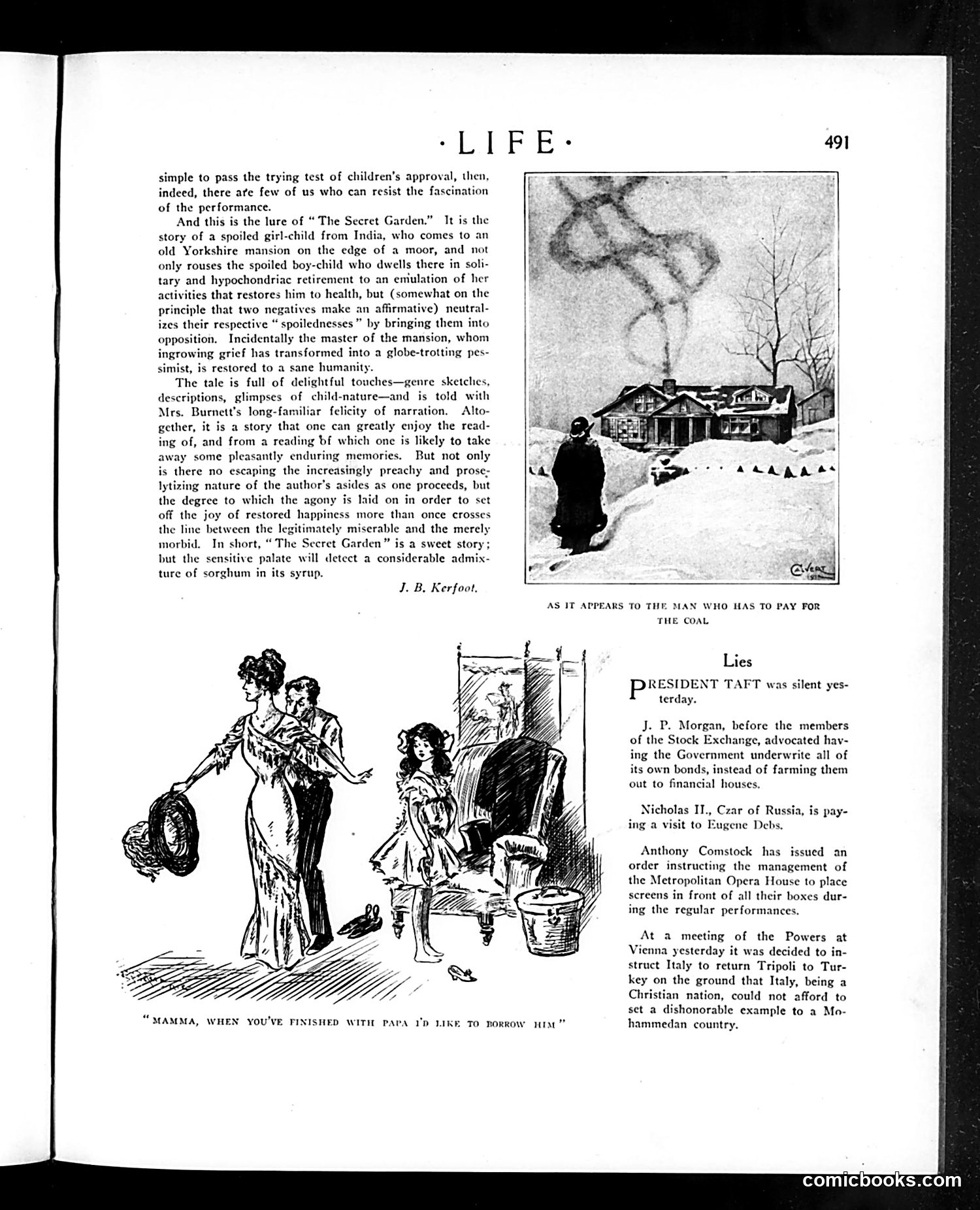
This page contains a book review of *The Secret Garden* and satirical "news" items mocking prominent figures of the era (appears to be early 1900s). **The cartoon** shows a mother and children asking to "borrow" father—a domestic joke about a father being so useless or burdensome that the family treats him as a communal nuisance. **The satirical "Lies" section** mocks real politicians and figures through obviously false statements: - President Taft's silence is deemed noteworthy - J.P. Morgan (the famous banker) advocating government bond underwriting - The absurd claim that Czar Nicholas II visits Eugene Debs (a socialist activist—their sworn opposite) - Anthony Comstock (famous censor) screening opera boxes from "immoral" viewing - Italy being instructed to return Tripoli to Turkey based on Christian morality The humor relies on readers recognizing the impossibility or hypocrisy of these scenarios, satirizing political corruption, financial manipulation, and social prudishness of the period.
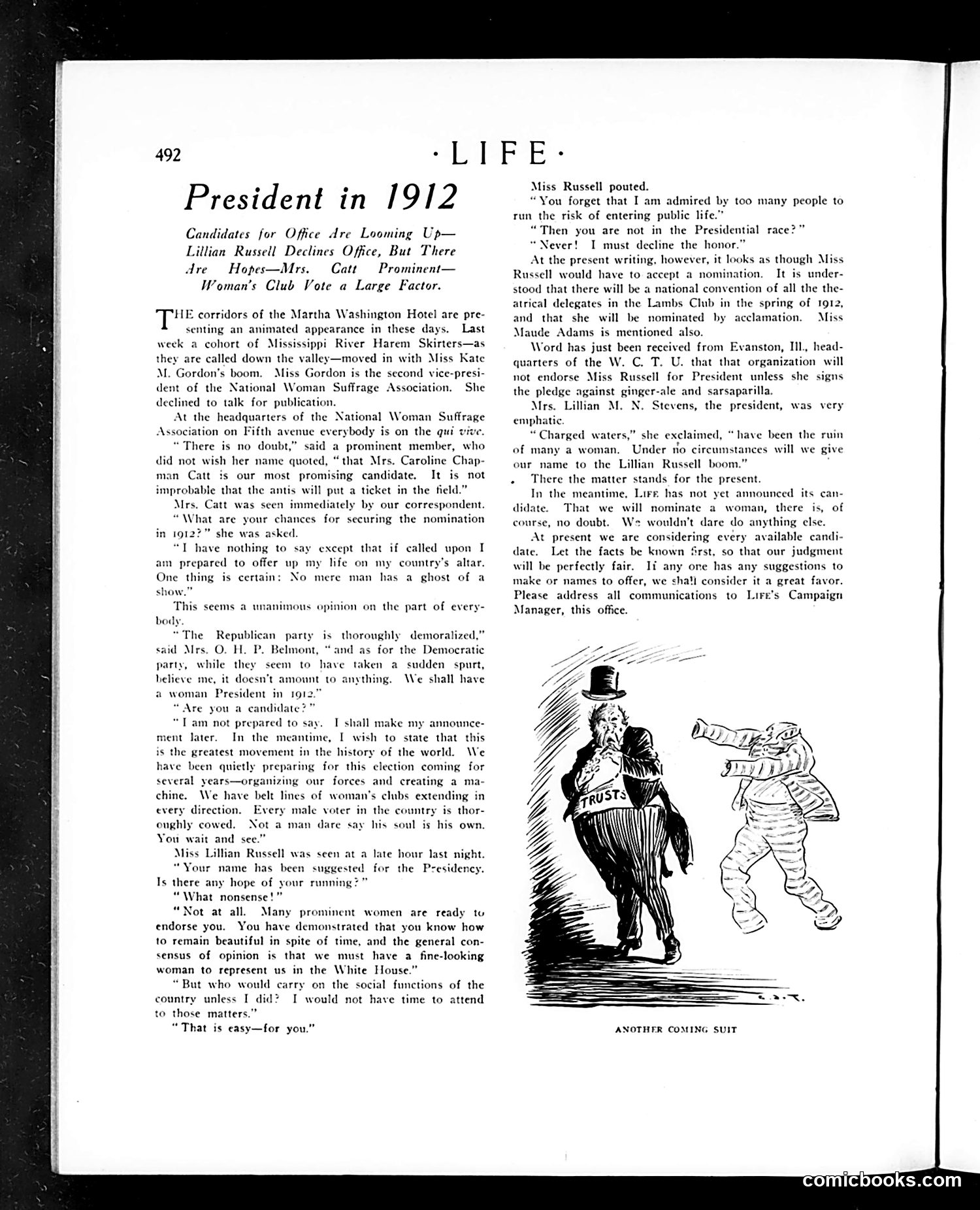
This Life magazine article satirizes the 1912 Presidential election by humorously proposing that women—not men—might run for President. The piece interviews prominent women of the era, including suffragist **Carrie Chapman Catt** and actress **Lillian Russell**, presenting mock-serious discussions of their potential candidacies. The accompanying cartoon depicts **Uncle Sam** (identifiable by his top hat and characteristic appearance) being chased or confronted by a figure labeled "TRUSTS," while money scattered on the ground suggests political corruption—a common turn-of-the-century concern. The satire mocks both female political ambitions and male anxiety about women's growing power. Notably, the women quoted (particularly **Mrs. O.H.P. Belmont**) boast confidently about organizing women voters and rendering male voters "thoroughly cowed." This reflects pre-1920 suffrage debates and satirizes contemporary fears about women's political potential.
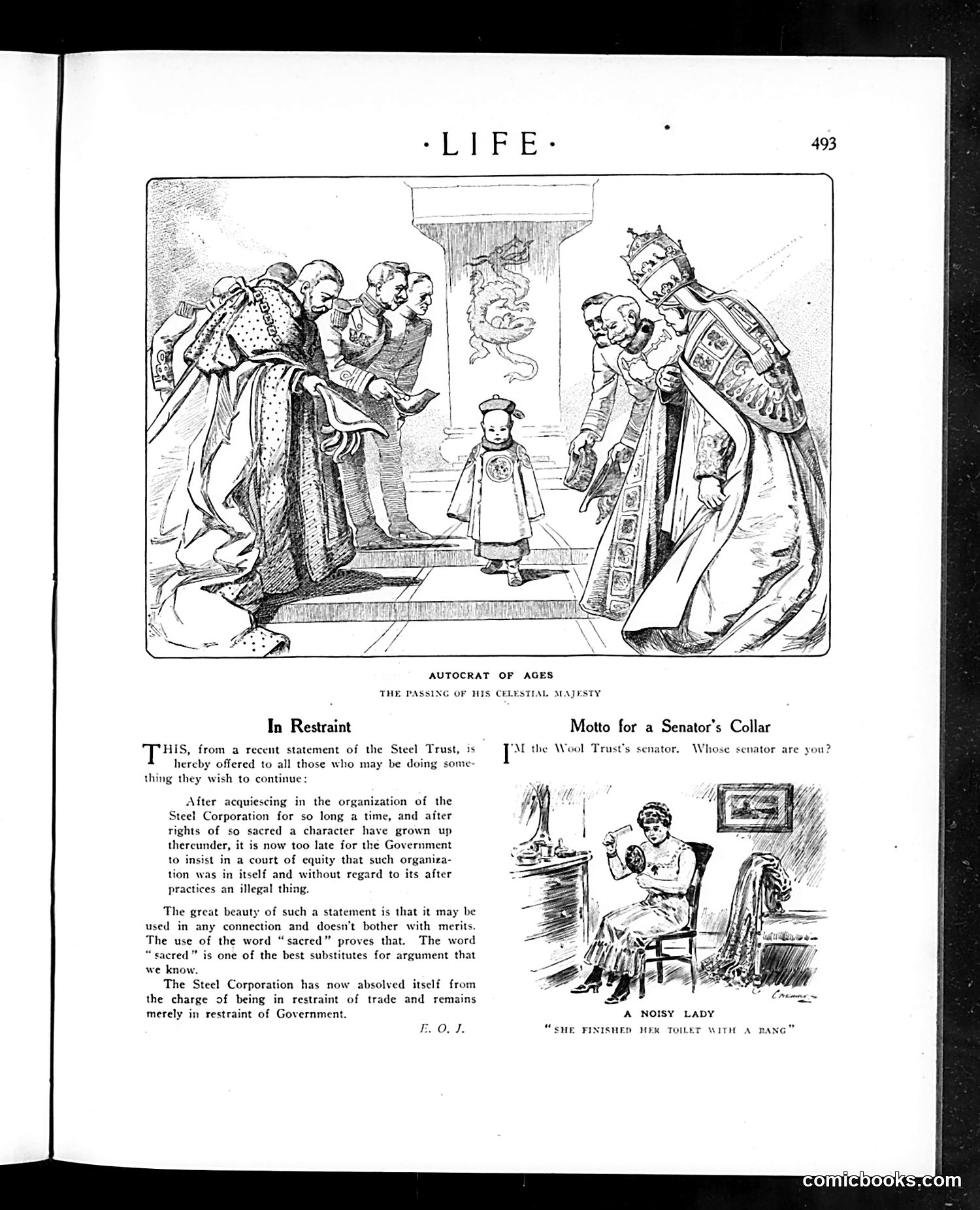
**Top Cartoon ("Autocrat of Ages"):** This depicts the Steel Trust as a powerful monarch figure surrounded by courtiers, with a small child (representing Government or the people) at its center. The composition suggests the Trust's dominance over democratic institutions. **"In Restraint" Article:** This satirizes the Steel Corporation's legal defense against antitrust charges. The Trust claims that because the Government allowed it to exist for so long, it's now "too late" to challenge it as illegal. The author mocks this circular reasoning, noting the word "sacred" replaces actual legal argument—a rhetorical dodge without merit. **"Motto for a Senator's Collar":** A brief jab suggesting senators are owned by corporate trusts (here, the Wool Trust). The question "Whose senator are you?" implies senators serve business interests rather than constituents. **"A Noisy Lady":** A separate humor piece mocking a woman finishing her toilet with loud noise—unrelated social commentary on domestic manners. The page attacks corporate monopolies and their political capture during the Progressive Era trust-busting period.
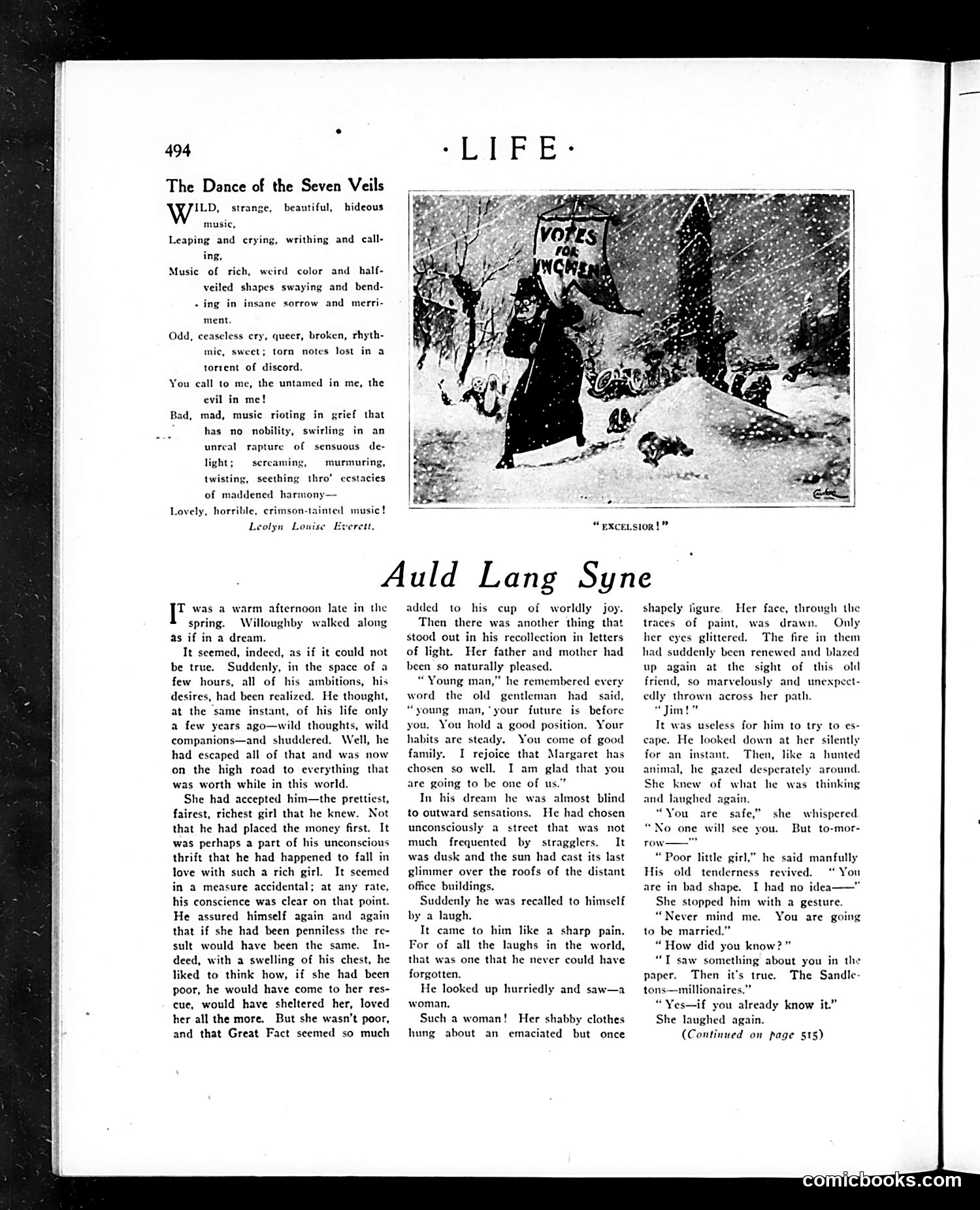
The page contains two distinct pieces: **Top: "Exclusion!"** A political cartoon showing suffragists (visible "Votes for Women" banner) being forcibly excluded or removed, likely referencing women's suffrage activism and opposition to it during the early 20th century. **Bottom: "Auld Lang Syne"** A serialized story about a man named Willoughby who has just become engaged to a wealthy, respectable woman. His contentment is disrupted when he encounters an old female acquaintance—shabby, painted, apparently fallen into difficult circumstances. The narrative suggests a romantic or intimate past between them, and his anxiety about being seen with her hints at social scandal. The story explores tension between respectability and past indiscretions, a common satirical theme in Life magazine examining hypocrisy and class consciousness.
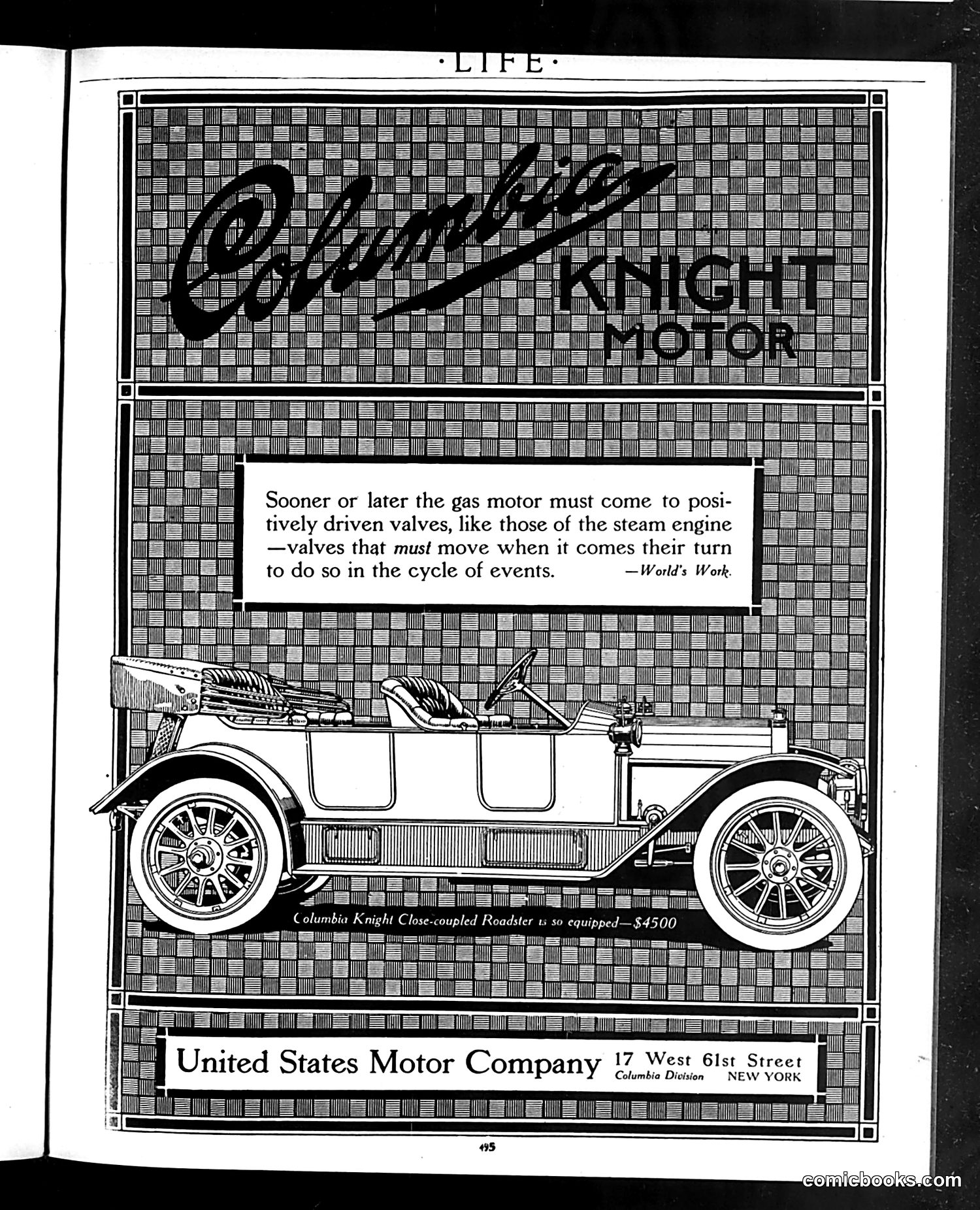
This is an advertisement for the United States Motor Company's Columbia automobile, specifically a "Knight Motor" roadster priced at $4500. The page is not satirical but rather promotional. The quoted text from *World's Work* discusses automotive engineering—specifically predicting that gasoline engines would eventually adopt positively-driven valves (like steam engines used) rather than the less reliable valve systems of early motors. This was a technical prediction about engine evolution. The advertisement features a side-profile illustration of an open-air roadster with detailed mechanical rendering, typical of early 1900s automotive marketing. The Knight motor was a real engine type known for sleeve-valve technology. This appears to be positioning Columbia as technologically advanced during a period of rapid automotive innovation.
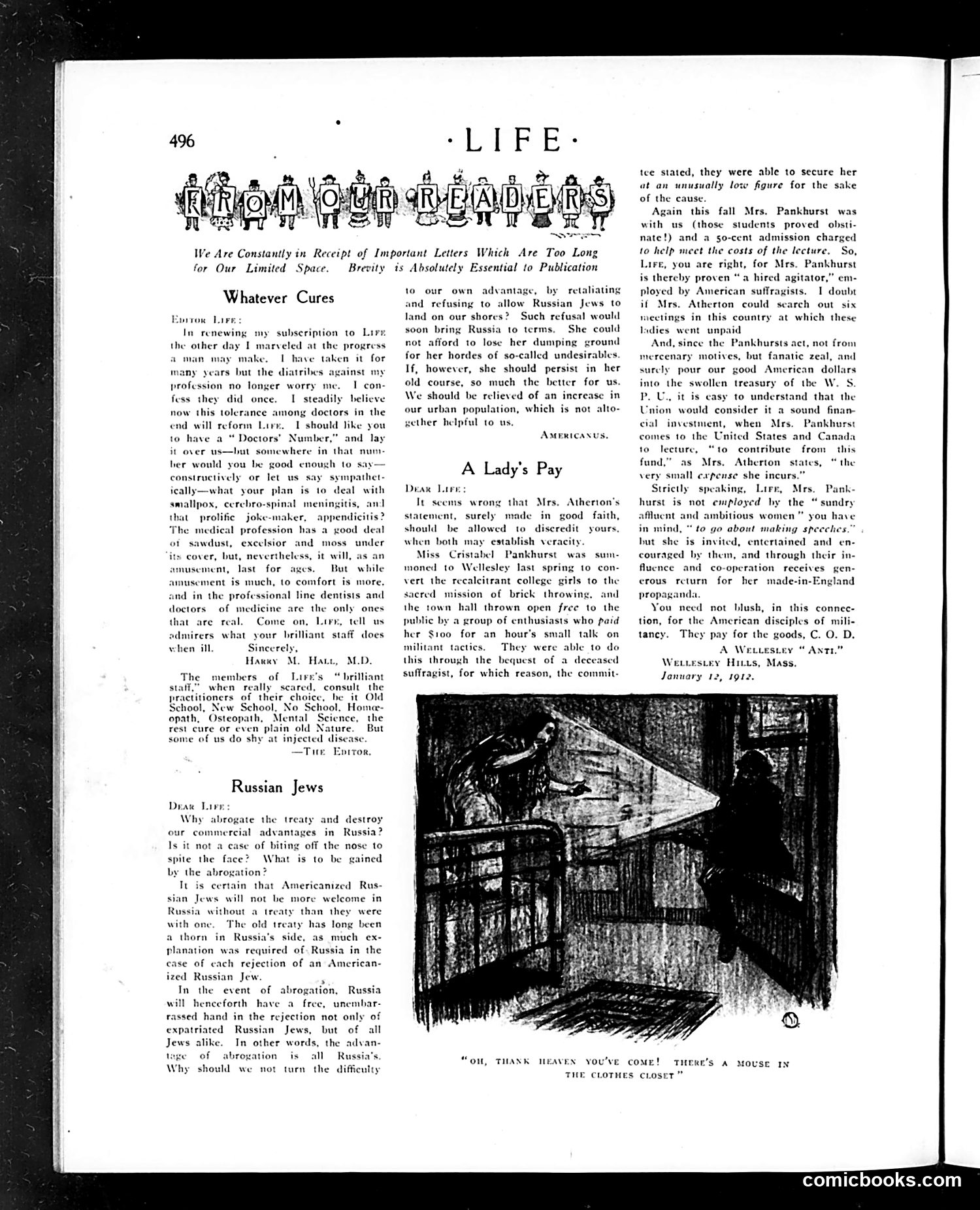
This page contains readers' letters to *Life* magazine addressing contemporary political issues. **"Whatever Cures"** and **"Russian Jews"**: These letters debate U.S.-Russia relations. A writer argues the U.S. should retaliate against Russia's discriminatory policies toward Jewish emigrants by refusing them entry—turning Russia's exclusionary tactics back on them. This reflects early-20th-century tensions over immigration and the U.S. treaty with Russia, which many Americans viewed as unfairly applied against American Jews seeking to visit or return to Russia. **"A Lady's Pay"**: Criticizes British suffragist Christabel Pankhurst's American lecture tour, sarcastically suggesting she's a "hired agitator" because she accepted payment ($100) for speaking at Wellesley College about militant suffragism (tactics like property destruction). The letter questions whether accepting money undermines her cause's moral legitimacy—a dig at the professionalization of the suffrage movement. The **illustration** (bottom) appears unrelated editorial content, showing an interior domestic scene with the caption about a mouse in a clothes closet.
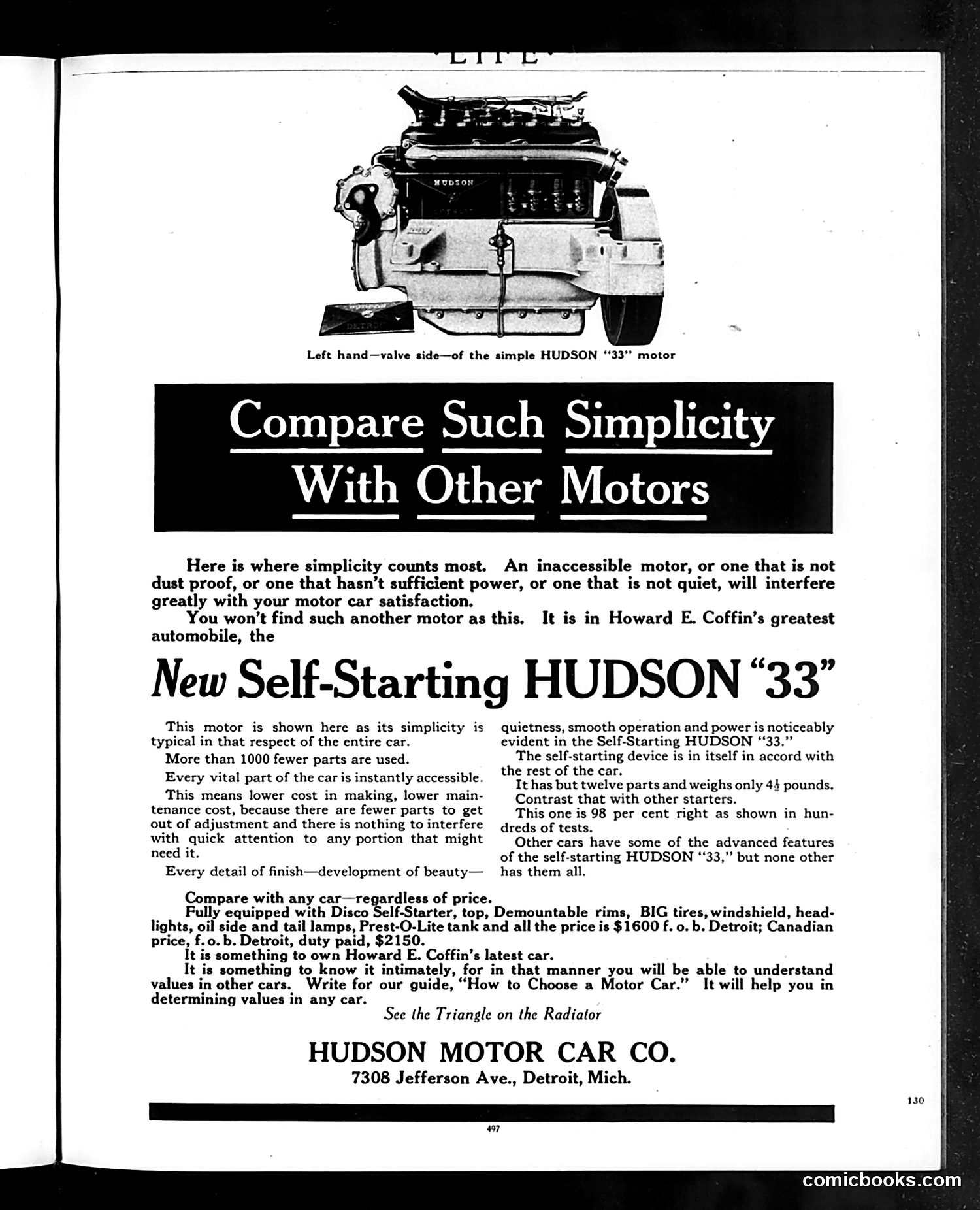
This is primarily a **automobile advertisement**, not a political cartoon. It promotes the Hudson "33" motor car, manufactured by the Hudson Motor Car Company in Detroit. The page features a technical photograph of the motor's valve mechanism, emphasizing its mechanical simplicity compared to competitors. The ad's central argument is that the Hudson "33" has over 1,000 fewer parts than rival vehicles, making it more accessible, maintainable, and reliable. It highlights innovations like a self-starting device (12 parts, 44 pounds) and claims 98% reliability from testing. The advertisement positions Howard E. Coffin's design as the most advanced and practical automobile available. The pricing ($1,600 f.o.b. Detroit) and comparison language ("Compare with any car—regardless of price") suggest this was marketed as a premium yet practical vehicle during what appears to be the 1910s automotive market. There is no satire or political content on this page—it is straightforward product promotion targeting consumers concerned with engineering quality and maintenance costs.
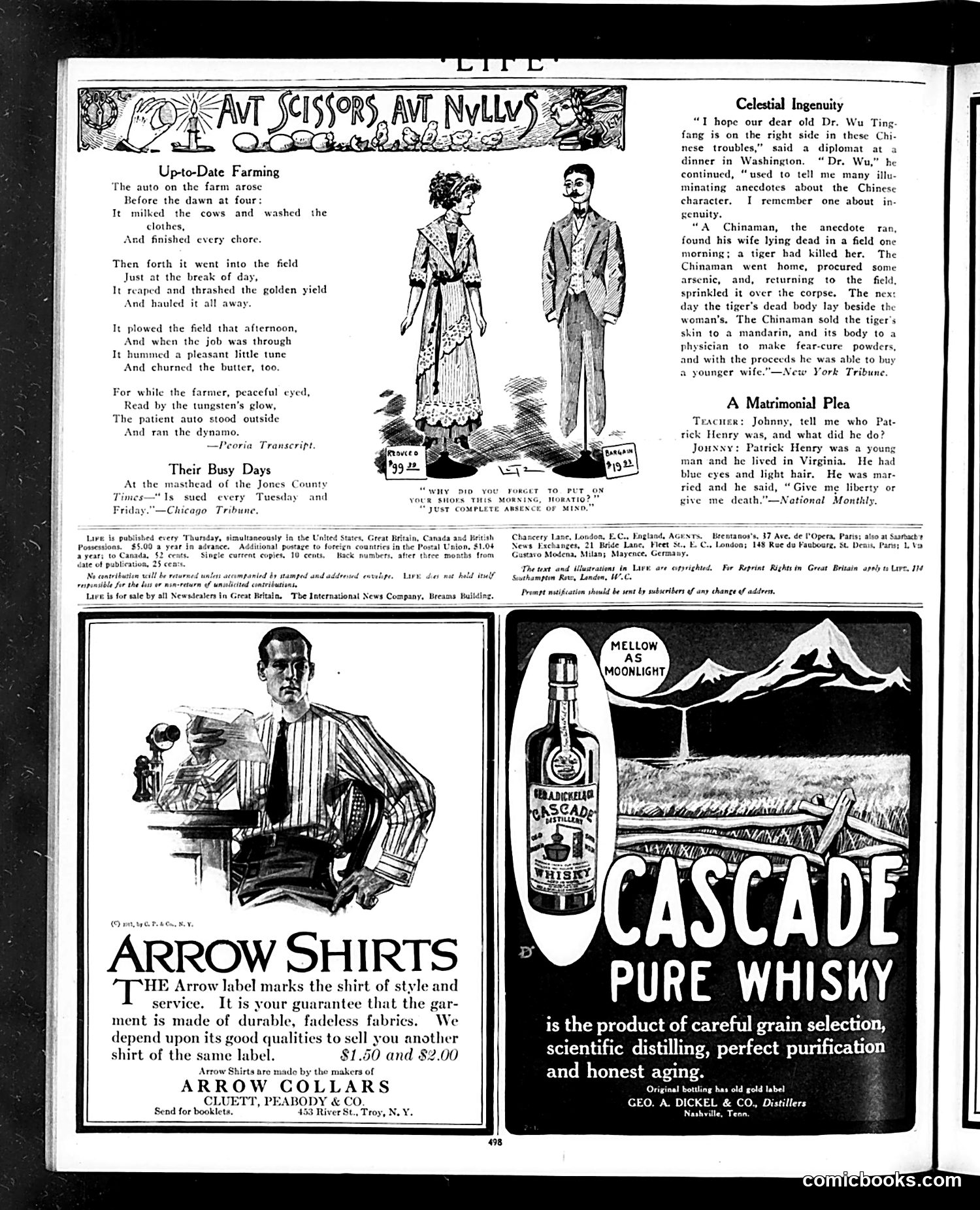
**"Up-to-Date Farming"** is a humorous poem satirizing early automotive enthusiasm. It depicts a miraculous farm automobile that performs all agricultural and domestic tasks—milking cows, plowing, threshing, churning butter—while the farmer relaxes reading by electric light. The joke critiques utopian faith in technology's labor-saving promises, suggesting such machines were fantasy rather than practical reality in the era when automobiles were still novelties. **"A Matrimonial Plea"** presents a classroom anecdote mocking a student's incomplete knowledge of Patrick Henry. The child recalls Henry was "married and said 'Give me liberty or give me death'"—confusing his revolutionary patriotism with marital complaint. The humor lies in the absurd juxtaposition, implying marriage makes liberty seem as desirable as death. The page is primarily **advertisements** for Arrow Shirts and Cascade Whisky, with light satirical content typical of Life magazine's format mixing commentary with commercial messaging.
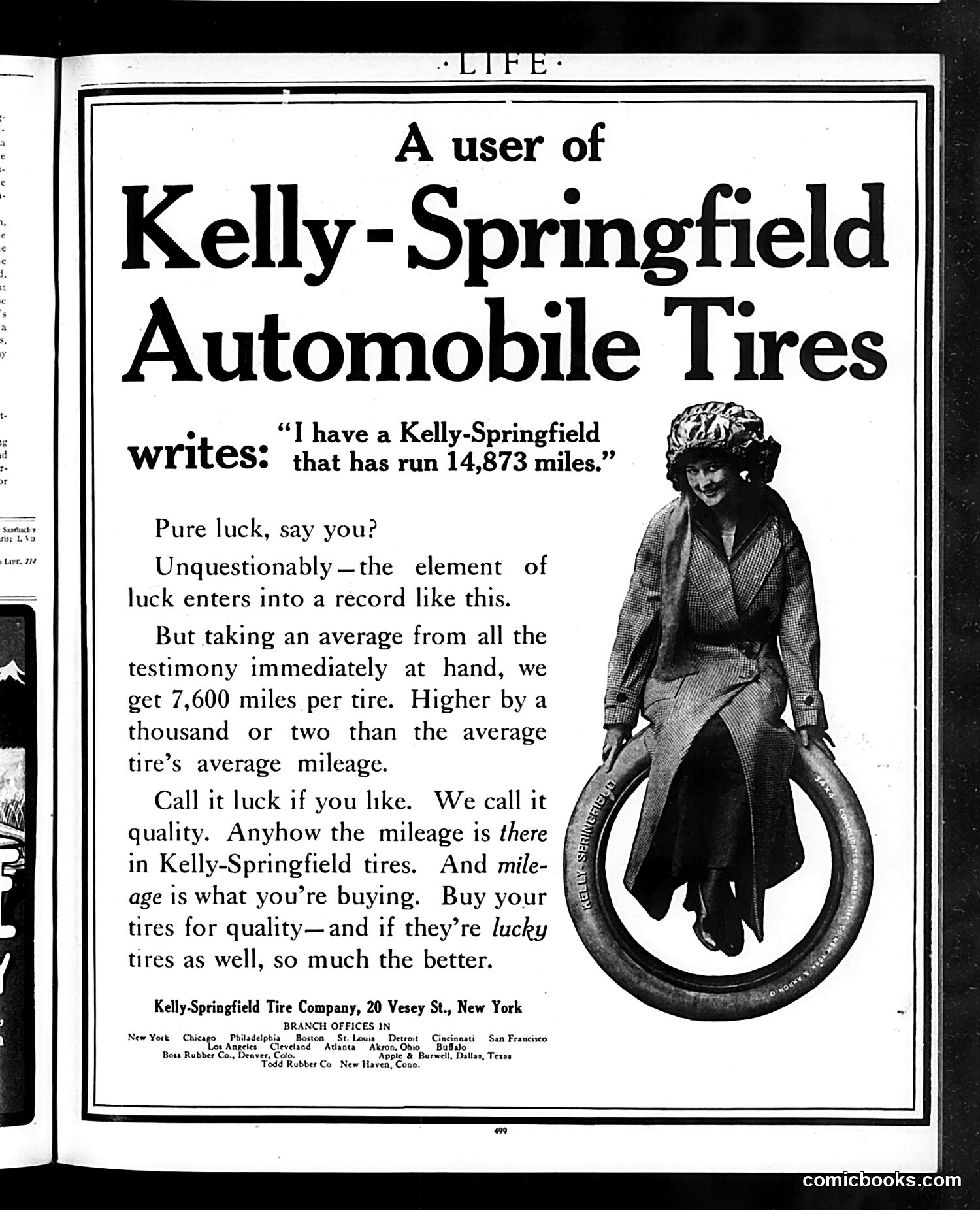
This is a **product advertisement**, not political satire. It promotes Kelly-Springfield automobile tires to early 20th-century readers. The ad features a woman sitting inside a large tire, illustrating the product. The testimonial claims one tire reached 14,873 miles—exceptional for the era when tire durability was a major consumer concern. The copy's rhetorical strategy is clever: it acknowledges that such mileage might seem like "luck," but argues this actually demonstrates "quality." The ad reframes luck as a byproduct of superior engineering, positioning Kelly-Springfield as reliably durable rather than gambling on chance. For modern readers: this reflects an era when tire longevity was genuinely unpredictable and heavily advertised as a competitive advantage. The gendered imagery (woman in tire) was typical early advertising but feels dated today. The emphasis on real-world testimony mirrors modern consumer reviews.
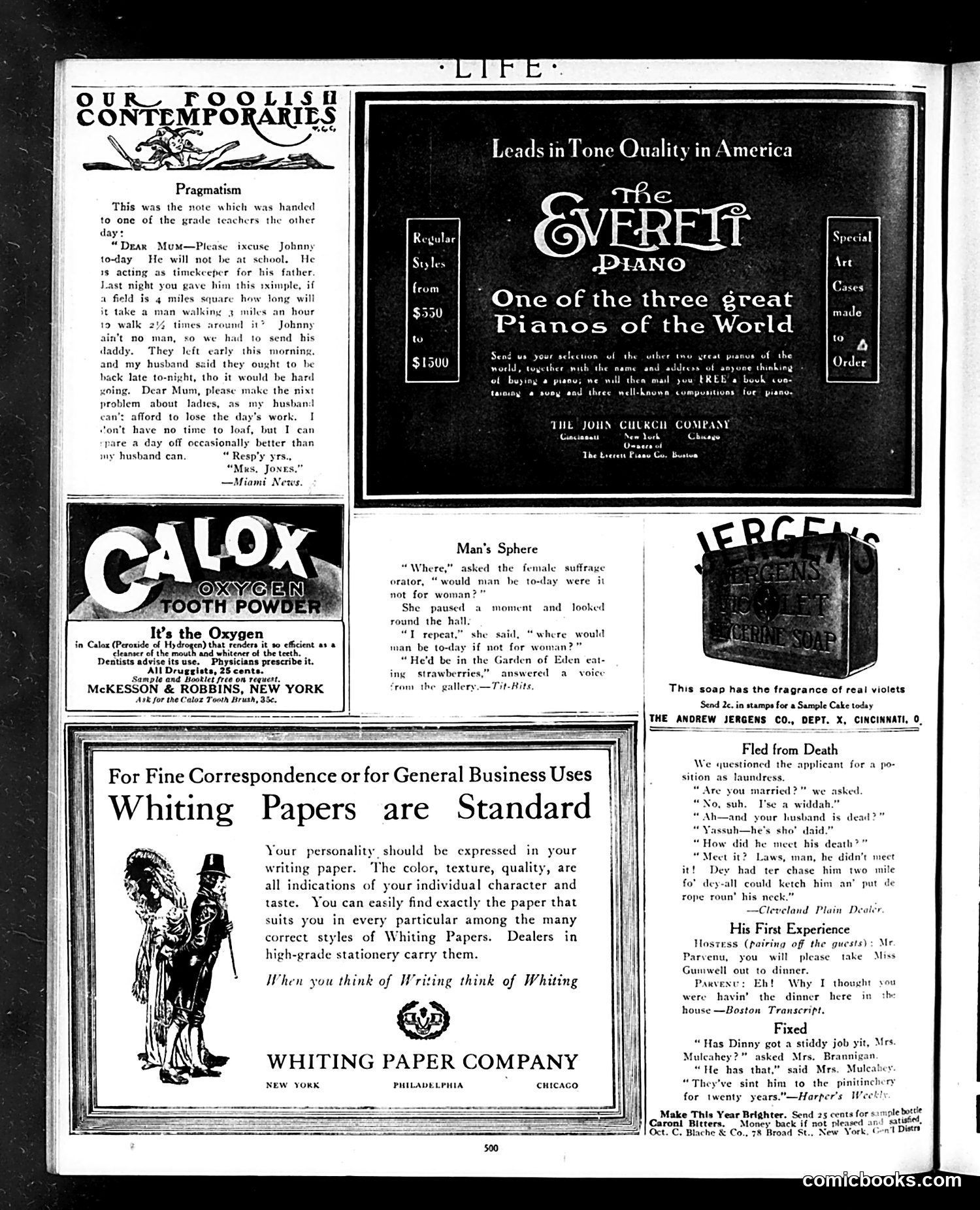
This page is primarily **advertisements and humor pieces** rather than political satire. The "Our Foolish Contemporaries" section collects humorous anecdotes mocking everyday foolishness: **"Pragmatism"** satirizes a parent's note excusing a child from school—the humor lies in the parent's illogical reasoning. A math problem asks about a man walking, so the parent sends the father instead because the son "ain't no man." **"Man's Sphere"** mocks female suffrage rhetoric. A suffragist asks where man would be without woman; a heckler replies "the Garden of Eden eating strawberries"—suggesting men would be better off without women's demands. The other short pieces ("Fled from Death," "His First Experience," "Fixed") use dialect humor (representing working-class and African American speech) to mock marital situations and employment. The page also contains advertisements for pianos, tooth powder, writing paper, soap, and bitters—typical of early 20th-century magazines. No specific historical figures are caricatured; rather, the humor targets broad social types and contemporary issues like women's suffrage.
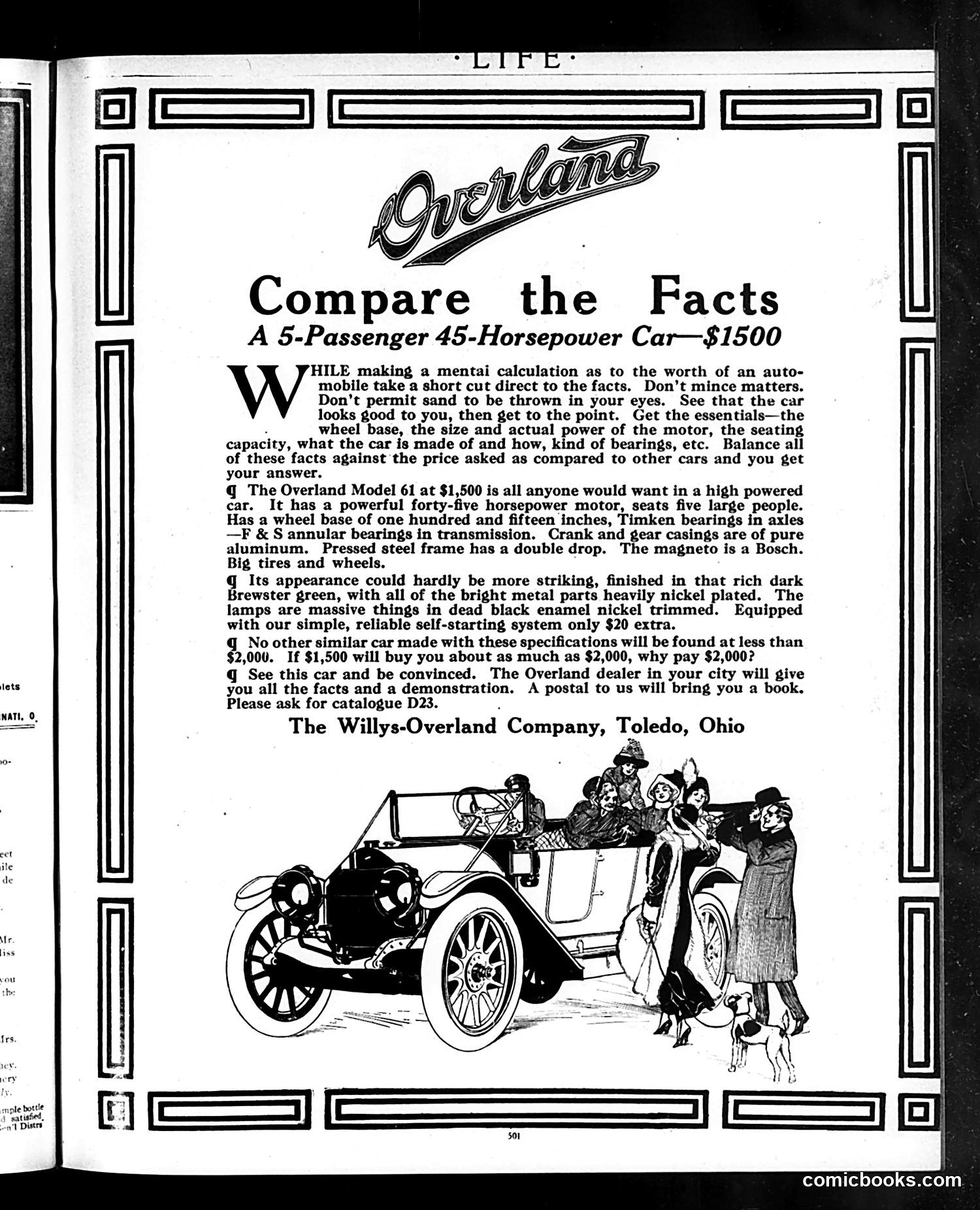
This is primarily **advertising content**, not satire or political commentary. The Willys-Overland Company is promoting its Model 61 automobile at $1,500. The illustration shows a car full of fashionably dressed passengers (women in hats and coats, men in formal wear) with a small dog, depicting the car's five-passenger capacity and appeal to middle-class consumers. The text's rhetorical approach—urging readers to "Compare the Facts" and "Don't permit sand to be thrown in your eyes"—adopts a consumer-advocacy tone common in early automotive advertising. It positions the Overland as offering superior specifications (45 horsepower, Timken bearings, aluminum castings) at a competitive price compared to cars costing $2,000 or $3,000. The phrase about "sand" being thrown in eyes is a metaphor for deceptive marketing tactics, suggesting Overland's competitors used such tactics. This was typical competitive advertising language of the early automobile era, not political satire.
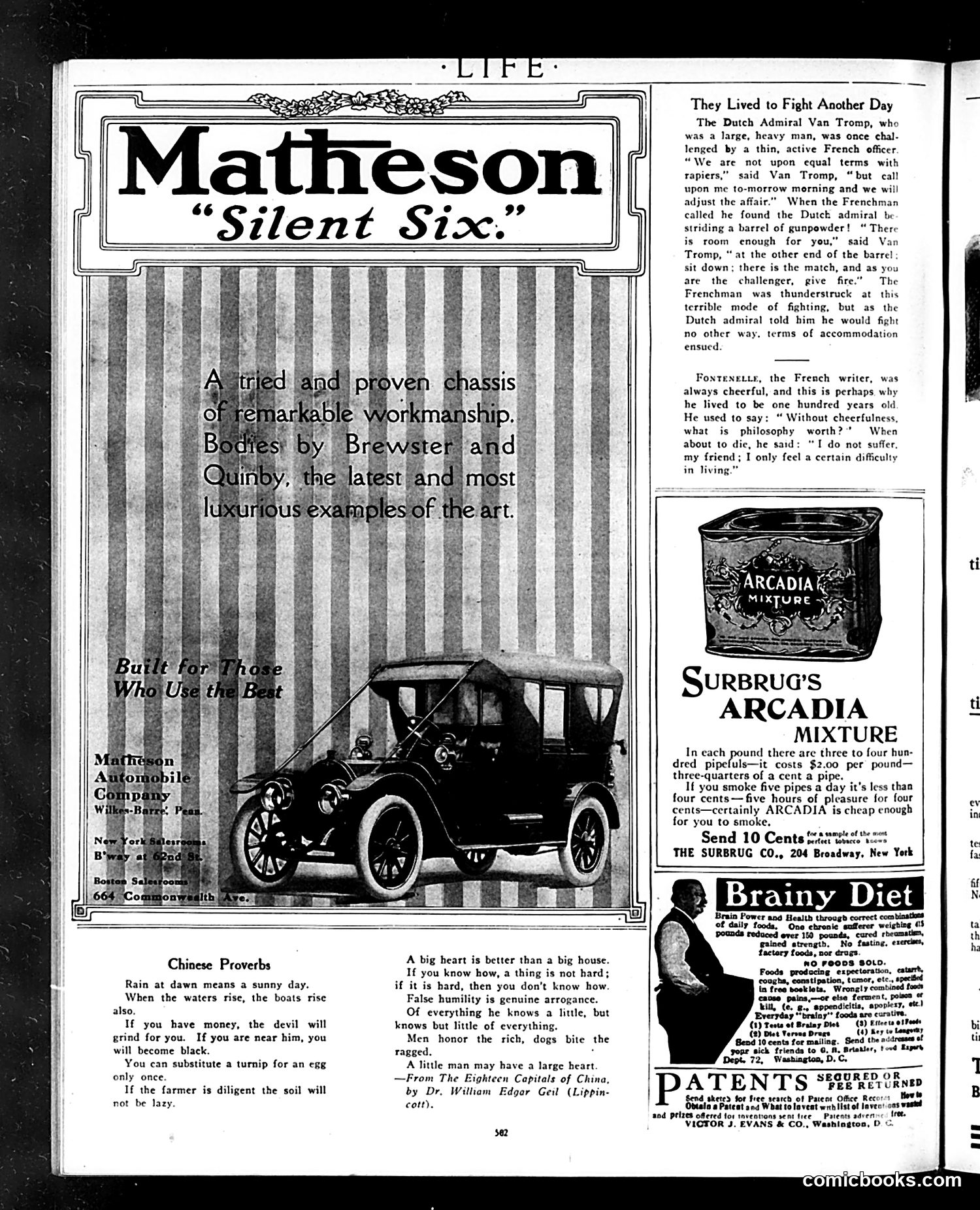
This page is primarily advertising for the Matheson "Silent Six" automobile, with the main image showing a early 1900s motorcar. The accompanying text is largely anecdotal rather than satirical—it presents historical stories about a Dutch Admiral Van Tromp and French writer Fontenelle as philosophical entertainment. The "cartoon" element is minimal; these are humorous historical anecdotes printed alongside the auto advertisement, apparently to provide light reading in what was a magazine format mixing editorial content with ads. The stories about Van Tromp's gunpowder dueling challenge and Fontenelle's cheerfulness are meant to entertain rather than critique current events. The page also includes unrelated advertisements for pipe tobacco, a "Brainy Diet" food product, and a patent service—typical of period magazines that functioned as vehicles for diverse commercial messages.
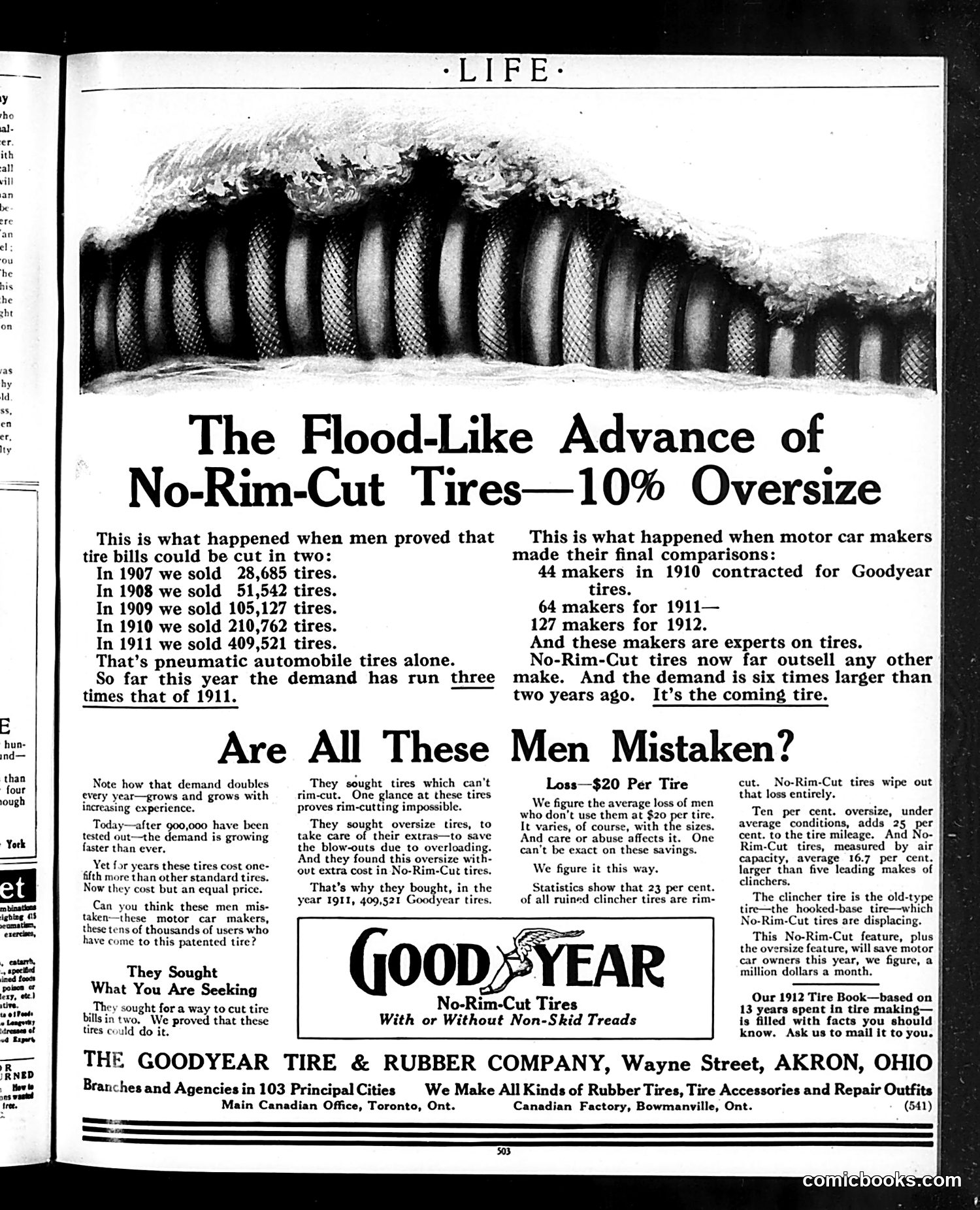
This is primarily **Goodyear tire advertising**, not satire or political content. The page presents a sales pitch disguised as news analysis. The visual shows a cross-section of a tire's tread pattern. The headline claims the "flood-like advance" of No-Rim-Cut tires demonstrates their superiority through exponential sales growth (from 28,685 tires in 1907 to 409,521 in 1911). The rhetorical strategy: "Are All These Men Mistaken?" challenges skepticism by citing adoption by major automobile manufacturers (44 makers in 1910, 127 by 1912), suggesting expert validation proves the product's worth. The copywriting emphasizes two benefits: eliminating "rim-cutting" (tire failure) and providing 10% extra size without extra cost. It quantifies savings ($20 per tire) to appeal to consumer economics. This reflects early-1900s marketing: using growth statistics and manufacturer endorsements as persuasive evidence, while presenting commercial advocacy as objective reporting.
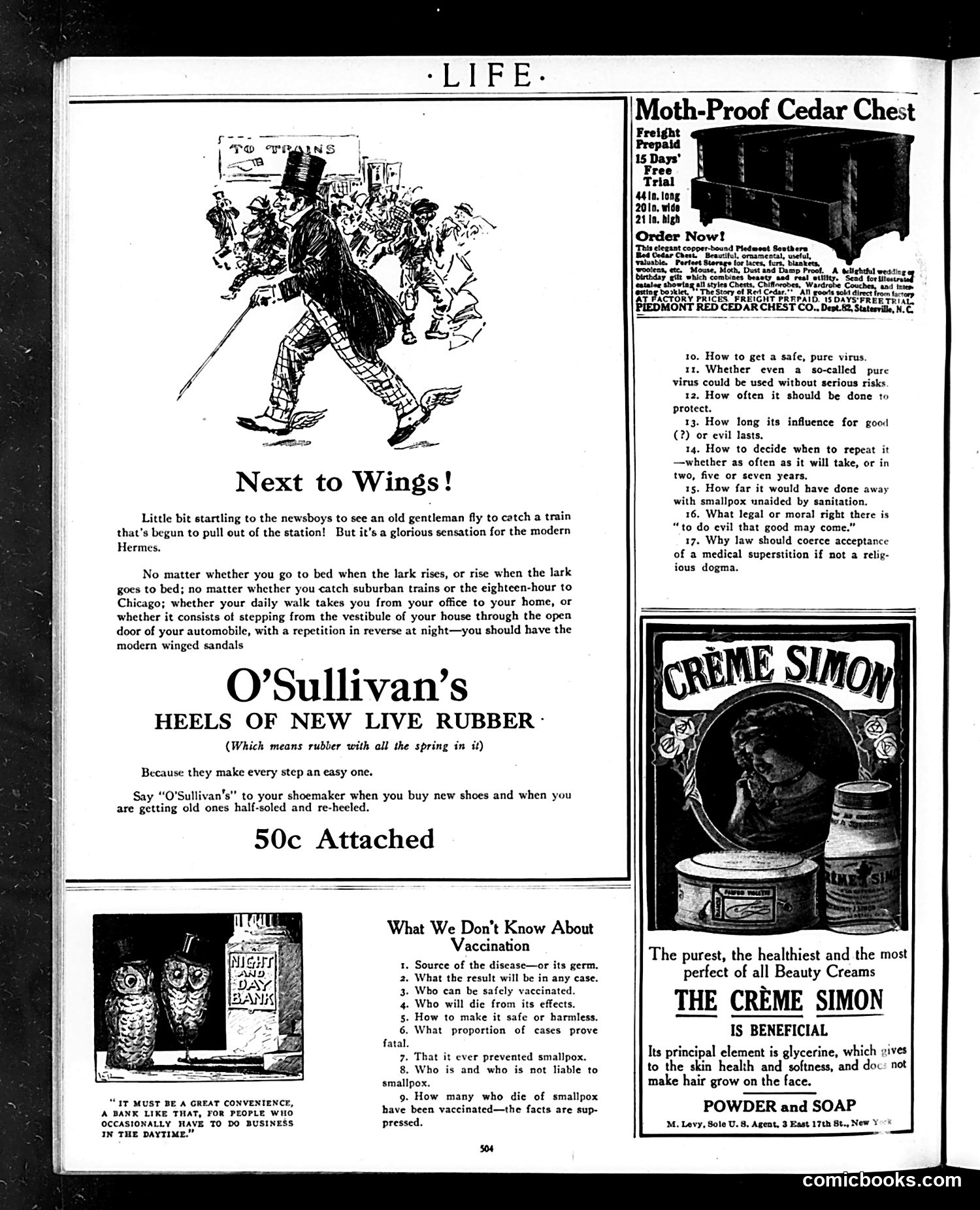
This page is primarily **advertising**, with one satirical cartoon at top-left showing an elderly gentleman literally flying (wearing winged sandals) to catch a departing train—a visual pun on speed and modern convenience. The cartoon advertises **O'Sullivan's rubber heels**, framing them as modern "winged sandals" (referencing the mythological messenger god Hermes). The joke: these shoe heels make walking so effortless they seem to give one flight-like speed for urban commuting. The page also includes a serious **anti-vaccination satire** titled "What We Don't Know About Vaccination"—a pointed critique listing 17 unknowns about the procedure, including whether it actually prevented smallpox and questioning forced medical compliance. This reflects early-20th-century skepticism about mandatory vaccination policies, presenting vaccination as medically unproven "superstition." The remaining content consists of period advertisements for cedar chests, beauty cream, and other products—typical of *Life* magazine's mixed editorial-advertising format.
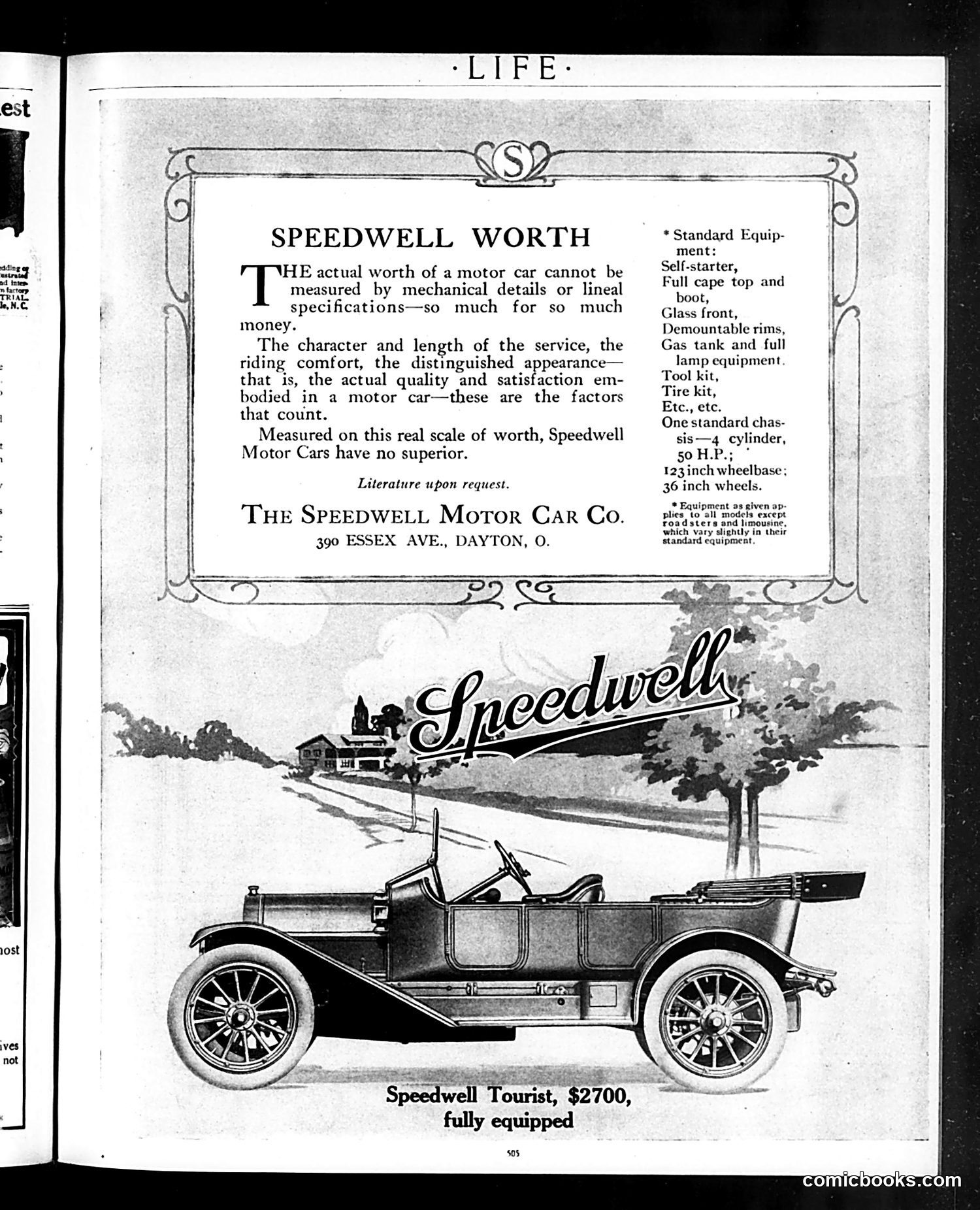
This is primarily **automobile advertising**, not political satire. The Speedwell Motor Car Company uses this Life magazine page to market their "Tourist" model at $2,700 (fully equipped). The ad's argument targets early-1900s car buyers concerned with value: rather than judging automobiles by mechanical specifications alone, Speedwell claims the "real worth" lies in service longevity, riding comfort, and appearance—essentially, quality and satisfaction. This was a common luxury-car marketing strategy of the era, positioning the brand against cheaper competitors on grounds of distinction rather than price. The illustration shows a touring car (open-air passenger vehicle) in a pastoral landscape, a typical period aesthetic suggesting leisure and progress. The specifications listed (self-starter, cape top, demountable rims, tool kit) reflect features that were then novel or desirable. There is no discernible political cartoon, caricature, or satire present on this page—it's straightforward commercial advertising in a magazine that mixed editorial content with ads.
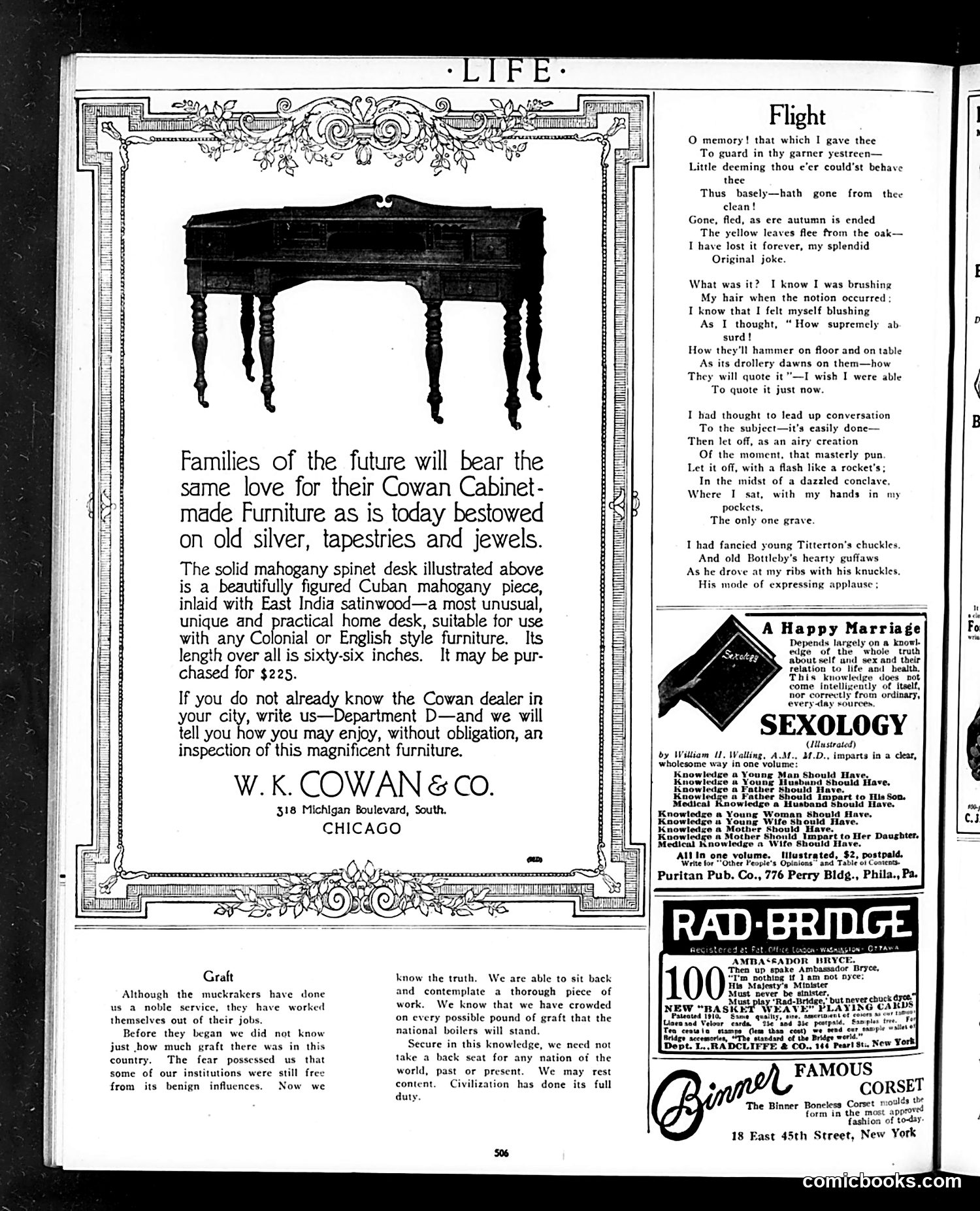
This page is primarily **advertising and light verse**, not political satire. The main content features: **Left side**: A Cowan Cabinet furniture advertisement showcasing a mahogany spinel desk, priced at $225. The copy claims future generations will treasure such furniture as heirlooms. **Right side**: A poem titled "Flight" about a writer who conceived a brilliant joke while brushing his hair but completely forgot it—a relatable comic scenario about fleeting inspiration and memory failure. The speaker fantasizes about impressing friends like "Titterton" and "Bottleby" with his wit, but cannot recall the punchline. Below are **various product advertisements** for books (Sexology), card games (Rad-Bridge), and corsets (Binney's Famous Corset). There is **one brief satirical piece** titled "Graft" mocking American complacency about institutional corruption—suggesting the "muckrakers" have done their job so thoroughly that citizens can now confidently accept graft as inevitable. The page reflects early 20th-century consumer culture and genteel humor rather than sharp political commentary.
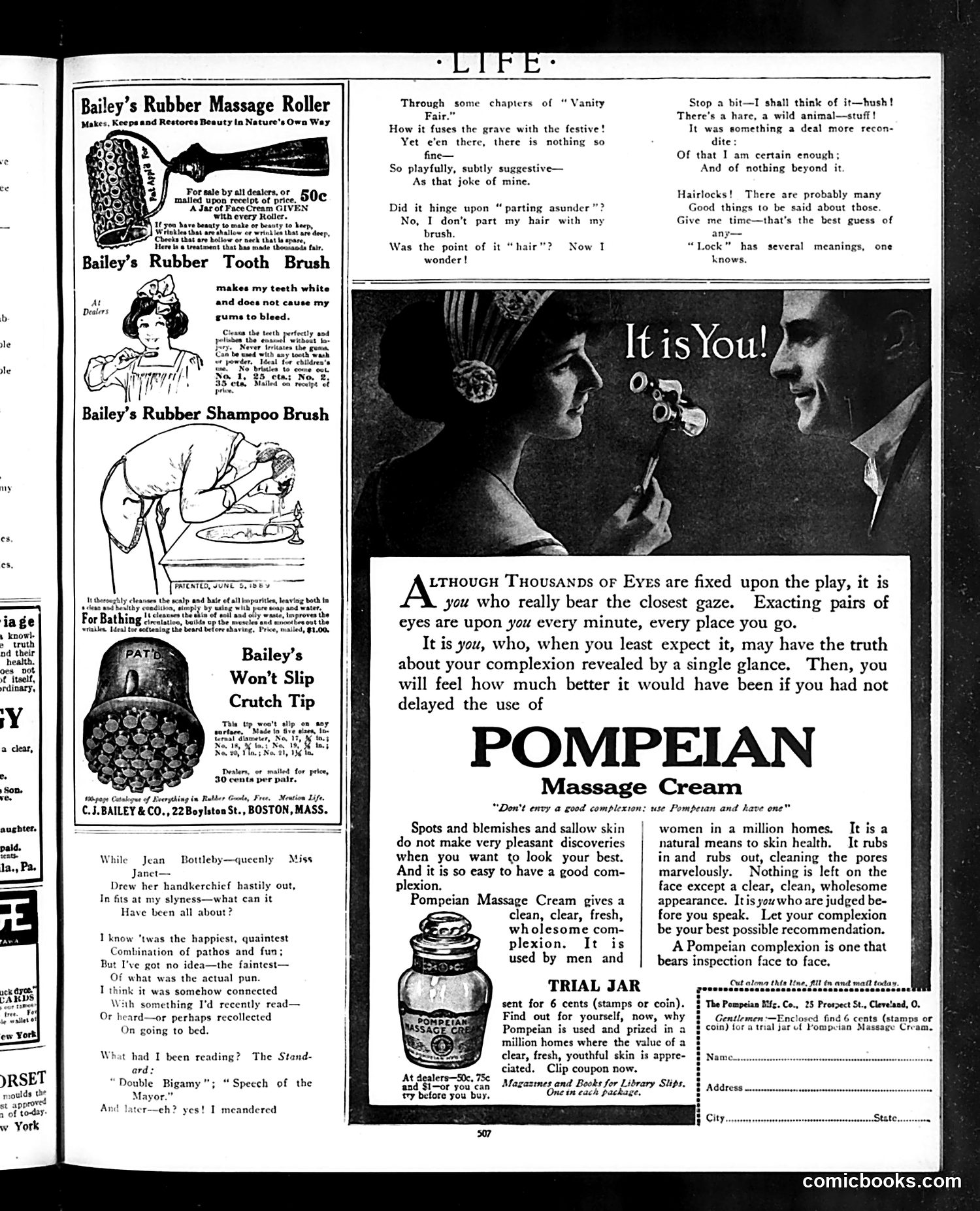
This page is primarily **advertising**, not political satire. It features vintage beauty and personal care product ads from the early 1900s (Bailey's rubber brushes and Pompeian Massage Cream). The only literary content is a humorous poem about a man who made a joke to a woman named Miss Janet while she was reading *Vanity Fair*. He can't remember what the joke was—he obsesses over whether it involved wordplay about "hair," "parting," or "hare" (the animal). The poem's humor comes from his befuddlement and the reader's realization the joke was likely trivial. The Pompeian ad uses social pressure as its sales pitch: women are constantly being observed and judged on appearance, so they should use the cream to improve their complexion before others notice flaws. This reflects period anxieties about women's public appearance and marriageability. There is no political content on this page.
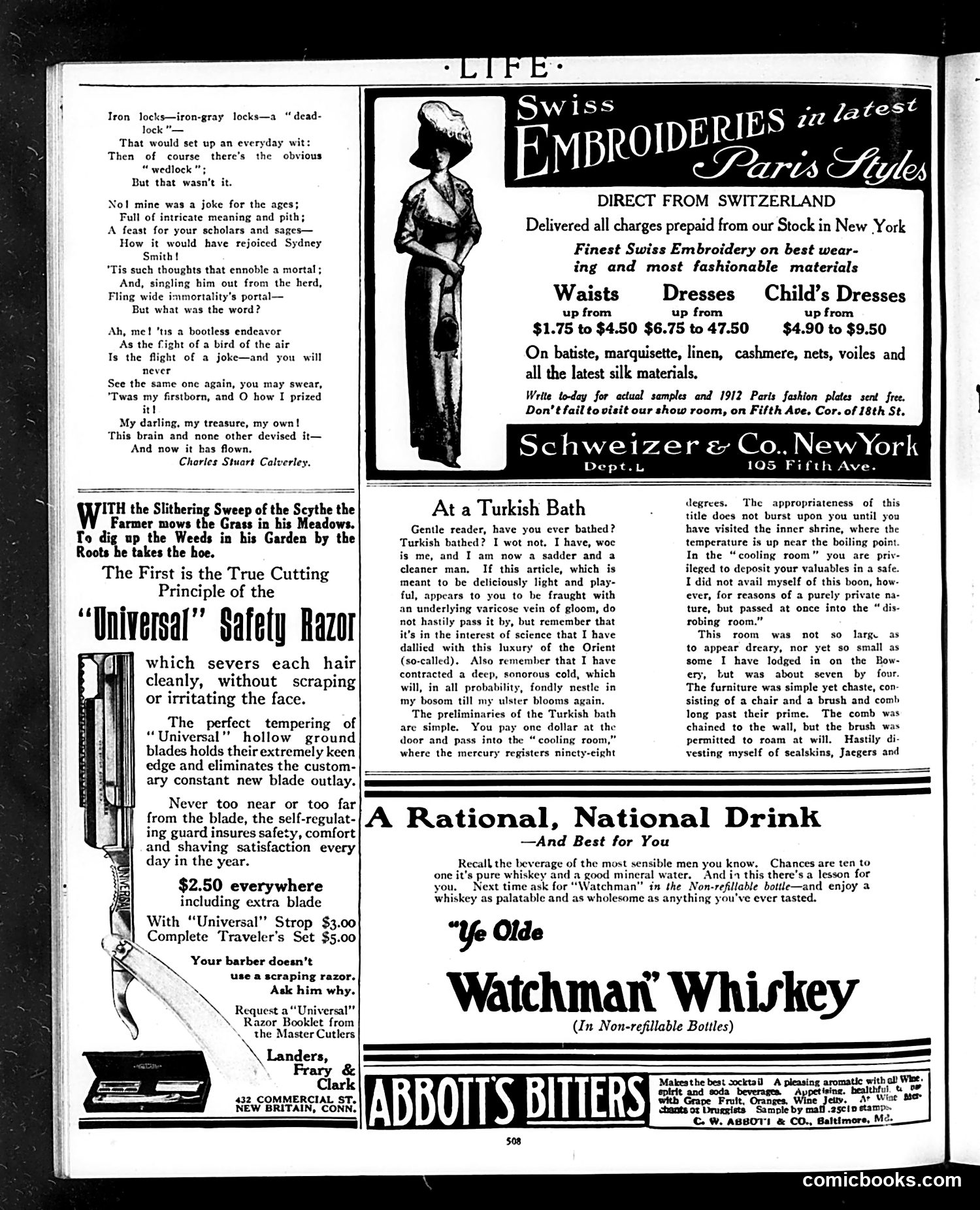
This page is primarily **advertising**, with a poem and article as secondary content. The **poem** (left side, attributed to Charles Stuart Calverley) is a whimsical meditation on a forgotten word—likely satirizing pretentious Victorian literature about profound ideas lost to memory. It's gentle wordplay rather than political satire. The **"Turkish Bath" article** (center-right) is a humorous travel piece describing the author's experience at a Turkish bathhouse. It's satirical in tone—self-deprecating comedy about the discomfort and complications of bathing customs unfamiliar to Western readers, with dry observations about the facilities and procedures. The **advertisements** dominate: Swiss embroideries from Schweizer & Co., a "Universal" Safety Razor (emphasizing its cutting principle), Watchman Whiskey, and Abbott's Bitters. These are standard commercial ads with no political content. The page reflects early 1900s consumer culture and lifestyle interests rather than political commentary.
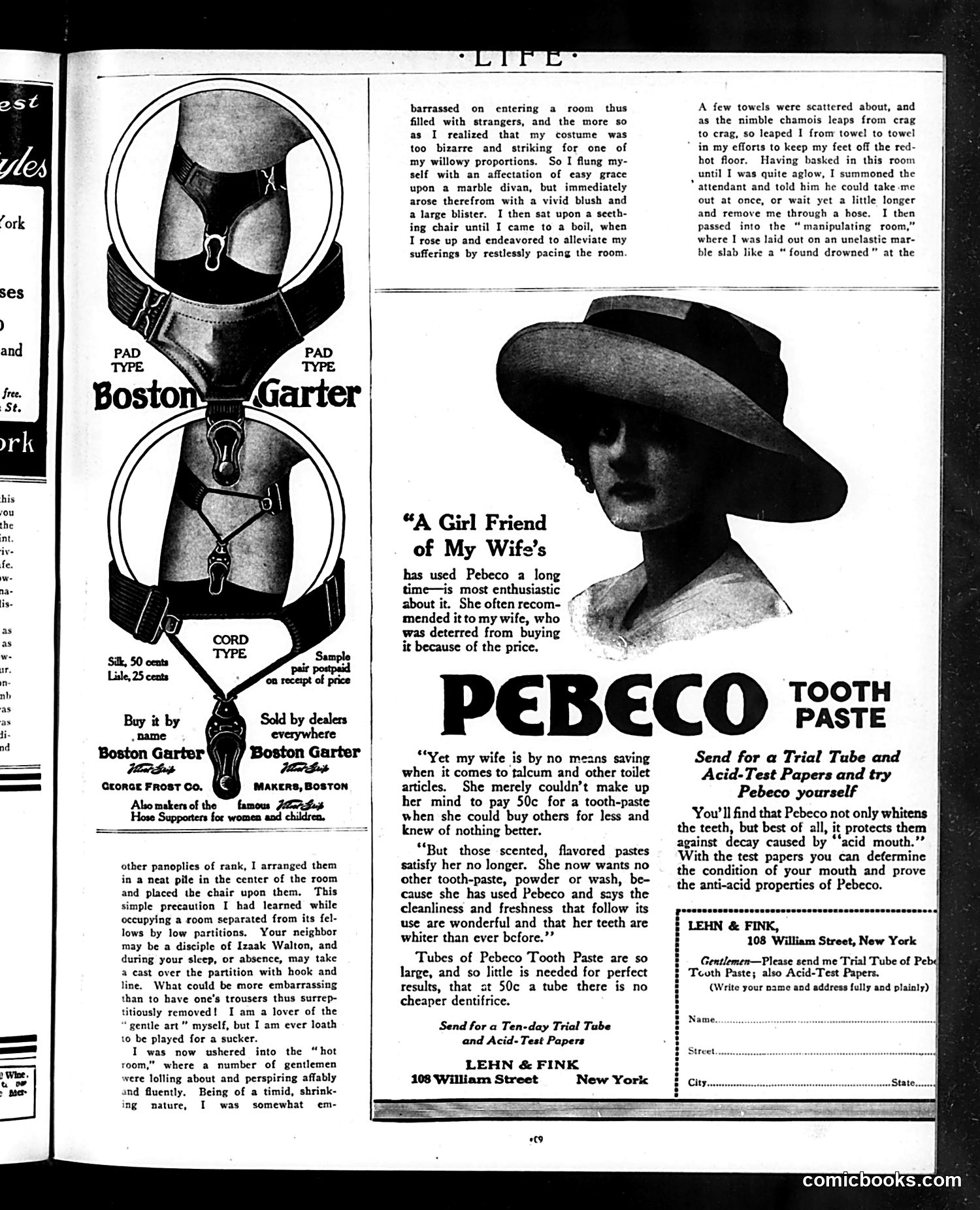
This is primarily a **vintage advertisement page**, not political satire. The main content is two ads: a Boston Garter (women's undergarment supporter) and Pebeco toothpaste. The text on the left is a **humorous personal narrative** about visiting a Turkish bath or spa. The author describes the absurd discomfort of the experience—sitting on scorching furniture, leaping between towels to avoid burning feet, emerging "like a found drowned" body. It's comedic exaggeration meant to entertain readers while the ads sell products below. The Pebeco ad uses **testimonial marketing**: a wife's friend enthusiastically recommends the toothpaste, converting the skeptical wife despite its 50-cent price (presented as expensive for tooth paste at the time). The ad emphasizes whitening and "acid mouth" protection via "Acid-Test Papers." The Boston Garter ad shows the product's construction with "pad type" and "cord type" options for women's and children's supporters. This represents early 20th-century **advertising mixed with entertainment content**—typical Life magazine strategy.
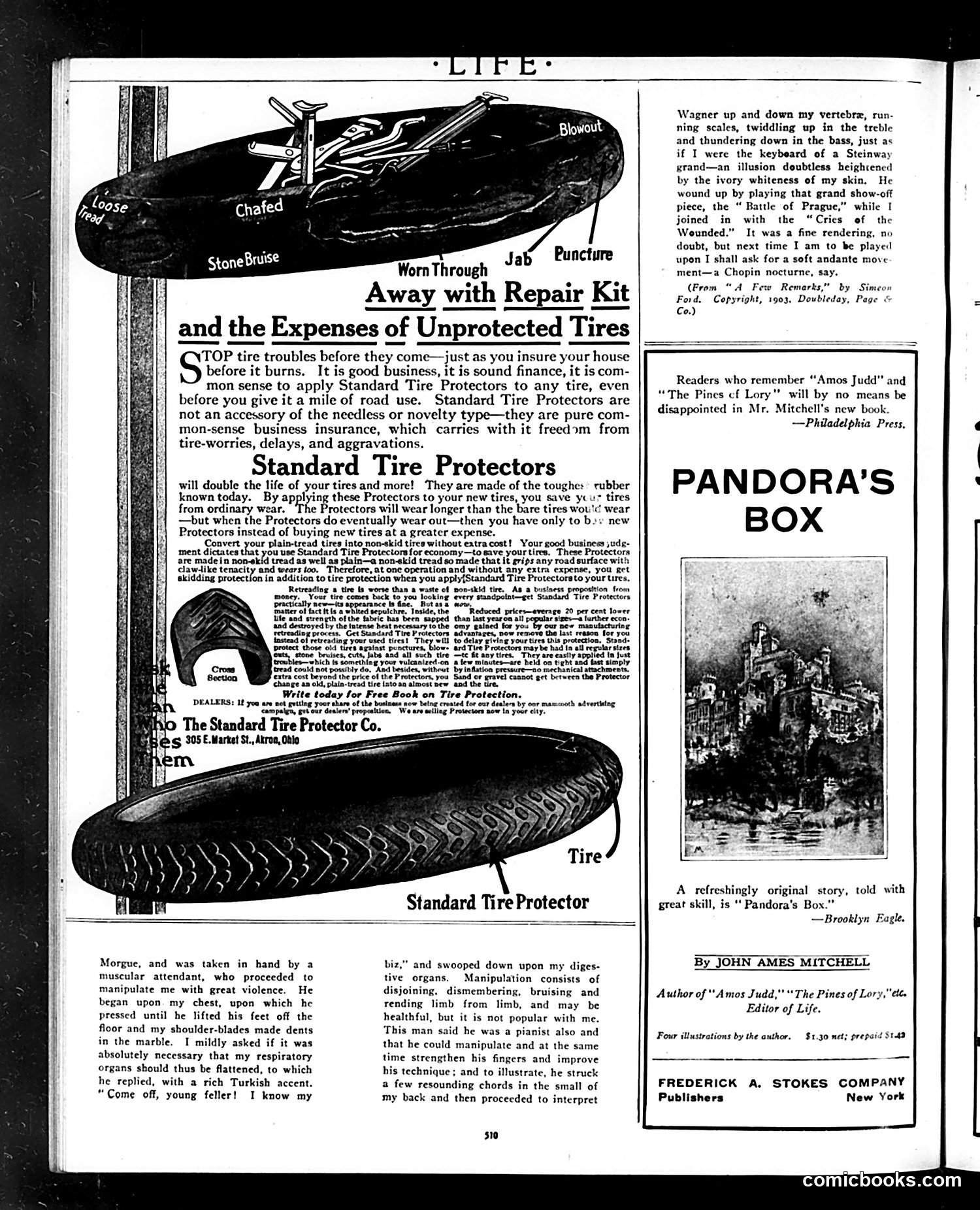
This page is primarily **advertising for Standard Tire Protectors**—a rubber covering applied to vehicle tires to extend their lifespan. The left side features a detailed product advertisement with diagrams showing common tire damage (loose tread, stone bruise, punctures, blowouts). The advertisement uses business-focused language ("good business," "sound finance") to market tire protection as preventative insurance, arguing it's cheaper to apply protectors than repeatedly buy new tires or resort to retreading (a repair process the ad criticizes as inferior). The right side contains two unrelated items: a literary excerpt from a satirical piece called "A Few Remarks" by Simon Ford, humorously describing a spa massage that leaves the narrator bruised and sore, and an advertisement for "Pandora's Box," a book by John James Mitchell published by Frederick A. Stokes Company. The page is primarily commercial rather than satirical, typical of *Life* magazine's mixed content format combining humor, literature, and advertising.
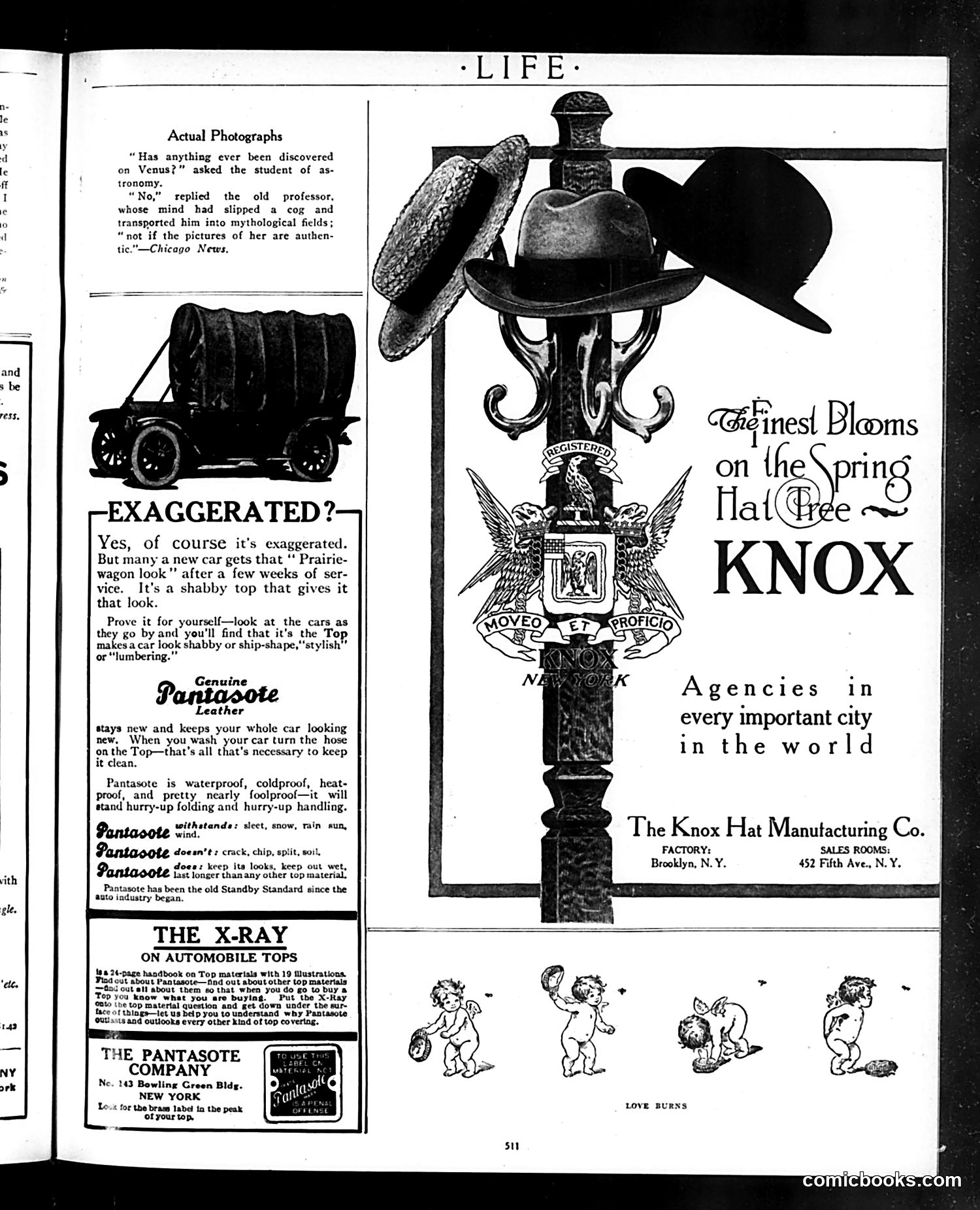
This is primarily an **advertising page** from Life magazine, not a political cartoon. It contains multiple product advertisements interspersed with a brief joke. The single humorous item is a short joke about **Venus** (the Roman goddess of love, not the planet). A student asks a professor of astronomy if anything has been discovered on Venus. The professor, whose "mind had slipped a cog," confuses the goddess with the celestial body and replies "No"—implying that actual photographs of the mythological Venus would be inauthentic or unflattering. The joke plays on the gap between mythology's idealized depiction of Venus as the goddess of beauty and whatever reality might show. The rest of the page advertises **Pantasote leather car tops** (emphasizing durability), **Knox hats** (with coat-of-arms imagery suggesting prestige), and **X-ray automobile top materials guide**. The small illustration at bottom labeled "Love Burns" shows cherubs and appears promotional rather than satirical.
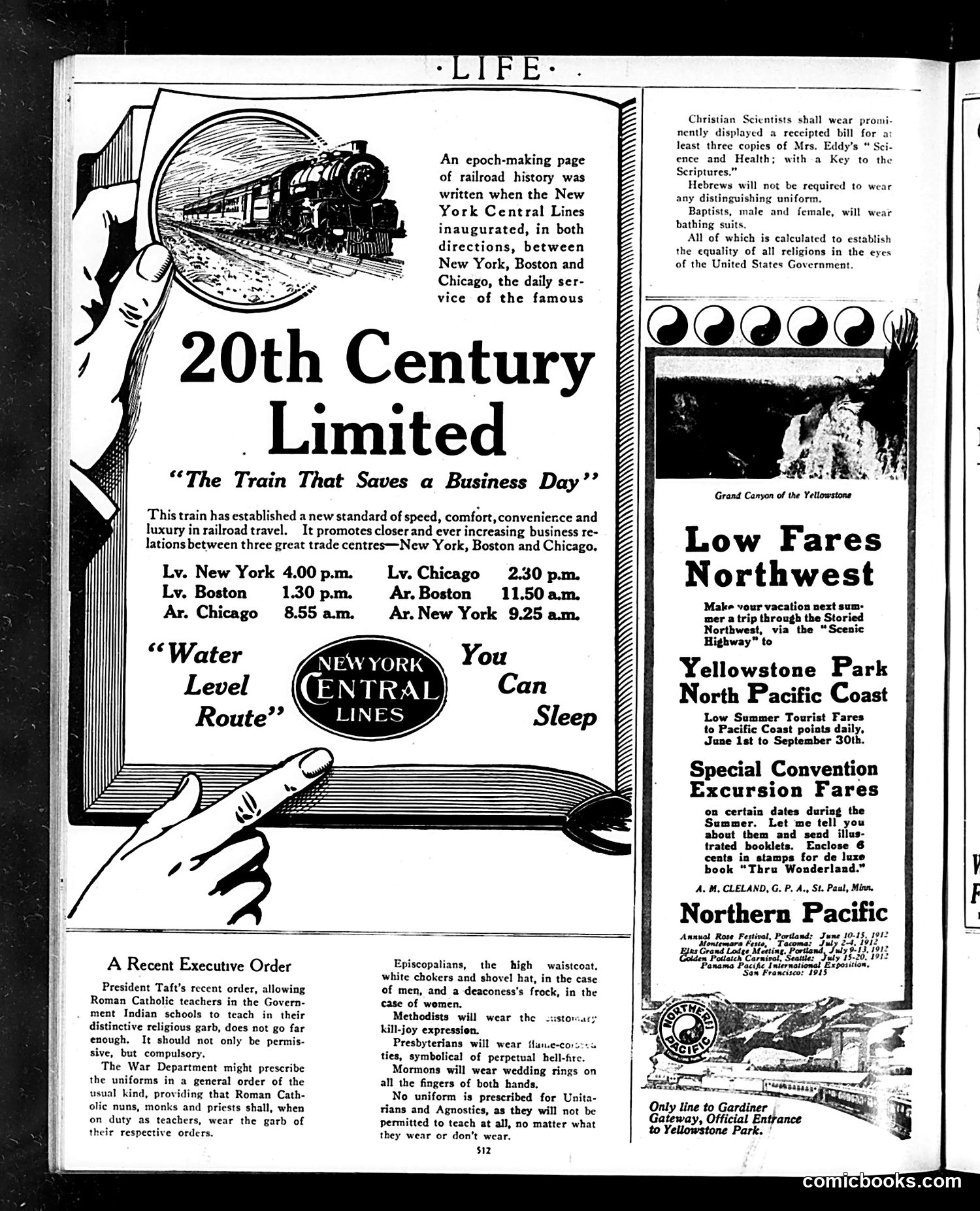
This page combines a railroad advertisement with political satire typical of early 20th-century Life magazine. **Main Content:** The left side advertises the "20th Century Limited" train service between New York, Boston, and Chicago, emphasizing speed and business efficiency. The illustration shows a streamlined locomotive symbolizing modern progress. **The Satire:** The right column mocks President Taft's 1909 executive order allowing Roman Catholic teachers in Indian schools to wear religious garb. Life suggests this should be *mandatory* for all religions, proposing ridiculous "uniforms": Methodists wearing "kill-joy expressions," Mormons displaying "wedding rings on all fingers," Baptists in "bathing suits," and notably, barring Unitarians and Agnostics from teaching entirely. The satire's point: it exposes the absurdity of mandating religious dress in public schools and the hypocrisy of claiming religious "equality" while actually privileging certain faiths. By pushing Taft's moderate accommodation to extremes, Life critiques both the original order and broader tensions over religion in American public institutions.
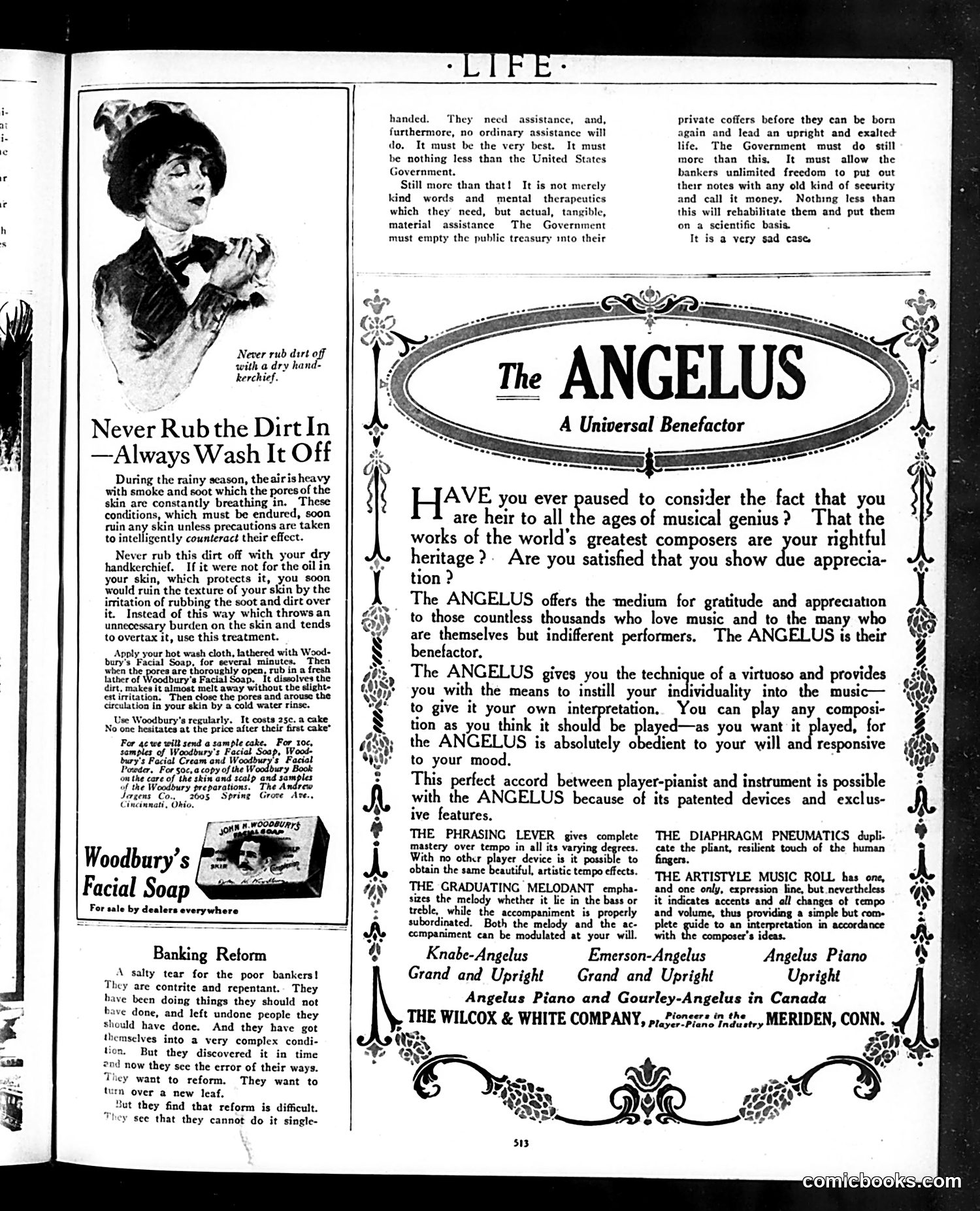
This page contains two distinct sections: a **satirical article on banking reform** and **product advertisements**. ## The Banking Reform Satire The left column mocks bankers with bitter irony. Written in faux-sympathetic tone, it portrays bankers as hapless figures seeking government bailout. The satire suggests bankers want the U.S. Treasury emptied into their coffers, unlimited freedom to issue notes backed by questionable security, and all presented as "scientific" rehabilitation. The piece clearly criticizes banker irresponsibility and their expectation that government (taxpayers) should rescue them—a pointed commentary on financial industry malfeasance and moral hazard. The historical context likely involves early 20th-century banking crises and reform debates. ## Advertisements The right side features two product ads: Woodbury's Facial Soap (with skincare advice) and the Angelus player piano (promoting musical accessibility). These are standard period advertising with no satirical content.
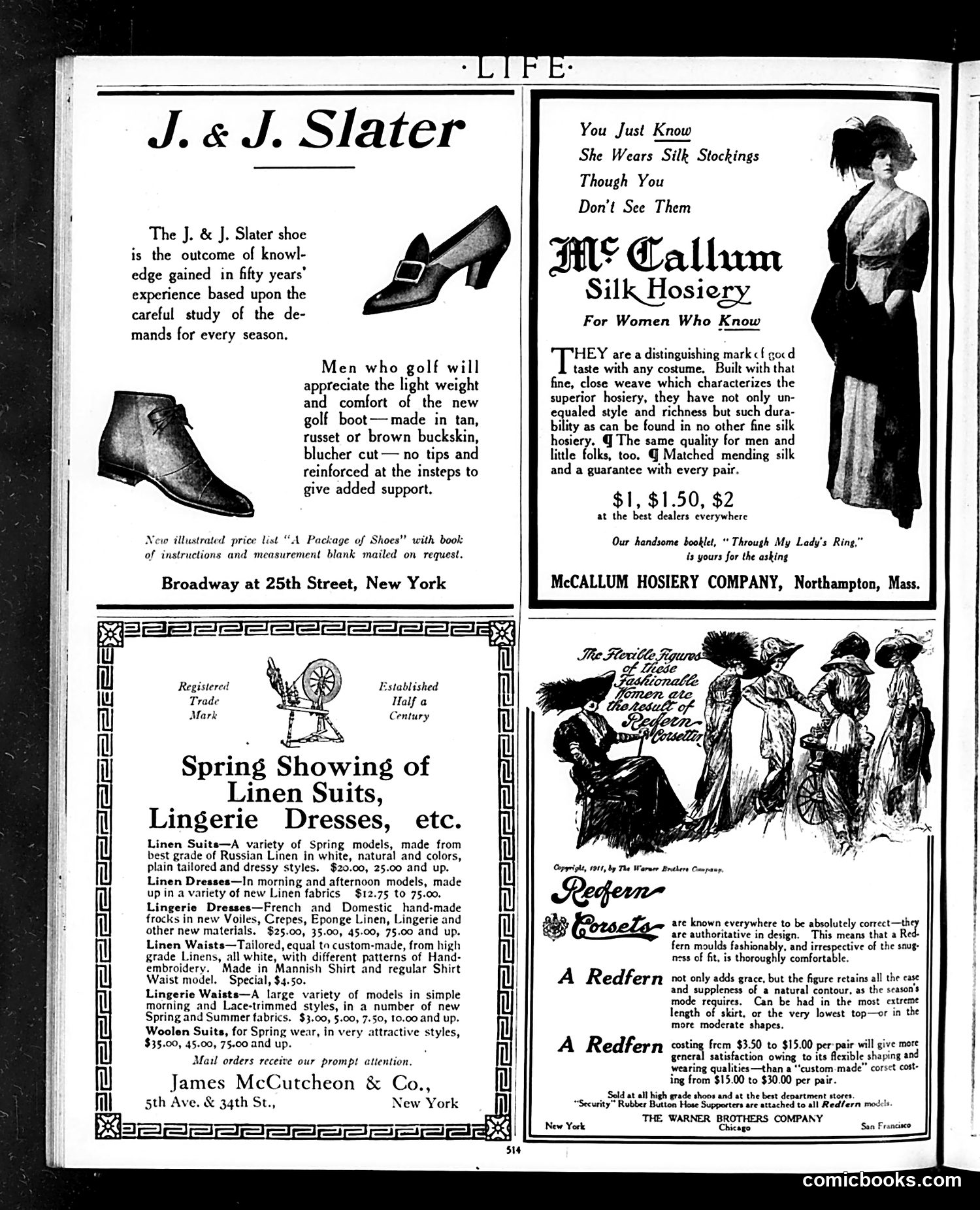
This is primarily an **advertising page** with no political cartoons or satire. It contains four separate luxury product advertisements from the early 1900s (circa 1911 based on copyright visible). The ads promote: 1. **J. & J. Slater shoes** — emphasizing fifty years of experience and a new golf boot for men 2. **McCallum Silk Hosiery** — targeting upper-class women, with copy suggesting that quality silk stockings signal good taste (even if invisible under clothing) 3. **James McCutcheon & Co.** — high-end linen suits and lingerie dresses for spring 4. **Redfern Corsets** — emphasizing fashionable shaping while maintaining comfort and natural movement The page reflects **Edwardian-era consumer culture**: luxury goods marketed to affluent Americans, emphasis on invisible refinement ("you don't see them"), and corsetry as essential fashion. There is no satire—these are straightforward, earnest appeals to wealthy consumers' desires for status and elegance.
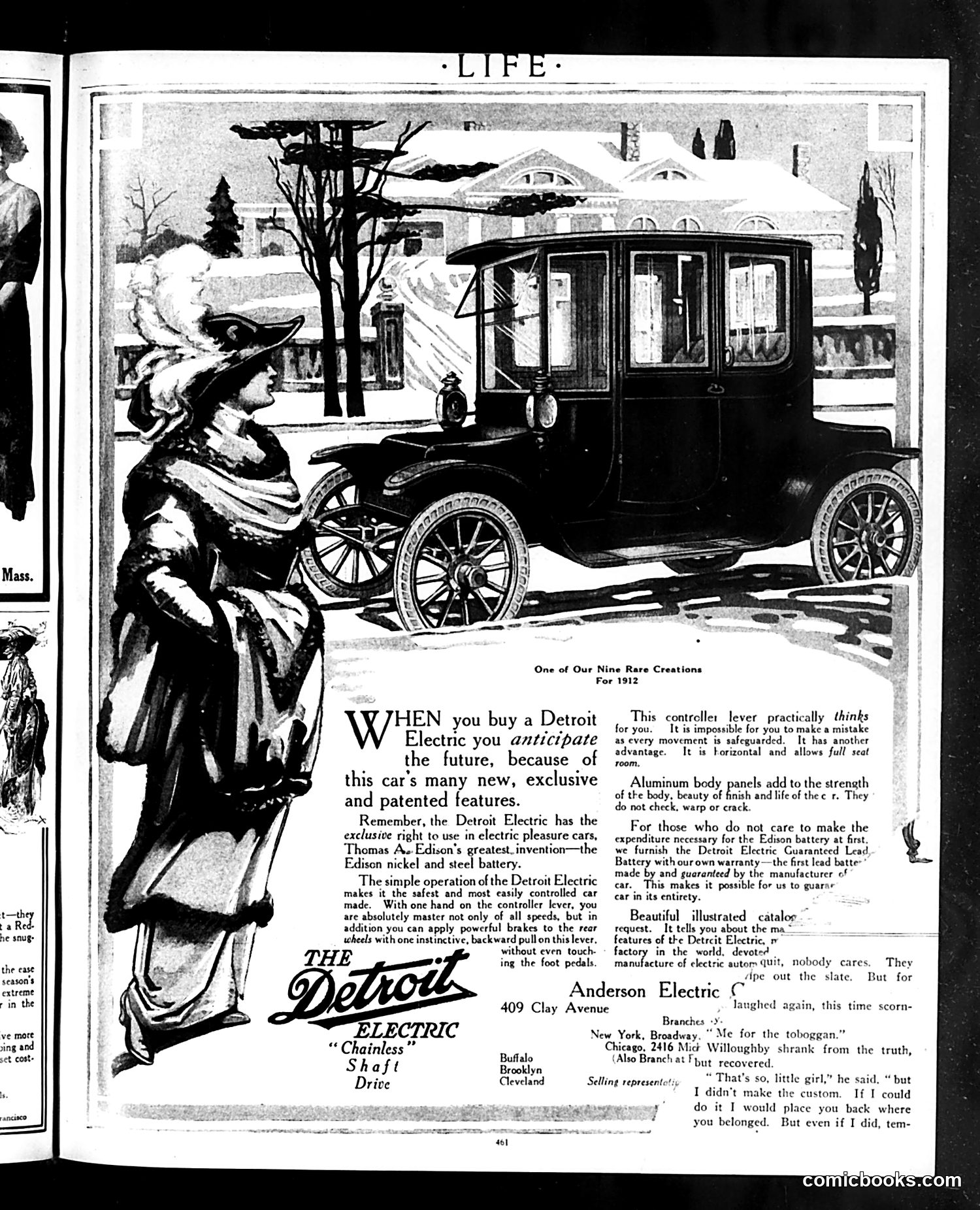
This page is primarily **advertising, not satire**. It features a 1912 Detroit Electric automobile advertisement aimed at wealthy female consumers—note the elegantly dressed woman in fashionable winter attire admiring the vehicle. The advertisement emphasizes the car's safety and ease of operation, highlighting its use of Thomas Edison's nickel-steel battery and a single "controller lever" requiring minimal physical effort. This marketing approach targets women, who were largely excluded from operating traditional manual automobiles. The fragmentary text at page's bottom appears to be unrelated editorial or fiction content, not commentary on the advertisement itself. **No political satire is evident here.** The page represents how early automotive marketing positioned electric cars as particularly suitable for female drivers due to their perceived mechanical simplicity—a gendered marketing strategy reflecting 1912 assumptions about women's capabilities and interests.
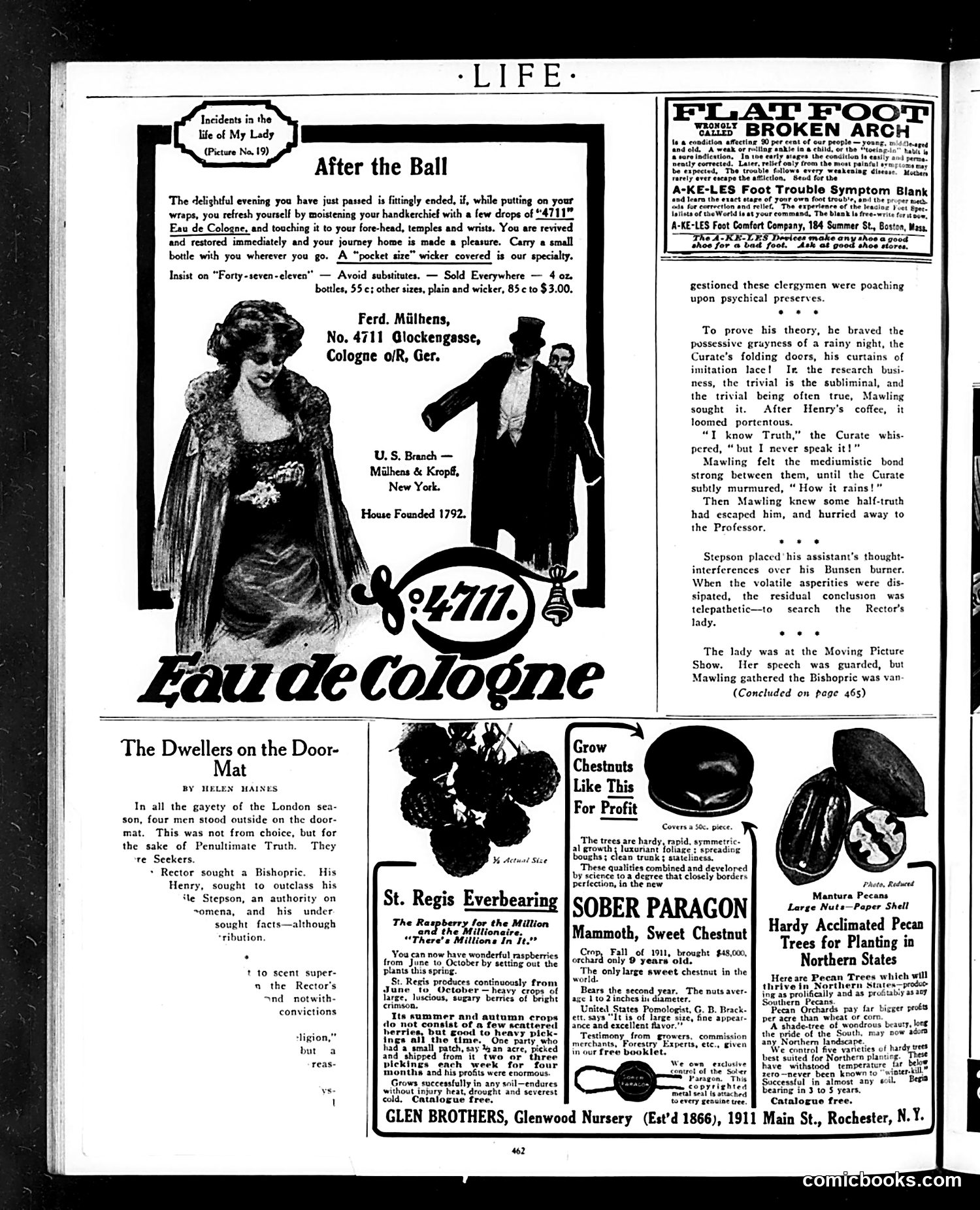
This page contains advertisements mixed with serialized fiction. The main content is a 4711 Eau de Cologne ad featuring an elegant woman and two men in formal evening wear, promoting the cologne as a refreshment after attending a ball. The ad emphasizes the product's portability in pocket-sized bottles. Below are advertisements for horticultural products: St. Regis everbearing raspberries, Sober Paragon chestnuts, and hardy pecan trees for northern climates—all pitched as profitable crops for farmers. The fictional narrative "The Dwellers on the Door-Mat" by Helen Haines appears to involve four men seeking "Penultimate Truth" while standing outside a rector's home. A subplot involves spiritualist investigations and a search for a "Rector's lady." The text references mediums, séances, and psychical research—popular pseudoscientific interests of the early 20th century that Life often satirized. The page reflects Edwardian-era concerns: genteel consumption, agricultural modernization, and fascination with spiritualism.
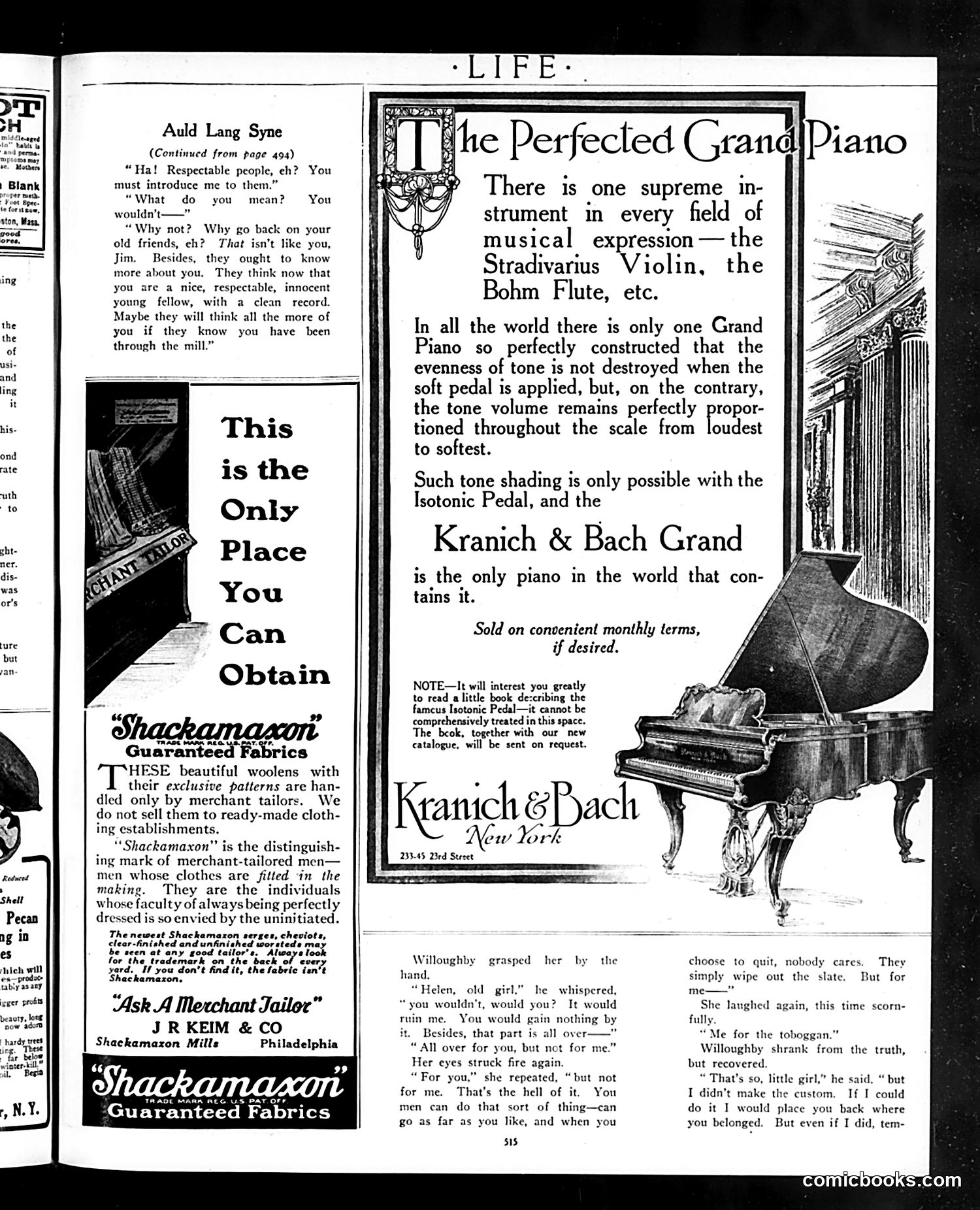
This page contains two distinct elements: a short story excerpt and advertisements. **The Story ("Auld Lang Syne"):** A man named Willoughby is attempting to persuade a woman named Helen not to reveal his past to respectable people he knows. Helen, apparently having a compromised reputation herself, threatens to expose him. The dialogue reveals a gendered double standard: Willoughby can move forward socially after indiscretions ("wipe out the slate"), but Helen cannot—she references being consigned to "the toboggan" (likely slang for social ruin/disgrace). The satire critiques how early 20th-century society judged women's morality far more harshly than men's. **The Advertisements:** The remaining content is commercial—promoting Shackamaxon tailored fabrics and a Kranich & Bach grand piano with an "Isotonic Pedal." These are standard period advertisements with no satirical content.
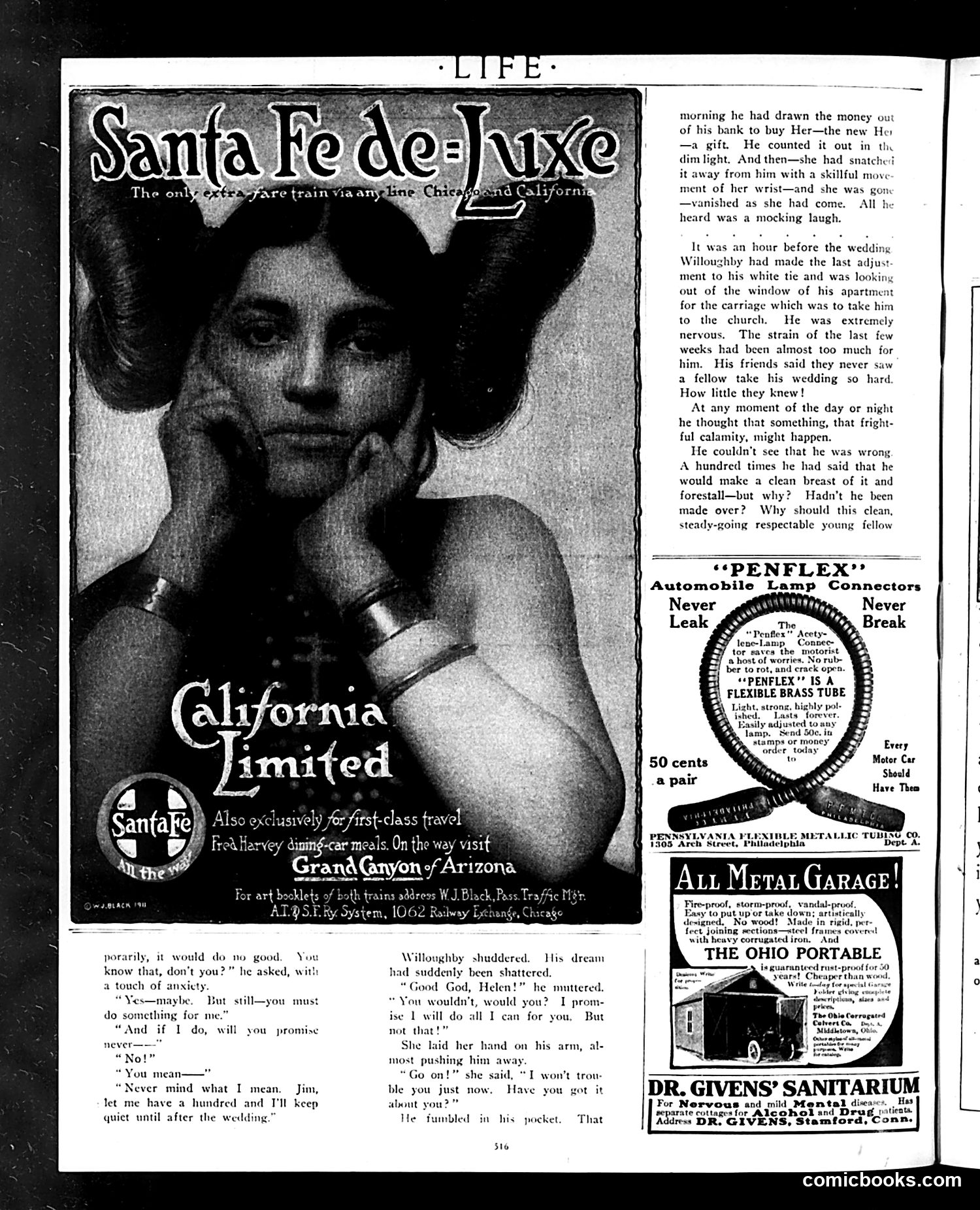
This page presents a serialized romantic drama titled "Santa Fe de Luxe" (advertisement for the train at top). The narrative concerns a man named Willoughby on his wedding day, gripped by anxiety about a secret. **The Plot:** A woman (presumably named Helen) has blackmailed Willoughby, demanding money to keep quiet about some undisclosed past transgression. That morning, she intercepted money he'd withdrawn as a gift, taking it with "a mocking laugh." Now, hours before his wedding, he's tormented by fear that she'll expose whatever scandal she knows—he repeatedly considers confessing to his bride-to-be but cannot bring himself to do so. **The Satirical Point:** This appears to be *satirizing* melodramatic serialized fiction popular in the era—the breathless anxiety, the femme fatale blackmailer, the guilty secret threatening respectable domesticity. The juxtaposition with mundane advertisements (lamp connectors, garages, sanitariums) underscores the absurdity of such overwrought dramatic scenarios. The page is primarily story/advertisement content rather than political cartoon.
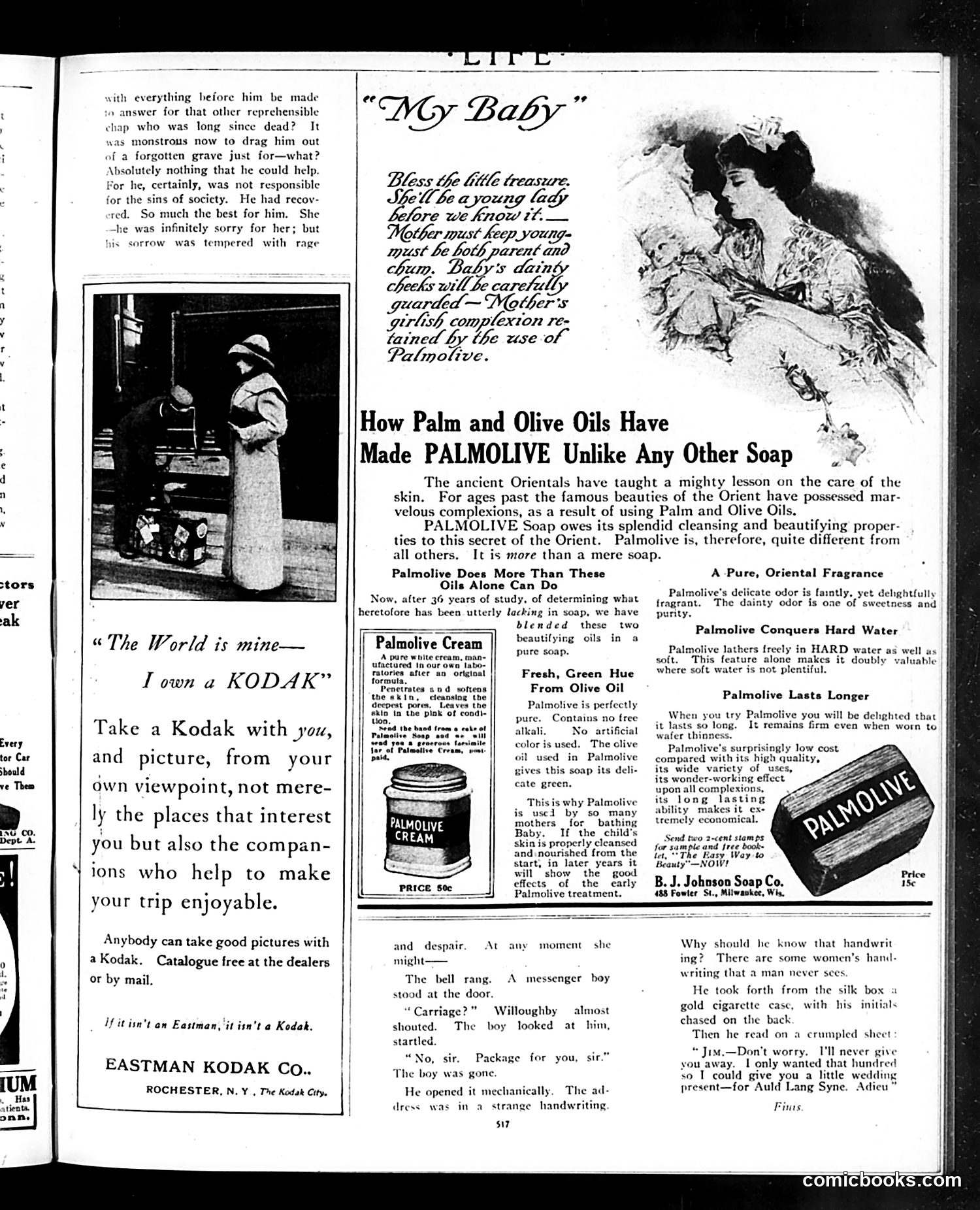
This page mixes fiction narrative with period advertisements. The main story appears to involve a man named Willoughby receiving a mysterious package with a cryptic message from "Jim" about money and secrecy—suggesting blackmail or scandal tied to a woman's past indiscretion. The advertisements are straightforward product promotions: Kodak cameras ("The World is mine—I own a Kodak") emphasizing amateur photography, and Palmolive soap highlighting its use of palm and olive oils for skincare, targeting mothers concerned with their babies' complexions. The decorative header "My Baby" with an illustration of an infant reinforces the maternal/domestic focus typical of *Life* magazine's era (early 20th century). There's no political satire visible here—this is standard period commercial and serialized fiction content, reflecting contemporary concerns about photography accessibility, personal hygiene products, and morality tales involving hidden pasts.
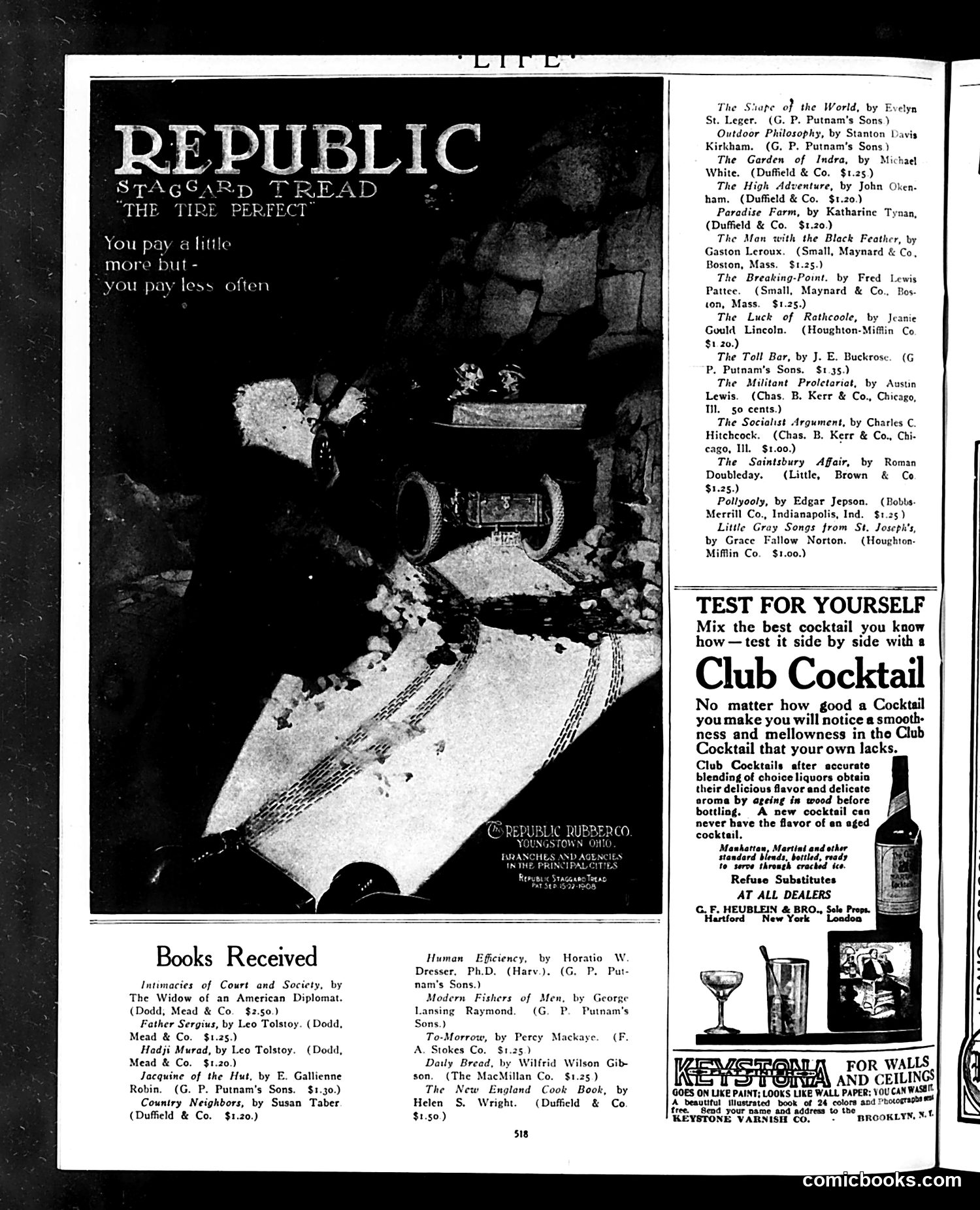
This page combines advertising with a book review section. The dominant feature is a Republic Rubber tire advertisement ("The Tire Perfect") showing a tire in use, with the sales pitch: "You pay a little more but—you pay less often." This appeals to economy-conscious consumers by emphasizing durability over initial cost. Below are two full-page advertisements: one for Club Cocktail liquor (inviting readers to compare homemade cocktails against their aged, wood-aged product) and Keystone Varnish for walls and ceilings. The "Books Received" section is a standard literary review listing recent publications, including works by Tolstoy and other contemporary authors, with prices typically $1-2.50. There is no political cartoon on this page. It functions primarily as an advertising and books review page from an early 20th-century American magazine.
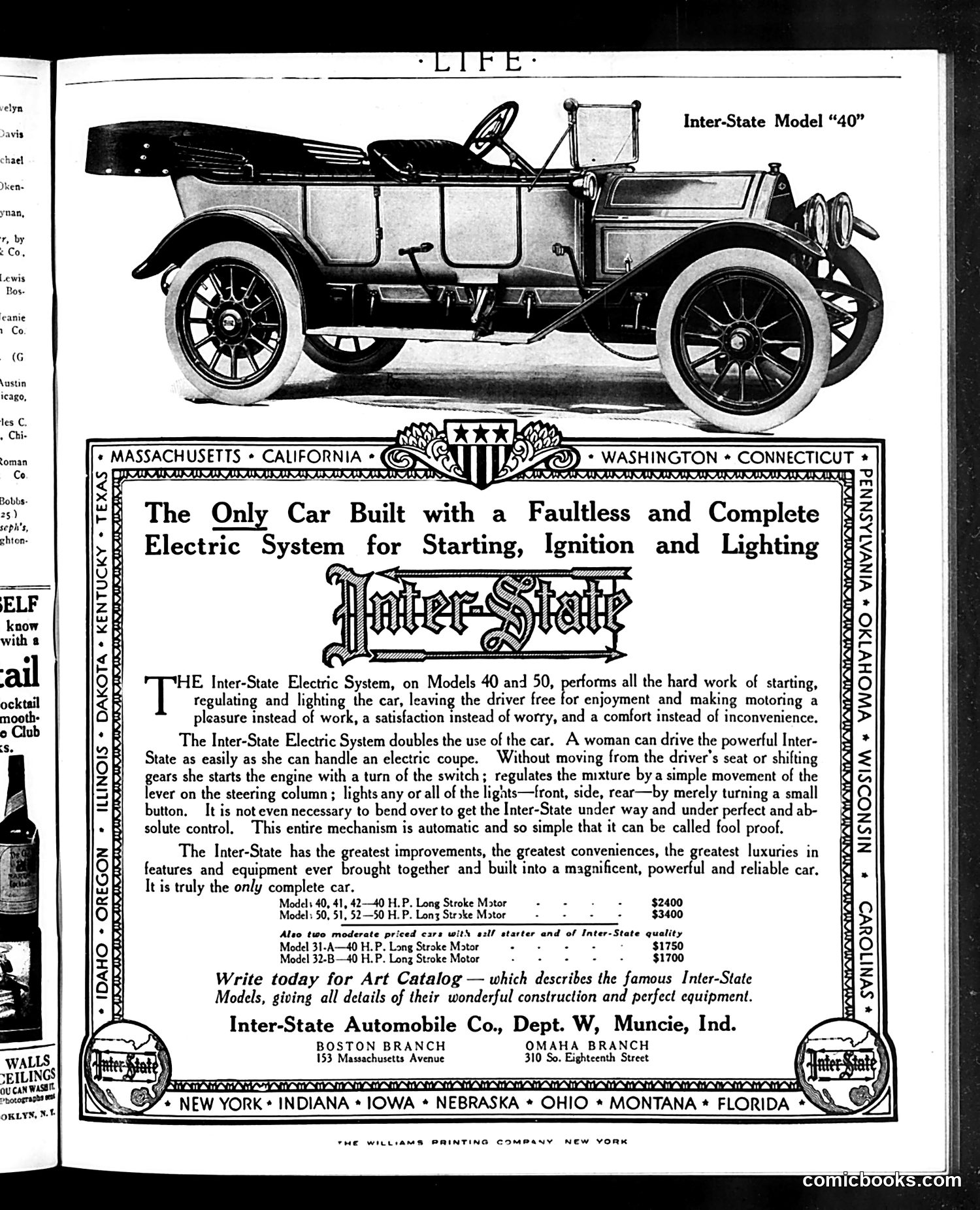
This page is **not a cartoon or satire** — it's a straightforward automobile advertisement from an early 20th-century *Life* magazine. The Inter-State Automobile Company advertises their Model "40" car, emphasizing its electric starting and ignition system as a major selling point. The key appeal targets **women drivers**: the ad stresses that the car is so easy to operate that a woman can drive it without physical strain — no hand-cranking, no gear-shifting required, just simple switches and buttons. This reflects the historical context of the 1910s, when electric starters were revolutionary technology (replacing dangerous hand-cranks), and when women's automotive independence was still novel enough to warrant special marketing emphasis. The decorative border listing multiple U.S. states indicates the company's national distribution network. Prices range from $1,700 to $3,400 — substantial sums for the era. This is commercial advertising, not editorial content or satire.
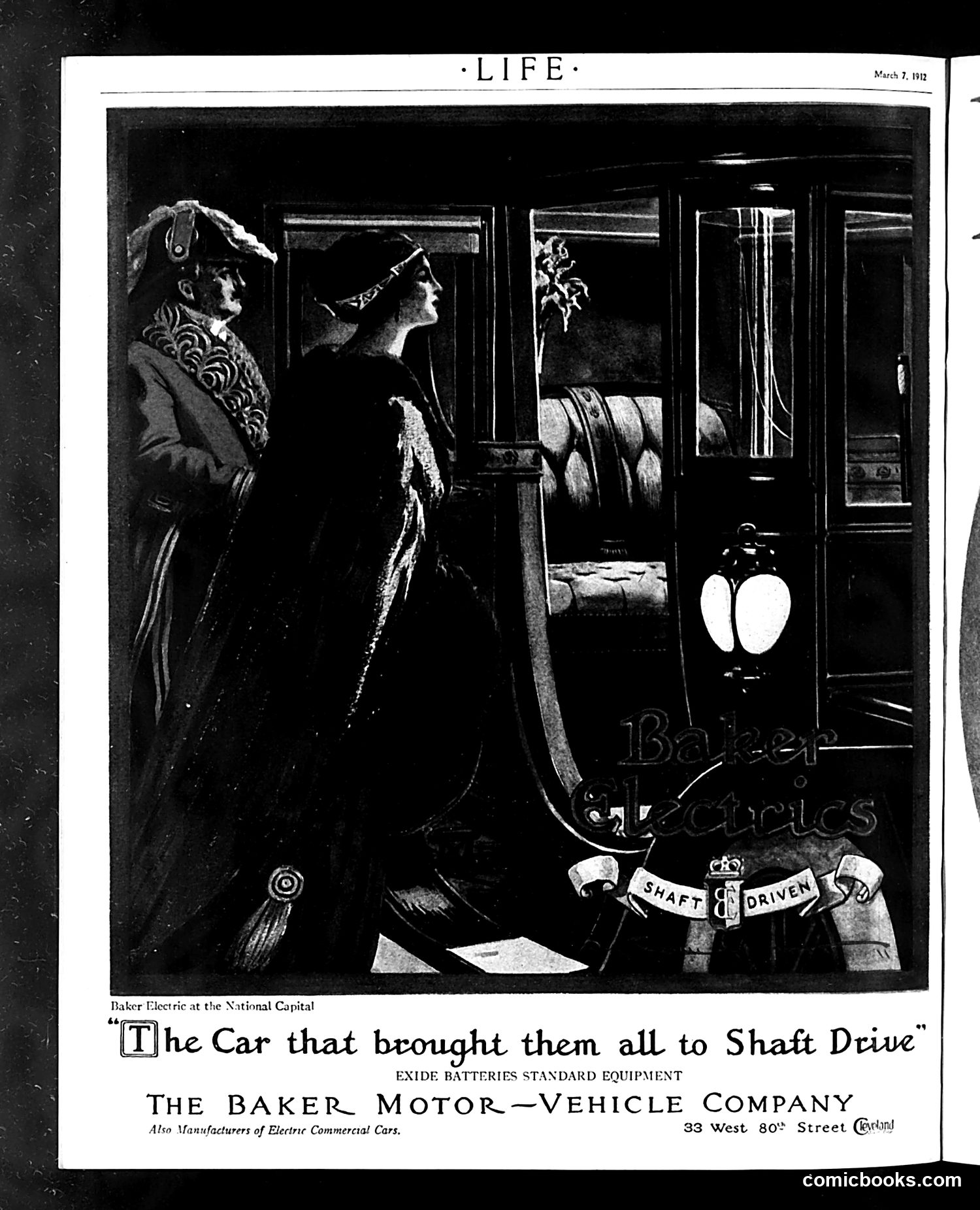
This is primarily a **commercial advertisement** for Baker Motor-Vehicle Company's electric cars, not political satire. The image shows two elegantly dressed women in early 1900s fashion entering or admiring a Baker Electric vehicle at the National Capitol. The advertisement's headline—"The Car that brought them all to Shaft Drive"—appears to be a play on words referencing the vehicle's mechanical features (shaft drive technology). The luxurious setting and fashionable female figures suggest the car's appeal to wealthy, sophisticated buyers. The notation "EXIDE BATTERIES STANDARD EQUIPMENT" emphasizes the vehicle's reliable electrical system—a significant selling point when electric cars competed with early gasoline vehicles.