
Life, 1912-03-07 · page 28 of 60
Life — March 7, 1912 — page 28: what you’re looking at
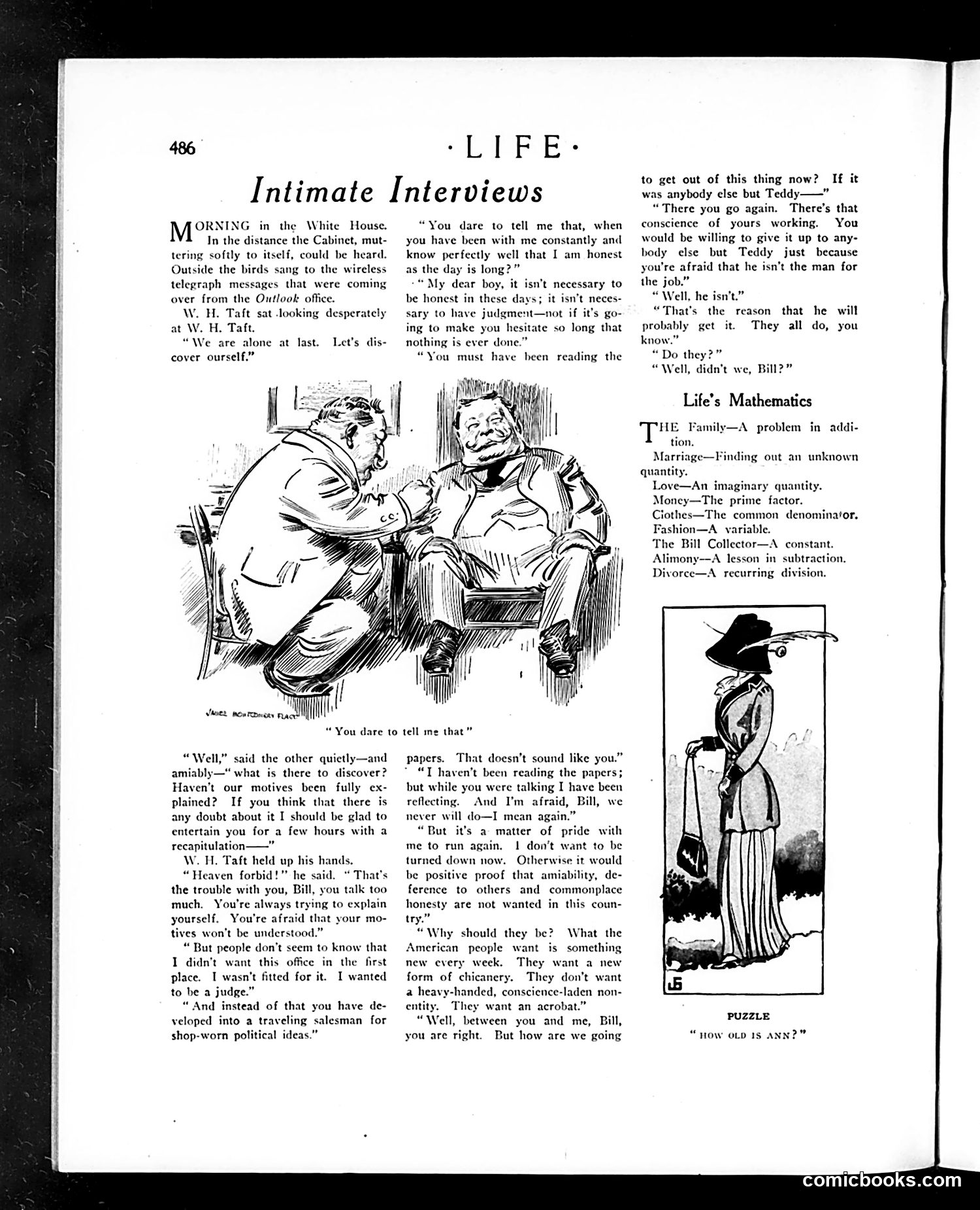
What you’re looking at
This dialogue depicts President **William Howard Taft** conversing with himself—a device satirizing his indecision and internal conflict. The "Bill" he addresses appears to be his alter ego or conscience. The satire centers on **Taft's reluctance to run for re-election** against **Theodore Roosevelt**, his predecessor. Taft's companion accuses him of being ineffectual ("traveling salesman for shop-worn political ideas") and suggests that Americans don't actually want honest, conscientious leaders—they want novelty and "acrobats" (likely alluding to Roosevelt's dynamic personality). The joke's bitter point: Taft won't withdraw because he fears looking weak, yet his very conscientiousness proves he's unfit for politics. The final exchange—"Well, didn't we, Bill?"—implies both men (Taft and Roosevelt) succeeded precisely because they weren't qualified. This reflects the real 1912 Republican split, when Roosevelt challenged Taft's renomination.
📄 Transcribed text from this page (OCR, searchable)
Machine-transcribed from the original scan — historical spelling and the odd misread are preserved.
“LIF E*= Intimate Interviews ORNING in the White House. In the distance the Cabinet, mut- tering softly to itself, could be heard. Outside the birds sang to the wireless telegraph messages that were coming over from the Outlook office. W. H. Taft sat looking desperately at W. H. Taft. “We are alone at last. cover ourself.” Let's dis- “You dare to tell me that, when you have been with me constantly and know perfectly well that I am honest as the day is long?” “My dear boy, it isn’t necessary to be honest in these days; it isn’t neces- sary to have judgment—not if it’s go- ing to make you hesitate so long that nothing is ever done.” “You must have been reading the “You dare to tell me that” “Well,” said the other quietly—and amiably—“ what is there to discover? Haven't our motives been fully ex- plained? If you think that there is any doubt about it I should be glad to entertain you for a few hours with a recapitulation——” W. H. Taft held up his hands, “Heaven forbid!" he said. “ That's the trouble with you, Bill, you talk too much. You're always trying to explain yourself. You're afraid that your mo- tives won't be understood.” “ But people don’t seem to know that I didn’t want this office in the first place. "t fitted for it. I wanted to be a judge.” “And instead of that you have de- veloped into a traveling salesman for shop-worn political ideas.” papers. That doesn’t sound like you.” “T haven't been reading the papers; but while you were talking I have been reflecting. And I'm afraid, Bill, we never will do—I mean again.” “But it’s a matter of pride with me to run again. 1 don’t want to be turned down now. Otherwise it would be positive proof that amiability, de- ference to others and commonplace honesty are not wanted in this coun- try.” “Why should they be? What the American people want is something new every week. They want a new form of chicanery. They don’t want a heavy-handed, conscience-laden non- entity. They want an acrobat.” “Well, between you and me, Bill, you are right. But how are we going to get out of this thing now? If it was anybody else but Teddy —” “There you go again. There’s that conscience of yours working. You would be willing to give it up to any- body else but Teddy just because you're afraid that he isn’t the man for the job.” “Well, he isn’t.” “That's the reason that he will probably get it. They all do, you know.” “Do they?” “Well, didn’t we, Bill?” Life’s Mathematics HE Family—A problem in addi- tion, Marriage—Finding out an unknown quantity. Love—An imaginary quantity. Money—The prime factor. Ciothes—The common denominator. Fashion—A_ variable. The Bill Collector—A constant. Alimony—A lesson in subtraction. A recurring division. “How OLD 1S ANN?” comicbooks.com