
Life, 1912-03-07 · page 26 of 60
Life — March 7, 1912 — page 26: what you’re looking at
What you’re looking at
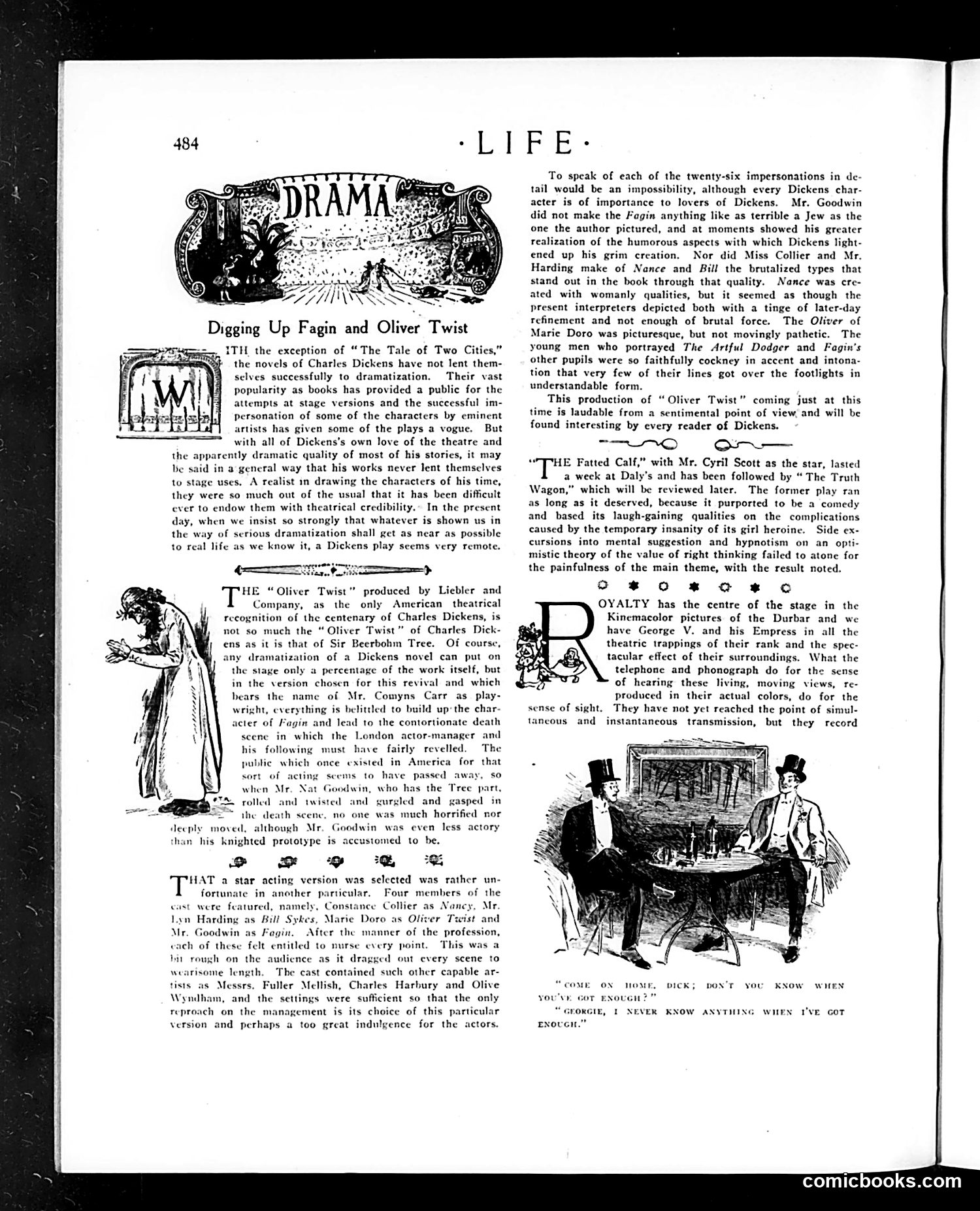
This is a theater review of an American production of *Oliver Twist* staged by Liebler and Company, presented as part of Charles Dickens's centenary celebration. The critic argues that Dickens's novels resist successful dramatization because his characters, though realistic for Victorian England, lack theatrical credibility on stage. The review critiques this particular adaptation—based on Sir Beerbohm Tree's earlier version—for overemphasizing Fagin's melodramatic death scene rather than faithfully representing Dickens's creation. The main complaint: the cast (including Mr. Goodwin as Fagin, Constance Collier as Nancy, and Marie Doro as Oliver) softened Dickens's brutal characters with excessive "refinement" and insufficient brutality. The critic particularly notes that the young actors playing pickpockets spoke such authentic cockney that audiences couldn't understand them. The cartoon (bottom right) depicts a social scene, though its specific satirical point remains unclear from the visible image and caption alone.
📄 Transcribed text from this page (OCR, searchable)
Machine-transcribed from the original scan — historical spelling and the odd misread are preserved.
“LIFE: EZZMNWRS Digging Up Fagin and Oliver Twist H_ the exception of “The Tale of Two Cities,” the novels of Charles Dickens have not lent them- selves successfully to dramatization. Their vast popularity as books has provided a public for the attempts at stage versions and the successful im- personation of some of the characters by eminent artists has given some of the plays a vogue. But with all of Dickens's own love of the theatre and the apparently dramatic quality of most of his stories, it may be said in a general way that his works never lent themselves to stage uses, A realist in drawing the characters of his time, they were so much out of the usual that it has been difficult ever to endow them with theatrical credibility.» In the present day, when we insist so strongly that whatever is shown us in the way of serious dramatization shall get as near as possible to real life as we know it, a Dickens play seems very remote. Te “Oliver Twist” produced by Liebler and Company, as the only American theatrical recognition of the centenary of Charles Dickens, is not so much the “Oliver Twist” of Charles Dick- ens as it is that of Sir Beerbohm Tree. Of course, any dramatization of a Dickens novel can put on the stage only a percentage of the work itself, but in the version chosen for this revival and which bears the name of Mr. Comyns Carr as play- wright, everything is belittled to build up: the char- acter of Fagin and lead to the contortionate death scene in which the London actor-manager his following must have fairly reveled. public which once existed in America for that sort of acting seems to have passed away, so at Goodwin, who ha art, Za when Mr. rolled and twisted and gurgled and gasped in the death scene, no one was much horrified nor deeply moved, although Mr. Goodwin was even less actory han his knighted prototype is accustomed to be. PS Se Te HAT a star acting version was selected was rather un- fortur Four members of the cast were featured, namely, Constance Collier as Nancy, Mr Lyn Harding s, Marie Doro as Oliver Tivist and Mr. Goodw Fagin. After the manner of the profession, cach of these felt entitled to nurse every point. This was a hit rough on the audience as it dragged out every scene to wearisome length, The cast contained such other capable ar- tists as Messrs, Fuller Mellish, Charles Harbury and Olive Wyndham, and the settings were sufficient so that the only reproach on the management is its choice of this particular version and perhaps a too great indulgence for the actors. other particular, To speak of each of the twenty-six impersonations in de- tail would be an impossibility, although every Dickens char- acter is of importance to lovers of Dicken: Mr. Goodwin did not make the Fagin anything like as terrible a Jew as the one the author pictured, and at moments showed his greater realization of the humorous aspects with which Dickens light- ened up his grim creation. Nor did Miss Collier and Mr. Harding make of Nance and Bill the brutalized types that stand out in the book through that quality. Nance was cre- ated with womanly qualities, but it seemed as though the present interpreters depicted both with a tinge of later-day refinement and not enough of brutal force. The Oliver of Marie Doro was picturesque, but not movingly pathetic. The young men who portrayed The Artful Dodger and Fagin's other pupils were so faithfully cockney in accent and intona- tion that very few of their lines got over the footlights in understandable form. This production of “Oliver Twist” coming just at this time is laudable from a sentimental point of view, and will be found interesting by every reader of Dickens. ae) on i 'HE Fatted Calf,” with Mr. Cyril Scott as the star, lasted a week at Daly's and has been followed by “The Truth Wagon,” which will be reviewed later. The former play ran as long as it deserved, because it purported to be a comedy and based its laugh-gaining qualities on the complications caused by the temporary insanity of its girl heroine. Side ex- cursions into mental suggestion and hypnotism on an opti- mistic theory of the value of right thinking failed to atone for the painfulness of the main theme, with the result noted. o *# oc * Oo # OYALTY has the centre of the stage in the Kinemacolor pictures of the Durbar and we have George V. and his Empress in all the theatric trappings of their rank and the spec- tacular effect of their surroundings. What the telephone and phonograph do for the sense of hearing these living, moving views, re- produced in their actual colors, do for the sense of sight. They have not yet reached the point of simul- taneous and instantancous transmission, but they record OME ON NOME, DICK; DON’T YOu KNOW WHEN you'vy cor ENoven “GroRGix, 1 NEVER KNOW ANYTHING WHEN I'VE GoT ENoven comicbooks.com