
Life, 1912-03-07 · page 14 of 60
Life — March 7, 1912 — page 14: what you’re looking at
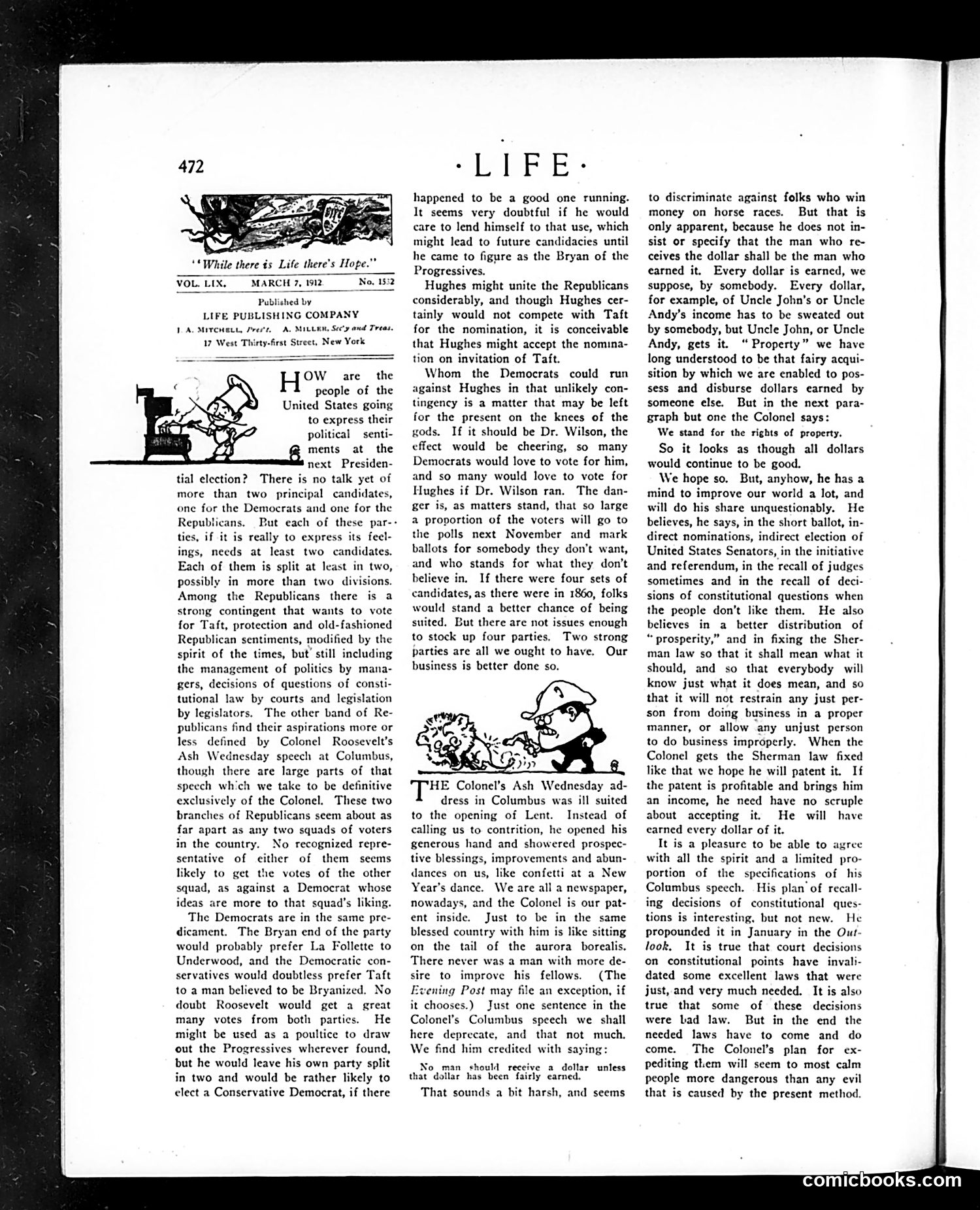
What you’re looking at
This Life magazine page (March 7, 1912) discusses potential Democratic and Republican candidates for the upcoming presidential election. The article debates whether Charles Evans Hughes might be nominated by Republicans as an alternative to President Taft, and whether Democrats could run Hughes against their own candidate. The small cartoon shows a figure (likely representing a political operative or candidate) emerging from or associated with a basket, suggesting deception or hidden dealings in candidate selection. The broader text argues for a multi-party system rather than just two parties, and includes commentary on Colonel Roosevelt's political activities and the need for clearer campaign finance laws—notably, a quote opposing politicians who haven't "fairly earned" their dollars, reflecting Progressive Era concerns about money in politics.
📄 Transcribed text from this page (OCR, searchable)
Machine-transcribed from the original scan — historical spelling and the odd misread are preserved.
‘* While there is Life there's Hop 2 No, 15:2 VOL. LL MARCH 7, 1912 Published by LIFE PUBLISHING COMPANY AL MILLA, See’y and Tr 1A. Miroment, Pres y-first Street, New York 7 West T OW are the people of the United States going to express their political senti- ments at the next Presiden- tial election? There is no talk yet of more than two principal candidates, one for the Democrats and one for the Republicans. ties, if it is really to express its feel- ings, needs at least two candidates. Each of them is split at least in two, possibly in more than two divisions. Among the Republicans there is a strong contingent that wants to vote for Taft, protection and old-fashioned Republican sentiments, modified by the spirit of the times, but’ still including the management of politics by mana- gers, decisions of questions of consti- tutional law by courts and legislation by legislators. The other band of Re- publicans find their aspirations more or less defined by Colonel Roosevelt's Ash Wednesday speech at Columbus, though there are large parts of that specch which we take to be definitive of the Colonel. These two s of Republicans seem about as far apart as any two squads of voters in the country. No recognized repre- sentative of either of them seems likely to get the votes of the other squad, as against a Democrat whose ideas are more to that squad’s liking. The Democrats are in the same pre- dicament. The Bryan end of the party would probably prefer La Follette to Underwood, and the Democratic con- servatives would doubtless prefer Taft to a man believed to be Bryanized. No doubt Roosevelt would get a great many votes from both parties. He might be used as a poultice to draw out the Progressives wherever found, but he would leave his own party split in two and would be rather likely to elect a Conservative Democrat, if there But each of these par-- aU ialee happened to be a good one running. It seems very doubtful if he would care to lend himself to that use, which might lead to future candidacies until he came to figure as the Bryan of the Progressives. Hughes might unite the Republicans considerably, and though Hughes cer- tainly would not compete with Taft for the nomination, it is conceivable that Hughes might accept the nomina- tion on invitation of Taft. Whom the Democrats could run against Hughes in that unlikely con- tingency is a matter that may be left for the present on the knees of the gods. If it should be Dr. Wilson, the effect would be cheering, so many Democrats would love to vote for him, and so many would love to vote for Hughes if Dr. Wilson ran. The dan- ger is, as matters stand, that so large a proportion of the voters will go to the polls next November and mark ballots for somebody they don’t want, and who stands for what they don't believe in. If there were four sets of candidates, as there were in 1860, folks would stand a better chance of being suited. But there are not issues enough to stock up four parties. Two strong parties are all we ought to have. Our business is better done so. Brin 'HE Colonel’s Ash Wednesday ad- dress in Columbus was ill suited to the opening of Lent. Instead of calling us to contrition, he opened his generous hand and showered prospec- tive blessings, improvements and abun- dances on us, like confetti at a New Year's dance. We are all a newspaper, nowadays, and the Colonel is our pat- ent inside. Just to be in the same blessed country with him is like sitting on the tail of the aurora borealis. There never was a man with more de- sire to improve his fellows. (The ning Post may file an exception, if it chooses.) Just one sentence in the Colonel’s Columbus speech we shall here deprecate, and that not much. We find him credited with saying: No man should ree a dollar unless that dollar been fairly earned. That sounds a bit harsh, and seems to discriminate against folks who win money on horse races. But that is only apparent, because he does not in- sist or specify that the man who re- ceives the dollar shall be the man who earned it. Every dollar is earned, we suppose, by somebody. Every dollar, for example, of Uncle John’s or Uncle Andy’s income has to be sweated out by somebody, but Uncle John, or Uncle Andy, gets it. “ Property” we have long understood to be that fairy acqui- sition by which we are enabled to pos- sess and disburse dollars earned by someone else. But in the next para- graph but one the Colonel says: We stand for the rights of property. So it looks as though all dollars would continue to be good. We hope so. But, anyhow, he has a mind to improve our world a lot, and will do his share unquestionably. He believes, he says, in the short ballot, in- direct nominations, indirect election of United States Senators, in the initiative and referendum, in the recall of judg sometimes and in the recall of deci sions of constitutional questions when the people don’t like them. He also believes in a better distribution of “prosperity,” and in fixing the Sher- man law so that it shall mean what it should, and so that everybody will know just what it does mean, and so that it will not restrain any just per- son from doing business in a proper manner, or allow any unjust person to do business improperly. When the Colonel gets the Sherman law fixed like that we hope he will patent it. If the patent is profitable and brings him an income, he need have no scruple about accepting it. He will have earned every dollar of it. It is a pleasure to be able to agree with all the spirit and a limited pro- portion of the specifications of his Columbus speech. His plan’ of recall- ing decisions of constitutional ques- tions is interesting, but not new. He propounded it in January in the Out- look, It is true that court decisions on constitutional points have invali- dated some excellent laws that were just, and very much needed. It is also true that some of these decisions were bad law. But in the end the needed laws have to come and do come. The Colonel’s plan for ex- pediting them will seem to most calm people more dangerous than any evil that is caused by the present method. comicbooks.com