
Life, 1912-03-07 · page 29 of 60
Life — March 7, 1912 — page 29: what you’re looking at
What you’re looking at
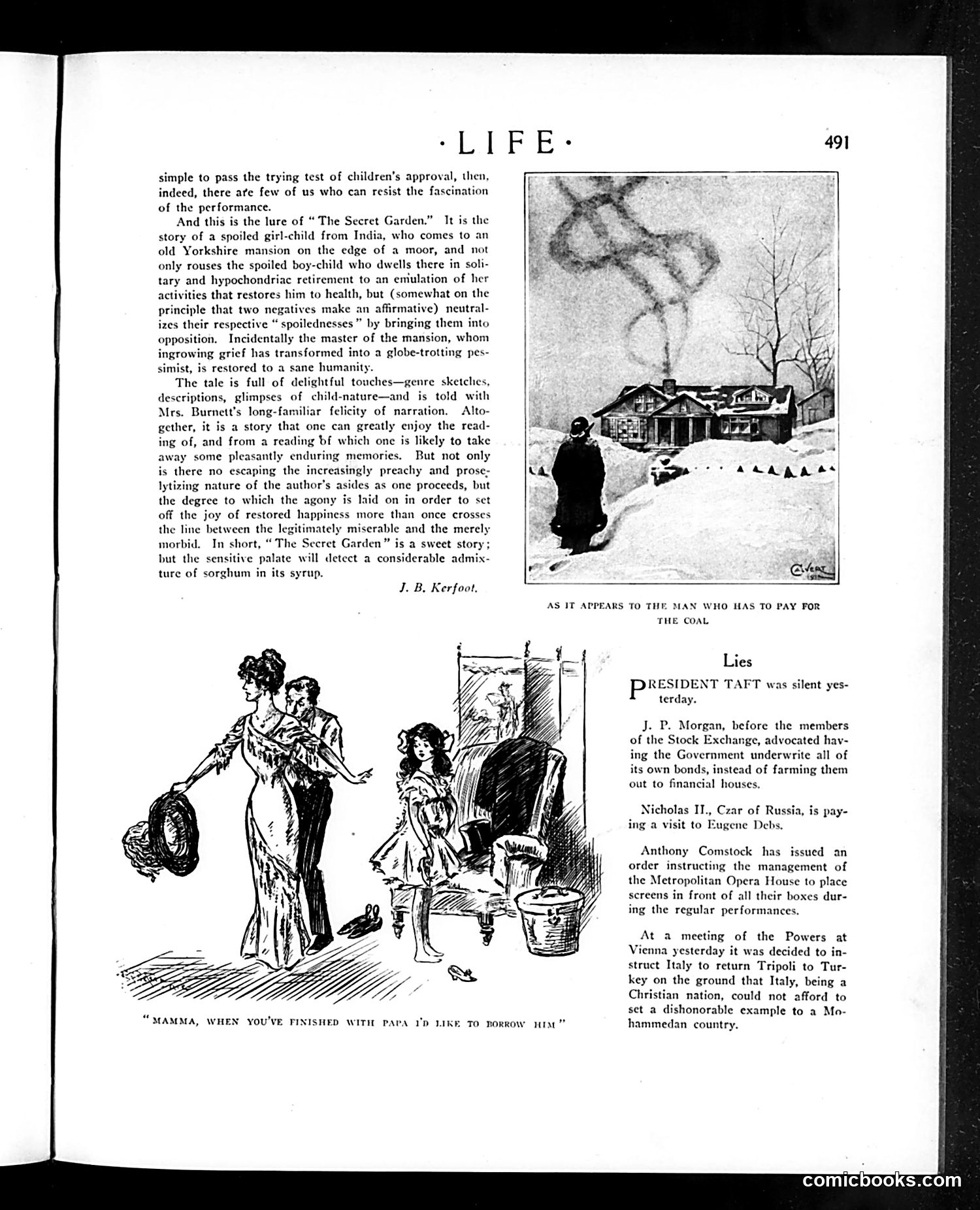
This page contains a book review of *The Secret Garden* and satirical "news" items mocking prominent figures of the era (appears to be early 1900s). **The cartoon** shows a mother and children asking to "borrow" father—a domestic joke about a father being so useless or burdensome that the family treats him as a communal nuisance. **The satirical "Lies" section** mocks real politicians and figures through obviously false statements: - President Taft's silence is deemed noteworthy - J.P. Morgan (the famous banker) advocating government bond underwriting - The absurd claim that Czar Nicholas II visits Eugene Debs (a socialist activist—their sworn opposite) - Anthony Comstock (famous censor) screening opera boxes from "immoral" viewing - Italy being instructed to return Tripoli to Turkey based on Christian morality The humor relies on readers recognizing the impossibility or hypocrisy of these scenarios, satirizing political corruption, financial manipulation, and social prudishness of the period.
📄 Transcribed text from this page (OCR, searchable)
Machine-transcribed from the original scan — historical spelling and the odd misread are preserved.
* LIFE * simple to pass the trying test of children’s approval, then, ie indeed, there ate few of us who can resist the fascination ; of the performance. And this is the lure of “ The Secret Garden.” It is the story of a spoiled girl-child from India, who comes to an old Yorkshire mansion on the edge of a moor, and not only rouses the spoiled boy-child who dwells there in soli- tary and hypochondriac retirement to an emulation of her ies that restores him to health, but (somewhat on the nciple that two negatives make an affirmative) neutral- izes their respective “ spoilednesses ” by bringing them into opposition. Incidentally the master of the mansion, whom ingrowing grief has transformed into a globe-trotting pes- simist, is restored to a sane humanity. The tale is full of delightful touches—genre sketches, descriptions, glimpses of child-nature—and is told with Mrs. Burnett’s long-familiar felicity of narration. Alto- gether, it is a story that one can greatly enjoy the read- ing of, and from a reading bf which one is likely to take away some pleasantly enduring memories. But not only is there no escaping the increasingly preachy and prose- ‘i ae4agpae lytizing nature of the author’s asides as one proceeds, but the degree to which the agony is laid on in order to set off the joy of restored happiness more than once crosses the line between the legitimately miserable and the merely morbid. In short, “ The Secret Garden” is a sweet story; but the sensitive palate will detect a considerable admix- ture of sorghum in its syrup. (as J.B. Kerfoot. = AS IT APPEARS TO THE MAN WHO HAS TO PAY FoR THE COAL Lies RESIDENT TAFT was silent yes- terday. J. P. Morgan, before the members of the Stock Exchange, advocated hav- ing the Government underwrite all of its own bonds, instead of farming them out to financial houses. Nicholas I., Czar of Russia, is pay- ing a visit to Eugene Debs, Anthony Comstock has issued an order instructing the management of the Metropolitan Opera House to place screens in front of all their boxes dur- ing the regular performances. At a meeting of the Powers at Vienna yesterday it was decided to in- struct Italy to return Tripoli to Tur- key on the ground that Italy, being a Christian nation, could not afford to . . set a dishonorable example to a Mo- MAMMA, WHEN YOU'VE FINISHED WITH PAPA I'D LIKE TO RORROW HIM”? hammedan country. comicbooks.com