
A complete issue · 40 pages · 1910
Life — July 28, 1910
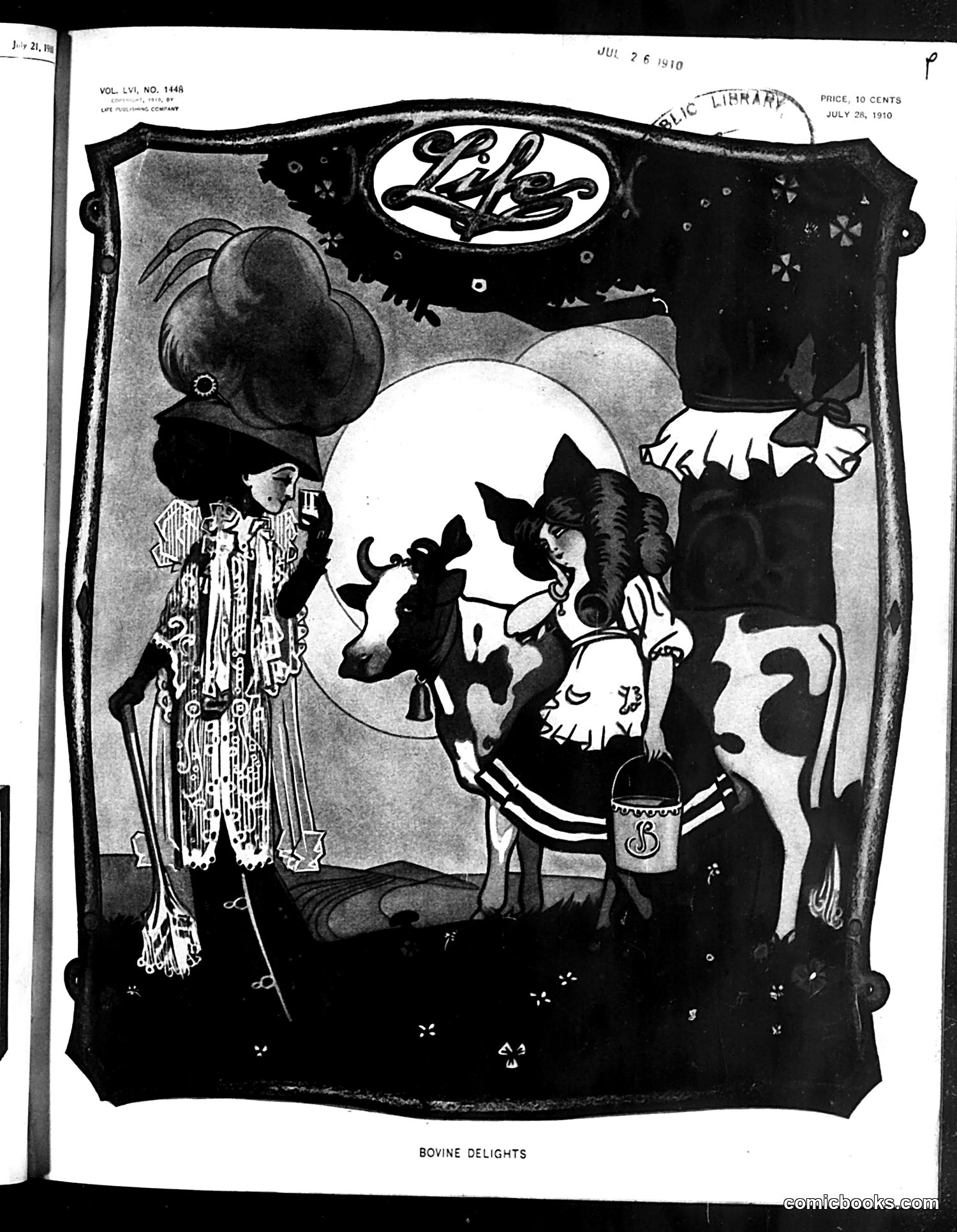
This satirical cartoon depicts a nighttime scene with anthropomorphized cows performing or socializing under a large moon. A elegantly dressed woman on the left observes the bovine activity, while the cows appear to be engaged in human-like social interaction—one smoking, others in various poses suggesting a social gathering or performance. The title "Bovine Delights" suggests mockery of either fashionable society pastimes or perhaps agricultural themes popular in entertainment of the era. The juxtaposition of refined fashion against farmyard animals likely satirizes either pretentious entertainment, rural life being portrayed as sophisticated, or the absurdity of treating cattle as subjects of human leisure activities. The specific social or political target remains unclear without additional context.
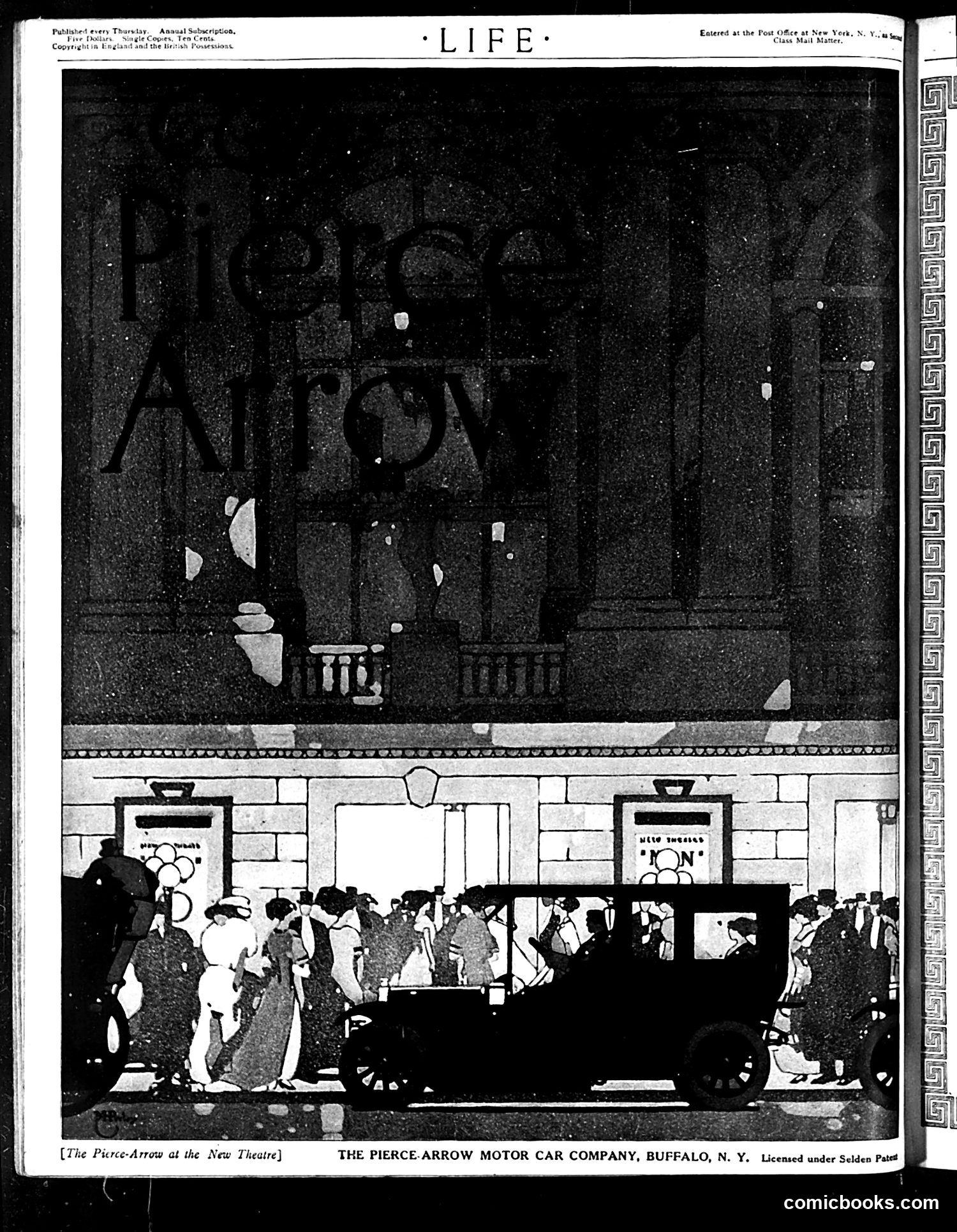
This page is primarily **advertising**, not political satire. The image shows a storefront display for the Pierce-Arrow Motor Car Company of Buffalo, New York. The upper portion features an elegant theatrical window display with classical architectural elements (columns, balustrade) and sculptural details—likely designed to showcase the luxury and sophistication associated with Pierce-Arrow automobiles. The lower portion depicts well-dressed crowds gathered outside what appears to be a showroom or theater entrance, with the distinctive Pierce-Arrow vehicle prominently displayed. The advertisement emphasizes the car's association with elegance, refinement, and high society—marketed as a luxury product to aspirational consumers. This represents typical early-20th-century automotive advertising strategy targeting wealthy clientele.
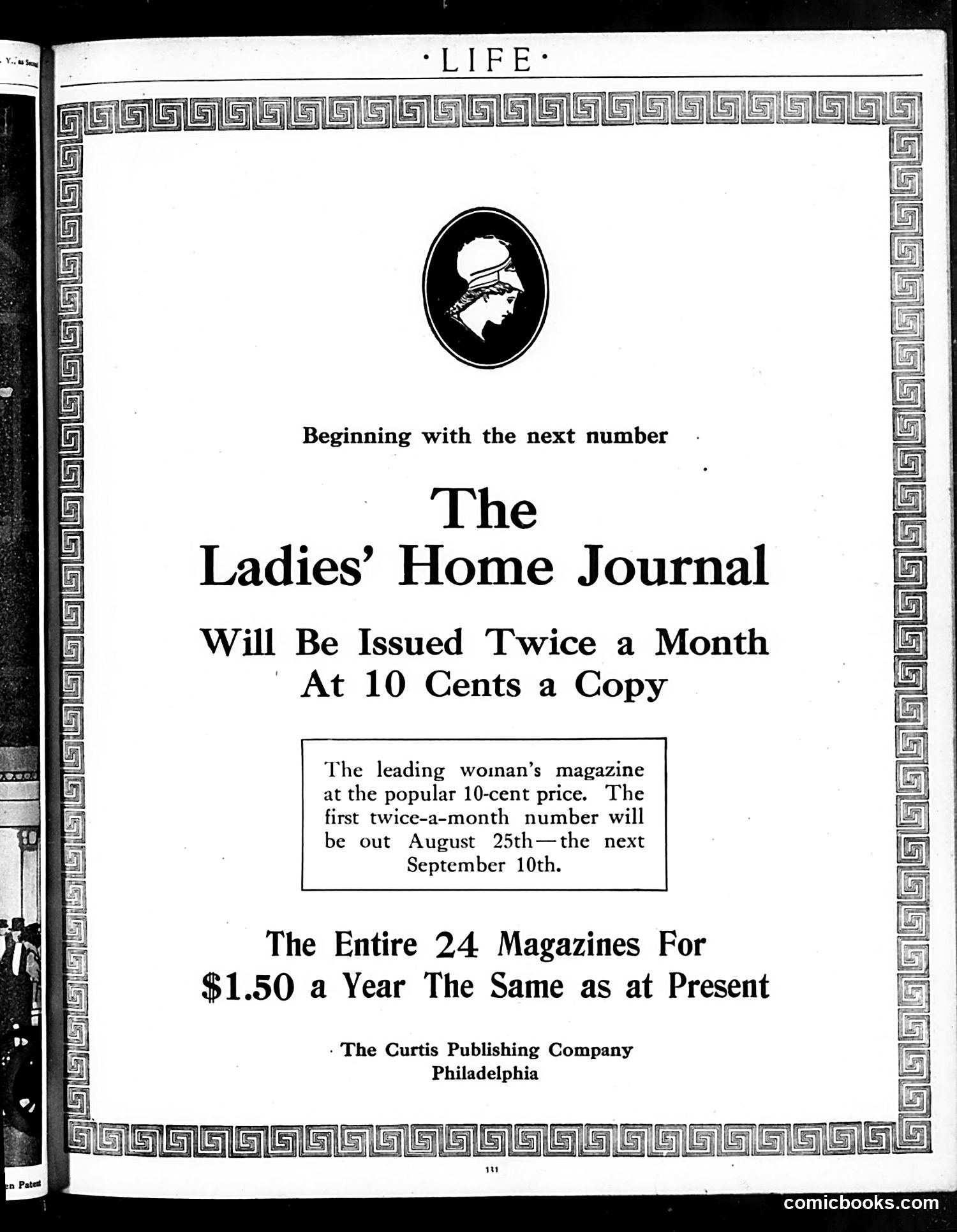
This is primarily an **advertisement**, not editorial content or satire. The Curtis Publishing Company announces that *The Ladies' Home Journal* will transition to twice-monthly publication at 10 cents per copy, beginning August 25th. The annual subscription remains $1.50 for 24 issues. The classical profile portrait (appearing to be a woman's head in cameo style) serves as decorative branding rather than political caricature. The ornamental Greek key border reinforces the magazine's aspirational, refined positioning. The ad emphasizes affordability and frequency as selling points during the early 20th century, when 10 cents was accessible to middle-class readers. This represents the magazine's competitive strategy in the popular periodicals market.
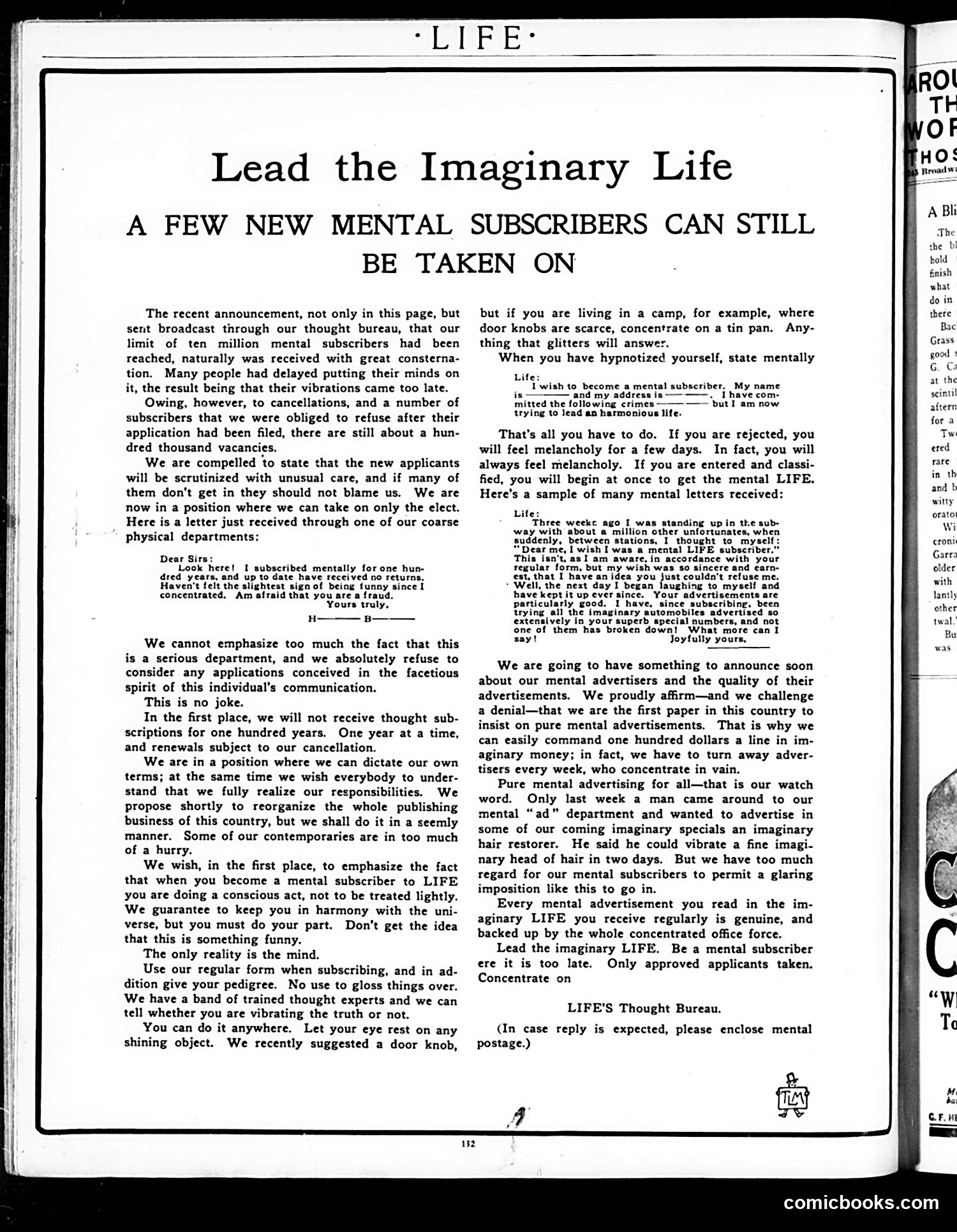
This page is **not a political cartoon** but rather **satirical editorial content** from Life magazine. It's a humorous mock-announcement about "mental subscribers" to an imaginary "LIFE" publication—a playful concept where people would subscribe using only their minds rather than physical means. The satire mocks: - Overly ambitious business expansion claims - Subscription department fraud and rejection of applicants - The absurdity of claiming millions of subscribers The included sample "mental subscriber" letter humorously mimics real complaint mail Life received. The piece's humor relies on treating this impossible concept (thought-based subscriptions) with deadpan seriousness, including warnings about "trained thought experts" who can detect mental vibrations. This represents Life's characteristic blend of **absurdist satire and self-referential corporate humor**.
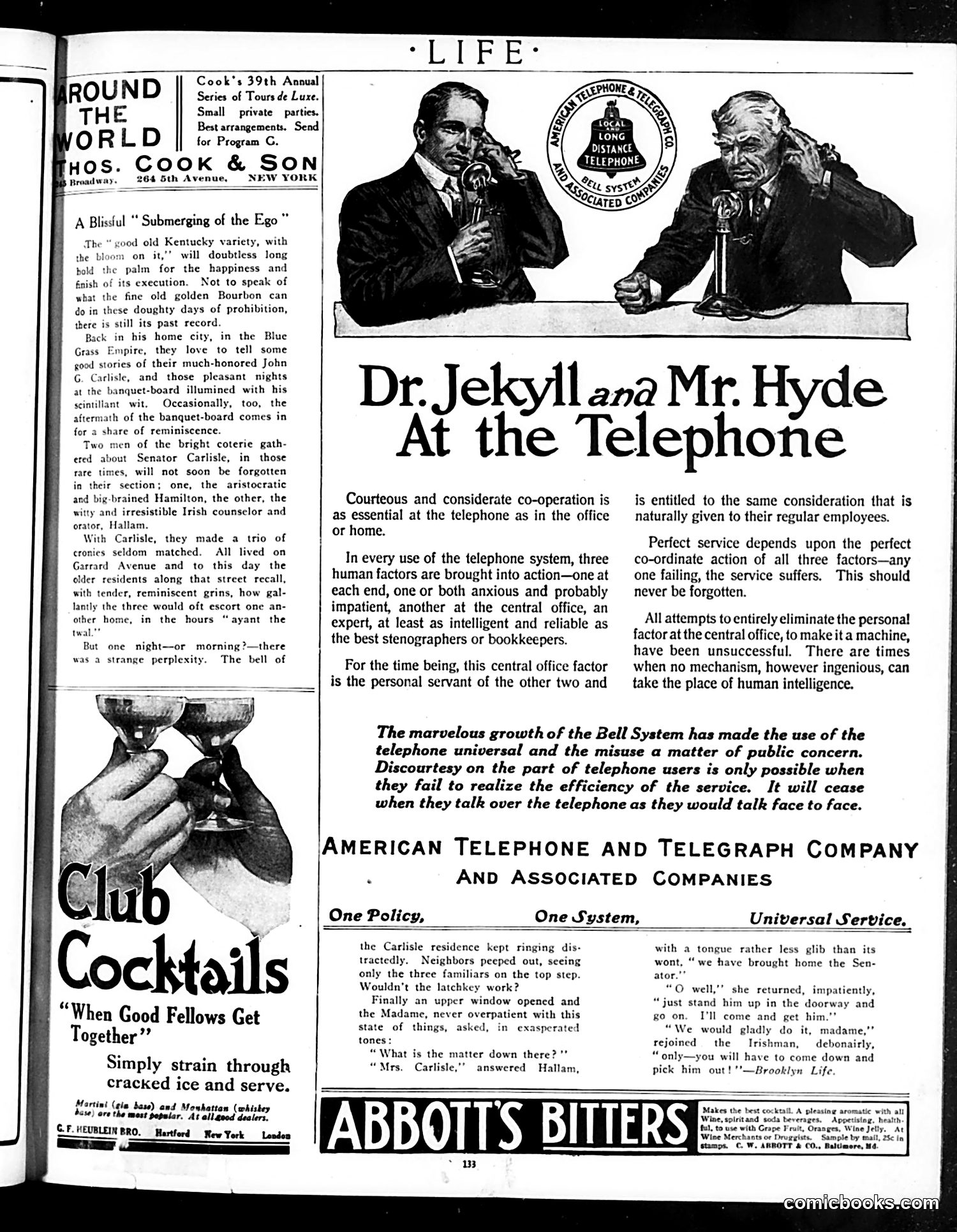
This page is primarily an **advertisement for the American Telephone and Telegraph Company** disguised as editorial content. The main illustration shows two men at telephones labeled "Dr. Jekyll and Mr. Hyde"—a literary reference to Robert Louis Stevenson's tale of dual personalities. The satire critiques telephone etiquette: the "Jekyll" persona represents courteous, considerate callers, while "Hyde" represents rude ones. The accompanying text lectures users on proper telephone conduct, arguing that operators (the "personal servant" at the central office) deserve respect. This is essentially corporate propaganda promoting "Universal Service" while subtly shaming customers into better behavior. The page also includes ads for Club Cocktails and Abbott's Bitters, typical period advertising.
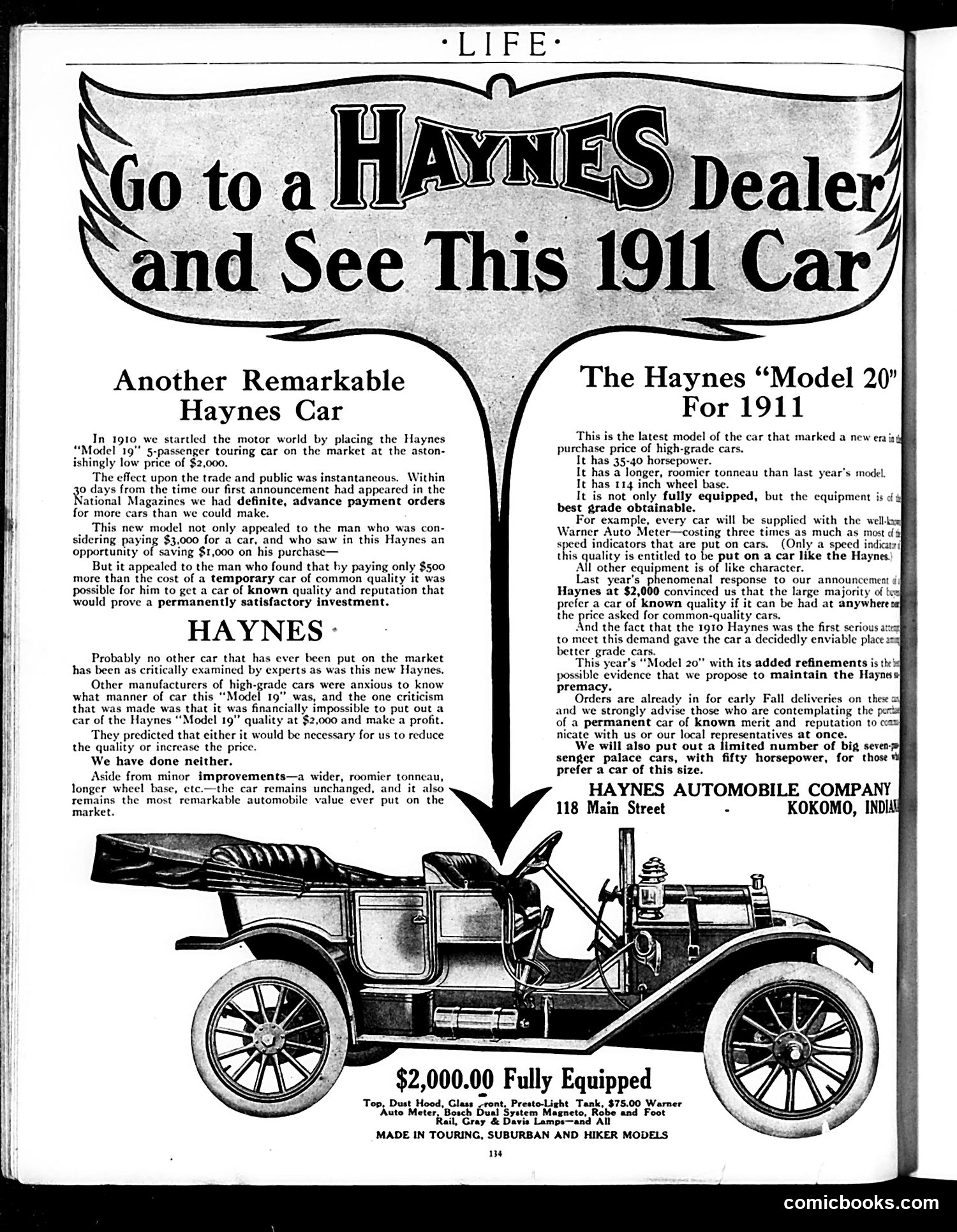
This is **not a political cartoon or satire**—it's a straightforward automobile advertisement for the Haynes Motor Company of Kokomo, Indiana. The page promotes the 1911 Haynes "Model 20," a high-grade touring car priced at $2,000 fully equipped. The text emphasizes the vehicle's quality, reliability, and value proposition, claiming competitors said it was financially impossible to produce such a car profitably at that price. The advertisement highlights features like a wider tonneau, roomier interior, and 114-inch wheelbase. It includes testimonial-style marketing claiming the car's "remarkable" market reception and urges readers to visit Haynes dealers. The only illustration is a side-view technical drawing of the actual automobile—typical of early 1900s car advertising. There is no satirical intent or political commentary present.
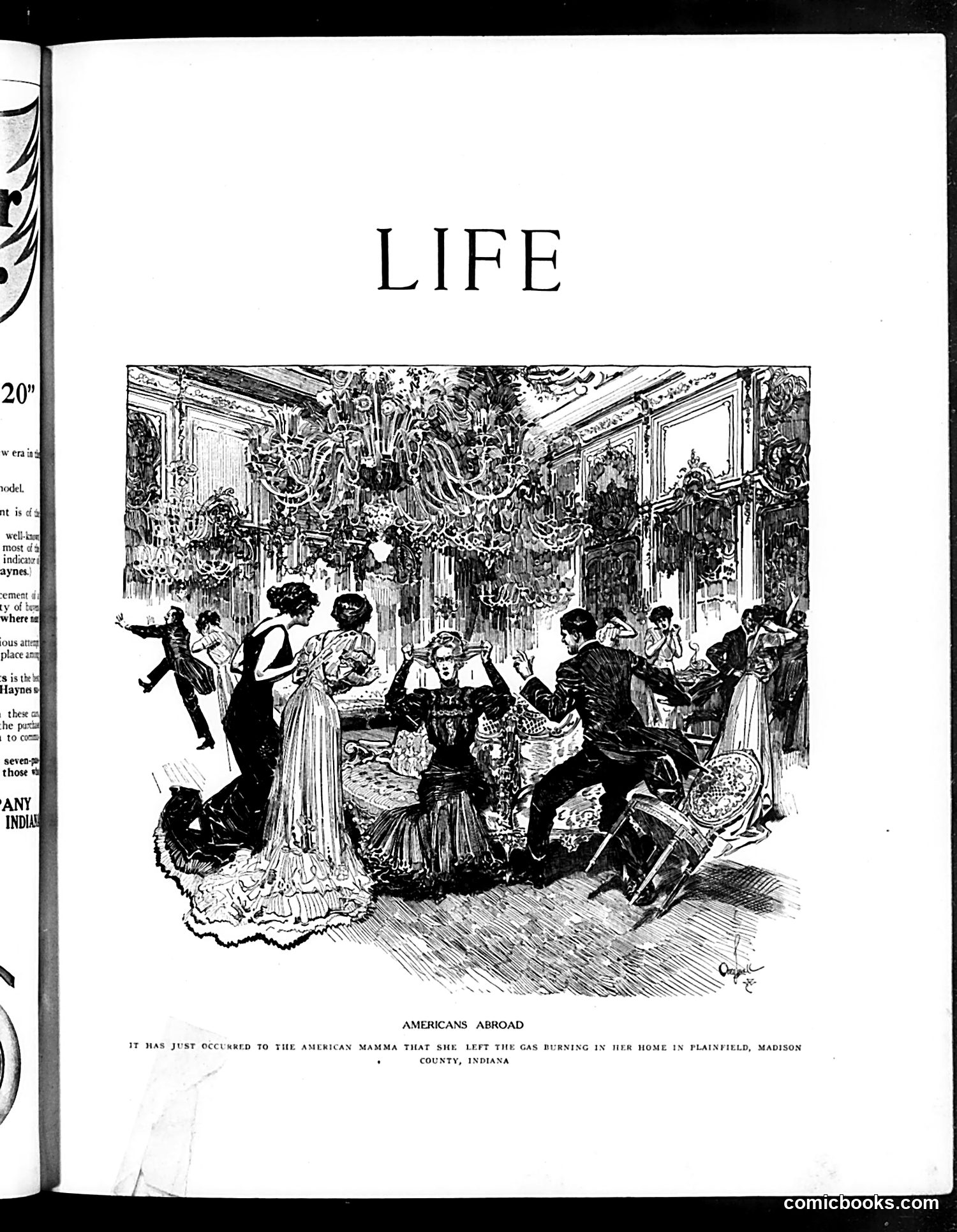
This is a title page for a section called "LIFE" featuring a satirical illustration labeled "AMERICANS ABROAD." The caption explains the joke: "It has just occurred to the American mamma that she left the gas burning in her home in Plainfield, Madison County, Indiana." The cartoon depicts an elegant European salon (ornate ceiling, chandeliers, decorated walls) filled with fashionably dressed people at what appears to be a social gathering. An American woman in the center has a sudden realization about her forgotten gas lamp back home. The satire mocks American tourists abroad—specifically wealthy women traveling in Europe—for their anxiety and preoccupation with domestic concerns even while enjoying sophisticated European society. It suggests Americans abroad cannot fully escape their provincial Midwestern roots and mundane household worries, no matter how elegant their surroundings.
This page contains satirical commentary on social etiquette and gender dynamics in early 20th-century America. The main article discusses Mr. Ballinger (likely Albert Ballinger, a public figure of that era) and critiques how men's clubs in New York operate, particularly regarding their reception rooms for ladies. The cartoon (top left) appears to illustrate tensions around club hospitality rules and women's access to male-dominated spaces. The broader satire targets the contradiction between claims of progressive thinking and actual restrictive practices—specifically how clubs exclude women despite professing modern values. The text also mocks the pretensions of wealthy travelers, particularly a "Mr. Walker of Minneapolis," and social hypocrisy regarding urbanization and conservation issues. The piece is quintessentially *Life* magazine: using specific social situations to expose broader American class and gender contradictions.
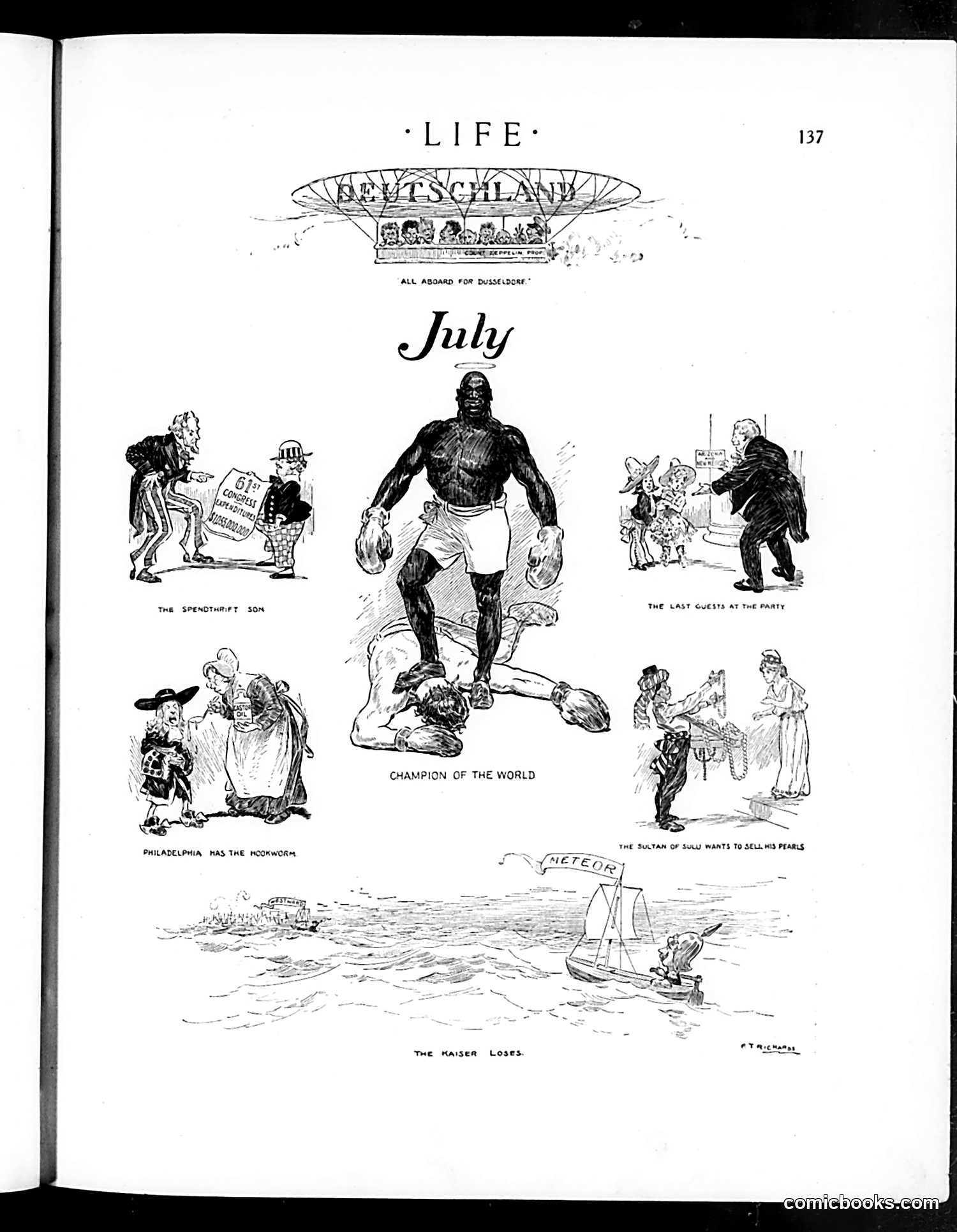
This page contains six political cartoons satirizing July 1900s events. The central figure labeled "Champion of the World" appears to be a boxer, likely referencing a contemporary heavyweight champion. Surrounding scenes mock current events: - "The Spendthrift Son" and "Philadelphia Has the Hookworm" reference social/health issues - "The Last Guests at the Party" and "The Sultan of Sulu Wants to Sell His Pearls" allude to international affairs - "The Kaiser Loses" depicts a ship labeled "Meteor" in distress, likely satirizing German imperial ambitions or military setbacks The cartoons use caricature and visual metaphor to comment on American society, international politics, and notable personalities of the era. Without specific historical context, exact references remain somewhat unclear, but the tone is clearly critical and humorous.
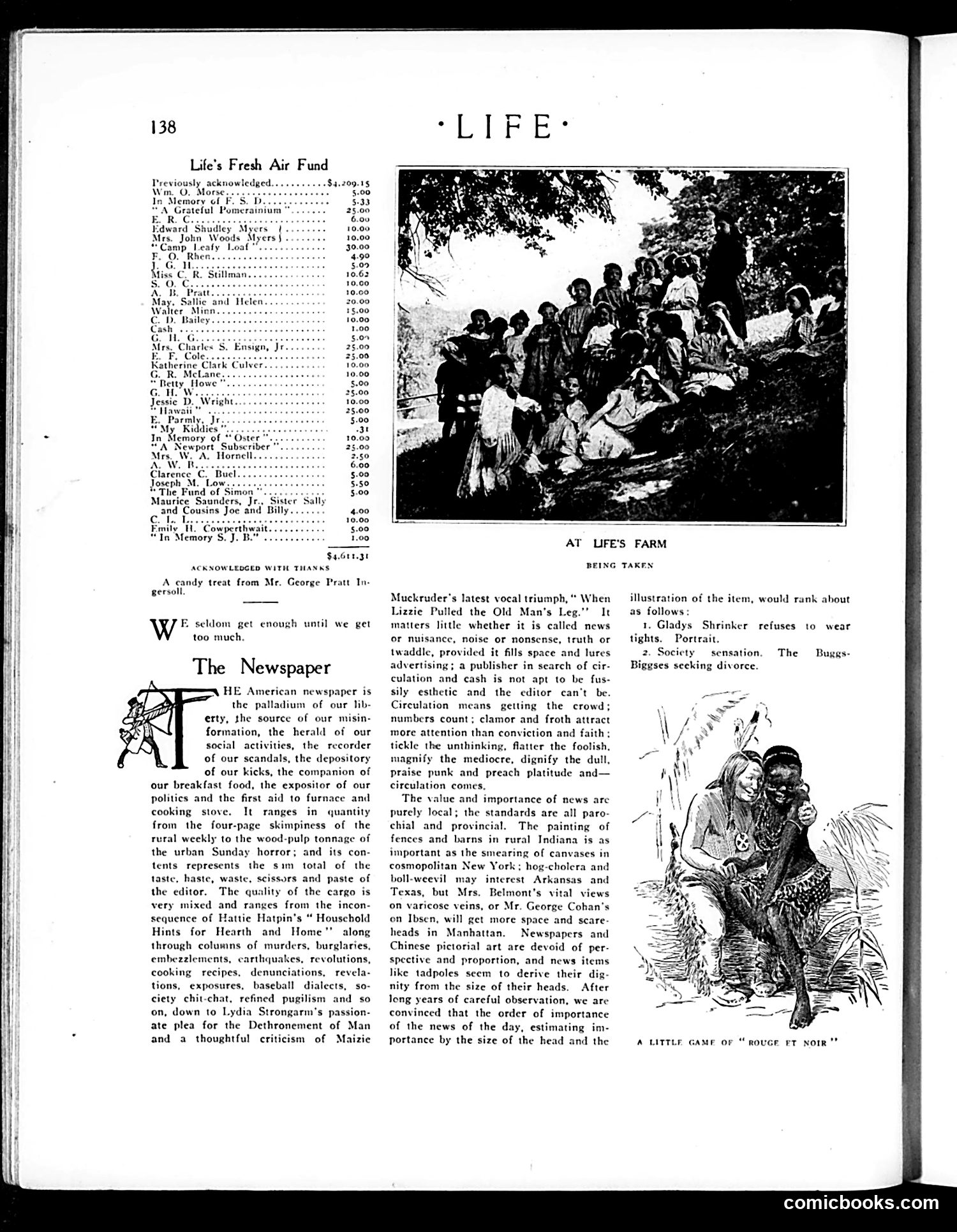
This page contains two distinct elements: **Top section:** A fundraising list for "Life's Fresh Air Fund," documenting donations toward sending children to a farm. The accompanying photograph shows a group of children and adults relaxing outdoors at "Life's Farm," labeled "Being Taken." **Main article:** "The Newspaper" — a satirical essay criticizing newspapers' sensationalism. It argues that newspapers prioritize circulation over truth, using crude imagery and exaggeration rather than serious reporting. The piece mocks how papers emphasize trivial, scandalous, or bizarre stories (murders, earthquakes, divorces) over substantive local news, measuring importance by headline size rather than actual significance. The small illustration "A Little Game of 'Rouge Fit Noir'" appears decorative. The satire reflects Progressive-era critiques of yellow journalism and commercial media's corrupting influence on public discourse.
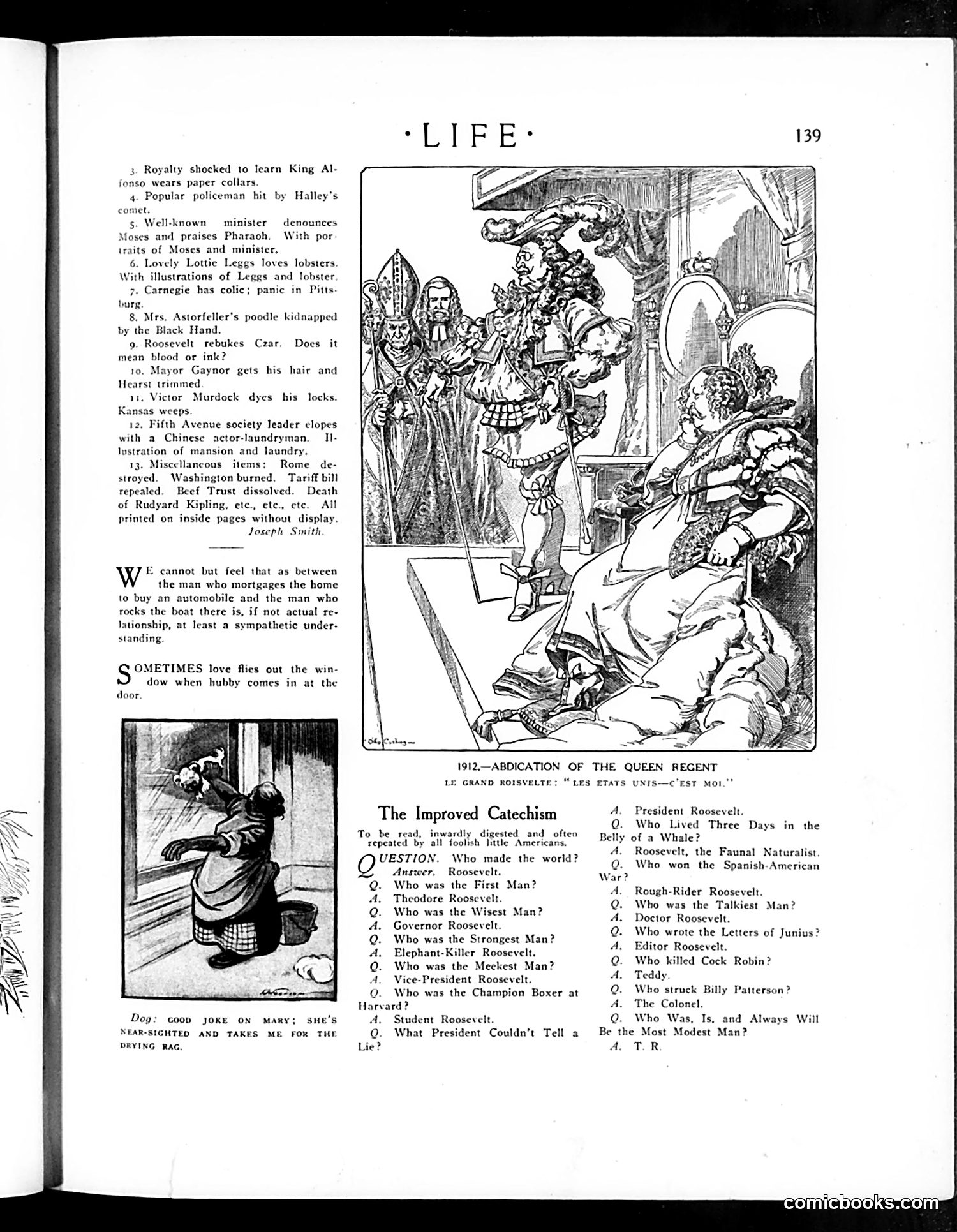
The main cartoon, captioned "1912—ABDICATION OF THE QUEEN REGENT," depicts a chaotic throne room scene satirizing American politics during 1912. The central figure appears to be a woman (likely representing the "Queen Regent") being physically removed or overthrown by male figures in suits and military dress, suggesting Roosevelt's political dominance that year. The accompanying catechism titled "The Improved Catechism" presents a series of rhetorical questions and answers, all pointing to Theodore Roosevelt as the answer. This mockingly suggests Roosevelt controlled everything—he was "the world," "the first man," "wisest man," etc.—satirizing his outsized political influence and ego during this pivotal election year when he challenged President Taft.
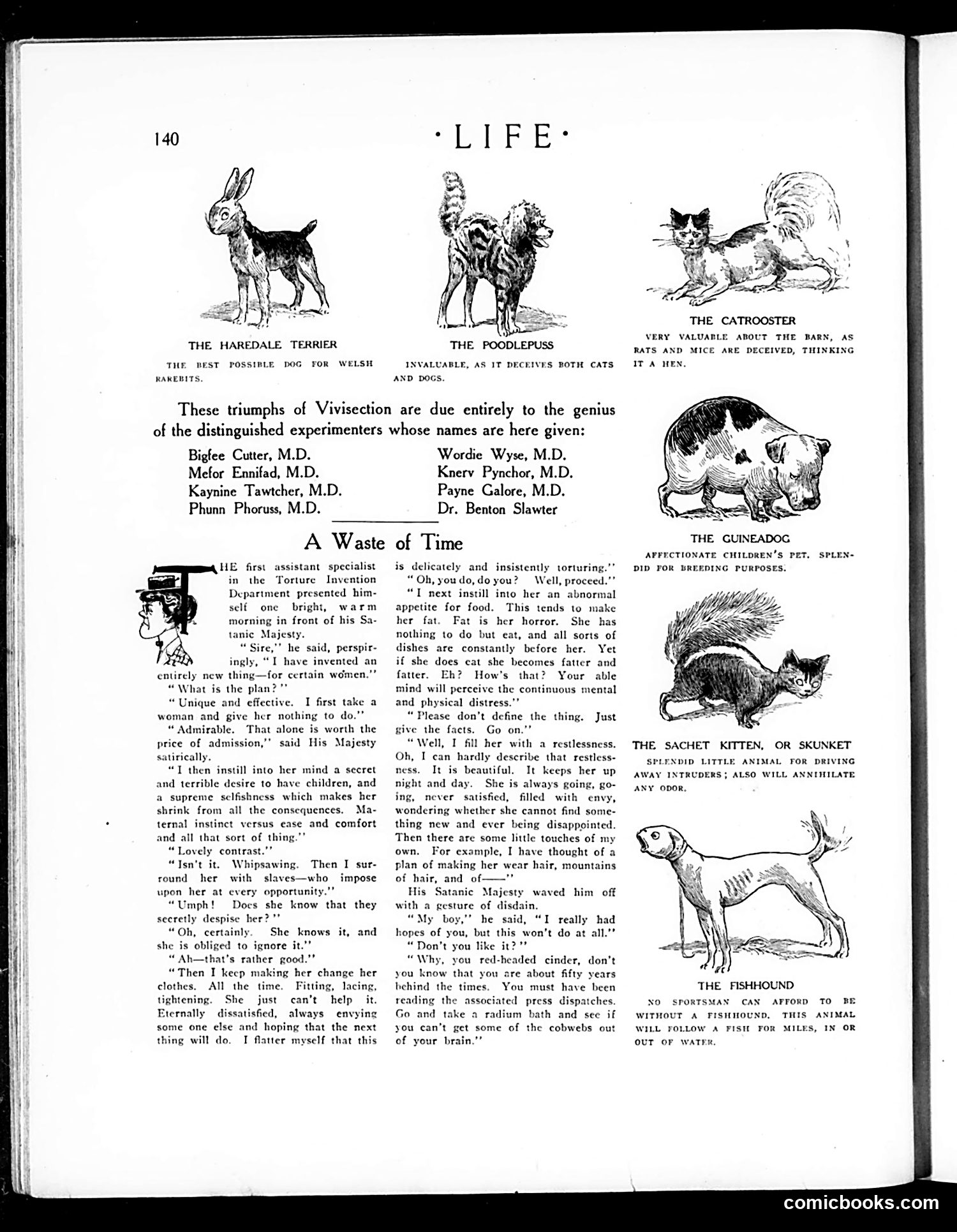
This page combines two unrelated satirical pieces: **Upper Section:** An illustrated catalog of dog and cat breeds with humorous descriptions—the Haredale Terrier, Poodlepuss, Catrooster, Guinea Dog, Sachet Kitten, and Fishhound. These are fictional hybrid animals presented as absurd breeding experiments, crediting various "M.D." experimenters. The satire targets pseudoscientific animal breeding fads and the pretentiousness of selective breeding practices. **"A Waste of Time":** A dialogue between a doctor and his female patient mocking both medical quackery and women's perceived obsessions with appearance and social status. The doctor suggests absurd "treatments" (radium baths) while critiquing her constant dissatisfaction and clothing concerns. The satire attacks both incompetent medical practitioners and contemporary stereotypes about frivolous women. Both pieces exemplify early 20th-century satirical humor targeting scientific charlatanism and gender stereotypes.
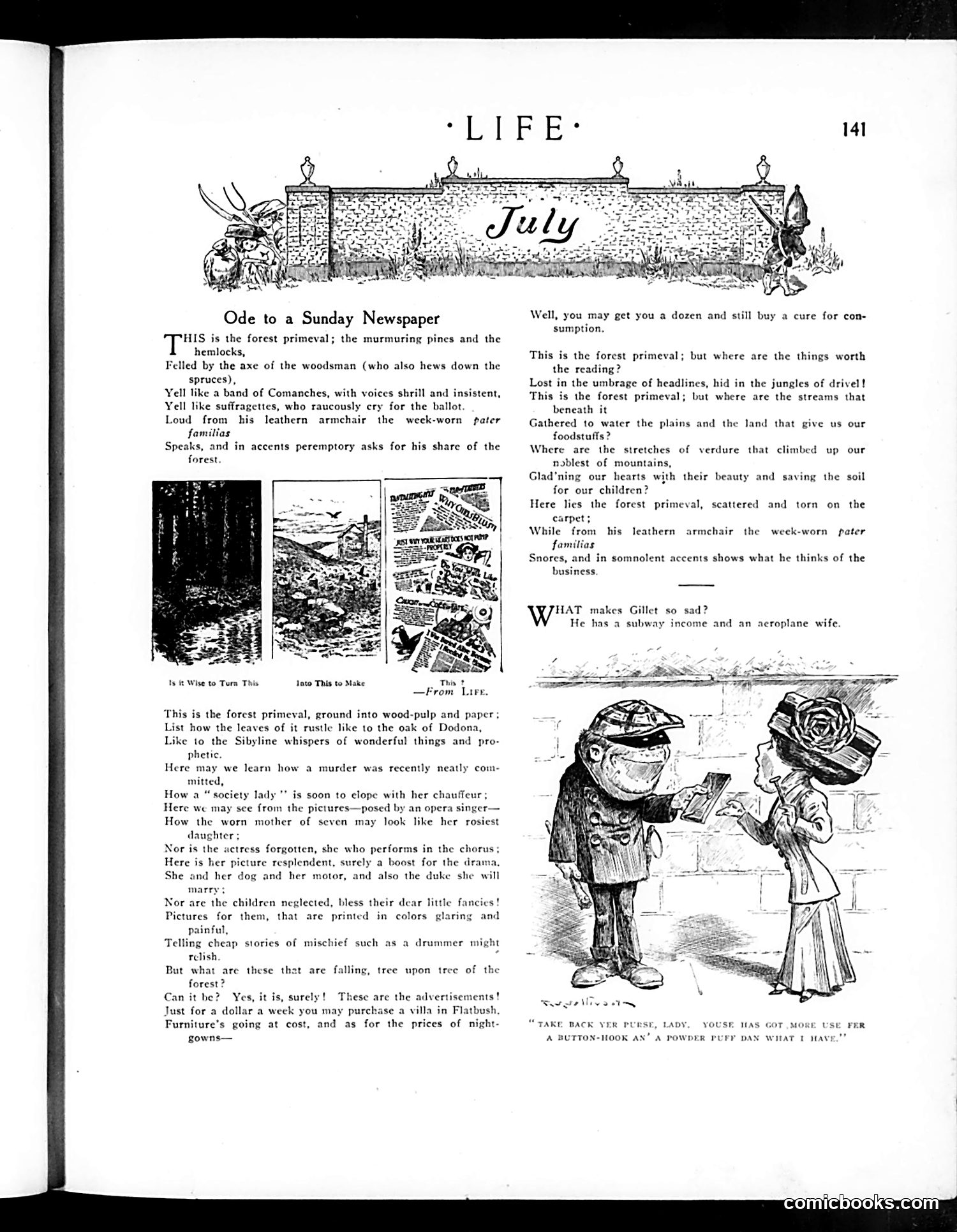
This page contains "Ode to a Sunday Newspaper," a satirical poem criticizing newspapers as repositories of sensationalism rather than substantive journalism. The poem mocks headlines about murders, elopements, opera singers, and neglected children—cheap human-interest stories sold to readers seeking scandal rather than meaningful content. The accompanying illustrations show three woodcut scenes labeled "Is Wise to Turn This / Into This to Make / From Life," depicting forest destruction transformed into newspapers and advertisements. Below, a separate cartoon depicts two figures discussing a purse, with one saying the other has "more use fer a button-hook an' a powder puff." The satire targets both newspaper sensationalism and, possibly, consumer culture advertising practices of the era.
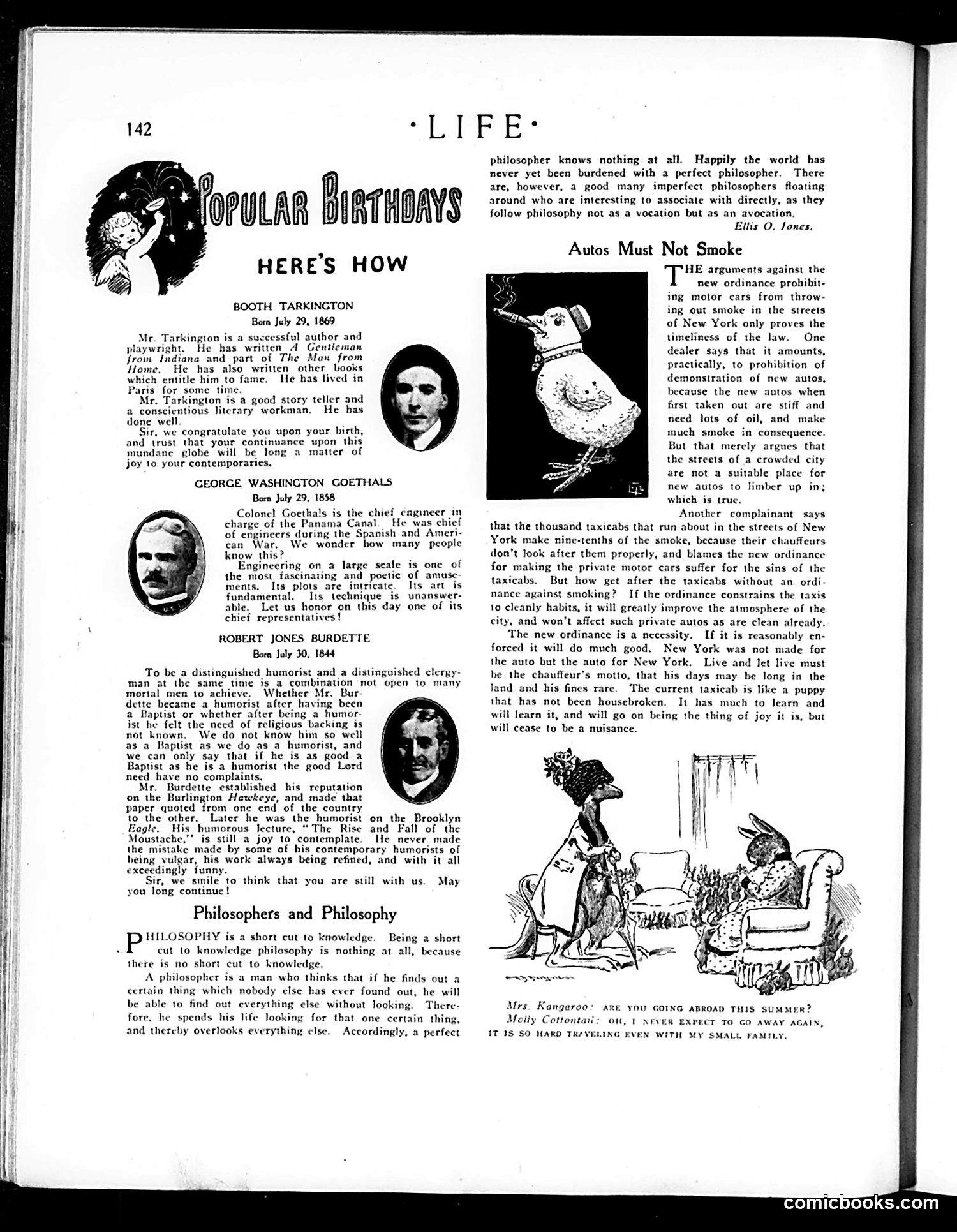
This page celebrates three notable Americans sharing July birthdays: **Booth Tarkington** (author/playwright), **George Washington Goethals** (Panama Canal chief engineer), and **Robert Jones Burdette** (humorist and Baptist clergyman). Life's satirical "Here's How" section offers mock-formal birthday congratulations to these public figures. The page also includes a philosophical essay mocking abstract philosophy as useless—a philosopher seeks one unknowable truth while ignoring everything else, thus "knows nothing at all." A secondary article critiques New York's new anti-smoking ordinance for automobiles. Dealers complain new cars naturally smoke when warming up; taxi operators blame chauffeurs' negligence. The piece sardonically supports the law, arguing crowded city streets aren't appropriate places for vehicles to "limber up." A cartoon (bottom right) depicts travelers debating summer vacation difficulties, illustrating contemporary leisure-travel concerns.
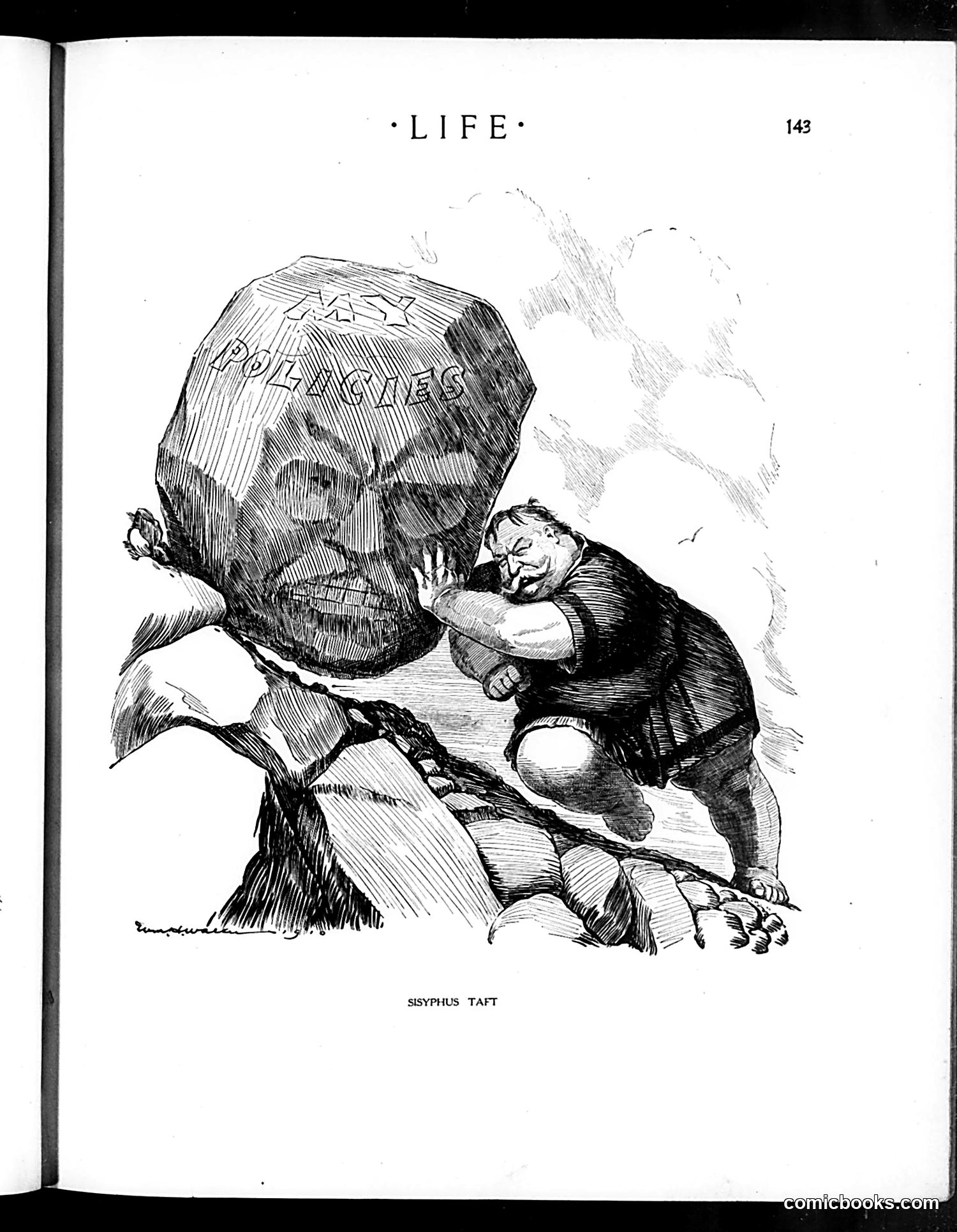
This political cartoon depicts William Howard Taft (U.S. President 1909-1913) as Sisyphus, the mythological figure condemned to eternally roll a boulder uphill. The boulder is labeled "POLICIES" and "PLEDGES," suggesting Taft's struggle to implement his agenda or fulfill campaign promises. The caricature emphasizes Taft's rotund physique, which was frequently mocked in political satire of the era. The cartoon satirizes his presidency as futile and exhausting—his efforts perpetually rolling back down, never reaching completion. This likely reflects contemporary criticism that Taft was ineffectual compared to his predecessor Theodore Roosevelt, or that his policies faced constant obstruction. The classical allusion elevates the critique from mere political disagreement to a commentary on the hopelessness of his administration's direction.
This Life magazine page (p. 144) contains two distinct pieces of satire: **"Improving Central Park"** mocks a type of businessman-reformer who wanted to commercialize and "modernize" New York's Central Park. The character "Mr. Hustler" proposes replacing its naturalistic design with amusement park attractions—phonographs, motor races, circuses, casinos, drill-sheds—treating it as real estate for profit rather than public green space. The satire targets the early-20th-century mindset that viewed parks as outdated and "efficiency" as requiring commercialization. **"Item: Ten Thousand"** is a short dramatic story about a young woman who discovers $10,000 hidden in a bungalow hearth. The setup suggests moral complexity: she knows her father is suspected of theft. The narrative leaves her choice ambiguous—whether she'll return or keep the money—creating tension around honor, loyalty, and desperation during what appears to be an economically uncertain period. Both pieces reflect Progressive-era anxieties about modernization, commercialism, and moral integrity.
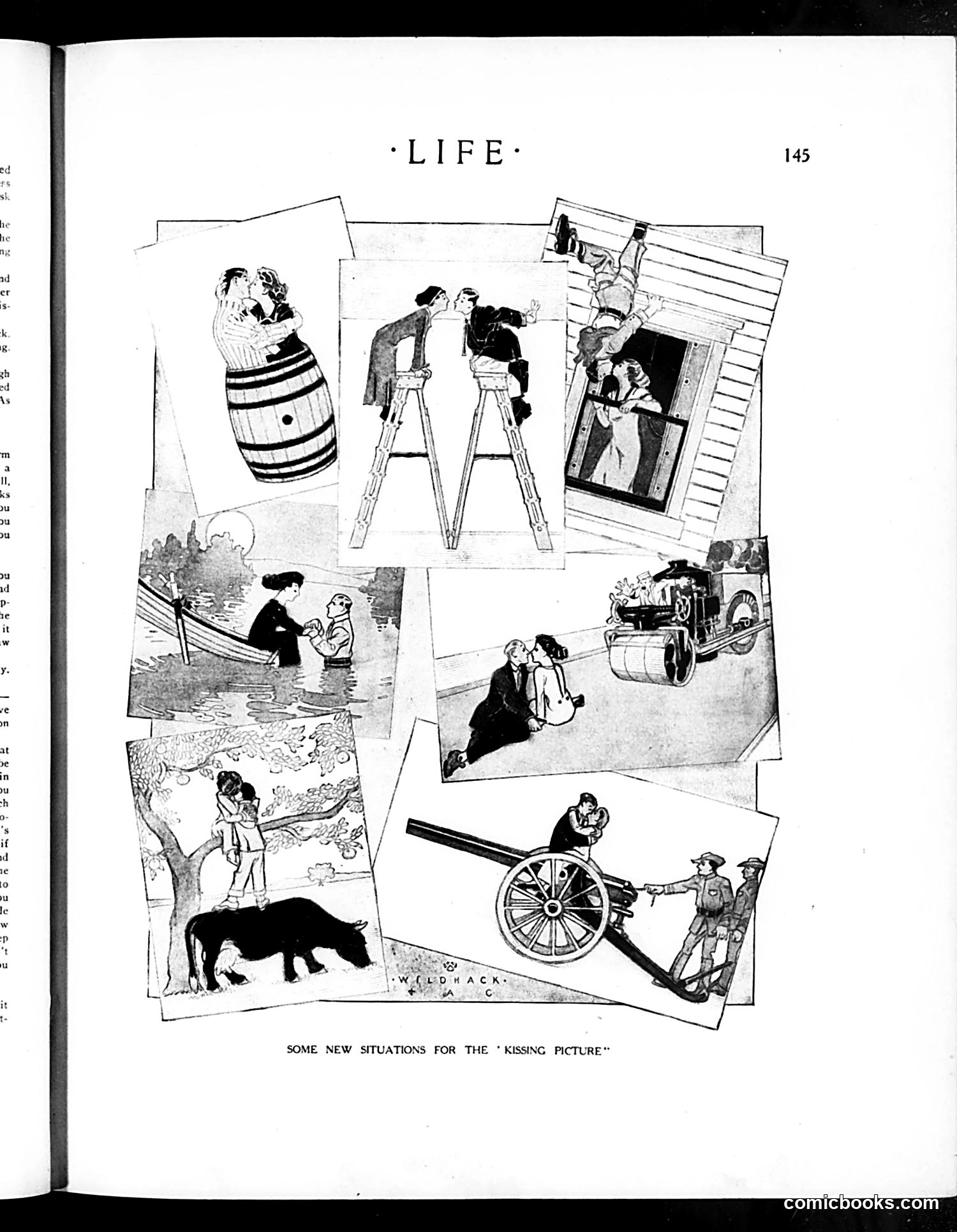
This page presents humorous illustrated scenarios depicting unconventional locations and circumstances for romantic kissing—a satirical commentary on cinema's popular "kissing picture" genre. The vignettes show couples kissing in absurd settings: inside a barrel, atop ladders, emerging from a house, while riding in a steamroller, fishing by a river, and near a cannon. The satire mocks both the predictability of early film romance tropes and the increasingly creative (or desperate) attempts filmmakers employed to keep the "kissing picture" formula fresh for audiences. By placing intimate moments in ridiculous, impractical contexts, the cartoonist highlights how formulaic and contrived such cinematic moments had become. This reflects broader early-20th-century anxiety about mass entertainment's repetitive conventions.
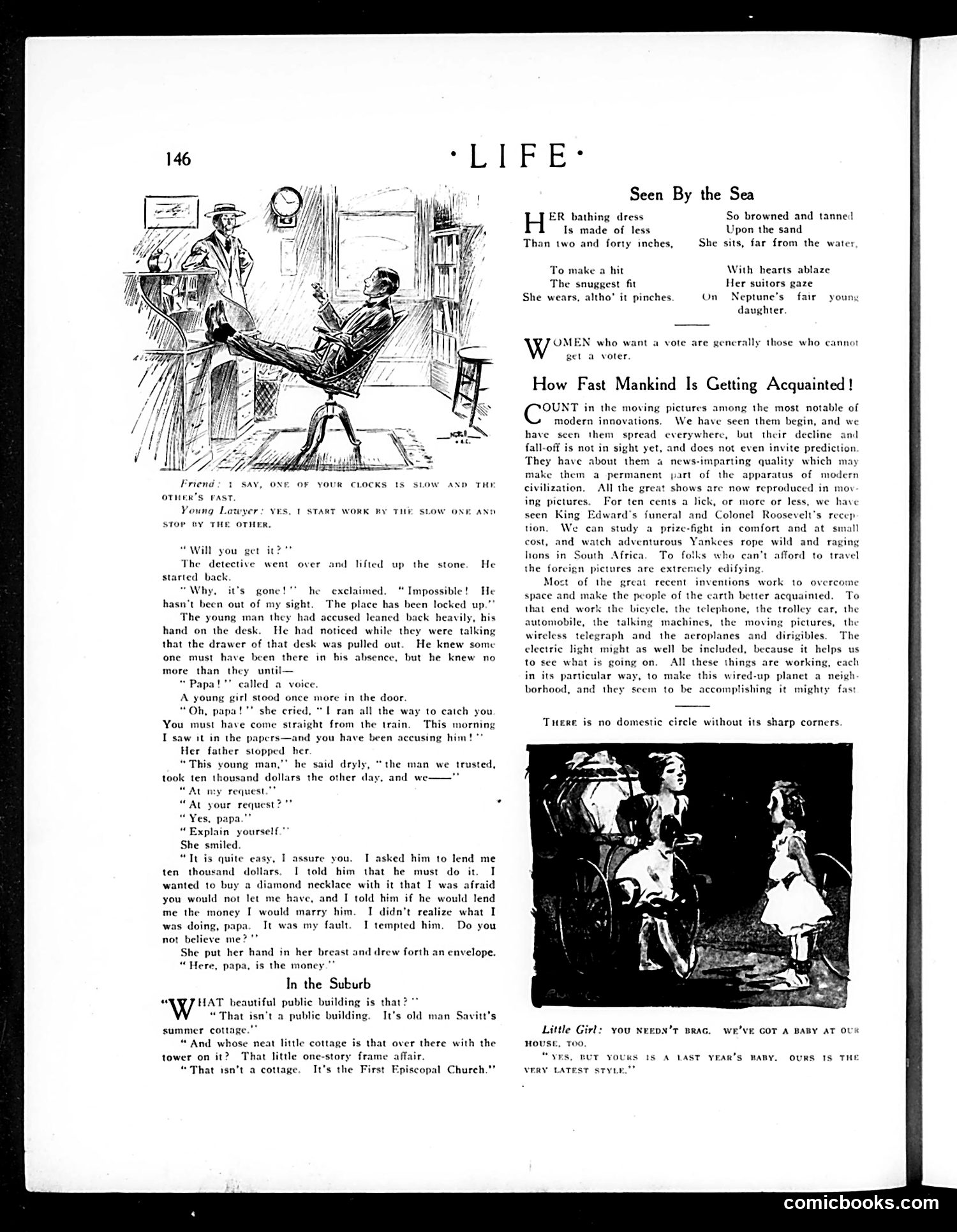
This page contains three distinct pieces of satirical content: **Main Story Cartoon**: A young lawyer admits to deliberately keeping one clock slow and one fast—starting work by the slow clock and leaving by the fast one. The satire mocks professional dishonesty and time-manipulation for personal gain. **Detective Story**: A narrative about a young man accused of stealing $10,000. The twist reveals his employer's daughter asked him to lend her the money (tempting him with marriage), then produces the cash, exonerating him. The satire critiques how the wealthy's children can manipulate situations without consequences. **"In the Suburb" Jokes**: Satirical confusion about local buildings—a millionaire's extravagant summer cottage is mistaken for a public building, while a church is mistaken for a modest cottage. This mocks nouveau riche excess and the blurring of private/public space. **Supporting Content**: A poem about women's scanty bathing suits; commentary praising moving pictures as modern innovation; a domestic humor caption about babies and fashion. The overall tone reflects early 1900s American satire—targeting professional dishonesty, class pretension, and social absurdities.
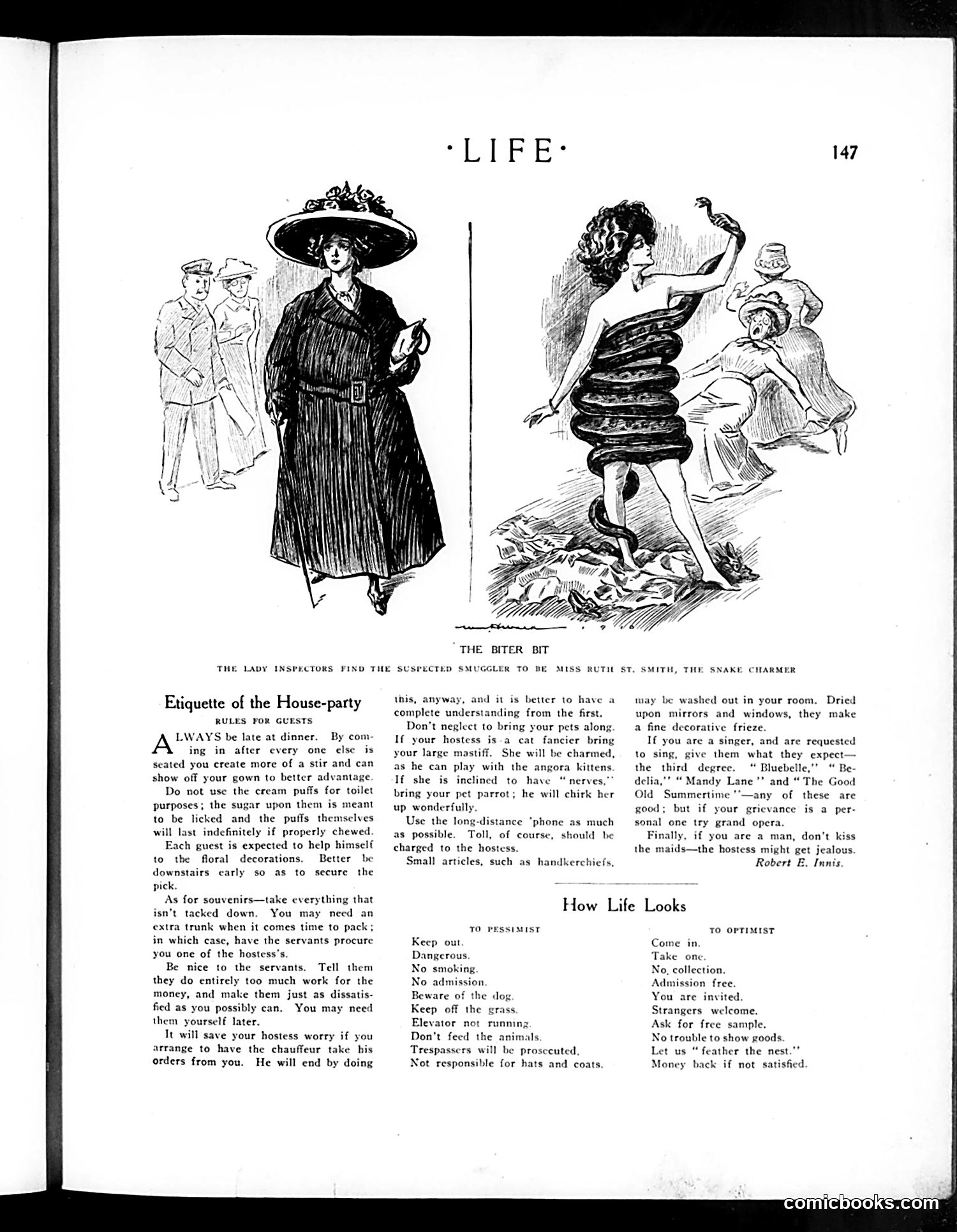
This page contains satirical advice about house-party etiquette (left column) and two cartoons. **"Etiquette of the House-Party"** is mock-serious advice telling guests to behave badly: arrive late, steal decorations and souvenirs, upset servants, commandeer the chauffeur, bring incompatible pets to annoy the hostess, make expensive long-distance calls charged to her, and leave wet handkerchiefs as "decorative" stains. The humor relies on inverting actual etiquette rules—presenting terrible behavior as acceptable. **"The Biter Bit"** cartoon (right) depicts a fashionable woman dressed in live snakes being examined by female "Lady Inspectors," apparently suspecting her of smuggling. The caption identifies her as "Miss Ruth St. Smith, the Snake Charmer." The joke satirizes both fashionable women's extreme clothing choices and the era's concern about smuggling. The bottom section contrasts pessimist vs. optimist perspectives on visiting a location (unclear which). The overall tone mocks both social pretension and guest behavior in the early 1900s.
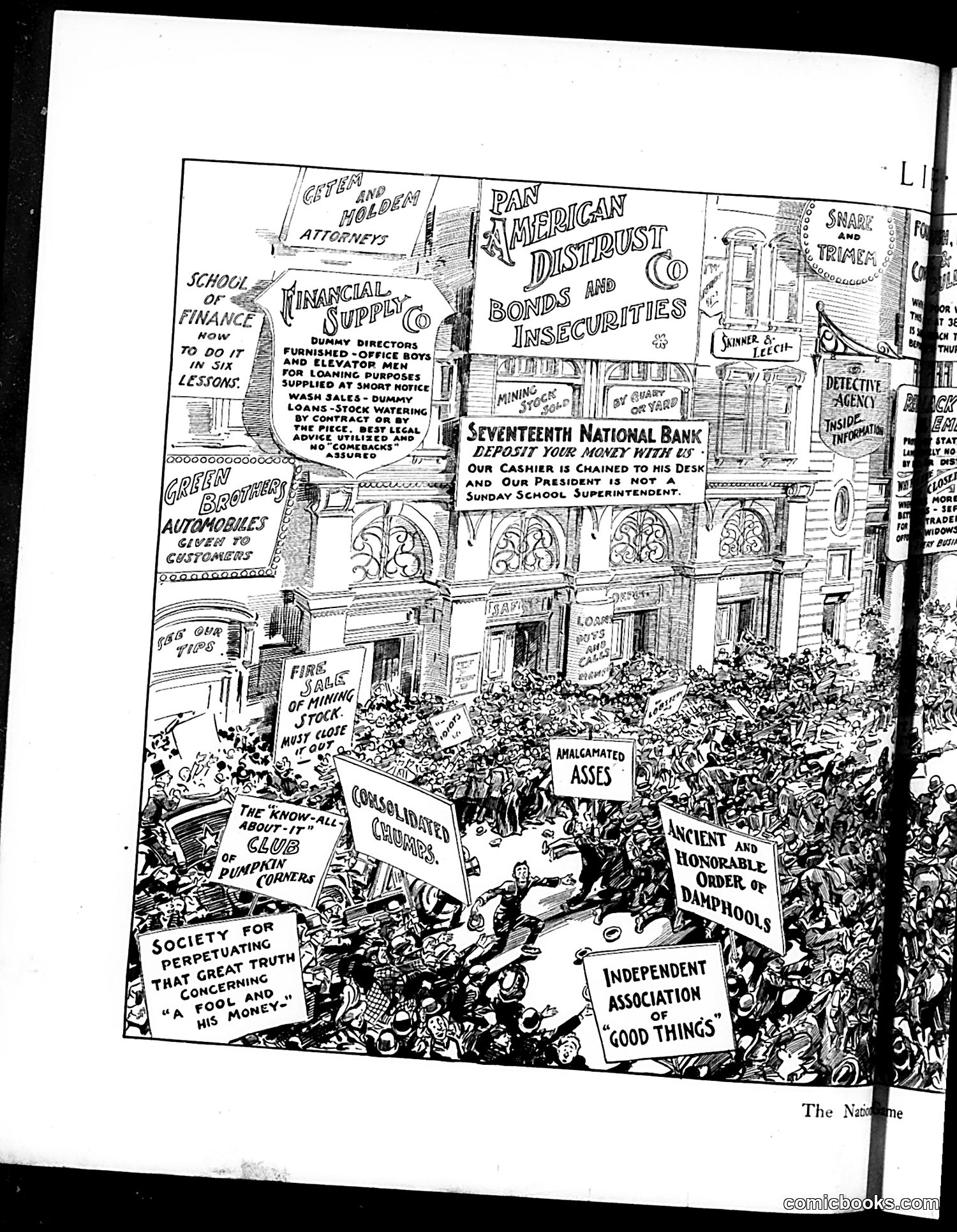
This is a satirical illustration depicting a crowded street scene outside various financial institutions and dubious businesses. The cartoon mocks the proliferation of get-rich-quick schemes and financial fraud targeting ordinary people. Visible businesses include: "Financial Supply Co." (offering dummy directors and stock manipulation), "Pan American Distrust & Bonds," "Seventeenth National Bank," and organizations like the "Know-All Club of Pumpkin Corners" and "Society for Perpetuating That Truth Concerning 'A Fool and His Money.'" The massive crowd of gullible citizens swarming before these establishments satirizes public susceptibility to financial scams and worthless investments—likely referencing the speculative excess and stock market manipulation of the 1920s. The humor derives from the brazen naming of fraudulent enterprises and the implied commentary on widespread financial naiveté during this period.
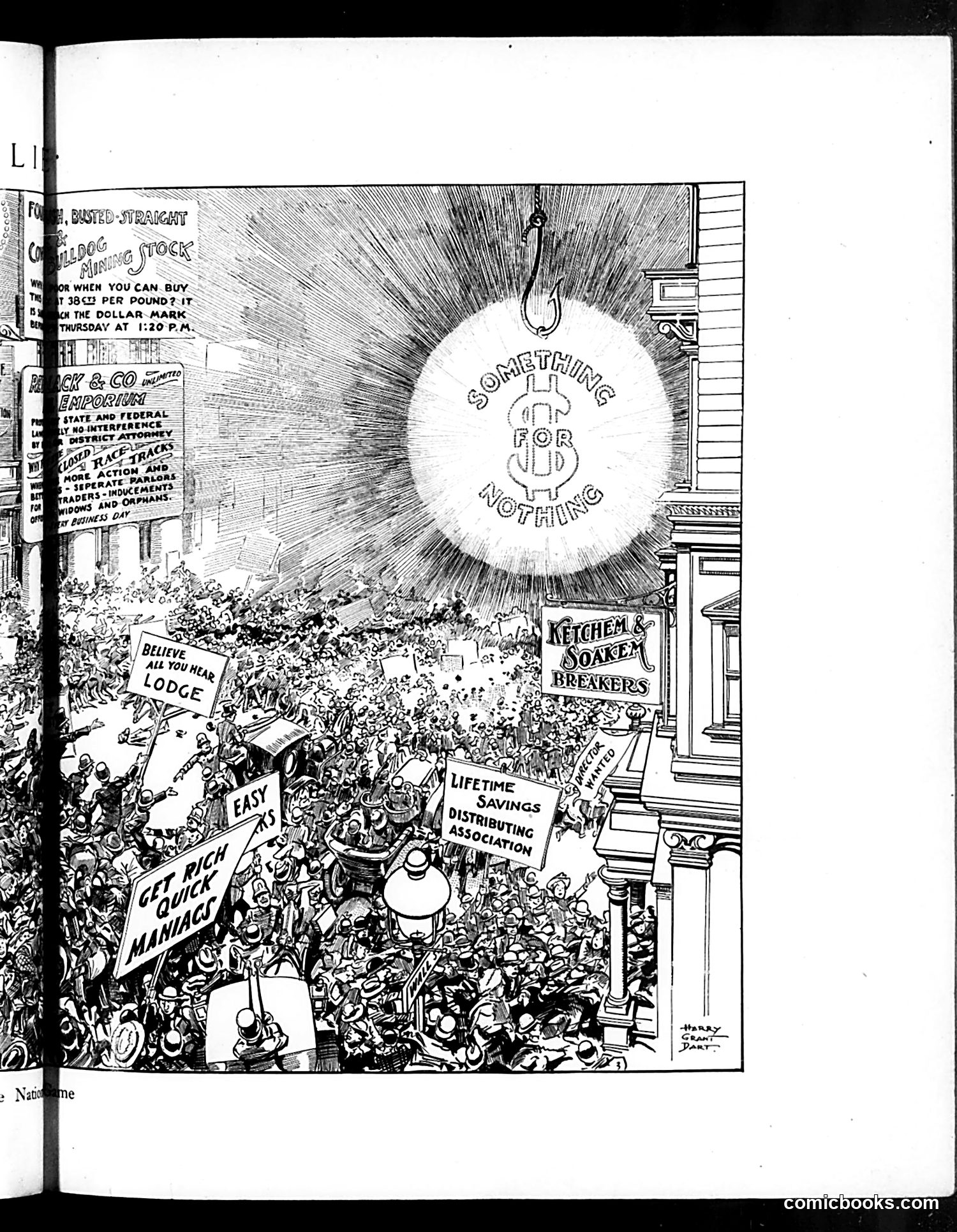
This is a satirical cartoon showing a massive crowd gathered beneath a glowing dollar sign inscribed "SOMETHING FOR NOTHING." The crowd holds signs for various commercial schemes: "Believe All You Hear Lodge," "Get Rich Quick Manioc," "Ketchen & Soaker Breakers," and "Lifetime Savings Distributing Association." The cartoon satirizes early 20th-century consumer gullibility and fraudulent business schemes promising easy wealth. The radiating light around the dollar sign ironically suggests these scams as an almost religious temptation. Visible advertising text mentions stock tips, race track information, and parlor schemes—all classic get-rich-quick pitches of the era. The satire targets how ordinary people were duped by elaborate promises of effortless profit, a recurring theme in Life magazine's social criticism during this period.
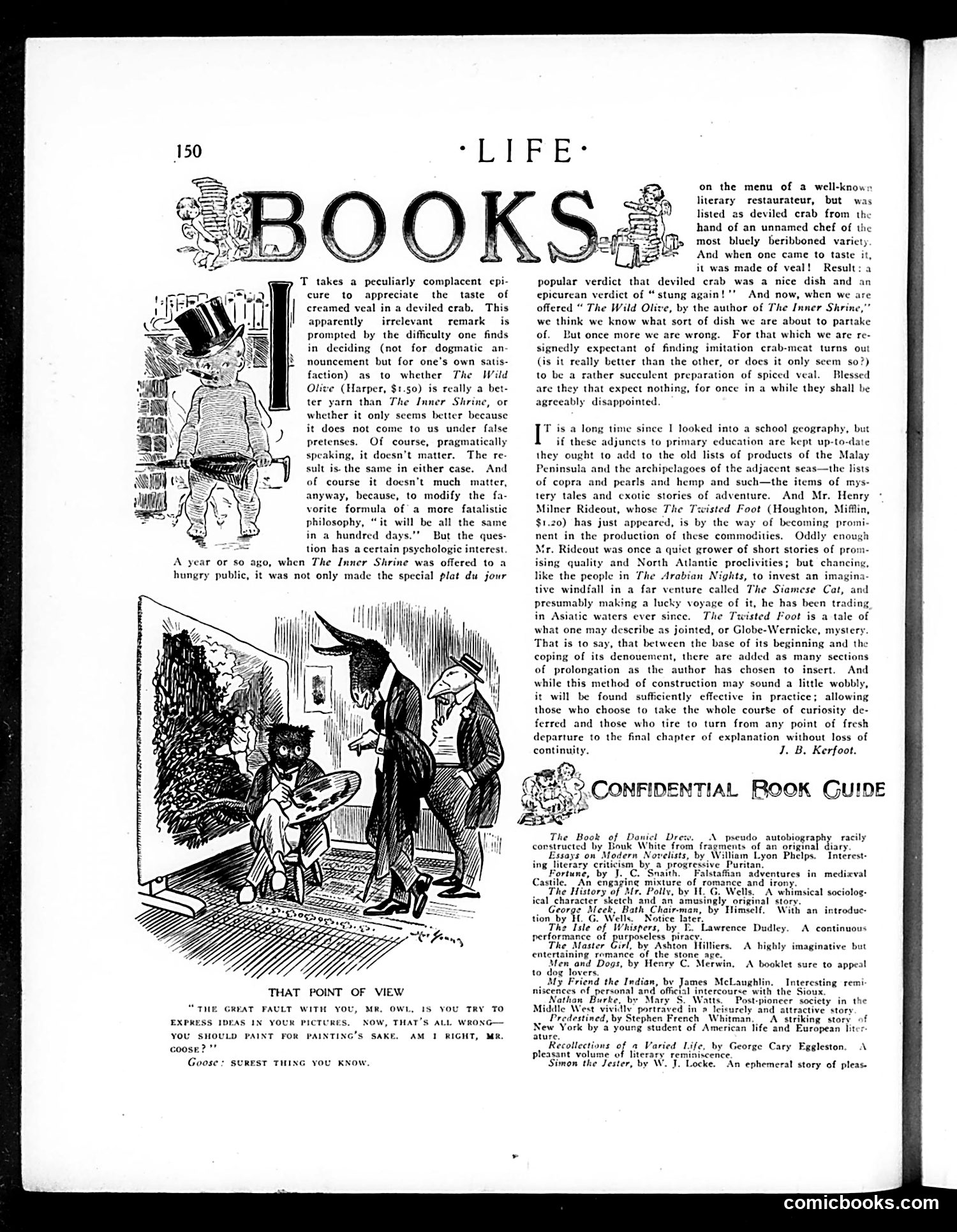
This page contains a satirical cartoon and book reviews. The cartoon depicts an owl and goose in conversation about art. A pretentious human critic (likely representing academic art establishment) lectures the owl that painting should focus on aesthetics ("painting's sake") rather than expressing ideas through pictures. The goose agrees obsequiously. The satire mocks art-world dogmatism—the critic's rigid theory that art shouldn't communicate meaning, treating it as mere formalism divorced from purpose or message. The book reviews discuss literary works, with particular focus on *The Twisted Foot* by Henry Milner Rideout. The text humorously compares reading experiences to tasting dishes mislabeled at a restaurant: readers expect one type of story but receive another, though sometimes pleasantly. The reviews suggest early 20th-century literary tastes favored exotic adventure tales set in Asia.
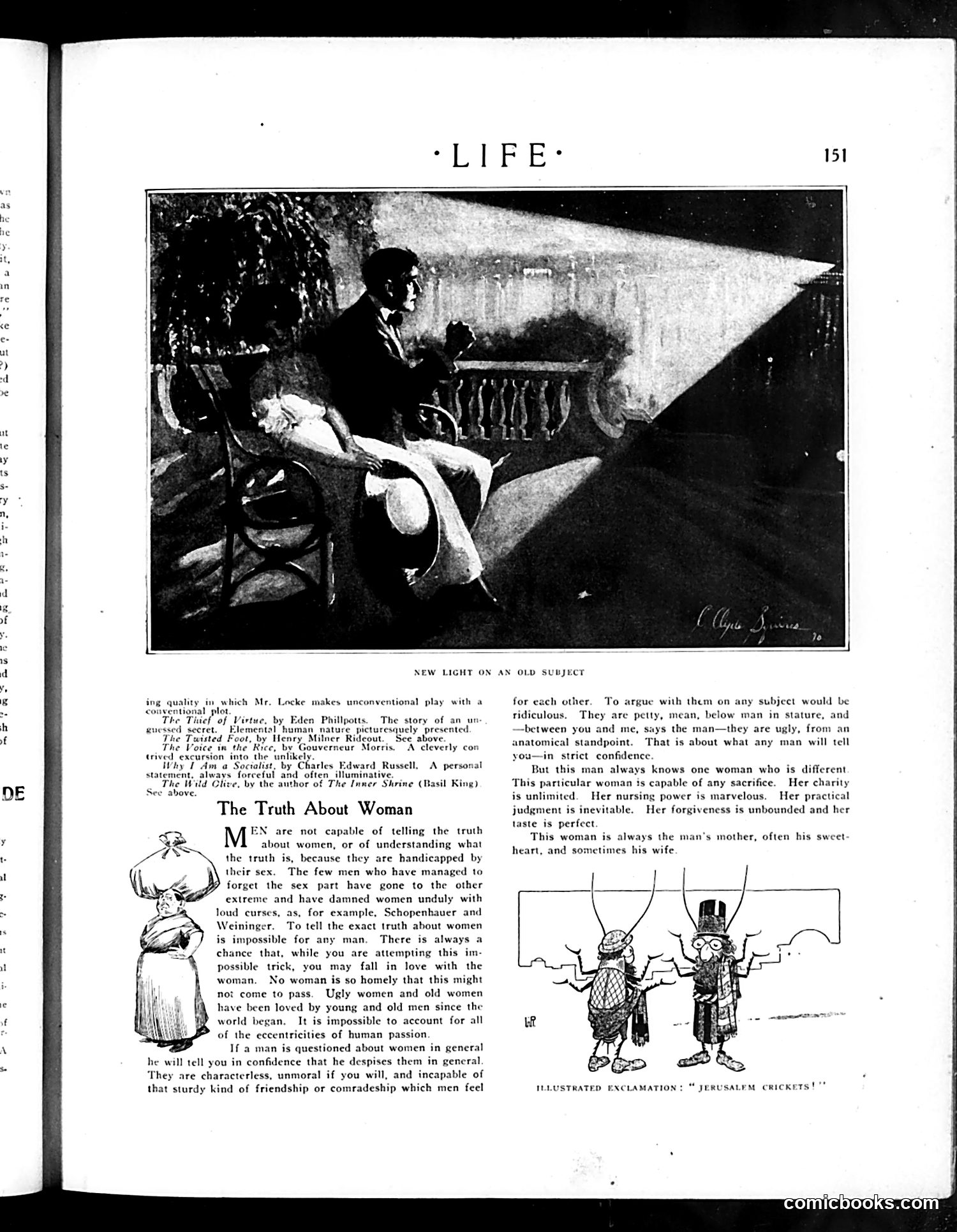
This page presents a satirical essay titled "The Truth About Woman" that critiques male hypocrisy regarding women. **The Argument:** The text argues that men cannot objectively discuss women because of sexual bias. It notes that men alternate between two extremes: either idealizing individual women in their lives (mothers, sweethearts, wives) while simultaneously claiming women are generally "characterless, unmoral," petty, and intellectually inferior. **The Satire:** The piece exposes a fundamental male contradiction: men claim women lack judgment and are incapable of serious friendship, yet they consistently recognize exceptional qualities in the specific women closest to them—without recognizing this contradicts their general misogyny. **The Cartoon:** The bottom illustration shows two cricket-like figures labeled "JERUSALEM CRICKETS"—likely a visual pun emphasizing the absurdity of these contradictory male attitudes. **Context:** Published during an era of rigid gender stereotypes, this represents an unusually progressive critique of misogyny for early 20th-century American satire.
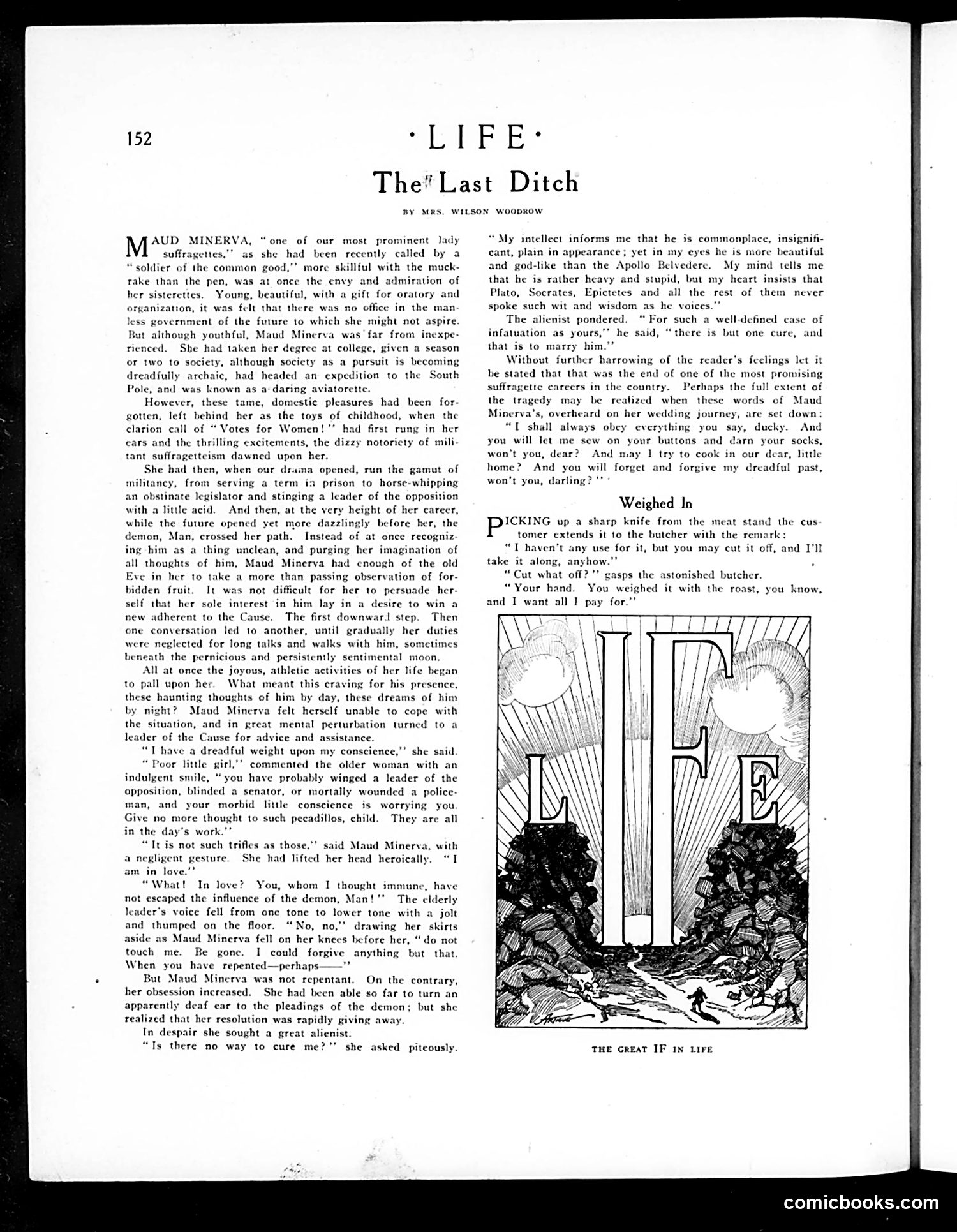
This is the opening of a satirical short story mocking militant suffragettes. The protagonist, Maud Minerva, is a caricatured "New Woman" — educated, athletic, and a devoted suffragist who has imprisoned herself, horse-whipped legislators, and attacked opposition leaders with acid in service to "the Cause" (women's voting rights). The satire's point: when Maud falls in love with a man, her fellow suffragettes treat it as a *betrayal* — worse than any violence she committed. The older female leader responds with horror and rejection, treating romance as an unforgivable corruption of political commitment. The cartoon titled "The Great If in Life" (showing large letters "IF") reinforces the joke: the satirist suggests that romantic love represents the ultimate contradiction to militant feminism's demands for women's complete independence and devotion to the cause. The piece ridicules both suffragettes' alleged extremism and the hypocrisy of their moral superiority claims.
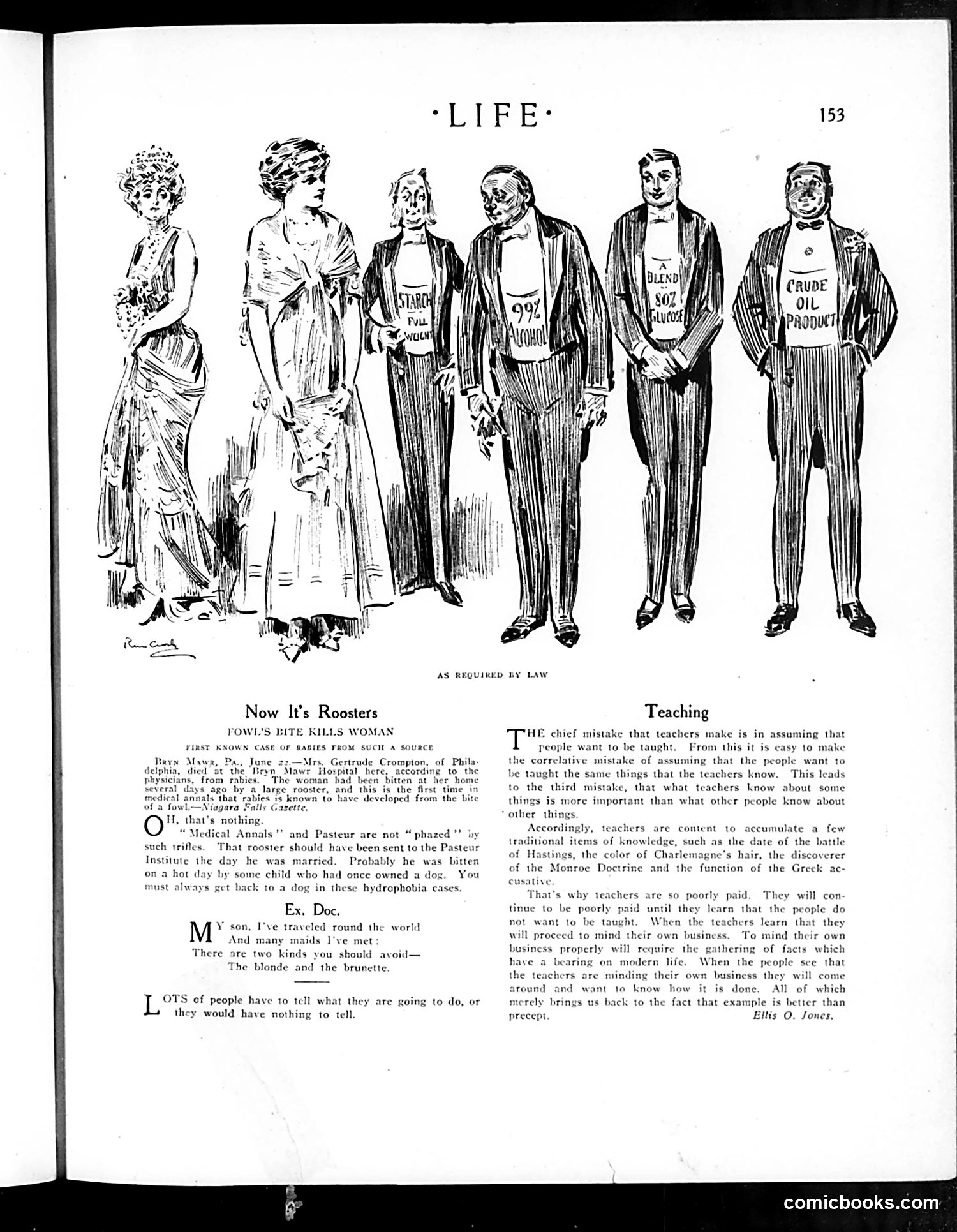
This page contains three separate satirical pieces: **"Now It's Roosters"** mocks a newspaper report of a woman contracting rabies from a rooster bite. The satire ridicules both the sensational medical claim and the automatic assumption that everything traces back to dogs—the piece jokes that doctors reflexively blame canines even when clearly inapplicable. **"Ex. Doc."** is a brief humorous verse warning against "the blonde and the brunette," suggesting romantic entanglements cause trouble. **"Teaching"** (by Elias O. Jones) offers social criticism of American education. It argues teachers wrongly assume people *want* instruction and mistakenly teach what *teachers* find important rather than what people actually need. The satirical conclusion: teachers remain poorly paid because they haven't learned that people prefer practical example over abstract instruction—ironically, the very lesson teachers should teach. The illustration at top shows figures in formal dress labeled "AS REQUIRED BY LAW," likely depicting dress codes or social conventions of the era.
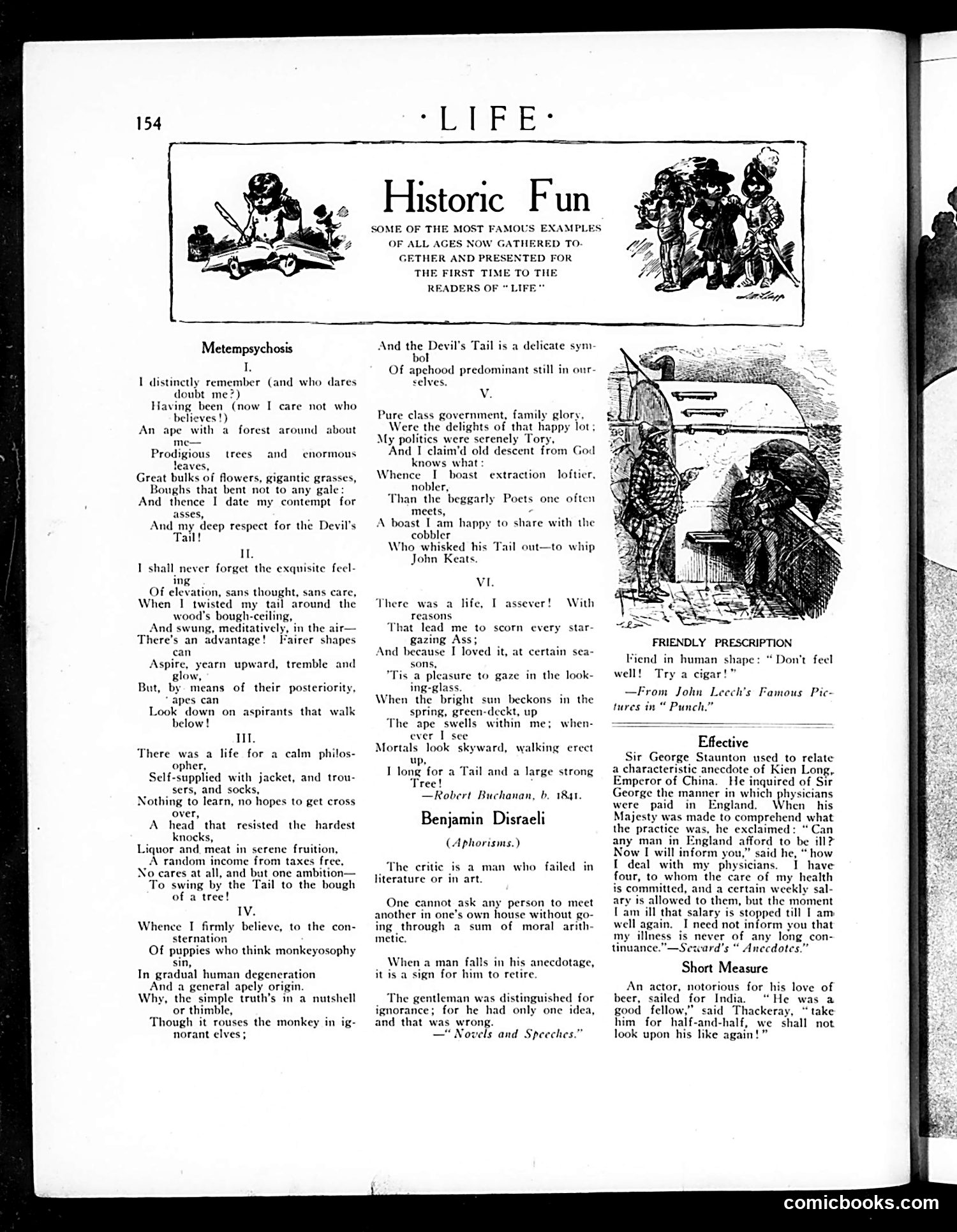
This is a miscellaneous "Historic Fun" collection page mixing poetry, aphorisms, and anecdotes—not a single cartoon. The main piece is a lengthy poem called "Metempsychosis" (reincarnation), where the speaker claims to remember being an ape and argues humans are descended from monkeys. The poem mocks pretension by having this former ape boast of aristocratic origins ("old descent from God knows what") and Tory politics—satirizing how the upper classes claim superiority while being fundamentally no better than beasts. There's a jab at Romantic poet John Keats via a reference to a cobbler who "whipped" him with his tail. The page includes aphorisms attributed to Benjamin Disraeli (Victorian Prime Minister) and a "Friendly Prescription" cartoon from *Punch* showing someone recommending cigars as medicine. Overall, the page satirizes class pretension, evolutionary theory debates popular in Victorian England, and the absurdity of human vanity—suggesting we're merely evolved apes despite our civilized pretenses.
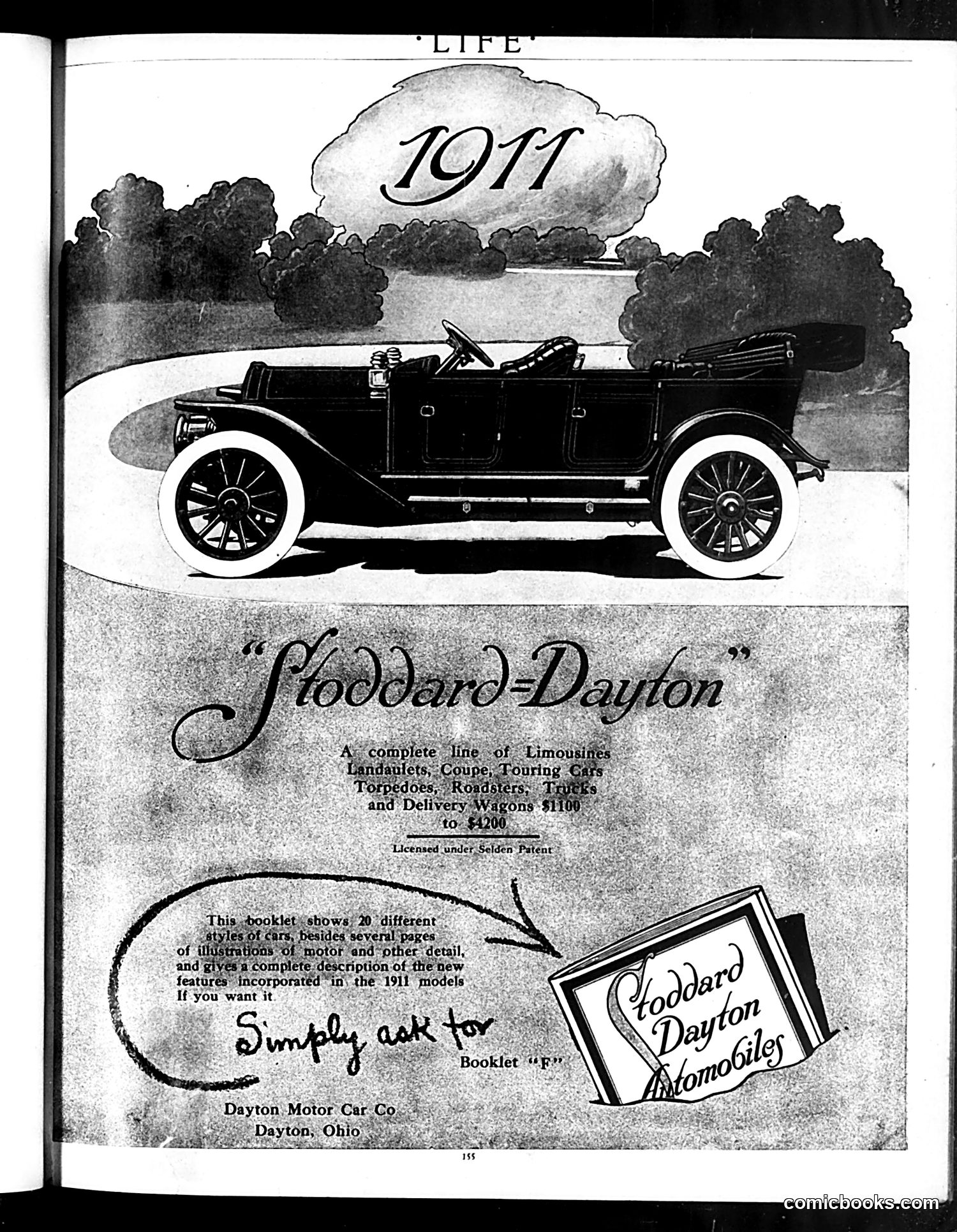
This is primarily a **1911 advertisement**, not a political cartoon. It promotes the Stoddard-Dayton automobile, manufactured by the Dayton Motor Car Co. in Dayton, Ohio. The ad showcases a sleek open-air touring car typical of the early automotive era. Key selling points include a "complete line of Limousines, Landaulets, Coupe, Touring Cars, Torpedoes, Roadsters, Trucks and Delivery Wagons" priced from $1100 to $4200—substantial sums for the period. The ad mentions a 20-page booklet with illustrations and specifications of 1911 models, encouraging potential buyers to "Simply ask for Booklet 'F'." This represents early mass-marketing strategies for automobiles, when the industry was still establishing itself and such vehicles remained luxury items for the affluent.
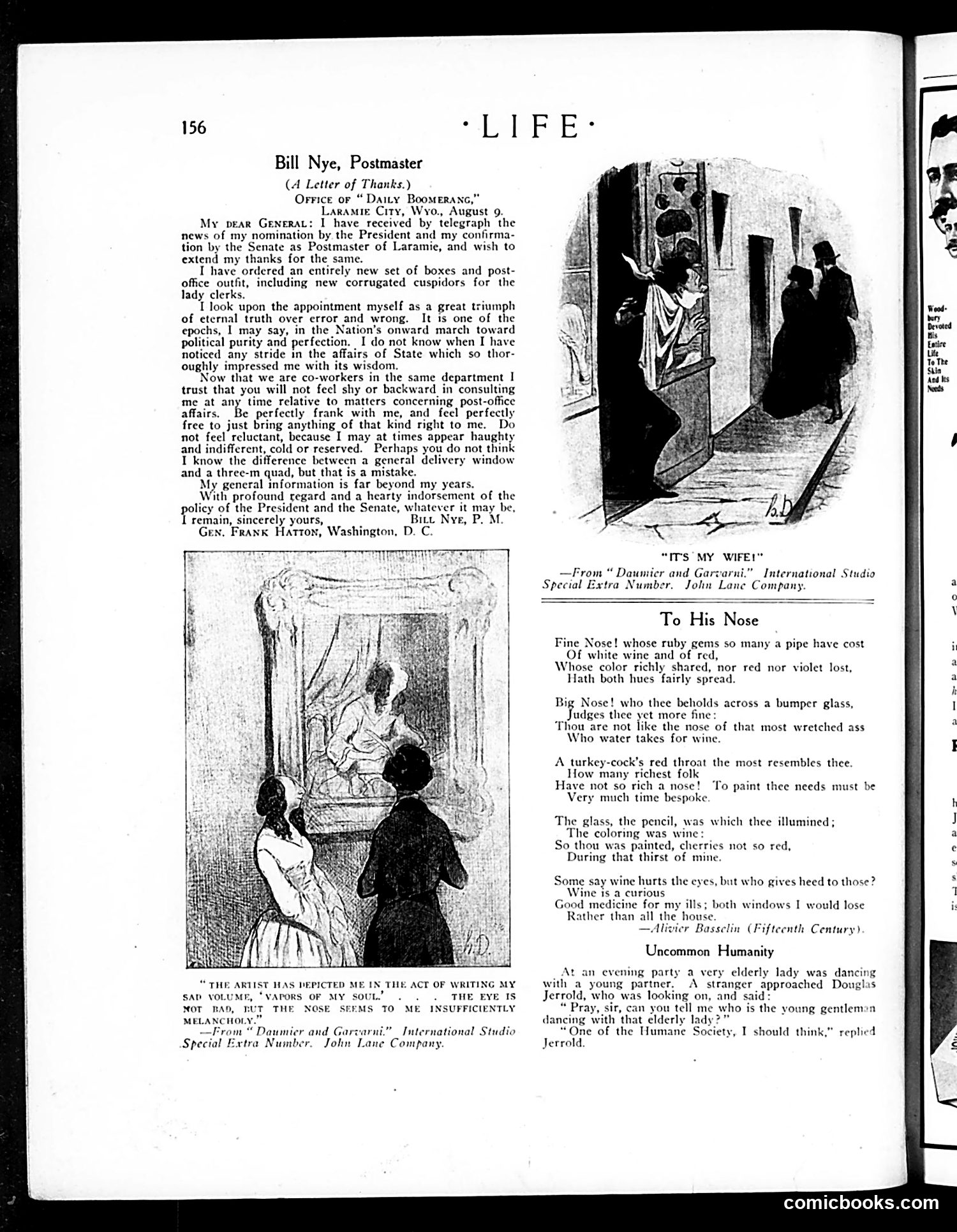
## "Bill Nye, Postmaster" This is a satirical letter from humorist Bill Nye (a real figure of the era) thanking the President for his appointment as Postmaster of Laramie, Wyoming. The joke is Nye's mock-serious tone about what should be a routine bureaucratic appointment—he describes it as "a great triumph of eternal truth over error and wrong" and "one of the epochs" in the nation's progress toward "political purity." This mocks both partisan patronage appointments (where political allies received government jobs) and Nye's own self-aggrandizing pomposity. His digression about "corrugated cuspidors for the lady clerks" adds absurdist humor. ## Other Content The page includes two unrelated items: a poem "To His Nose" (apparently a classical drinking song celebrating a wine-drinker's reddened nose) and a brief anecdote "Uncommon Humanity" where Douglas Jerrold observes an elderly lady dancing with a young man, sardonically suggesting only a member of the Humane Society would show such kindness.
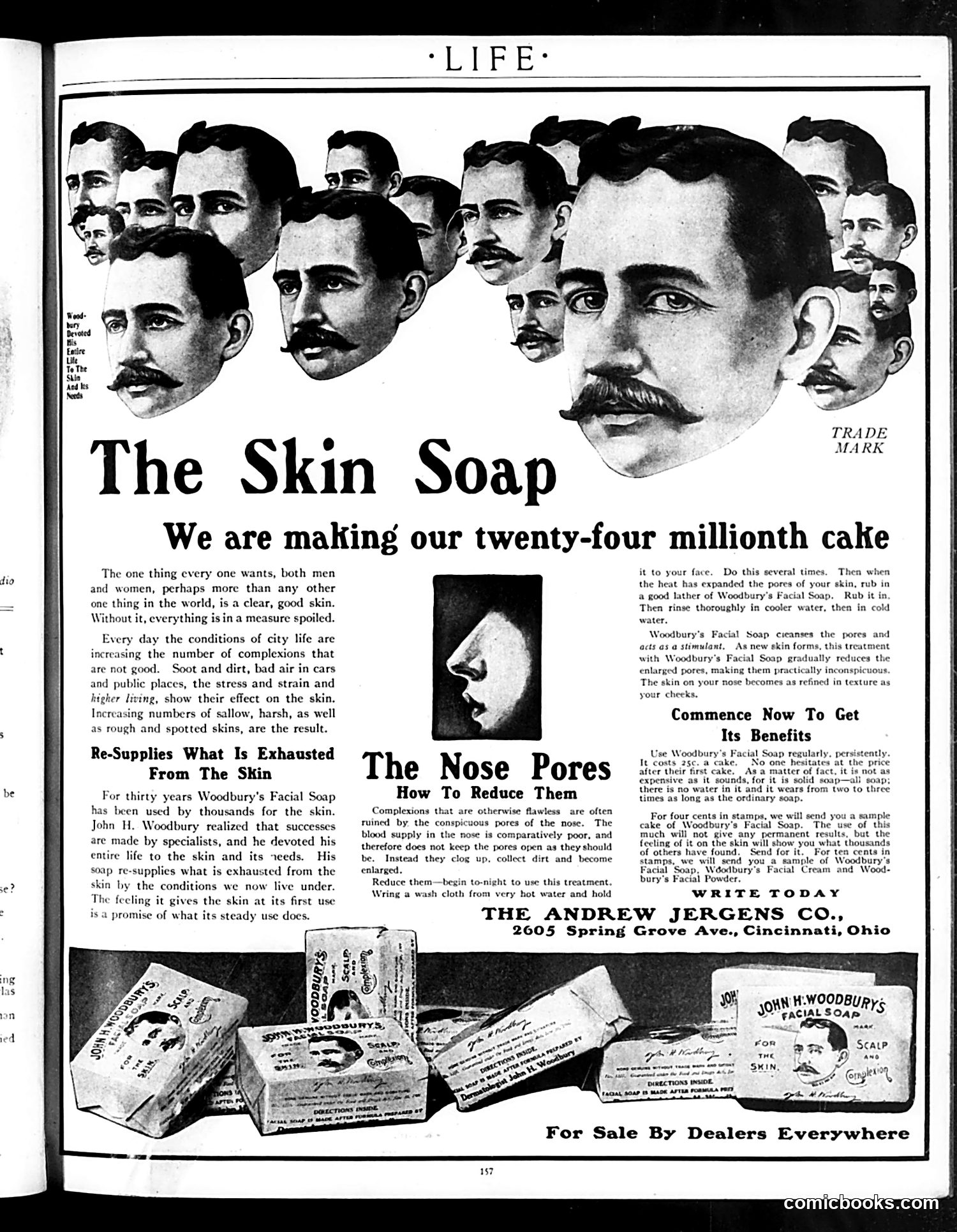
This is a **product advertisement**, not political satire. The page promotes Woodbury's Facial Soap, claiming it's made its "twenty-four millionth cake." The numerous male faces at the top serve as visual evidence of the product's popularity and masculine appeal—countering any assumption that facial soap was only for women. This was important messaging in the early 20th century. The advertisement addresses real urban problems of the era: soot, poor air quality in public transportation, and stress from modern city life damaging complexions. It positions the soap as a specialist solution created by "John H. Woodbury," who devoted his life to skin care. The "nose pores" section offers specific treatment instructions, typical of patent-medicine-era advertising that promised detailed solutions to embarrassing problems. The product cost 25¢ per cake—presented as economical since it contained no water and lasted longer than ordinary soap. A sample could be obtained for four cents in stamps. This reflects early 1900s advertising approaches: addressing social anxieties, claiming scientific expertise, and offering free samples to drive sales.
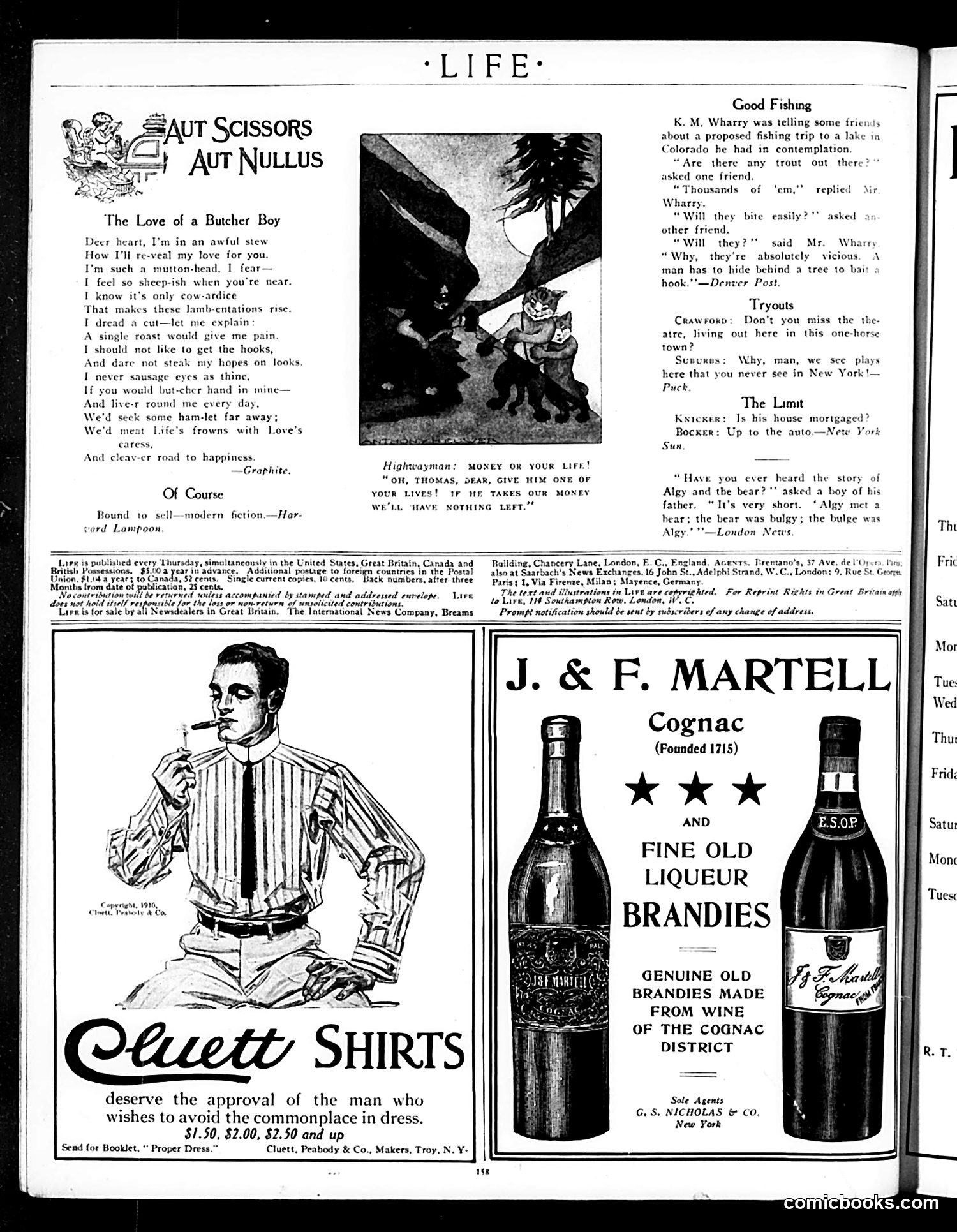
This page from *Life* magazine contains several humorous pieces typical of early 20th-century American satire: **"The Love of a Butcher Boy"** is a comic poem using meat-industry puns (mutton-head, sheepish, lamb-entations, steak, sausage, ham-let, meat) to parody sentimental love poetry—mocking both butchers and romantic verse simultaneously. **The cartoon** titled "Highwayman: Money or Your Life!" depicts a robbery scene with darkly comedic dialogue where a highway robber demands money, threatening "we'll have nothing left." The humor lies in the absurdist logic of the threat. **Short anecdotes** ("Good Fishing," "Tryouts," "The Limit," "Algy and the Bear") are brief jokes playing on exaggeration and wordplay—typical of *Life*'s humor style. The page is otherwise dominated by **period advertisements** for Cluett Shirts and J. & F. Martell Cognac, reflecting the magazine's commercial content.
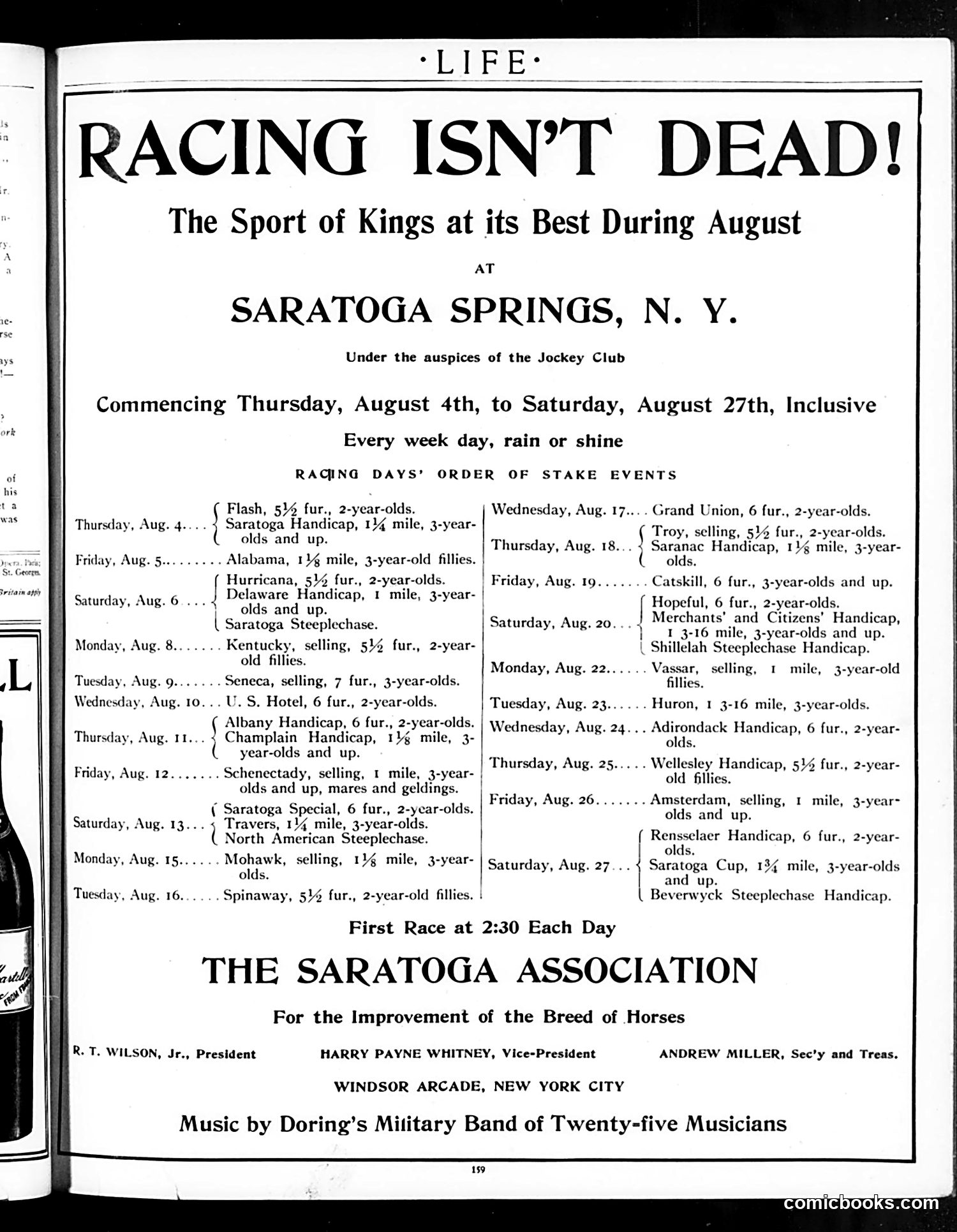
This is an advertisement, not a political cartoon. It's a promotional page for horse racing season at Saratoga Springs, New York, running August 4-27. The headline "RACING ISN'T DEAD!" responds to contemporary concerns—likely the sport faced criticism or decline. The page reassures readers that racing thrives, offering detailed race schedules ("every week day, rain or shine") and emphasizing prestige through the Jockey Club's auspices and prominent officials like Harry Payne Whitney. The races bear ornate names referencing New York locations and historical significance. The final line about "Doring's Military Band" adds entertainment appeal. This essentially refutes skepticism about horse racing's viability, marketing the sport of wealthy elites as vital and flourishing.
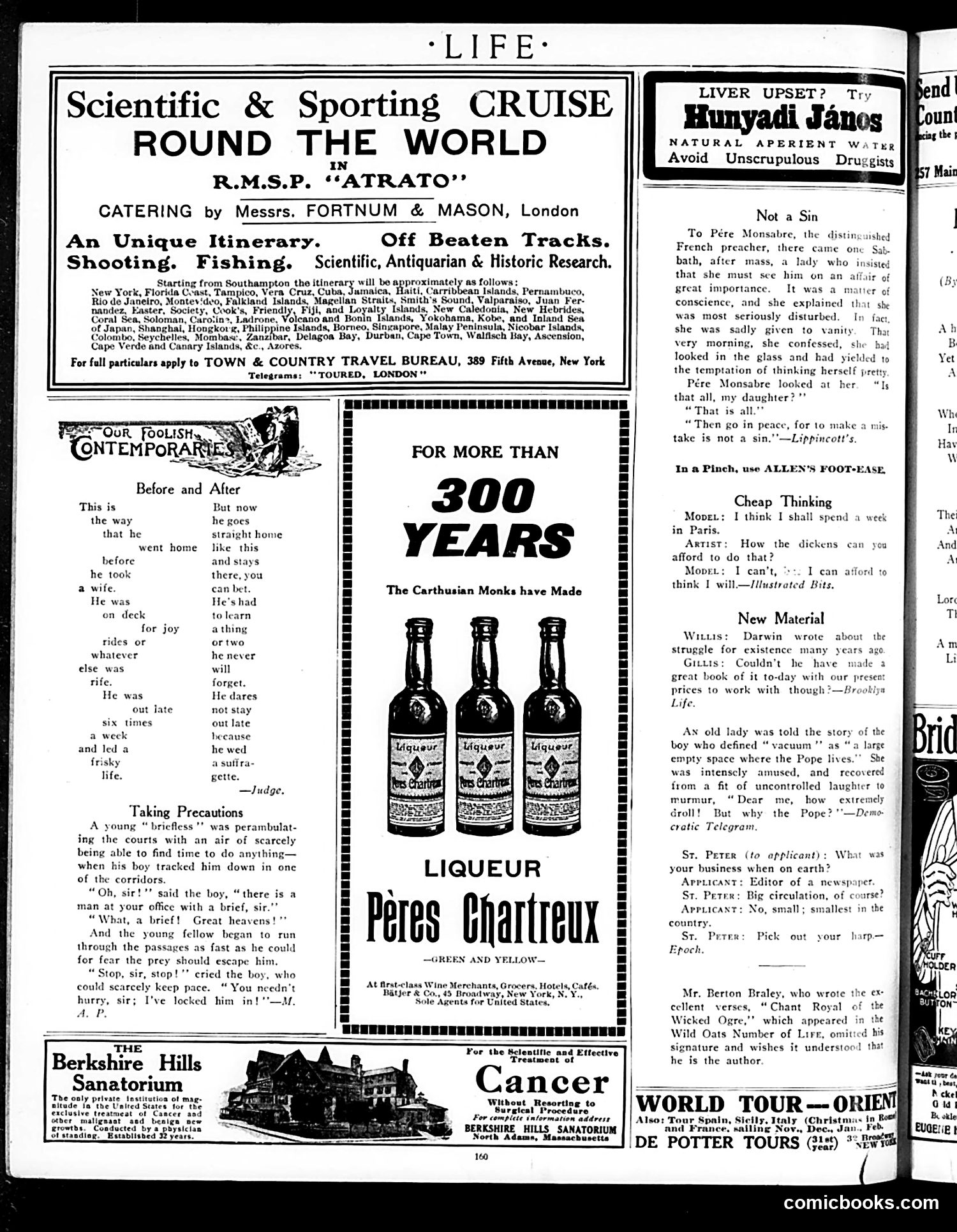
This page is primarily **advertisements and humor columns** rather than political cartooning. The main satirical content includes: **"Our Foolish Contemporaries" cartoon**: A before-and-after comparison mocking how marriage changes men. The joke: a bachelor who went home late, took a wife casually, and lived recklessly is now domesticated—he comes straight home, stays put, and "had to learn a thing or two" because "he wed a suffragette." This reflects early 20th-century anxiety about women's suffrage movements constraining male freedom. **Humor snippets** mock vanity (a woman confessing to priest about admiring herself in mirrors), Darwinian economics (high prices as "struggle for existence"), and journalism (a newspaper editor with tiny circulation applying to heaven—satirizing failed media ventures). The page reflects **Edwardian anxieties**: suffragettes as life-limiting forces, consumerism, and social pretension. The tone is lighthearted rather than biting political commentary.
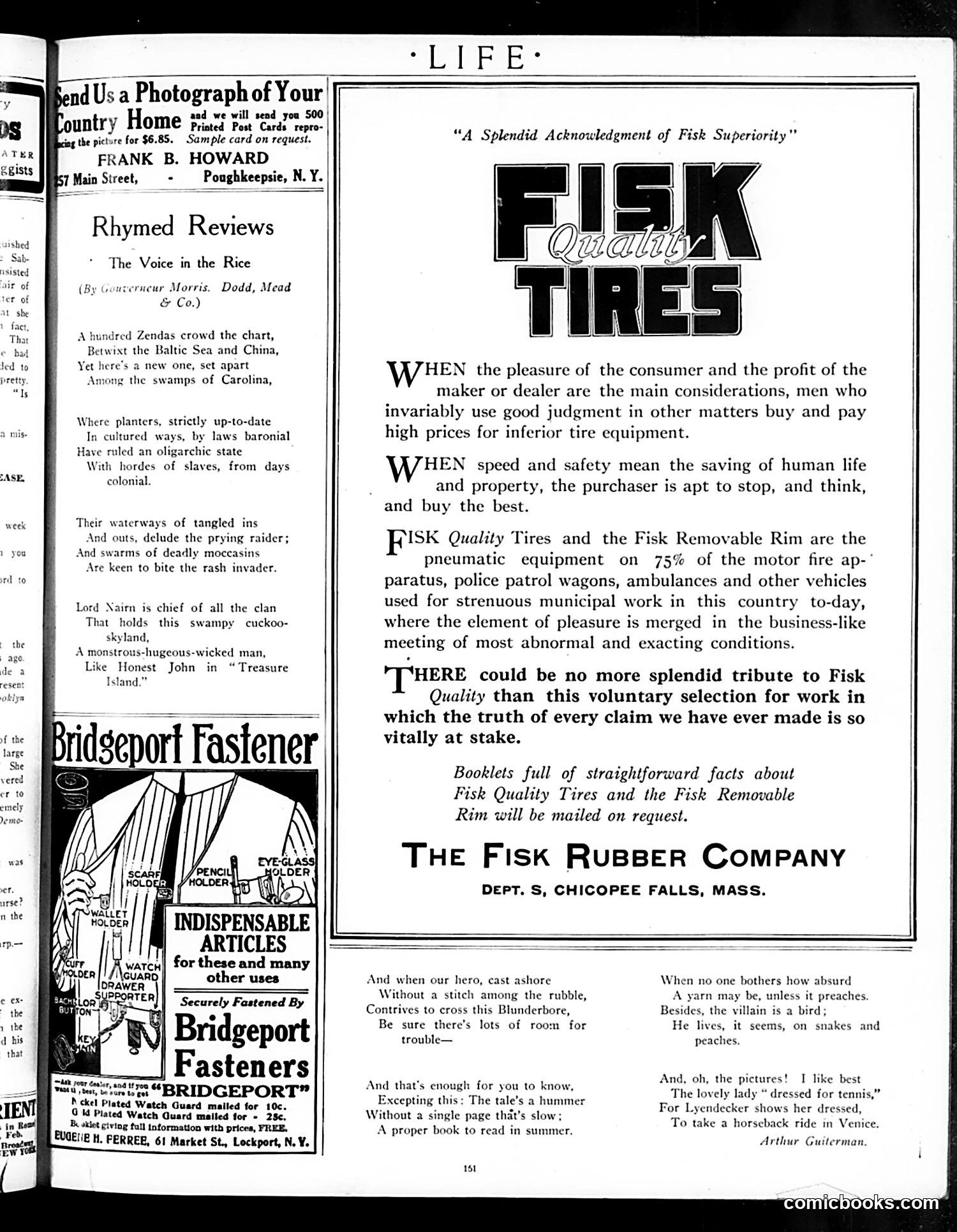
This page contains primarily **advertisements and book reviews**, not political cartoons. The main content includes: 1. **Frank B. Howard ad**: A postcard service offering to print photographs of country homes. 2. **"Rhymed Reviews"**: A poem by Arthur Guiterman reviewing a book called *The Voice in the Rice* (published by Dodd, Mead & Co.). The review describes a story set in the Carolinas involving a villainous character named Lord Nairn who rules a swampy region, with references to slaves and danger. Guiterman praises the book as good summer reading, noting the illustrations by Lyendecker (a famous illustrator). 3. **Bridgeport Fasteners ad**: Industrial fastening products. 4. **Fisk Rubber Company ad**: A full-page advertisement claiming that Fisk Quality Tires are used on 75% of municipal emergency vehicles (fire apparatus, police wagons, ambulances) because they prioritize safety and performance over cost. There is **no political satire or social commentary** on this page—it's a standard magazine page mixing editorial and advertising content.
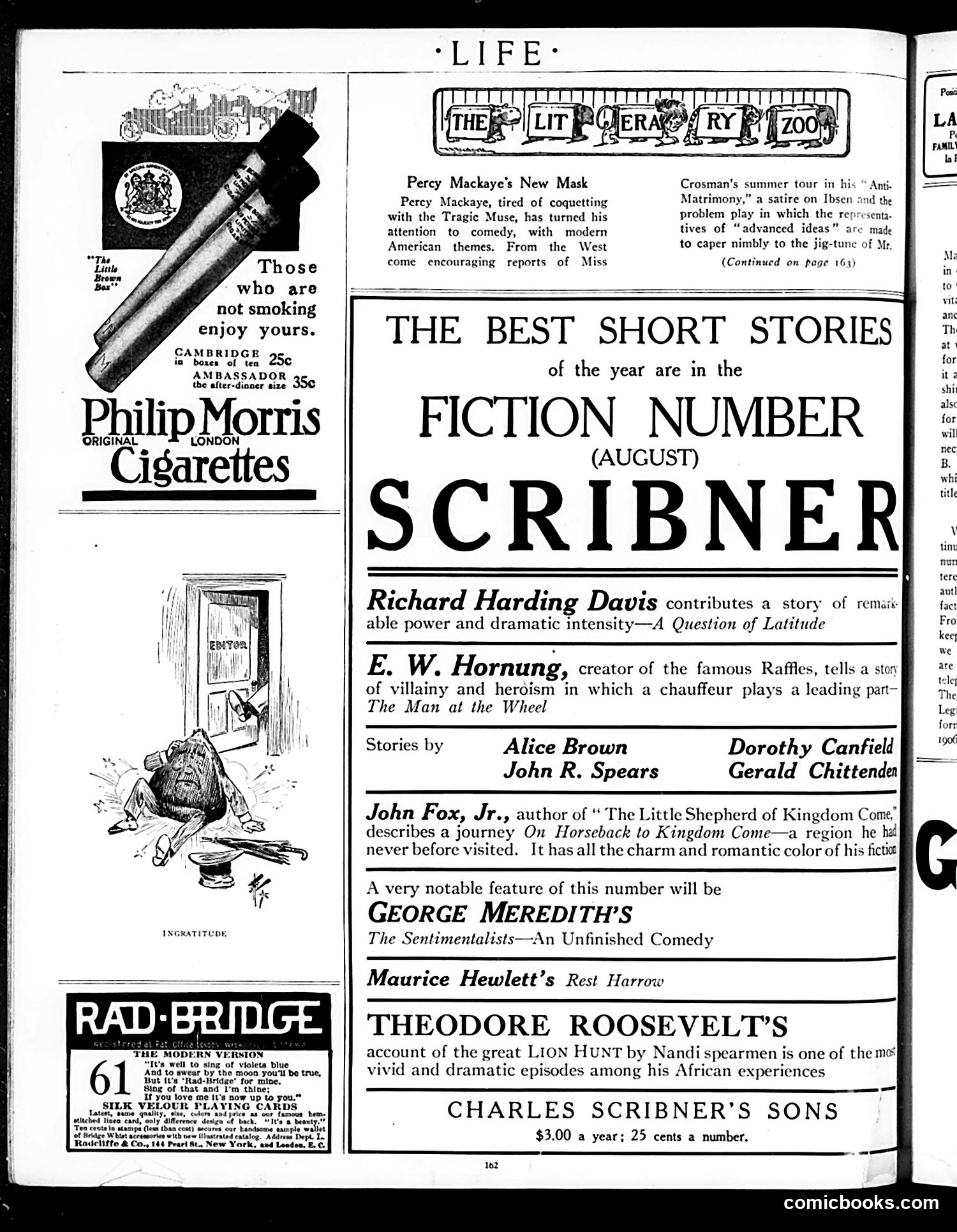
This page combines advertisements with literary promotion, primarily showcasing *Scribner's* fiction magazine's August issue. **The Cartoon**: "Ingratitude, The Modern Version" depicts a woman rejecting romantic gestures (violets, moon vows) in favor of a "Rad-Bridge" playing card game—satirizing how modern women prioritize practical entertainment over traditional courtship sentiments. The joke plays on shifting female interests away from Victorian romance. **The Advertisements**: Philip Morris cigarettes and Rad-Bridge playing cards occupy the left side, using gender-coded appeals typical of 1910s marketing. **The Main Content**: The right side advertises *Scribner's* Fiction Number, listing prominent authors including Richard Harding Davis, Theodore Roosevelt (describing an African lion hunt), and George Meredith. This represents *Scribner's* as a prestigious literary magazine featuring established, respectable male writers—positioning it as serious American literature. The page reflects early 20th-century attitudes toward modernizing gender roles and the marketing of both consumer goods and "highbrow" literature to educated middle-class readers.
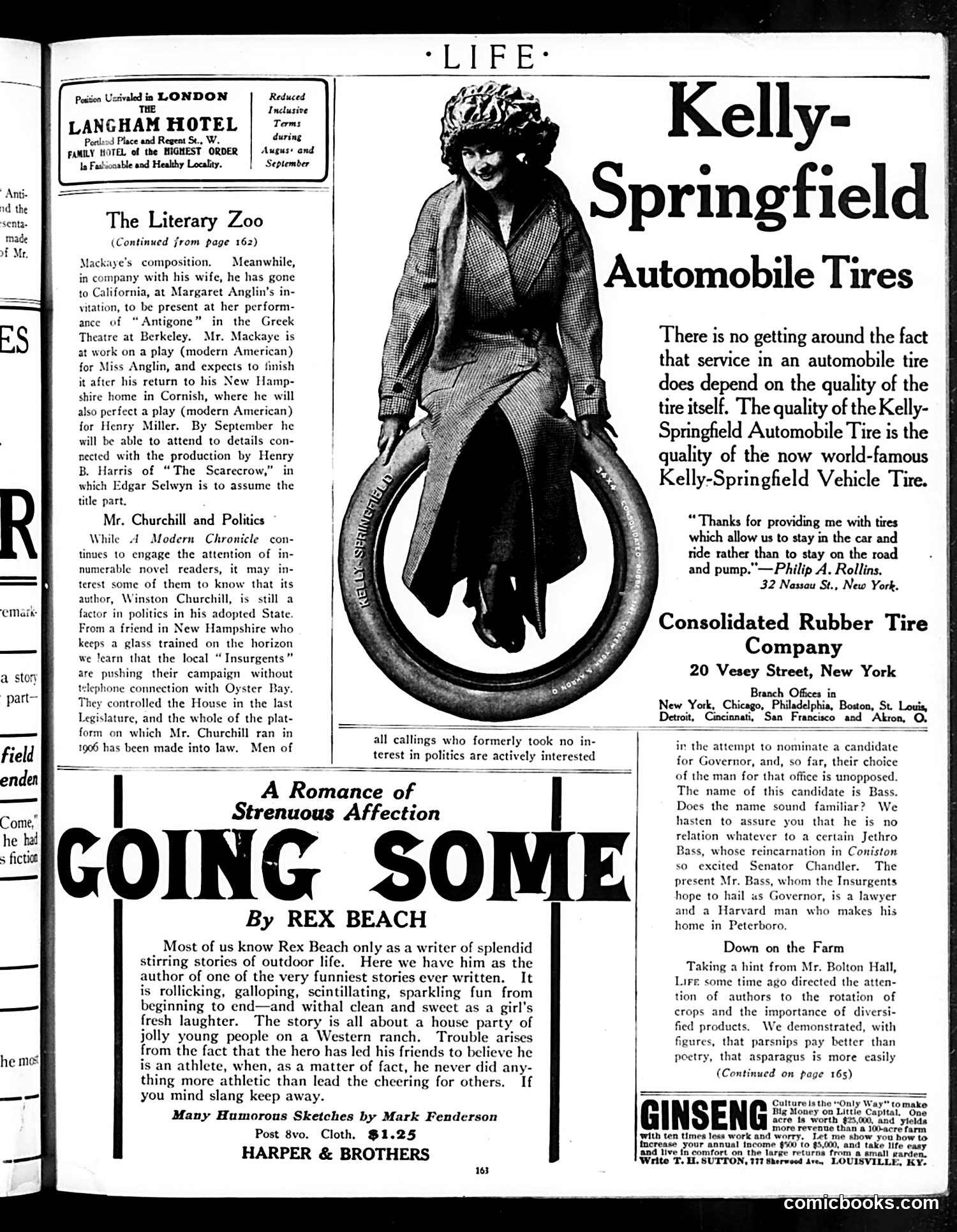
This is primarily a **literary and advertising page** rather than a political cartoon. The main content includes: **"The Literary Zoo"** discusses prominent American authors' activities—notably **Winston Churchill** (the American novelist, not the British politician), whose political involvement in New Hampshire is highlighted. The text notes Churchill's 1906 campaign platform has become law, and local "Insurgents" are pushing reform politics independent of Theodore Roosevelt's Oyster Bay influence. **Book advertisements** promote Rex Beach's novel "Going Some" and other Harper & Brothers publications. **"Going Some"** by Rex Beach is humorously presented as a comedic departure from Beach's typical outdoor adventure stories. The **Kelly-Springfield Automobile Tires advertisement** features a woman and tire, emphasizing product quality through a customer testimonial. The page reflects early 1900s literary culture and contemporary political reform movements, but contains no satirical cartoons or caricatures requiring specialized historical interpretation.
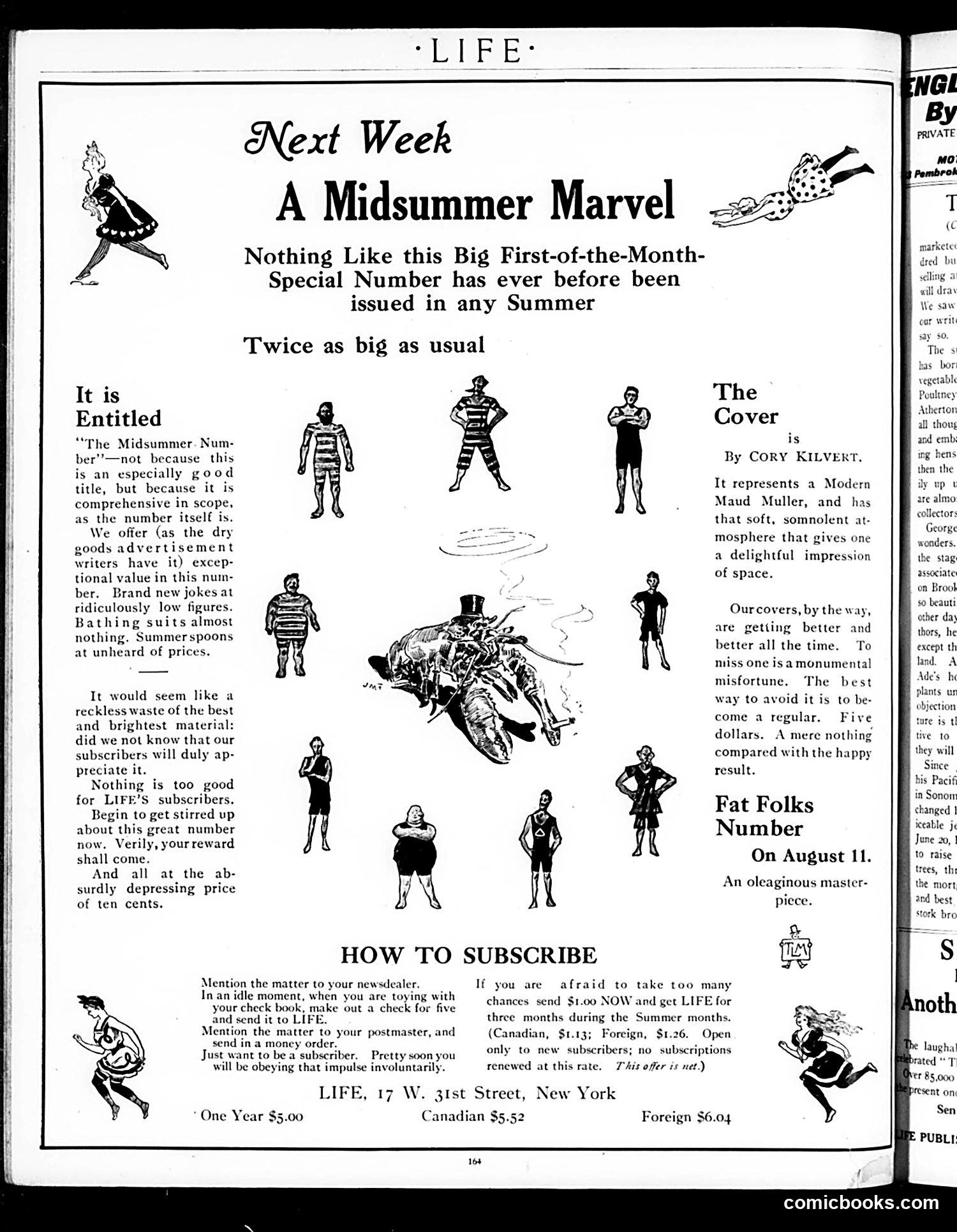
This is primarily a **promotional/advertising page** for Life magazine's upcoming "Midsummer Number" rather than a political cartoon. The central illustration shows a **giant lobster surrounded by figures in bathing suits**—a visual metaphor for summer leisure and beach culture. The surrounding smaller figures in various swimwear styles illustrate the issue's content about bathing fashions. **Key points:** - Life is promoting a double-sized special summer edition at the standard ten-cent price - The cover, by artist Cory Kilvert, depicts a "Modern Maud Muller" (referencing the poem about a country girl), meant to evoke peaceful summer atmosphere - Upcoming features include a "Fat Folks Number" (August 11)—apparently satirizing body types, typical of early 20th-century humor - The subscription pitch emphasizes exceptional value and appeals to readers' vanity ("nothing is too good for LIFE's subscribers") The tone is typical of Life's self-promotional, tongue-in-cheek advertising style.
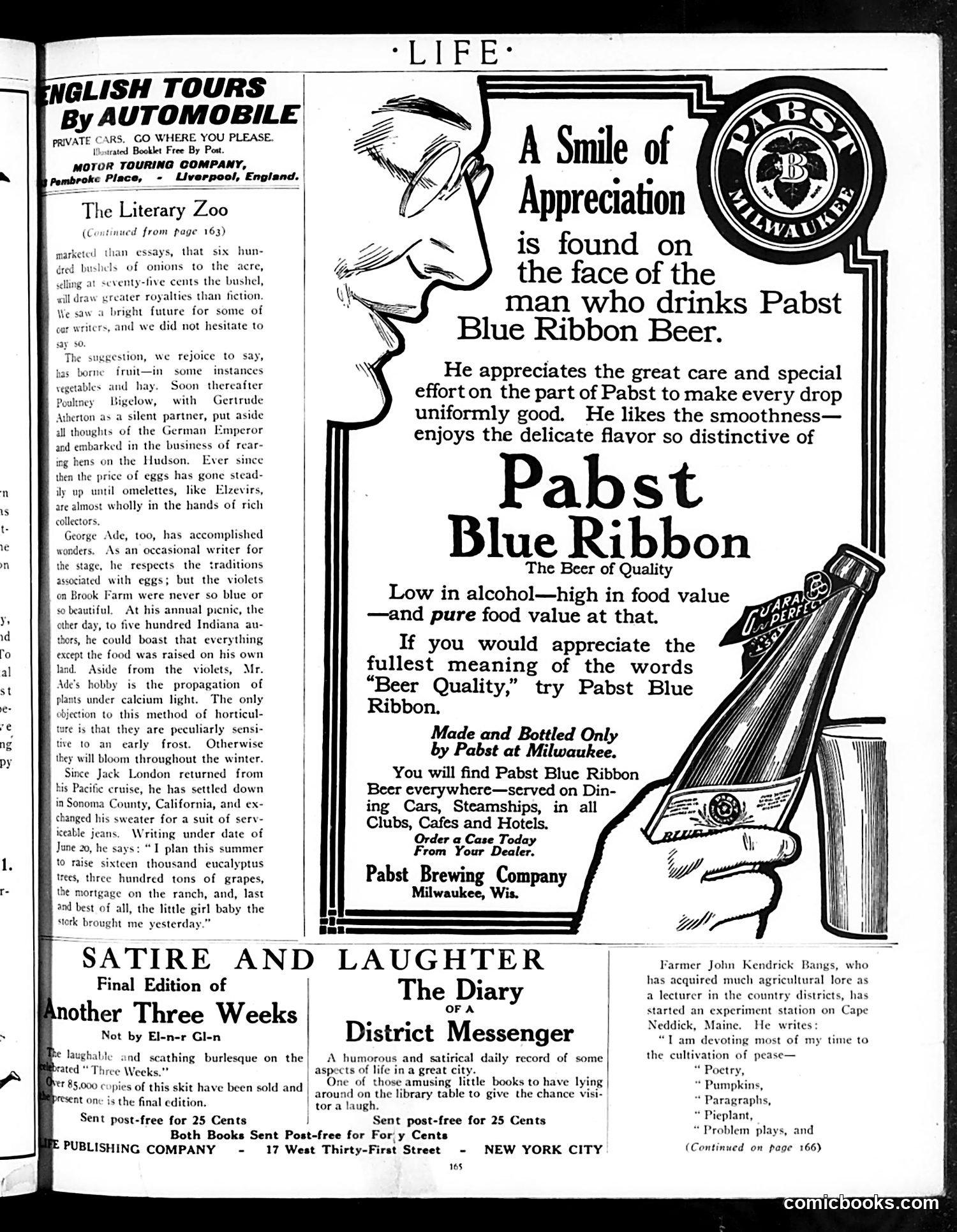
This page is primarily **advertising and literary content** from an early 20th-century *Life* magazine. The dominant feature is a **Pabst Blue Ribbon Beer advertisement** using a caricatured male face to promote the product's "quality" and "appreciation." The adjacent text, "The Literary Zoo," is a satirical column discussing American writers (George Ade, Jack London, Gertrude Atherton) who've abandoned literary careers for agricultural pursuits—raising chickens, eucalyptus trees, and grapes. The satire mocks this trend, suggesting these authors value farming profits over serious writing. The beer ad's central claim—that the beer's drinker demonstrates "appreciation" through his satisfied expression—is a marketing strategy linking beer consumption to refined taste. The ad emphasizes "food value" and "purity," likely referencing early 20th-century concerns about food safety and Prohibition-era anxieties (though Prohibition hadn't begun yet). The page also advertises books: a final edition of "Another Three Weeks" (parodying the scandalous novel) and "The Diary of a District Messenger" (a humorous book). No political cartoons appear on this page.
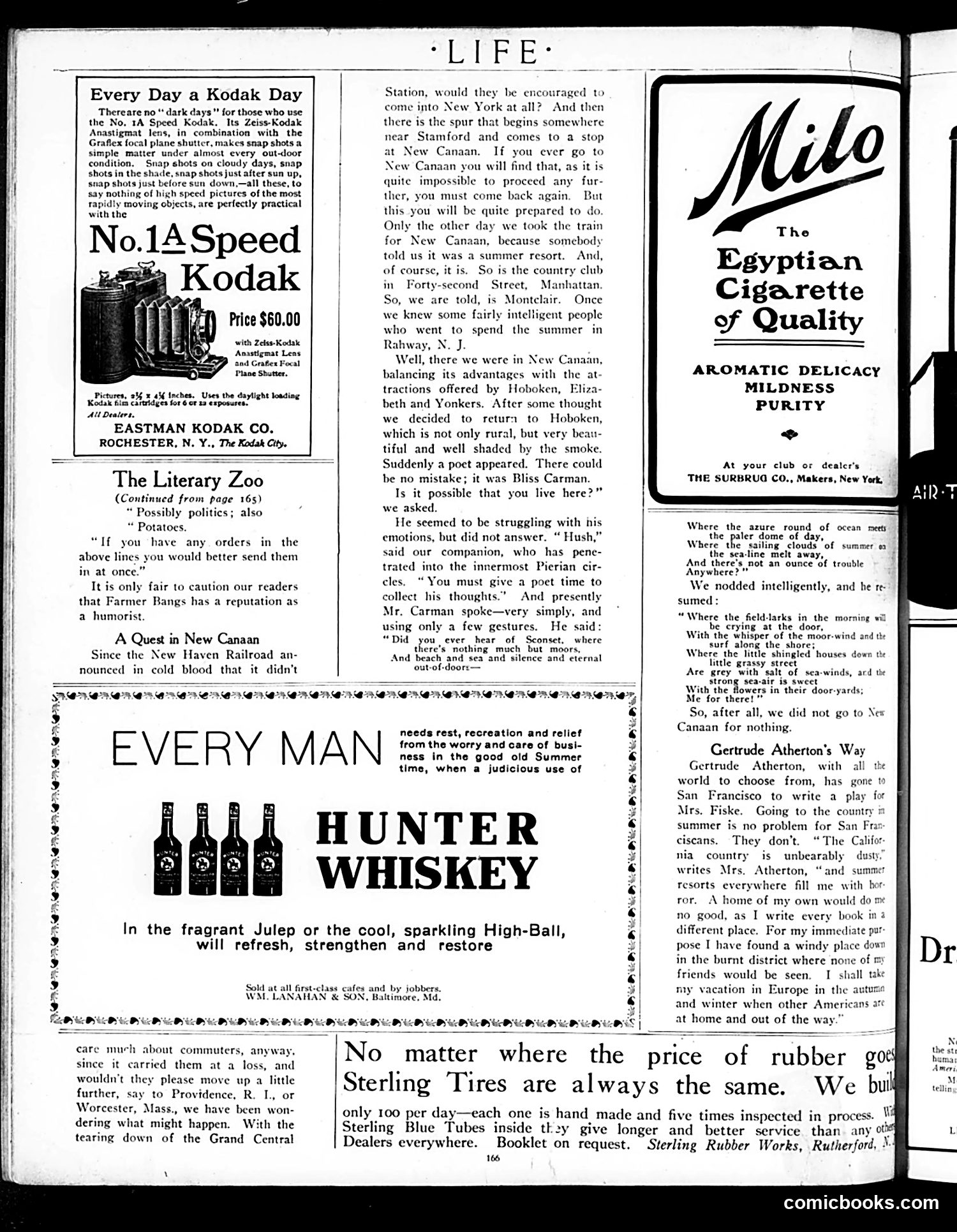
This page is primarily **advertising with light satirical editorial content**. The main satire appears in "A Quest in New Canaan," which gently mocks New England commuter towns. The author visits New Canaan expecting a summer resort but finds it a dead-end destination ("quite impossible to proceed any further"). The joke hinges on deflating suburban pretensions—New Canaan, like Montclair and the "country club in Forty-second Street, Manhattan," markets itself as resort-worthy when it offers little distinction. The piece's centerpiece is an encounter with poet **Bliss Carman** (a real Canadian-American poet, 1861-1929), presented as the archetypal romantic poet—emotional, poetic, speaking only in flowery verse about moors and silence. The satire gently mocks both the poet's melodrama and the author's own pretentiousness in seeking "literary" experiences. The remainder is **commercial advertising**: Kodak cameras, Milo cigarettes, Hunter Whiskey, and Sterling Tires—standard period ads with no satirical content visible.
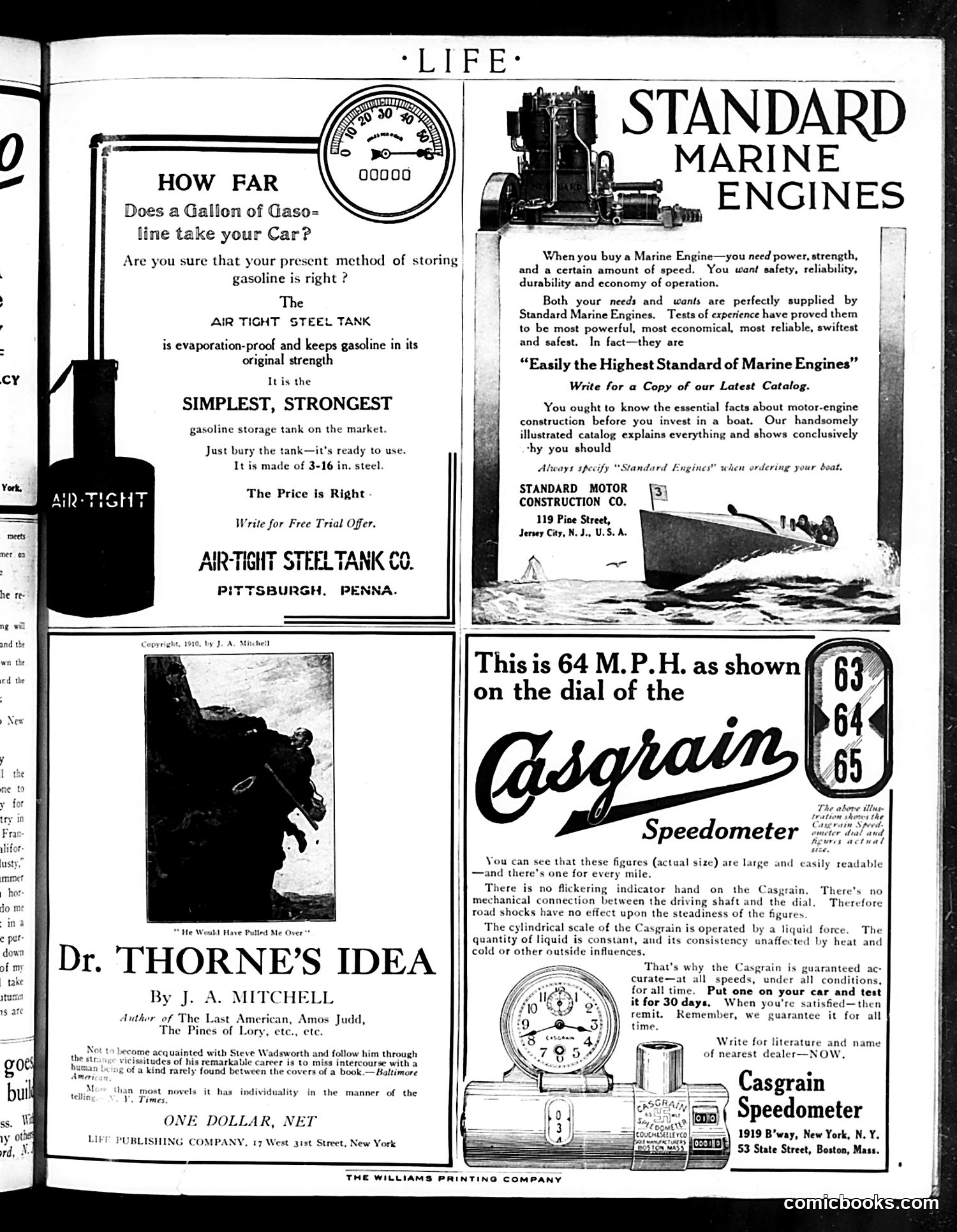
This page is primarily **advertising** rather than editorial content or political satire. It contains four distinct product advertisements from the early automotive era: 1. **Air-Tight Steel Tank Co.** (Pittsburgh): Promotes underground gasoline storage tanks, addressing a practical concern of early car owners—fuel evaporation and preservation. 2. **Dr. Thorne's Idea** (bottom left): A serialized story advertisement by J.A. Mitchell, promoting a novel available for one dollar. 3. **Standard Marine Engines**: Advertises marine motors emphasizing reliability and power. 4. **Casgrain Speedometer**: Highlights a speedometer with a liquid-filled gauge mechanism, claiming superior accuracy and reliability compared to mechanical alternatives. The page reflects early 1920s automotive technology and consumer concerns—fuel storage, engine reliability, and instrument precision. There is no political satire or social commentary evident. The crude photograph labeled "He Woul'd Have Pulled Me Over" appears to be illustrative content for the Dr. Thorne story rather than standalone commentary.
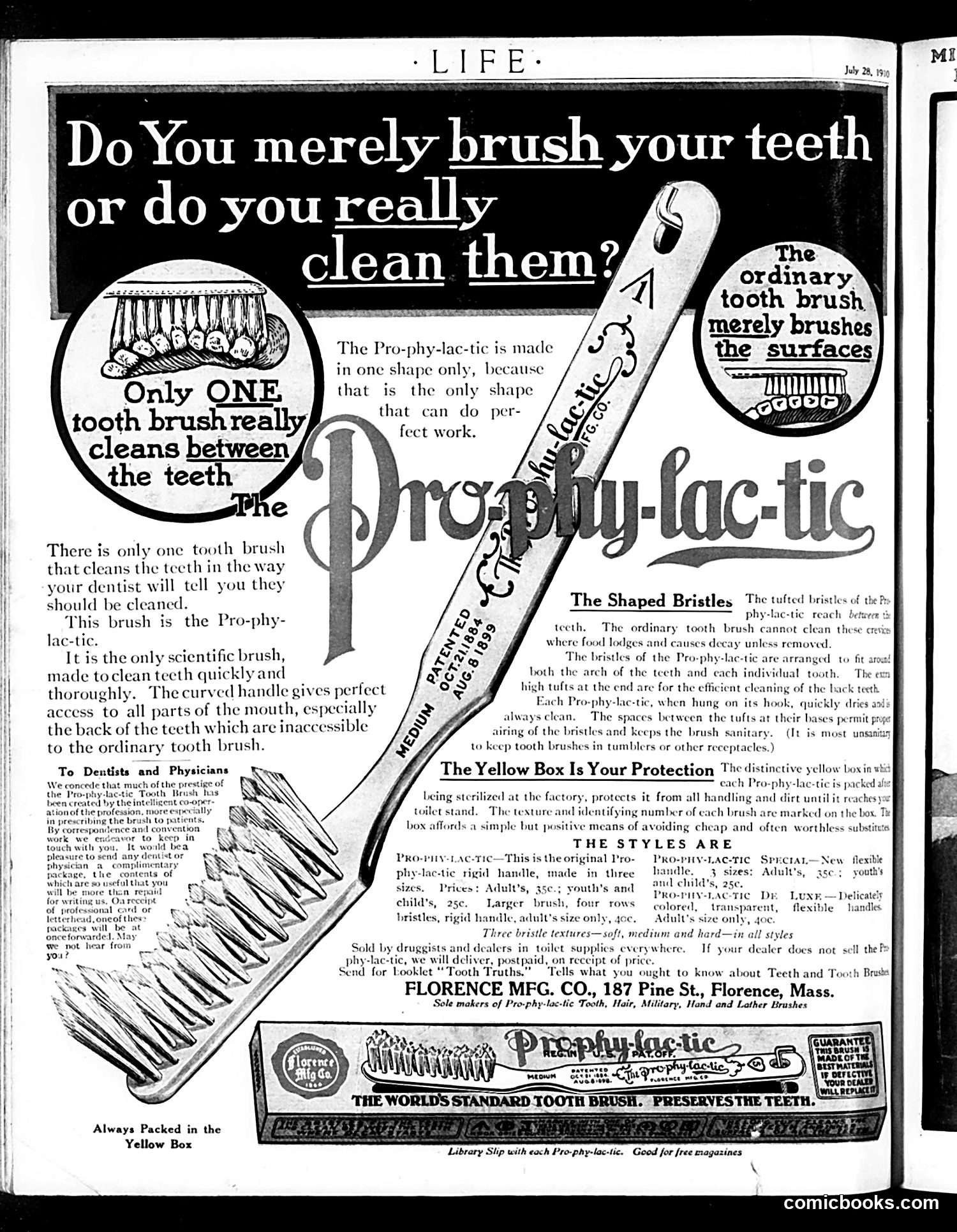
This is **not satire or political commentary**—it's a straightforward product advertisement from Life magazine (July 28, 1925), promoting the Pro-phy-lac-tic toothbrush. The page uses comparative claims common to early 20th-century advertising: it contrasts ordinary toothbrushes (which "merely brush surfaces") against the Pro-phy-lac-tic's supposedly superior design. The ad emphasizes scientific endorsement ("only scientific brush"), features like shaped bristles that reach between teeth, and a curved handle for better access. The "yellow box" mentioned repeatedly served as brand identification and sanitary protection. Appeals to dentists and physicians were standard marketing tactics meant to lend medical credibility. The format—with diagrams, testimonial-style text, and competing claims—represents typical early commercial advertising that blurred claims between cleaning effectiveness and implied health benefits. No satire is present; Life's pages mixed editorial content with such advertisements as standard practice.