
Life, 1910-07-28 · page 8 of 40
Life — July 28, 1910 — page 8: what you’re looking at
What you’re looking at
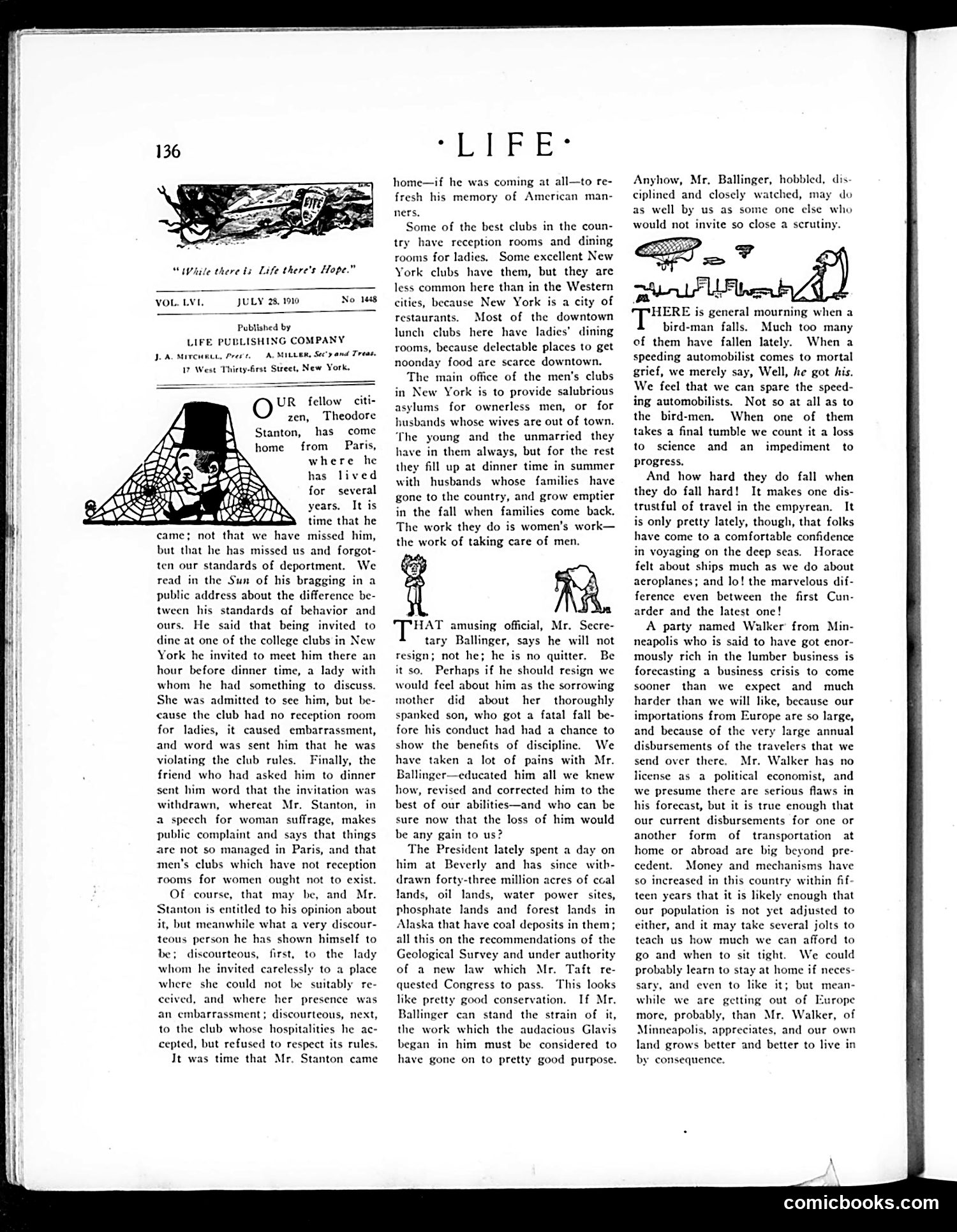
This page contains satirical commentary on social etiquette and gender dynamics in early 20th-century America. The main article discusses Mr. Ballinger (likely Albert Ballinger, a public figure of that era) and critiques how men's clubs in New York operate, particularly regarding their reception rooms for ladies. The cartoon (top left) appears to illustrate tensions around club hospitality rules and women's access to male-dominated spaces. The broader satire targets the contradiction between claims of progressive thinking and actual restrictive practices—specifically how clubs exclude women despite professing modern values. The text also mocks the pretensions of wealthy travelers, particularly a "Mr. Walker of Minneapolis," and social hypocrisy regarding urbanization and conservation issues. The piece is quintessentially *Life* magazine: using specific social situations to expose broader American class and gender contradictions.
📄 Transcribed text from this page (OCR, searchable)
Machine-transcribed from the original scan — historical spelling and the odd misread are preserved.
“While there ts Life there's Hope.” No 1438 VOL. LVL. JULY 28, 1910 Published by PUBLISHING COMPANY A. MILLER, Sec'y and Treas, LiF} Jo AL MITOHRLL, Preset, 17 West Thirty-Grst Street, New Yor fellow. citi- Theodore has come from Paris, where he has lived for several years. It is time that he came; not that we have missed him, but that he has missed us and forgot- ten our standards of deportment. We read in the Sun of his bragging in a public address about the difference be- tween his standards af behavior and ours. He said that being invited to dine at one of the college clubs in New York he invited to meet him there an hour before dinner time, a lady with whom he had something to discuss. She was admitted to see him, but be- cause the club had no reception room for ladies, it caused embarrassment, and word was sent him that he was violating the club rules. Finally, the friend who had asked him to dinner sent him word that the invitation was withdrawn, whereat Mr. Stanton, in a speech for woman suffrage, makes public complaint and says that things are not so managed in Paris, and that men's clubs which have not reception rooms for women ought not to exist. Of course, that may be, and Mr. Stanton is entitled to his opinion about. it, but meanwhile what a very discour- teous person he has shown himself to be; discourteous, first, to the lady whom he invited carelessly to a place where she could not be suitably re- ceived, and where her presence was an embarrassment; discourteous, next, to the club whose hospitalities he ac- cepted, but refused to respect its rules. Jt was time that Mr, Stanton came UR zen, Stanton, home LTE home—if he was coming at all—to re- fresh his memory of American man- ners. Some of the best clubs in the coun- try have reception rooms and dining rooms for ladies. Some excellent New York clubs have them, but they are less common here than in the Western cities, because New York is a city of restaurants. Most of the downtown lunch clubs here have ladies’ dining rooms, because delectable places to get noonday food are scarce downtown. The main office of the men’s clubs in New York is to provide salubrious asylums for ownerless men, or for husbands whose wives are out of town. The young and the unmarried they have in them always, but for the rest they fill up at dinner time in summer with husbands whose families have gone to the country, and grow emptier in the fall when families come back. The work they do is women’s work— the work of taking care of men. HAT amusing official, Mr. Secre- tary Ballinger, says he will not resign; not he; he is no quitter. Be it so. Perhaps if he should resign we would feel about him as the sorrowing mother did about her thoroughly spanked son, who got a fatal fall be- fore his conduct had had a chance to show the benefits of discipline. We have taken a lot of pains with Mr. Ballinger—educated him all we knew how, revised and corrected him to the best of our abilities—and who can be sure now that the loss of him would be any gain to us? The President lately spent a day on him at Beverly and has since with- drawn forty-three million acres of ccal lands, oil lands, water power sites, phosphate lands and forest lands in Alaska that have coal deposits in them; all this on the recommendations of the Geological Survey and under authority of a new law which Mr. Taft. re- quested Congress to pass. This looks like pretty good conservation. If Mr. Ballinger can stand the strain of it, the work which the audacious Glavis began in him must be considered to have gone on to pretty good purpose. Anyhow, Mr, Ballinger, hobbled, dis- ciplined and closely watched, may do as well by us as some one else who would not invite so close a scrutin: HERE is general mourning when a bird-man falls. Much too many of them have fallen lately. When a speeding automobilist comes to mortal grief, we merely say, Well, he got his. We feel that we can spare the speed- ing automobilists. Not so at all as to the bird-men. When one of them takes a final tumble we count it a loss to science and an impediment to progress, And how hard they do fall when they do fall hard! It makes one dis- trustful of travel in the empyrean. It is only pretty lately, though, that folks have come to a comfortable confidence in voyaging on the deep seas. Horace felt about ships much as we do about aeroplanes; and lo! the marvelous dif- ference even between the first Cun- arder and the latest one! A party named Walker from Min- neapolis who is said to have got enor- mously rich in the lumber business is forecasting a business crisis to come sooner than we expect and much harder than we will like, because our importations from Europe are so large, and because of the very large annual disbursements of the travelers that we send over there. Mr. Walker has no license as a political economist, and we presume there are serious flaws in his forecast, but it is true enough that our current disbursements for one or another form of transportation at home or abroad are big beyond pre- cedent. Money and mechanisms have so increased in this country within fif- teen years that it is likely enough that our population is not yet adjusted to cither, and it may take several jolts to teach us how much we can afford to go and when to sit tight. We could probably learn to stay at home if neces- sary, and even to like it; but mean- while we are getting out of Europe more, probably, than Mr. Walker, of Minneapolis, appreciates, and our own land grows better and better to live in by consequence. comicbooks.com