
Life, 1910-07-28 · page 26 of 40
Life — July 28, 1910 — page 26: what you’re looking at
What you’re looking at
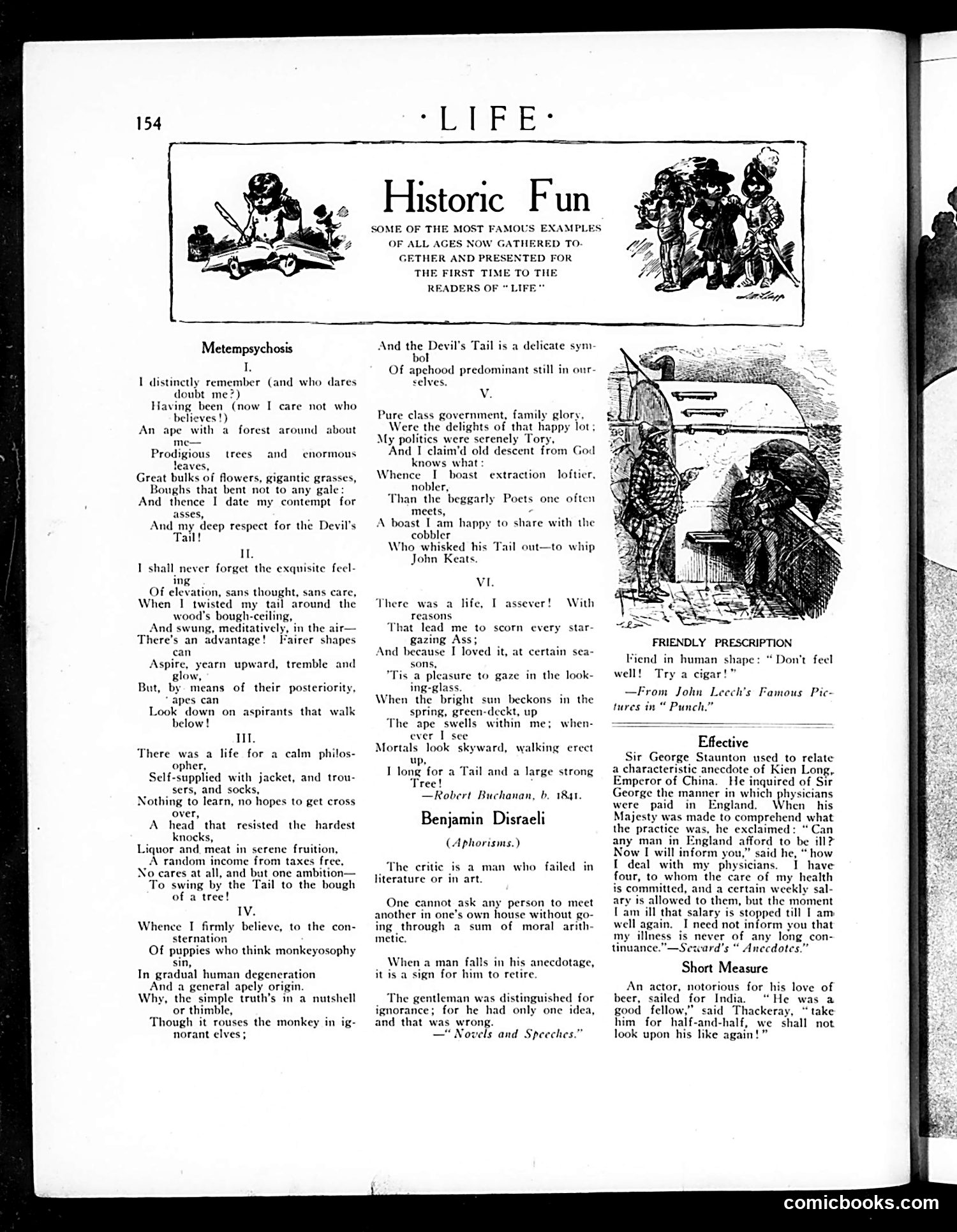
This is a miscellaneous "Historic Fun" collection page mixing poetry, aphorisms, and anecdotes—not a single cartoon. The main piece is a lengthy poem called "Metempsychosis" (reincarnation), where the speaker claims to remember being an ape and argues humans are descended from monkeys. The poem mocks pretension by having this former ape boast of aristocratic origins ("old descent from God knows what") and Tory politics—satirizing how the upper classes claim superiority while being fundamentally no better than beasts. There's a jab at Romantic poet John Keats via a reference to a cobbler who "whipped" him with his tail. The page includes aphorisms attributed to Benjamin Disraeli (Victorian Prime Minister) and a "Friendly Prescription" cartoon from *Punch* showing someone recommending cigars as medicine. Overall, the page satirizes class pretension, evolutionary theory debates popular in Victorian England, and the absurdity of human vanity—suggesting we're merely evolved apes despite our civilized pretenses.
📄 Transcribed text from this page (OCR, searchable)
Machine-transcribed from the original scan — historical spelling and the odd misread are preserved.
Metempsychosis I. 1 distinctly remember (and who dares doubt me?) Having been (now I care not who believes!) An ape with a forest around about me Prodigious leaves, Great bulks of flowers, gigantic grasses, Boughs that bent not to any gale: And thence I date my contempt for asses, And my deep respect for the Devil's Tail! trees and enormous II. I shall never forget the exquisite feel- ing Of elevation, sans thought, sans care, When I twisted my tail around the wood’s bough-ceiling, And swung, meditatively, in the air— There’s an advantage! Fairer shapes can Aspire, yearn upward, tremble and glow, But, by means of their posteriority, apes can Look down on aspirants that walk below! ll. There was a life for a calm philos- opher, Self-supplied with jac! sers, and socks, Nothing to learn, no hopes to get cross over, A head _ that knocks, Liquor and. meat in serene fruition, A random income from taxes free, No cares at all, and but one ambition— To swing by the Tail to the bough of a tree! IV. Whence I firmly believe, to the con- sternation Of puppies who think monkeyosophy sin, In gradual human degeneration And a general apely origin. Why, the simple truth’s in a nutshell or thimble, Though it rouses the monkey in ig- norant elves; and trou- resisted the hardest Historic Fun SOME OF THE MOST FAMOUS EXAMPLES OF ALL A OW GATHERED TO- GETHER AND PRESENTED FOR THE FIRST TIME TO THE READERS OF “LIF And the Devil's Tail is a delicate sym. bol Of apchood predominant still in our- selves, , Pure class government, family glory, Were the delights of that happy lot; My politics were serenely Tory, And I claim’d old descent from God knows what : Whence I boast nobler, Than the beggarly Poets one often meets, - A boast I am happy to share with the cobbler Who whisked his Tail out—to whip John Keats. extraction loftier, Vi There was a life, I assever! With reasons ‘That lead me to scorn every star- gazing Ass; And because I loved it, at certain sea- sons, ‘Tis a pleasure to gaze in the look- ing-glass. When the bright sun beckons in the spring, green-deckt, up ape swells within me; ever I see Mortals look skyward, walking erect up, I long for a Tail and a large strong Tree! —Robert Buchanan, b. The when- Rar. Benjamin Disraeli Aphorisms.) The critic is a man who failed in literature or in art. One cannot ask any person to meet another in one’s own house without go- ing through a sum of moral arith- metic. When a man falls in his anecdotage, it is a sign for him to retire. The gentleman was distinguished for ignorance; for he had only one idea, and that was wrong. Novels and Speeches.” FRIENDLY PRESCRIPTION Fiend in human sh “Don't feel well! Try a cigar!” ‘om John Leech’s Famous Pic- tures in“ Punch.” Effective Sir George Staunton used to relate a characteristic anecdote of Kien Long, Empcror of China. He inquired of Sir George the manner in which physicians paid in gland. When his sty was made to comprehend what practice was, he exclaimed: “Can any man in England afford to be ill? Now I will inform you,” said he, “how { deal with my physicians. I have four, to whom the care of my health is committed, and a certain weekly sal- 's allowed to them, but the moment {am ill that salary is stopped till | am well again. I need not inform you that my illness is never of any long con- tinuance."”—Seward’s “ Anecdotes.” Short Measure An actor, notorious for his love of beer, sailed for India. “He was a good fellow,” said Thackeray, “take him for half-and-half, we shall not look upon his like again!” comicbooks.com