
Life, 1910-07-28 · page 13 of 40
Life — July 28, 1910 — page 13: what you’re looking at
What you’re looking at
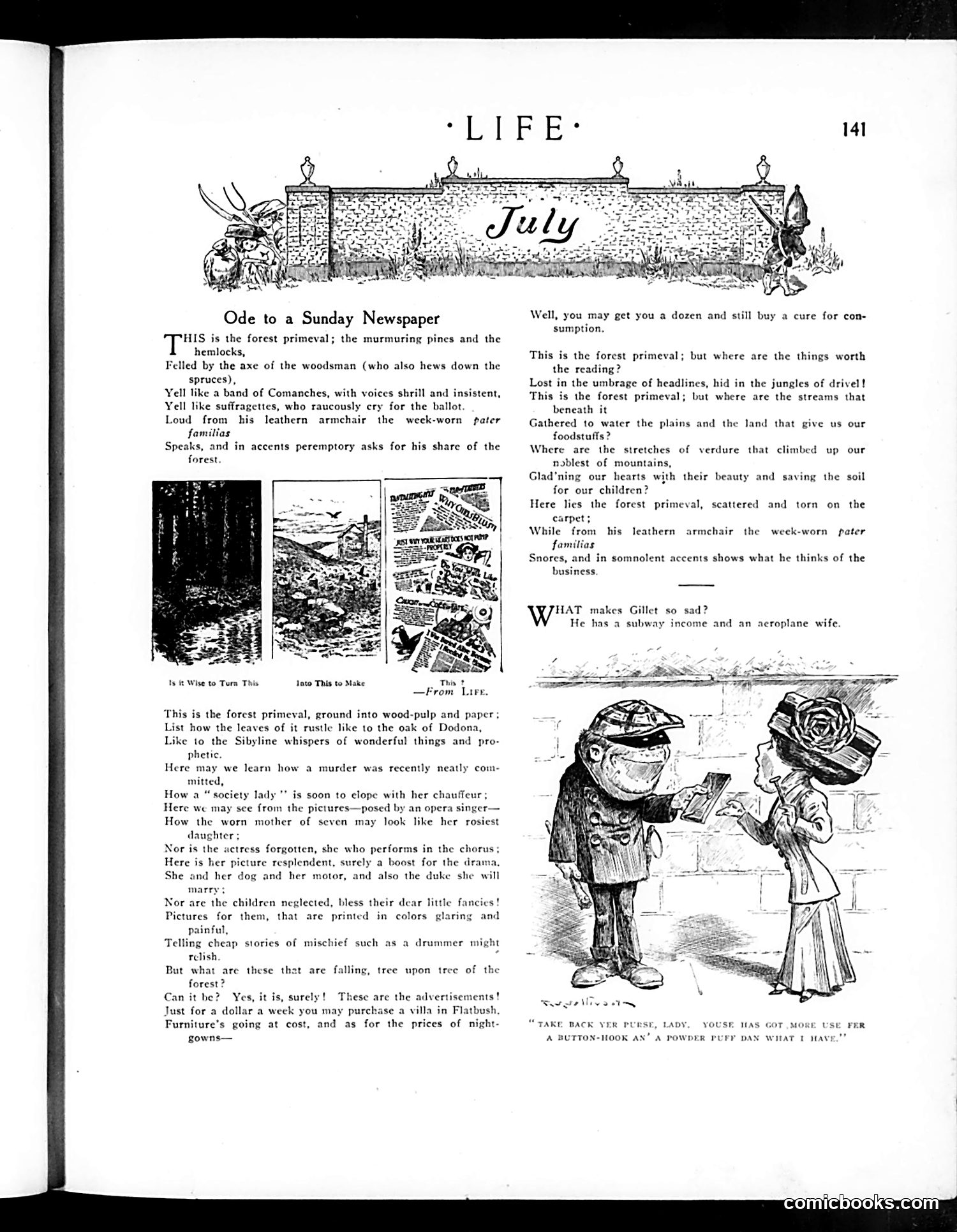
This page contains "Ode to a Sunday Newspaper," a satirical poem criticizing newspapers as repositories of sensationalism rather than substantive journalism. The poem mocks headlines about murders, elopements, opera singers, and neglected children—cheap human-interest stories sold to readers seeking scandal rather than meaningful content. The accompanying illustrations show three woodcut scenes labeled "Is Wise to Turn This / Into This to Make / From Life," depicting forest destruction transformed into newspapers and advertisements. Below, a separate cartoon depicts two figures discussing a purse, with one saying the other has "more use fer a button-hook an' a powder puff." The satire targets both newspaper sensationalism and, possibly, consumer culture advertising practices of the era.
📄 Transcribed text from this page (OCR, searchable)
Machine-transcribed from the original scan — historical spelling and the odd misread are preserved.
Ode to a Sunday Newspaper HIS is the forest primeval; the murmuring pines and the hemlocks, led by the axe of the woodsman (who also hews down the spruces), Yell like a band of Comanches, with voices shrill and insistent, Yell like suffragettes, who raucously ery for the ballot Loud from his leathern armchair the week-worn pater familias Speaks, and in accents peremptory asks for his share of the forest Is ft Wise to Turn This Into This to Make Thi t —From Lire. This is the forest primeval, ground into wood-pulp and paper; List how the leaves of it rustle like to the oak of Dodona, Like to the Sibyline whispers of wonderful things and pro- phetic. Here may we learn how a murder was recently neatly com- mitted, How a “society lady "’ is soon to elope with her chauffeur; Here we may see from the pictures—posed by an opera singer— How the worn mother of seven may look like her rosiest daughter ; Nor is the uctress forgotten, she who performs in the chorus; Here is her picture resplendent, surely a boost for the drama, She and her dog and her motor, and also the duke she will marry: Nor are the children neglected, bless their dear little fancies! Pictures for them, that are printed in colors glaring and painful, Telling cheap stories of mischief such as a drummer might relish . But what are these that are falling, tree upon tree of the forest? Can it be? Yes, it is, surely! These are the advertisements! Just for a dollar a week you may purchase a villa in Flatbush. Furniture’s going at cost, and as for the prices of night- gowns— Well, you may get you a dozen and still buy a cure for con- sumption. This is the forest primeval; but where are the things worth the reading? Lost in the umbrage of headlines, hid in the jungles of drivel! This is the forest primeval; but where are the streams that beneath it Gathered to water the plains and the land that give us our foodstuffs? Where are the stretches of verdure that climbed up our noblest of mountains, Glad’ning our hearts with their beauty and saving the soil for our children? Here lies the forest primeval, scattered and torn on the carpet; While from his leathern armchair the week-worn pater familias Snores, and in somnolent accents shows what he thinks of the business. HAT makes Gillet so sad? He has a subway income and an aeroplane wife “TAKE BACK VER Pt A BUTTON-HOOK AN’ A POWDER PUFF DAN WHAT I MAVE.” SE, LADY, YOUSK IAS GOT MORE USE FER