
Life, 1910-07-28 · page 16 of 40
Life — July 28, 1910 — page 16: what you’re looking at
What you’re looking at
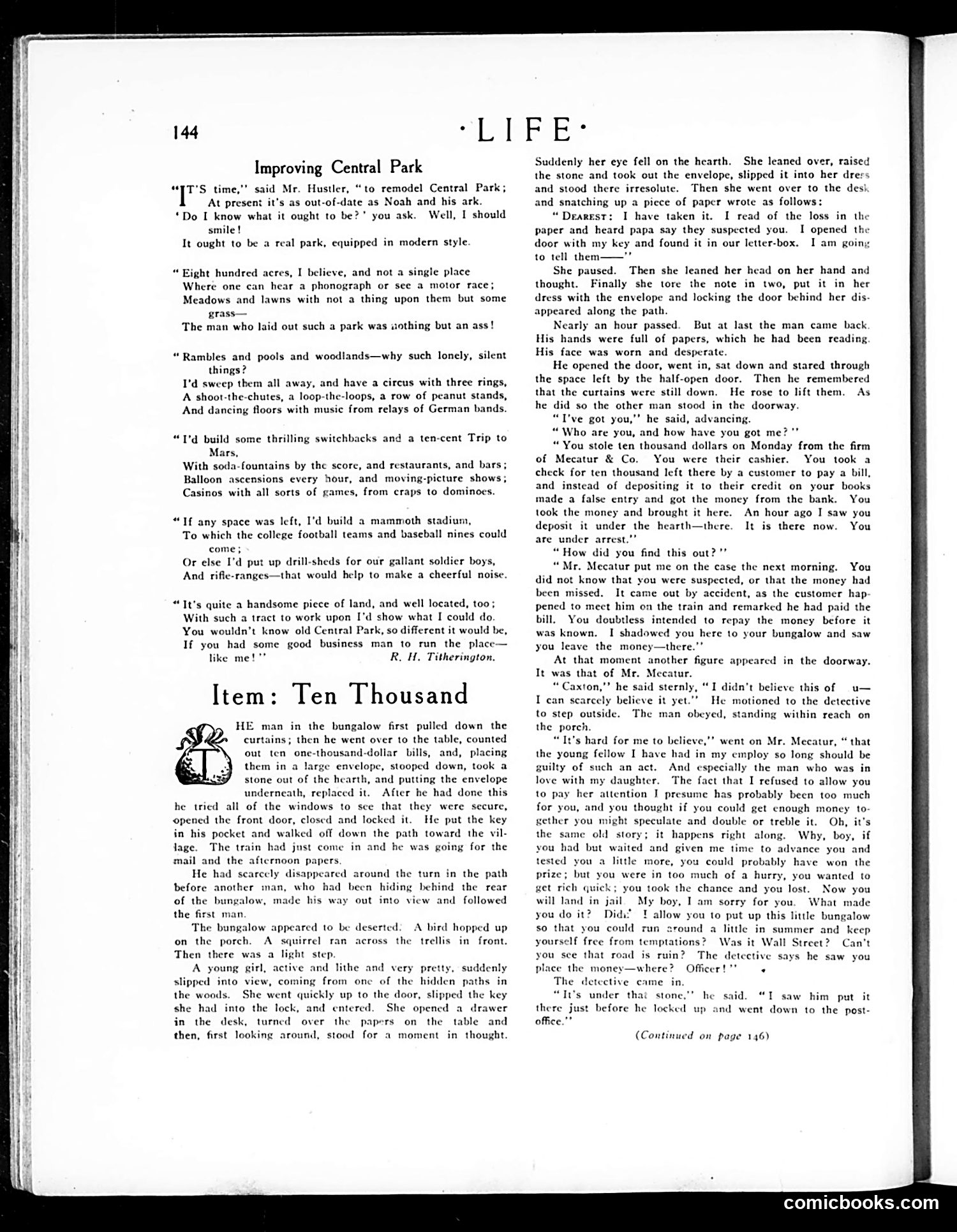
This Life magazine page (p. 144) contains two distinct pieces of satire: **"Improving Central Park"** mocks a type of businessman-reformer who wanted to commercialize and "modernize" New York's Central Park. The character "Mr. Hustler" proposes replacing its naturalistic design with amusement park attractions—phonographs, motor races, circuses, casinos, drill-sheds—treating it as real estate for profit rather than public green space. The satire targets the early-20th-century mindset that viewed parks as outdated and "efficiency" as requiring commercialization. **"Item: Ten Thousand"** is a short dramatic story about a young woman who discovers $10,000 hidden in a bungalow hearth. The setup suggests moral complexity: she knows her father is suspected of theft. The narrative leaves her choice ambiguous—whether she'll return or keep the money—creating tension around honor, loyalty, and desperation during what appears to be an economically uncertain period. Both pieces reflect Progressive-era anxieties about modernization, commercialism, and moral integrity.
📄 Transcribed text from this page (OCR, searchable)
Machine-transcribed from the original scan — historical spelling and the odd misread are preserved.
144 -LIFE: Improving Central Park “IT'S time," said Mr. Hustler, “to remodel Central Park; At present it’s as out-of-date as Noah and his ark. ‘Do I know what it ought to be?” you ask. Well, I should smile! It ought to be a real park, equipped in modern style. “ Eight hundred acres, I believe, and not a single place Where one can hear a phonograph or see a motor race; Meadows and lawns with not a thing upon them but some grass— The man who laid out such a park was uothing but an ass! “Rambles and pools and woodlands—why such lonely, silent things? I'd sweep them all away, and have a circus with three rings, A shoot-the-chutes, a loop-the-loops, a row of peanut stands, And dancing floors with music from relays of German bands. “I'd build some thrilling switchbacks and a ten-cent Trip to Mars, With soda-fountains by the score, and restaurants, and bars ; Balloon ascensions every hour, and moving-picture shows; Casinos with all sorts of games, from craps to dominoes. “If any space was left, I'd build a mammoth stadium, To which the college football teams and baseball nines could come; Or else I'd put up drill-sheds for our gallant soldier boys, And rifle-ranges—that would help to make a cheerful noise. “It's quite a handsome picce of land, and well located, too; With such a tract to work upon I’d show what I could do. You wouldn’t know old Central Park, so different it would be, If you had some good business man to run the place— like me!"’ R. H, Titherington, Item: Ten Thousand HE man in the bungalow first pulled down the curtains; then he went over to the table, counted out ten one-thousand-doliar bills, and, placing them in a large envelope, stooped down, took a stone out of the hearth, and putting the envelope underneath, replaced it, After he had done this he tried all of the windows to sce that they were secure, opened the front door, closed and locked it. He put the key in his pocket and walked off down the path toward the vil- lage. The train had just come in and he was going for the mail and the afternoon papers. He had scarcely disappeared around the turn in the path before another man, who had been hiding behind the rear of the bungalow, made his way out into view and followed the first man. The bungalow appeared to be deserted. A bird hopped up on the porch. A squirrel ran across the trellis in front. Then there was a light step. A young girl, active and lithe and very pretty, suddenly slipped into view, coming from one of the hidden paths in the woods. She went quickly up to the door, slipped the key she had into the lock, and entered. She opened a drawer in the desk, turned over the papers on the table and then, first looking around, stood for a moment in thought. Suddenly her eye fell on the hearth, She leaned over, raised the stone and took out the envelope, slipped it into her dress and stood there irresolute. Then she went over to the desi and snatching up a piece of paper wrote as follow: Dearest: I have taken it. I read of the loss in the paper and heard papa say they suspected you. I opened the door with my key and found it in our letter-box. I am goiny to tell them: She paused. Then she leaned her head on her hand and thought. Finally she tore the note in two, put it in her dress with the envelope and locking the door behind her dis- appeared along the path. Nearly an hour passed. But at last the man came back His hands were full of papers, which he had been reading His face was worn and desperate. He opened the door, went in, sat down and stared through the space left by the half-open door. Then he remembered that the curtains were still down. He rose to lift them, As he did so the other man stood in the doorway. “T've got you," he said, advancing. “Who are you, and how have you got m “You stole ten thousand dollars on Monday from the firm of Mecatur & Co. You were their cashier. You took a check for ten thousand left there by a customer to pay a bill, and instead of depositing it to their credit on your books made a false entry and got the money from the bank. You took the money and brought it here. An hour ago I saw you deposit it under the hearth—there. It is there now. You are under arrest.’" “How did you find this out? ’’ “Mr. Mecatur put me on the case the next morning. You did not know that you were suspected, or that the money had been missed. It came out by accident, as the customer hap. pened to mect him on the train and remarked he had paid the bill, You doubtless intended to repay the moncy before it was known. I shadowed you here to your bungalow and saw you leave the money—there.”” At that moment another figure appeared in the doorway. Tt was that of Mr. Mecatur. “ Caxton,"’ he said sternly, “I didn't believe this of — wu. T can scarcely believe it yet He motioned to the detective to step outside. The man obeyed, standing within reach on the porch. “It's hard for me to believe,” went on Mr. Mecatur, “ that the young fellow I have had in my employ so long should be guilty of such an act. And especially the man who was in love with my daughter. he fact that I refused to allow you to pay her attention I presume has probably been too much for you, and you thought you could get enough money to- gether you might speculate and double or treble it. Ob, it’s the same old story; it happens right along. Why, boy, if you had but waited and given me time to advance you and tested you a little more, you could probably have won the prize; but you were in too much of a hurry, you wanted to get rich q uu took the chance and you lost. Now you will land in jai My boy, I am sorry for you. What made you do it? Dids? ! allow you to put up this little bungalow so that you could run sround a little in summer and keep yourself free from temptations? Was it Wall Street? Can't you sce that road is ruin? The detective says he saw you place the money—where? Officer!” « . The detective came in. “It's under that stone,’ he said. “1 saw him put it there just before he locked up and went down to the post- office.” (Continued on page 146) comicbooks.com