
Life, 1910-07-28 · page 22 of 40
Life — July 28, 1910 — page 22: what you’re looking at
What you’re looking at
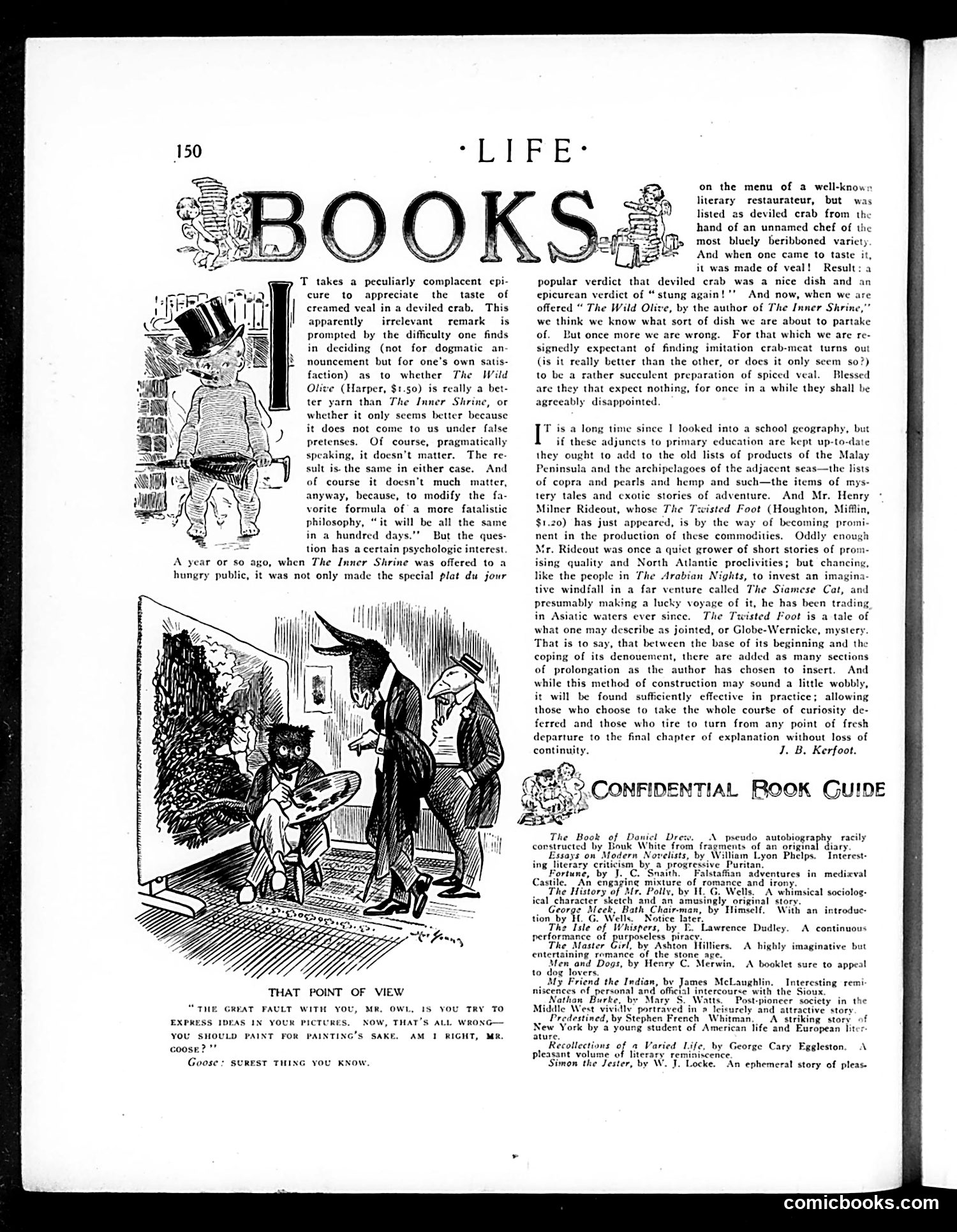
This page contains a satirical cartoon and book reviews. The cartoon depicts an owl and goose in conversation about art. A pretentious human critic (likely representing academic art establishment) lectures the owl that painting should focus on aesthetics ("painting's sake") rather than expressing ideas through pictures. The goose agrees obsequiously. The satire mocks art-world dogmatism—the critic's rigid theory that art shouldn't communicate meaning, treating it as mere formalism divorced from purpose or message. The book reviews discuss literary works, with particular focus on *The Twisted Foot* by Henry Milner Rideout. The text humorously compares reading experiences to tasting dishes mislabeled at a restaurant: readers expect one type of story but receive another, though sometimes pleasantly. The reviews suggest early 20th-century literary tastes favored exotic adventure tales set in Asia.
📄 Transcribed text from this page (OCR, searchable)
Machine-transcribed from the original scan — historical spelling and the odd misread are preserved.
T takes a peculiarly complacent epi- cure to appreciate the taste of creamed veal in a deviled crab. This apparently irrelevant remark is prompted by the difficulty one finds in deciding (not for dogmatic an- nouncement but for one’s own satis- faction) as to whether The Wild Olive (Harper, $1.50) is really a bet- ter yarn than The Inner Shrine, or whether it only seems better because it does not come to us under false pretenses. Of course, pragmatically speaking, it doesn’t matter. The re- sult is. the same in either case. And of course it doesn’t much matter, anyway, because, to modify the vorite formula of a more fatalistic philosophy, “it will be all the same in a hundred days."’ But the ques- tion has a certain psychologic interest ‘i THAT POINT OF VIEW “THE GREAT FAULT WITIT YOU, MR. OWL, 1S YoU TRY TO EXPRESS IDEAS IN YOUR PICTURES. NOW, THAT'S ALL WRoNG— YOU SHOULD PAINT FOR PAINTING’S SAKE. AM 1 RIGHT, MR. coose?"" Goose: SUREST THING YoU KNOW. on the menu of a well-knows literary restaurateur, but was listed as deviled crab from the hand of an unnamed chef of most bluely beribboned varie And when one came to taste it, it was made of veal! Result: a popular verdict that deviled crab was a nice dish and epicurean verdict of “stung again! "’ And now, when we offered “ The Wild Olive, by the author of The Inner Shrine we think we know what sort of dish we are about to partake of. But once more we are wrong. For that which we are re- signedly expectant of finding imitation crab-meat turns out (is it really better than the other, or docs it only seem so?) to be a rather succulent preparation of spiced veal. Blessed are they that expect nothing, for once in a while they shall be agreeably disappointed. T is a long time since I looked into a school geograph; if these adjuncts to primary education are kept up-to- they ought to add to the old lists of products of the Malay Peninsula and the archipclagoes of the adjacent seas—the lists of copra and pearls and hemp and such—the items of mys- tery tales and cxotic stories of adventure. And Mr. Henry Milner Rideout, whose The Twisted Foot (Houghton, Miffiin, $1.20) has just appeared, is by the way of becoming promi- nent in the production of these commodities. Oddly eno; Mr. Ridcout was once a quict grower of short stories of prom- ising quality and North Atlantic proclivities; but chancing, like the people in The Arabian Nights, to invest an imagina- tive windfall in a far venture called The Siamese Cat, and presumably making a lucky voyage of it, he has been trading in Asiatic waters ever since. The Twisted Foot is a tale of describe as jointed, or Globe-Wernicke, mystery. y, that between the base of its beginning and the coping of its denouement, there are added as many sections as the author has chosen to insert. And it will be found sufficiently effective in practice; allowing those who choose to take the whole course of curiosity de- ferred and those who tire to turn from any point of fresh departure to the final chapter of explanation without loss of continuity. J. B. Kerfoot. 3. CONFIDENTIAL Rook Gu!DE The Book of Donict Drew. A pseudo autobiography racily constructed by Bouk White from fragments of an original diary Essays on Modern Novelists, by William Lyon Phelps. Interest- ing literary criticism by a progressive Puritan. Fortune, by J.C. Snaith. Falstafian adventures in medixval Castile. An engaging mixture of romance and irony. "The History of Mr. Polly, by H. G. Wells. A whimsical sociolog- ical character ‘sketch and an amusingly original story. George Meek, Bath Chairman, by Himself, With an introduc: tion by Hl. G. Wells. Notice later, The Isle of Whispers, by ¥.. Lawrence Dudley. performance of purposeless piracy, The Master Girl, by Ashton Mlilliers. A highly imaginative but entertaining romance of the stone age. Men and Dogs, by Henry C. Merwin, A booklet sure to appe. to dog lovers My Friend the Indian, by James McLaughlin. Interesting remi niscences of personal and’ official intercourse with the Sioux Nathan Burke, by Mary S$. Watts. Post-pioneer society in the Middle West vividly portraved in 9 leisurely and attractive story Predestined, by Stephen French Whitman. A striking story of New York by a young student of American life and European lite ature. Recollections of a Varied Life, by George Cary Eggleston. .\ pleasant volume of literary. reminiscence. Simon the Jester, by W. J. Locke. An ephemeral story of pleas: A continuous comicbooks.com