
Life, 1910-07-28 · page 14 of 40
Life — July 28, 1910 — page 14: what you’re looking at
What you’re looking at
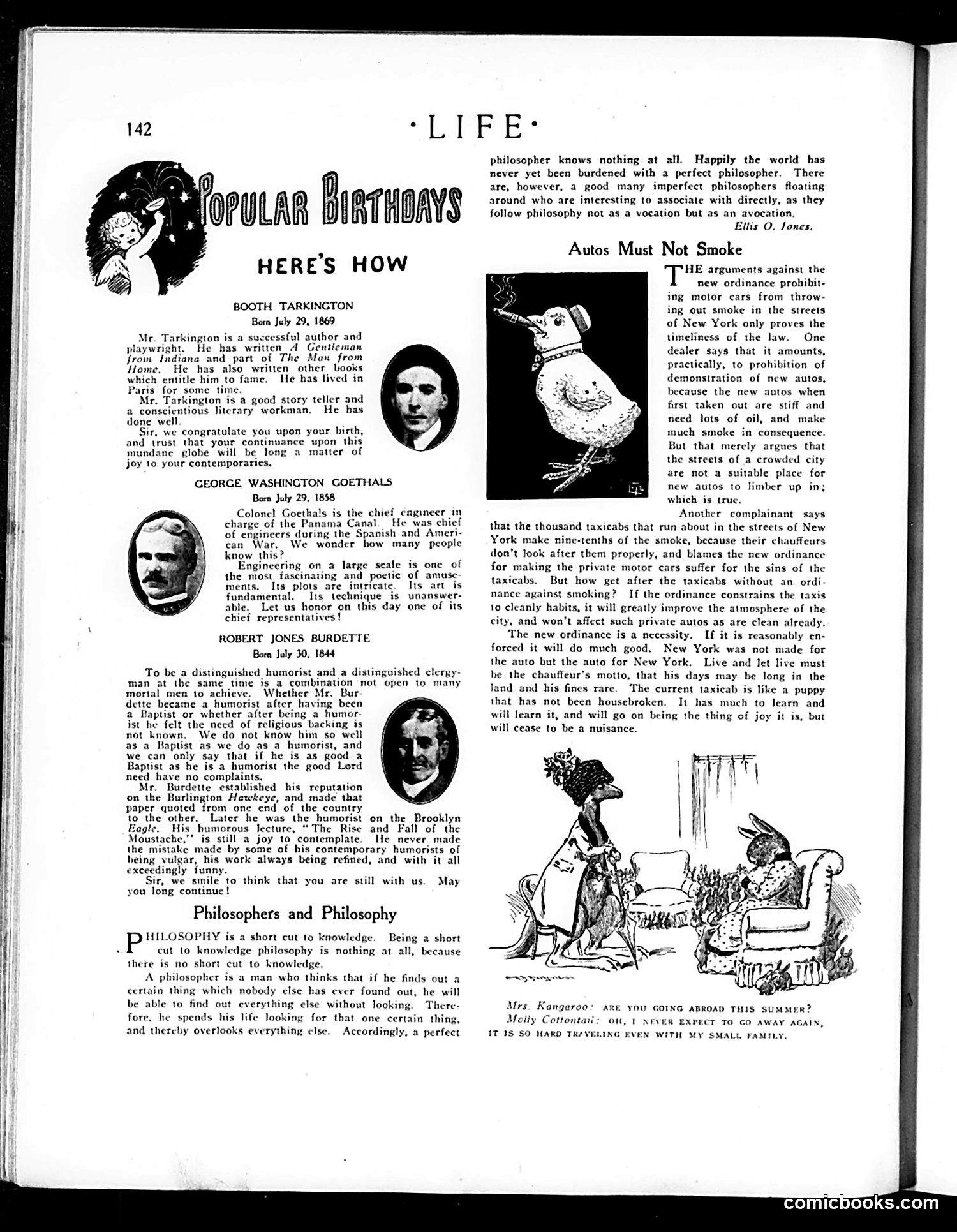
This page celebrates three notable Americans sharing July birthdays: **Booth Tarkington** (author/playwright), **George Washington Goethals** (Panama Canal chief engineer), and **Robert Jones Burdette** (humorist and Baptist clergyman). Life's satirical "Here's How" section offers mock-formal birthday congratulations to these public figures. The page also includes a philosophical essay mocking abstract philosophy as useless—a philosopher seeks one unknowable truth while ignoring everything else, thus "knows nothing at all." A secondary article critiques New York's new anti-smoking ordinance for automobiles. Dealers complain new cars naturally smoke when warming up; taxi operators blame chauffeurs' negligence. The piece sardonically supports the law, arguing crowded city streets aren't appropriate places for vehicles to "limber up." A cartoon (bottom right) depicts travelers debating summer vacation difficulties, illustrating contemporary leisure-travel concerns.
📄 Transcribed text from this page (OCR, searchable)
Machine-transcribed from the original scan — historical spelling and the odd misread are preserved.
“LR E* vputae BiarHaays HERE'S HOW BOOTH TARKINGTON Born July 29, 1869 Mr. Tarkington is a successful author and playwright. He has written 4 Gentleman from Indiana and part of The Man from Home. He has also written other books which entitle him to fame. He has lived in Paris for some tim Mr. Tarkington is a good story teller and a conscientious literary workman, He has done well ; Sir, we congratulate you upon your birth, and trust that your continuance upon this mundane globe will be long a matter of joy to your contemporaries, GEORGE WASHINGTON GOETHALS Born July 29, 1858 Colone} Goethals is the chief Engineer in charge of the Panama Canal. He was chief of engineers during the Spanish and Ameri- can War. We wonder how many people know th Engineering on a large scale is one of the most fascinating and poetic of amuse- ments. Its plots are intricate. Its art is fundamental. Its technique is unanswer- able. Let us honor on this day one of its chief representatives! ROBERT JONES BURDETTE Born July 30, 1844 To be a distinguished humorist and a distinguished clergy- man at the same time is a combination not open to many mortal men to achieve. Whether Mr. Bur- dette became a humorist after having been a Baptist or whether after being a humor- ist he felt the need of religious backing is not known. We do not know him so well as a Baptist as we do as a humorist, and we can only say that if he is as good a Baptist as he is a humorist the good Lord need have no complaints, Mr. Burdette established his reputation on the Burlington Hawkeye, and made that paper quoted from one end of the country to the other. Later he was the humorist on the Brooklyn Eagle. humorous lecture, “ The Rise and Fall of the Moustachi is still a joy to contemplate. He never made the mistake made by some of his contemporary humorists of being vulgar, his work always being refined, and with it all exceedingly funny. Sir, we smile to think that you are still with us. May you long continue! Philosophers and Philosophy HILOSOPHY is a short cut to knowledge. Being a short cut to knowledge philosophy is nothing at all, because there is no short cut to knowledge. A philosopher is a man who thinks that if he finds o certain thing which nobody clse has ever found out, he will be able to find out everything else without looking. There fore, he spends his life looking for that one certain thing, and thereby overlooks everything clse. Accordingly, a perfect Ej philosopher knows nothing at all. Happily the world has never yet been burdened with a perfect philosopher. There are, however, a good many imperfect philosophers floating around who are interesting to associate with directly, as they follow philosophy not as a vocation but as an avocation. Elis O. Jones. Autos Must Not Smoke HE arguments against the new ordinance prohibit- ing motor cars from throw- ing out smoke in the streets of New York only proves the timeliness of the law. One dealer says that it amounts, practically, to prohibition of demonstration of new autos, because the new autos when first taken out are stiff and need lots of oil, and make much smoke in consequence. But that mercly argues that the streets of a crowded city are not a suitable place for new autos to limber up in; which is true. Another complainant says that the thousand taxicabs that run about in the streets of New York make nine-tenths of the smoke, because their chauffeurs don’t look after them properly, and blames the new ordinance for making the private motor cars suffer for the sins of the taxicabs, But how get after the taxicabs without an ordi- nance inst smoking? If the ordinance constrains the taxis to cleanly habits, it will greatly improve the atmosphere of the city, and won't affect such private autos as are clean already. The new ordinance is a necessity. If it is reasonably en- forced it will do much good. New York was not made for the auto but the auto for New York. Live and Ict live must be the chauffeur’s motto, that his days may be long in the land and his fines rare. The current taxicab is like a puppy that has not been housebroken. It has much to learn and will learn it, and will go on being the thing of joy it is, but will cease to be a nuisance. mean Mrs. Kangaroo: ant. you GOING ABROAD THIS SUMMER? Molly Cottontaii: om, | NVER EXPECT TO GO AWAY AGal IT 15 SO HARD TREVELING EVEN WITH MY SMALL FAMILY. comicbooks.com