
A complete issue · 44 pages · 1910
Life — June 16, 1910
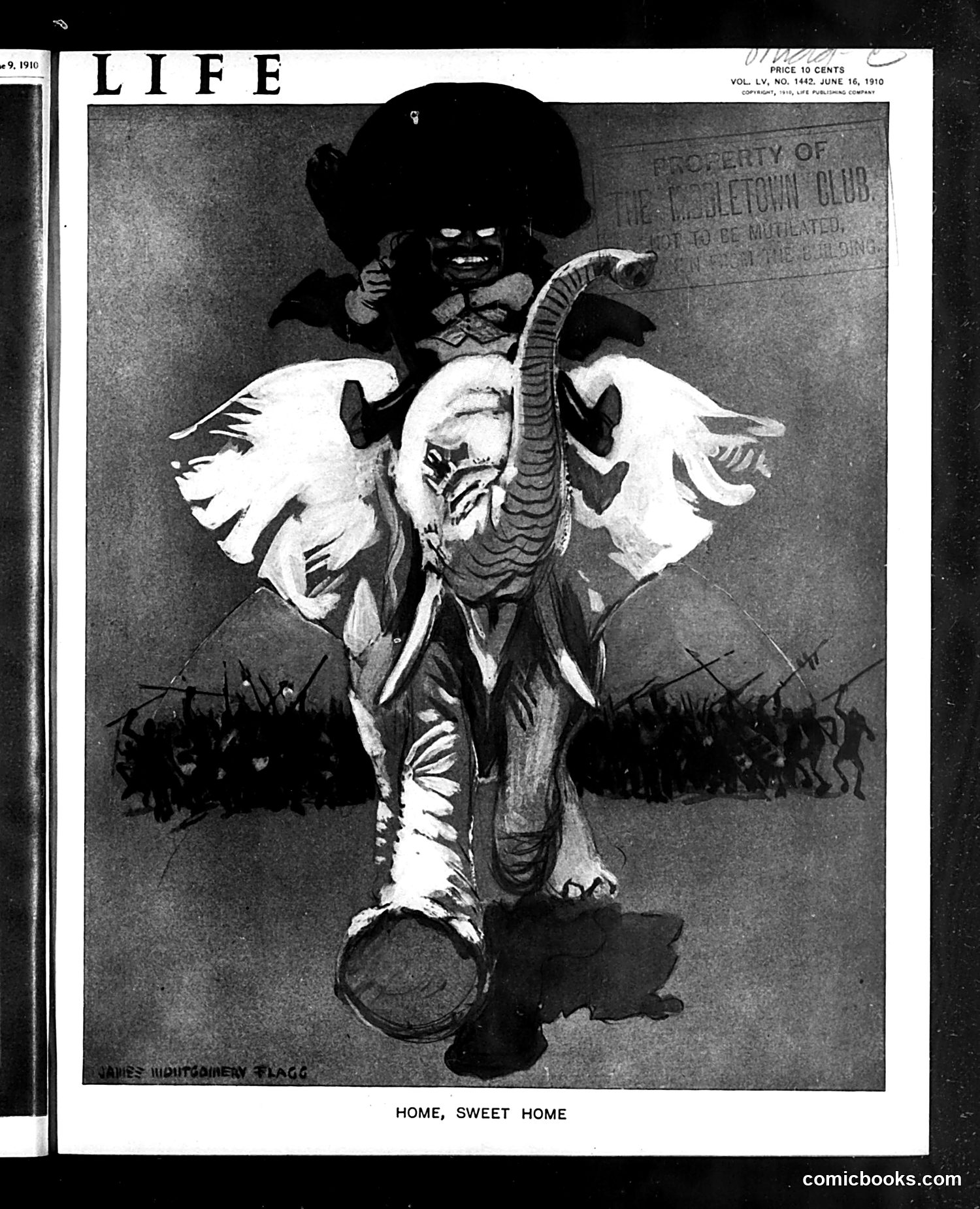
This satirical cartoon by James Montgomery Flagg depicts an elephant carrying a small dark figure (likely representing a Republican or conservative politician) on its back, surrounded by soldiers or a crowd below. The elephant, a traditional Republican symbol, appears burdened or troubled. The caption "Home, Sweet Home" suggests ironic commentary on returning to domestic politics after military or international conflict. Given the 1916 date, this likely references debates over American military intervention or preparedness during World War I, or internal political tensions about America's role abroad versus domestic concerns. The small figure riding the elephant may represent a political leader being carried by party machinery, commenting on how politicians are supported or controlled by their party apparatus while addressing national crises.
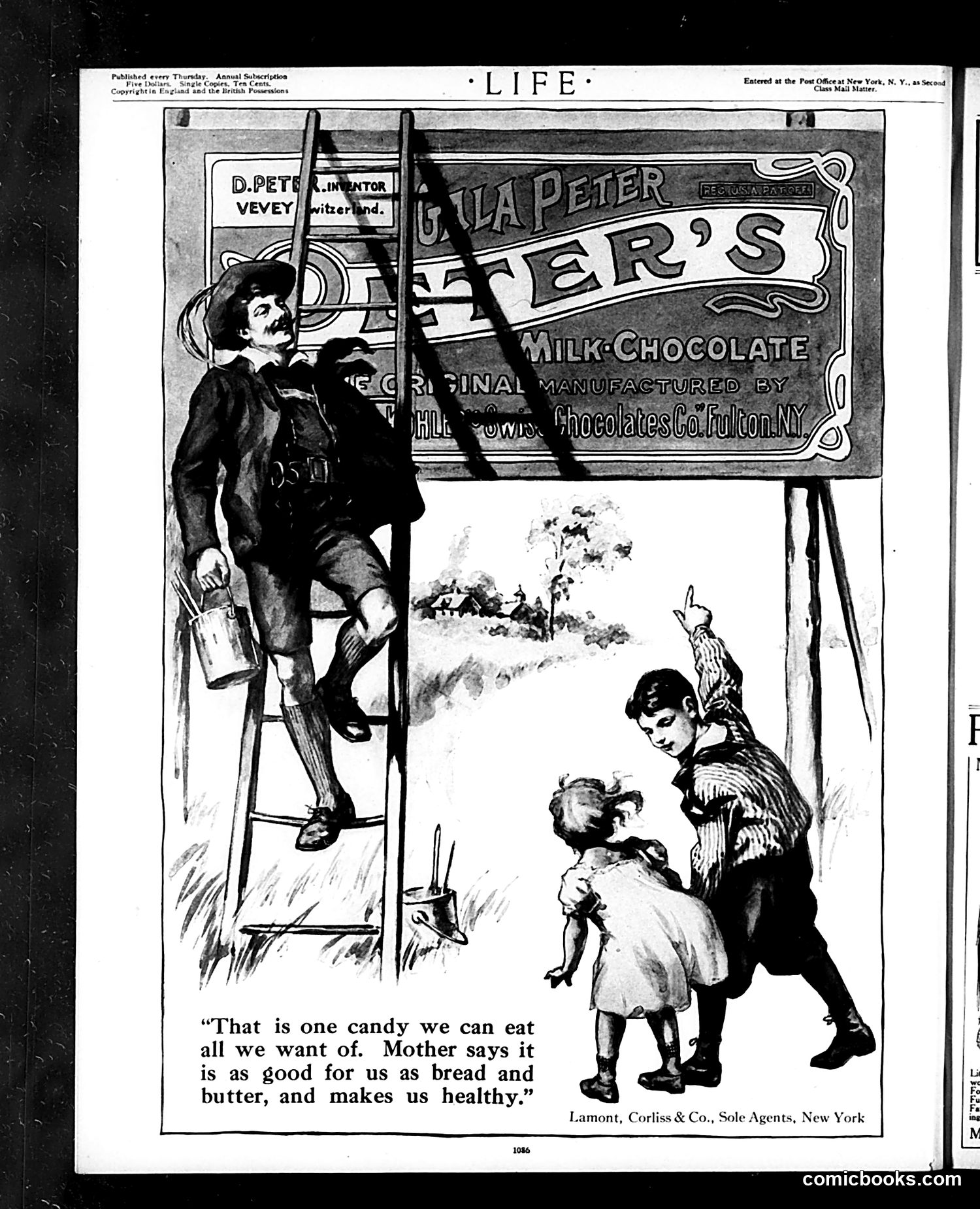
This page is primarily **an advertisement** for **D. Peter's Milk Chocolate**, manufactured by Lamont, Corliss & Co. in Fulton, New York. The ad depicts two children pointing upward at a man on a ladder posting the chocolate advertisement. The accompanying quote—"That is one candy we can eat all we want of. Mother says it is as good for us as bread and butter, and makes us healthy"—represents a **health claim** common to early 20th-century advertising. This reflects the **marketing strategy of the era**, when manufacturers made exaggerated nutritional claims about candy and chocolate to appeal to parents' concerns about children's wellbeing. The satire likely resides in *Life* magazine's implicit mockery of such dubious health assertions—the notion that chocolate was genuinely as wholesome as staple foods would have struck contemporary readers as absurd.
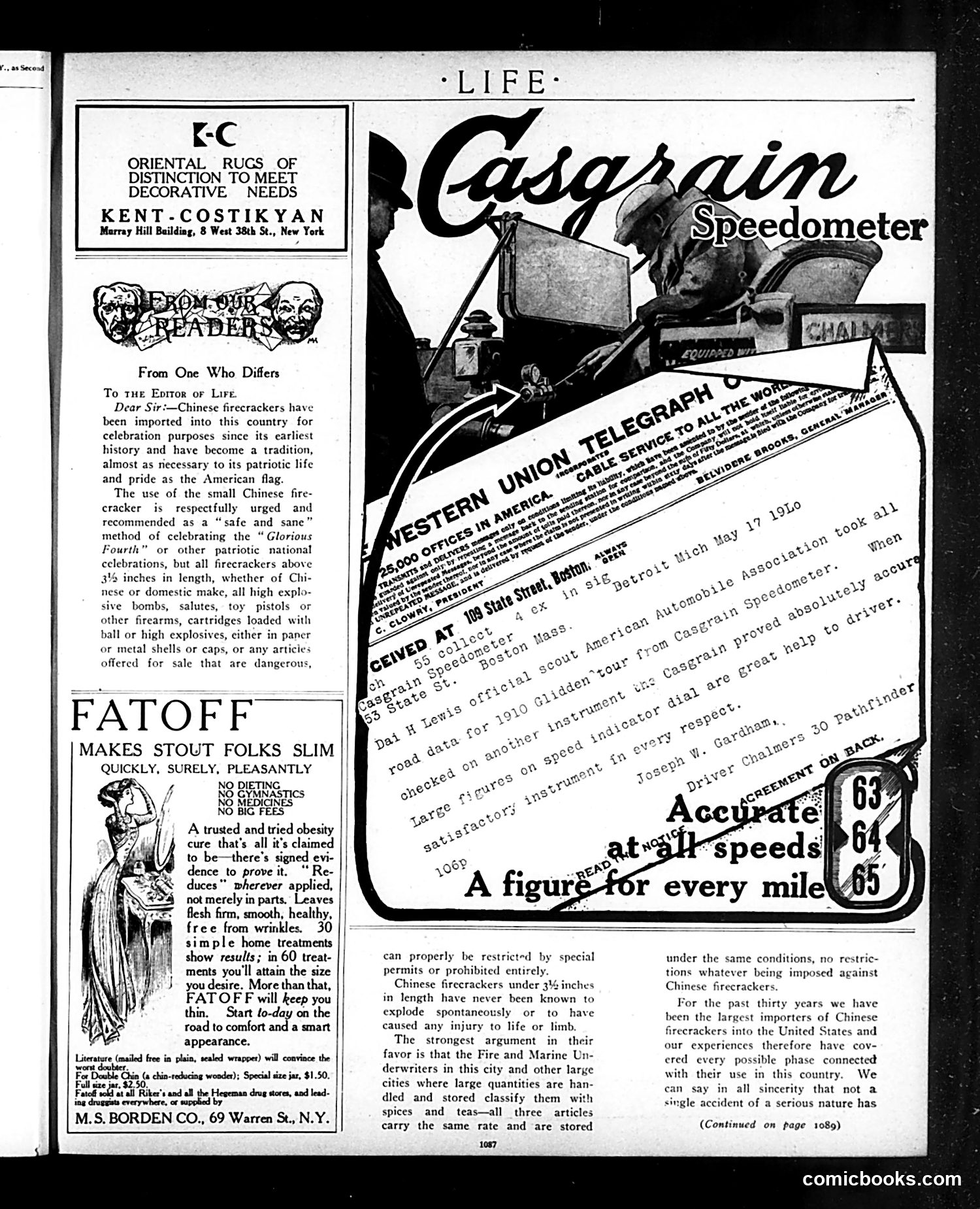
This page is **primarily advertising** rather than political satire. The dominant content features two product ads: 1. **Casgrain Speedometer** (top right): An illustrated advertisement showing a car with a speedometer gauge, emphasizing accuracy for automobile drivers. The ad includes a Western Union telegraph message dated May 17, 1926, apparently lending credibility to the product. 2. **Fatoff** (left side): A weight-loss product advertisement claiming to "make stout folks slim quickly, surely, pleasantly" with no dieting or exercise required. It features a before/after illustration and testimonial language. The left column contains a brief letter to the editor about Chinese firecrackers and patriotic celebrations, unrelated to the advertisements. This reflects typical 1920s magazine content mixing editorial material with commercial pitches.
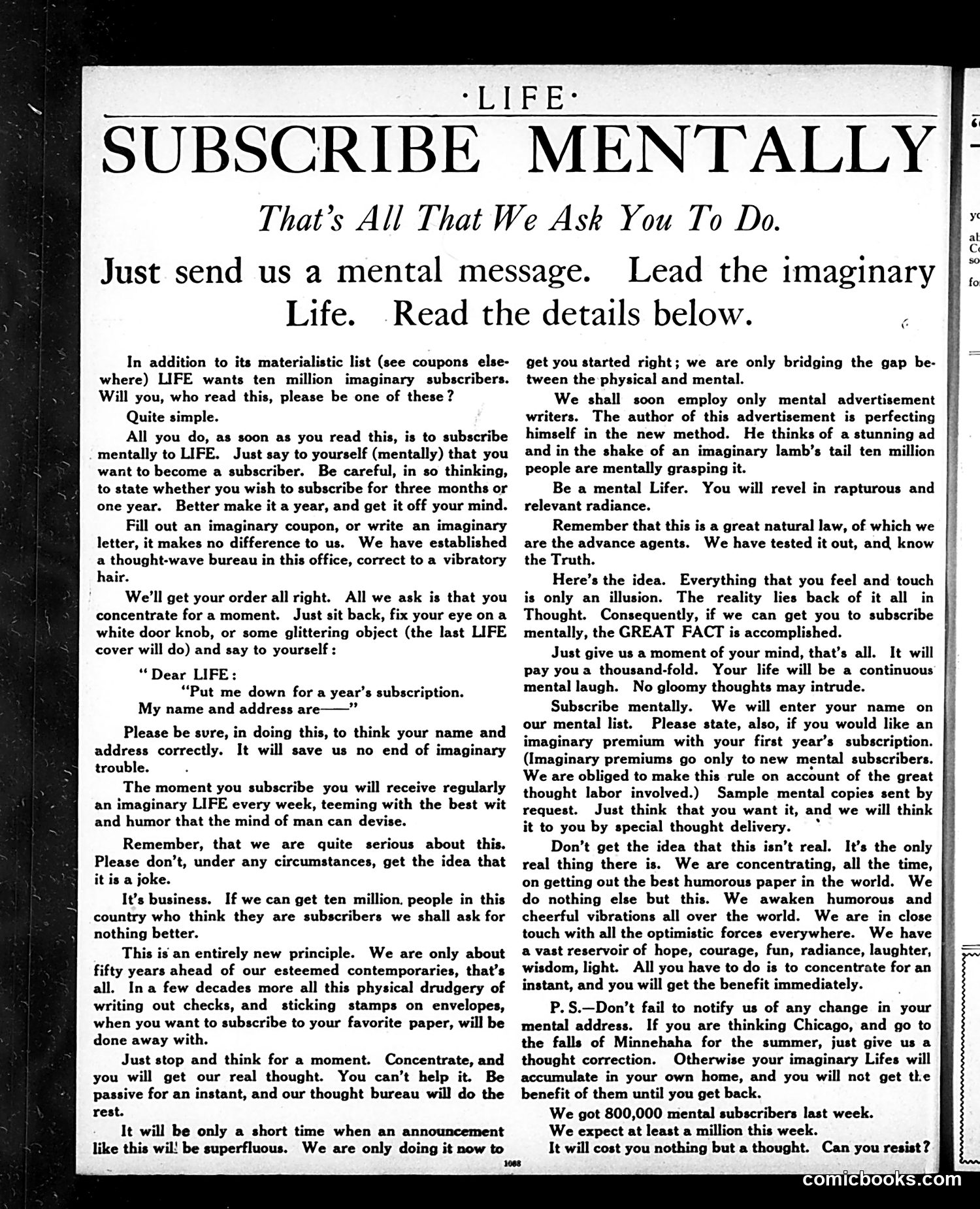
This is a satirical advertisement from *Life* magazine promoting a "mental subscription" service. The satire targets early 20th-century New Thought and mental science movements—pseudoscientific belief systems claiming that thoughts could materially reshape reality. The joke: subscribers would simply *think* about subscribing to *Life* rather than actually paying. The ad mockingly promises that concentrated thought alone will accomplish real results, claiming a "thought-wave bureau" exists in their office and that "everything that you feel and touch is only an illusion." The satire exposes the absurdity of popular mental-science cults by taking their claims to their logical extreme—if thoughts create reality, why not subscribe mentally? It's primarily social commentary on contemporary gullibility and pseudoscientific fads rather than political satire.
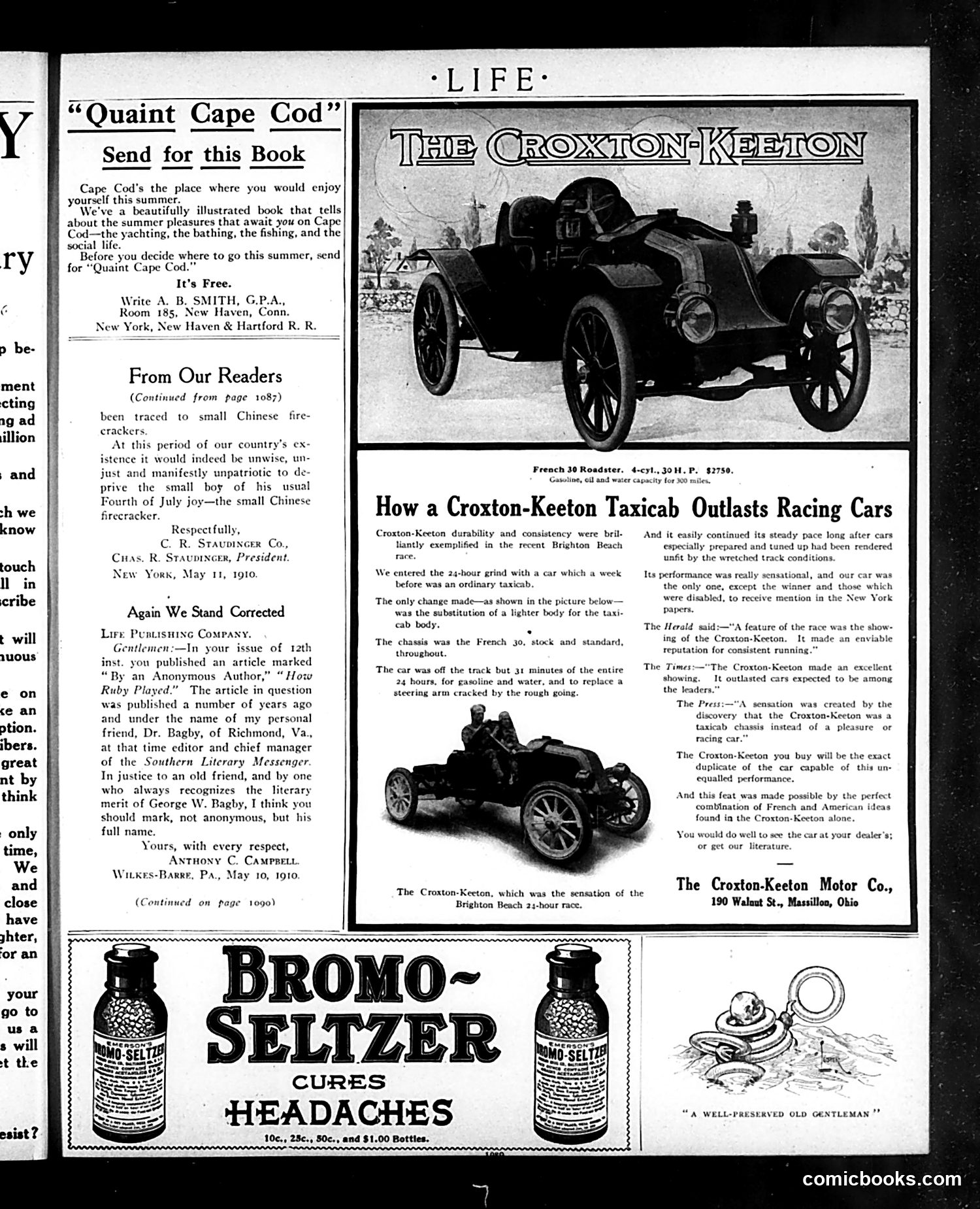
This page is primarily **advertising and editorial content**, not political satire. The main feature is a **Croxton-Keeton Motor Company advertisement** showcasing their French 39 Roadster taxicab. The ad describes how this vehicle "outlasts racing cars" through durability tests—specifically referencing a 23-hour grind and the Brighton Beach 2-hour race. The text emphasizes the taxi's superior performance compared to racing vehicles. Below is a **Bromo-Seltzer advertisement** for headache relief. The left column contains reader letters, including one correcting a previous attribution error for an article titled "How Ruby Played." **No political satire is present**. This appears to be a standard early-1910s magazine page mixing automotive advertising with reader correspondence and patent medicine ads—typical content for the era.
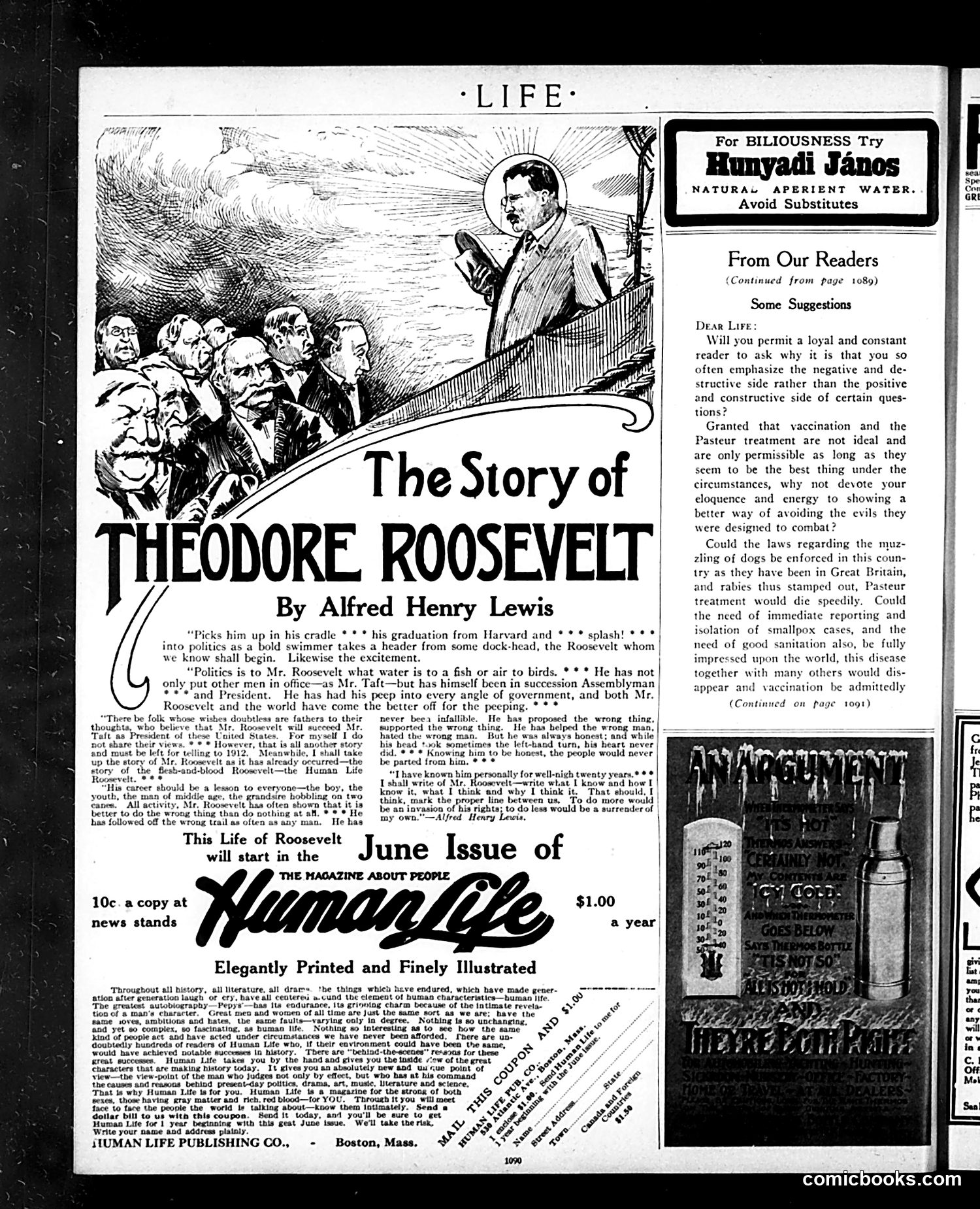
This page is primarily **advertising** for *Human Life* magazine's June issue, which will feature "The Story of Theodore Roosevelt" by Alfred Henry Lewis. The large illustration depicts **Roosevelt as a preacher or orator** addressing a crowd of attentive listeners, with dramatic rays of light behind him—a visual metaphor presenting him as an inspiring, almost messianic figure. The accompanying text uses hyperbolic praise, calling Roosevelt's life a lesson to everyone and emphasizing his honesty and success. The satirical point appears implicit: *Life* magazine is gently mocking the contemporary Roosevelt mythology and public adulation by presenting him in such grandiose, almost religious terms. The page also contains a reader's letter criticizing negative emphasis in journalism, which may relate to Roosevelt coverage debates of the era.
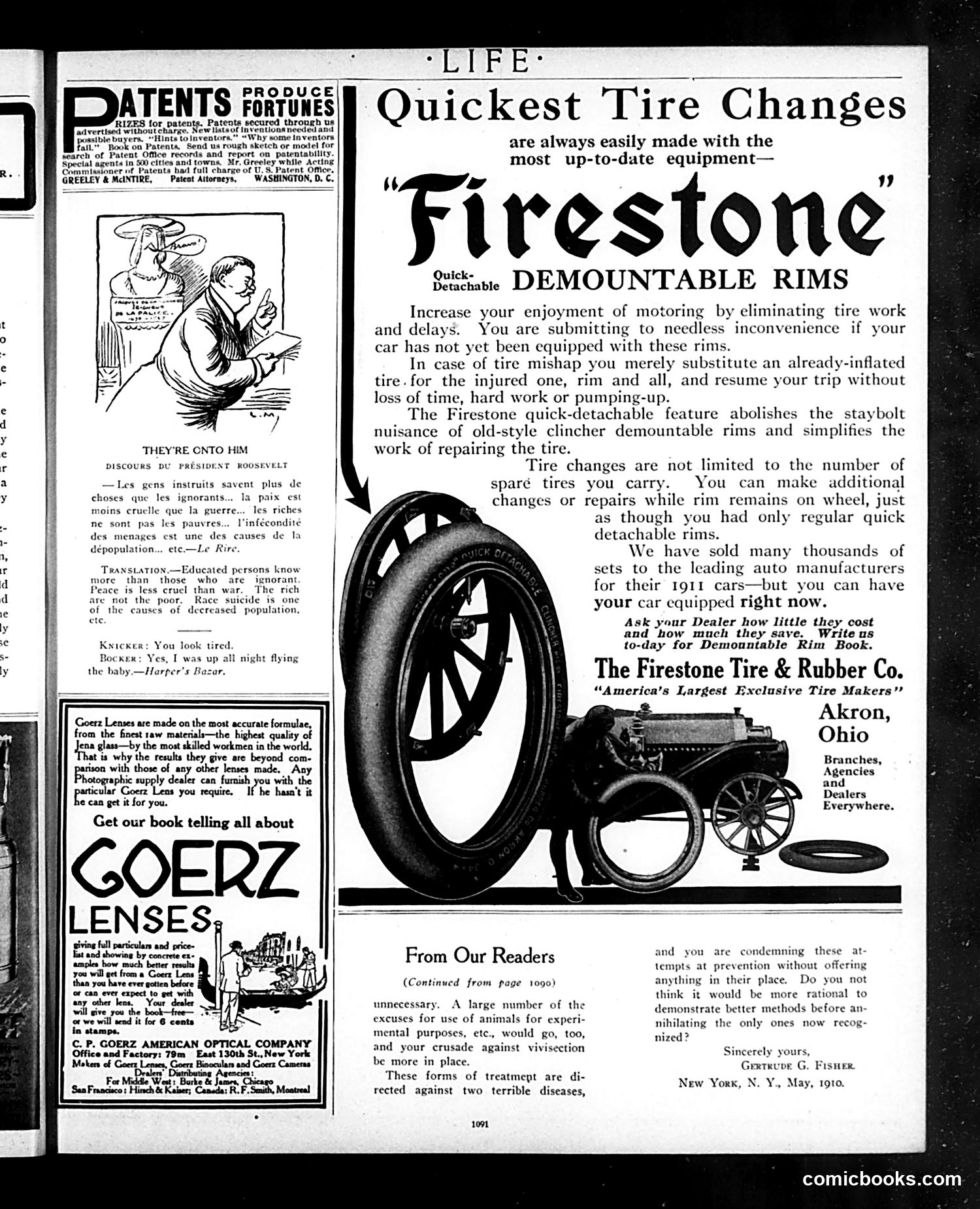
This page is primarily **advertising** for Firestone Tire & Rubber Company's "Demountable Rims" (quick-detachable wheels), with supporting ads for patents, Goerz lenses, and a "From Our Readers" section. The small cartoon labeled "They're Onto Him" depicts a figure in a basket being addressed by another character. The caption references Roosevelt, suggesting **political satire about President Theodore Roosevelt**. The joke appears to concern someone being "onto" Roosevelt's activities, though the specific political reference is unclear without additional context. The primary content emphasizes the convenience of Firestone's removable tire technology for 1911 automobiles, highlighting how it eliminated tedious tire-repair work—a significant selling point when automotive travel was still novel and tire maintenance genuinely burdensome.
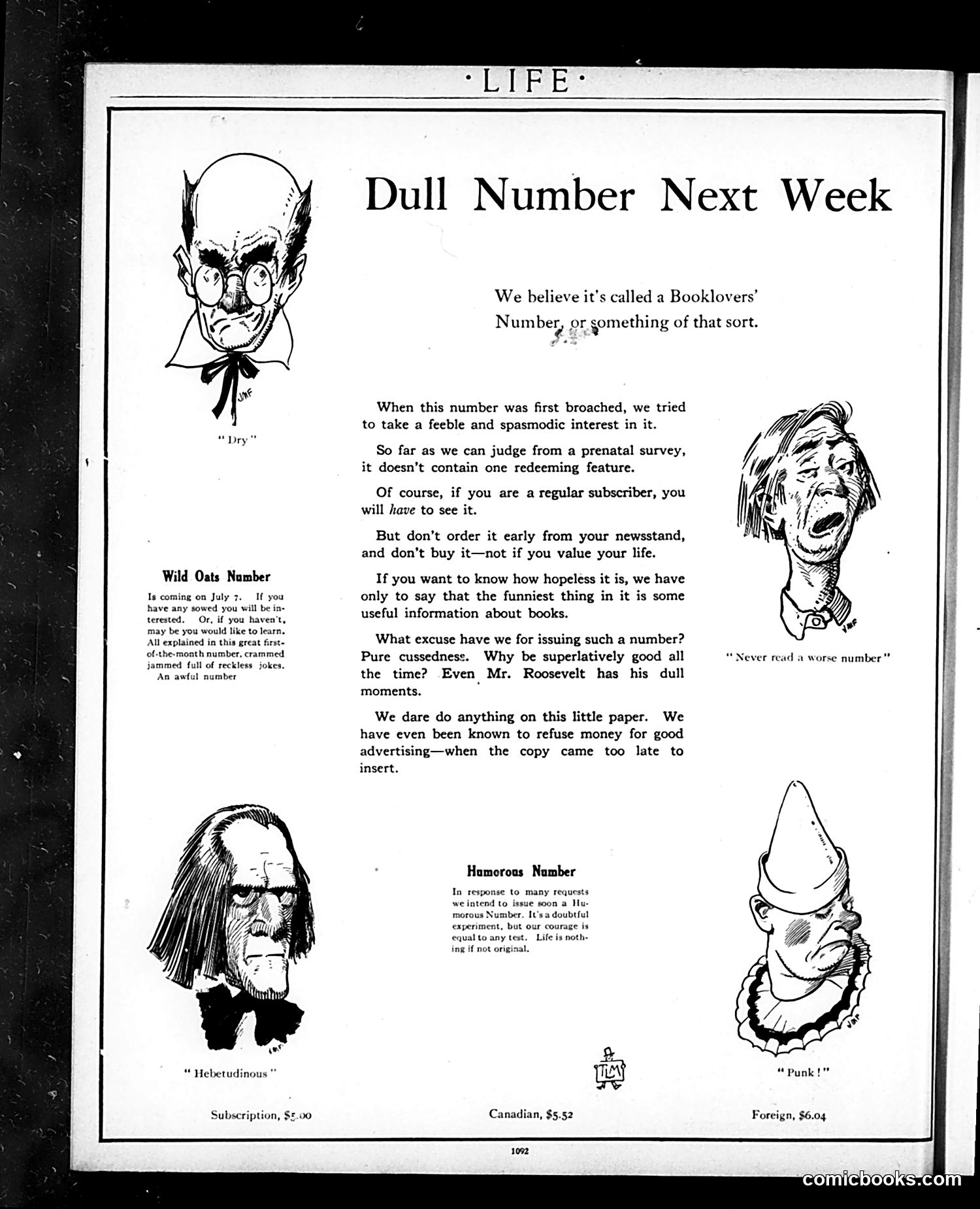
This page announces an upcoming "Dull Number" for the following week. The editors humorously acknowledge that the issue will contain uninspired content—describing it as a "Booklovers' Number" focused on books, which they joke is inherently tedious. The accompanying caricatures illustrate different character types representing dullness: - "Dry" (bald man with spectacles) - "Hebetudious" (long-haired figure, the word meaning stupid) - "Punk!" (pointy-headed character) The text self-mockingly warns readers not to order the issue early and admits the magazine "dare[s] do anything" with its content. This is satirical self-deprecation—the editors playfully roast their own upcoming issue before publication, inviting readers to share in the joke about a presumably boring, book-focused edition.
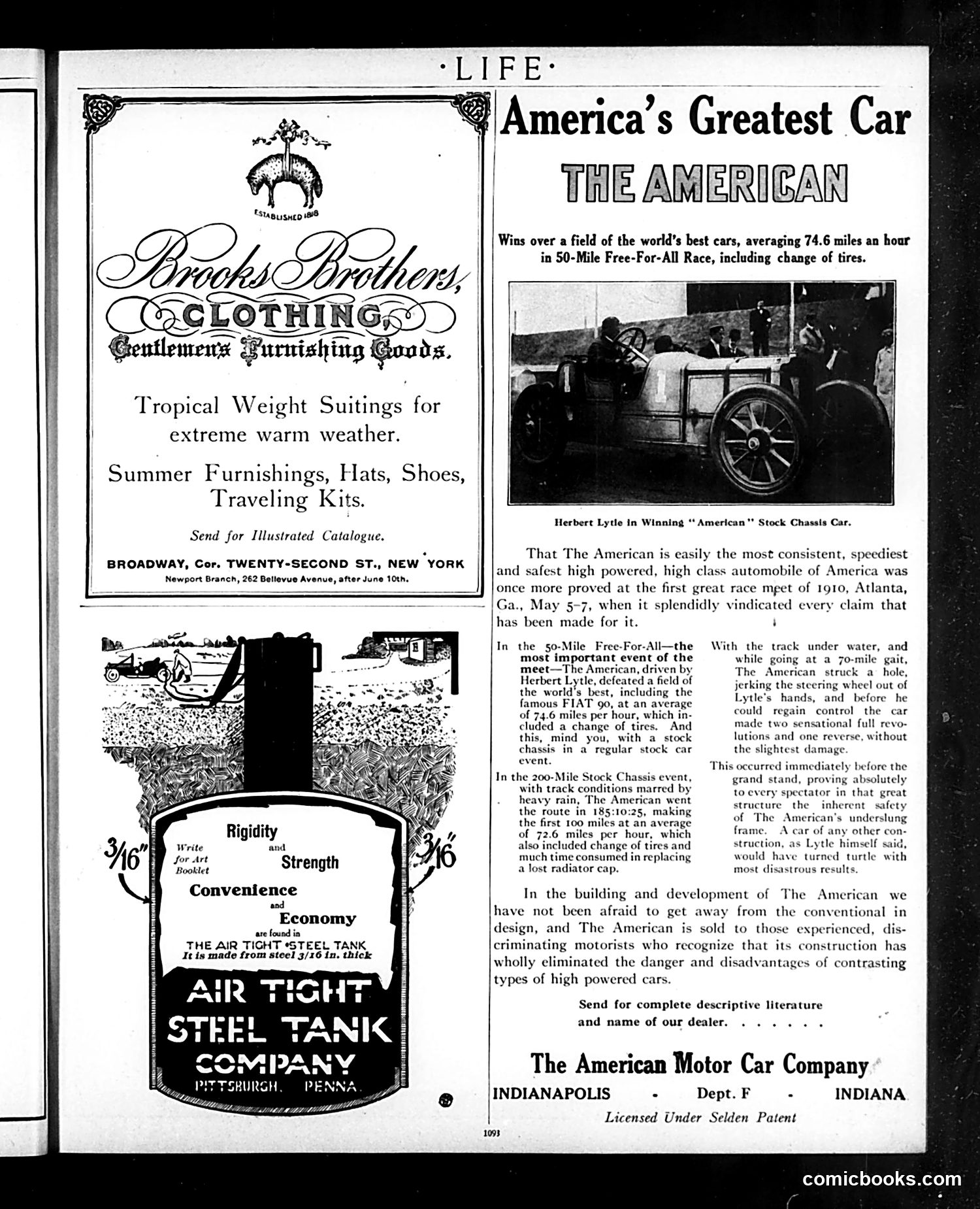
This page is primarily **advertising**, not satire or political commentary. The left side features ads for Brooks Brothers clothing and Air Tight Steel Tank Company. The right side is a full-page advertisement for "The American" automobile, made by American Motor Car Company in Indianapolis. The car ad includes a photograph of Herbert Lytle winning a 50-mile stock chassis race, averaging 74.6 miles per hour. The text emphasizes the car's reliability, speed, and safety—claiming it "easily the most consistent, speediest and safest high powered, high class automobile of America" based on a 1910 Atlanta race. No cartoon satire or political commentary is present. This is straightforward product promotion typical of early 20th-century *Life* magazine advertising.
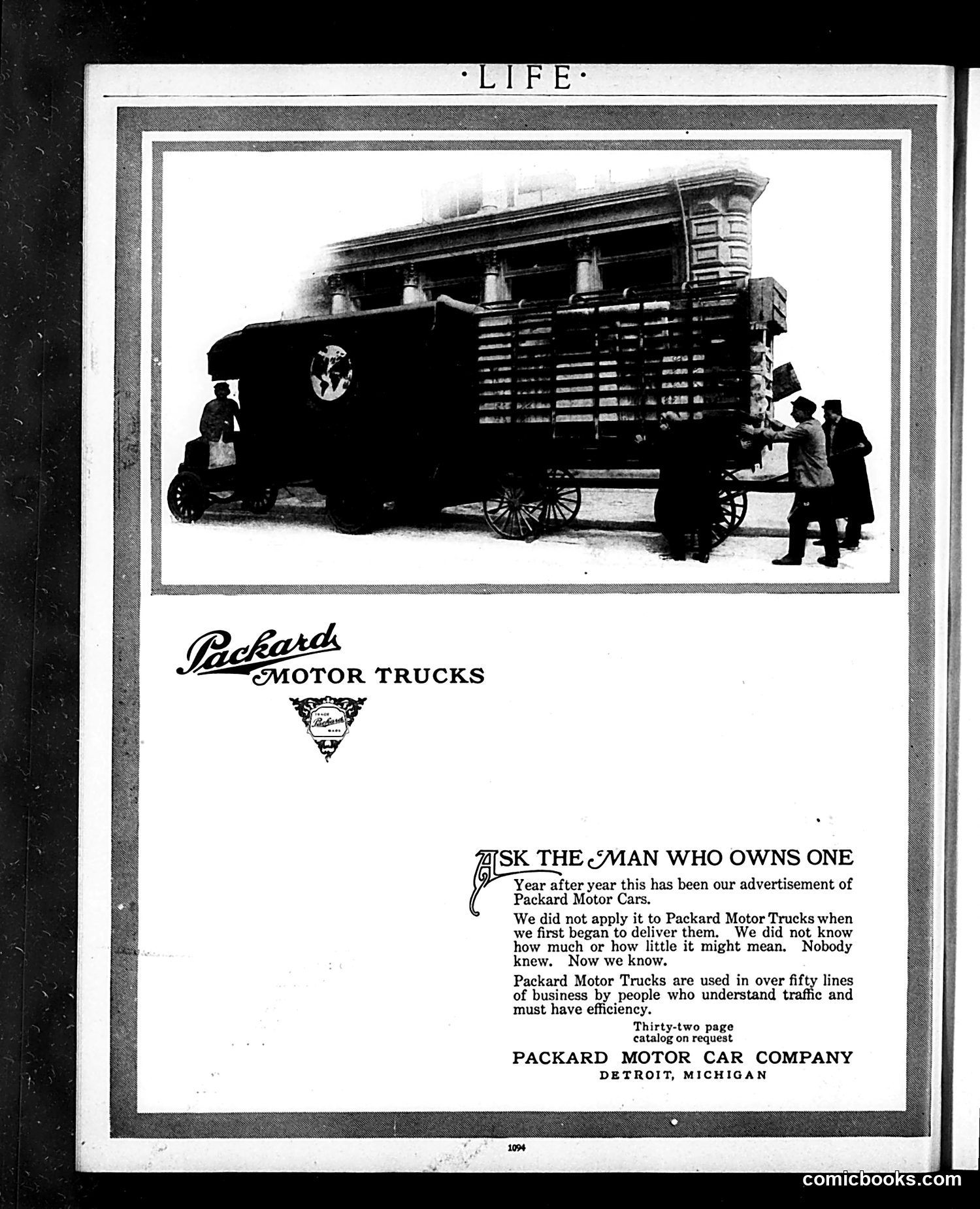
This is a **Packard Motor Trucks advertisement**, not satirical content. The page features a photograph of an early motorized truck with wooden slat sides, positioned against a backdrop of what appears to be a railway car or industrial structure, with several men in period suits examining or standing near it. The ad's text employs a testimonial approach, urging potential customers to "ask the man who owns one." It claims Packard Motor Trucks are used by "over fifty lines of business" and emphasizes their efficiency and traffic capability—suggesting these were commercial vehicles marketed to business owners who needed reliable transportation. This reflects early 20th-century advertising strategy: leveraging peer endorsement and practical business benefits to promote emerging automotive technology to commercial enterprises.
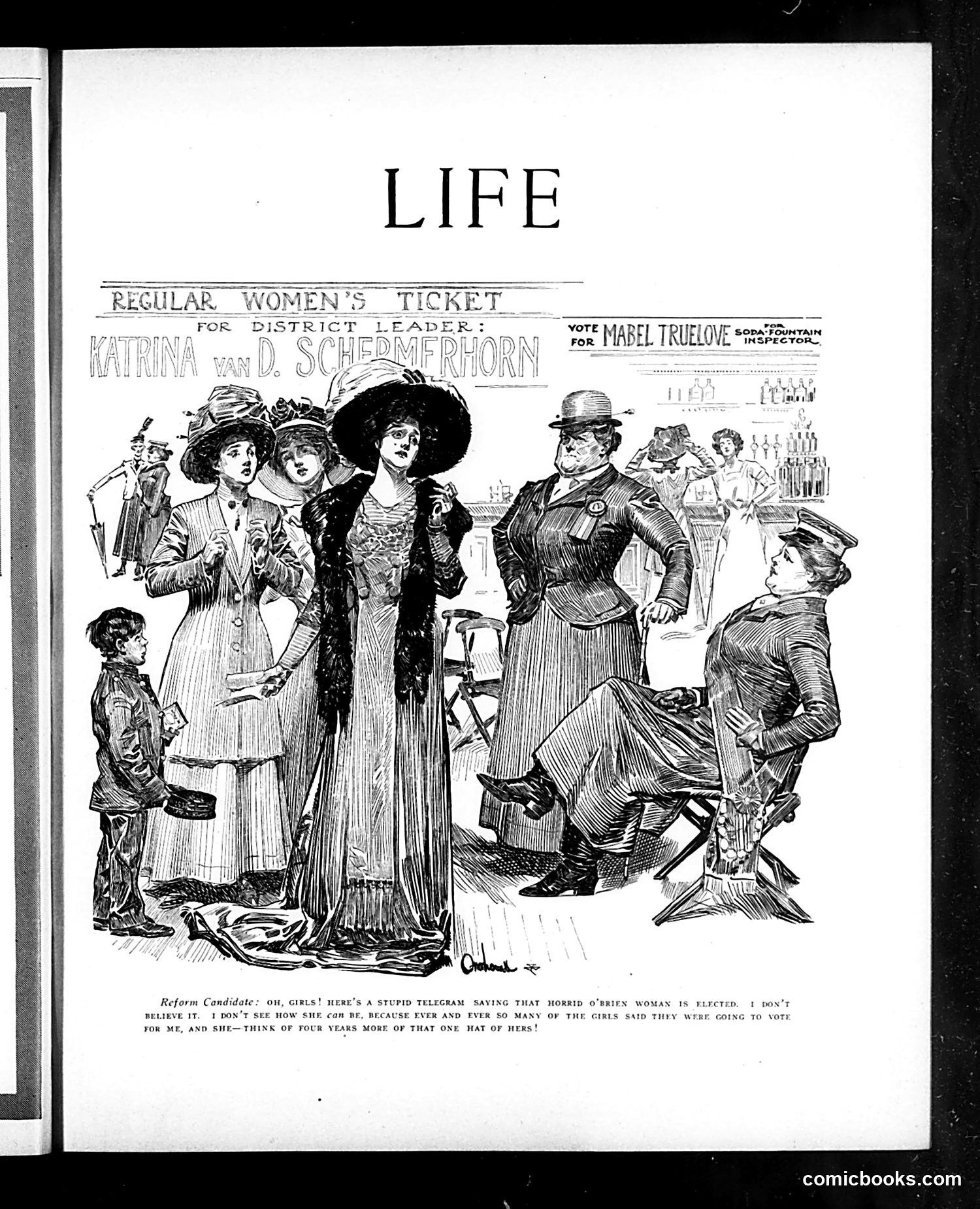
This Life magazine page satirizes women's suffrage efforts, likely from the early 1900s. The heading advertises a "Regular Women's Ticket for District Leader" featuring "Katrina van D. Schemerhorn" and urges voting for "Mabel Truelove" as "Soda Fountain Inspector." The illustration mocks female political participation by depicting elaborately dressed women in exaggerated poses, suggesting they're unfit for serious governance. The caption quotes a "Reform Candidate" dismissing women voters as foolish and unreliable, claiming he doesn't believe women will actually vote despite what they claim. The satire targets both the women's suffrage movement and reform-minded politicians, presenting female political engagement as comical and women themselves as superficial, vain, and incapable of meaningful civic participation.
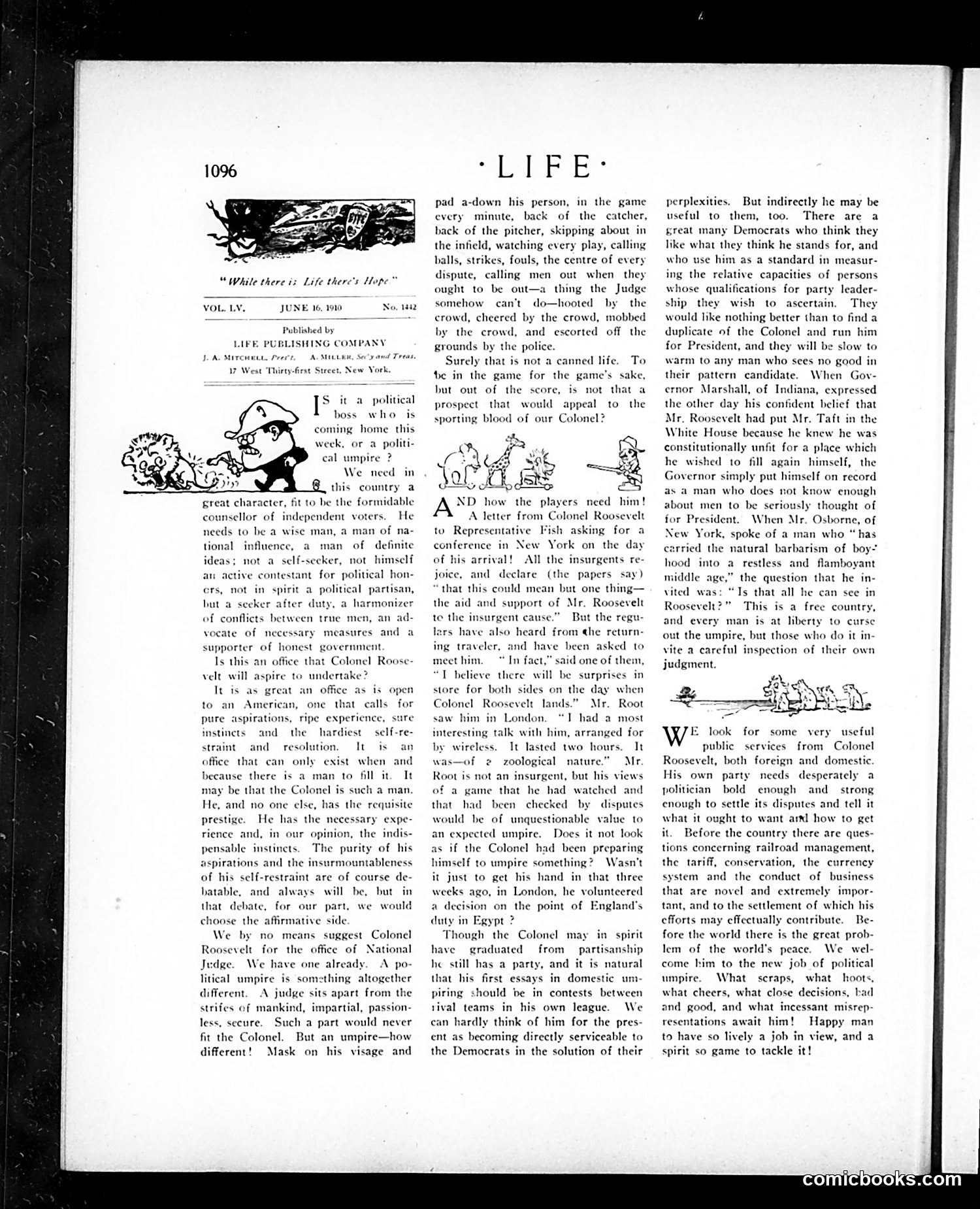
This is a political commentary page from Life magazine (June 16, 1919, No. 1442). The small cartoon depicts a caricatured figure wearing what appears to be a military uniform or hat, in a confrontational pose. The text discusses Colonel Roosevelt's potential political future, debating whether he should run for National Judge or President. The author argues that an "umpire" like Roosevelt—someone of demonstrated integrity and independence—would be valuable to the Democrats, who need a candidate transcending partisan divisions. The piece references Roosevelt's recent return from London and mentions his interest in resolving party conflicts. It positions him as a figure of sufficient stature and impartiality that either party might benefit from his leadership. The cartoon likely caricatures Roosevelt himself in this political context, though the specific satirical point requires clearer image visibility.
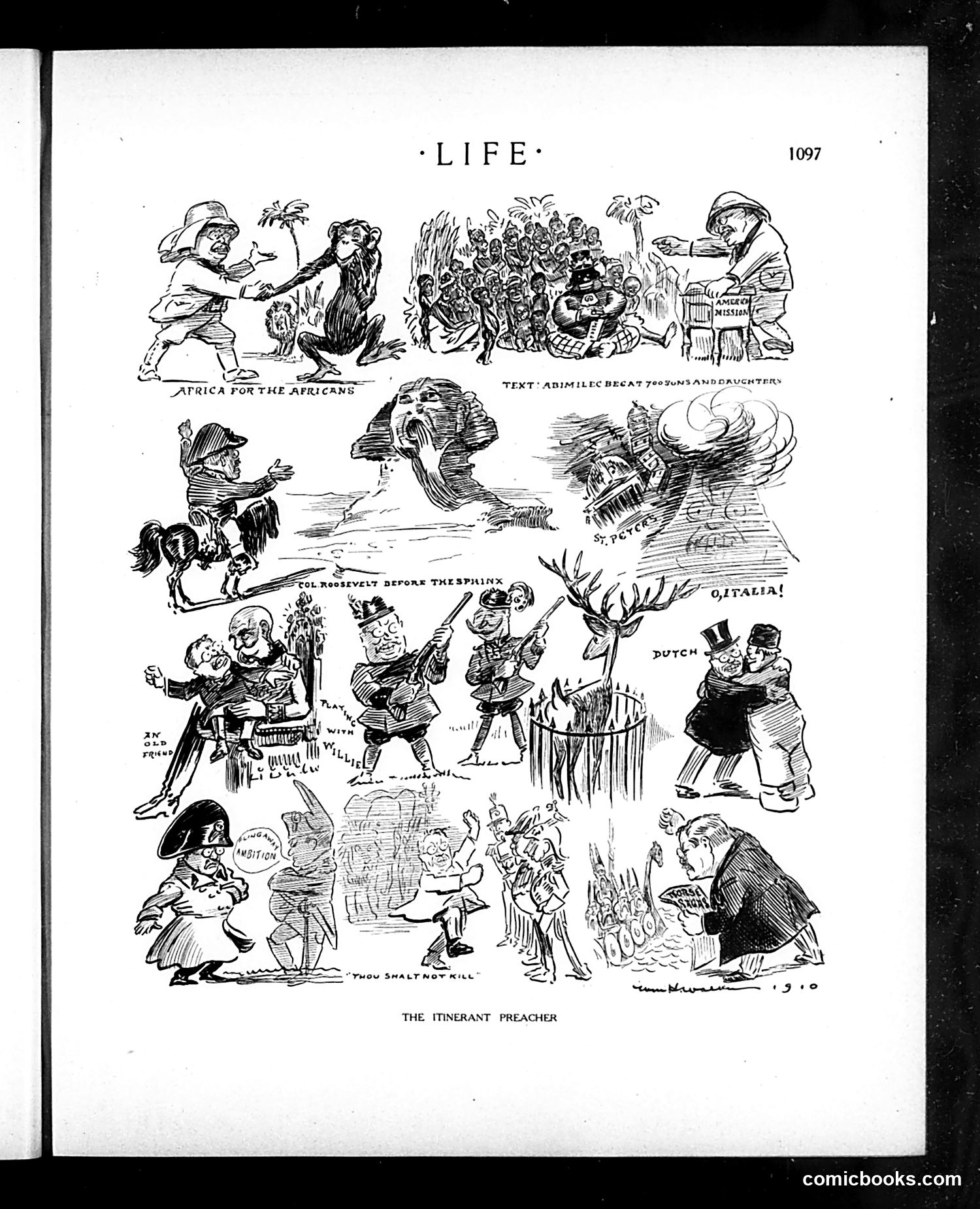
This satirical page depicts various global conflicts and political situations through caricatured vignettes. The cartoons show: - **"Africa for the Africans"**: Colonial violence, likely criticizing imperialism - **"Text: Abimilec Becat..."**: A crowded scene suggesting colonial or missionary activity - **"St. Peter's"** and **"O, Italia!"**: References to Vatican/Italian politics - **"Roosevelt Before the Sphinx"**: Appears to reference Theodore Roosevelt's post-presidency travels - **Various military/political figures** engaged in combat or diplomatic scenes - **"The Itinerant Preacher"** (title): Suggests a traveling minister bringing moral judgment to world affairs The overall theme appears to satirize American and European intervention in global affairs, with the "preacher" metaphor suggesting moralistic imperialism. The cartoons critique colonial expansion, military adventurism, and geopolitical meddling presented as righteous crusades.
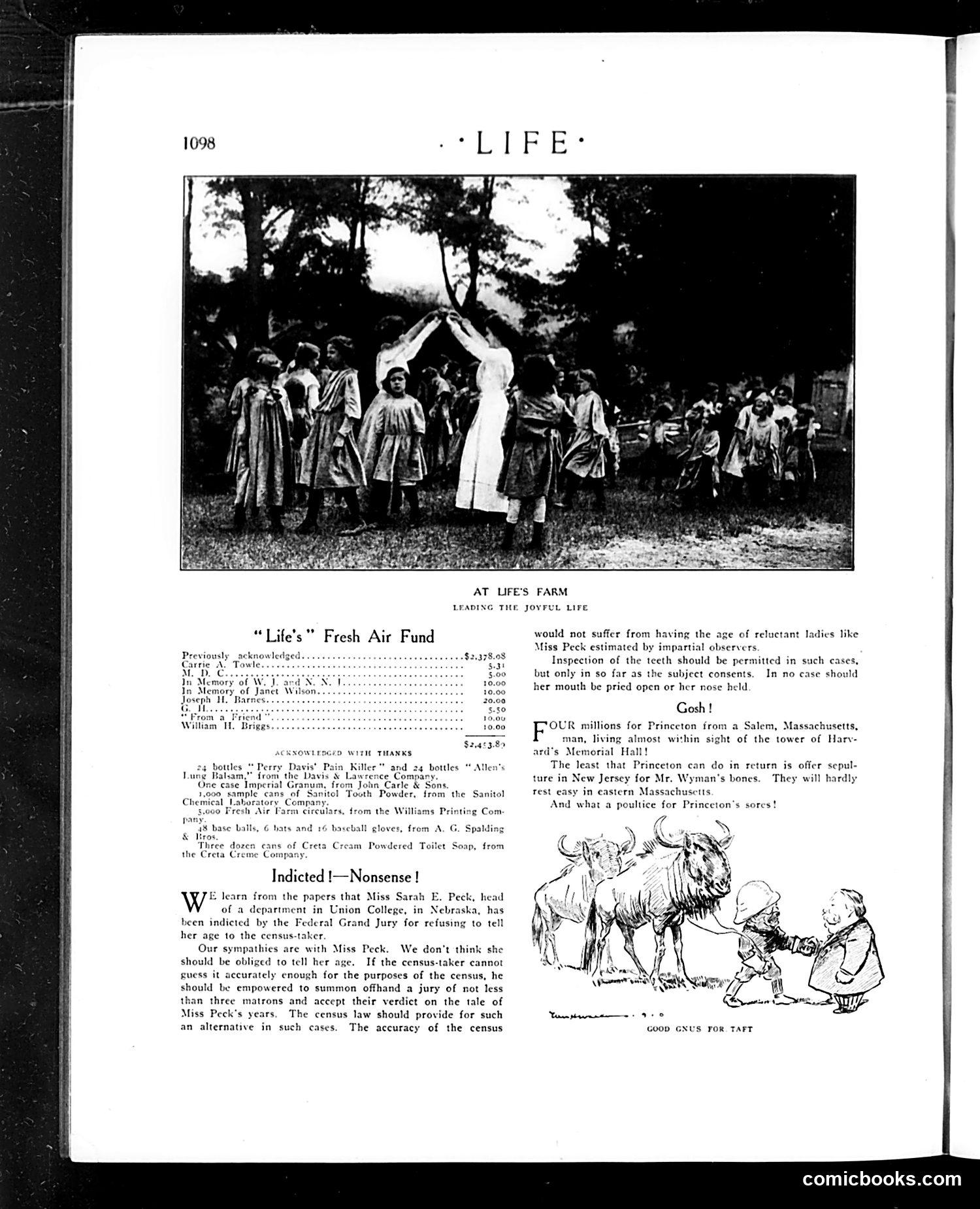
This page satirizes the 1910 U.S. Census, specifically the indictment of Sarah E. Peck, a Union College department head in Nebraska, for refusing to disclose her age to the census-taker. The magazine's commentary is tongue-in-cheek: it defends Peck's refusal by suggesting that if census-takers can't guess a woman's age accurately, they should empanel "three matrons" to judge it instead. The satirical bite targets both women's reluctance to reveal their age and the absurdity of census enforcement. The cartoon showing a cow with a child likely illustrates the rural/"farm" theme of "Life's Farm" section. The photographic image at top shows what appears to be a children's gathering or camp activity. The page also acknowledges contributions to "Life's Fresh Air Fund" (a charitable program for children) and includes various small donations, establishing this as a charity-focused issue during the Progressive Era.
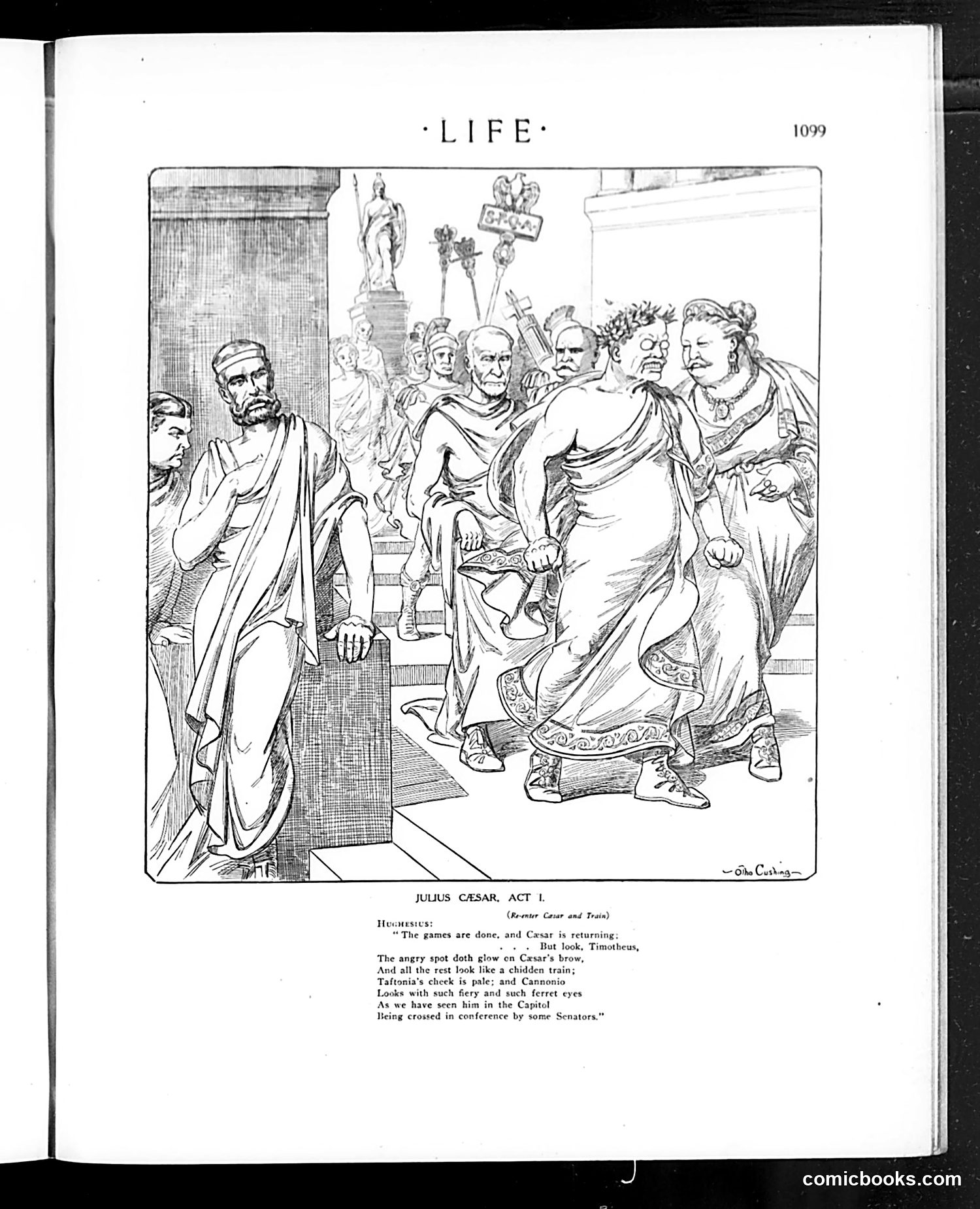
This is a satirical illustration adapting Shakespeare's *Julius Caesar* to contemporary American politics. The cartoon depicts Caesar returning angry from games, with his attendants looking worried and chastened. The references to "Taftonia" and "Cannonio" appear to be satirical stand-ins for real political figures—likely referencing President William Howard Taft and another contemporary politician (possibly Cannon, a prominent congressman). The joke uses Shakespeare's dramatic language about Caesar's displeasure and senatorial conflict to mock current political tensions and rivalries. The visual emphasizes Caesar's anger and his associates' nervous reactions, suggesting a power struggle or recent political defeat in Washington. By framing contemporary politics through classical tragedy, the cartoonist creates ironic commentary on the seriousness with which politicians take their conflicts. The overall effect mocks both the figures involved and the theatrical nature of political posturing.
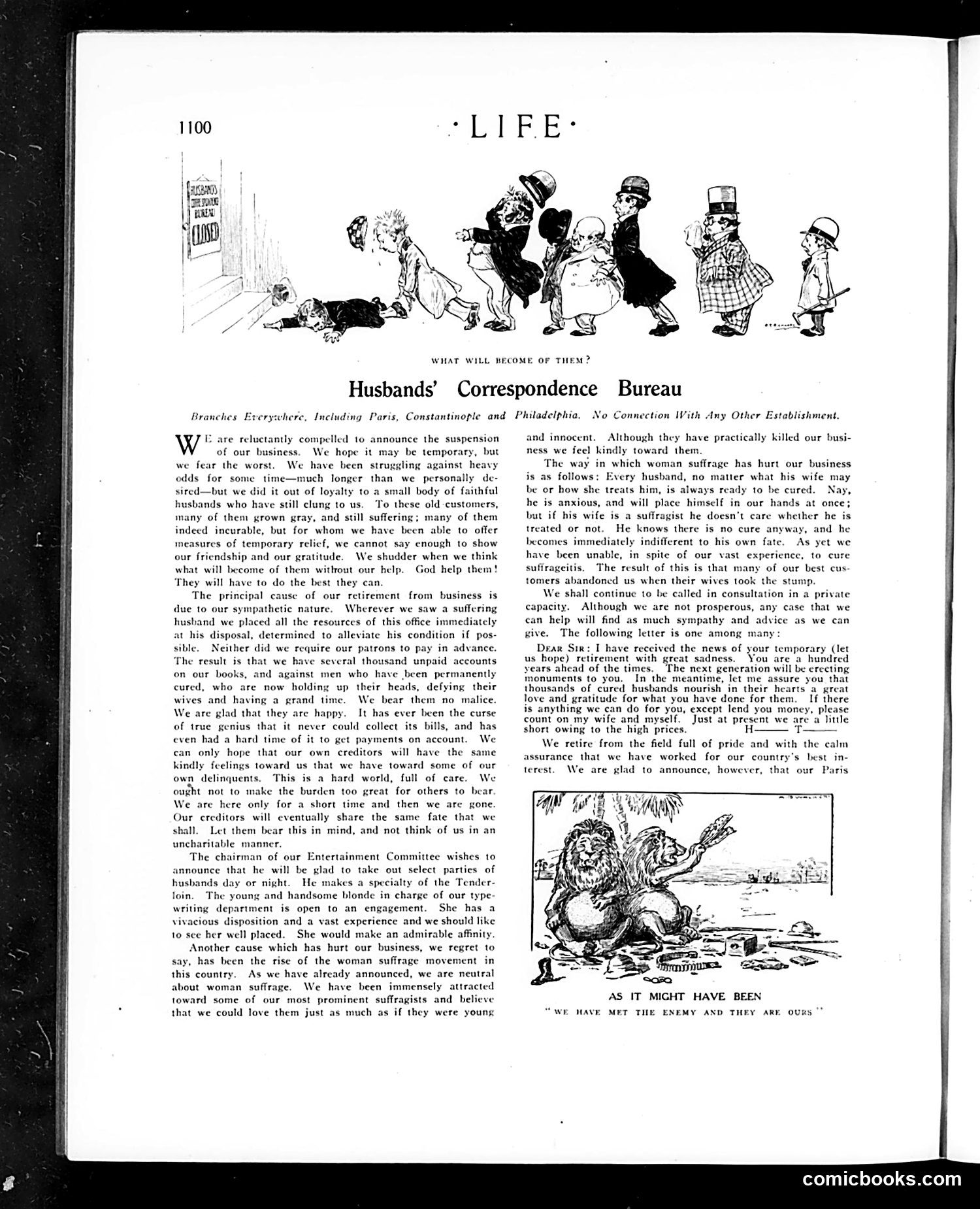
This is a mock "going out of business" notice from a fictional "Husbands' Correspondence Bureau"—a satirical jab at the women's suffrage movement of the early 20th century. The cartoon shows a man lying prone outside the bureau while other figures (appearing to be suffragists with megaphones and campaign materials) celebrate nearby, captioned "What will become of them?" The satire presents suffragists as having destroyed husbands' livelihoods by making wives politically active. The text claims that when women become suffragists, their husbands lose interest in self-improvement because "there is no cure anyway"—a cruel implication that wives becoming politically empowered is inherently destructive to marriage. The bureau's closure is blamed on woman suffrage "practically killing our business." This represents anti-suffrage propaganda portraying women's political activism as a threat to traditional marital and social structures.
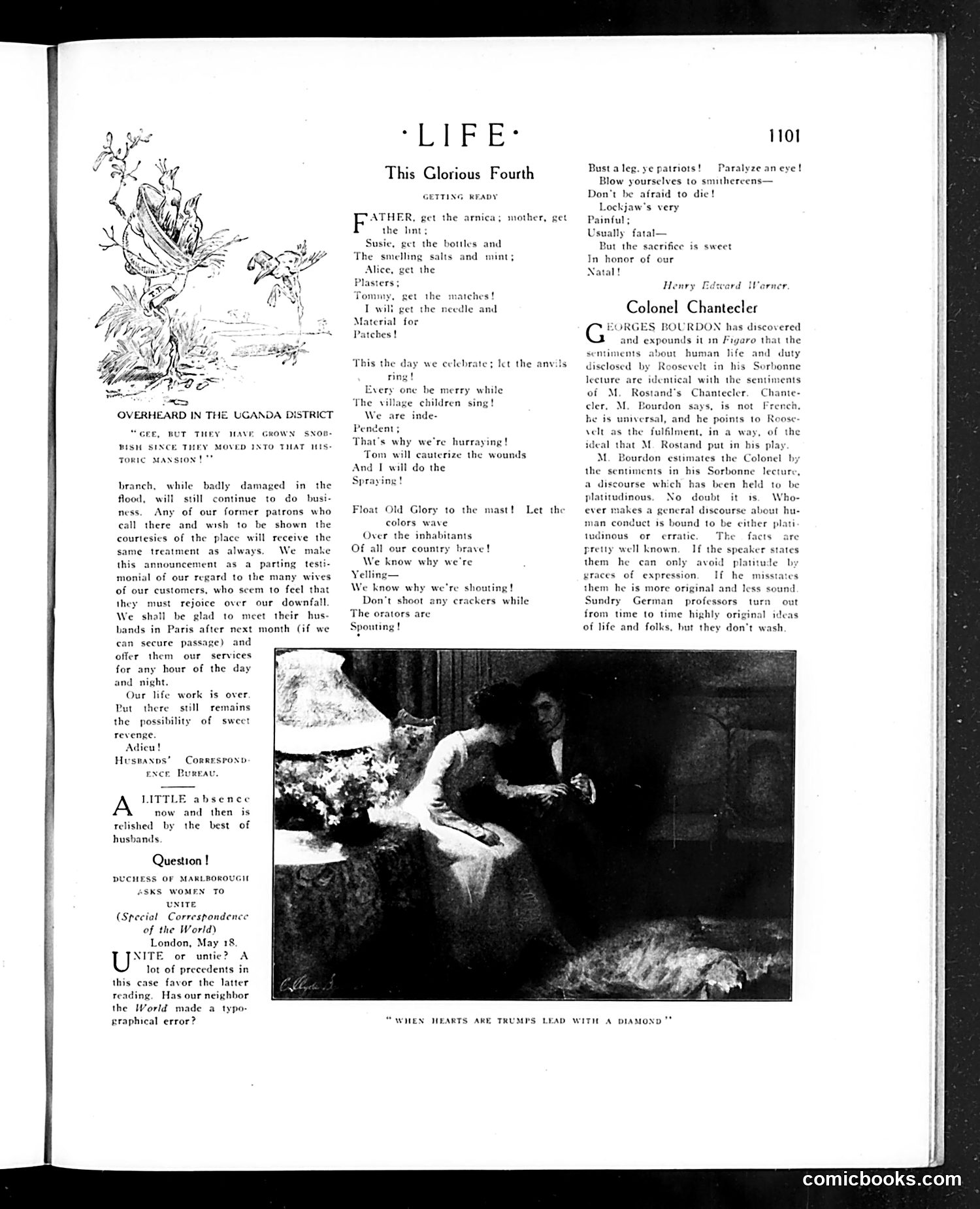
This page contains **satirical commentary on American Independence Day celebrations**. The main cartoon, "This Glorious Fourth," mocks the Fourth of July by depicting preparations that focus on inevitable injuries rather than patriotic ideals. The poem sarcastically instructs families to gather medical supplies (arnica, lint, salts) and materials for bandages in anticipation of fireworks accidents. The humor lies in the contrast between solemn patriotic language ("Float Old Glory to the mast!") and practical concerns about burns, eye injuries, and lockjaw from dangerous fireworks. The caption "When Hearts Are Trumps Lead With a Diamond" appears to reference a card game, though its connection to the cartoon is unclear. Below is a brief note about **Colonel Chantecler**, likely referencing Edmond Rostand's play character, comparing Roosevelt's Sorbonne lecture sentiments to the fictional rooster—probably satirizing Roosevelt's grandiose rhetoric as derivative rather than original. The page illustrates Life magazine's typical approach: poking fun at American customs and public figures through witty verse and social observation.
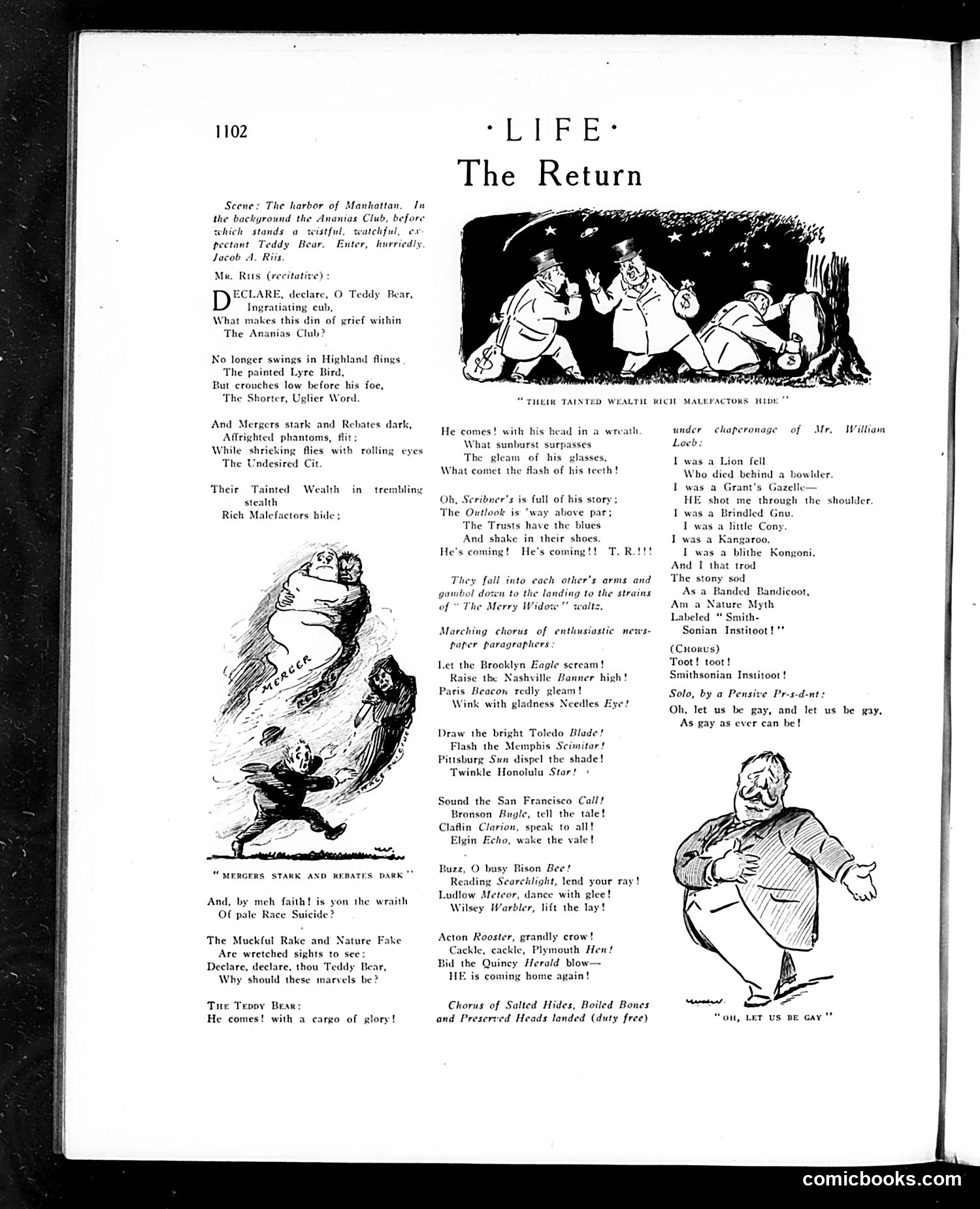
This satirical piece celebrates Theodore Roosevelt's anticipated return to prominence (likely referencing his post-presidency activities or political re-emergence). The page uses mock-operatic language to mock both Roosevelt and the press's enthusiastic coverage of him. **Key satirical targets:** - **Roosevelt himself**: Portrayed as vain and celebrated beyond reason, with references to his hunting exploits ("Grant's Gazelle," "Lion fell") mocking his famous African safari - **Sensationalist newspapers**: Named explicitly (Brooklyn Eagle, Nashville Banner, etc.), the chorus satirizes how newspapers fawned over Roosevelt's movements - **Corrupt wealth**: The "Ananias Club" (a reference to biblical liars), "Mergers," "Rebates," and "Tainted Wealth" suggest Roosevelt posed as a trust-buster while wealthy elites secretly supported him - **Press sycophancy**: William Loeb (Roosevelt's secretary) shepherds preserved animal heads—a joke about the press manufacturing mythology around Roosevelt The overall message: Roosevelt's return generates absurd media hysteria, and his anti-corruption rhetoric masks continued elite corruption.
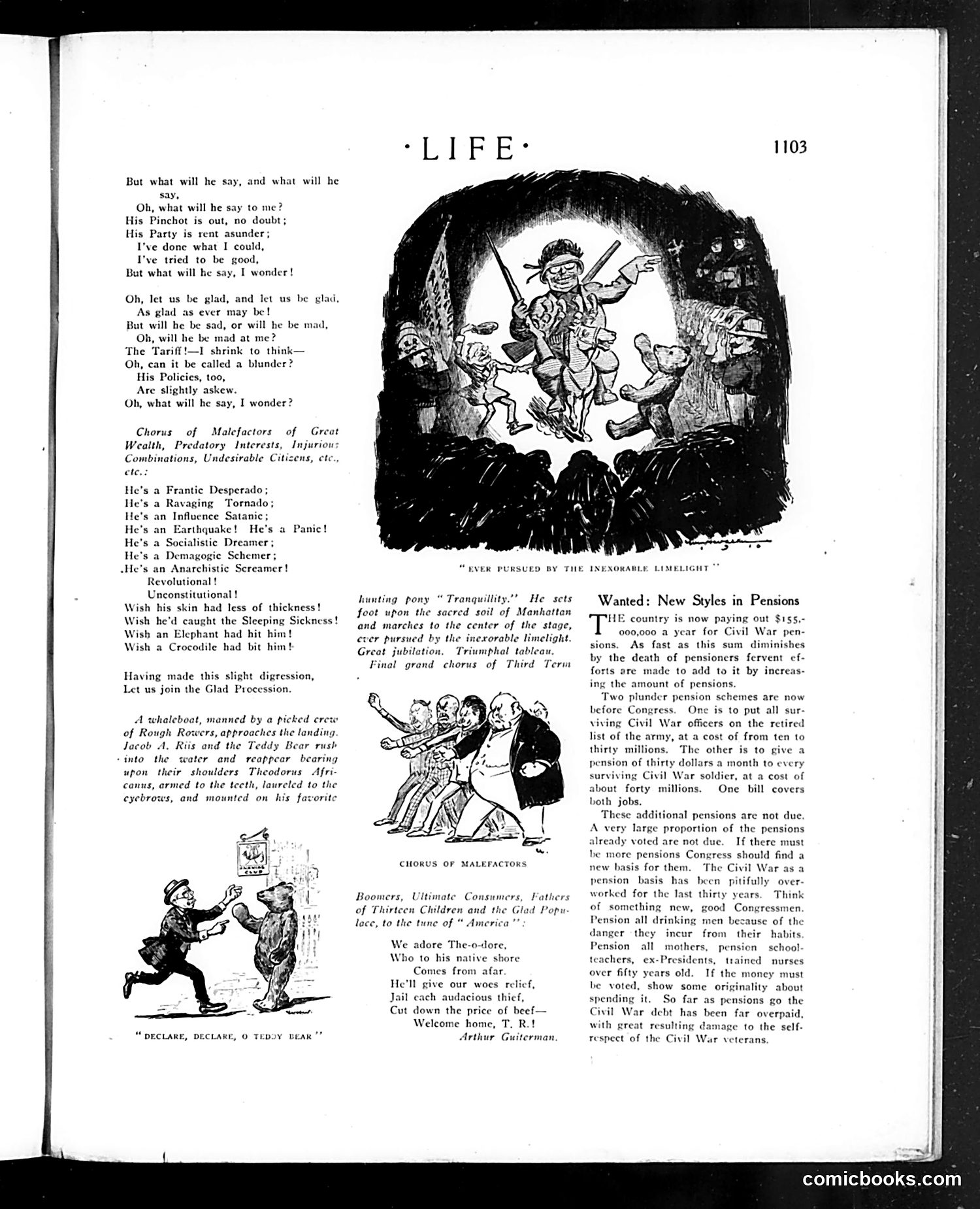
This page satirizes Theodore Roosevelt's anticipated political comeback, likely during the 1912 election cycle. The main cartoon depicts Roosevelt ("Theodorus Africanus") returning triumphantly to Manhattan, carried ashore like a conquering hero on a "Teddy Bear," accompanied by Jacob A. Riis. The left column's anxious lyrics mock conservative businessmen ("Malefactors of Great Wealth") who fear Roosevelt will return and disrupt their interests—worrying about his tariff policies, "Pinchot" (likely James Pinchot, conservation issue), and radical reputation. They call him a "Socialistic Dreamer" and "Anarchistic Screamer." The right column's chorus celebrates his return, promising relief from thieves and lower beef prices. The article "Wanted: New Styles in Pensions" shifts tone, criticizing Congress for inflating Civil War pensions beyond what's justified—a fiscal complaint separate from the Roosevelt satire but on the same page.
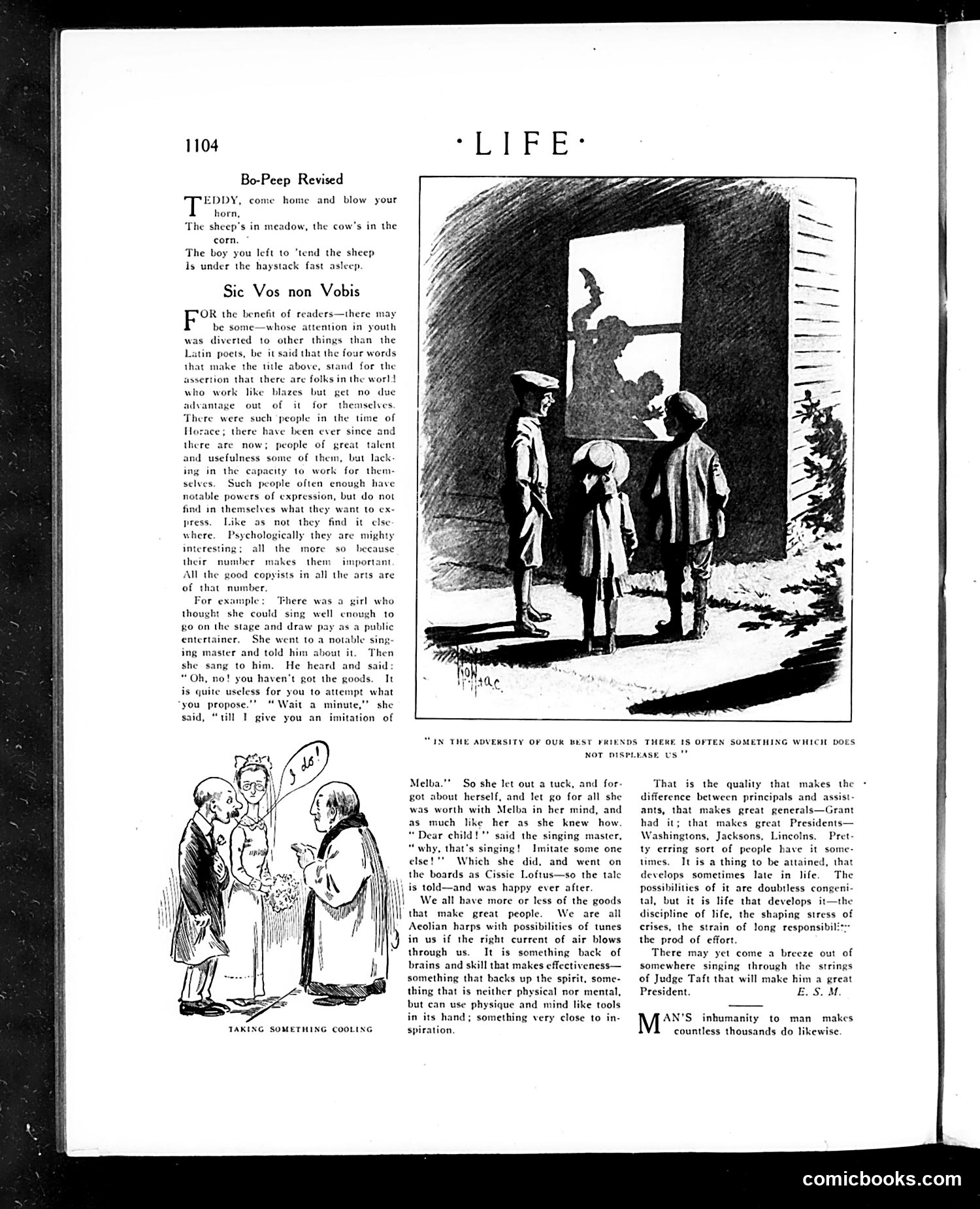
This page contains two satirical pieces about hidden talent and potential. **"Bo-Peep Revised"** (top) is a nursery rhyme parody mocking Theodore Roosevelt ("Teddy"), suggesting he's neglecting his duties as president—the "sheep" and "cow" represent national interests left unattended while the caretaker sleeps. **"Sic Vos non Vobis"** (main article) discusses talented people who lack the drive or self-belief to succeed, using a anecdote about a girl who could only sing well while imitating Nellie Melba rather than performing as herself. The essay argues that true greatness requires an intangible quality beyond mere skill. **The closing passage** pivots to **Judge William Howard Taft** (Roosevelt's chosen successor), suggesting he possesses latent presidential potential that needs proper circumstances to emerge. This appears to be pre-election commentary about whether Taft could become a truly great president—implying skepticism about his current capabilities without proper "discipline" or "crisis." The piece reflects early 1900s concerns about leadership succession and whether talent alone ensures effectiveness.
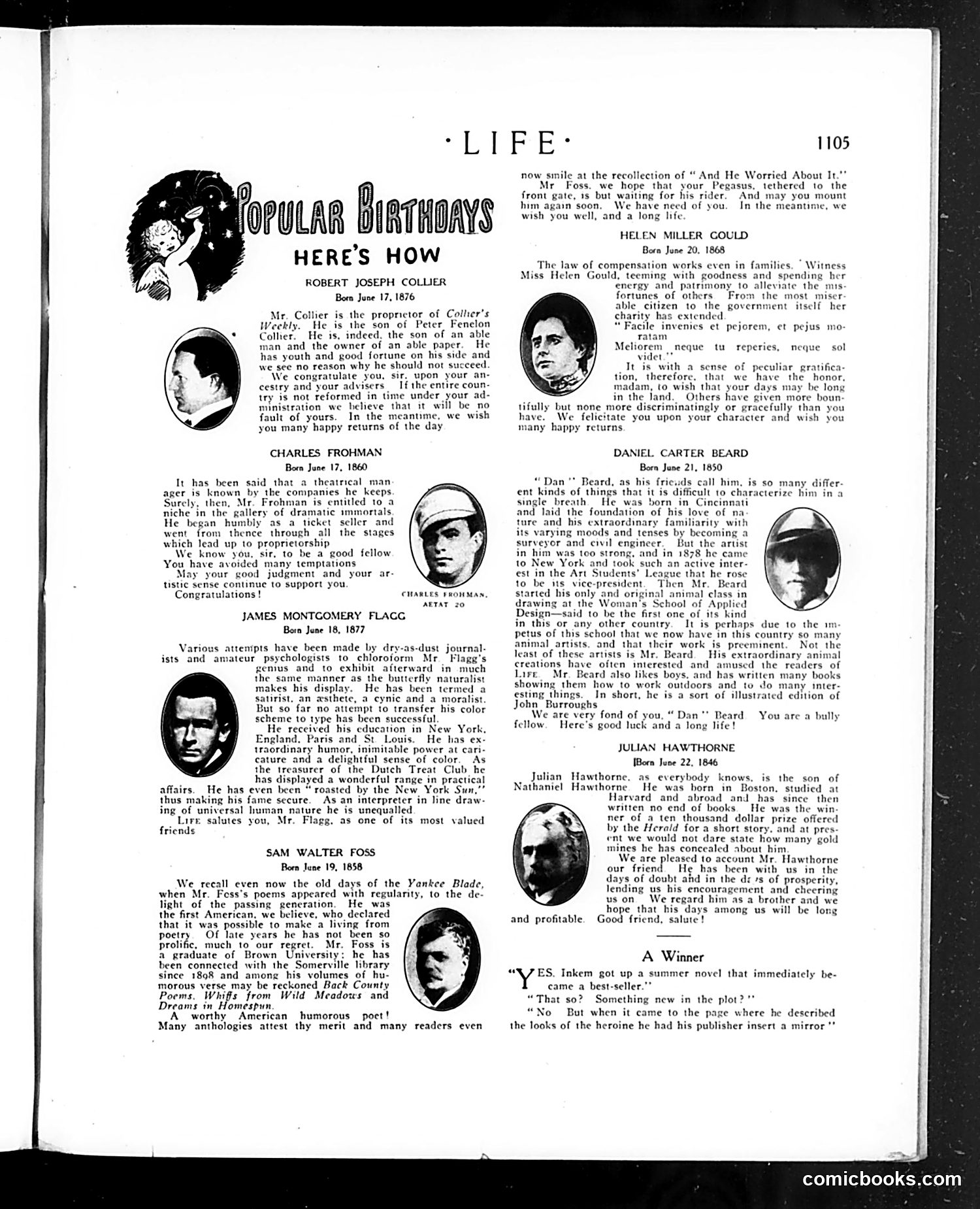
This page celebrates the birthdays of prominent American figures in arts, publishing, and literature. It's structured as a series of short biographical tributes with portrait photographs. The subjects include Robert Collier (publisher of *Collier's Weekly*), theatrical producer Charles Frohman, illustrator James Montgomery Flagg, poet Sam Walter Foss, and philanthropist Helen Miller Gould. Each entry offers congratulatory remarks on their accomplishments and character. The tone is affectionate and congratulatory—typical of *Life's* social commentary approach. The references to Flagg's "extraordinary humor" and his role at the Dutch Treat Club, or Foss's earlier success in the *Yankee Blade*, ground these as recognizable cultural figures to *Life's* educated readership. Helen Gould receives particular praise for her charitable works, framed through classical Latin epigraphs emphasizing her discriminating generosity. The page functions as both celebration and gentle social commentary on who *Life* deemed culturally significant.
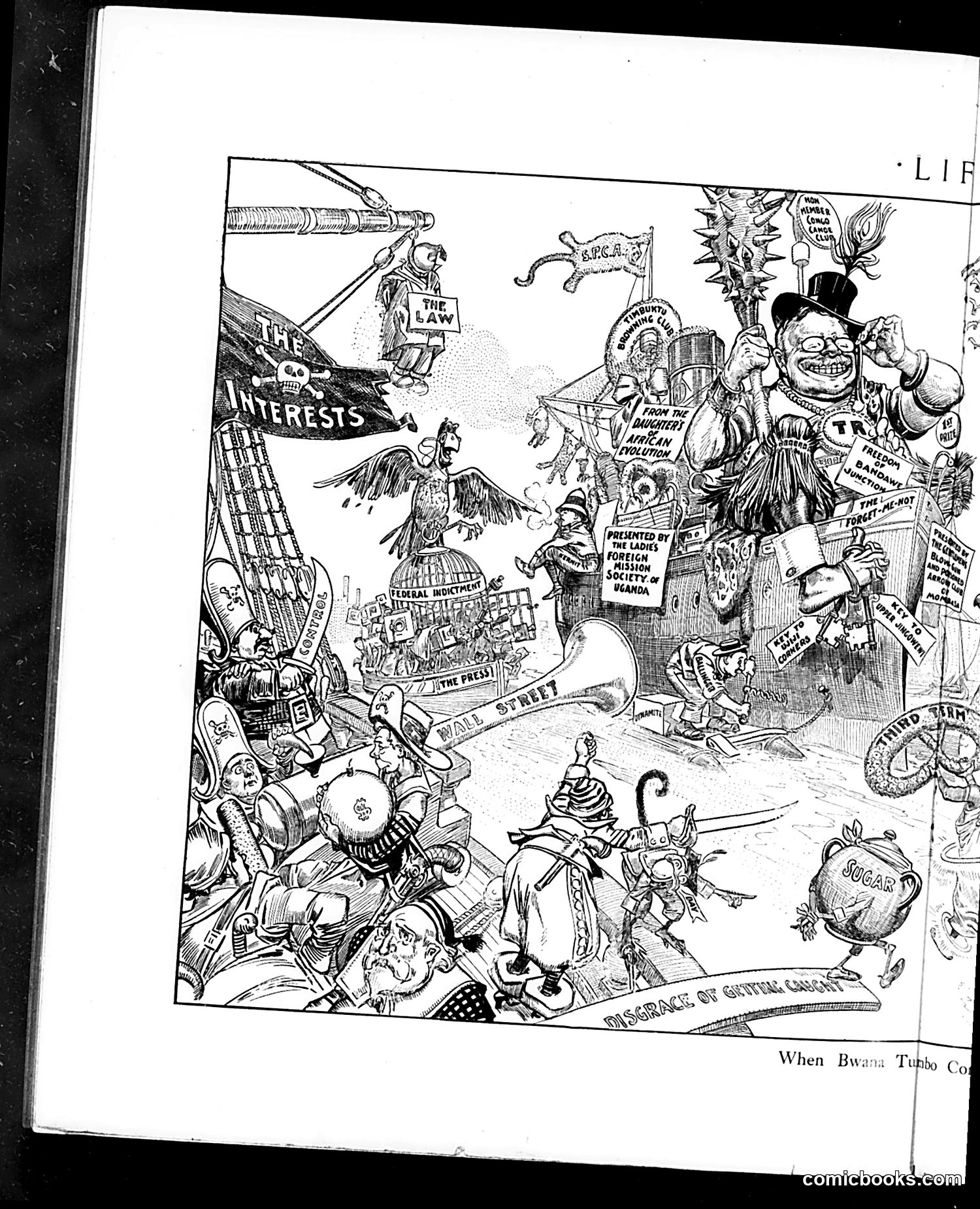
This Life magazine cartoon satirizes competing interests and organizations vying for influence over African Americans during the early 20th century. The left side shows "The Law" and "Special Interests" as controlling forces. The right depicts various organizations—identifiable text includes "S.P.C.A." and references to missions and societies—as chaotic competitors, some presenting themselves as helpers while apparently serving their own agendas. The central figure appears to be a wizard or manipulative character directing this circus. The overall message critiques how different groups (charitable organizations, churches, political movements) claimed to represent or uplift Black Americans while actually pursuing conflicting or self-serving goals. The carnival-like atmosphere emphasizes the confusion and exploitation occurring in these competing claims.
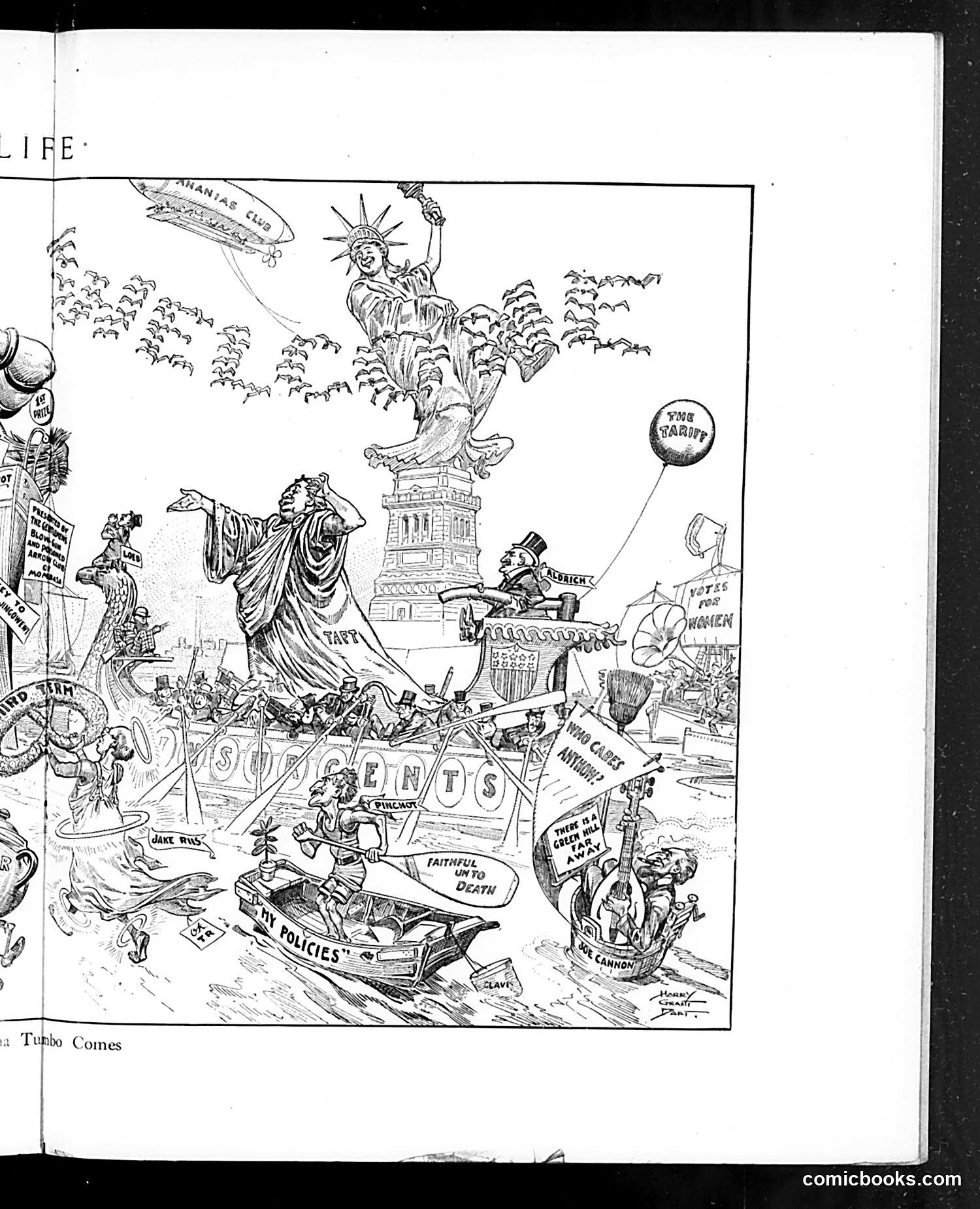
This is a satirical cartoon from *Life* magazine depicting the Statue of Liberty presiding over a chaotic scene of American political and social concerns. The central female figure labeled "Tart" appears to represent corruption or moral compromise, while surrounding elements include references to "Suffragists," "Votes for Women," and various policy issues ("Tariff," "Anti-Monopoly," "Cannon," "Policies"). The cartoon satirizes competing political interests and factions—likely from the Progressive Era—all clamoring for attention beneath Lady Liberty. The "Anarchists Club" balloon and various labeled figures suggest commentary on immigration, women's suffrage, monopolistic business practices, and political corruption. The overall message appears critical of the fractious, self-interested nature of American political life during this period.
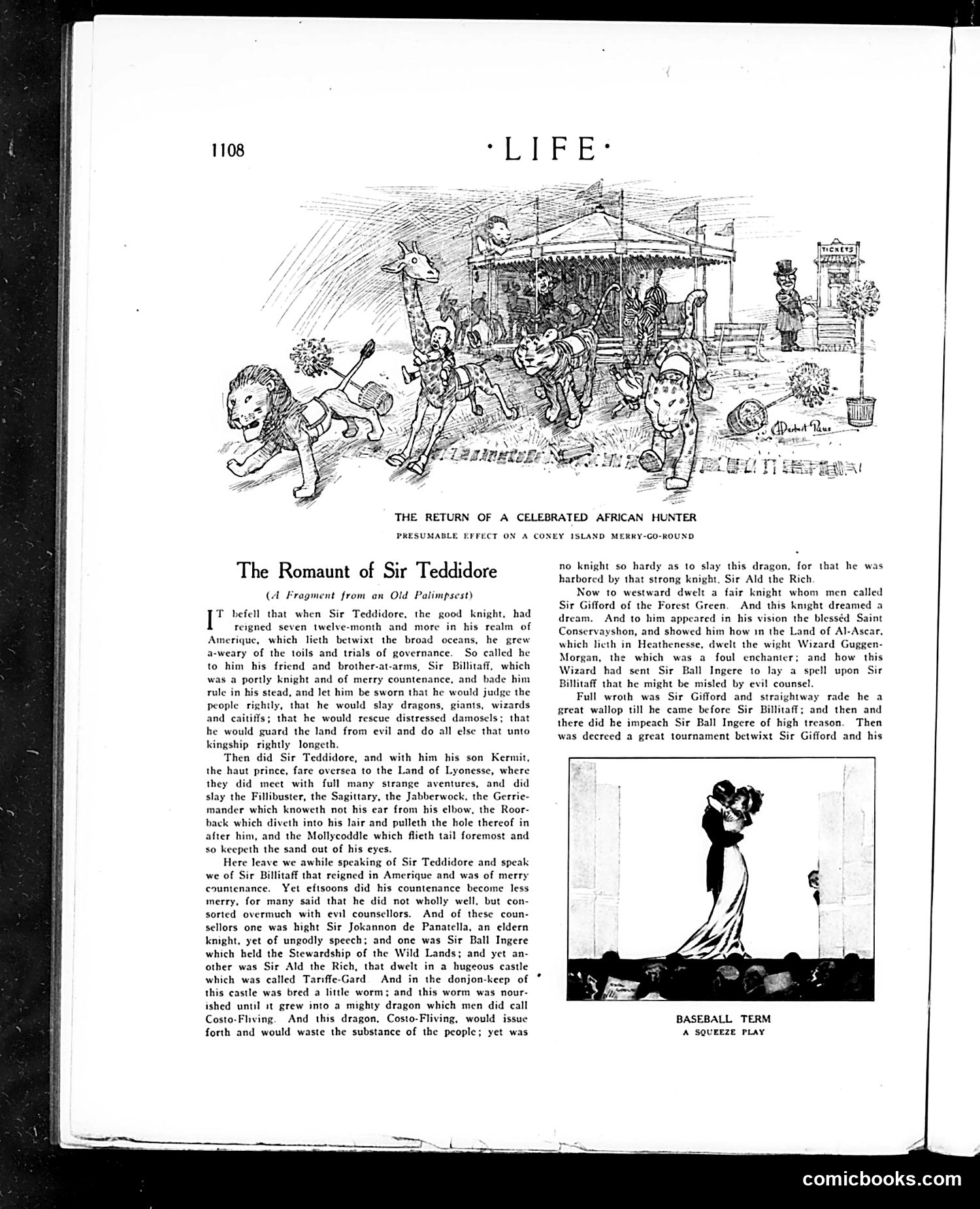
This is a satirical piece mocking President Theodore Roosevelt's African hunting expedition. The top cartoon shows the chaotic effect of "a celebrated African hunter" returning to Coney Island's merry-go-round—depicting wild animals and pandemonium. The medieval narrative parodies Roosevelt ("Sir Teddidore") leaving office, with Vice President William Howard Taft ("Sir Billitaff") assuming power. The story ridicules Taft's administration, particularly his association with controversial advisors and his handling of conservation issues. "Sir Gifford of the Forest Green" appears to reference Gifford Pinchot, the conservationist who clashed with Taft's Secretary of the Interior. The satire suggests Roosevelt's absence created chaos, with evil counselors corrupting Taft's leadership. The "dragon" of rising costs plagued the nation unchecked. The "Baseball Term: A Squeeze Play" caption likely references political maneuvering or pressure tactics occurring simultaneously.
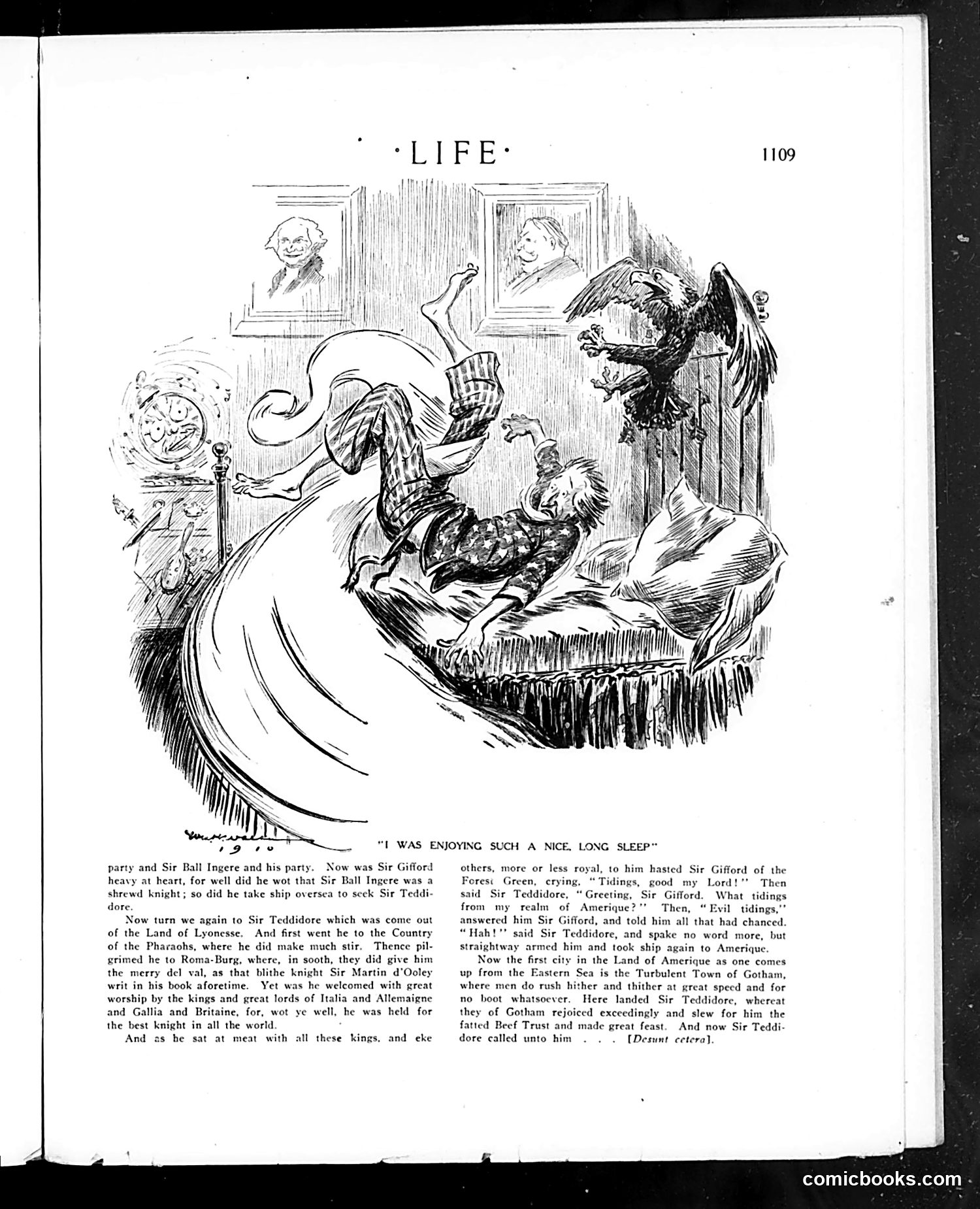
This is a satirical narrative in mock-medieval language about "Sir Teddidore" (Theodore Roosevelt) awakening from sleep to find his American realm in disorder. The illustration shows a sleeping figure being rudely awakened by an eagle and news-bearer. The satire operates on multiple levels: **The Setup**: Roosevelt is depicted as a knight who has been traveling abroad (referencing his post-presidency African safari and European tour, 1909-1910), leaving his "realm of Amerique" unattended. **The Crisis**: "Sir Gifford of the Forest Green" arrives with bad tidings from home—likely referencing the Ballinger-Pinchot conservation controversy, where Roosevelt's chosen successor William Howard Taft fired conservationist Gifford Pinchot, angering Roosevelt's progressive base. **The Point**: The cartoon mocks Roosevelt's surprise at domestic problems erupting during his absence, suggesting his chosen heir has mismanaged affairs. The dramatic awakening and immediate re-arming implies Roosevelt must rush back to restore order. The medieval parody tone underscores the grandiose perception of Roosevelt's political importance to American politics.
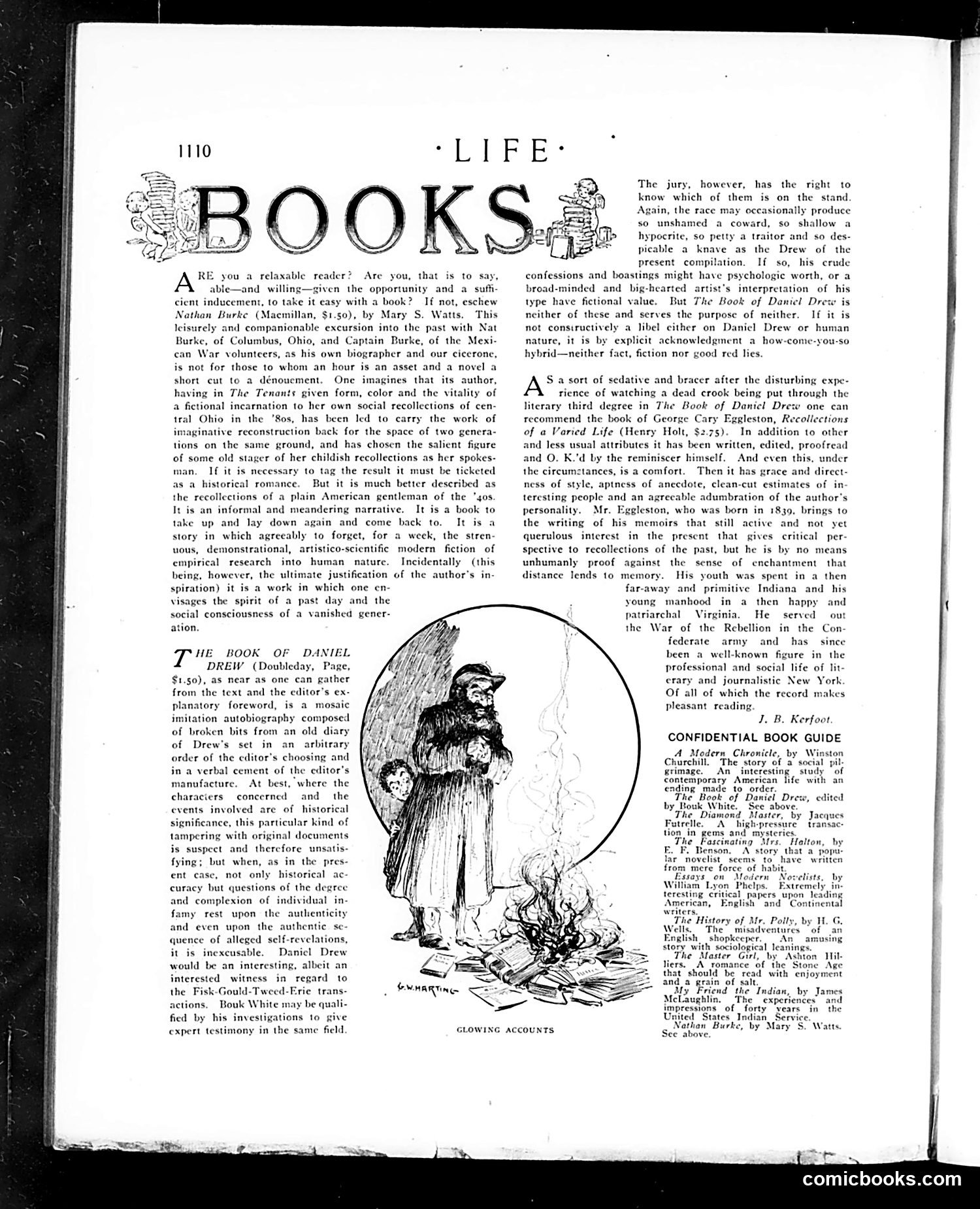
This page from *Life* magazine presents book reviews under the heading "GLOWING ACCOUNTS"—itself a satirical title, since the reviews are decidedly mixed. The main illustration shows a figure surrounded by books and papers, likely representing Daniel Drew, the subject of one reviewed book. Drew was a notorious 19th-century financier involved in railroad schemes with Jay Gould and Jim Fisk—scandals familiar to contemporary readers. The reviewer criticizes "The Book of Daniel Drew" harshly, questioning whether it's authentic autobiography or editorial fabrication. The key satire: the reviewer suggests Drew might be too contemptible a person to merit even fictional treatment—he's simultaneously so morally corrupt yet so trivial that his confessions serve neither historical truth nor artistic value. It's a cutting joke: Drew is too despicable even for a damning biography. By contrast, the reviewer praises Mary S. Watts's "Nathan Burke" as a leisurely, humane historical novel about ordinary Ohio life—implicitly favoring genteel recollection over exposés of financial villainy.
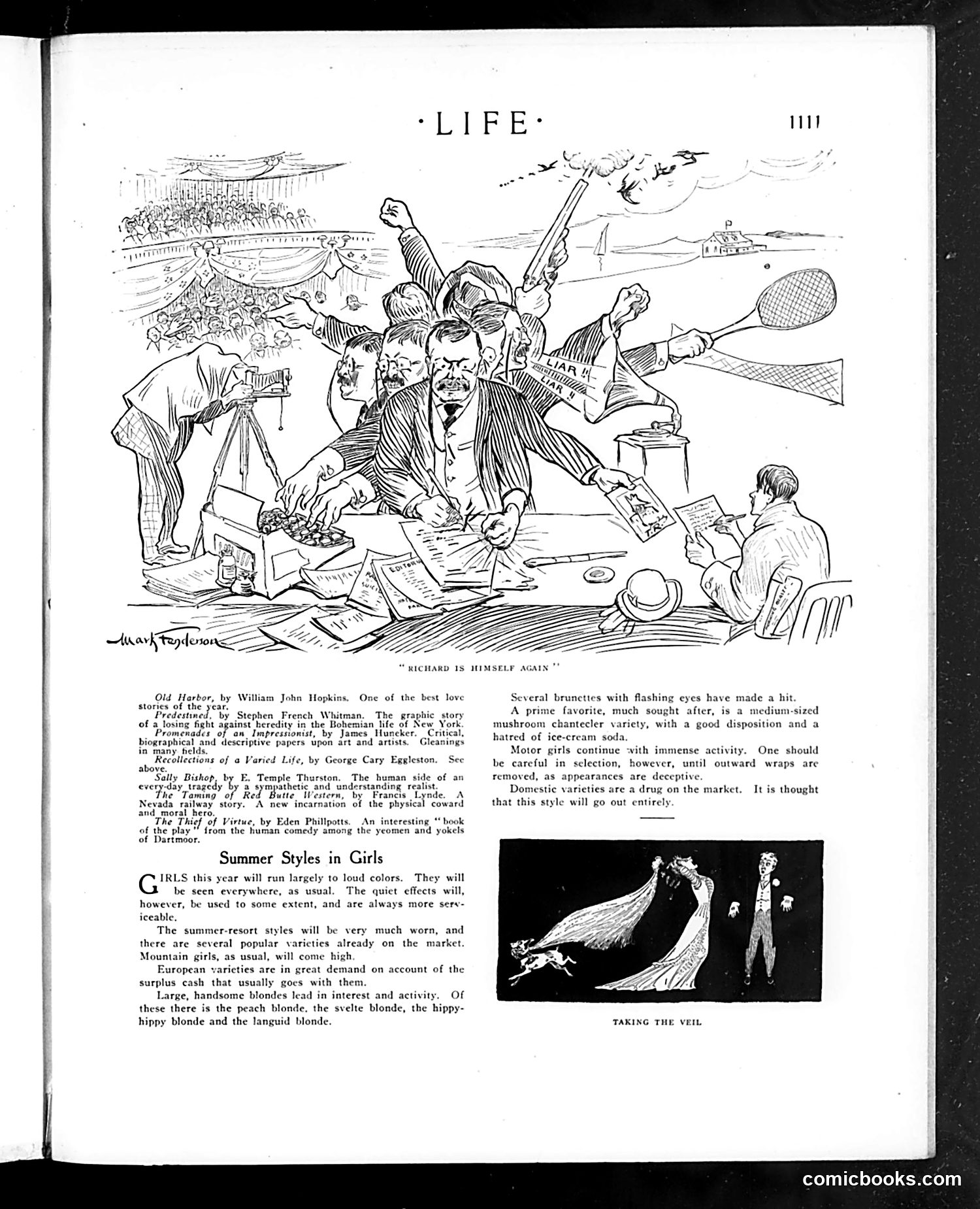
The main cartoon, titled "Richard is Himself Again," depicts a frantically multi-tasking man surrounded by competing demands—a circus-like scene showing him juggling a telescope, tennis racket, papers, and other objects while various figures make claims on his attention. The satire satirizes the overstimulated modern man of the era, overwhelmed by simultaneous professional, social, and recreational obligations. The accompanying text section, "Summer Styles in Girls," is tongue-in-cheek commentary on fashionable young women, treating them as consumer goods with market varieties—"peach blonde," "hippy-hippy blonde," "mountain girls," "motor girls," and "domestic varieties." The humor lies in cataloging women by appearance and type as one might list seasonal fashion products, with dismissive asides (domestic varieties described as "a drug on the market"). This reflects period attitudes about women as decorative social fixtures rather than full persons, presented here for satirical effect to expose those very attitudes.
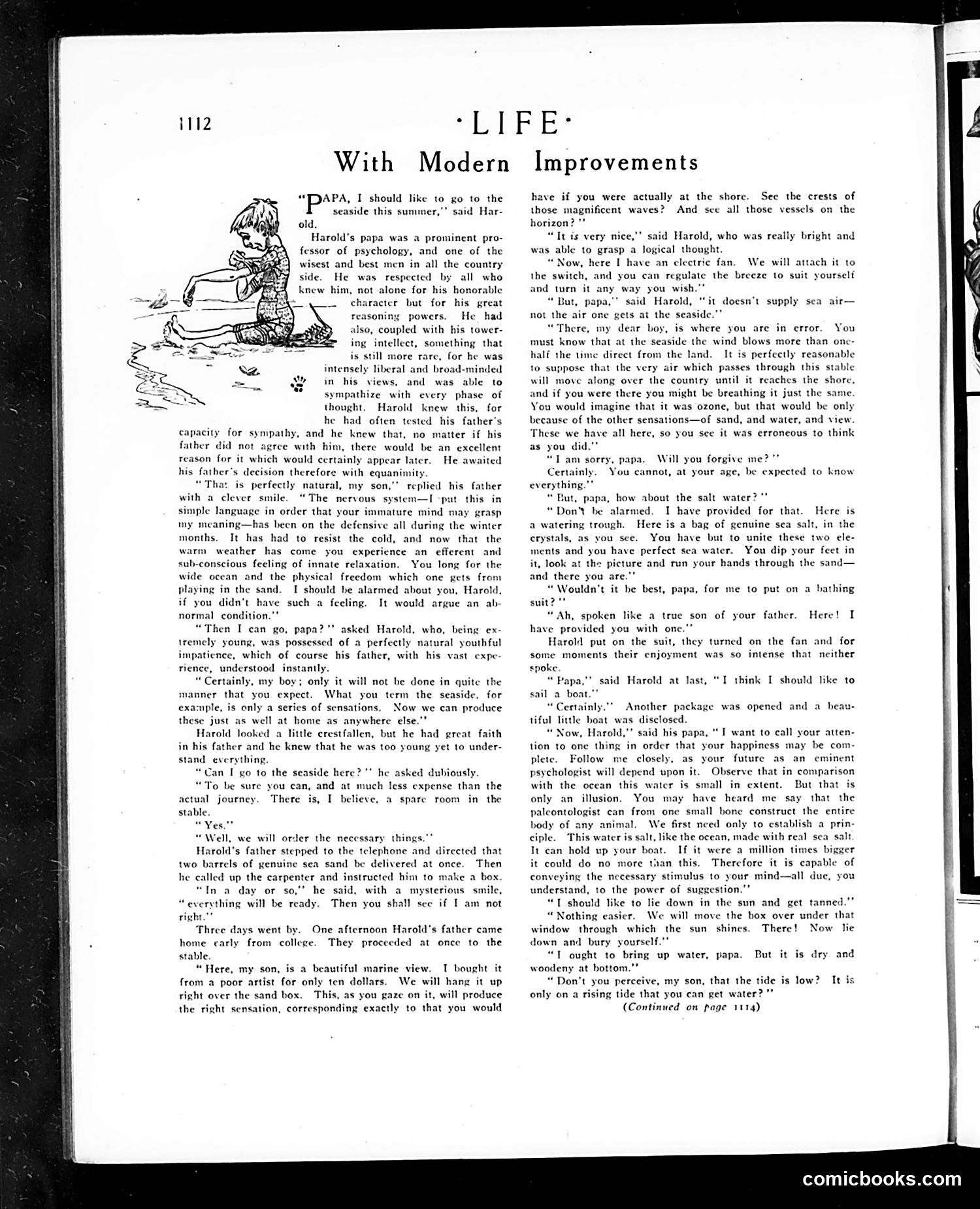
This page satirizes the pretentious intellectualism of early 20th-century psychology and pseudo-scientific parenting. Harold's father—a prominent psychology professor—epitomizes the era's faith in pseudoscientific rationalization of everyday life. When Harold requests a seaside holiday, his father delivers an absurdly elaborate explanation of the "nervous system" and "efferent sub-conscious feeling" before refusing the actual trip. Instead, he constructs a fake seaside in the stable: a painted marine picture, sand in a box, and an electric fan to simulate ocean breeze. The humor lies in the father's pompous justification that since the seaside is "only a series of sensations," he can manufacture identical sensations artificially—missing entirely that his son simply wants a real beach experience. The satire mocks how intellectuals misapply scientific jargon to avoid practical solutions and how they rationalize away simple human desires through overwrought theory.
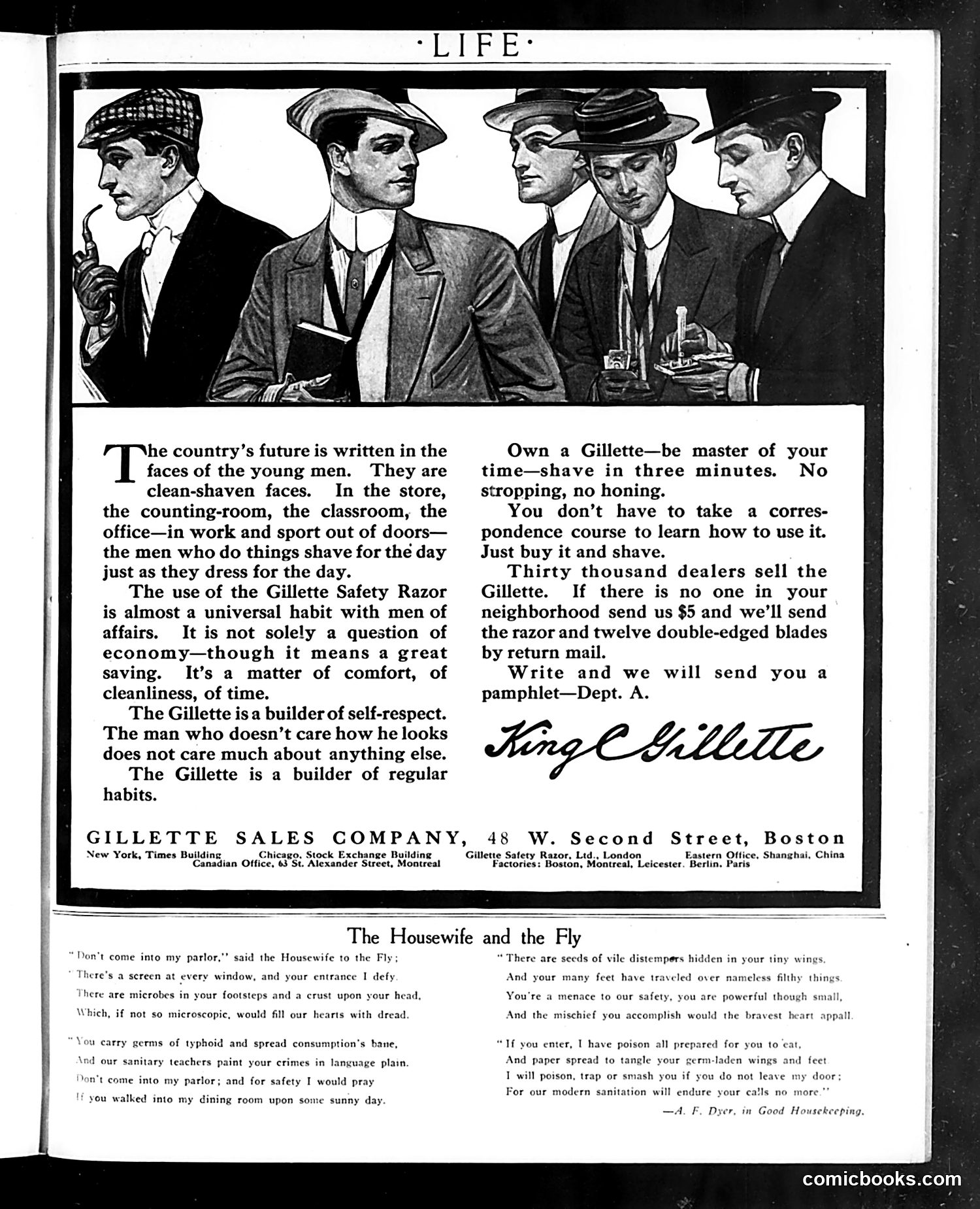
This page is primarily a **Gillette Safety Razor advertisement** (top two-thirds) with an unrelated poem below. The ad features five illustrated men in profile, presented as exemplars of modern masculinity and success. The accompanying text connects clean-shaving to character and ambition: young men who "do things" shave daily, and grooming reflects self-respect and regular habits. The ad frames the Gillette as enabling efficiency—shaving in three minutes—and positioning it as a tool of self-improvement tied to professional and social advancement. The message conflates personal grooming with moral character, a common early 20th-century marketing tactic appealing to aspirational working and middle-class men. Below is an unrelated poem, "The Housewife and the Fly," using the housewife's perspective to humorously detail disease transmission by houseflies—reflecting contemporary public health concerns about sanitation and germ theory that were gaining public attention in this era.
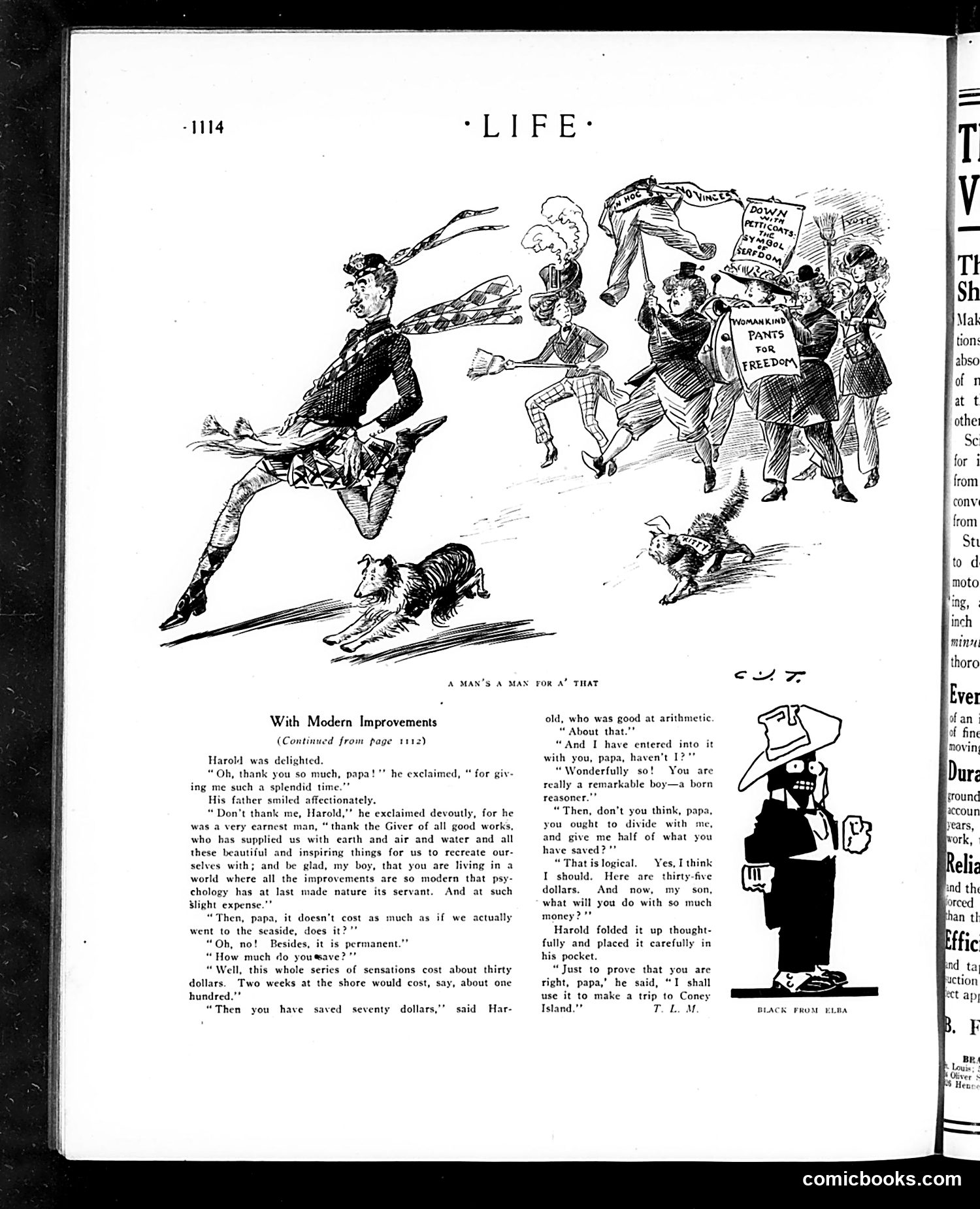
This satirical story mocks the modern era's obsession with efficiency and artificial substitutes for authentic experience. A father takes his son Harold on a fake seaside vacation created through "psychology" and "modern improvements"—apparently some kind of simulated or staged experience—costing only $30 instead of $100 for a real trip. The satire targets two targets: first, the replacement of genuine nature with manufactured alternatives in the name of progress; second, the father's smug rationalization of this deception as scientific advancement and economy. Harold's innocent logic—that if they saved money, the father should share it—exposes the absurdity: the boy then uses his half to visit *actual* Coney Island, defeating the entire premise. The cartoon title references Burns's famous line about human equality, suggesting irony about modern "improvements" that separate people from authentic living.
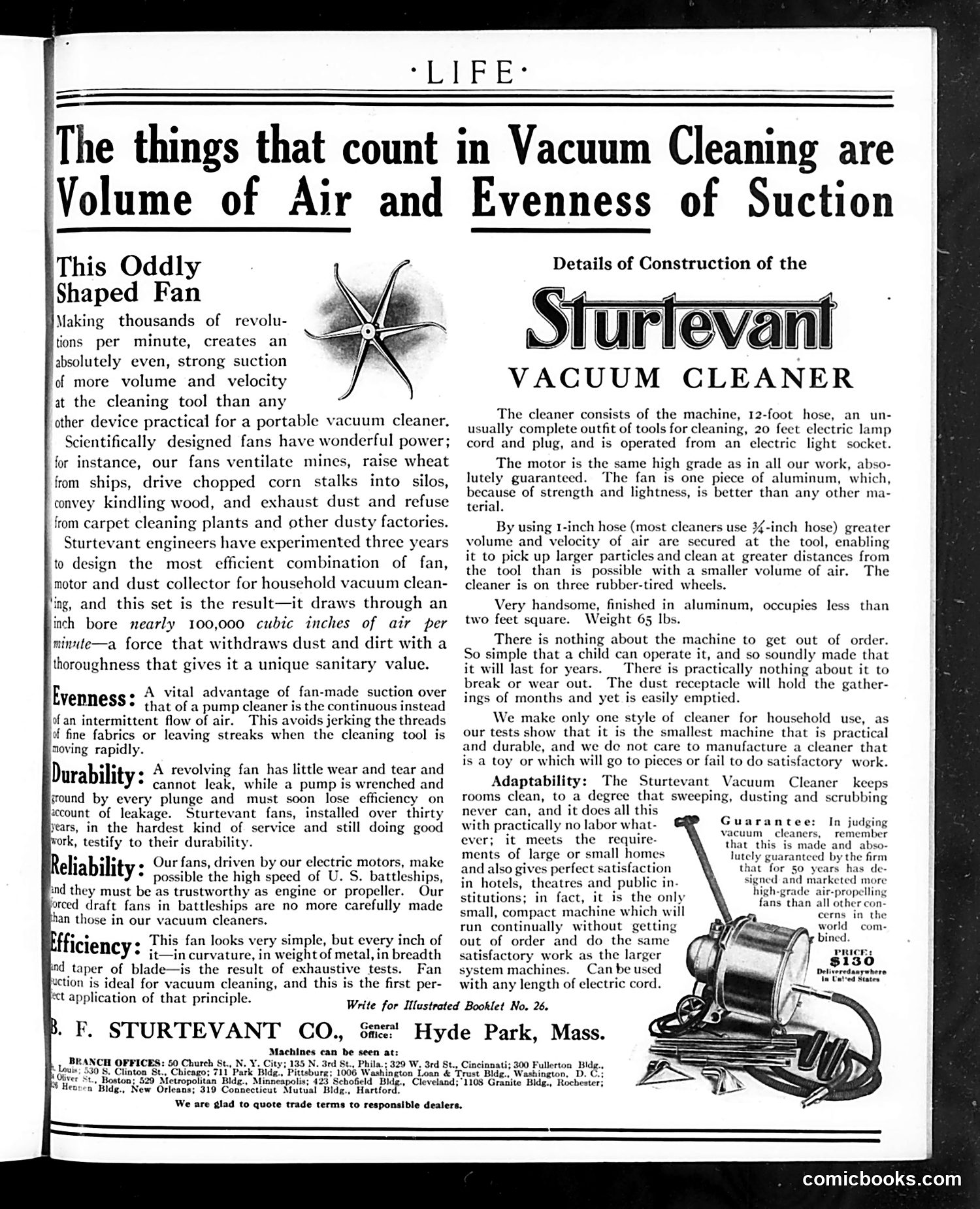
This page is primarily a **product advertisement**, not political satire. It promotes the Sturlevant brand vacuum cleaner to American households. The oddly-shaped fan diagram illustrates the cleaner's technical superiority—its ability to move large volumes of air evenly. The text emphasizes practical advantages: durability (fans don't leak like pumps), reliability (Sturlevant motors power U.S. battleships), and efficiency. The machine is marketed as foolproof ("a child can operate it") and durable ("nothing about it to break"). The lengthy copy stresses industrial applications (ventilating mines, powering farm equipment) to establish engineering credibility before pivoting to household use. The $130 price tag and guarantee statement position it as a premium product for the emerging suburban American market of the early 20th century. This represents Life magazine's commercial function alongside satire during this era.
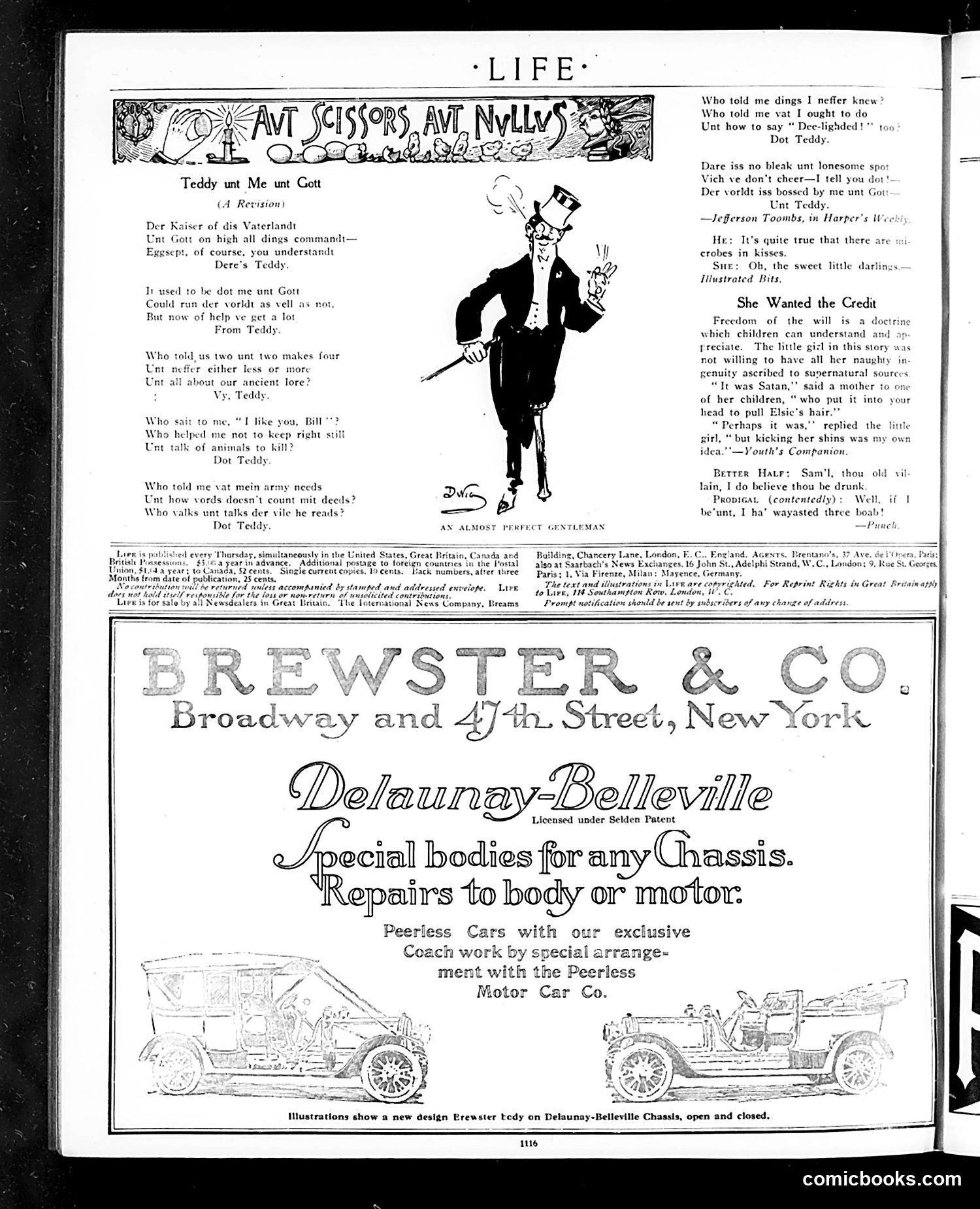
This is a German-dialect satire mocking Kaiser Wilhelm II's inflated sense of power relative to Theodore Roosevelt. The cartoon presents the Kaiser boasting that he and God once controlled the world—until "Teddy" (Roosevelt) arrived to upstage them both. The poem's repeated refrain "Dot Teddy" catalogs Roosevelt's alleged meddling: teaching mathematics, offering unsolicited advice, influencing military strategy, and generally dominating world affairs. The Kaiser's grudging admission that Roosevelt now effectively "bosses" the world alongside himself and God is the satire's core joke. The dialect humor (German accent rendered phonetically: "vorldt," "vat," "nefier") was a common contemporary comedic device. This reflects early-1900s American satirical attitudes toward both German arrogance and Roosevelt's expansionist foreign policy and reputation for aggressive intervention in global affairs. The piece critiques Roosevelt's outsized influence on the world stage through mock-resentful portrayal of his superiority.
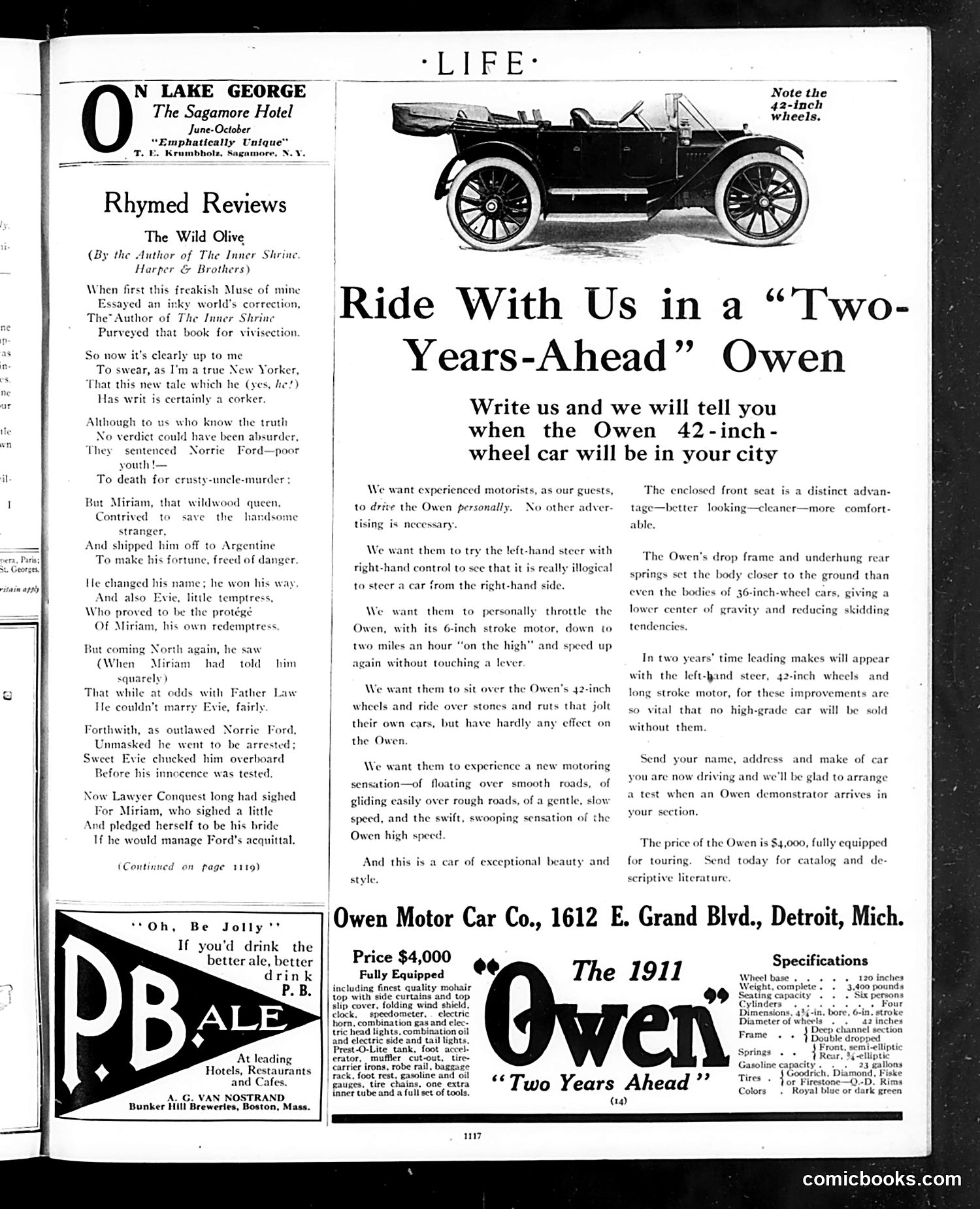
This page combines literary content with automobile advertising, reflecting early 1900s magazine conventions. **Left Column—"Rhymed Reviews":** A satirical poetry review of a novel called *The Wild Olive* by the author of *The Inner Shrine*. The reviewer mocks the melodramatic plot—involving a man falsely sentenced to death for murder, an exotic "wildwood queen" named Miriam, exile to Argentina, and romantic complications—calling the verdict "absurd" and the story contrived. This is genteel literary satire typical of Life's cultural criticism. **Right Section—Owen Motor Car Advertisement:** A full-page advertisement for the 1911 Owen automobile ($4,000), emphasizing its innovative features: 42-inch wheels, left-hand steering with right-hand controls, and low-slung frame design. The ad invites experienced drivers to test-drive it personally and predicts these features will become industry standard within two years. **Bottom Left:** A P.B. Ale advertisement using humor ("Oh, Be Jolly"). The page represents Life's mix of satirical book reviews and high-end consumer advertising aimed at affluent, educated readers.
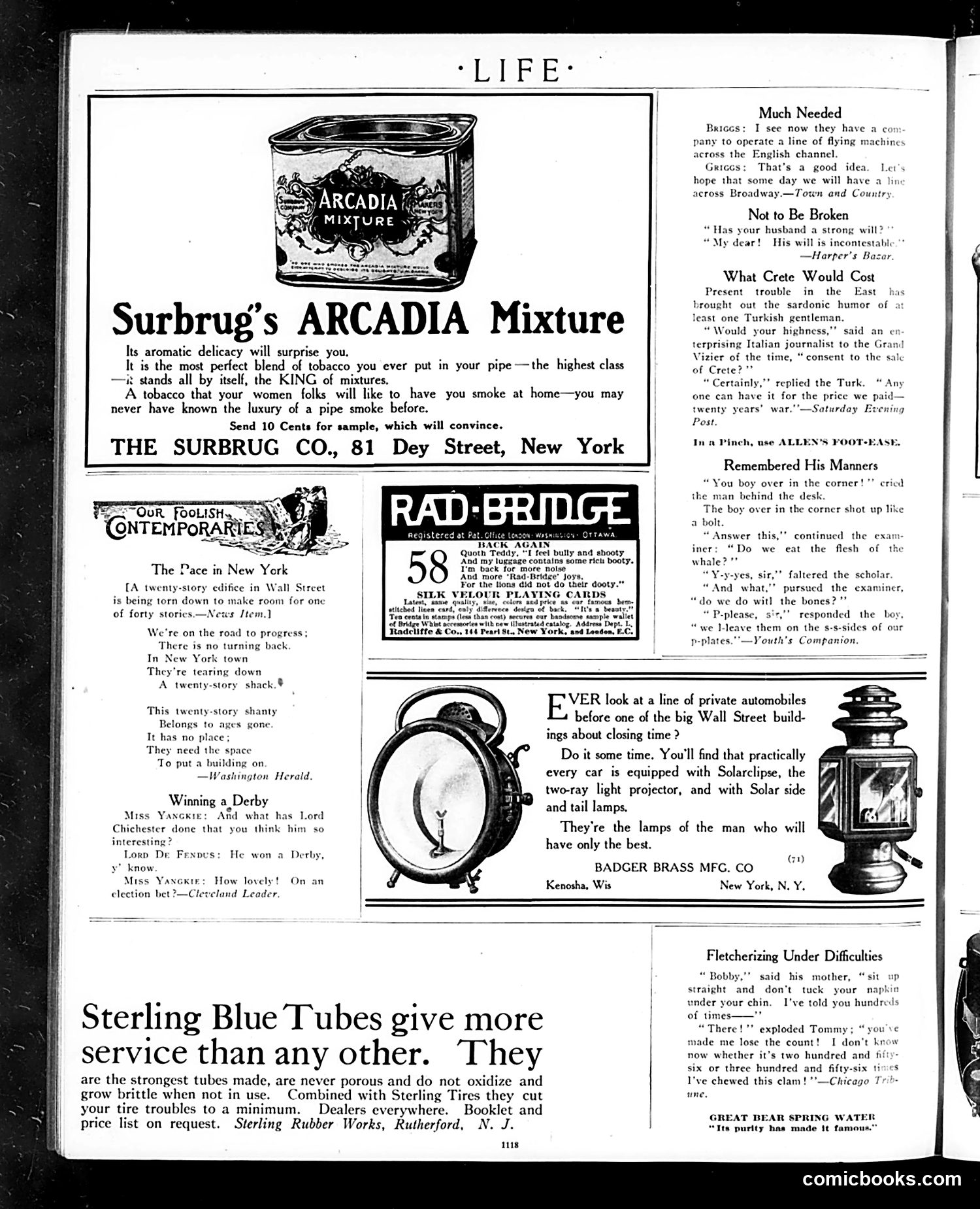
This page is primarily **advertising** interspersed with brief humor items typical of early 20th-century satirical magazines. The advertisements include tobacco (Surbrug's Arcadia Mixture), playing cards (Rad-Bridge), automobile lamps (Badger Brass), and rubber tubes (Sterling Blue Tubes). The text-based humor items are short jokes and quips unrelated to each other: - Flying machines across the English Channel vs. Broadway - A joke about a husband's will - A historical anecdote about Ottoman officials discussing Crete's cost - A schoolboy examination about whales - Commentary on New York's architectural development (tearing down a 20-story building for a 40-story one) - A domestic humor piece about a mother correcting her son's table manners None reference specific political figures or events requiring historical context. The humor relies on wordplay, domestic situations, and general observations about modern life—typical of Life's lighter content from this era (appears to be early 1900s based on style and references).
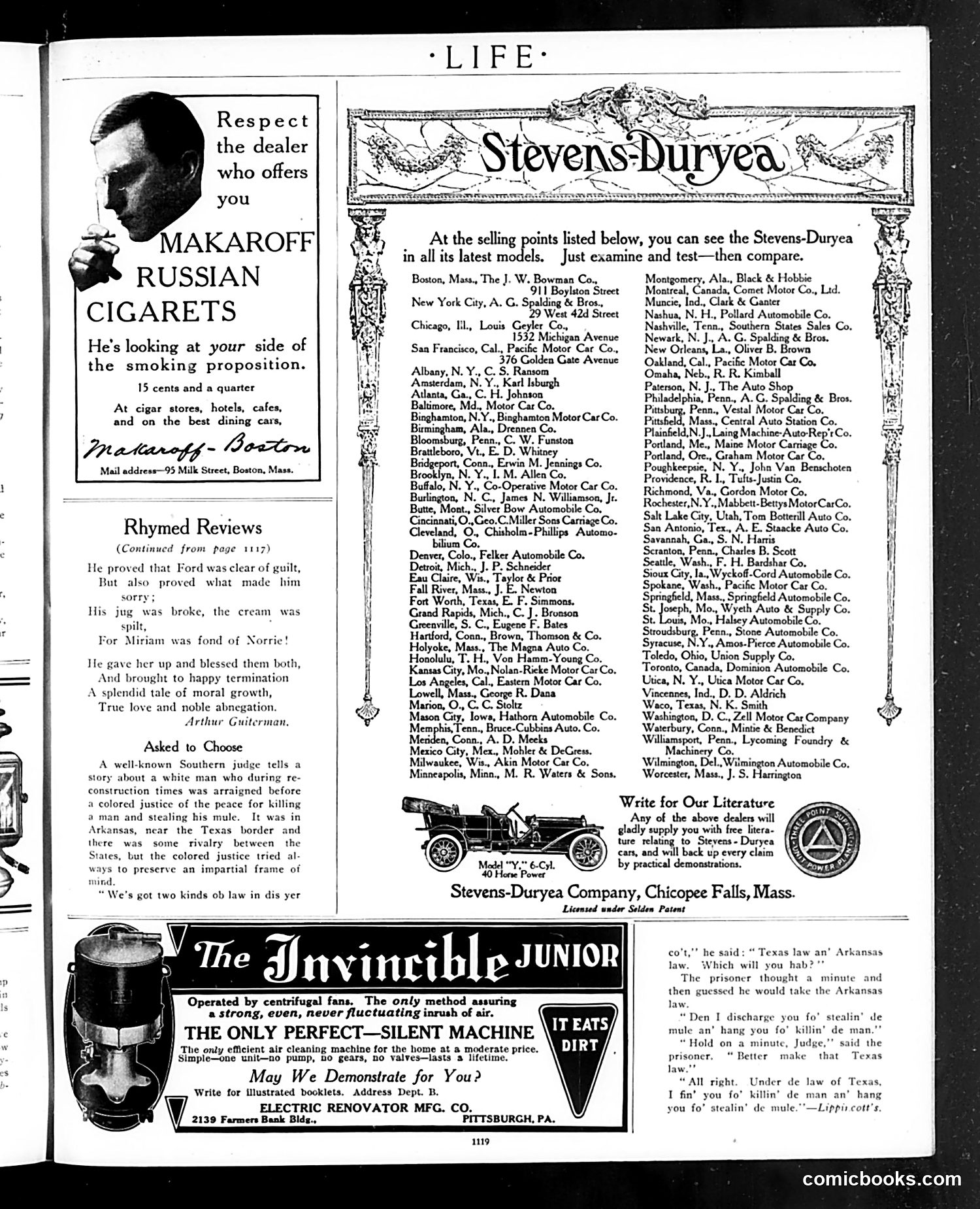
This is primarily an **advertising page** from Life magazine, not satirical content. The page contains three distinct advertisements: 1. **Makaroff Russian Cigarettes**: An ad featuring a profile portrait of a man, emphasizing respectability and availability at quality establishments. 2. **Stevens-Duryea automobiles**: A large display listing hundreds of authorized dealers across North America, showcasing the car's widespread distribution network. 3. **The Invincible Junior air cleaner**: An industrial product advertisement promising effective dust removal. The only actual editorial content is a brief "Rhymed Reviews" section discussing a Ford film and a humorous anecdote about Reconstruction-era Arkansas law. The judge's story plays on period racial stereotypes and tensions between states during that post-Civil War era. The page reflects early 20th-century advertising practices and consumer culture rather than political satire.
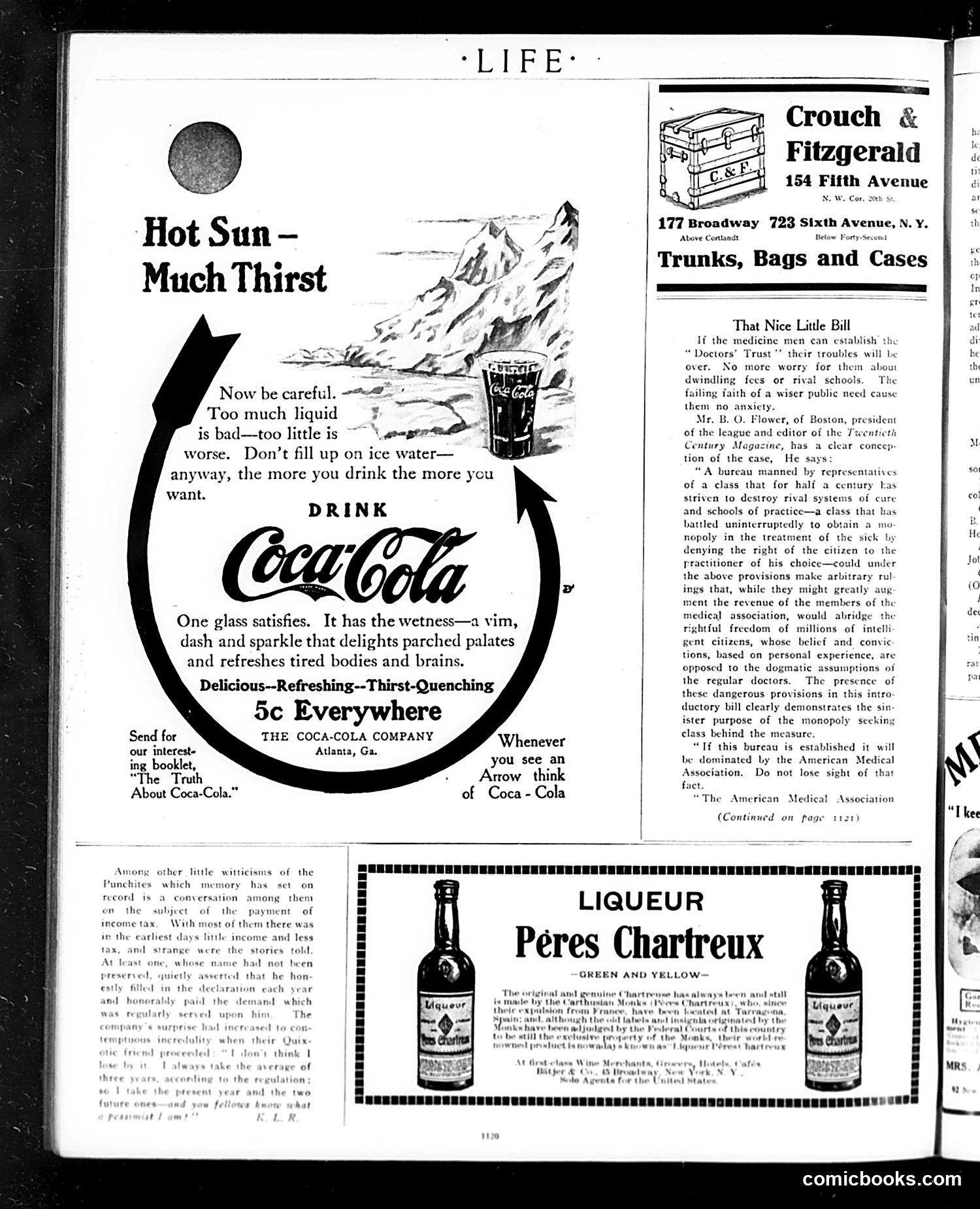
This page contains **primarily advertisements** with one editorial piece about medical regulation. The main **Coca-Cola ad** uses a desert/heat scenario to pitch the drink as thirst-quenching relief. The messaging warns against drinking too much water ("the more you drink the more you want") and promotes Coca-Cola as the superior alternative—a common early 20th-century advertising claim before modern understanding of hydration. The editorial piece titled "That Nice Little Bill" argues **against medical monopoly legislation**. It criticizes the "Doctors' Trust"—a proposed regulatory bureau that would be controlled by the American Medical Association. The author (B.O. Flower) warns this would restrict citizens' freedom to choose alternative medical practitioners and treatments, consolidating power in the hands of conventional doctors while limiting competition from other healing systems and schools of practice. This reflects Progressive Era tensions between **medical professionalization and patient autonomy**, when alternative practitioners (homeopaths, naturopaths, etc.) still had significant popular support before allopathic medicine became dominant. The remaining advertisements are for luggage and liqueur.
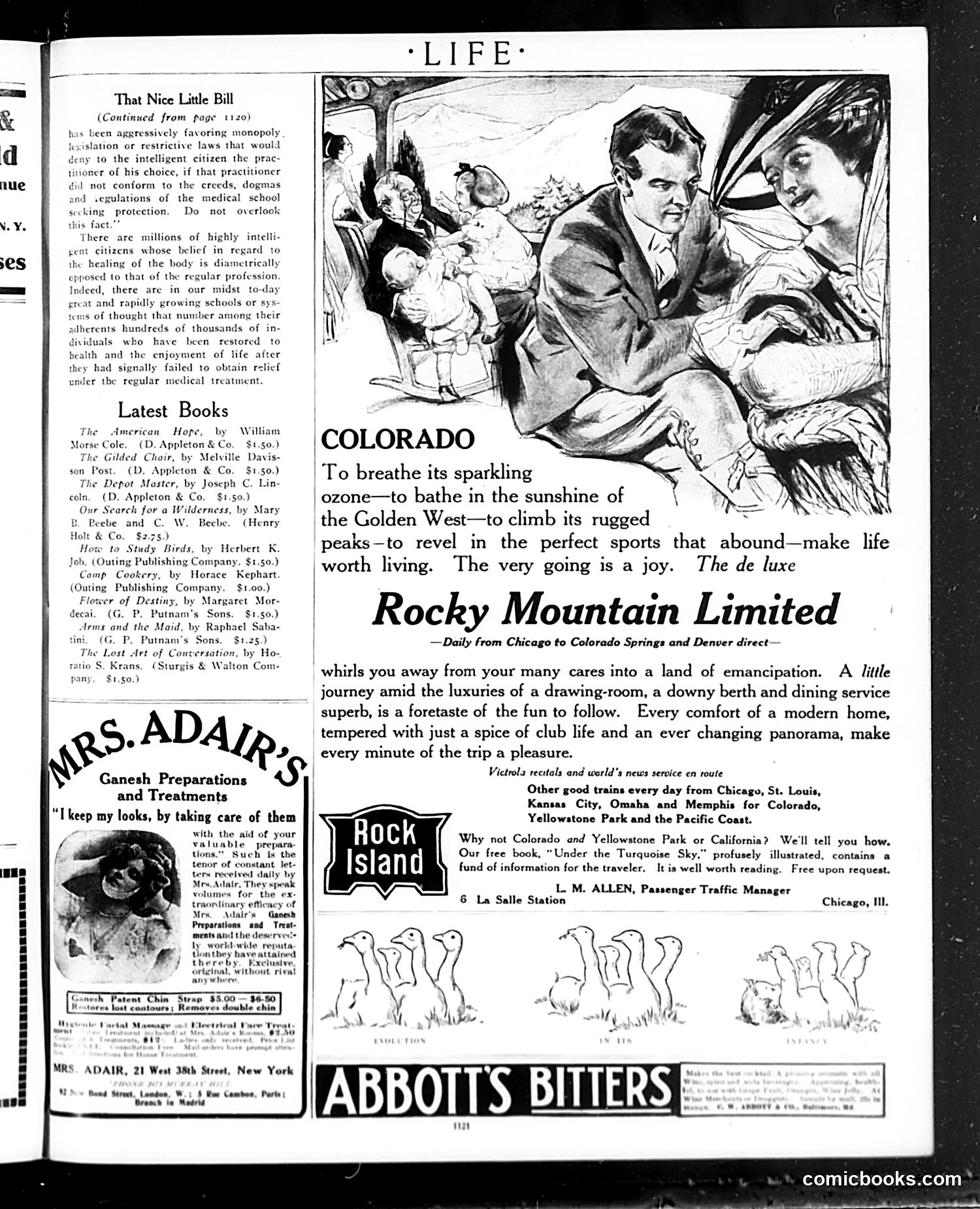
This page mixes editorial content with advertising. The main article, "That Nice Little Bill" (continued from page 1120), criticizes medical monopoly legislation that would restrict citizens' choice of practitioners. The writer defends alternative healing systems and practitioners outside mainstream medicine—referencing "schools or systems of thought" with "hundreds of thousands" of adherents who found relief where regular medicine failed. This reflects early 20th-century tensions between established medical licensing and alternative practitioners (homeopaths, naturopaths, etc.). The piece argues intelligent citizens deserve freedom to choose unorthodox treatments despite medical establishment opposition. The rest of the page contains book advertisements and travel promotions, including Mrs. Adair's beauty preparations and the Rocky Mountain Limited train service to Colorado—typical Life magazine content mixing social commentary with consumer advertising.
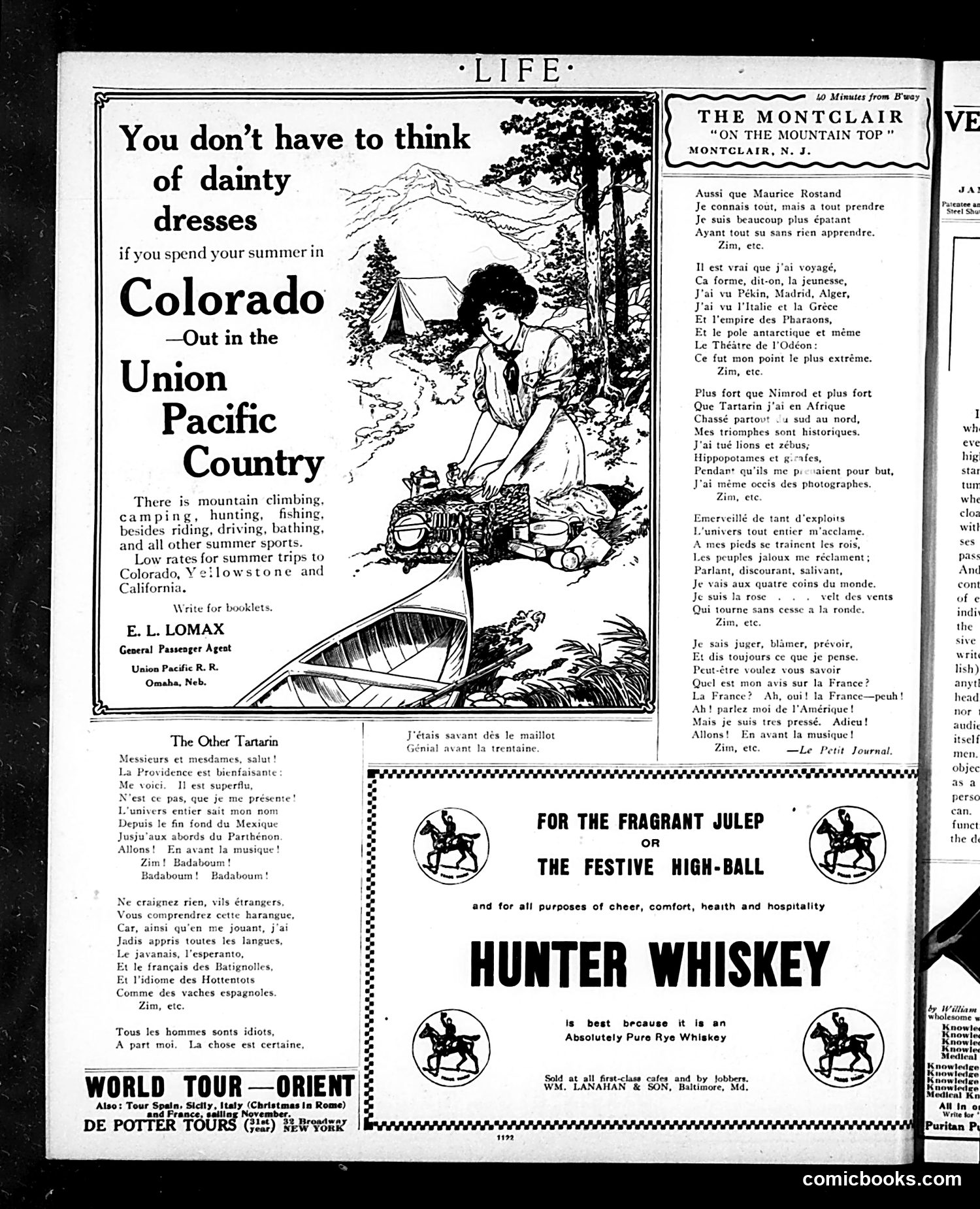
This page contains primarily **advertisements and French literary content**, not political cartoons requiring historical context. The main visual element is a **Union Pacific Railroad advertisement** (left side) featuring an illustration of a woman camping in Colorado, promoting summer travel. The ad's message is straightforward: outdoor recreation doesn't require "dainty dresses"—practical clothing suffices for mountain activities. The French text appears to be a satirical poem titled "The Other Tartarin," mocking a boastful character who claims impossible feats of travel and conquest across the world while simultaneously dismissing France and America. This likely references **Tartarin of Tarascon**, a famous French literary character known for tall tales and exaggeration. The satire targets pompous braggadocio and cultural pretension. The bottom half features a **Hunter Whiskey advertisement**, emphasizing it as "Absolutely Pure Rye Whiskey" for social occasions. The page is primarily **commercial content with literary humor** rather than political satire requiring specialized historical knowledge.
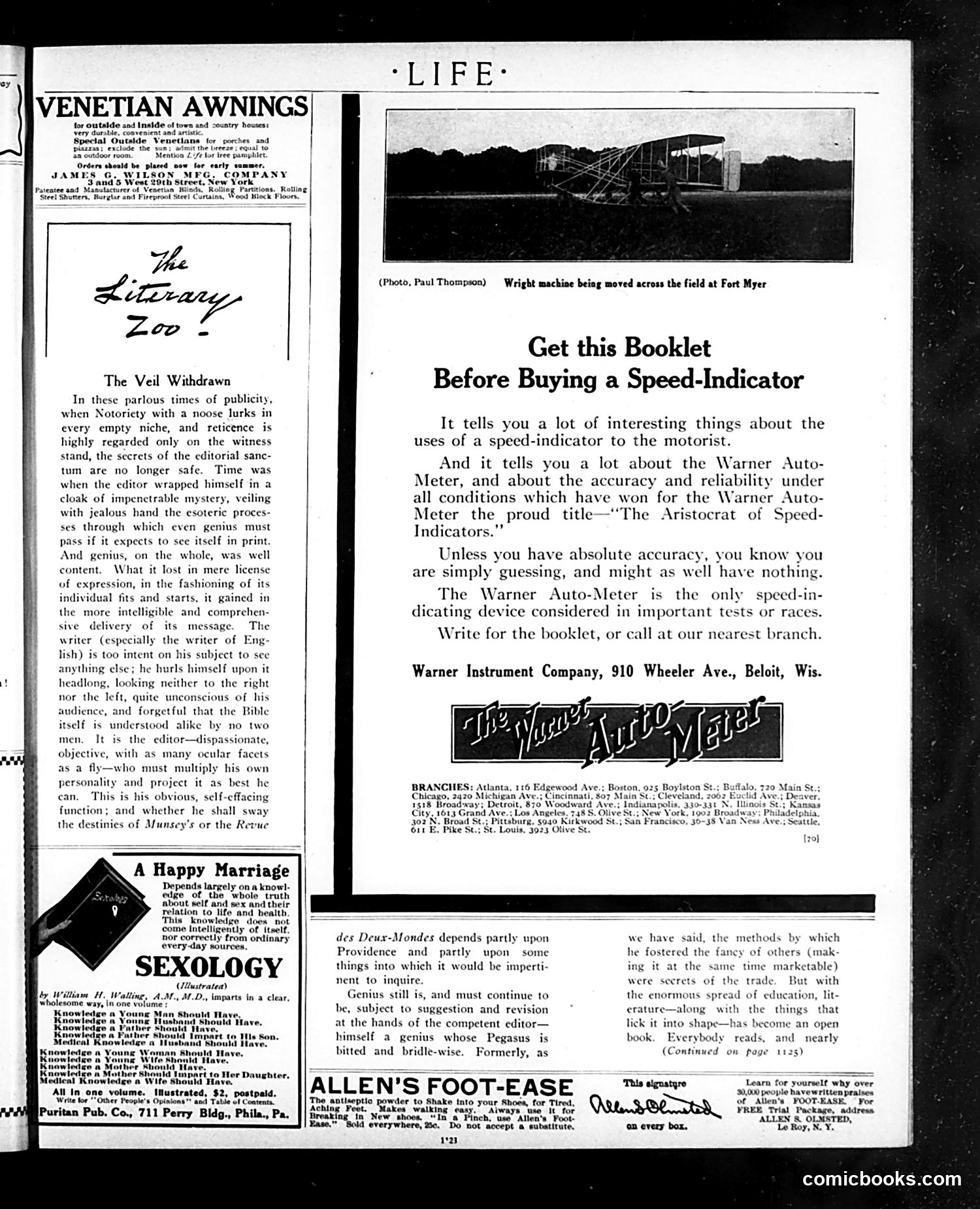
This is primarily a **page of advertisements and sponsored content** from an early-20th-century issue of *Life* magazine. While a lead essay titled "The Veil Withdrawn" discusses the editorial process—critiquing how modern publicity has exposed the once-secretive methods by which editors shape content for readers—the page's main purpose is commercial. The page features: - An ad for **Venetian awnings** (James G. Wilson MFG.) - A prominent **Warner Auto-Meter speed-indicator advertisement** featuring a photograph of a Wright airplane being moved at Fort Myer - A **sexology book advertisement** (*Illustrated*) - An **Allen's Foot-Ease powder advertisement** The Wright airplane photo suggests an early aviation context (likely pre-1910), when such machines were still experimental and newsworthy. The satire offered is editorial commentary on transparency and authority—noting that editors once wielded mysterious power over published content, now compromised by widespread education and publicity. The advertisements surrounding this essay illustrate precisely that point: mass production and mass marketing.
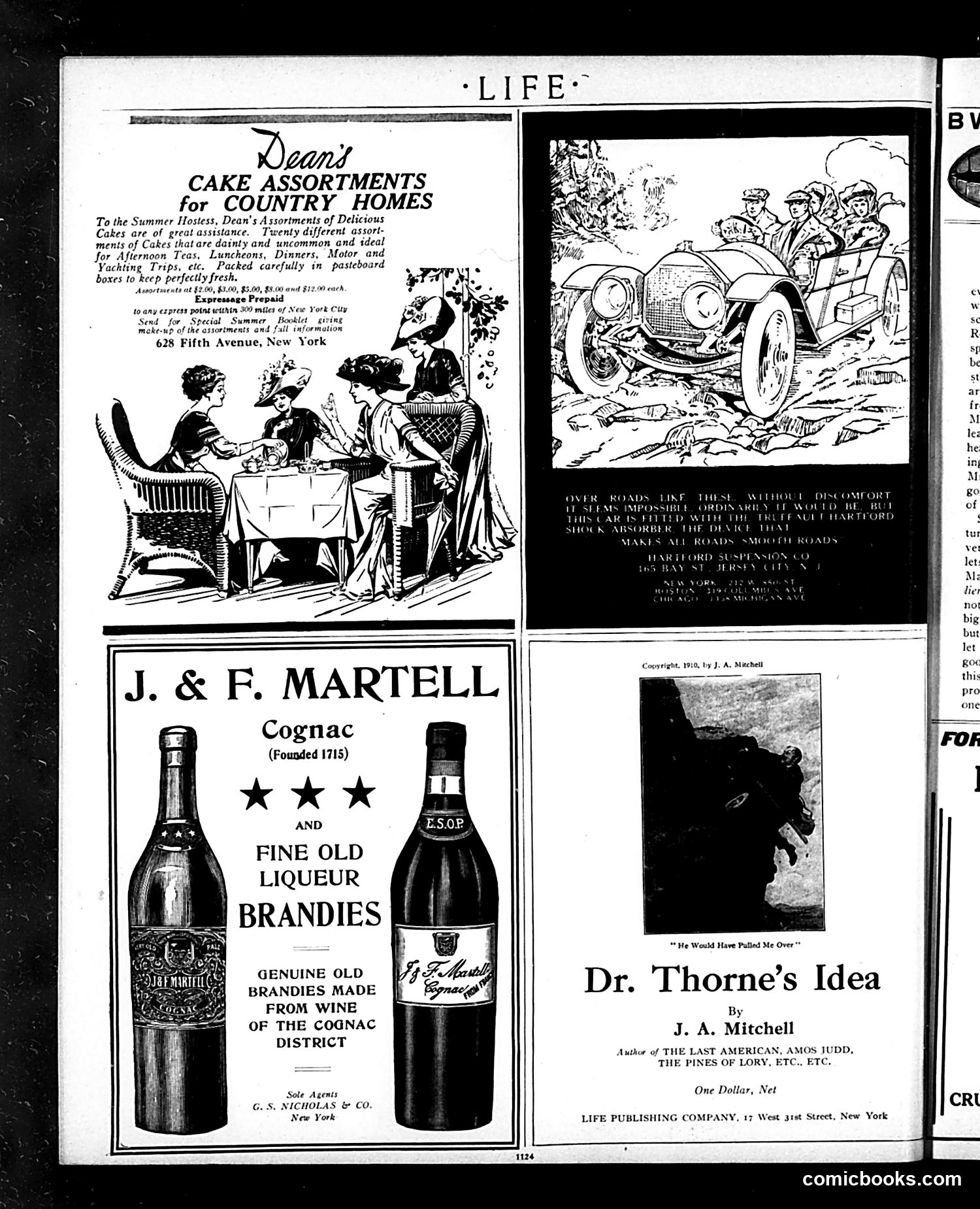
This page is primarily **advertising**, not political satire. It contains four distinct ads: 1. **Dean's Cake Assortments**: Luxury boxed cakes for wealthy summer hostesses entertaining at country homes—targeting the leisure class. 2. **J. & F. Martell Cognac**: Premium French brandy (founded 1715), emphasizing authenticity and age. 3. **Hartford Shock Absorber**: An automobile ad showing passengers in a car on rough roads, highlighting how the device smooths rides—early automotive technology marketing. 4. **Dr. Thorne's Idea**: A serialized story by J. A. Mitchell (Life's co-founder), priced at one dollar. The image caption reads "He Would Have Pulled Me Over," suggesting a romantic or humorous narrative. The page reflects early 20th-century Life magazine's dual focus: humor/literature alongside high-end consumer advertising targeting affluent readers.
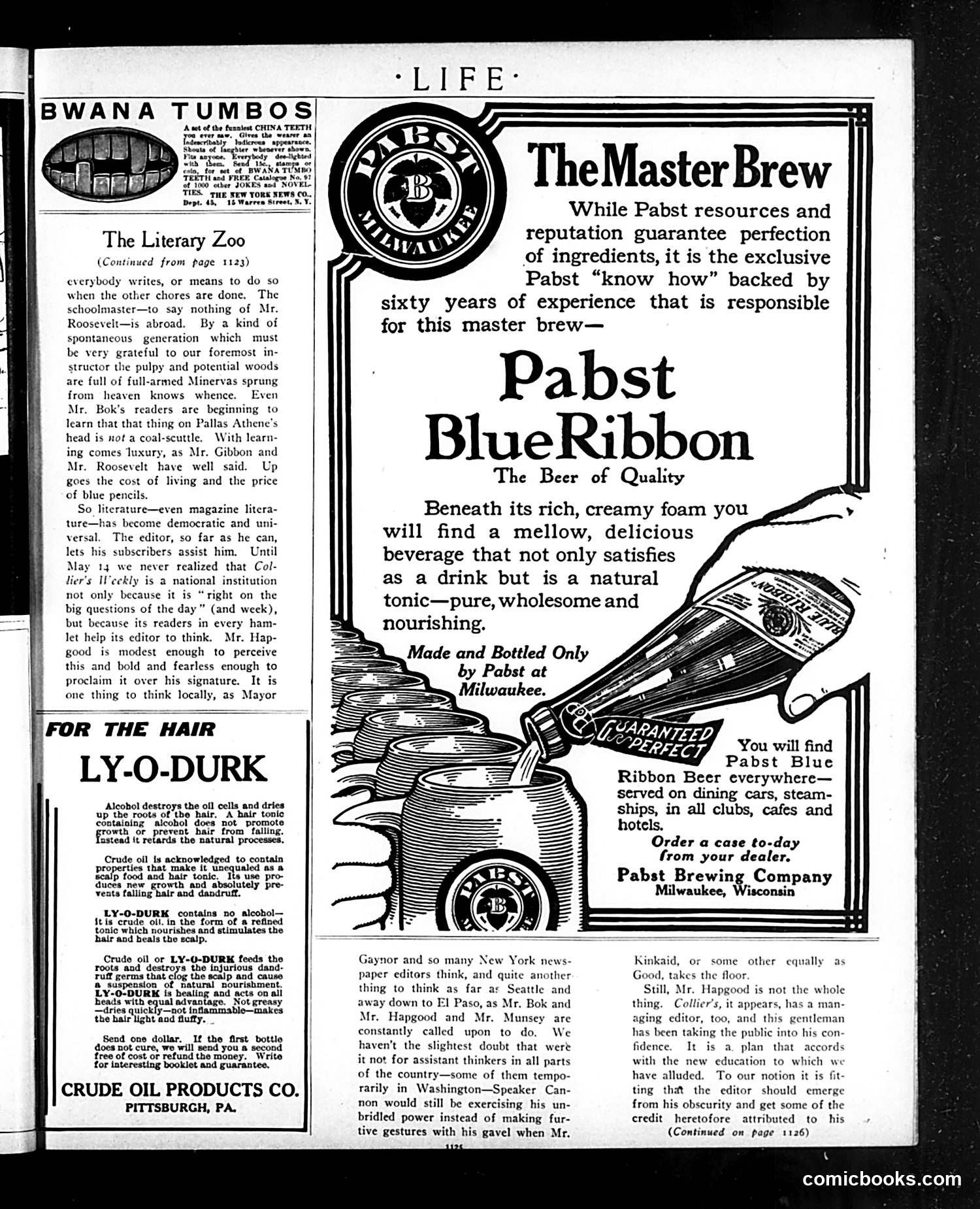
This is primarily a **magazine advertisements and articles page**, not a political cartoon. The main content includes: **"The Literary Zoo" article** (continued from earlier): Commentary on American literature and democratization of writing. It discusses magazine editors like Norman Hapgood (Collier's Weekly) and S.S. McClure as national thought leaders, referencing President Roosevelt and Speaker Cannon's political power. **Advertisements:** The page features product ads for Bwana Tumbo (fake teeth novelty item), Ly-O-Durk (hair tonic claiming superiority to alcohol-based competitors), and prominently, **Pabst Blue Ribbon beer** — marketed as a "natural tonic" that is "pure, wholesome and nourishing" (pre-Prohibition era advertising). The satirical element appears subtle here—the juxtaposition of serious literary discussion with dubious health claims in advertisements reflects the era's loose advertising regulations and the magazine's role critiquing both culture and commercial excess.
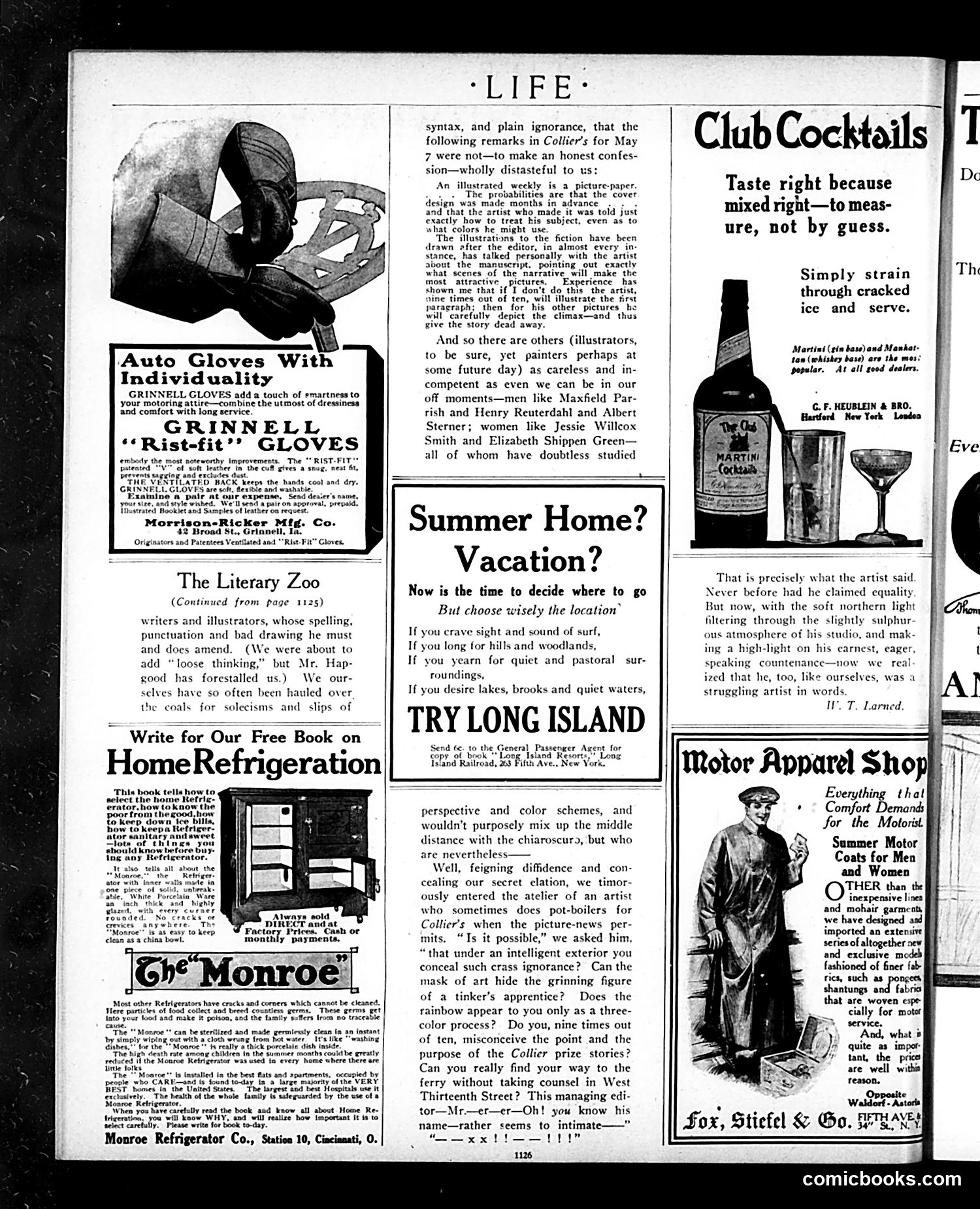
This page from *Life* magazine is primarily **advertising and editorial content**, not political satire. The main items are: 1. **Auto Gloves advertisement** (Grinnell brand) - promoting driving gloves with new ventilation features for early motorists 2. **"The Literary Zoo"** - a brief editorial defending magazine illustrators against criticism in *Collier's* magazine. The author argues that editors properly direct illustrators' work and that some talented artists (naming Maxfield Parrish, Henry Reuterdahl, Albert Sterner, Jessie Willcox Smith, Elizabeth Shippen Green) are sometimes careless despite their skill. This is internal magazine-industry commentary. 3. **Home Refrigeration advertisement** - promoting the "Monroe" brand refrigerator, emphasizing its cleanliness and safety for food preservation, particularly important for child health 4. **Long Island vacation advertisement** and **Motor Apparel Shop advertisement** (bottom right) The page reflects early 20th-century concerns: automobile accessories, food safety and refrigeration technology, and the emerging professionalization of magazine illustration.
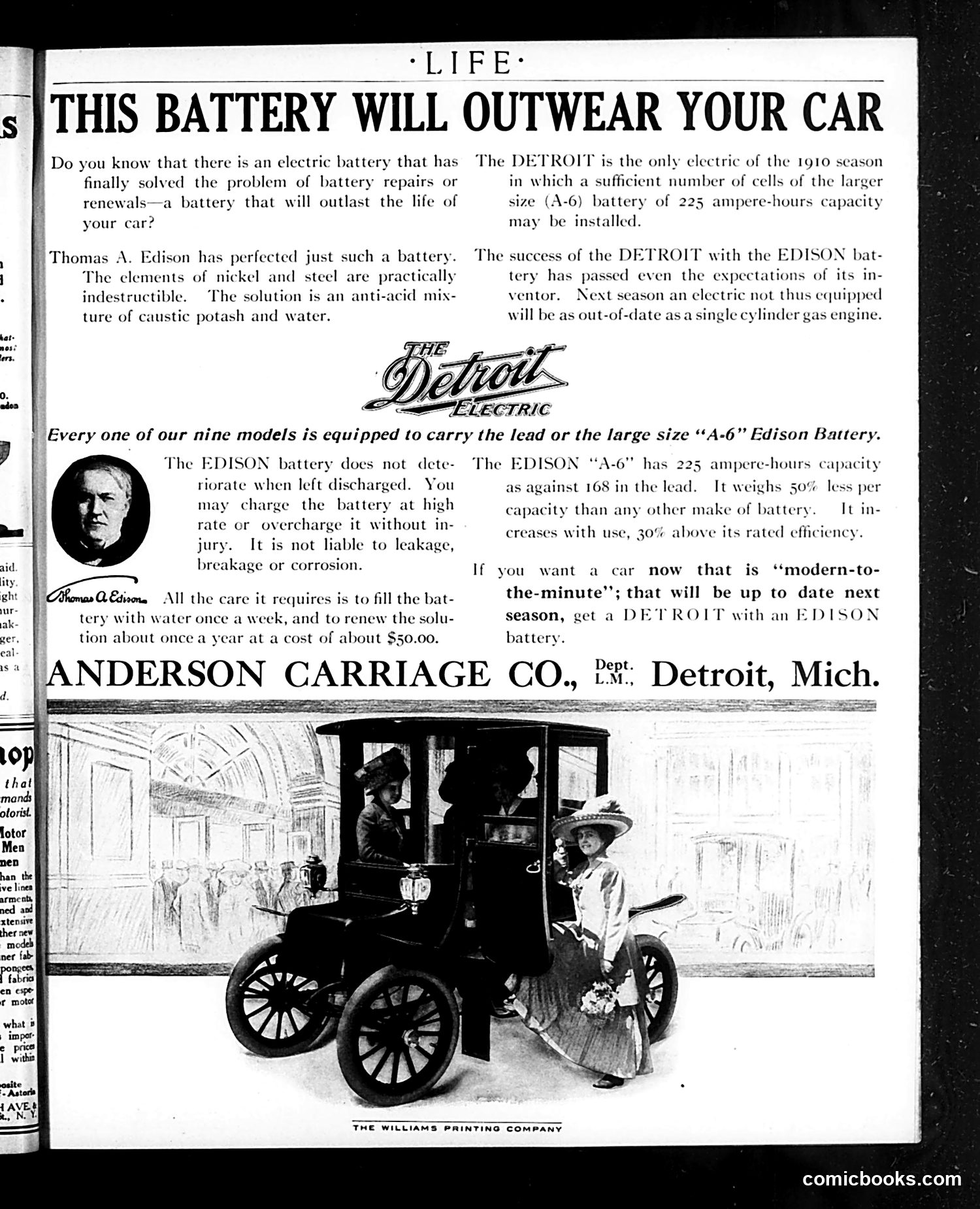
This is **not a cartoon or satire**—it's a straightforward advertisement for Detroit Electric automobiles equipped with Thomas Edison's nickel-steel batteries. The page features Edison's photograph and endorsement of his own battery technology, emphasizing its superiority over lead-acid batteries: it's more durable, lighter, requires minimal maintenance (just weekly water and annual solution renewal at $50/year), and won't deteriorate when discharged. The ad positions electric cars as the modern choice for 1910, claiming that next season, gas-engine cars will be "as out-of-date as a single cylinder gas engine"—a strikingly inaccurate prediction, given that internal combustion engines ultimately dominated. The illustration shows a well-dressed woman with the vehicle, targeting affluent female buyers who preferred the quiet, clean operation of electric cars. This represents a moment when electric vehicles were genuinely competitive technology before gasoline engines became dominant.
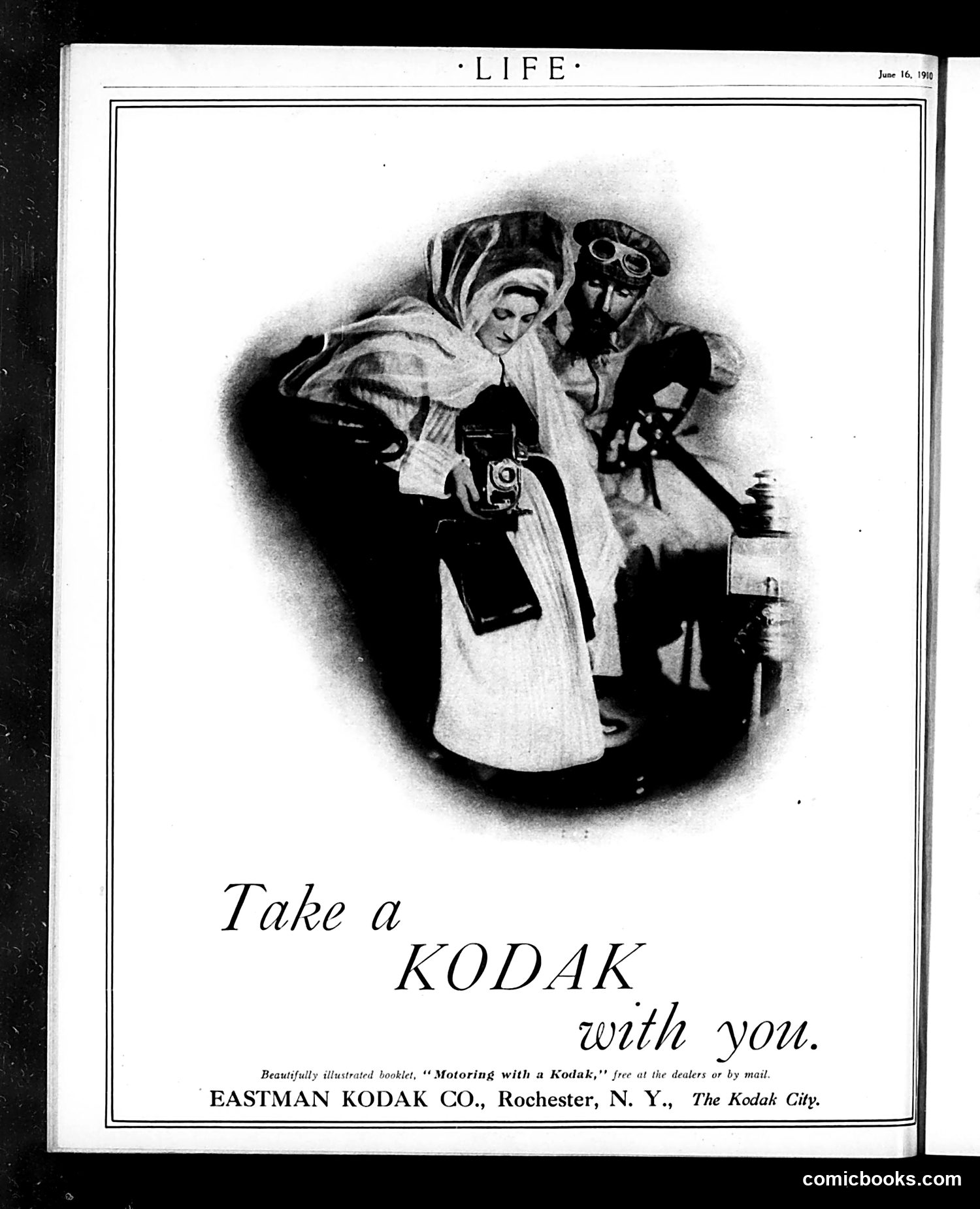
This is a full-page advertisement for Kodak cameras from Life magazine (June 16, 1918). The image shows two people in what appears to be an early automobile—a woman in the foreground holding a camera, and a man in aviator goggles behind her. The advertisement's tagline, "Take a KODAK with you," encourages readers to bring cameras on motorcar trips. The satire here is subtle: the aviator goggles and the emphasis on capturing moments while traveling suggest the modern, adventurous lifestyle available to those who owned both automobiles and cameras. This was aspirational advertising targeting middle-class consumers. The reference to a free booklet, "Motoring with a Kodak," promoted the idea that photography and automotive travel were complementary leisure activities—a novel concept in 1918.