
Life, 1910-06-16 · page 20 of 44
Life — June 16, 1910 — page 20: what you’re looking at
What you’re looking at
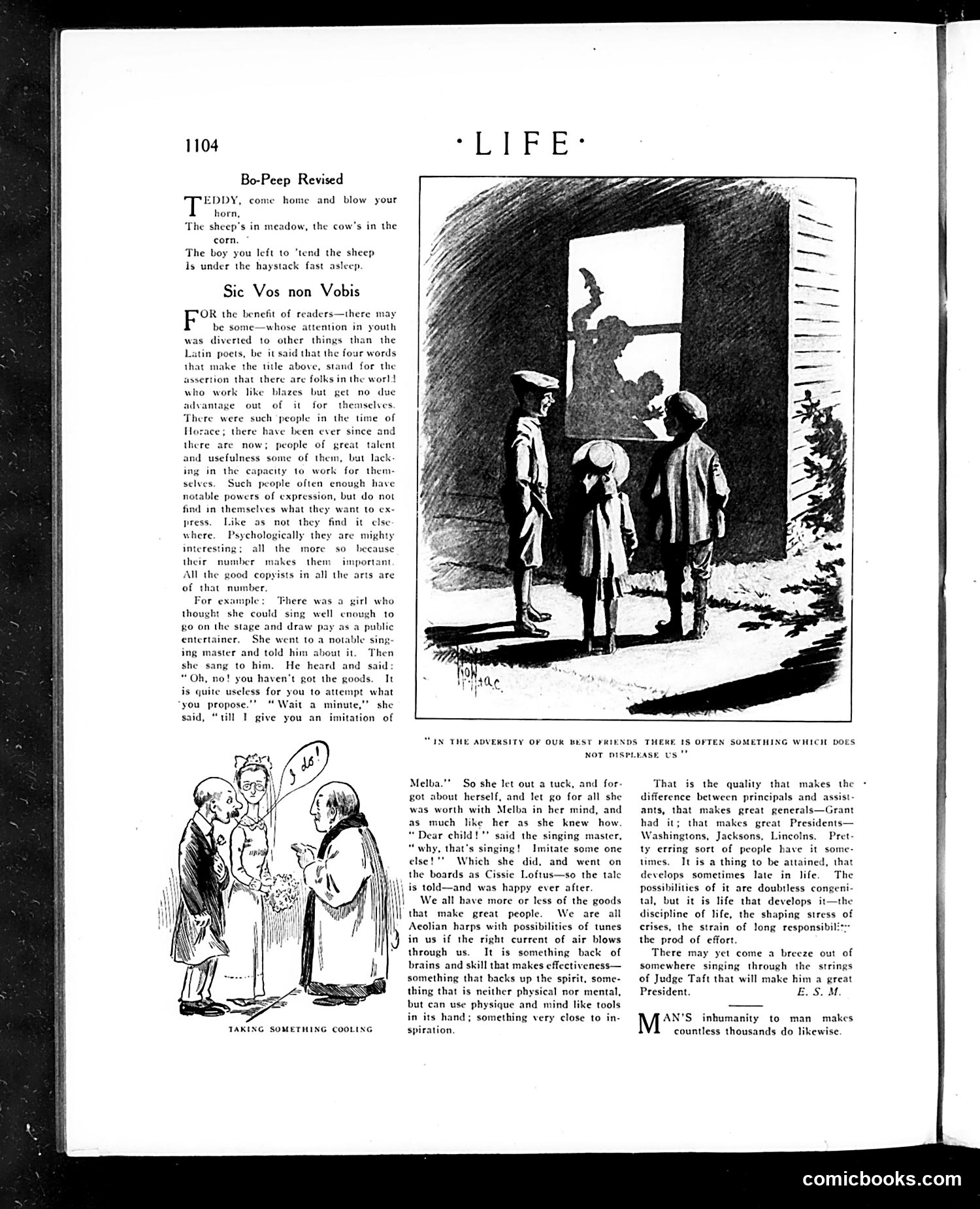
This page contains two satirical pieces about hidden talent and potential. **"Bo-Peep Revised"** (top) is a nursery rhyme parody mocking Theodore Roosevelt ("Teddy"), suggesting he's neglecting his duties as president—the "sheep" and "cow" represent national interests left unattended while the caretaker sleeps. **"Sic Vos non Vobis"** (main article) discusses talented people who lack the drive or self-belief to succeed, using a anecdote about a girl who could only sing well while imitating Nellie Melba rather than performing as herself. The essay argues that true greatness requires an intangible quality beyond mere skill. **The closing passage** pivots to **Judge William Howard Taft** (Roosevelt's chosen successor), suggesting he possesses latent presidential potential that needs proper circumstances to emerge. This appears to be pre-election commentary about whether Taft could become a truly great president—implying skepticism about his current capabilities without proper "discipline" or "crisis." The piece reflects early 1900s concerns about leadership succession and whether talent alone ensures effectiveness.
📄 Transcribed text from this page (OCR, searchable)
Machine-transcribed from the original scan — historical spelling and the odd misread are preserved.
1104 Bo-Peep Revised T EDDY, come horn, The sheep's in meadow, the cow's in the corn. The boy you left to ‘tend the sheep Js under the haystack fast asleep. Sic Vos non Vobis ‘OR the benefit of readers—there may be some—whose attention in youth was diverted to other things than the Latin poets, be it said that the four words that make the title above, stand for the ion that there are folks in the worl! like blazes but get no due advantage out of it for themselves There were such people in the time of Horace; there have been ever since and there are now; people of great talent rat lack- for them- home and blow your ase who work and usefulness some of them, ing in the capacity to selves. Such people often enough have notable powers of expression, but do not work find in themselves what they want to cx- Like as not they find it Psychologically they are mighty interesting; all the more so their number makes them All the good copyists in all the arts are of that number For example: thought she could sing well enough to press. clse where. because importal There was a girl who go on the stage and draw pay as a public entertainer. She went to a notable sing- ing master and told him about it. Then she sang to him. He heard and said: “Oh, no! you haven't got the goods. It is quite useless for you to attempt what “you propose.” “Wait a minute,” she said, “till I give you an imitation of “IN THE ADVERSITY OF OUK BEST FRIENDS THERE S OFTEN SOMETHING WHICH DOES NOT DISPLEASE US Melba." So she let out a tuck, and for- got about herself, and let go for all she was worth with Melba in her mind, and as much like her as she knew how “Dear child!" said the singing master, “why, that’s singing! Imitate some one else!" Which she did, and went on the boards as Cissie Loftus—so the tale is told—and was happy ever after We all have more or less of the goods that make great people. We are all Acolian harps with possibilitics of tunes in us if the right current of air blows through us. It is something back of brains and skill that makes effectiveness— something that backs up the spirit, some- thing that is neither physical nor menta but can use physique and mind like tools in its hand; something very close to in- spiration. That is the quality that makes the difference between principals and assi ants, that makes great generals—Grant had it; that makes great Presidents— Washingtons, Jacksons, Lincolns. Pret ty erring sort of people have it some- times. It is a thing to be attained, that develops sometimes late in life. The possibilities of it are doubtless congeni- tal, but it is life that develops it—the discipline of life, the shaping stress of crises, the strain of long responsibil! the prod of effort. There may yet come a breeze out of somewhere singing through the strings of Judge Taft that will make him a great President. Mi28'5. inhomanity, to man makes countless thousands do likewise. comicbooks.com