
Life, 1910-06-16 · page 28 of 44
Life — June 16, 1910 — page 28: what you’re looking at
What you’re looking at
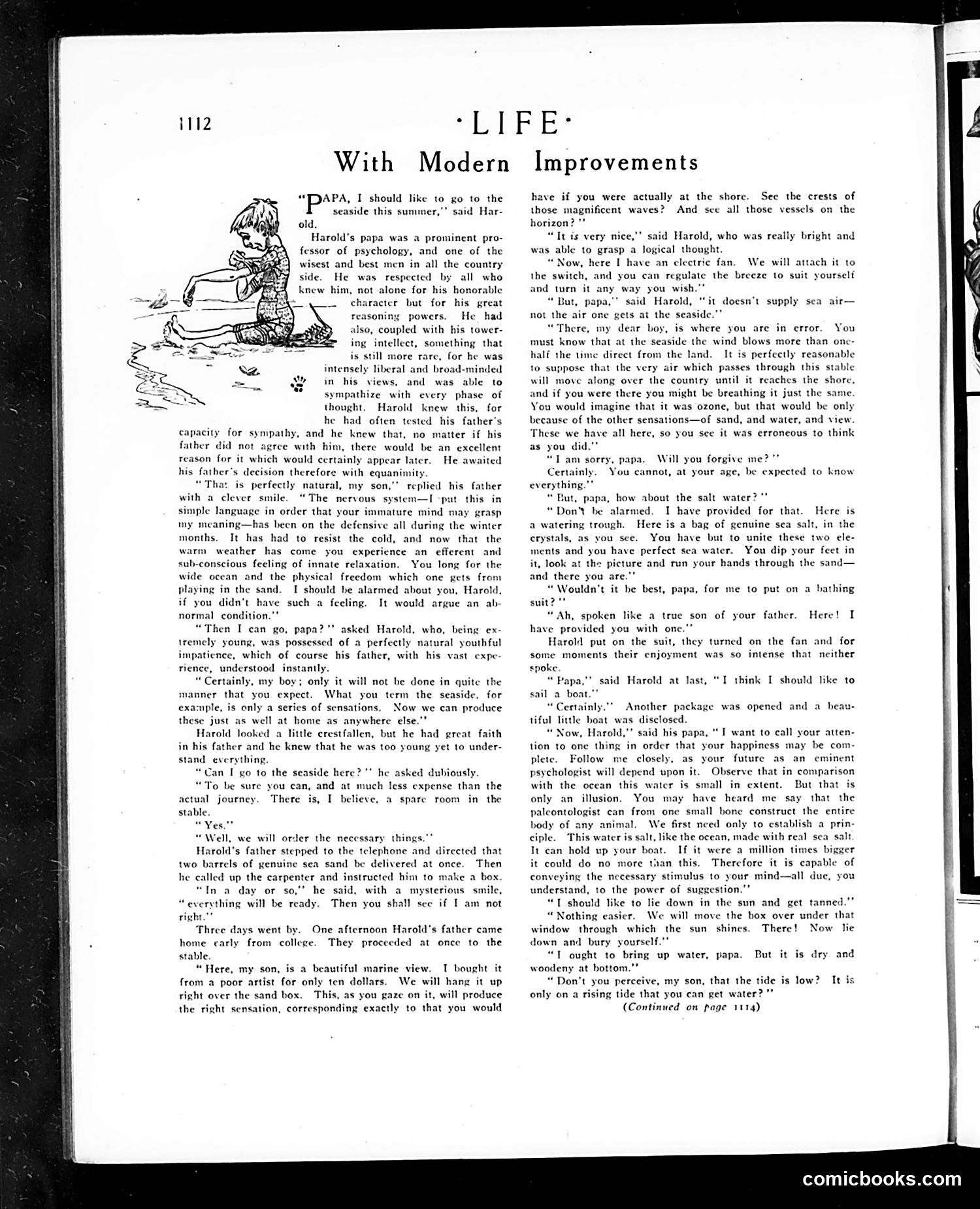
This page satirizes the pretentious intellectualism of early 20th-century psychology and pseudo-scientific parenting. Harold's father—a prominent psychology professor—epitomizes the era's faith in pseudoscientific rationalization of everyday life. When Harold requests a seaside holiday, his father delivers an absurdly elaborate explanation of the "nervous system" and "efferent sub-conscious feeling" before refusing the actual trip. Instead, he constructs a fake seaside in the stable: a painted marine picture, sand in a box, and an electric fan to simulate ocean breeze. The humor lies in the father's pompous justification that since the seaside is "only a series of sensations," he can manufacture identical sensations artificially—missing entirely that his son simply wants a real beach experience. The satire mocks how intellectuals misapply scientific jargon to avoid practical solutions and how they rationalize away simple human desires through overwrought theory.
📄 Transcribed text from this page (OCR, searchable)
Machine-transcribed from the original scan — historical spelling and the odd misread are preserved.
“EEE With Modern Improvements “para. I should like to go to the seaside this summer,” said Har- old. Harold's papa was a prominent pro- fessor of psychology, and one of the wisest and best men in all the country side. He was respected by all who knew him, not alone for his honorable character but for his great ing powers, He had also, coupled with his tower- tellect, something that is still more rare, for he was intensely liberal and broad-minded in his views, and was able to sympathize with every phase of thought. Harold knew this, for he had often tested his father's capacity for sympathy, and he knew that, no matter if his father did not agree with him, there would be an excellent reason for it which would certainly appear later. He awaited his father’s decision therefore with equanimity. “That is perfectly natural, my son,’’ replied his father with a clever smile. “The nervous system—I put this in simple language in order that your immature mind may grasp my meaning—has been on the defensive all during the winter months. It has had to resist the cold, and now that the warm weather has come you experience an efferent and sub-conscious feeling of innate relaxation. You long for the wide oc and the physical freedom which one gets from playing in the sand. I should be alarmed about you, Harold, if you didn't have such a feeling. It would argue an ab normal condition.” “Then I can go, papa?’? asked Harold, who, being ex- tremely young, was possessed of a perfectly natural youthful impatience, which of course his father, with his vast expe rience, understood instantly. “Certainly, my boy; only it will not be done in quite the manner that you expect. What you term the seaside, for example, is only a series of sensations. Now we can produce these just as well at home as anywhere else.’” Harold looked a little crestfallen, but he had great faith in his father and he knew that he was too young yet to under- stand everything. “Can go to the seaside here?" he asked dubiously. ‘0 be sure you can, and at much less expense than the actual journey. There is, I believe, a spare room in the stable. Yes.” “Well, we will order the necessary things.”* Harold’s father stepped to the telephone and directed that two barrels of genuine sea sand be delivered at once. Then he called up the carpenter and instructed him to make a box In a day or so," he said, with a mysterious smile, “everything will be ready. Then you shall sec if [am not right Three days went by home carly from college One afternoon Harold's father came They proceeded at once to the stable. “Here, my son, is a beautiful marine view. T bought it from a poor artist for only ten dollars. We will hang it up right over the sand box. This, as you gaze on it, will produce the right sensation, corresponding exactly to that you would have if you were actually at the shore. Sec the crests of those magnificent waves? And sce all those vessels on the horizon?” “It is very nice,’ said Harold, who was really bright and was able to grasp a logical thought. Now, here I have an electric fan. We will attach it to the switch, and you can regulate the breeze to suit yourself and turn it any way you wish.”’ “ But, papa,” said Harold, “it doesn't supply sea air— not the air one gets at the seaside.”” “There, my dear boy, is where you are in error. You must know that at the seaside the wind blows more than one- half the time direct from the land. It is perfectly reasonable to suppose that the very air which passes through this stable will move along over the country until it reaches the shore, and if you were there you might be breathing it just the same. You would imagine that it was ozone, but that would be only because of the other sensations—of sand, and water, and view. These we have all here, so you see it was erroneous to think as you did.” “Tam sorry, papa. Will you forgive me?” Certainly. You cannot, at your age, be expected to know everything.”” “But, papa, how about the salt water?” “Don’t be alarmed. I have provided for that. Here is a watering trough. Here is a bag of genuine sea salt, in the crystals, as you see. You have but to unite these two ele- ments and you have perfect sea water. You dip your feet in it, look at the picture and run your hands through the sand— and there you are. “Wouldn't it be best, papa, for me to put on a bathing suit?" “Ah, spoken like a true son of your father. have provided you with one.” Harold put on the suit, they turned on the fan and for some moments their enjoyment was so intense that neither spoke. “ Papa," said Harold at last, “I think I should like to sail_aboat.”’ “Certainly.” Another package was opened and a heau- tiful little boat was disclosed. “ Now, Harold," said his papa, “I want to call your atten- tion to one thing in order that your happiness may be com- plete. Follow me closely, as your future as an eminent psychologist will depend upon it. Observe that in comparison with the ocean this water is small in extent. But that is only an illusion. You may have heard me say that the paleontologist can from one small bone construct the entire body of any animal. We first nced only to establish a prin- ciple. This water is salt, like the ocean, made with real sea salt It can hold up your boat. If it were a million times bigger it could do no more than this. Therefore it is capable of conveying the necessary stimulus to your mind—all due, you understand, 10 the power of suggestion.”” “T should like to lie down in the sun and get tanned “Nothing easier. We will move the box over under that window through which the sun shines. There! Now lie down and bury yourself." “T ought to bring up water, papa, But it is dry and woodeny at bottom.” “Don’t you perceive, my son, that the tide is low? It is only on a rising tide that you can get water?" (Continued on page 1114) Here! I comicbooks.com