
Life, 1910-06-16 · page 26 of 44
Life — June 16, 1910 — page 26: what you’re looking at
What you’re looking at
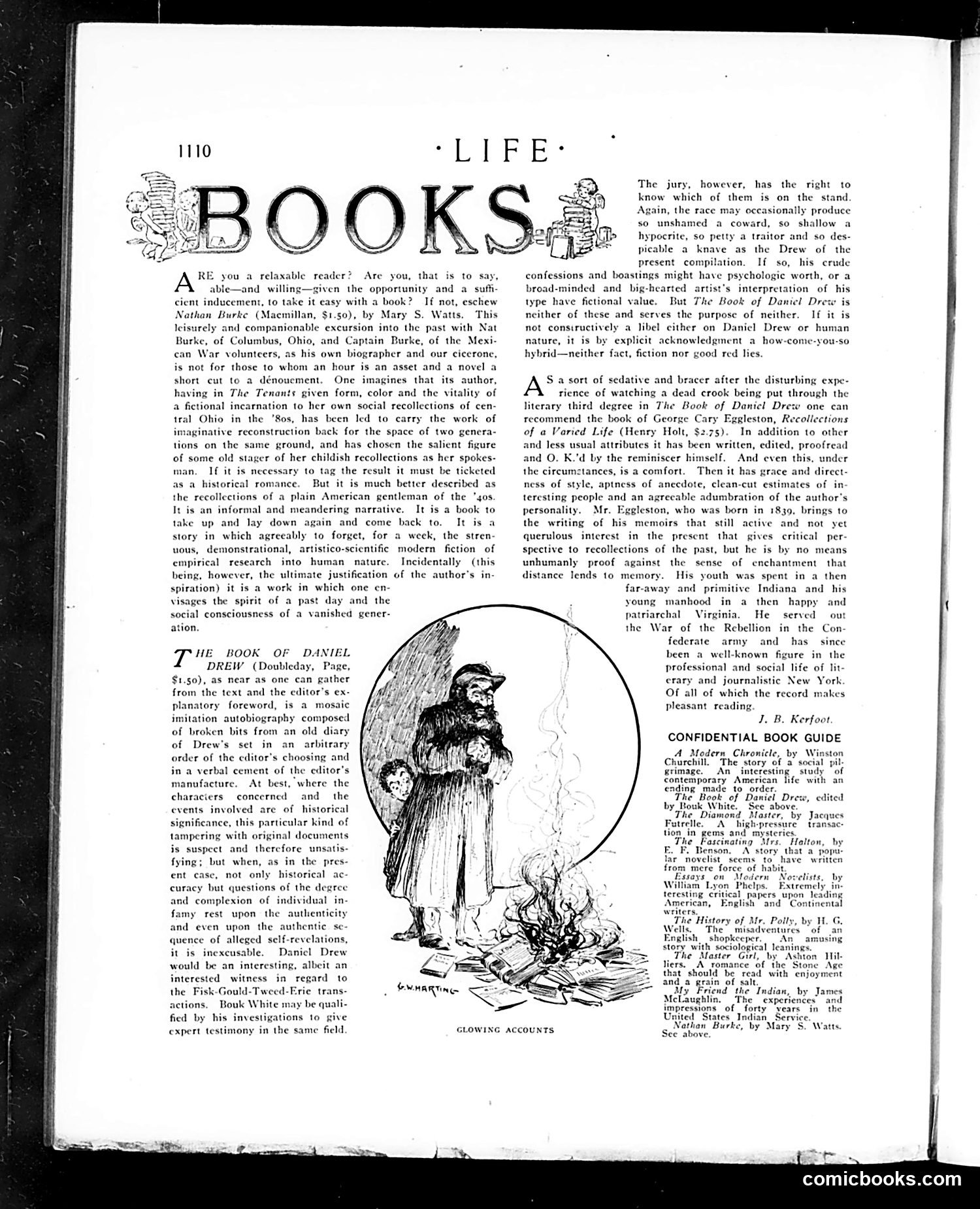
This page from *Life* magazine presents book reviews under the heading "GLOWING ACCOUNTS"—itself a satirical title, since the reviews are decidedly mixed. The main illustration shows a figure surrounded by books and papers, likely representing Daniel Drew, the subject of one reviewed book. Drew was a notorious 19th-century financier involved in railroad schemes with Jay Gould and Jim Fisk—scandals familiar to contemporary readers. The reviewer criticizes "The Book of Daniel Drew" harshly, questioning whether it's authentic autobiography or editorial fabrication. The key satire: the reviewer suggests Drew might be too contemptible a person to merit even fictional treatment—he's simultaneously so morally corrupt yet so trivial that his confessions serve neither historical truth nor artistic value. It's a cutting joke: Drew is too despicable even for a damning biography. By contrast, the reviewer praises Mary S. Watts's "Nathan Burke" as a leisurely, humane historical novel about ordinary Ohio life—implicitly favoring genteel recollection over exposés of financial villainy.
📄 Transcribed text from this page (OCR, searchable)
Machine-transcribed from the original scan — historical spelling and the odd misread are preserved.
you a relaxable reader? Are you, that is to say, and willing—given the opportunity and a sufti- 1 inducement, to take it easy with a book? If not, eschew Nathan Burke (Macmillan, $1.50), by Mary S. Watts. This leisurely and companionable excursion into the past with Nat Burke, of Columbus, Ohio, and Captain Burke, of the Mexi- can War volunteers, as his own biographer and our cicerone, is not for those to whom an hour is an asset and a novel a short cut to a dénouement. One imagines that its author, having in The Tenants given form, color and the vitality of a fictional incarnation to her own social recollections of cen- tral Ohio in the "Sos, has been led to carry the work of maginative reconstruction back for the space of two genera- jons on the same ground, and has chosen the salient figure of some old stager of her childish recollections as her spokes- man. If it is necessary to tag the result it must be ticketed as a historical romance. But it is much better described as the recollections of a plain American gentleman of the ‘40s It is an informal and meandering narrative. It is a book to take up and lay down again and come back to. It is story in which agreeably to forget, for a week, the stren- uous, demonstrational, artistico-scientific modern fiction of empirical research into human nature. Incidentally (this being, however, the ultimate justification of the author's in- spiration) it is a work in which one en- visages the spirit of a past day and the social consciousness of a vanished gener- ation. HE BOOK OF DANIEL DREW (Doubleday, Page, $1.50), as near as one can gather from the text and the editor's ex- planatory foreword, is a mosaic imitation autobiography composed of broken bits from an old diary of Drew's set in an arbitrary order of the cditor’s choosing and in a verbal cement of the editor's manufacture. At best, ‘where the characiers concerned and the events involved are of historical significance, this particular kind of tampering with original documents is suspect and therefore unsatis- fying; but when, as in the pres- ent case, not only historical ac- curacy but questions of the degree and complexion of individual in- famy rest upon the authenticity and even upon the authentic. se- quence of alleged self-revelations, it is inexcusable. Daniel Drew would be an interesting, albeit an interested witness in regard to the Fisk-Gould-Tweed-Erie trans- actions. Bouk White may be qual fied by his investigations to give expert testimony in the same field GLOWING accouNTS The jury, however, has the right to know which of them is on the stand Again, the race may occasionally produce so unshamed a coward, so shallow a hypocrite, so petty a traitor and so des- picable a knave as the Drew of the present compilation. If so, his crude confessions and boastings might have psychologic worth, or a broad-minded and big-hearted artist's interpretation of his type have fictional value. But The Book of Daniel Dri neither of these and serves the purpose of neither. If it is not constructively a libel cither on Danicl Drew or human nature, it is by explicit acknowledgment a how-come-you-so hybrid—neither fact, fiction nor good red lies. AS a sort of sedative and bracer after the disturbing expe- rience of watching a dead crook being put through the literary third degree in The Book of Danicl Drew one can recommend the book of George Cary Eggleston, Recollections of a Varied Life (Henry Holt, $2.75). In addition to other and less usual attributes it has been written, edited, proofread and O. K.'d by the reminiscer himself. And even this, under the circumctances, is a comfort. Then it has grace and direct- ness of style, aptness of anecdote, clean-cut estimates of in teresting people and an agrecable adumbration of the author's personality. Mr. Eggleston, who was born in 1830, brings to the writing of his memoirs that still active and not yet querulous interest in the present that gives critical per- spective to recollections of the past, but he is by no means unhumanly proof against the sense of enchantment that distance Iends to memory. His youth was spent in a then far-away and primitive Indiana and his young manhood in a then happy and patriarchal Virginia. He served out the War of the Rebellion in the Con- federate army and since been a well-known figure in the professional and social life of lit- crary and journalistic New York Of all of which the record makes pleasant reading. J. B. Kerfoot CONFIDENTIAL BOOK GUIDE A Modern Chronicle, by Winston Churchill, The story of a social grimage. An interesting study "of contemporary American life with an ending made to order. The Book of Daniel Drew, edited by Bouk White. “See above The Diamond Master, by J Futrelle, e ivar tion in gi a The Fascinating Halton, by E. F. Benson. A story that a popu- lar novelist seems to have written from mere force of habit. Essays on Modern Novelists. by William Lyon Phelps. Extremely teresting critical papers upon leading American, English and Continental writers. The History of Mr. Polly, by I. G. Wells.” The’ misadventures of English shopkeeper. An story with sociological lean _ The Master Gurl, by liers. A romance of the Stone Age that should be read with enjoyment and a grain of salt. My Friend the Indian, by James McLaughlin. The experiences and impressions of forty vears in ¢! United States Indian. Service. _ Nathan Burke, by Mary See above. Watts, comicbooks.com