
Life, 1910-06-16 · page 12 of 44
Life — June 16, 1910 — page 12: what you’re looking at
What you’re looking at
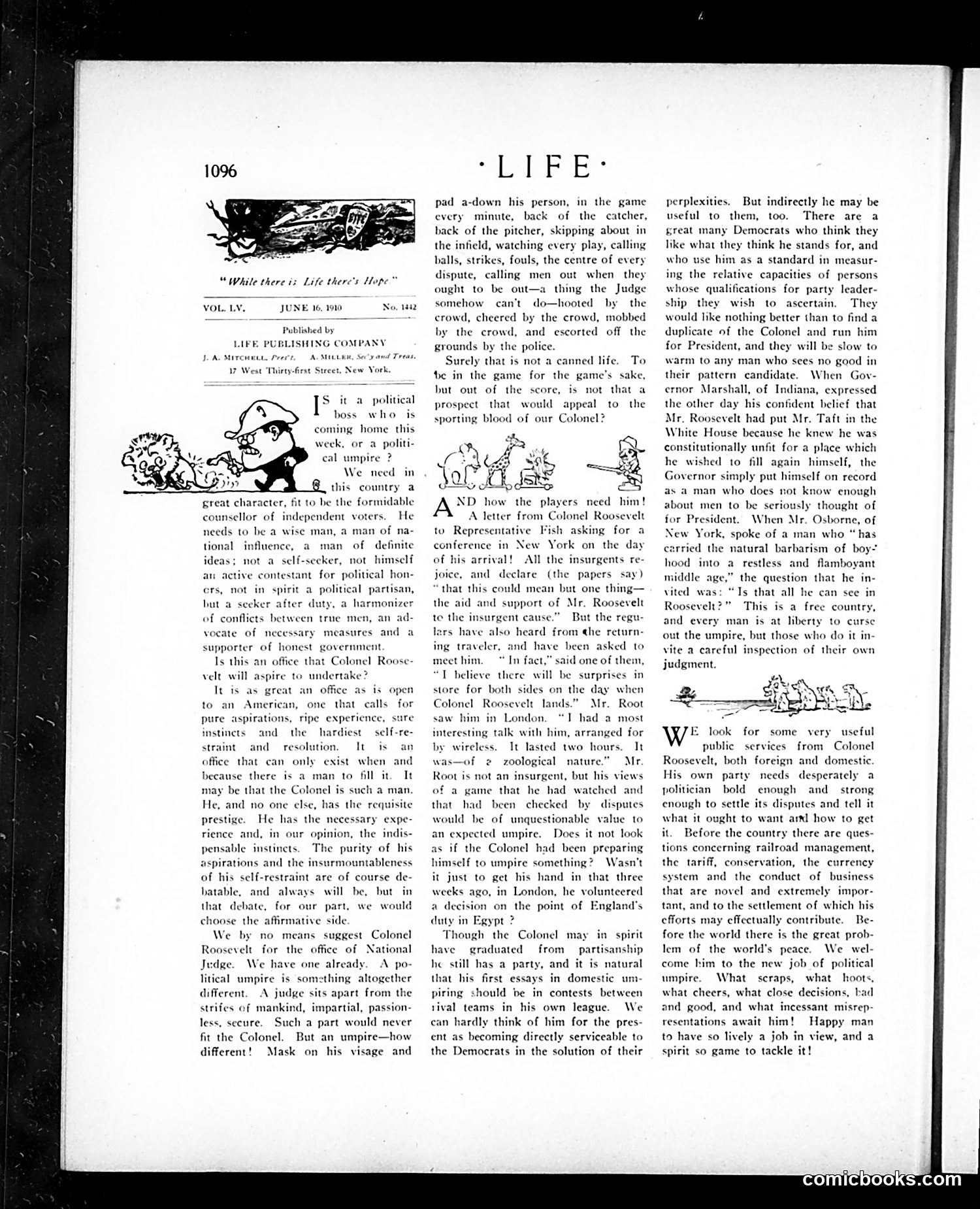
This is a political commentary page from Life magazine (June 16, 1919, No. 1442). The small cartoon depicts a caricatured figure wearing what appears to be a military uniform or hat, in a confrontational pose. The text discusses Colonel Roosevelt's potential political future, debating whether he should run for National Judge or President. The author argues that an "umpire" like Roosevelt—someone of demonstrated integrity and independence—would be valuable to the Democrats, who need a candidate transcending partisan divisions. The piece references Roosevelt's recent return from London and mentions his interest in resolving party conflicts. It positions him as a figure of sufficient stature and impartiality that either party might benefit from his leadership. The cartoon likely caricatures Roosevelt himself in this political context, though the specific satirical point requires clearer image visibility.
📄 Transcribed text from this page (OCR, searchable)
Machine-transcribed from the original scan — historical spelling and the odd misread are preserved.
“While there iz Life there's He JUNE 16, 1910 VOL. LY, No, 4a LIFE PUP JA. MITCHELL, Pree YW West Thirty-fi A. MILLE, Say aml Treas, t Street, New Vork. Is it_a_ political boss who is coming home this or a politi- umpire ? We need in this country a great character, fit to be the formidable counsellor of independent voters, He a wise man, a man of na- definite himself needs to b tional influence, ideas; not a an active contestant for political hon- crs, not in spirit a political partisan, but a seeker after duty, a harmonizer f conflicts between true men, an ad- man of self-secker, not vocate of necessary measures and a supporter of honest government Is this an office that Colonel Roose- velt will aspire to undertake? It is as great an office as is open to an American, one that calls for pure aspirations, ripe experience, sure instincts and the hardiest self-re straint: and resolution. It) is an office that can only exist when and man to fill it, It nel is such a man. because there is may be that the C He, and no one else, has the requisite prestige, He has the necessary expe- rience and, in our opinion, the indis- pensable instincts. The purity of his aspirations and the insurmountableness of his self-restraint are of course de- hatable, and always will be, but in debate, for would choose the affirmative side We by no means suggest Colonel Roosevelt for the office of National Judge. We have one already. A po- litical umpire is something altogether different. A judge sits apart from the strifes of mankind, impartial, passion- less, secure. Such a part would never fit the Colonel. But an umpire—how different! Mask on his visage and that our part, we pad a-down his person, in the every minute, back of the catcher, back of the pitcher, skipping about in the infield, watching every play, calling balls, strikes, fouls, the centre of every dispute, calling men out when they ought to be out—a thing the Judge somehow can't do—hooted by the crowd, cheered by the crowd, mobbed by the crowd, and escorted off the grounds by the police. Surely that is not a canned life. To te in the game for the game’s sake, but out of the score, is not that a prospect that would appeal to the sporting blood of our Colonel? D how the players need him! A letter from Colonel Roosevelt to Representative Fish asking for a conference in New York on the day of his arrival! All the insurgents re- joice, and declare (the say) “that this could mean but one thing— the aid and support of Mr. Roosevelt te the insurgent cause.” But the regu- lars have also heard from ahe return- ing traveler, and have been asked to meethim. “In fact,” said one of th “T believe there will be surprises in store for both sides on the day when Colonel Roosevelt lands.” Mr. Root saw him in London. “J had a most interesting talk with him, arranged for Tt lasted two hours. It was—of 2 zoological nature.” Mr. Root is not an insurgent, but his views of a game that he had watched and that had been checked by disputes would be of unquestionable value to an expected umpire. Does it not look as if the Colonel had been preparing himself to umpire something? Wasn't it just to get his hand in that three weeks ago, in London, he volunteered a decision on the point of England’s duty in Egypt ? Though the Colonel may in. spirit have graduated from partisanshiy he still has a party, and it is natural that his first essays in domestic um- piring should be in contests between rival teams in his own league. We can hardly think of him for the pres- ent as becoming directly serviceable to the Democrats in the solution of their papers by wireless. perplexities. But indirectly he may be useful to them, too. There are a great many Democrats who think they like what they think he stands for, and who use him as a standard in measur- ing the relative capacities of persons whose qualifications for party leader- ship they wish to ascertain. They would like nothing better than to find a duplicate of the Colonel and run him for President, and they will be slow to warm to any man who sees no good in their pattern candi When Gov- ernor Marshall, of Indiana, expressed the other day his confident belief that Mr. Roosevelt had put Mr. Taft in the White House because he knew he was constitutionally unfit for a place which he wished to fill again himself, the Governor simply put himself on record as a man who does not know enough about men to be seriously thought of for President. When Mr. Osborne, of New York, spoke of a man who “has rried the natural barbarism of boy- hood into a nd flamboyant middle age,” the question that he in- vited was: “Is that all he can see in Roosevelt?” This is a free country and every man is at liberty to curse out the umpire, but those who do it in- vite a careful inspection of their own judgment. restless useful Colonel look for some very from Roosevelt, both foreign and domestic public services His own party needs desperately a politician bold enough and strong cnough to settle its disputes and tell it what it ought to want arm how to get it. Before the country there are ques- tions concerning railroad management, the tariff, conservation, the currency system and the conduct of business that are novel and extremely impor- tant, and to the settlement of which his efforts may effectually contribute. Be- fore the world there is the great prob- lem of the world’s peace. We wel- come lim to the new job of political umpire. What scraps, what hoots, what cheers, what close decisions, bad and good, and what incessant misrep- resentations await him! Happy man to have so lively a job in view, and a spirit so game to tackle it!