
A complete issue · 44 pages · 1910
Life — February 3, 1910
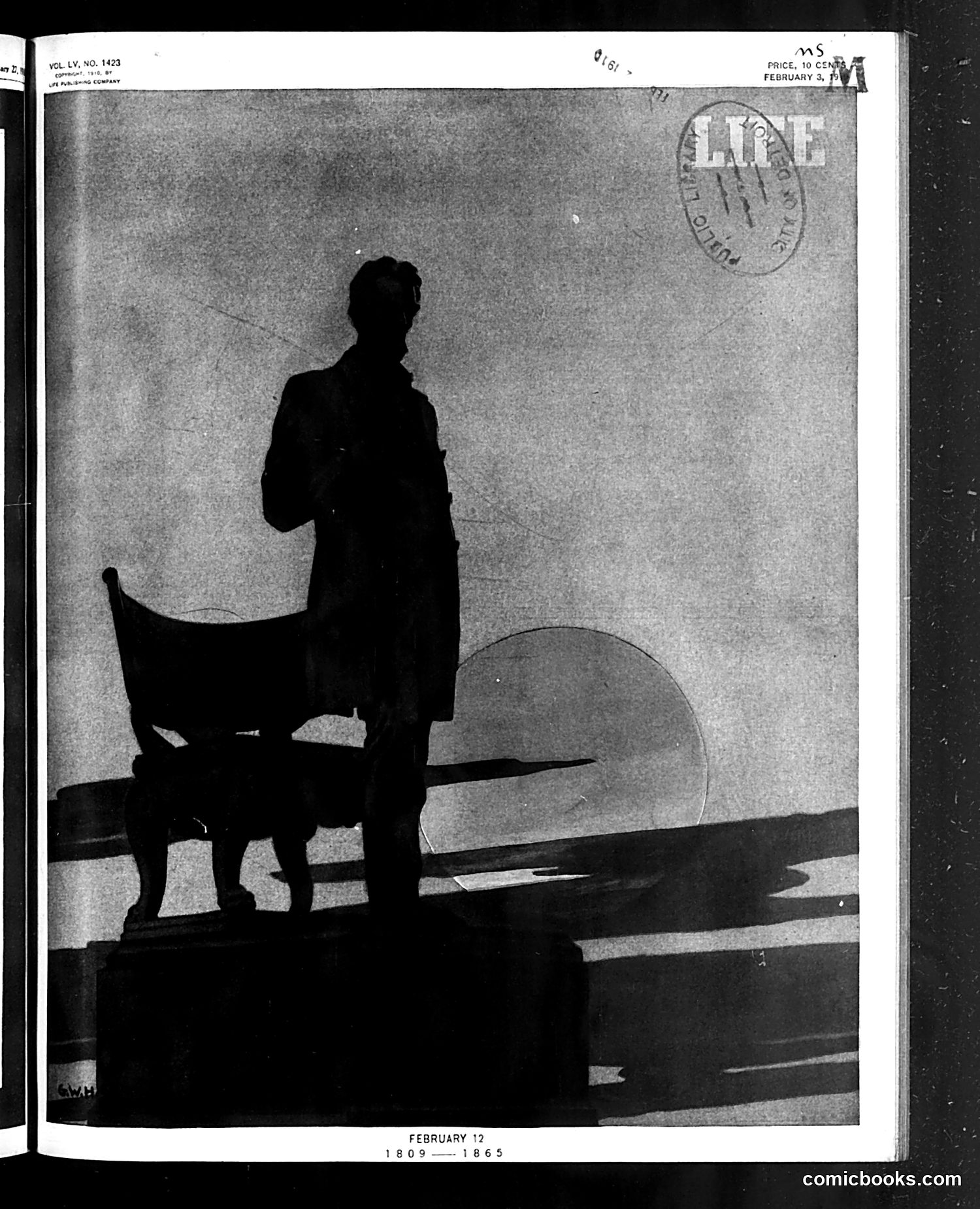
This silhouette illustration from Life magazine (dated February 12, 1809-1865) appears to commemorate Abraham Lincoln's birthday. The standing figure in silhouette represents Lincoln, shown in formal dress with characteristic proportions. The seated figure likely represents a soldier or common citizen, suggesting themes of leadership during wartime or national crisis. The date range "1809-1865" references Lincoln's birth year (1809) and assassination year (1865). This memorial-style composition—with the prominent standing figure overlooking a subordinate one—emphasizes Lincoln's historical importance and leadership during the Civil War era. The silhouette format was a common artistic technique for this period, creating dramatic, recognizable iconic imagery suitable for a satirical magazine's serious commemorative content.
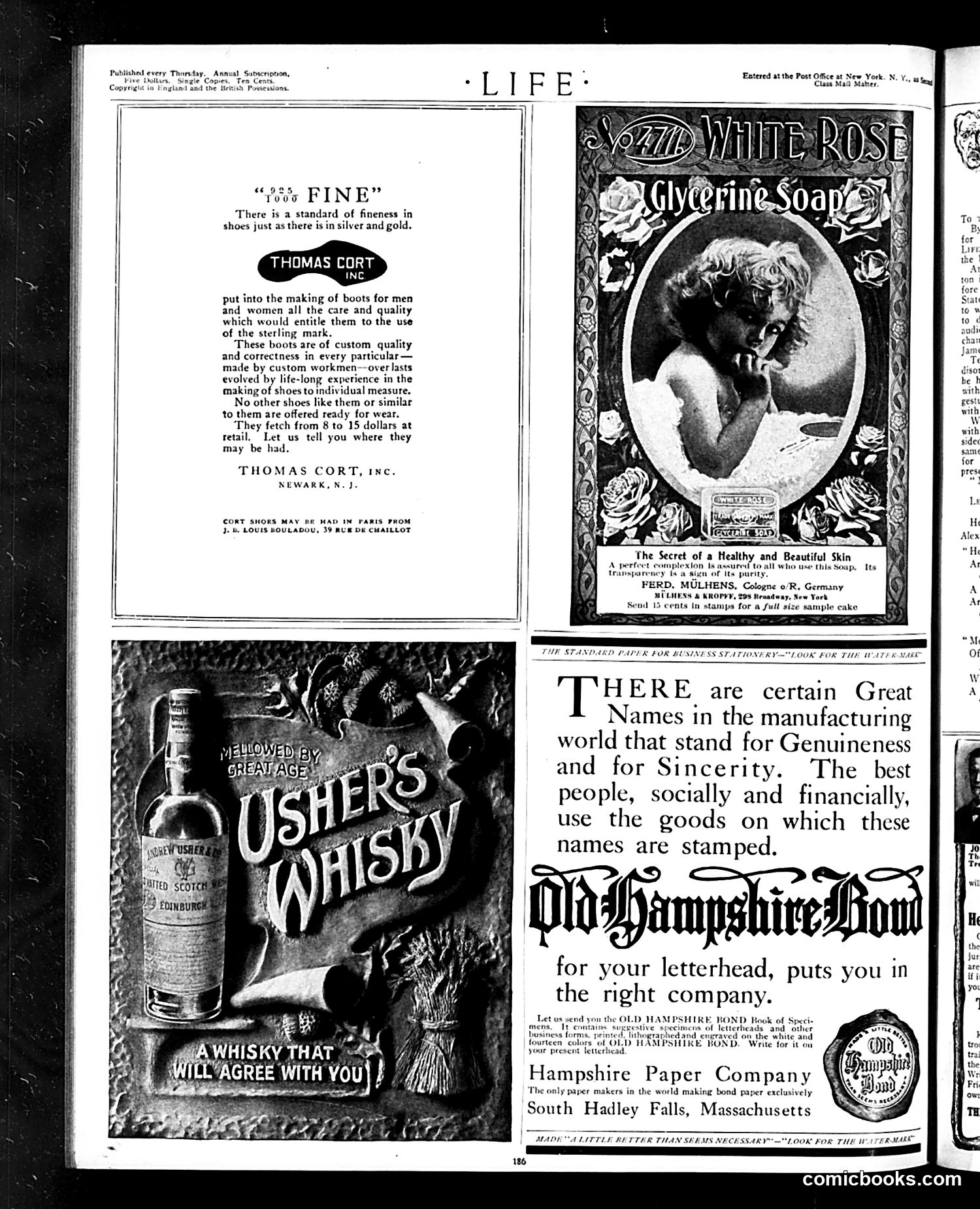
This page is **primarily advertising**, not editorial content or satire. The page contains three distinct ads: 1. **Thomas Cort boots** (top left): A straightforward product advertisement emphasizing handcrafted quality and durability for $8-15. 2. **White Rose Glycerine Soap** (top right): A beauty product ad featuring an illustrated woman's face surrounded by roses, promising healthy skin. 3. **Usher's Whisky** (bottom left): A product ad with decorative imagery and the slogan "A Whisky That Will Agree With You." 4. **Old Hampshire Bond paper** (bottom right): Stationery advertising that claims using their letterhead puts you "in the right company" and associates the brand with "Genuineness and Sincerity." There is **no political cartoon or satire** on this page—it's a standard magazine advertising section typical of early 20th-century Life magazine.
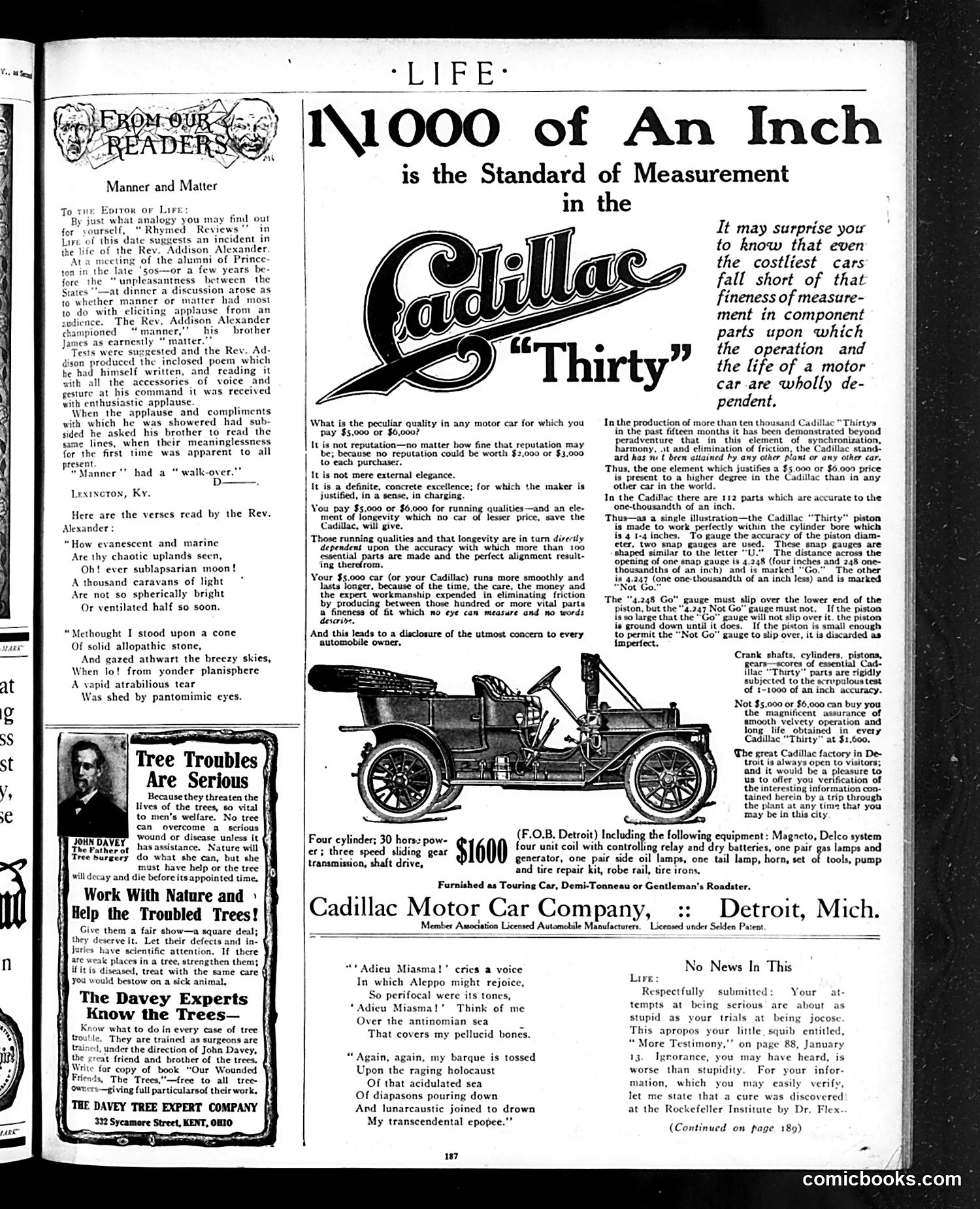
This page is primarily a **Cadillac automobile advertisement** rather than satirical content. The main image shows an early 1900s touring car with detailed specifications and price ($1600 F.O.B. Detroit). The left column contains reader letters and unrelated content about tree care and a tree expert company—standard filler material for magazines of this era. There is **no political cartoon or satire** on this page. The advertisement's tone is straightforward promotional copy emphasizing the Cadillac "Thirty" model's precision engineering and manufacturing standards (measuring tolerances to 1/1000th of an inch). This precision claim was genuinely notable for early automotive manufacturing. The page reflects early 20th-century magazine layout, mixing editorial content with advertising.
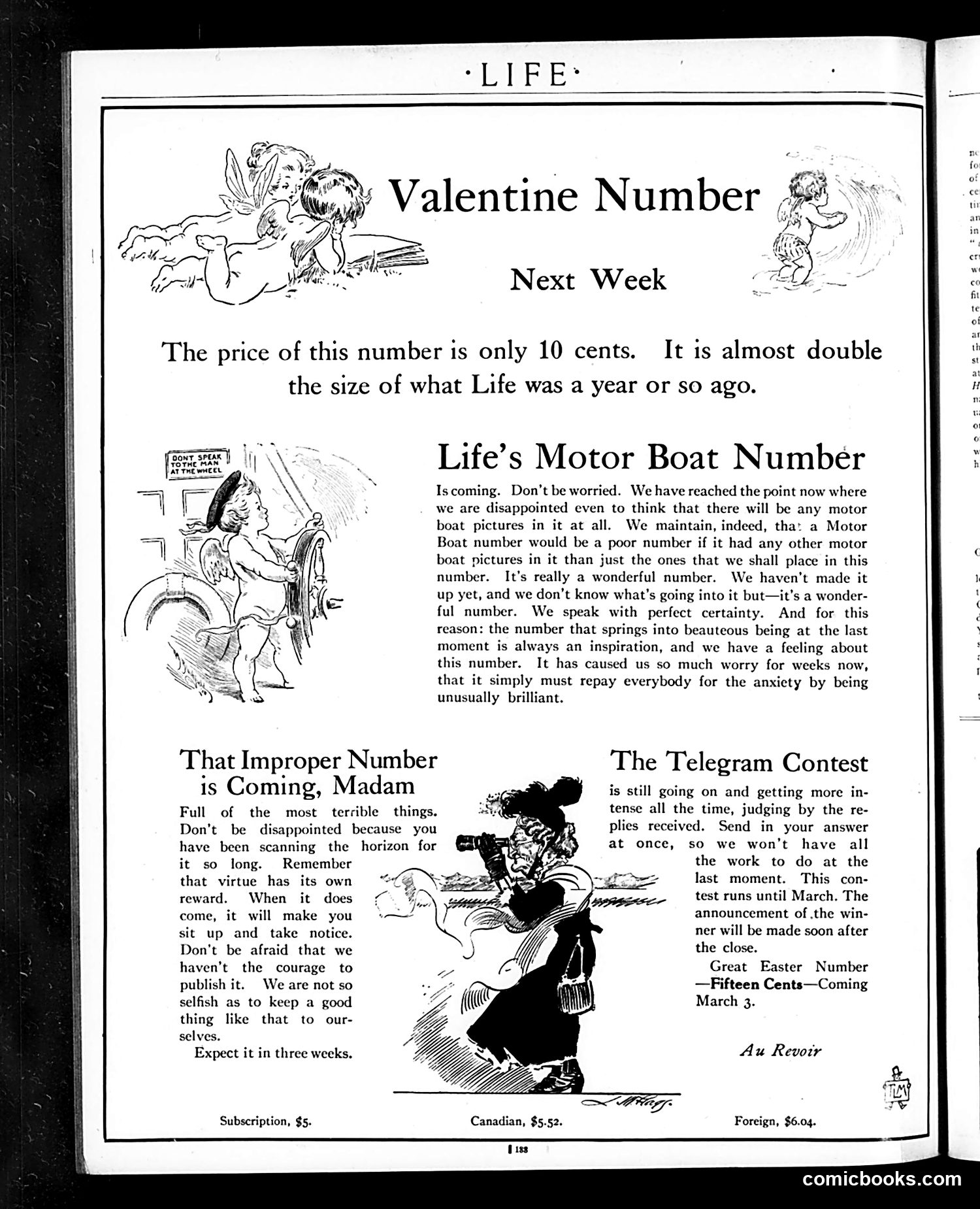
This page is primarily **promotional material** announcing upcoming special issues rather than satirical content. The **Valentine Number** (next week, 10 cents) is promoted as nearly double the size of a year-ago issue, suggesting the magazine's growth. The **Motor Boat Number** announcement uses self-deprecating humor—the editors claim they're "disappointed" the issue will *only* contain motor boat pictures, joking they haven't finalized content yet. The satire targets their own editorial uncertainty and the magazine's tendency toward themed special issues. "**That Improper Number**" teases an upcoming issue (in three weeks) promised to be "full of terrible things"—likely sexual or scandalous content—with comedic reassurance to worried readers. The illustration of a woman at a ship's wheel accompanies this announcement. A **Telegram Contest** and **Easter Number** (March 3, fifteen cents) are also advertised.
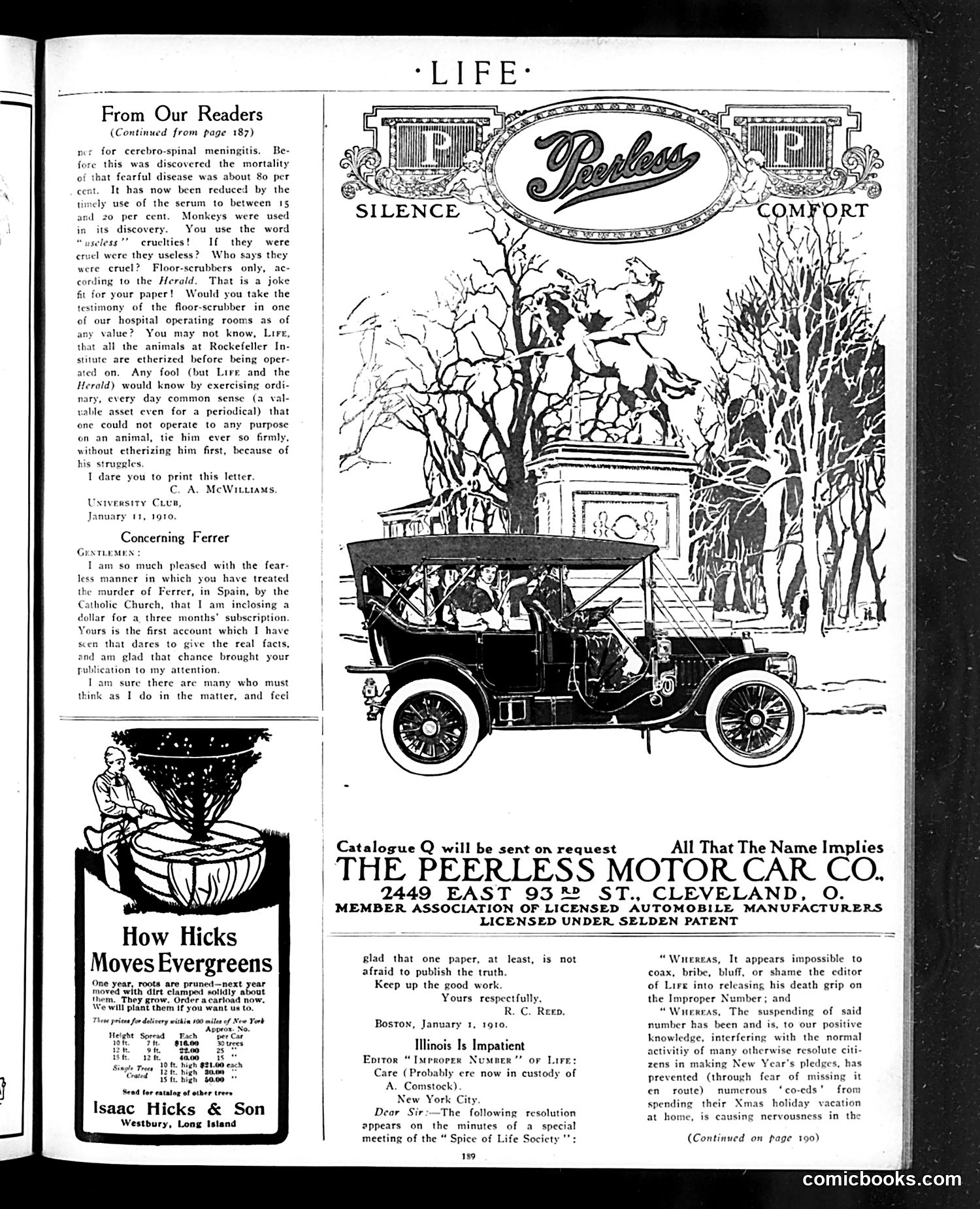
This page is primarily **advertising and reader correspondence**, not political satire. The main content includes: - **Letters to the editor** debating animal testing and ferrets in Spain - **A Peerless Motor Car advertisement** featuring an illustrated early automobile with decorative elements (bare trees, cornfields) - **A small ad for evergreen plants** by Isaac Hicks & Son The only potentially satirical element is the Peerless ad's ornamental framing—the juxtaposition of nature imagery with industrial machinery may suggest contemporary tensions between progress and pastoral life, but this appears incidental to the advertisement's primary purpose. The page reflects early 20th-century concerns: animal welfare debates and automobiles as emerging consumer products.
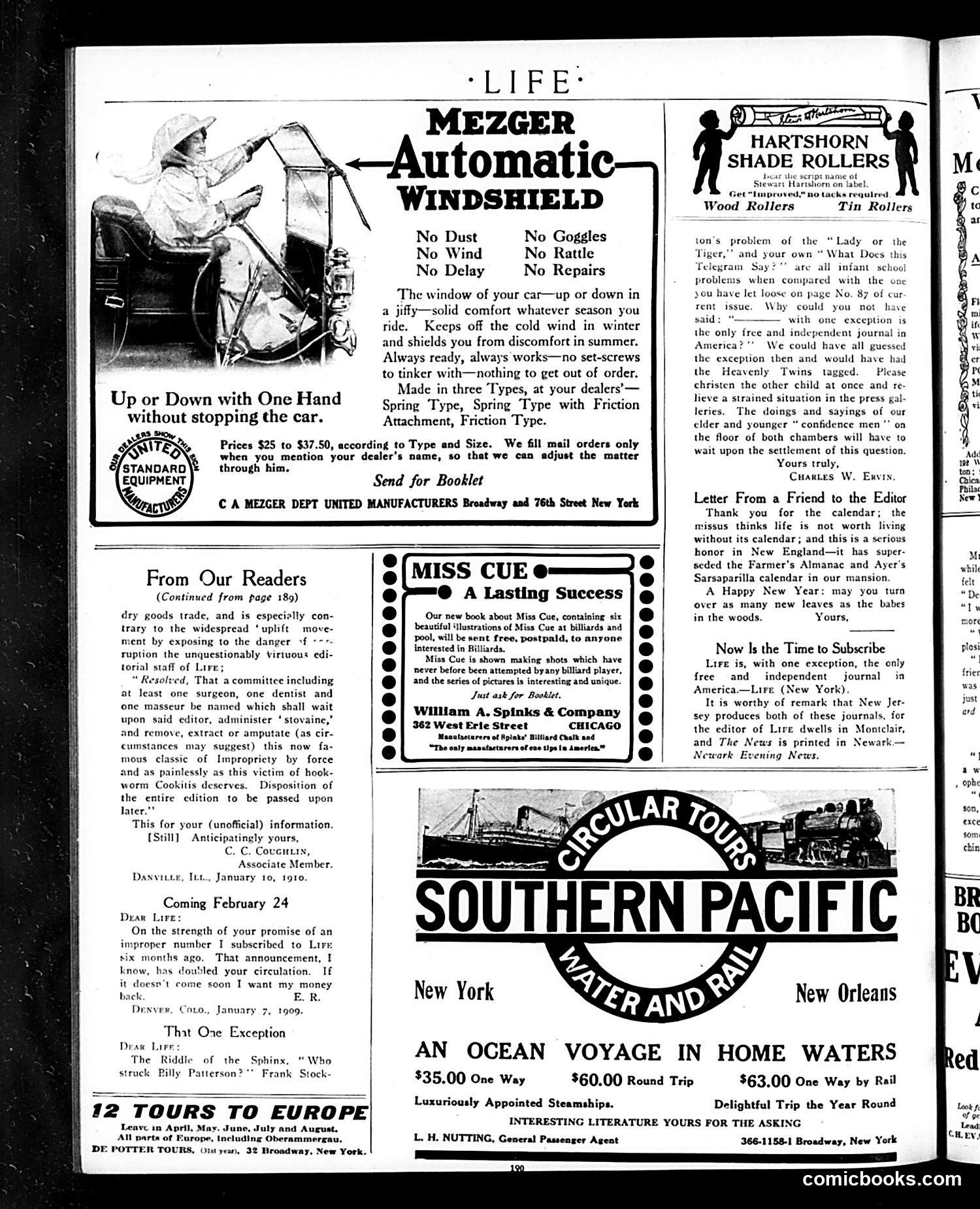
This page is primarily **advertisements and reader letters**, not satirical cartoons. The main content includes: - **Mezger Automatic Windshield ad**: Promotes a mechanical car window that operates with one hand, emphasizing comfort and convenience ("no dust, no wind, no delay") - **Hartshorn Shade Rollers ad**: Window shade product - **Miss Cue ad**: Billiards-themed product with illustrations - **Southern Pacific Railroad ad**: Ocean voyage cruises from New York to New Orleans ($35-$63) - **Reader letters** addressing various Life magazine articles The "From Our Readers" section shows early 1900s reader engagement—discussing editorial content and requesting subscriptions. One notable letter expresses concern about Life magazine's influence on social issues. The advertisements reflect period automotive and travel innovations rather than political satire.
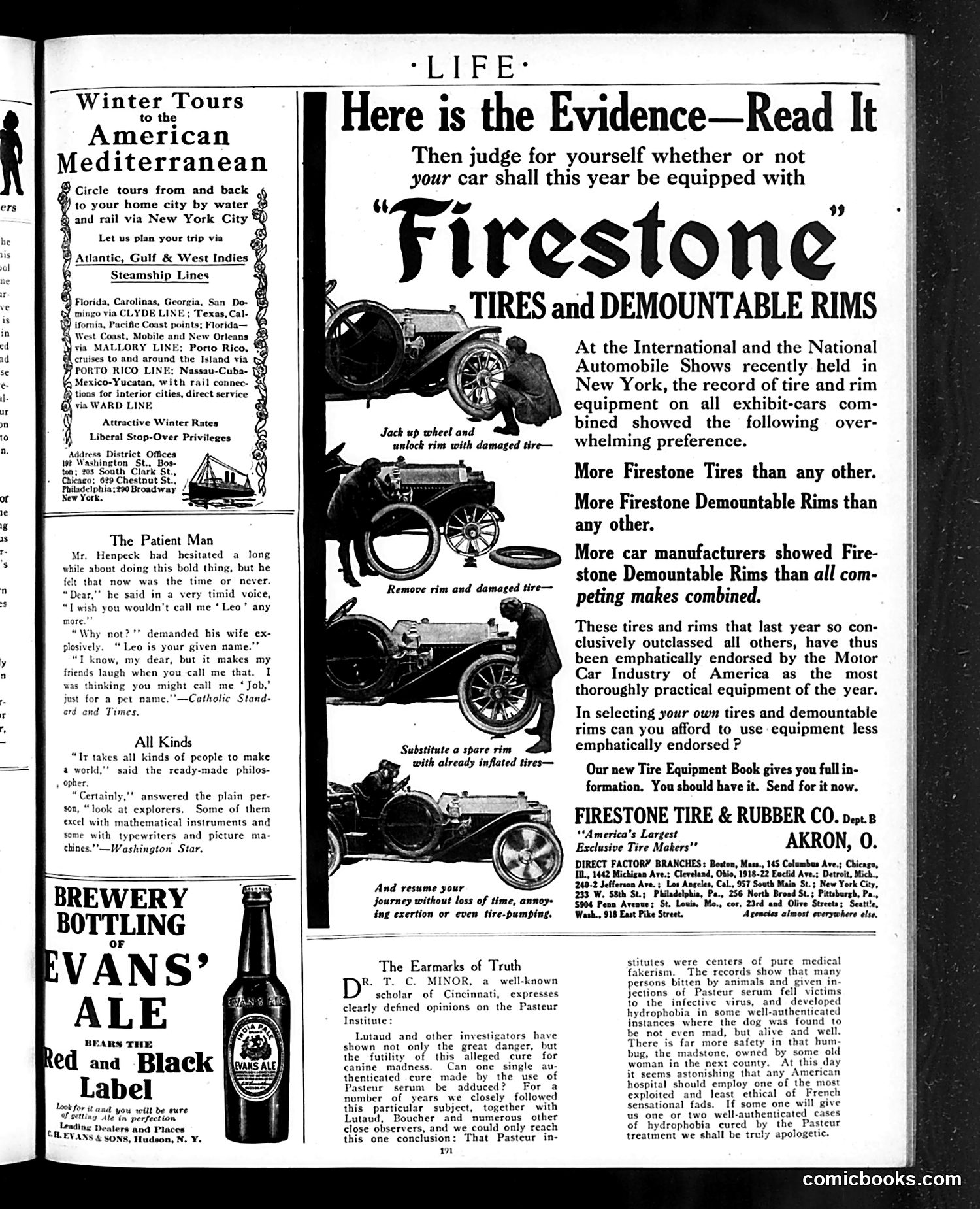
This page is primarily a **commercial advertisement**, not editorial satire. The Firestone Tire & Rubber Company showcases their "Demountable Rims" — a then-modern convenience allowing drivers to quickly remove and replace damaged tires without tools. The four illustrated panels demonstrate the practical advantages: jacking up a wheel, removing the damaged rim, substituting a spare, and resuming travel. The advertisement claims Firestone dominated automobile show exhibits and earned endorsement from the Motor Car Industry of America. The accompanying text emphasizes reliability and time-savings for motorists — key selling points in the early automotive era when tire failure and flat tires were common problems requiring roadside repairs.
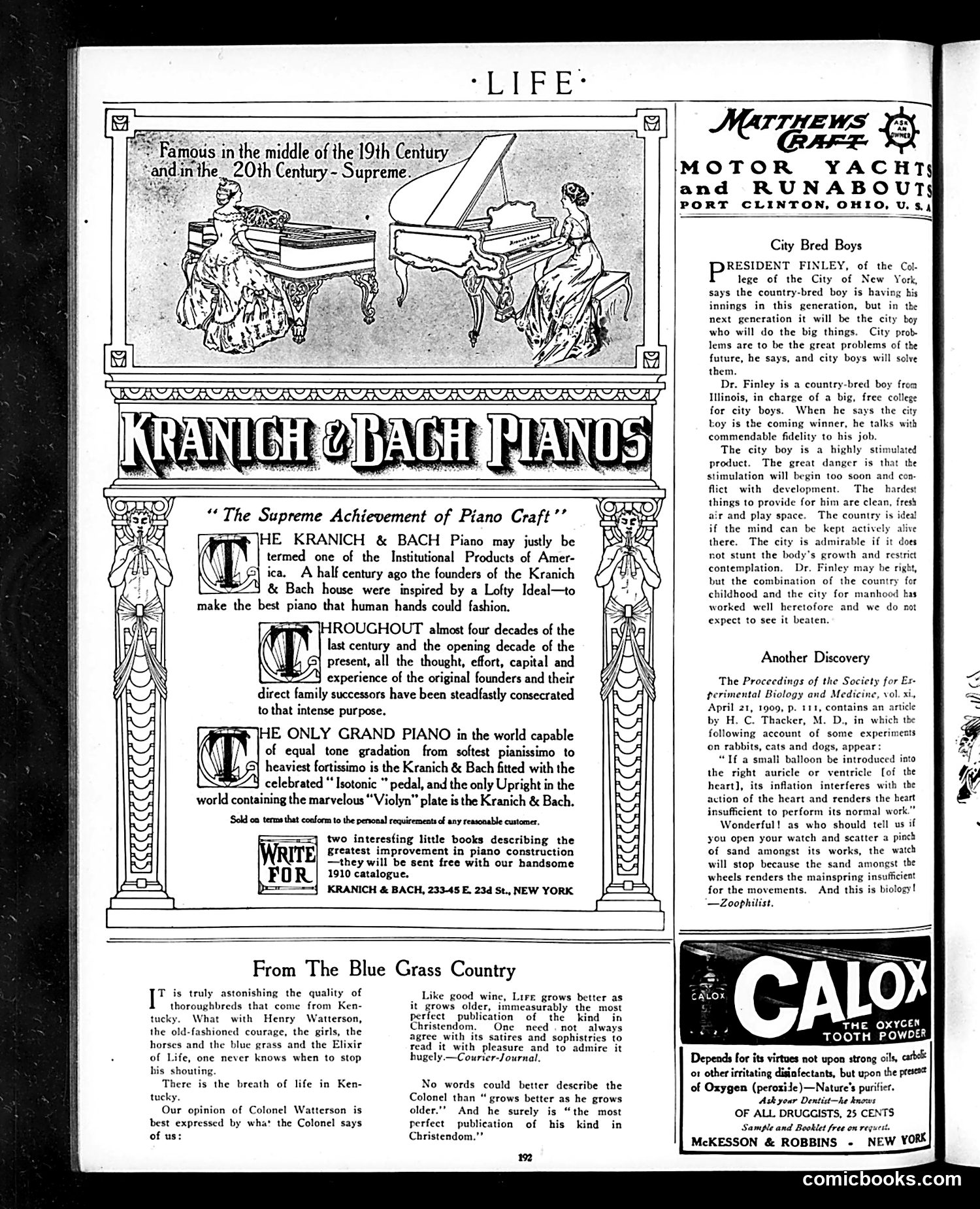
This page is primarily **advertising and editorial content rather than satire**. The main feature is a large advertisement for Kranich & Bach pianos, emphasizing their prestige and craftsmanship over "almost four decades" with claims about their superior construction and pedal mechanisms. The right side contains two short articles: "City Bred Boys" discusses concerns about urban children's development versus country-bred children (quoting Dr. Finley of City College), and "Another Discovery" describes a scientific experiment involving balloons and sand's properties. Below is a piece titled "From The Blue Grass Country" about Kentucky horses and Colonel Watterson's perspective on life and publishing. The page functions as a typical Life magazine spread mixing advertisements with light editorial commentary on early 20th-century social observations.
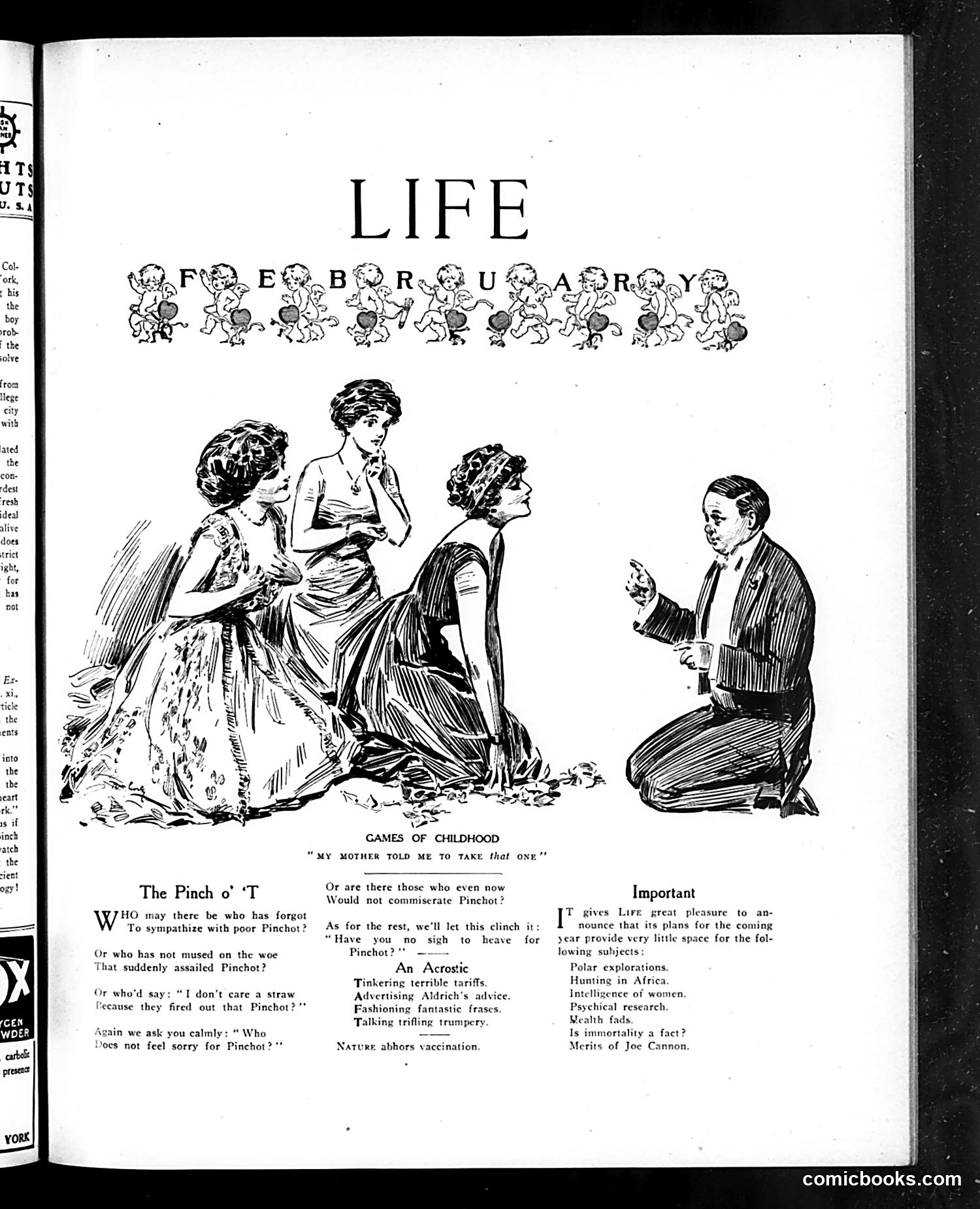
This satirical page critiques wealthy society women and their frivolous pursuits. The main illustration shows three fashionably-dressed women playing "Pinchot" (a children's game) with a man, mocking adult behavior that mimics childish games. The accompanying poems ridicule various social absurdities: "The Pinch o' T" jokes about women's complaints regarding Pinchot; "An Acrostic" lists trivial upper-class concerns (tariffs, Aldrich's advice, fashion, gossip, vaccination); and "Important" sarcastically announces Life's editorial focus on weightier matters like polar exploration and women's intelligence—implying these are notably absent from society's actual priorities. The satire targets the disconnect between serious issues and the shallow preoccupations of wealthy women, while questioning their intellectual engagement with current events.
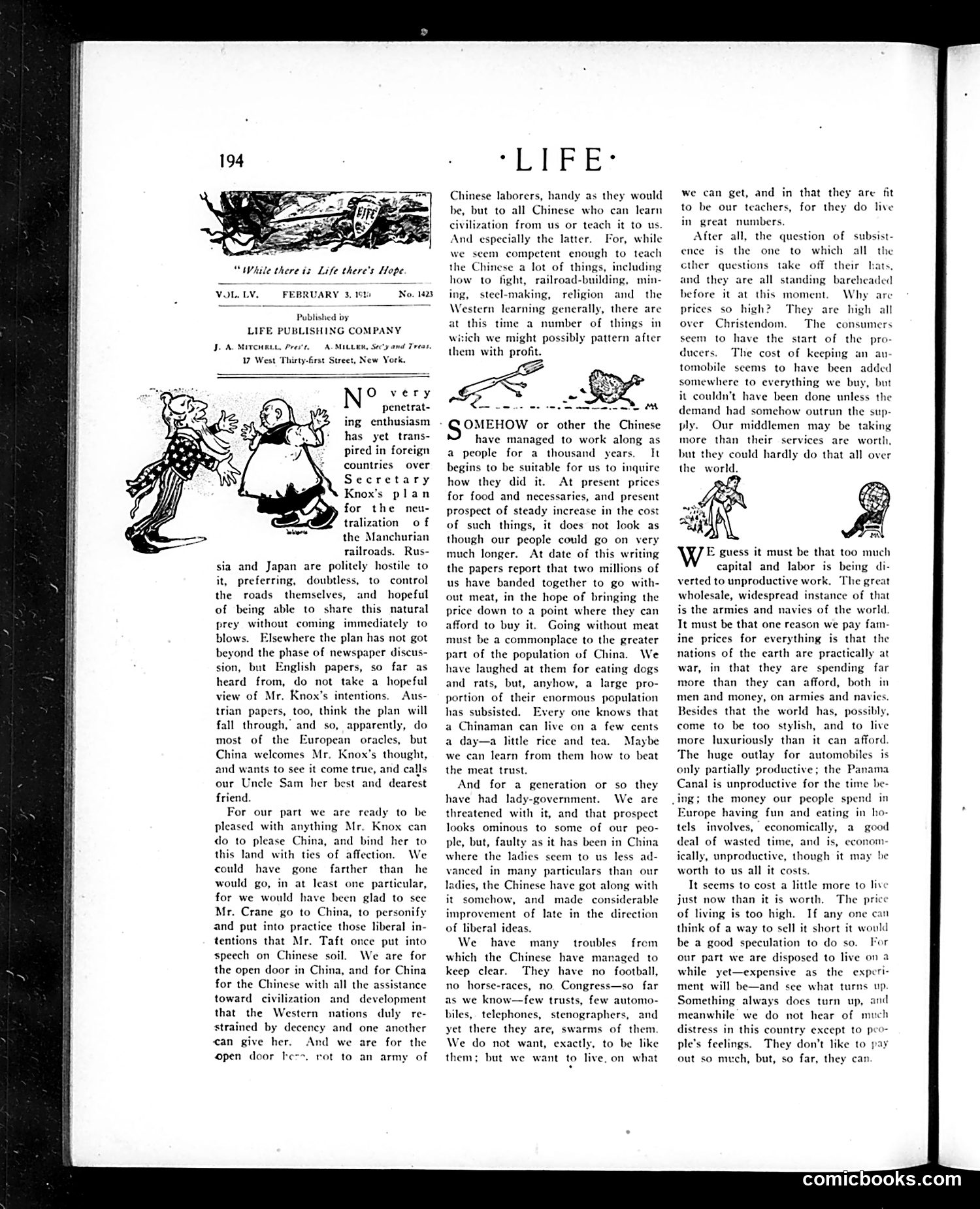
This February 3, 1912 *Life* magazine page satirizes American attitudes toward China. The main illustration shows a figure labeled "Secretary Knox's plan for the neutralization of the Manchurian railroads"—likely referencing Secretary of State Philander Knox's actual diplomatic efforts in Manchuria. The cartoon depicts a portly Western figure attempting to control or manipulate Chinese affairs, personified as a small Chinese character. The satire mocks American presumption that Western powers could easily reshape Asian geopolitics through financial schemes. The accompanying text expresses skeptical, paternalistic views typical of the era: praising Chinese laborers while doubting Chinese capability for self-governance, and questioning whether American commercial interests should dominate Chinese development. The overall message critiques both American foreign interventionism and Western assumptions of cultural superiority.
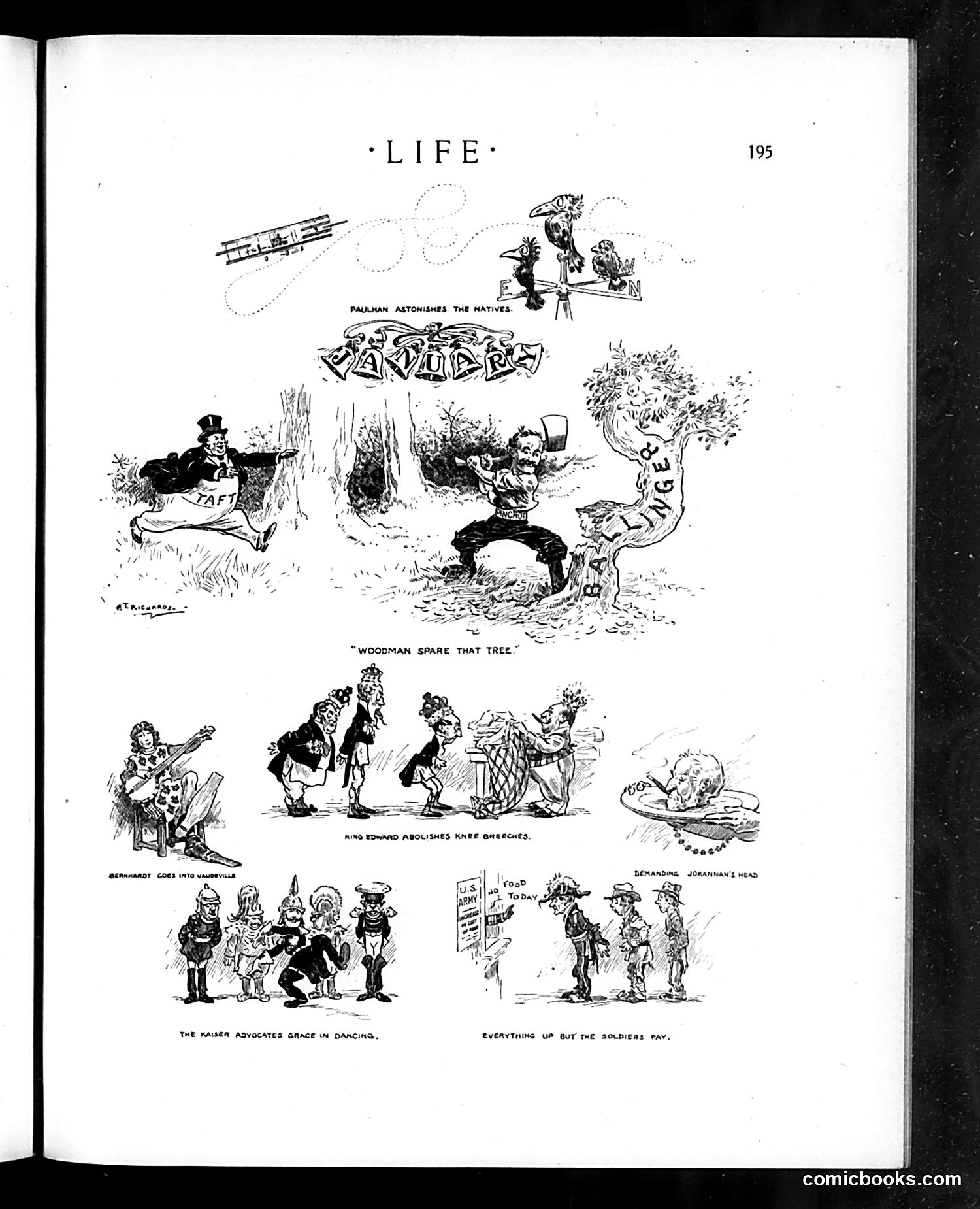
This page contains six separate satirical cartoons addressing World War I-era issues: 1. **Top panel**: "Palkman Astonishes the Natives" - appears to reference colonial/imperial themes with an airplane (dotted flight path). 2. **"Woodman Spare That Tree"** - A soldier protects a tree labeled "ING" while another figure chops it, likely satirizing wartime resource demands. 3. **"King Edward Abolishes Knee Breeches"** - Mocks British royal fashion decisions during wartime. 4. **"Bernhardt Goes into Vaudeville"** - References actress Sarah Bernhardt's career (unclear exact satire). 5. **"The Kaiser Advocates Grace in Dancing"** - Mocks Kaiser Wilhelm II's pronouncements on morality while waging war. 6. **"Everything Up But the Soldiers Pay"** - Criticizes inflation and cost-of-living increases while soldiers' wages remain static—a direct social complaint about wartime economics.
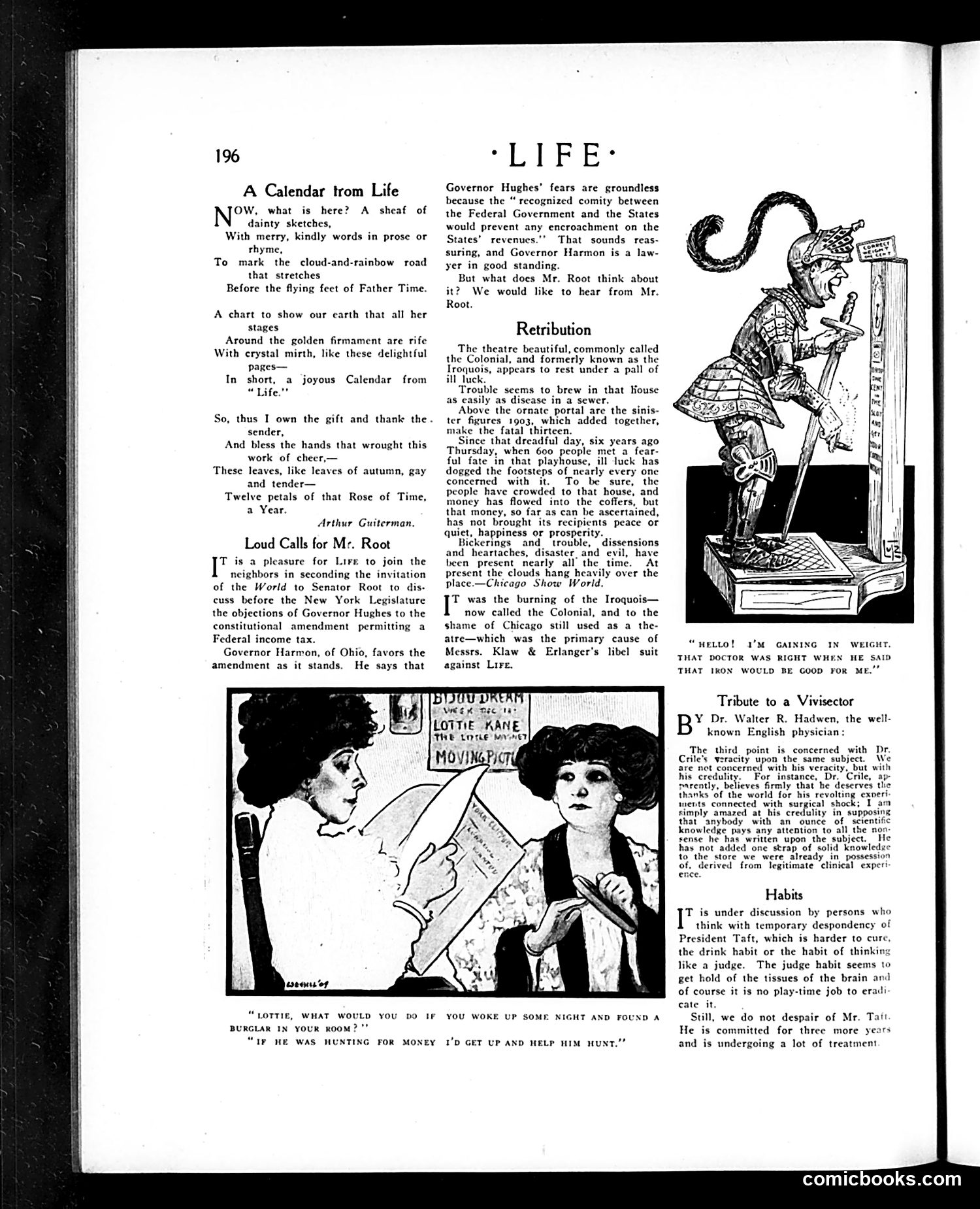
This page contains several distinct pieces: 1. **"A Calendar from Life"** - A poem by Arthur Guiterman about marking time's passage, presented as satirical verse about life's stages. 2. **"Loud Calls for Mr. Root"** - Commentary on Senator Root's discussion of a constitutional amendment for Federal income tax, with Governor Harmon of Ohio supporting it. 3. **"Retribution"** - A detailed article about the Colonial Theatre's misfortunes, describing six years of bad luck following a fatal incident there. 4. **The cartoon** (bottom left) depicts a woman asking what she'd do if she found a burglar—the man responds he'd help catch him if the burglar was "hunting for money," implying commentary on financial desperation during economic hardship. 5. **"Tribute to a Viviscector"** and **"Habits"** - Brief editorial pieces on medical practice and President Taft's habits, respectively.
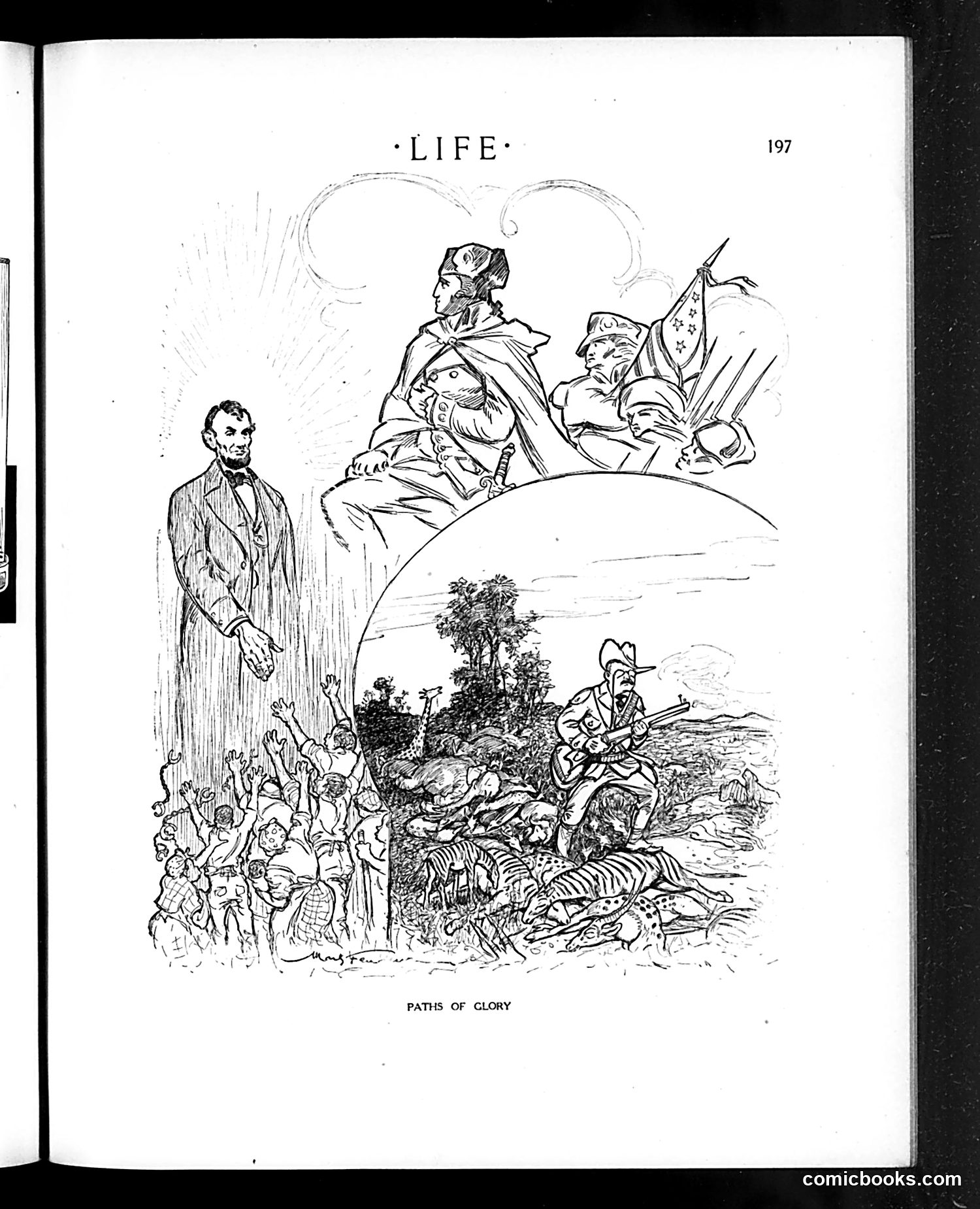
This cartoon contrasts two visions of American ambition. On the left stands an ordinary man in civilian dress, appearing modest and grounded. Above him floats an elaborate vision of military glory—officers on horseback, soldiers with flags, and scenes of conquest and warfare. Below, the earthly reality shows the consequences: dead soldiers, destruction, and suffering on a battlefield, with a lone cowboy or frontiersman surveying the carnage. The satire critiques the gap between romantic ideals of military glory (the cloud-vision) and the brutal reality of war's human cost. The title "Paths of Glory" suggests ambition's illusory nature—what appears glorious from a distance becomes devastating up close. This reflects common anti-war sentiment in American satirical publications.
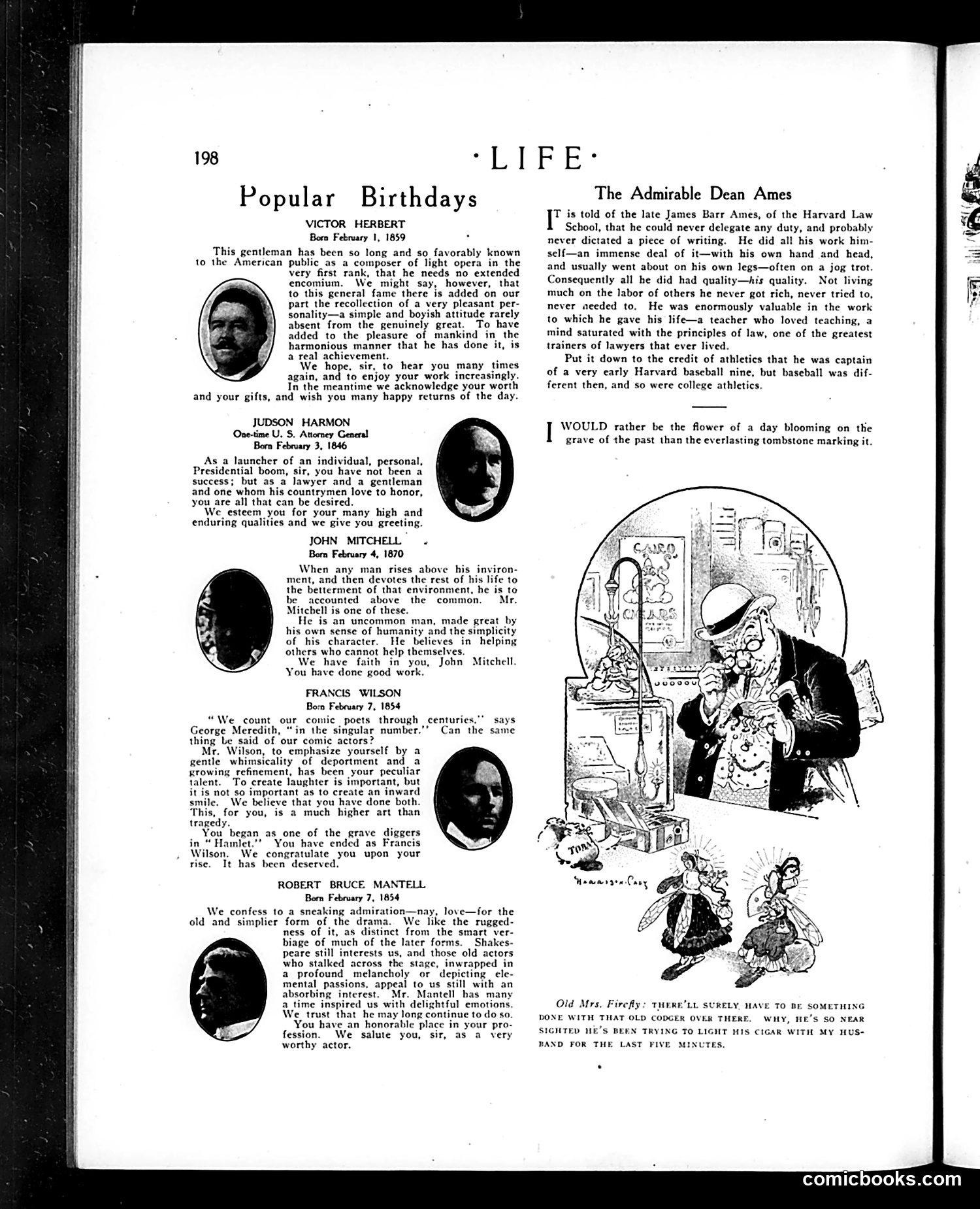
This page celebrates notable people's birthdays with portraits and brief celebratory verses (a popular Life magazine feature circa early 1900s). **The birthday subjects** include: - **Victor Herbert** (composer of light operas)—praised for both artistic achievement and pleasant personality - **Judson Harmon** (former U.S. Attorney General)—acknowledged as a worthy lawyer and gentleman despite his unsuccessful presidential ambitions - **John Mitchell** (appears to be a labor leader or humanitarian, born 1870)—celebrated for rising above his circumstances to help others - **Francis Wilson** (comic actor)—complimented for creating genuine smiles rather than mere laughter - **Robert Bruce Mantell** (Shakespearean actor)—valued for reviving classical dramatic traditions **The right side essay** memorializes **Dean James Barr Ames** of Harvard Law School, praising his meticulous personal work ethic, refusal to delegate, and profound impact training lawyers—suggesting that quality of character and labor matters more than wealth accumulation. The cartoons and tone suggest early-20th-century American values: honoring professional achievement, integrity, and public service.
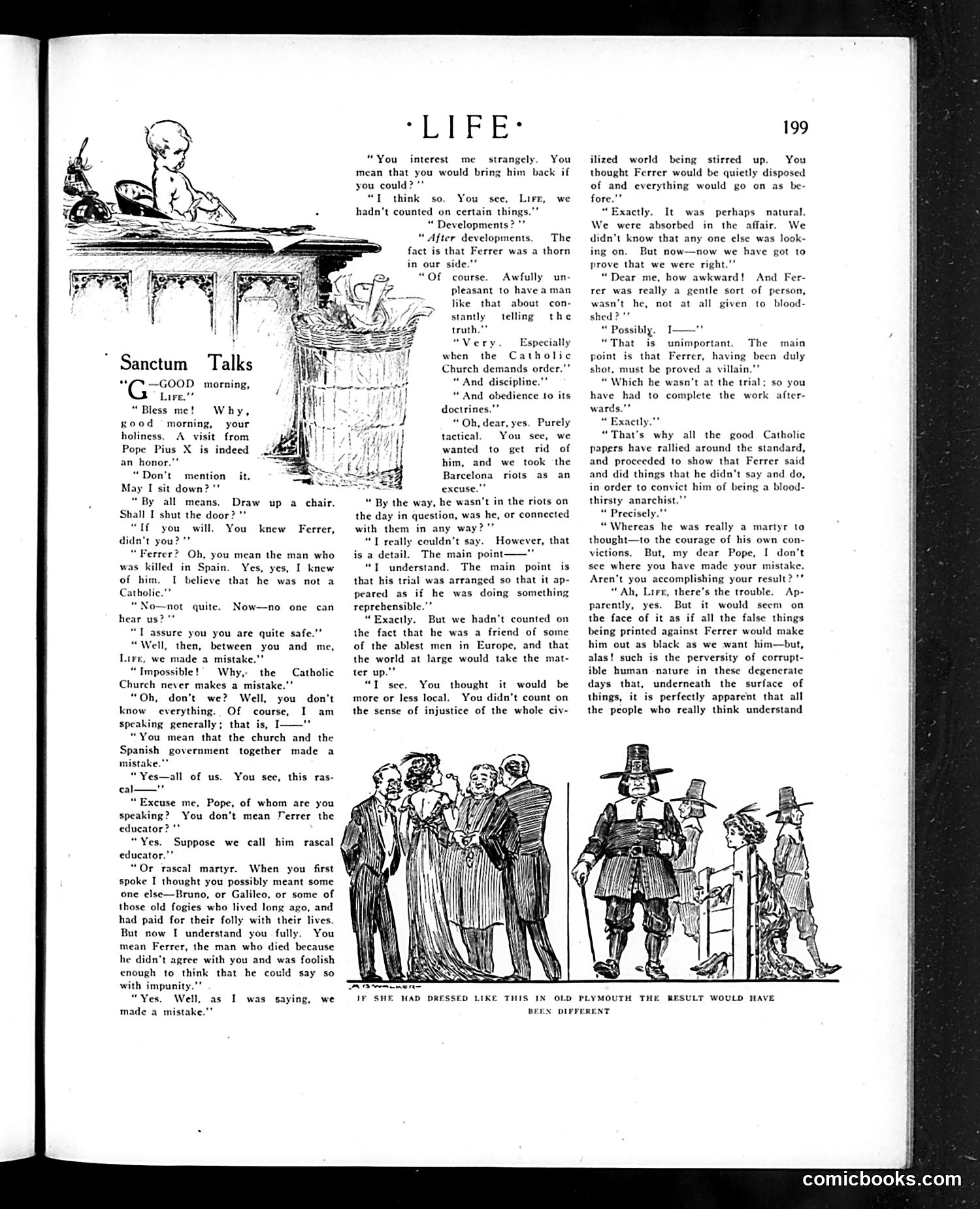
This satirical dialogue concerns **Francisco Ferrer**, a Spanish educator executed in 1909. The cartoon depicts Pope Pius X admitting to "Life" (the magazine's personified editor) that the Church and Spanish government made a mistake executing Ferrer. **The satire's point:** The Pope confesses they used the Barcelona riots as a pretext to eliminate Ferrer, a vocal critic of Church authority. They expected his death to pass quietly but underestimated international outrage from "the ablest men in Europe." Now trapped, they've enlisted Catholic newspapers to retroactively blacken Ferrer's reputation—painting him a "bloodthirsty anarchist" when he was actually "a martyr to thought." **The joke:** The Pope candidly admits to orchestrated injustice, character assassination, and propaganda—treating it as a tactical miscalculation rather than moral wrong. The cartoon mocks institutional hypocrisy: the Church preaches truth while systematically manufacturing lies to cover its crime.
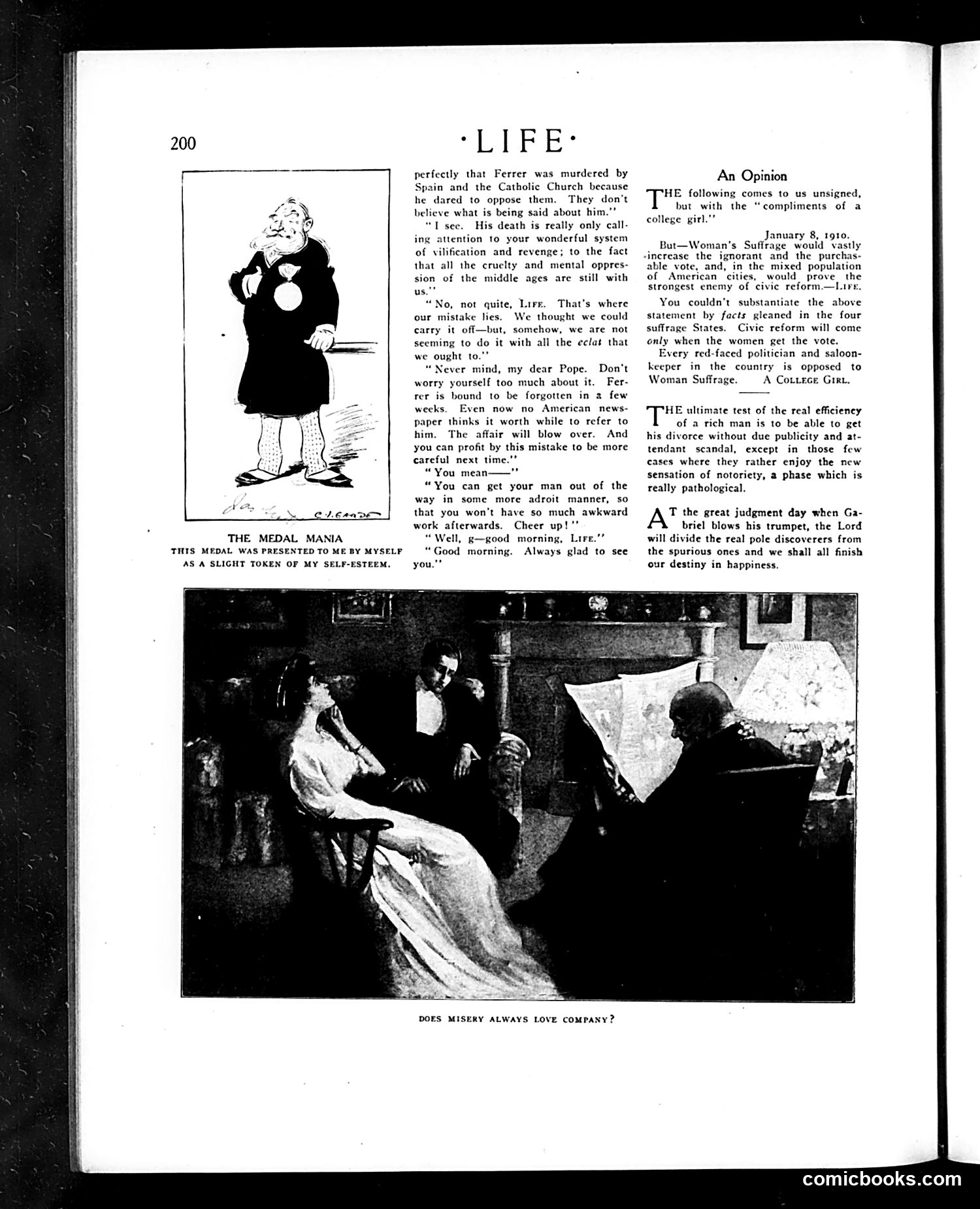
**The Cartoon:** The top cartoon satirizes self-aggrandizement—a figure presenting himself with a medal "as a slight token of my self-esteem." The joke mocks those who award themselves honors without external validation. **The Dialogue Section:** This appears to be a satirical conversation between "Life" (the magazine's voice) and the Pope, discussing Francisco Ferrer, a Spanish educator executed in 1909 by the Spanish government and Catholic Church for his secular, anti-clerical views. Life's editorial position criticizes the Church's brutality while cynically advising the Pope to be more discreet in future killings—a biting satire on institutional evil and complicity. **"An Opinion" Section:** Two opposing letters debate Women's Suffrage. One correspondent argues suffrage would empower ignorant voters; a college girl rebuts that suffrage is supported by working-class men (politicians, saloon-keepers) only opposing it out of self-interest. The exchange reflects genuine 1910 suffrage debate. **Overall:** The page satirizes institutional hypocrisy, religious oppression, and gendered political exclusion.
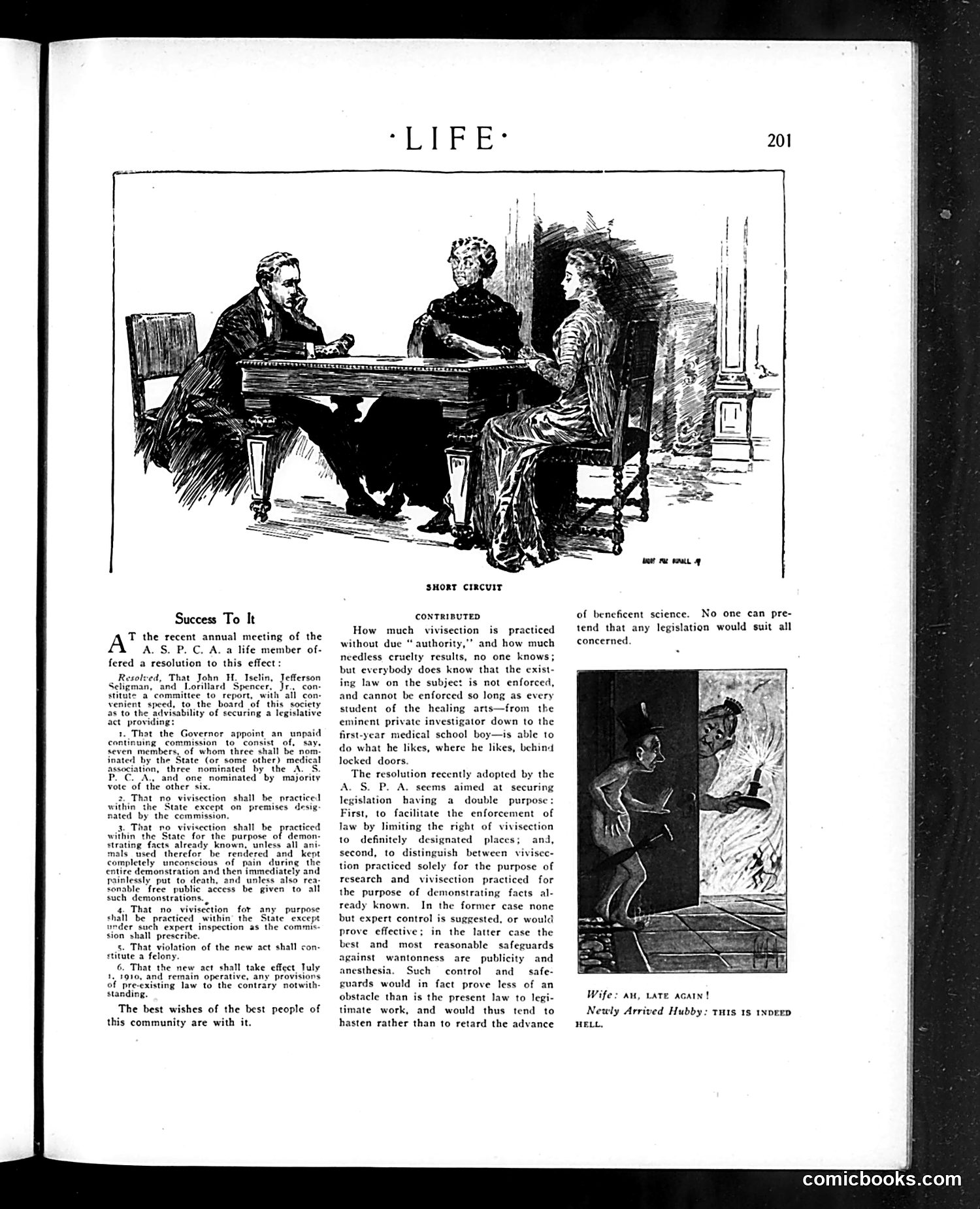
This page addresses animal vivisection (medical testing on live animals), a contentious issue in early 20th-century America. **The Main Cartoon ("Short Circuit"):** Shows three figures in what appears to be a domestic setting—likely a husband arriving home late. The caption jokes that he's experiencing a "short circuit" with his wife, who greets his late arrival with sarcasm ("Ah, late again!"). This is visual wordplay connecting to the legislative discussion below. **The Editorial Content:** Life endorses a proposed resolution by the ASPCA to regulate vivisection through state legislation. The proposed rules would: - Restrict vivisection to designated facilities - Distinguish between research and demonstration purposes - Require anesthesia and public access for demonstrations - Make violations a felony **The Satire's Point:** Life supports stronger animal welfare protections while arguing that regulation actually serves science better than current unenforced law—because it would eliminate unnecessary cruelty while maintaining legitimate research capability. The cartoon's "short circuit" joke provides lighthearted relief from the serious legislative discussion.
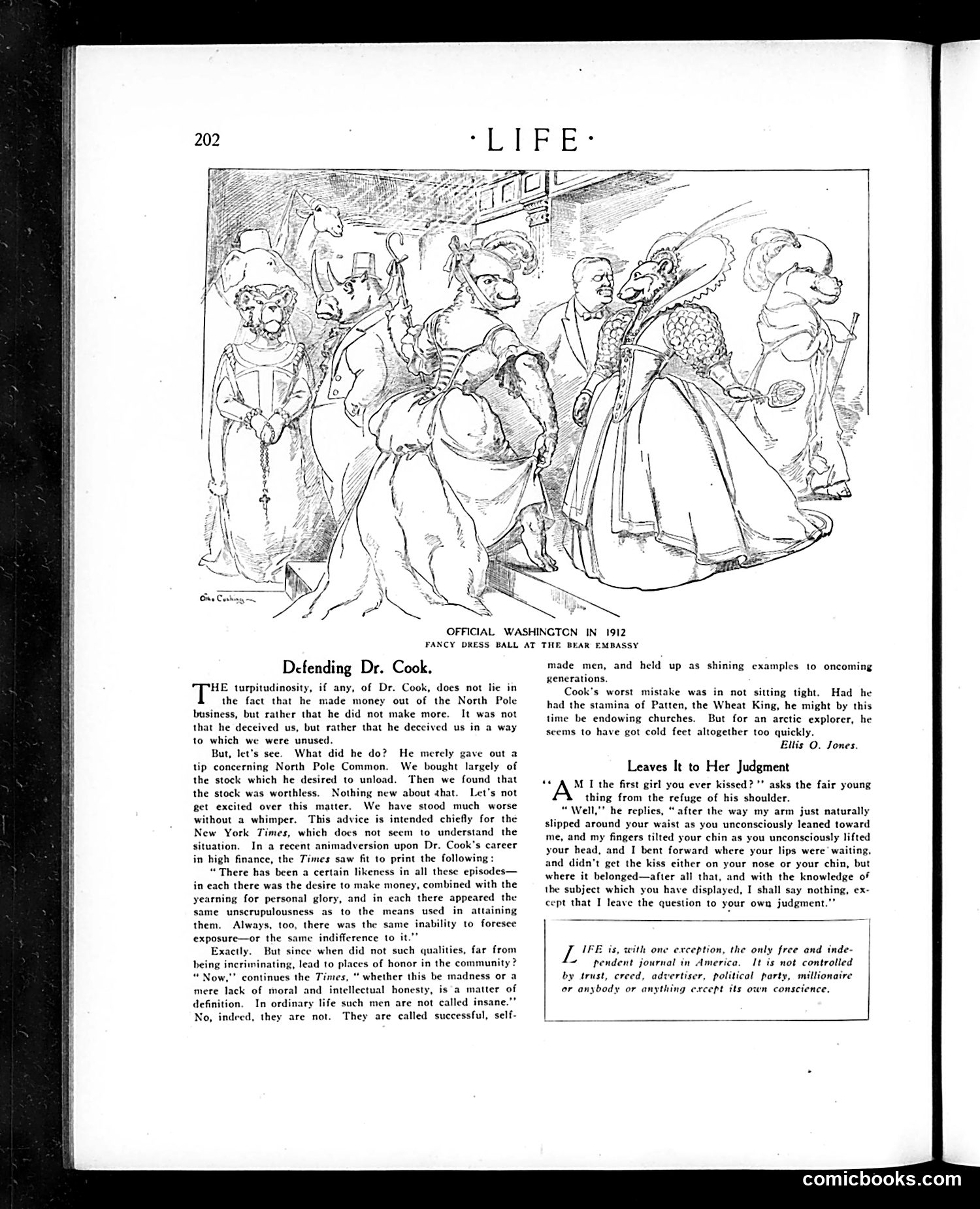
**The Cartoon:** The illustration depicts a fancy dress ball at the "Bear Embassy" in official Washington, 1912. The figures wear animal heads—likely representing political figures as bears and other creatures—satirizing Washington society and power players. **"Defending Dr. Cook":** This article defends Arctic explorer Frederick Cook, who had made money promoting worthless stock based on North Pole claims. Life's satirical point: Cook's real crime wasn't deception itself, but being *bad at it*. The magazine cynically argues that financial manipulation, greed, and dishonesty are actually rewarded in American society—successful businessmen do exactly what Cook did and receive honor. Cook's mistake was getting caught. The article contrasts him with Patten ("the Wheat King"), a wealthy commodities speculator who "might by this time be endowing churches." **"Leaves It to Her Judgment":** A brief romantic comedy about a young couple kissing, where the man deflects answering whether she's his first kiss by turning the question back to her. **Overall Context:** This page illustrates Life's role as a satirical social critic, exposing hypocrisy in American business and politics.
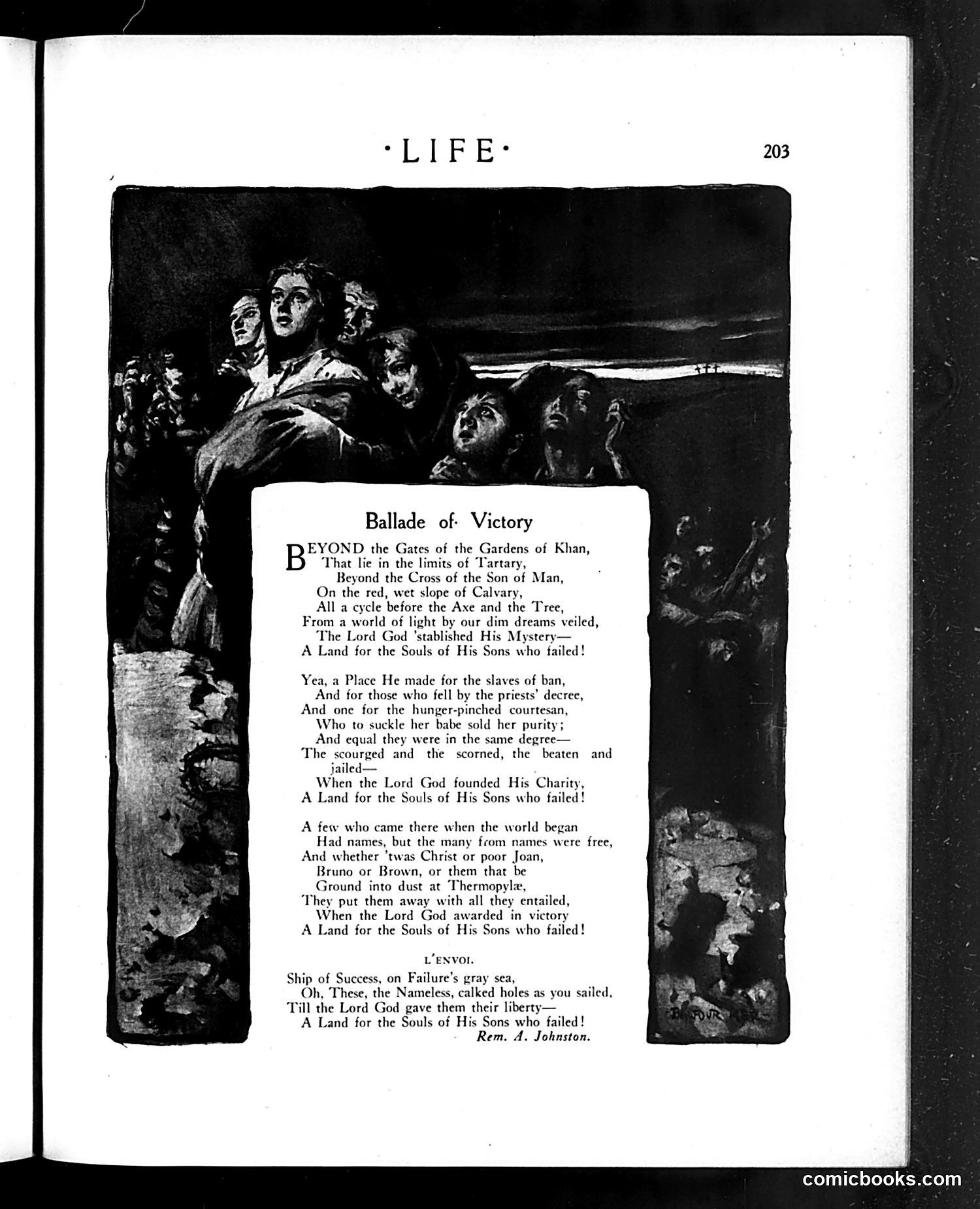
This page contains a serious poem rather than satire or political cartoon. "Ballade of Victory" by Rem. A. Johnston is a religious allegory about divine justice and redemption. The poem imagines an afterlife where God creates a sanctuary for society's rejected and failed—slaves, heretics, executed prisoners (likely referencing Joan of Arc and Bruno), prostitutes, and the nameless masses killed in conflict (Thermopylae). The refrain emphasizes that these outcasts achieve equality and liberation through God's charity. The accompanying dark, dramatic illustration shows figures in anguish or reverence, suggesting spiritual transcendence. The poem's message is progressive for its era: it advocates that the lowly and disgraced deserve divine mercy equal to the privileged, and that their earthly suffering finds redemption in heaven. This reflects early 20th-century social consciousness about inequality and injustice.
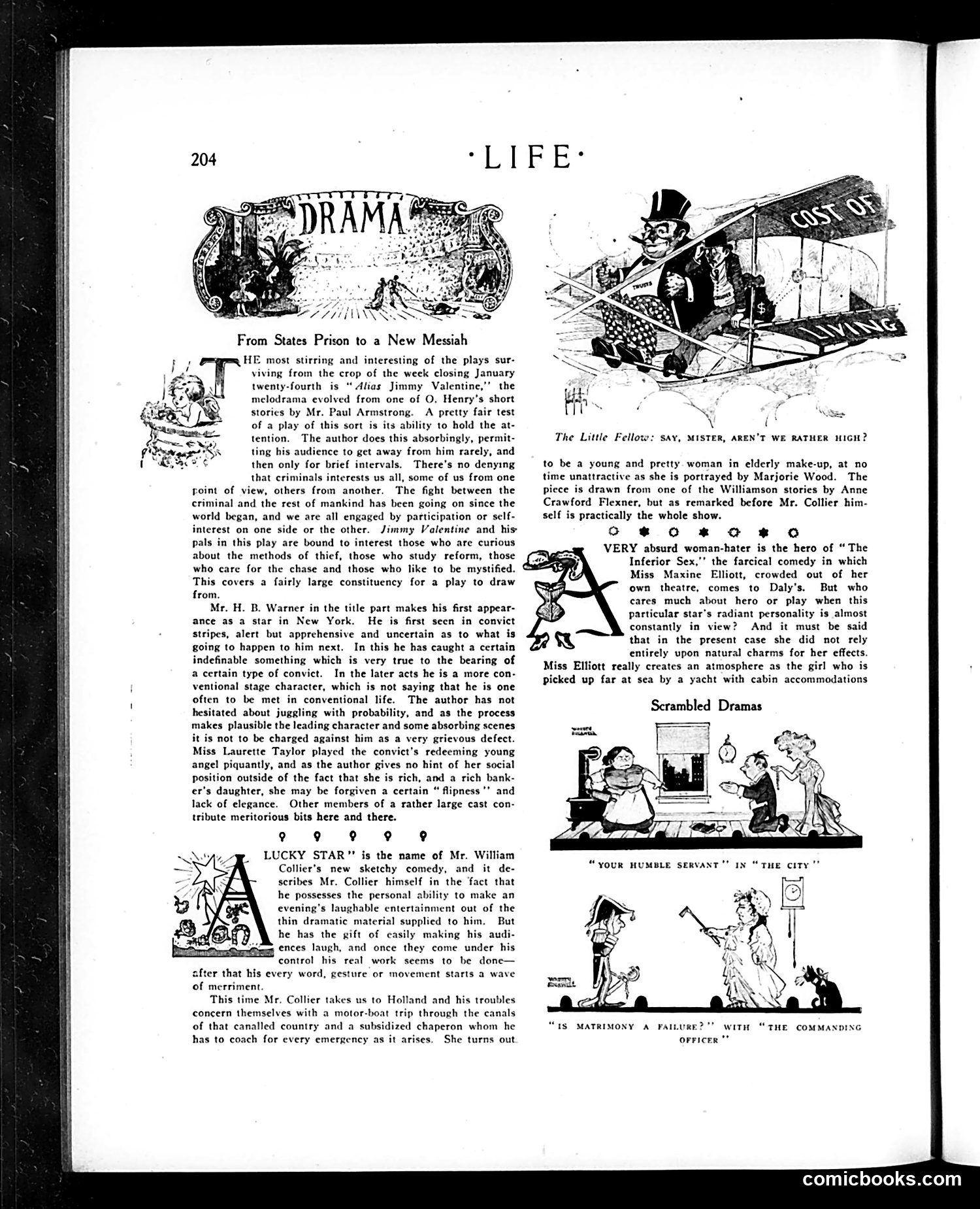
This page reviews three Broadway plays. The main critique discusses **"Alias Jimmy Valentine,"** adapted from an O. Henry story about a reformed safecracker. The review praises how the plot holds audience attention through the inherent drama of crime and redemption—noting that criminals interest us all, whether from moral concern or fascination with criminal methods. **H.B. Warner** makes his New York starring debut playing Jimmy Valentine. The review commends his convincing portrayal of a convict's bearing in early scenes, though notes the playwright takes liberties with probability for dramatic effect. **Laurette Taylor** plays the redemptive female lead—a wealthy banker's daughter. Two other comedies are briefly reviewed: William Collier's **"A Lucky Star"** (set in Holland) and **"The Inferior Sex"** starring **Maxine Elliott**, where the star's personality largely overshadows the thin plot. The cartoons satirize theatrical clichés—servants in comedies, failed marriage proposals—standard vaudeville fare of the era.
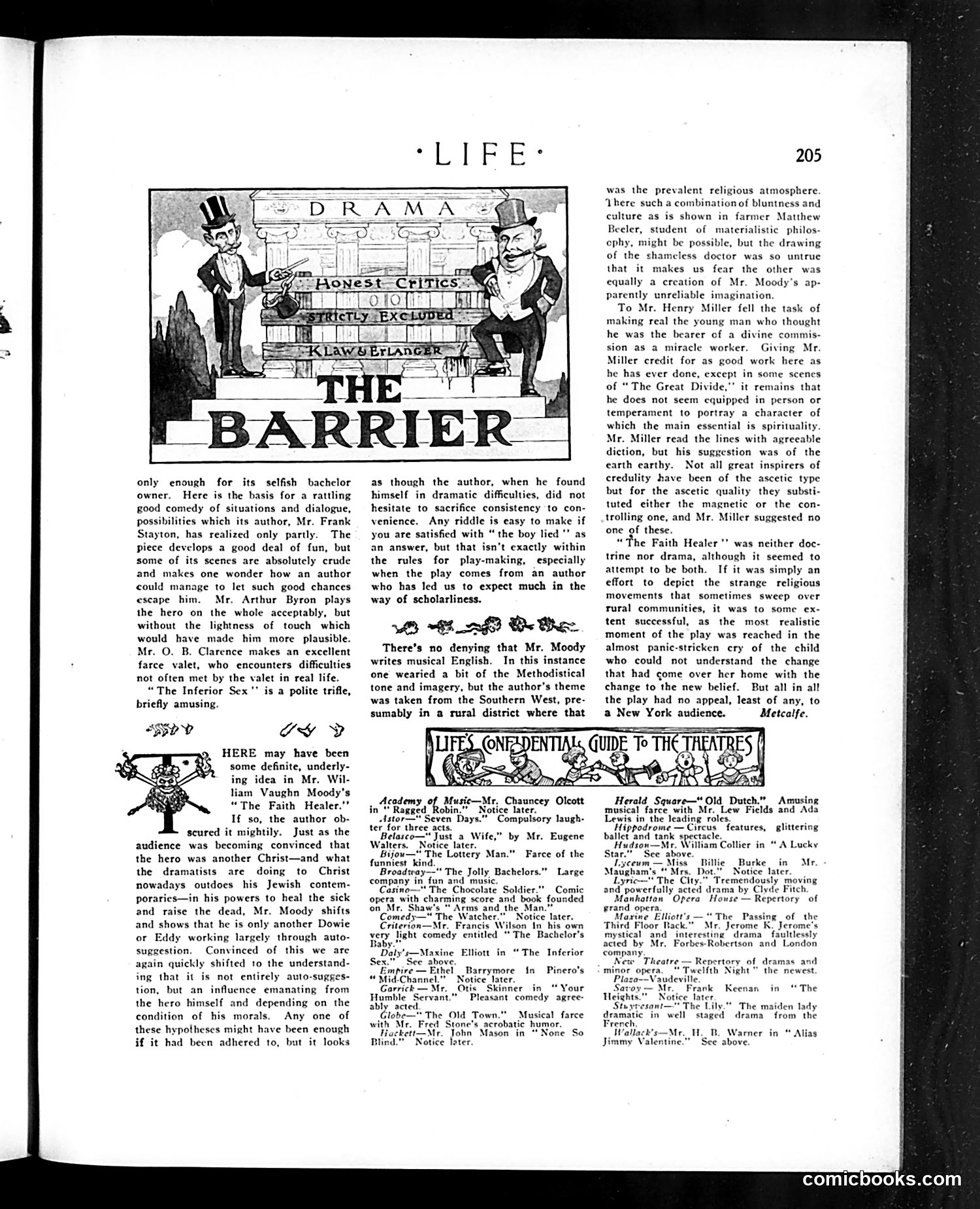
This page contains theater reviews from Life magazine's drama section. The prominent cartoon at top—titled "The Barrier"—depicts two well-dressed men (appearing to be theater critics) standing before a stage entrance marked "Honest Critics Strictly Excluded," suggesting satirical commentary on theater criticism itself. The reviews discuss contemporary Broadway plays including "The Faith Healer" by William Vaughn Moody. The critic faults Moody for inconsistent plotting, comparing the play's muddled philosophy to poorly constructed riddles. The reviewer criticizes how Moody shifts between presenting his protagonist as Christ-like, then as a charlatan like religious figures Dowie or Eddy (likely referring to Mary Baker Eddy of Christian Science), then retreating to vague auto-suggestion. The text also reviews "The Barrier" and other productions, evaluating actors' performances and dramatic construction. The tone is sophisticated but caustic—typical of Life's urbane satire aimed at educated readers familiar with theatrical trends and contemporary religious movements.
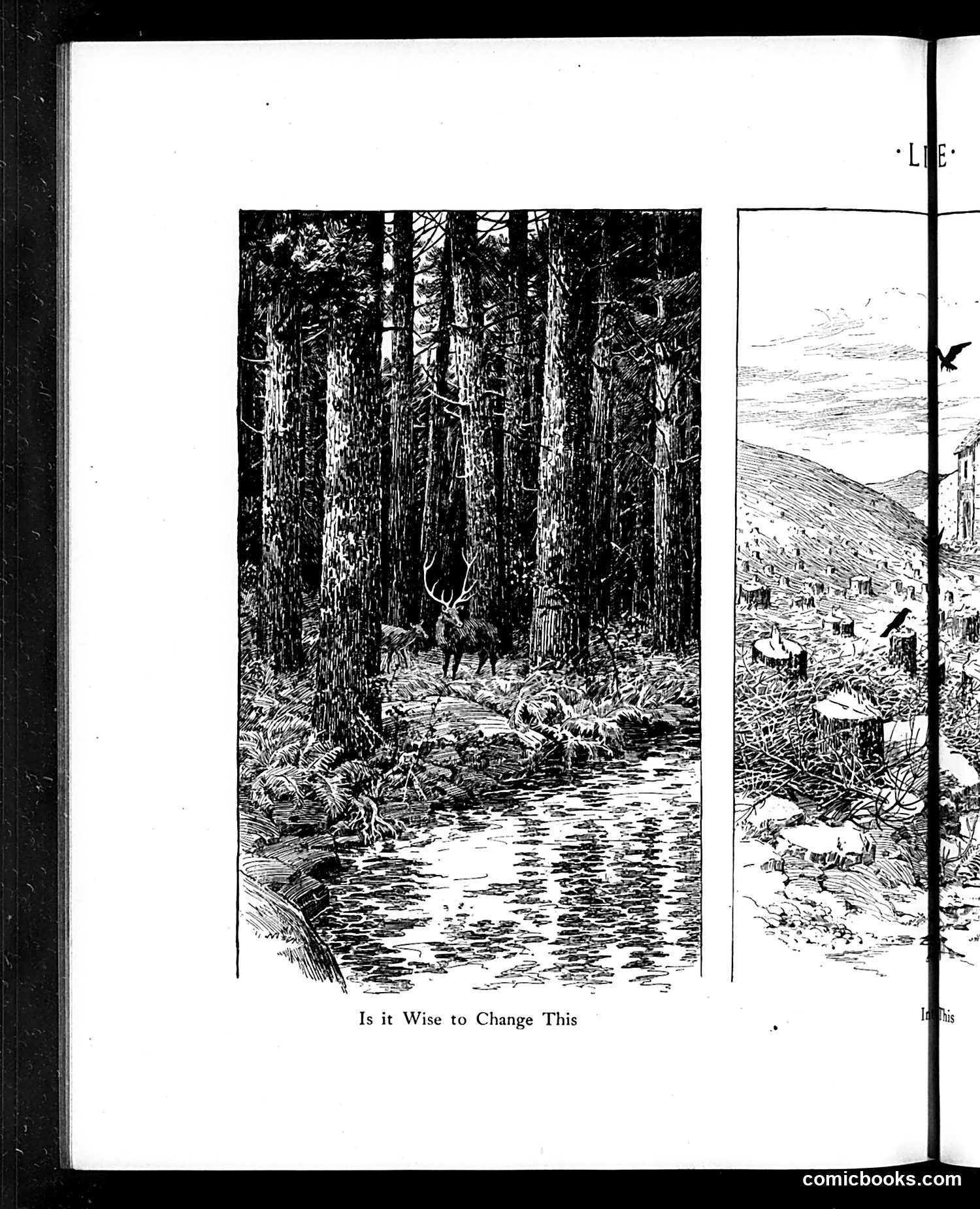
This page presents a nature illustration titled "Is it Wise to Change This?" The image depicts a dense forest scene with tall trees, a stream running through it, and a deer standing in the water. The right panel shows a cleared, deforested landscape with stumps and human activity. The caption poses a rhetorical question about whether such environmental transformation is advisable. This is **conservation satire**—criticizing deforestation and industrial development that destroys natural wilderness. The contrast between the pristine forest (left) and denuded landscape (right) makes the satirical argument: replacing undisturbed nature with human exploitation is unwise. This reflects early-to-mid 20th century American conservation debates, when *Life* magazine frequently advocated for environmental preservation against industrial expansion.
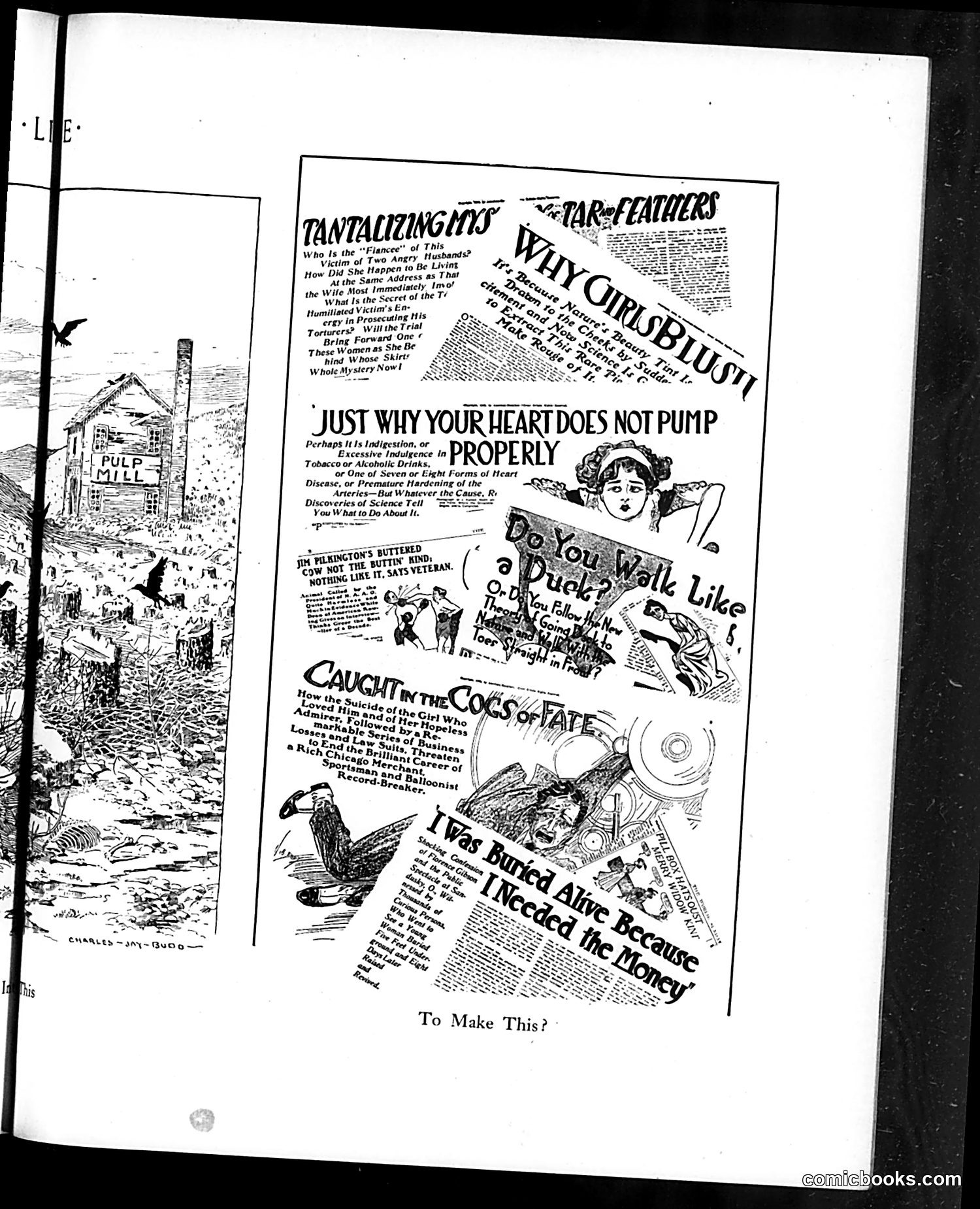
This page collects **sensationalist movie advertisements** from the silent film era, presenting lurid melodramatic titles designed to entice audiences. The visible titles include: - "Tantalizing Nights" (featuring romantic/scandal intrigue) - "Why Girls Bust" (likely about moral or social transgression) - "Just Why Your Heart Does Not Pump Properly" (health-related) - "Caught in the Coils of Fate" - "I Was Buried Alive Because I Needed the Money" The satire targets **early 1900s cinema's sensationalism**—studios marketed films through increasingly outrageous, salacious premises to draw paying crowds. The collage and the question "To Make This?" mock how these overwrought plot summaries (promising murder, deception, moral crises, financial desperation) were artificially constructed entertainment designed purely for commercial appeal. The left shows a "Pulp Mill," suggesting these stories are mass-produced content of dubious quality. This is satire of **tabloid filmmaking** and the public's appetite for manufactured scandal and melodrama.
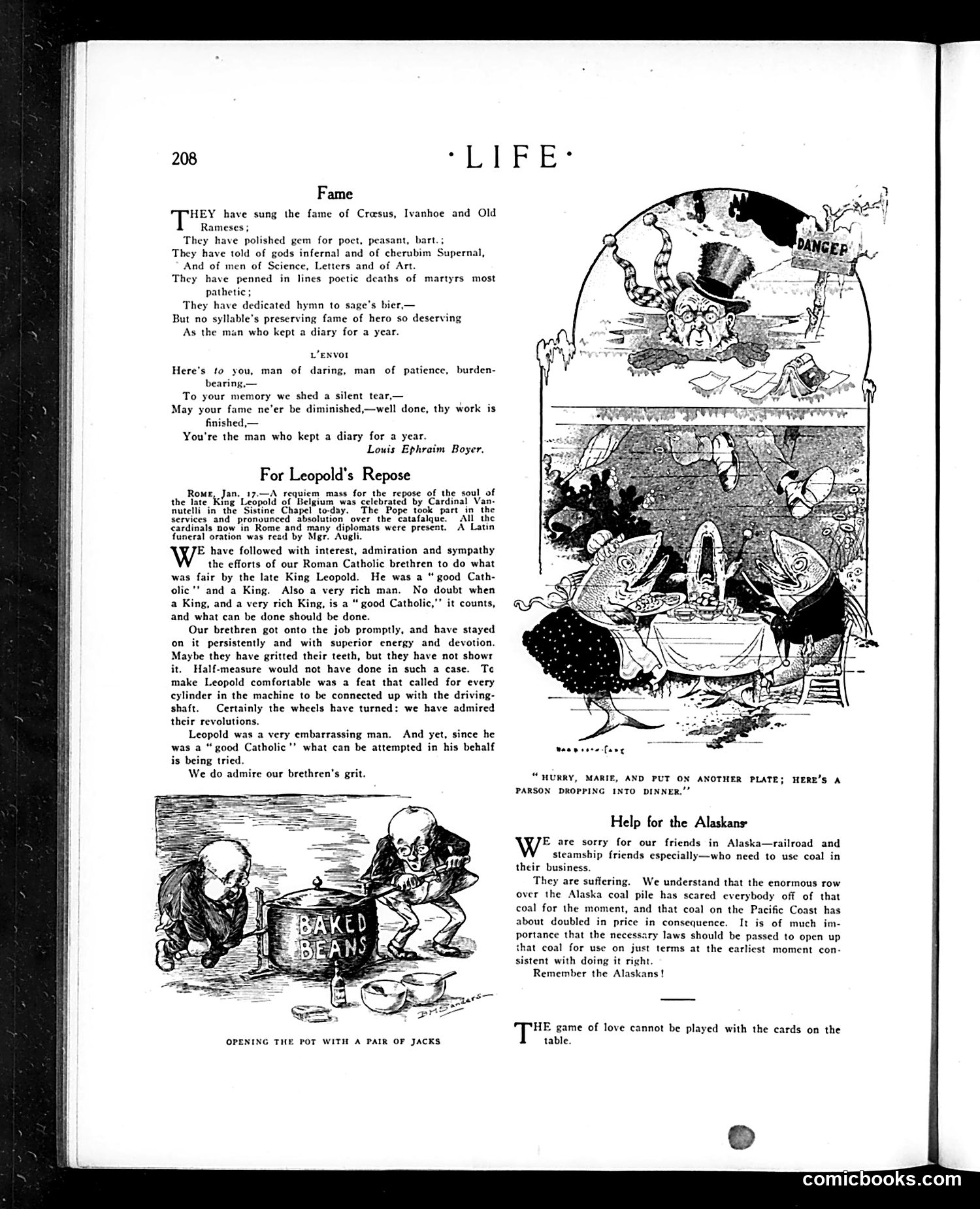
This page contains three satirical pieces: **"Fame"** mocks the pretension of recording trivial daily life. The poem humorously elevates a man who merely "kept a diary for a year" above historical figures like Croesus and famous martyrs—satire on vanity and the human impulse to document the mundane as if significant. **"For Leopold's Repose"** addresses King Leopold II of Belgium's recent death (appears to reference early 1900s). The text sarcastically praises the Catholic Church's elaborate funeral efforts, suggesting they're working hard to secure divine forgiveness for Leopold—implying his life required extensive spiritual damage control. The cartoons humorously show priests and a parson appearing unexpectedly at dinner, suggesting the Church's ubiquitous involvement in Leopold's affairs. **"Help for the Alaskans"** concerns Alaska coal disputes, likely referencing the Ballinger-Pinchot conservation controversy of 1909-1910, which paralyzed Alaska coal development through political scandal. The final aphorism about love and cards is unrelated social commentary.
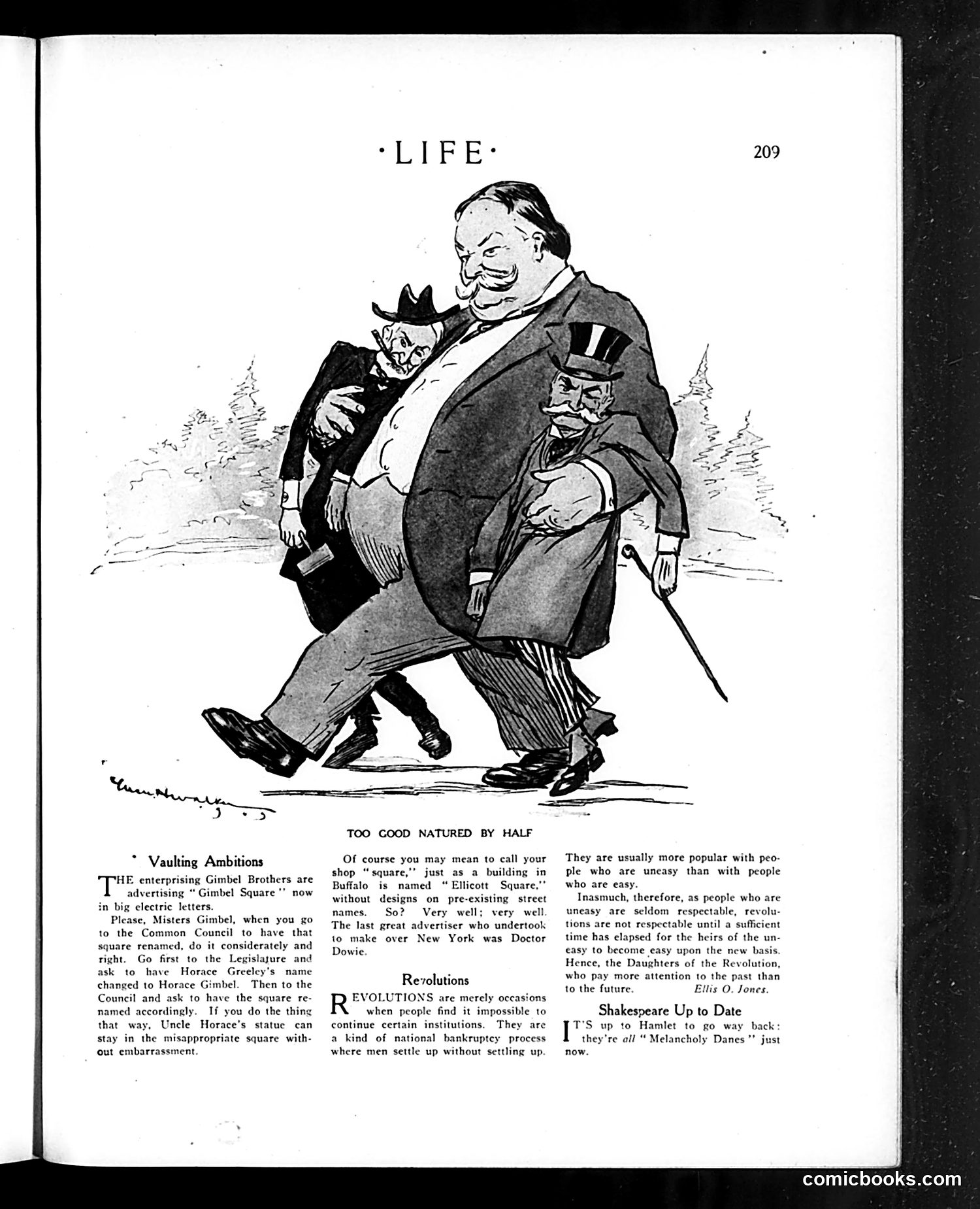
This cartoon satirizes the Gimbel Brothers department store's advertising campaign promoting "Gimbel Square." The store apparently sought to rename an existing New York City square after themselves—likely one currently named after Horace Greeley (visible statue referenced in text). The caricatured figure represents the Gimbels, depicted as corpulent and self-aggrandizing, carrying smaller figures (perhaps representing their commercial ambitions). The satire mocks their presumption: the editorial suggests they should properly petition the legislature to rename *Greeley himself* to "Horace Gimbel" before renaming the square—a sarcastic commentary on their naked commercial ego-branding. The text references Dr. Dowie as a previous "great advertiser" who attempted similar self-promotion, implying this is unseemly corporate vanity, not legitimate civic contribution.
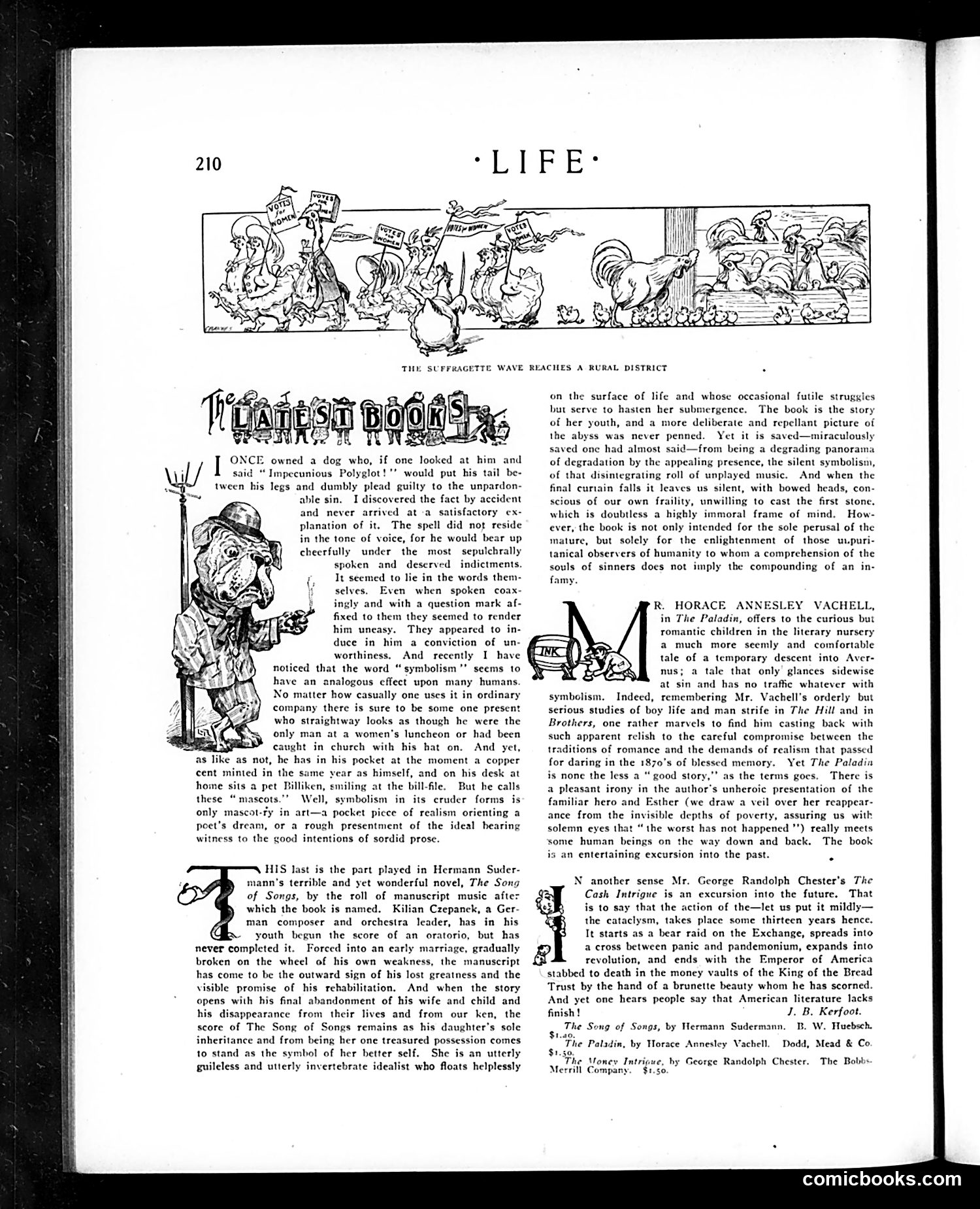
This page contains **no political cartoon**—it's a literary review section from *Life* magazine. The main content critiques three novels: 1. **"The Song of Songs"** by Hermann Sudermann—a German novel about a composer's abandoned daughter who inherits his unfinished musical score as a symbol of lost potential and moral redemption. The reviewer notes the book depicts moral degradation but is "saved" by this symbolic manuscript. 2. **"The Paladin"** by Horace Annesley Vachell—presented as a more wholesome alternative, avoiding the darker symbolism and sin depicted in Sudermann's work. 3. **"The Cash Intrigue"** by George Randolph Chester—apparently a thriller involving financial conspiracy and political turmoil. The left margin includes a humorous anecdote about a dog responding to the word "symbolism," mocking intellectuals who become anxious when encountering the term—satirizing pretentious literary culture of the era.
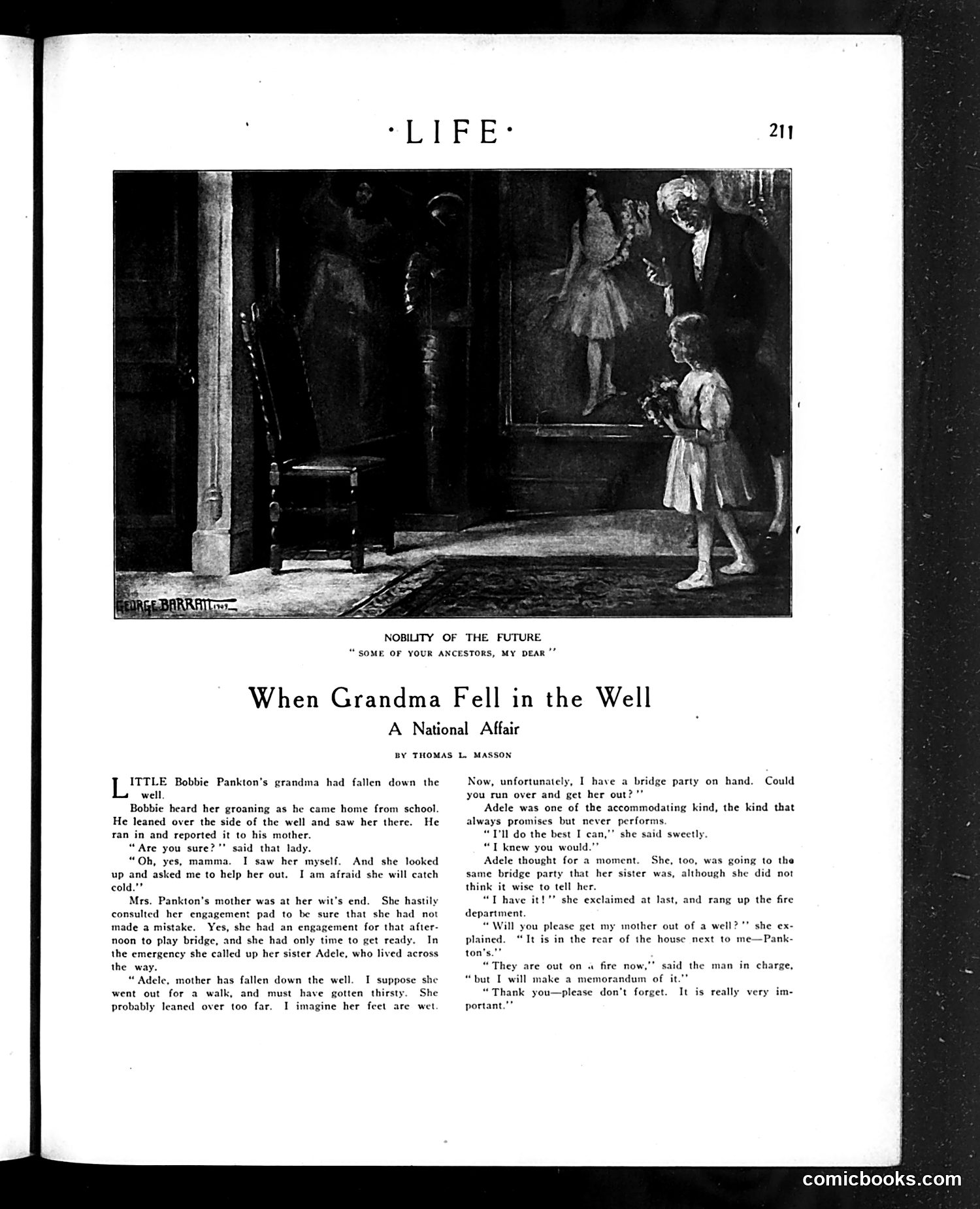
This is a humorous short story satirizing upper-class women's priorities and social habits in early 20th-century America. The joke centers on a grandmother trapped in a well, but her daughter and niece are preoccupied with attending a bridge party—a fashionable social card game among wealthy women. The satire targets the superficiality and callousness of society women: Mrs. Pankton consults her engagement calendar before helping her own mother, and Adele lies about her own bridge commitment while casually delegating the rescue to the fire department with vague instructions ("next to me"). The grandmother's life-threatening emergency is treated as an inconvenient scheduling conflict. The image's title, "Nobility of the Future," drips with irony, suggesting these women represent the moral decline of the upper class. The story mocks their leisure-obsessed lifestyle and indifference to family welfare when social obligations interfere.
This appears to be a humorous story satirizing early 20th-century American society's bureaucratic incompetence and selfish indifference. An elderly woman has fallen into a well, but no one will help her due to absurd reasons: the fireman fears insurance fines, the doctor claims Christian Science and professional etiquette prevent assistance, the waitress refuses extra duties, Mrs. Pankton is too busy, her husband won't help because he's "not mechanical" and the workers are unionized, and a neighbor threatens to report them to health authorities for *her own* protection. The satire mocks how modern institutions and self-interest paralyze practical action. Everyone prioritizes rules, comfort, or liability over basic human compassion—leaving grandma literally stuck in a well while society argues about procedures.
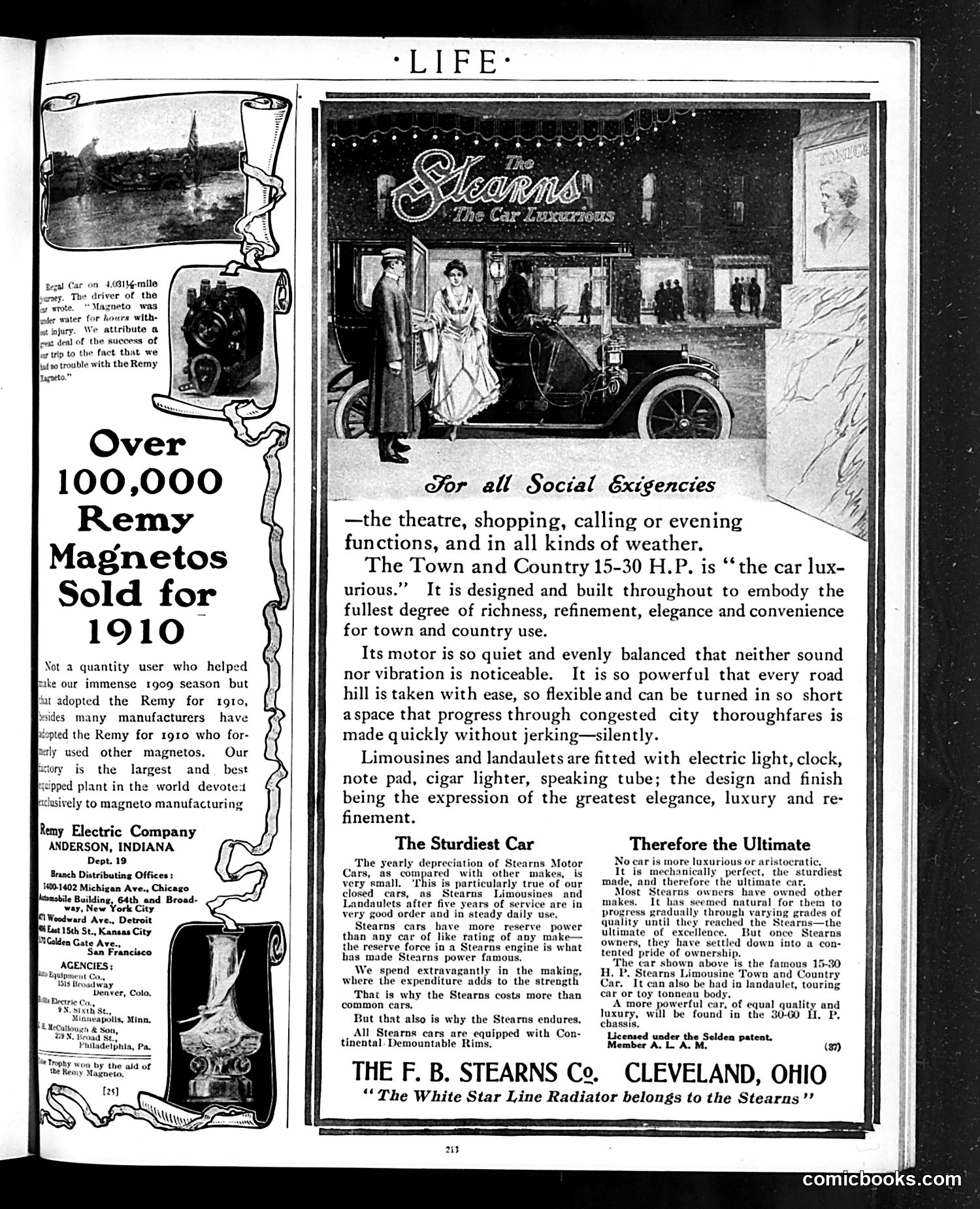
This page contains two distinct advertisements rather than editorial satire. **Left side:** A Remy Magnetos advertisement claims 100,000 units sold in 1910, celebrating automotive electrical components. The decorative border illustrates a car journey, emphasizing reliability. **Right side:** A Stearns Motor Car advertisement for their "Town and Country 15-30 H.P." luxury automobile. The ad targets wealthy buyers by emphasizing exclusivity—describing the car as suitable "for all Social Exigencies" (theatre, shopping, evening functions) with features like electric lights, speaking tubes, and superior engineering. The Stearns copy employs class-conscious language, noting that owners "have owned other makes" before "progressing" to Stearns as "the ultimate of excellence." This appeals to status-conscious buyers seeking visible markers of wealth and refinement. These are straightforward early-1900s luxury goods advertisements, not satire. The page reflects how Life magazine monetized its affluent readership.
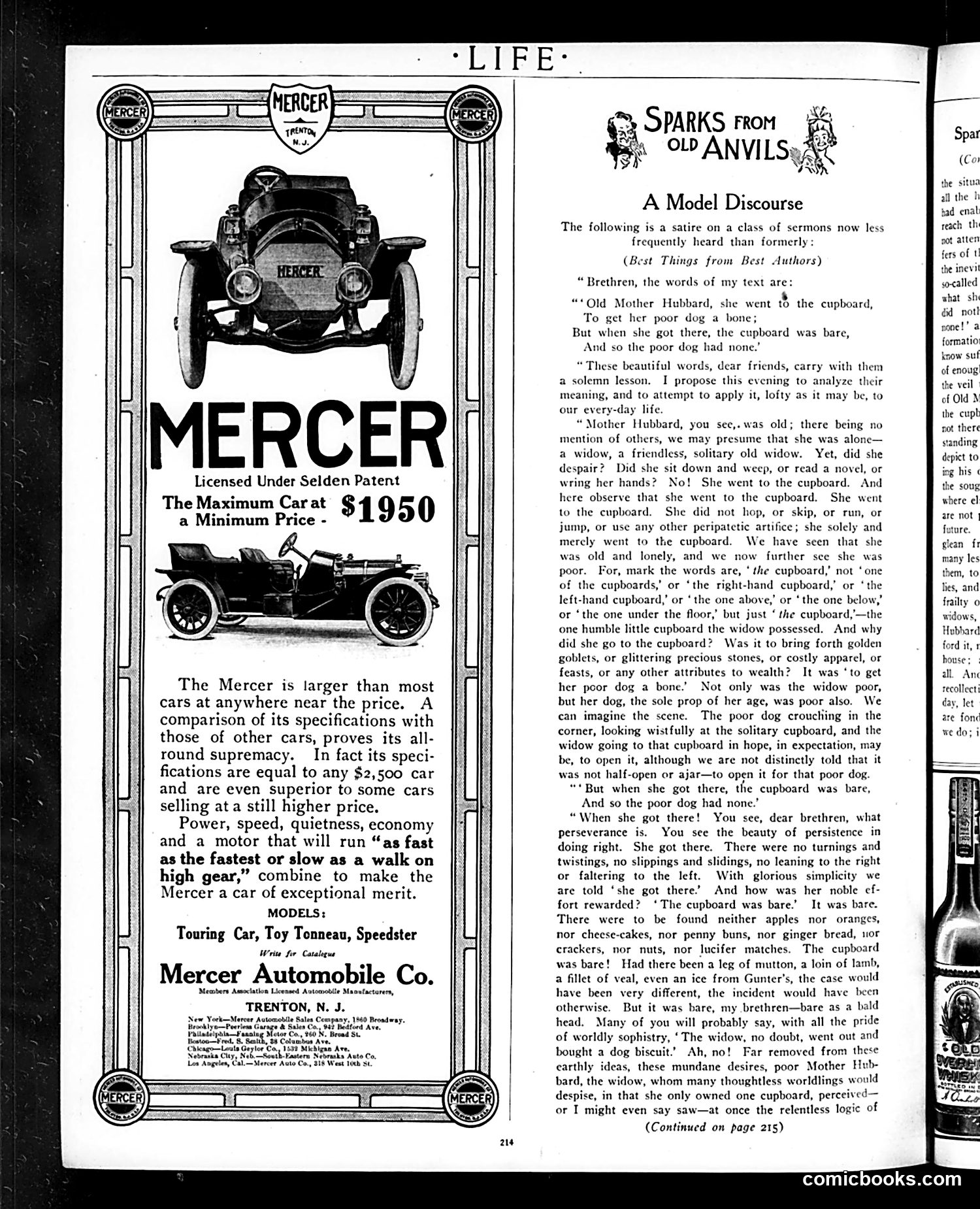
This page contains two distinct elements: a **Mercer automobile advertisement** (left) and a **satirical sermon parody** titled "Sparks from Old Anvils" (right). The advertisement promotes the Mercer car as superior value, priced at $1,950—a competitive price point for the early automobile era. The satire mocks **overwrought Victorian-era sermons** that extract grandiose moral lessons from trivial nursery rhyme subjects. The preacher treats Mother Hubbard's simple trip to an empty cupboard as profound spiritual instruction, obsessively analyzing each word ("the cupboard"—not "a cupboard") and reading deep significance into mundane details. The joke targets clergy who deliver tediously pedantic, inflated sermons mining profundity from humble sources. It's a commentary on pompous religious rhetoric of the era—ministers treating children's verses with unwarranted gravity. The satire continues beyond this page, suggesting this was a recognizable, tiresome sermon style readers would appreciate mocking.
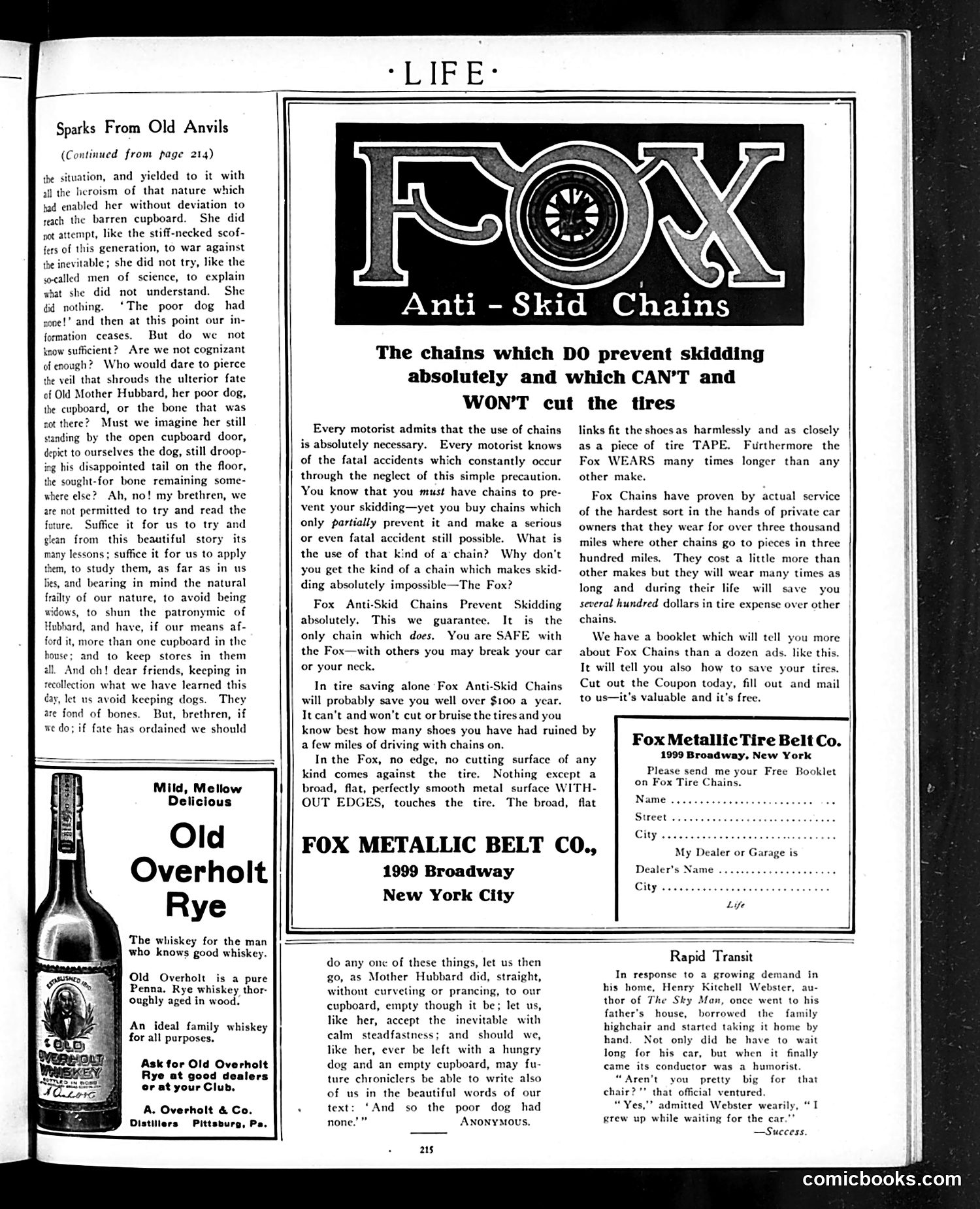
This page contains primarily **advertisements** rather than political cartoons or satire requiring historical context. The main content includes: 1. **"Sparks From Old Anvils"** — a humorous essay (continued from page 214) that satirizes *expectations of narrative closure*. It mockingly analyzes the nursery rhyme "Old Mother Hubbard," pretending it's profound literature while deliberately refusing to resolve the story's outcome. The satire targets overly serious literary criticism and people who demand neat endings. 2. **Three advertisements**: Old Overholt Rye whiskey, and two competing anti-skid automobile tire chain products (Fox Metallic Belt Co. and another maker). These ads reflect early 20th-century automobile safety concerns—winter driving hazards were genuine problems requiring chains. The page offers no apparent political commentary or caricature. It's a typical magazine format mixing satirical humor with period-specific commercial messaging about consumer goods.
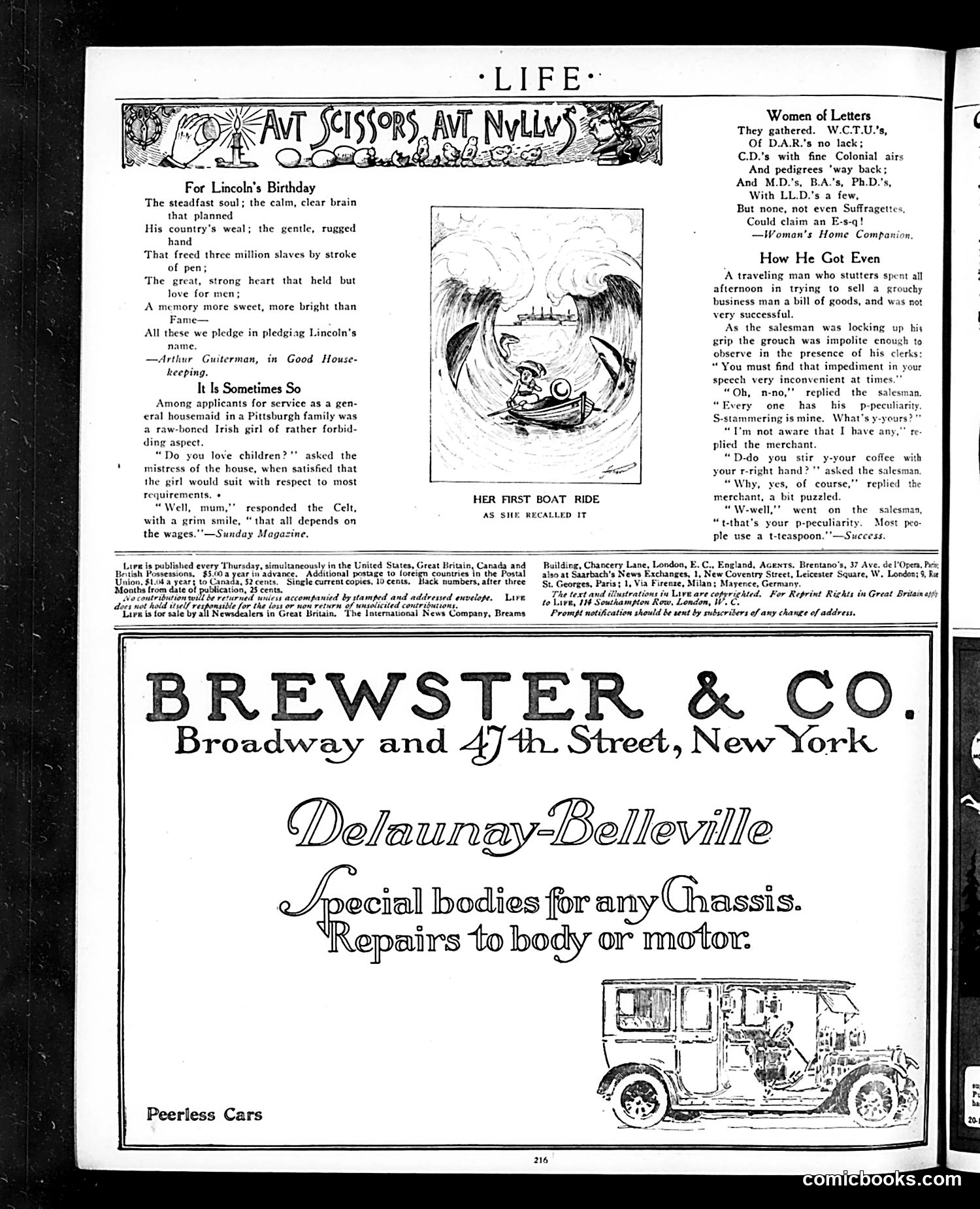
This page contains three satirical pieces typical of Life's humor circa early 20th century: **"For Lincoln's Birthday"** is a reverent poem praising Lincoln's character and accomplishments, particularly emancipation. It's straightforward tribute rather than satire. **"Women of Letters"** mocks educated women's organizations—the W.C.T.U. (Women's Christian Temperance Union), D.A.R. (Daughters of the American Revolution), and suffragettes—by listing their credentials (M.D.'s, Ph.D.'s, etc.) but noting none can claim the title "Esq." (Esquire). The joke: despite their accomplishments and social standing, women cannot achieve the male honorific, highlighting the period's gender discrimination. **"How He Got Even"** jokes about a stuttering salesman who retaliates against a rude businessman by pointing out the businessman's own "peculiarity"—stirring coffee with his right hand instead of a teaspoon—mimicking the businessman's mockery. The page is primarily content with advertising for Brewster & Co. automobiles at bottom.
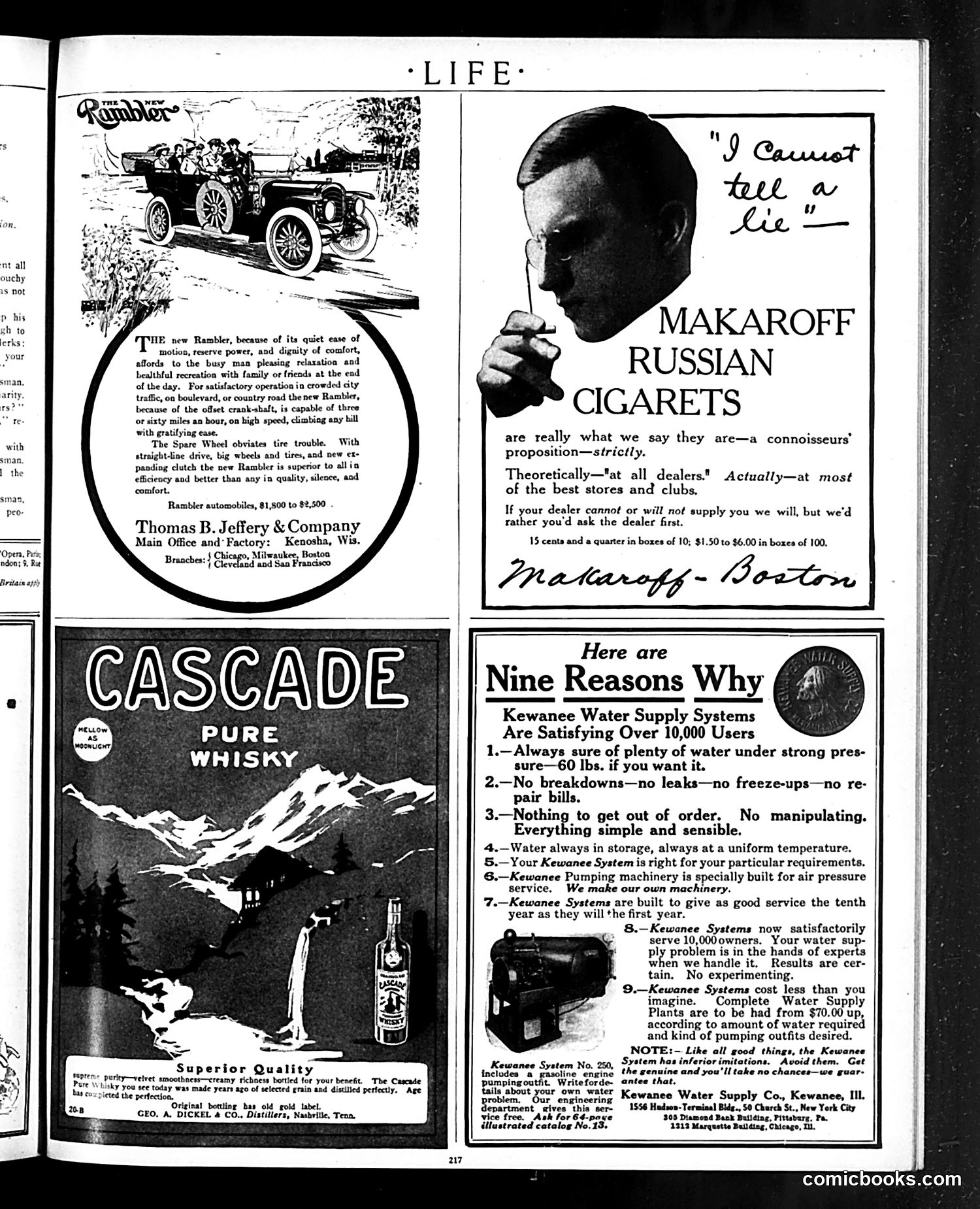
This page is primarily **advertising**, not satire or political commentary. It contains four product advertisements from the early 1900s: 1. **Rambler automobiles** - promotes the new model's quiet operation, power, and comfort for urban and rural driving. 2. **Makaroff Russian Cigarets** - a luxury cigarette brand positioned as a "connoisseur's proposition," available at upscale dealers and clubs, with a portrait of an unidentified man stating "I cannot tell a lie." 3. **Cascade Pure Whisky** - distilled whiskey emphasizing quality and aging. 4. **Kewanee Water Supply Systems** - lists nine reasons why their pump systems satisfy over 10,000 users, emphasizing reliability, simplicity, and affordability ($70+). The Makaroff cigarette ad's "cannot tell a lie" reference appears to invoke honesty/integrity messaging, though the specific allusion is unclear from the image alone. All ads reflect early 1900s consumer goods and technological pride in American manufacturing.
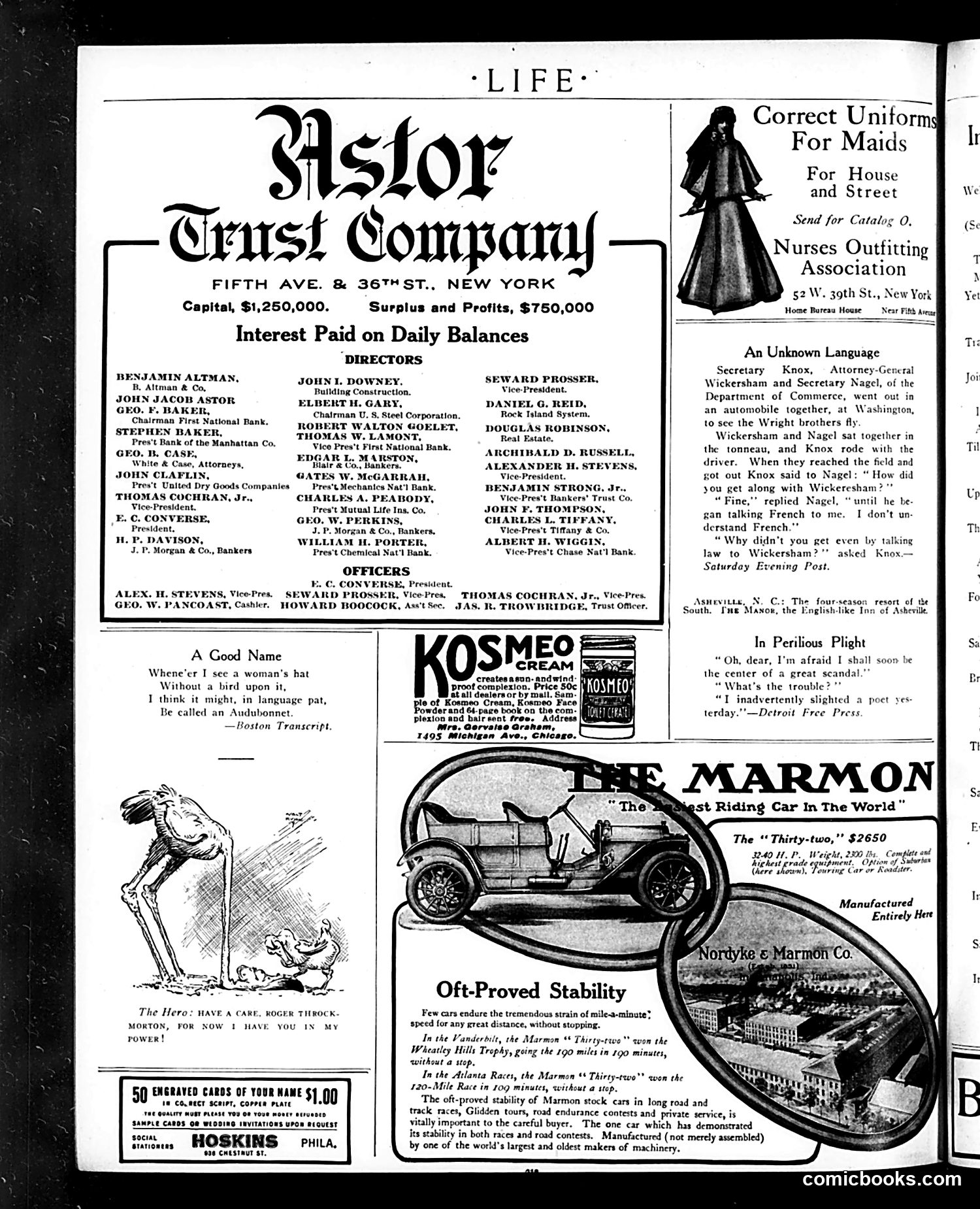
This page is primarily **advertisements and financial notices** rather than political satire. The main content includes: - A bank advertisement (Astor Trust Company) listing directors and officers - A humorous anecdote titled "An Unknown Language" about Secretary of State Knox, Attorney General Wickersham, and Commerce Secretary Nagel on an automobile ride. The joke: Wickersham speaks French to Nagel, who doesn't understand it, prompting Knox to suggest Nagel respond in "law" to Wickersham—a play on professional jargon as incomprehensible as foreign languages. - Minor advertisements for maids' uniforms, nurses' outfitting, and cosmetics - A cartoon showing a skeletal figure labeled "The Hero" (unclear reference) - Car advertisements for Marmon and Kosmeo products The "Unknown Language" anecdote is the only political content, gently mocking government officials' pretentiousness rather than critiquing policy.
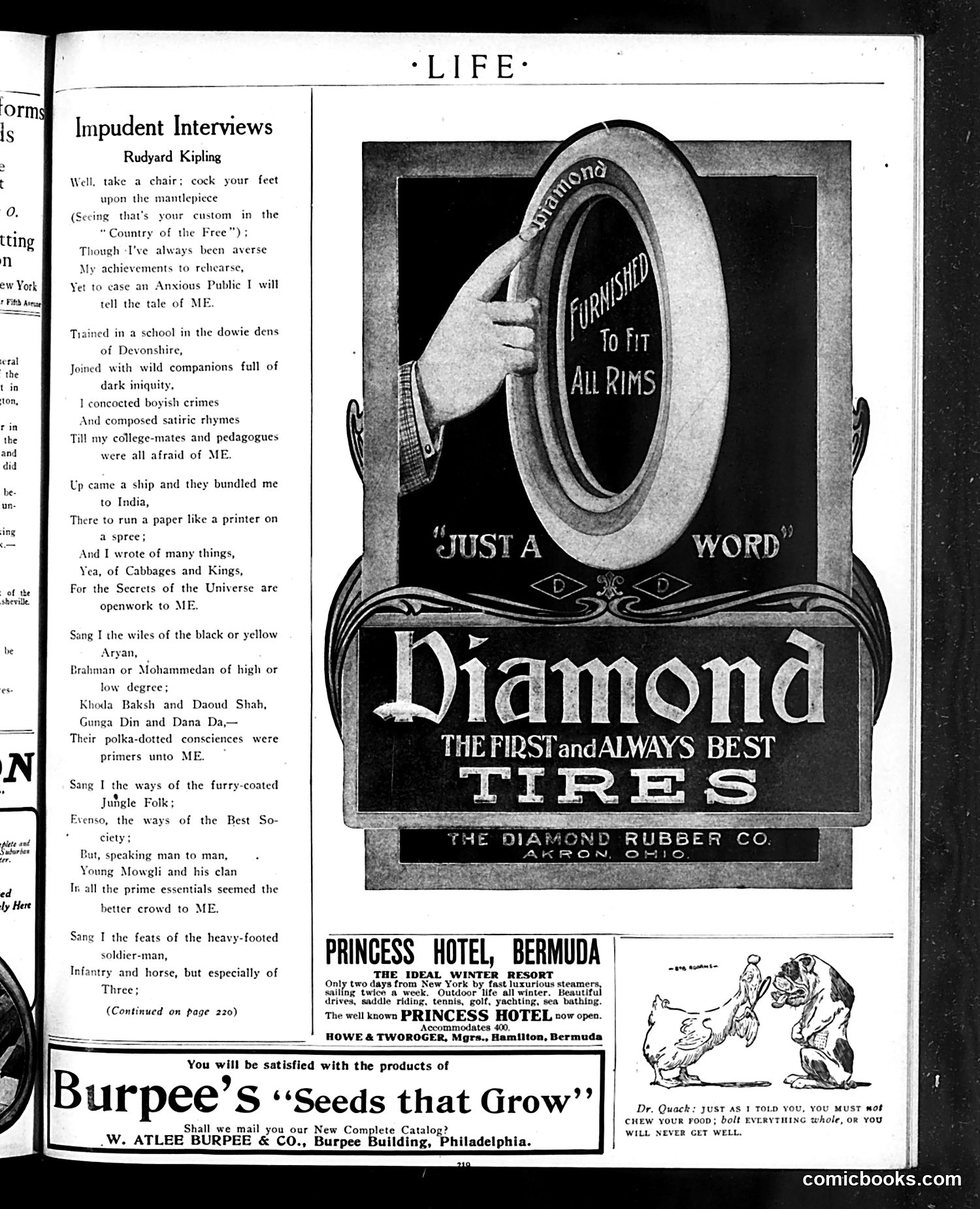
This page features an "Impudent Interview" with **Rudyard Kipling**, the famous British author. The satirical poem humorously chronicles Kipling's life and literary career in his own boastful voice—from his schooling in Devon, to his newspaper work in India, to his famous literary creations (Gunga Din, Mowgli from *The Jungle Book*). The satire mocks Kipling's **self-importance and prolific output**. He claims knowledge of everything from "Cabbages and Kings" to the "Secrets of the Universe," and presents himself as superior to all around him—even ranking animal characters above high society. The poem's title ("Impudent") and tone capture the presumed arrogance of this celebrated author speaking candidly about his own genius. The page also contains period advertisements (Diamond Tires, Princess Hotel, Burpee Seeds) typical of early 20th-century magazine layout. The cartoon at bottom-right appears unrelated to the main content.
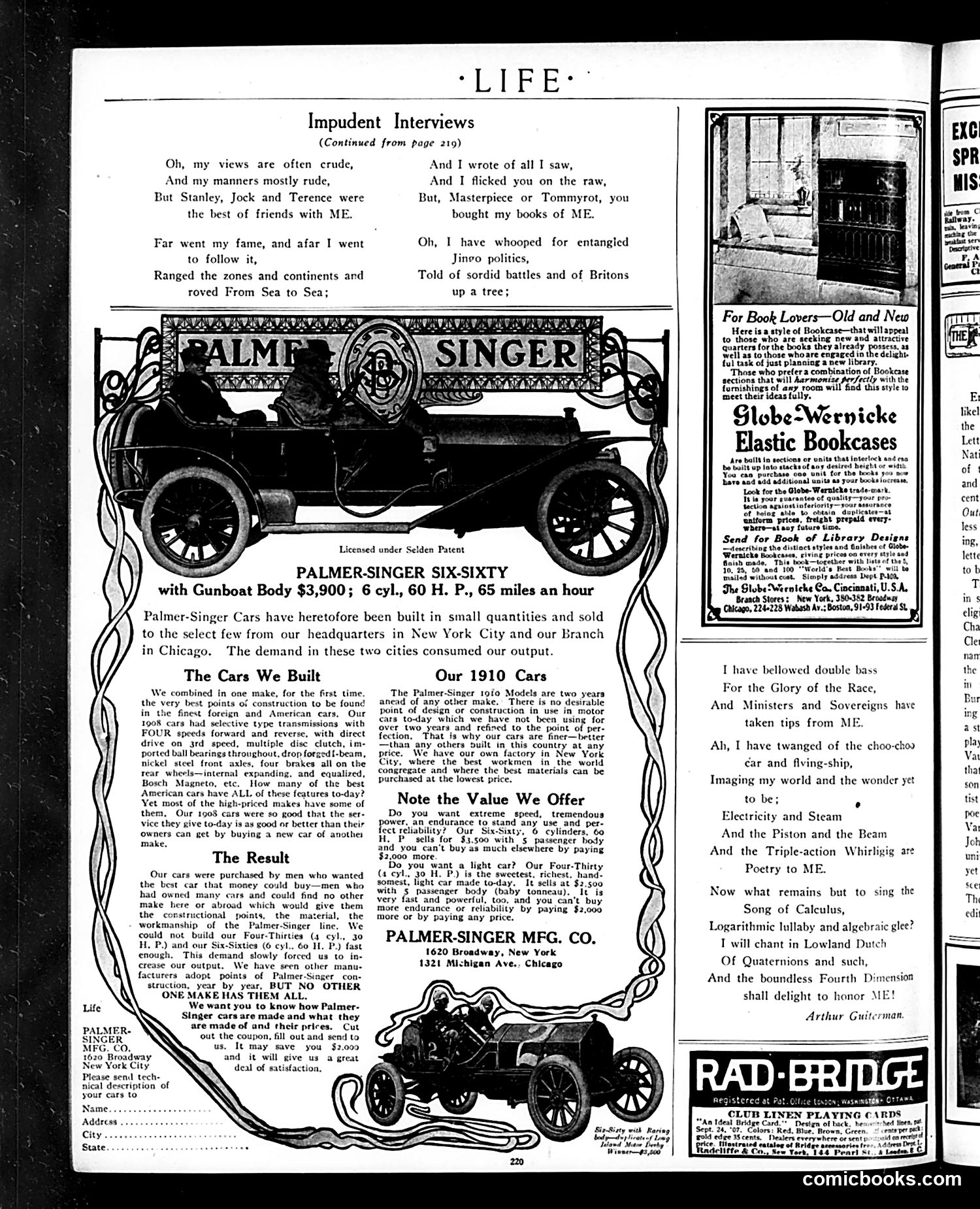
This page primarily features **automobile advertising** rather than political satire or editorial cartoons. The main content is a Palmer-Singer motor car advertisement showcasing their "Six-Sixty" model ($3,900) and touting manufacturing superiority over competitors. The "Impudent Interviews" section at the top appears to be a continued literary piece (from page 219) featuring an unnamed speaker reflecting on his fame, travels, and prolific writing—possibly a British author given references to "Jingo politics" and "Britons." The tone is self-congratulatory about commercial success regardless of quality ("Masterpiece or Tommyrot, you bought my books"). The Palmer-Singer ads emphasize American manufacturing excellence and quality construction details, claiming their vehicles incorporate superior features that competitors later adopted. This reflects early 1910s automotive industry competition and marketing tactics emphasizing domestic pride and technical innovation. There is no political cartoon visible on this page—it is primarily commercial advertising typical of Life magazine's revenue model.
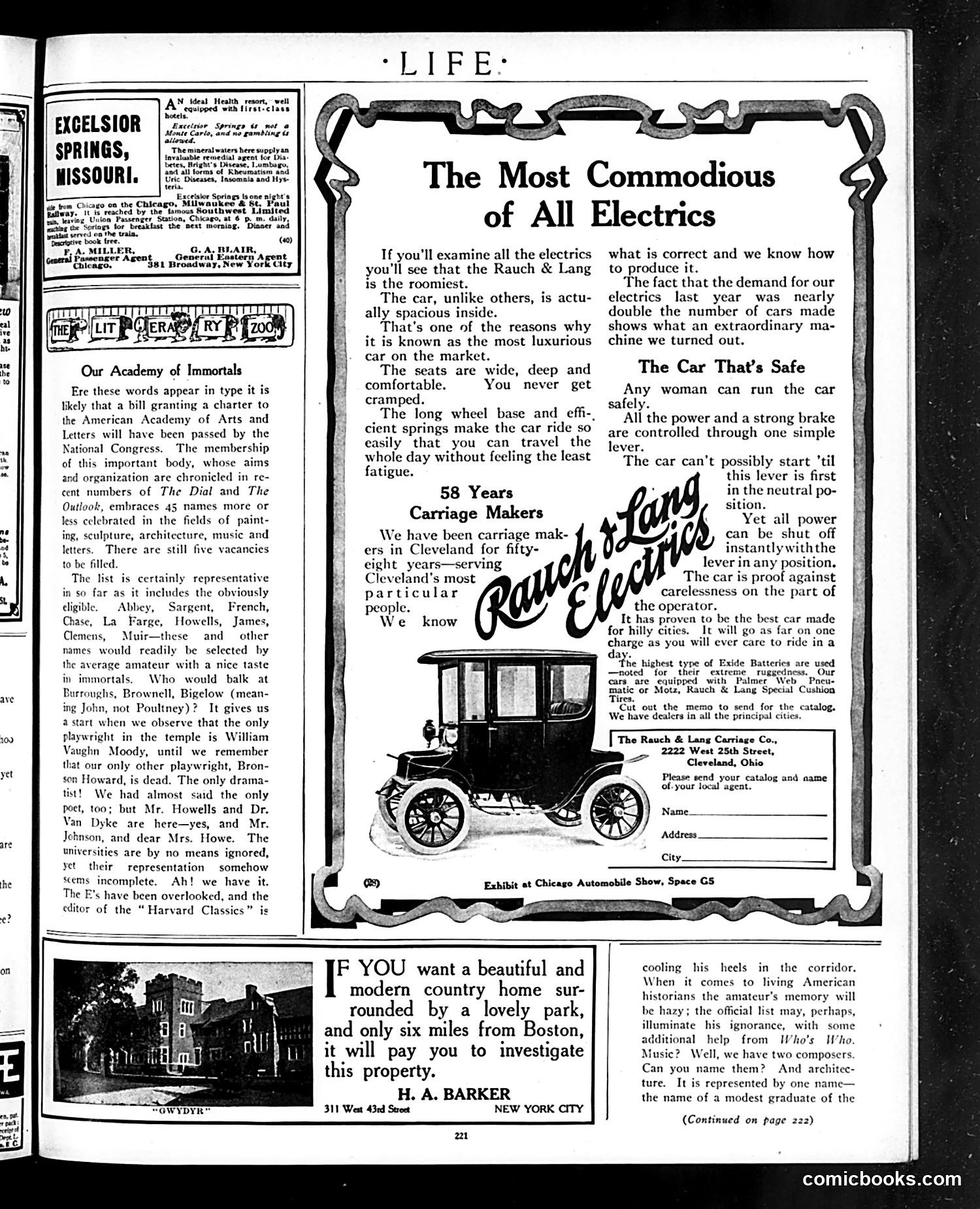
This page is primarily **advertising and literary content** rather than political satire. The main content includes: 1. **Rauch & Lang Electric Car advertisement** - promoting an electric automobile as "the most commodious of all electrics," emphasizing spaciousness, comfort, and safety features controlled by a simple lever. This reflects early 1900s automobile marketing when electrics competed with gasoline cars. 2. **"Our Academy of Immortals"** - a tongue-in-cheek essay discussing the imminent founding of the American Academy of Arts and Letters, with satirical commentary on which artists/writers deserve membership. It pokes fun at the omission of certain figures and notes the under-representation of universities. 3. **Real estate advertisement** for a country home near Boston by H.A. Barker. The satire is **mild and literary** rather than political—the piece gently mocks institutional pretension and the subjective nature of canonizing "immortal" artists. No specific political figures or events are caricatured. This represents Life magazine's general approach as a sophisticated humor publication for educated readers.
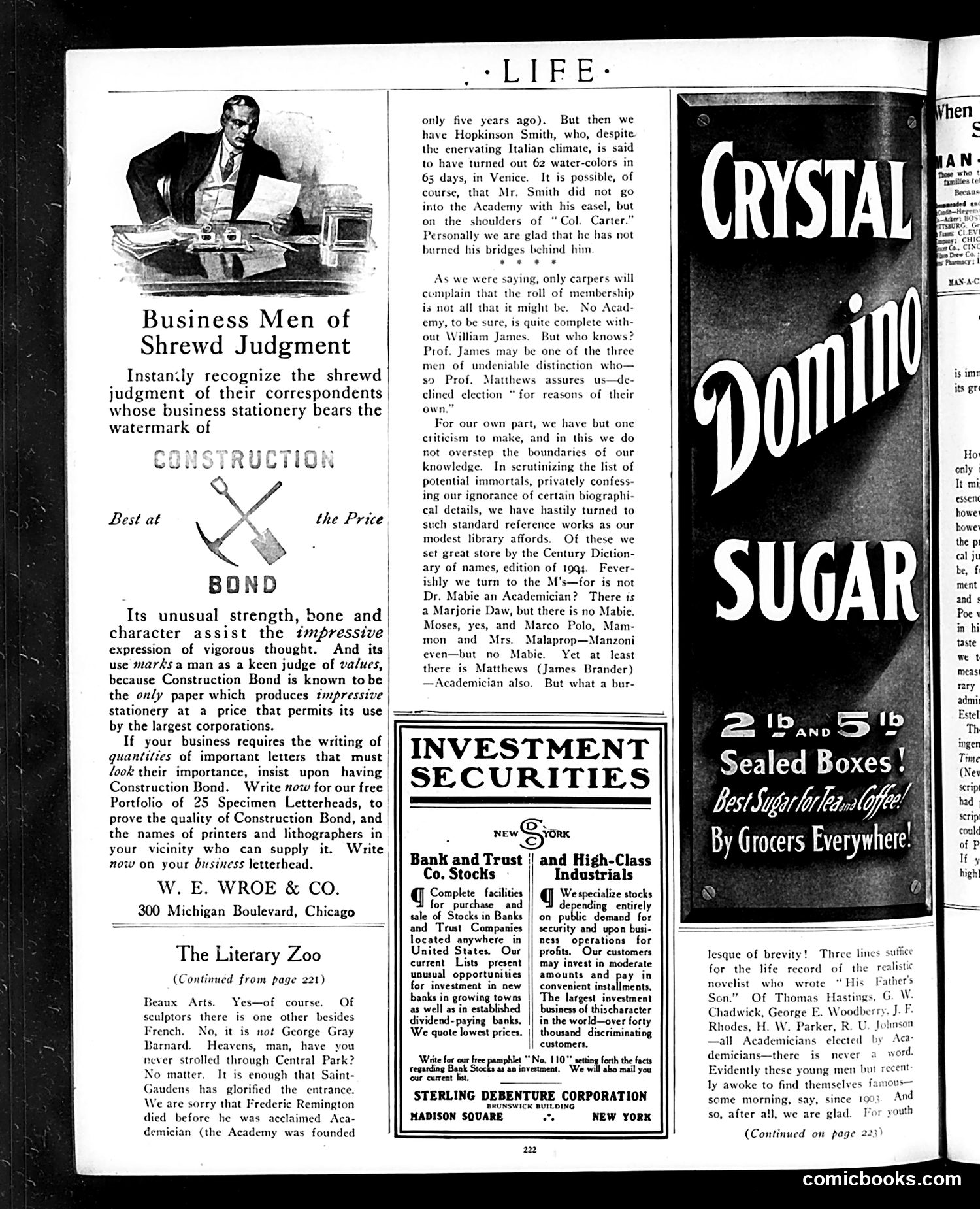
This page is primarily **advertising**, with a small satirical column. The main cartoon features a businessman at his desk examining stationery—illustrating an advertisement for "Construction Bond" paper, which claims that using quality letterhead signals shrewd business judgment and good taste. The substantive content is "The Literary Zoo," a satirical piece (continued from page 221) mocking the recently-founded National Academy of Arts and Letters. The author uses humor to critique the Academy's membership selections, noting conspicuous absences (like psychologist William James) while questioning whether certain members—specifically someone named "Dr. Mabie"—actually merit inclusion. The satire suggests the Academy's prestige is exaggerated and its selection criteria questionable. The remaining page space contains financial advertisements for banking stocks and investment securities, plus a sugar product ad.
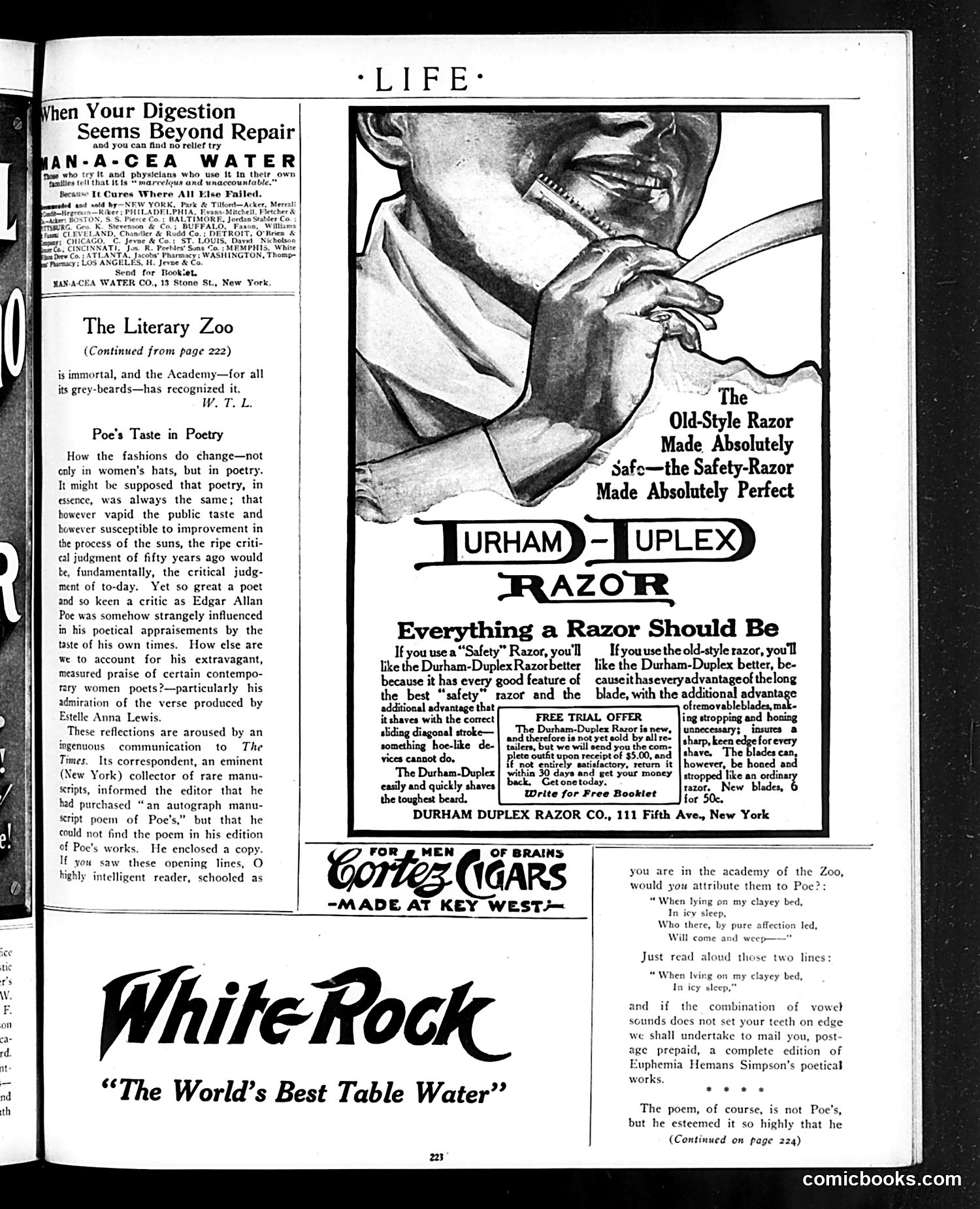
This page is primarily **advertising**, with a sidebar article about literary taste. The main article "Poe's Taste in Poetry" discusses how Edgar Allan Poe's critical judgments were influenced by the fashions of his own era—specifically how he praised mediocre women poets of his time. The piece then becomes a gentle joke: a collector claims to own a Poe autograph manuscript, but when the editor reads the opening lines aloud ("When lying on my clayey bed..."), the awkward, clunky vowel sounds are obviously *not* Poe's work. The article reveals the poem actually belongs to Euphemia Hemans Simpson, a now-obscure poet Poe apparently admired. **The satirical point**: Even great critics like Poe were victims of their era's poor taste, and what seemed brilliant then sounds embarrassingly bad today. The page is otherwise filled with period advertisements (An-a-cea Water for digestion, Durham-Duplex Razors, Cortes Cigars, White Rock water)—typical early 20th-century Life magazine content targeting middle-class male readers.
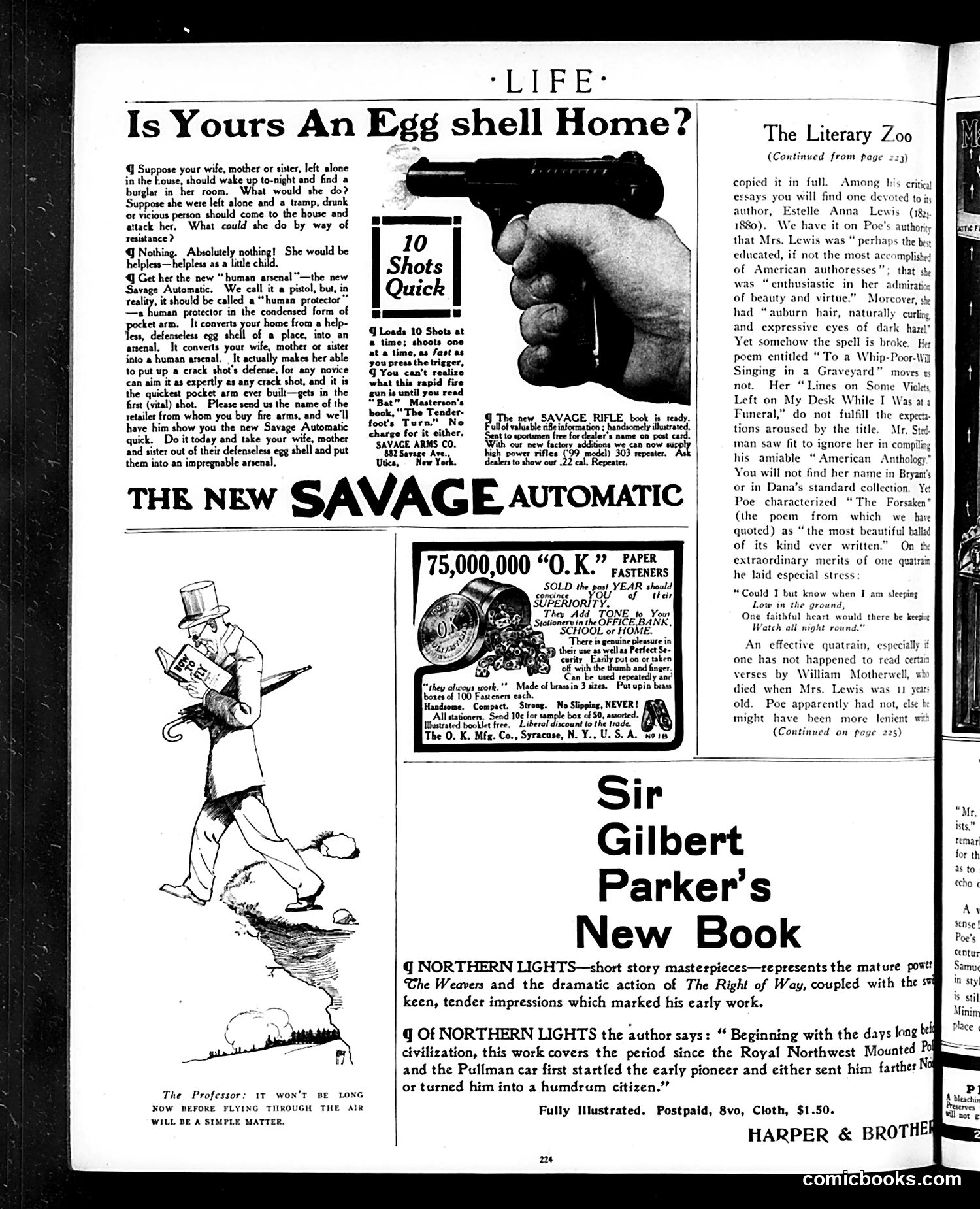
This page combines satirical commentary with period advertising. The main content is a **Savage Automatic rifle advertisement** disguised as social commentary. The ad poses a rhetorical question: if a woman is alone and threatened by a burglar or "vicious person," what can she do? The answer: nothing—*unless* she owns a Savage rifle, which the ad then promotes as a "human protector." The accompanying cartoon depicts a man demonstrating the rifle's rapid-fire capability ("10 Shots Quick"), emphasizing speed and ease of use. The satire targets early-20th-century anxieties about home security and women's vulnerability, weaponizing these fears to sell firearms. The page also includes literary criticism of a book called *Northern Lights* by Sir Gilbert Parker, and discusses 19th-century American poet Estelle Anna Lewis—content typical of Life's cultural coverage alongside advertisements.
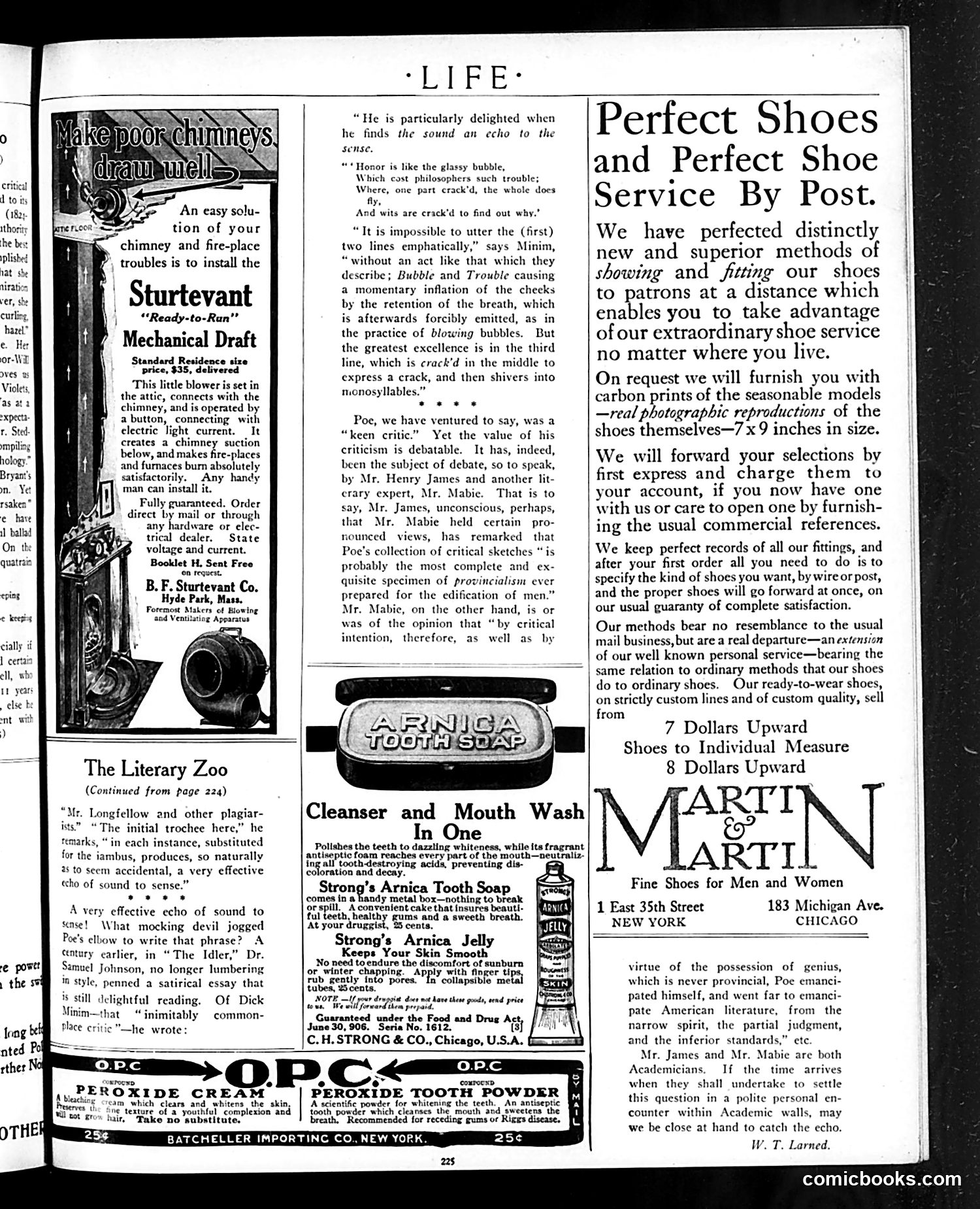
This page is primarily **advertising**, not satire or political commentary. The main content is "The Literary Zoo" (continued), which discusses literary criticism rather than cartoon satire. The literary section critiques Edgar Allan Poe's critical work. It quotes Dr. Samuel Johnson's 18th-century essay mocking critics obsessed with "sound as echo to sense"—the idea that word sounds should mirror meanings. The passage suggests Poe, while a "keen critic," produced "provincialism" according to Henry James, though Mabie disagreed. The piece appears to be a literary debate about Poe's critical merit. The rest of the page contains period product advertisements: a Sturtevant mechanical chimney draft system, Strong's Arnica Tooth Soap and Jelly, Peroxide creams, and Marti Fine Shoes. No political cartoons or satirical illustrations are present—only decorative commercial imagery typical of early 20th-century magazine advertising.
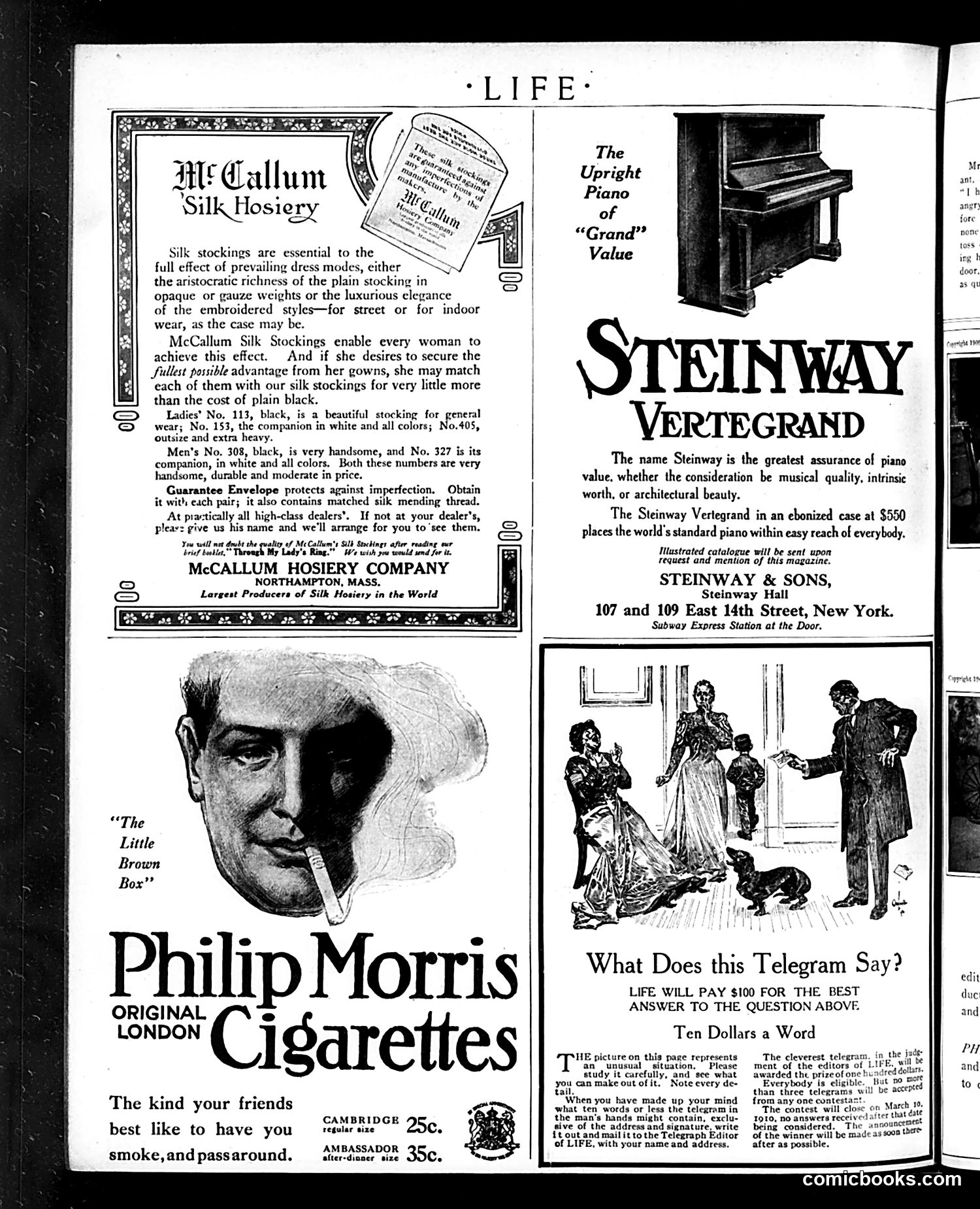
This page is primarily **advertising**, not political satire. It contains four product advertisements: 1. **McCallum Silk Hosiery**: Sells silk stockings for men and women, emphasizing luxury and quality with a guarantee envelope for protection. 2. **Steinway Vertegrand Piano**: Markets an upright piano at $550, positioning Steinway as the standard of quality and value in pianos. 3. **Philip Morris Cigarettes**: Features a caricatured male face smoking ("The Little Brown Box"), advertising Cambridge (25¢) and Ambassador (35¢) sizes. The slogan claims these are "the kind your friends best like to have you smoke." 4. **Life Magazine Contest**: A puzzle asking readers to decode a telegram shown in an illustration. Readers submit ten-word answers for a chance to win $100, with entries due by March 1910. The page reflects early 20th-century consumer culture and Life's revenue model through paid advertisements mixed with reader engagement contests.
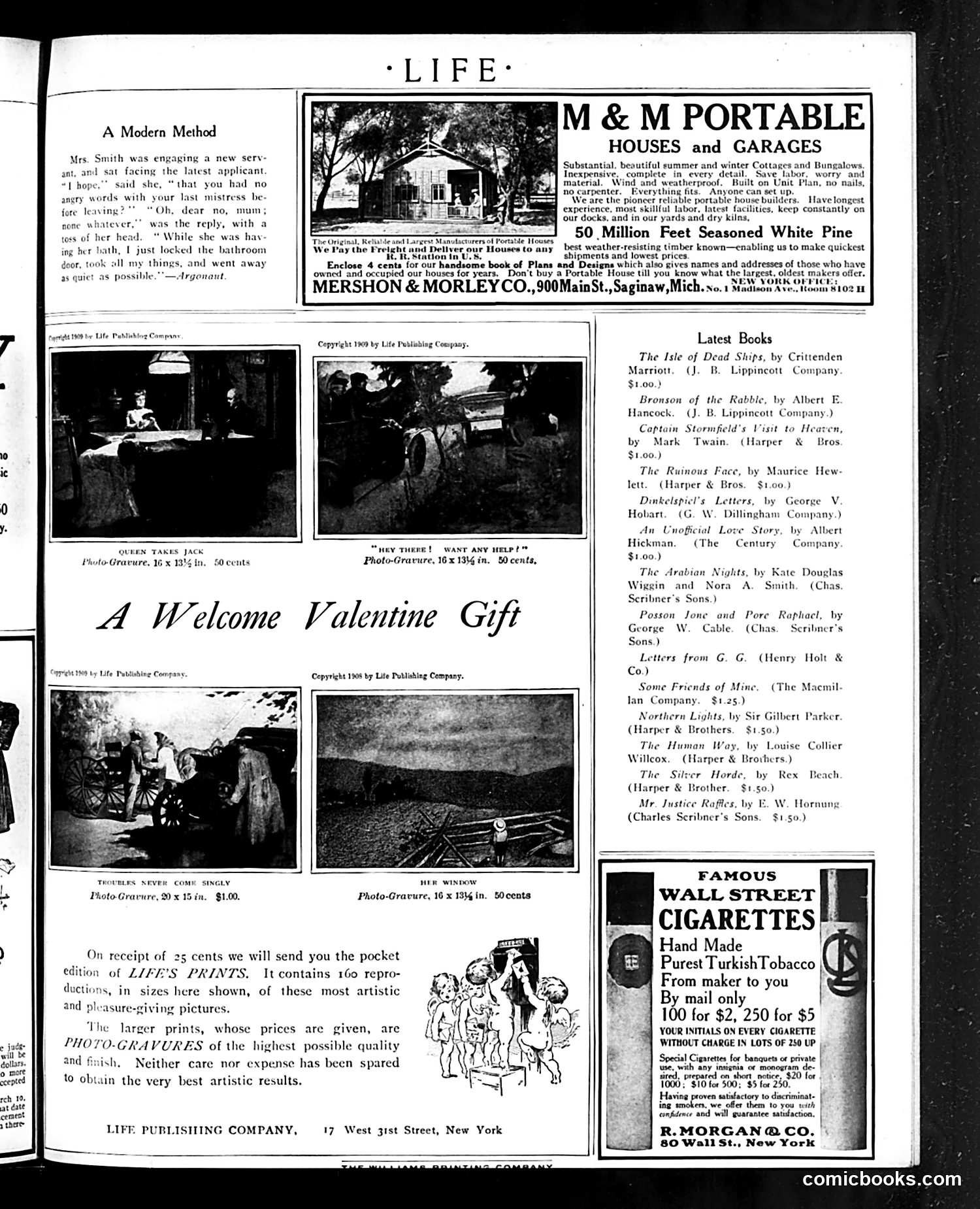
This page is primarily **advertising and book listings** with minimal satirical content. The main editorial material is a brief anecdote at top left titled "A Modern Method." **The Anecdote's Point:** Mrs. Smith interviews a new servant and asks if she had "any angry words" with her previous employer before leaving. The servant replies cheerfully that she didn't—she simply "locked the bathroom door, took all my things, and went away" without speaking to anyone. The joke satirizes **servant dishonesty and workplace relations** of the era: the servant admits to theft through silence rather than confrontation, highlighting the class tensions and trust issues between employers and domestic help in early 1900s households. **Remainder of Page:** The page consists almost entirely of **advertisements** (M&M Portable Houses, Wall Street Cigarettes) and a **book review section** listing contemporary titles. Four photogravure images appear to be unrelated samples of Life's artistic prints available for purchase. No political cartoons or identifiable caricatures are present.
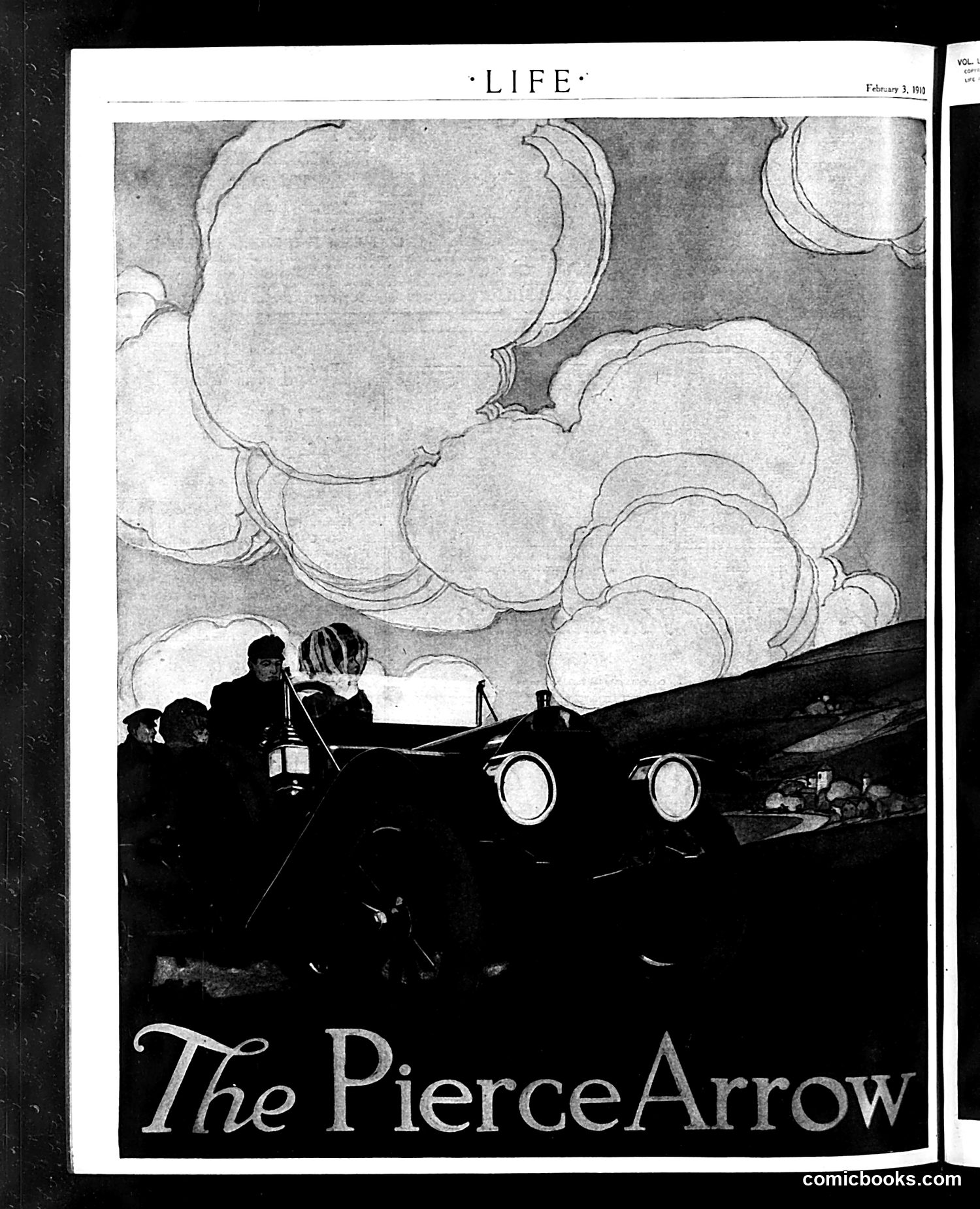
This page is a **product advertisement** for the Pierce Arrow automobile, not political satire. The image shows a luxury car with prominent headlights in a nighttime scene. Well-dressed figures (appearing to be wealthy travelers or socialites) are depicted with the vehicle against a dramatic cloudy sky backdrop, suggesting sophistication and adventure. The art style is characteristic of early 20th-century commercial illustration—elegant, aspirational imagery designed to appeal to affluent readers. The "Pierce Arrow" was a prestigious American luxury automobile brand, and this ad emphasizes elegance, modernity, and status. The advertisement occupies the full page of *Life* magazine (dated February 3, 1910), typical of how high-end brands marketed to the magazine's educated, wealthy readership during this era.