
Life, 1910-02-03 · page 17 of 44
Life — February 3, 1910 — page 17: what you’re looking at
What you’re looking at
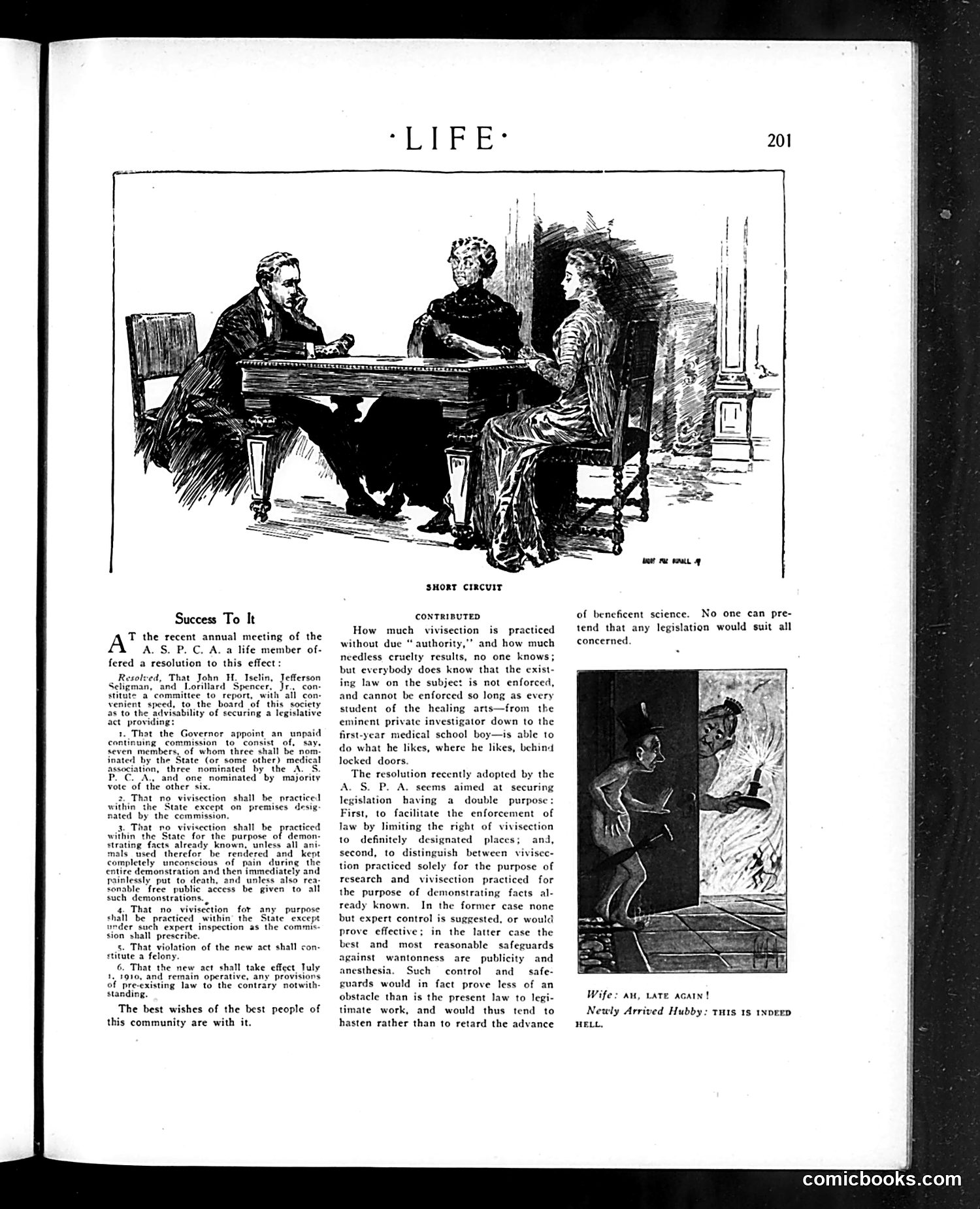
This page addresses animal vivisection (medical testing on live animals), a contentious issue in early 20th-century America. **The Main Cartoon ("Short Circuit"):** Shows three figures in what appears to be a domestic setting—likely a husband arriving home late. The caption jokes that he's experiencing a "short circuit" with his wife, who greets his late arrival with sarcasm ("Ah, late again!"). This is visual wordplay connecting to the legislative discussion below. **The Editorial Content:** Life endorses a proposed resolution by the ASPCA to regulate vivisection through state legislation. The proposed rules would: - Restrict vivisection to designated facilities - Distinguish between research and demonstration purposes - Require anesthesia and public access for demonstrations - Make violations a felony **The Satire's Point:** Life supports stronger animal welfare protections while arguing that regulation actually serves science better than current unenforced law—because it would eliminate unnecessary cruelty while maintaining legitimate research capability. The cartoon's "short circuit" joke provides lighthearted relief from the serious legislative discussion.
📄 Transcribed text from this page (OCR, searchable)
Machine-transcribed from the original scan — historical spelling and the odd misread are preserved.
Success To It T the recent annual meeting of the A. S. P. C. A. a life member of- fered a resolution to this effect: Resolved, That John I, Tsclin, Jefferson Seligman, ‘and Lorillard Spencer, Jr., con- stitute a’ committee to report, with’ all con- venient speed, to the board of this society as to the advisability of securing a legislative act providing: 1. That the Governor appoint an unpaid continuing commission to. consist of, sa seven members, of whom three shall be nom: inated by the State (or some other) medical association, three nominated by the A. S. P. C.A,,’and one nominated by majority vote of the other six. 2. That no vivisection shall be practiced within the State except on premises desig nated by the commission. 3. That no vivisection shall be practiced within the ‘State for the purpose of demon- strating facts already known, unless all ani- mals used therefor be rendered and kept completely unconscious of pain during the entire demonstration and then immediately and rainlessly put to death, and unless also rea- ronable free public access be given to all such demonstrations. | 4, That no vivisection fot any purpose shall be practiced within’ the State except under such expert inspection as the commis sion shall prescribe. s. That violation of the new act shall con- stitute a felony. 6. That the new act shall take effect, Tuly 1, 1910, and remain operative, any provisions of pre-existing law to the contrary notwith- standing. The best wishes of the best people of this community are with it. SHORT CIRCUIT conTRIBUTED How much vivisection is practiced without due “authority,” and how much needless cruelty results, no one knows; but everybody does know that the exist- law on the subject is not enforced, and cannot be enforced so long as every student of the healing arts—from the eminent private investigator down to the dical school boy—is able to cs, where he likes, behind first-year do what he I locked door: The resolution recently adopted by the A. S. P. A. seems aimed at securing legislation having a double purpose: First, to facilitate the enforcement of law by limiting the right of vivisection to definitely designated places; and, second, to distinguish between vivisce- tion practiced solely for the purpose of research and vivisection practiced for the purpose of demonstrating facts al- ready known. In the former case none but expert control is suggested. or would prove effective; in the latter case the best and most reasonable safeguards against wantonness are publicity and anesthesia. Such control and safe- guards would in fact prove less of an obstacle than is the present law to legi- timate work, and would thus tend to hasten rather than to retard the advance of beneficent science. No one can pre- tend that any legislation would suit all concerned. Wife: av, Late acan! Newly Arrived Hubb: HELL. THIS 18 INDEED comicbooks.com