
Life, 1910-02-03 · page 26 of 44
Life — February 3, 1910 — page 26: what you’re looking at
What you’re looking at
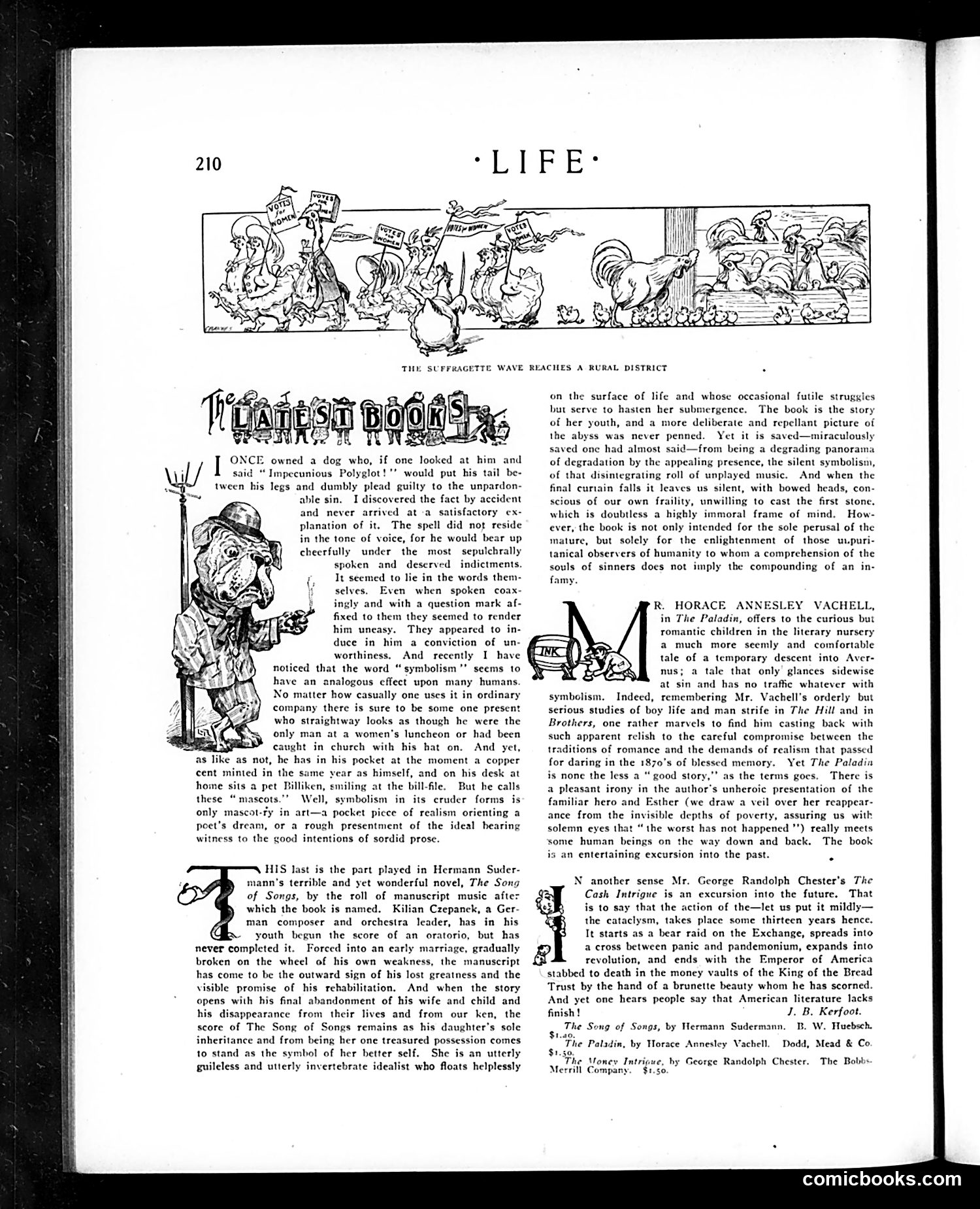
This page contains **no political cartoon**—it's a literary review section from *Life* magazine. The main content critiques three novels: 1. **"The Song of Songs"** by Hermann Sudermann—a German novel about a composer's abandoned daughter who inherits his unfinished musical score as a symbol of lost potential and moral redemption. The reviewer notes the book depicts moral degradation but is "saved" by this symbolic manuscript. 2. **"The Paladin"** by Horace Annesley Vachell—presented as a more wholesome alternative, avoiding the darker symbolism and sin depicted in Sudermann's work. 3. **"The Cash Intrigue"** by George Randolph Chester—apparently a thriller involving financial conspiracy and political turmoil. The left margin includes a humorous anecdote about a dog responding to the word "symbolism," mocking intellectuals who become anxious when encountering the term—satirizing pretentious literary culture of the era.
📄 Transcribed text from this page (OCR, searchable)
Machine-transcribed from the original scan — historical spelling and the odd misread are preserved.
THE St 2 owned a dog who, if one looked at him and said “Impecunious Polyglot! '* would put his tail be- tween his legs and dumbly plead guilty to the unpardon- able sin, I discovered the fact by accident and never arrived ata satisfactory ex- planation of it. The spell did not reside in the tone of voice, for he would bear up cheerfully under the most sepulchrally spoken and descrved indictments. It seemed to lie in the words them- selves. Even when spoken coax- ingly and with a question mark af- fixed to them they seemed to render him uneasy. They appeared to in- duce in him a conviction of un- worthiness. And recently I have noticed that the word “ symbolism’? seems to have an analogous effect upon many humans. No matter how casually one uses it in ordinary company there is sure to be some one present who straightway looks as though he were the only man at a women’s luncheon or had been caught in church with his hat on. And yet, as like as not, he has in his pocket at the moment a copper cent minted in the same year as himself, and on his desk at home sits a pet Billiken, smiling at the bill-file. But he calls these “mascots.” Well, symbolism in its cruder forms is only mascot-fy in art—a pocket picce of realism orienting a poct’s dream, or a rough presentment of the ideal hearing witness to the good intentions of sordid prose. HIS last is the part played in Hermann Suder- mann’s terrible and yet wonderful novel, The Song of Songs, by the roll of manuscript music after which the book is named. Kilian Czepanck, a Ger- man composer and orchestra leader, has in his - youth begun the score of an oratorio, but has never completed it. Forced into an carly marriage, gradually broken on the wheel of his own weakness, the manuscript has come to be the outward sign of his lost greatness and the visible promise of his rehabilitation. And when the story opens with his final abandonment of his wife and child and his disappearance from their lives and from our ken, the score of The Song of Songs remains as his daughter's sole inheritance and from being her one treasured possession comes to stand as the symbol of her better self. She is an utterly guileless and utterly invertebrate idealist who floats helplessly on the surface of life and whose occasional futile struggle: but serve to hasten her submergence, The book is the story of her youth, and a more deliberate and repellant picture of the abyss was never penned. Yet it is saved—miraculously saved one had almost said—from being a degrading panorama of degradation by the appealing presence, the silent symbolism, of that disintegrating roll of unplayed music. And when the final curtain falls it leaves us silent, with bowed heads, con- scious of our own fraility, unwilling to cast the first stone. which is doubtless a highly immoral frame of mind. How- ever, the book is not only intended for the sole perusal of the mature, but solely for the enlightenment of those w.puri- tanical observers of humanity to whom a comprehension of the souls of sinners does not imply the compounding of an in- famy. R. HORACE ANNESLEY VACHELL, in The Paladin, offers to the curious but romantic children in the literary nursery a much more seemly and comfortable tale of a temporary descent into Aver- Je that only’ glances sidewise at sin and has no traffic whatever with symbolism. Indeed, remembering Mr. Vachell’s orderly but serious studies of boy life and man strife in The Hill and in Brothers, one rather marvels to find him casting back with such apparent relish to the careful compromise between the traditions of romance and the demands of realism that passed for daring in the 1870's of blessed memory. Yet The Paladin is none the less a “good story,” as the terms gocs. There is a pleasant irony in the author's unheroic presentation of the familiar hero and Esther (we draw a veil over her reappear- ance from the invisible depths of poverty, assuring us with “the worst has not happened ’") really meets © way down and back. The book is an entertaining excursion into the past. . another sense Mr. George Randolph Chester's The Cash Intrigue is an excursion into the future. That is to say that the action of the—let us put it mildly— the cataclysm, takes place some thirteen years hence. It starts as a bear raid on the Exchange, spreads into a cross between panic and pandemonium, expands into revolution, and ends with the Emperor of America stabbed to death in the money vaults of the King of the Bread Trust by the hand of a brunette beauty whom he has scorned. And yet one hears people say that American literature lacks finish! J. B. Kerfoot. The Song of Songs, by Hermann Sudermann, B. W. Huebsch. $1.40. The Paladin, by Worace Annesley Vachell. Dodd, Mead & Co. “The Money Intrigue, by George Randolph Chester. The Bobbs Merrill Company. $1.50. $ comicbooks.com