
Life, 1910-02-03 · page 20 of 44
Life — February 3, 1910 — page 20: what you’re looking at
What you’re looking at
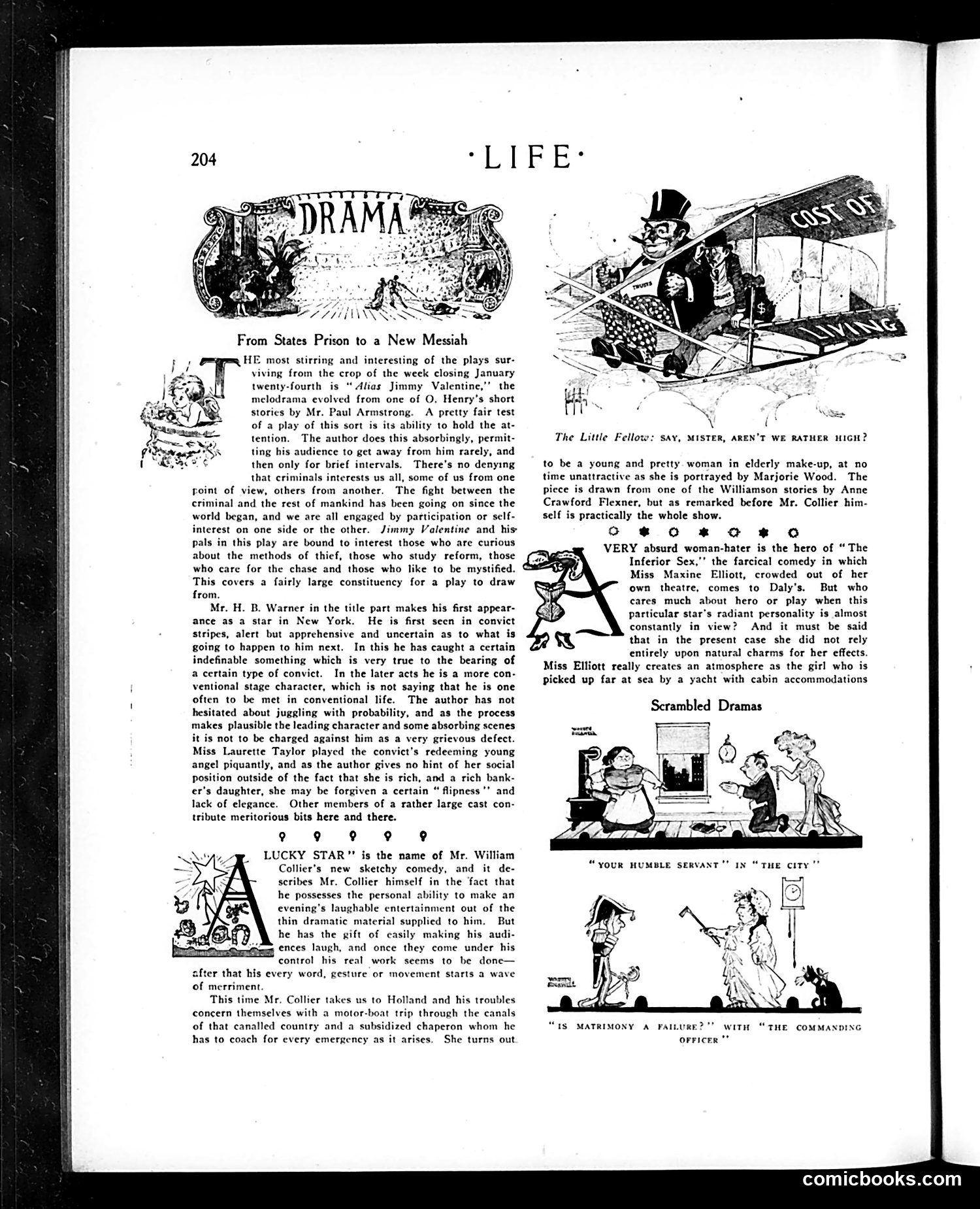
This page reviews three Broadway plays. The main critique discusses **"Alias Jimmy Valentine,"** adapted from an O. Henry story about a reformed safecracker. The review praises how the plot holds audience attention through the inherent drama of crime and redemption—noting that criminals interest us all, whether from moral concern or fascination with criminal methods. **H.B. Warner** makes his New York starring debut playing Jimmy Valentine. The review commends his convincing portrayal of a convict's bearing in early scenes, though notes the playwright takes liberties with probability for dramatic effect. **Laurette Taylor** plays the redemptive female lead—a wealthy banker's daughter. Two other comedies are briefly reviewed: William Collier's **"A Lucky Star"** (set in Holland) and **"The Inferior Sex"** starring **Maxine Elliott**, where the star's personality largely overshadows the thin plot. The cartoons satirize theatrical clichés—servants in comedies, failed marriage proposals—standard vaudeville fare of the era.
📄 Transcribed text from this page (OCR, searchable)
Machine-transcribed from the original scan — historical spelling and the odd misread are preserved.
From States Prison to a New Messiah HE most stirring and interesting of the plays sur- viving from the crop of the week closing January twenty-fourth is “Alias Jimmy Valentine,” the melodrama evolved from one of O, Henry's short stories by Mr. Paul Armstrong. A pretty fair test of a play of this sort is its ability to hold the at- tention. The author does this absorbingly, permit- ting his audience to get away from him rarely, and then only for brief intervals. There’s no denying that criminals interests us all, some of us from one point of view, others from another. The fight between the criminal and the rest of mankind has been going on since the world began, and we are all engaged by participation or sclf- interest on one side or the other. Jimmy Valentine and his pals in this play are bound to interest those who are curious about the methods of thief, those who study reform, those who care for the chase and those who like to be mystified. This covers a fairly large constituency for a play to draw from. Mr. H. B. Warner in the title part makes his first appear- ance as a star in New York. He is first seen in convict stripes, alert but apprehensive and uncertain as to what is going to happen to him next. In this he has caught a certain indefinable something which is very true to the bearing of a certain type of convict. In the later acts he is a more con- ventional stage character, which is not saying that he is one often to be met in conventional life. The author has not hesitated about juggling with probability, and as the process makes plausible the leading character and some absorbing scenes it is not to be charged against him as a very grievous defect. Miss Laurette Taylor played the convict's redeeming young angel piquantly, and as the author gives no hint of her social position outside of the fact that she is rich, and a rich bank- er's daughter, she may be forgiven a certain “ flipness'’ and lack of elegance. Other members of a rather large cast con- tribute meritorious bits here and there. 9 9 8 LUCKY STAR" is the name of Mr. William Collier’s new sketchy comedy, and it de- scribes Mr. Collier himself in the fact that he possesses the personal ability to make an evening’s laughable entertainment out of the thin dramatic material supplied to him, But he has the gift of casily making his audi- ences laugh, and once they come under his control his real work seems to be done— after that his every word, gesture or movement starts a wave of merriment This time Mr. Collier takes us to Holland and his troubles concern themselves with a motor-boat trip through the canals of that canalled country and a subsidized chaperon whom he has to coach for every emergency as it arises. She turns out The Little Fellow: Say, MISTER, AREN'T WE RATHER HIGH? to be a young and pretty woman in elderly make-up, at no time unattractive as she is portrayed by Marjorie Wood. The picce is drawn from one of the Williamson stories by Anne Crawford Flexner, but as remarked before Mr. Collier him- self is practically the whole show. o #€ Oo *#£ G9 # 6 VERY absurd woman-hater is the hero of “The Inferior Sex,’’ the farcical comedy in which Miss Maxine Elliott, crowded out of her own theatre, comes to Daly's. But who cares much about hero or play when this particular star’s radiant personality is almost constantly in view? And it must be said that in the present case she did not rely entirely vpon natural charms for her effects. Miss Elliott really creates an atmosphere as the girl who is picked up far at sea by a yacht with cabin accommodations Scrambled Dramas “YOUR HUMBLE SERVANT "’ IN “THE CIT) “1S MATRIMONY A FAILURE? '? WITH “THE COMMANDING orricer comicbooks.com